M. Cleveland-Innes, PhD

Professor and Chair
Centre for Distance Education
Athabasca University
Guest Professor, Department of Learning
KTH Royal Institute of Technology
Stockholm, Sweden

COHERE 2013 Vancouver, B.C.

FACULTY VIEWS ON OPEN
EDUCATION RESOURCES AND
ONLINE TEACHING

1
Questions guiding this
presentation

What is the current context of higher
education and why is this work
important?
What is the purpose of this research in
reference to the above?
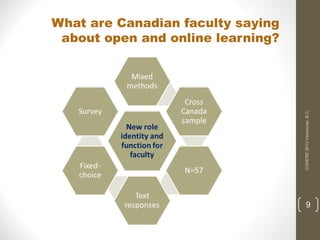
What are Canadian faculty saying about
open and online learning?

COHERE 2013 Vancouver, B.C.

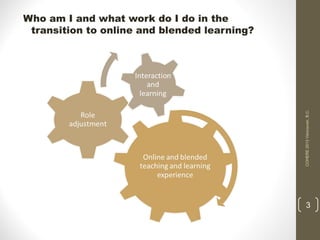
Who am I and what work do I do in the
transition to online and blended
learning?

2
COHERE 2013 Vancouver, B.C.

Who am I and what work do I do in the
transition to online and blended learning?

3
Co-Researcher (with D. Briton, M. Gismondi & C. Ives)
“MOOC instructional design principles: ensuring quality across scale
and diversity”
2013 Bill and Melinda Gates Foundation.

Research Principal
“Community of Inquiry Research Integration and Practice Alliance”
Research Principal
“Teaching with technology: New role identity and function for
faculty”
2011 Social Sciences and Humanities Research Council of Canada.

Co-Researcher (with Mohamed Ally)
“Using mobile communication devices to support online learning
communities”
2010 Social Sciences and Humanities Research Council of Canada.

COHERE 2013 Vancouver, B.C.

2013 Athabasca University Mission Critical Research Fund.

4
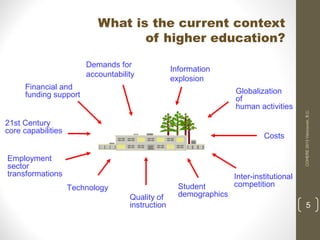
What is the current context
of higher education?

Financial and
funding support

Information
explosion
Globalization
of
human activities

21st Century
core capabilities

Costs

Employment
sector
transformations
Technology
Quality of
instruction

Student
demographics

COHERE 2013 Vancouver, B.C.

Demands for
accountability

Inter-institutional
competition
5
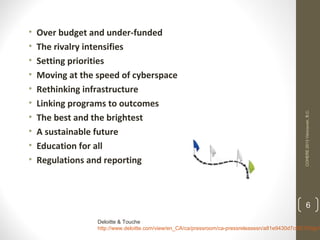
Over budget and under-funded
The rivalry intensifies
Setting priorities
Moving at the speed of cyberspace
Rethinking infrastructure
Linking programs to outcomes
The best and the brightest
A sustainable future
Education for all
Regulations and reporting

COHERE 2013 Vancouver, B.C.

•
•
•
•
•
•
•
•
•
•

6

Deloitte & Touche
http://www.deloitte.com/view/en_CA/ca/pressroom/ca-pressreleasesn/a81e9430d7c6f210VgnV
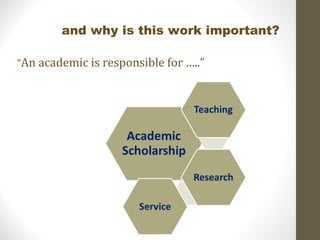
and why is this work important?
“An academic is responsible for …..”
“…. institutional challenges include economics issues, changing
demographics, the demand for accountability, new teaching and
learning models and emerging technology. Net-based
educational opportunities, the result of the last two of these
institutional challenges listed here, emerged in the early 90s,
most often with a promise of ameliorating problems within
education. What occurred has been called an educational
revolution, in response to demands for education reform,
particularly in reference to teaching and learning (Kanuka &
Brooks, 2010). This reform can begin with faculty role
change.”

Adapted from Cleveland-Innes, M., Hrastinski, S., Balter, O., & Wiseman, C. (in press).
Faculty, teaching with technology and leadership. In Ally, M. (Ed.), International Handbook
of eLearning. Hershey, PA., IGI Global.

COHERE 2013 Vancouver, B.C.

What is the purpose of this
research in reference to the above?

8
COHERE 2013 Vancouver, B.C.

What are Canadian faculty saying
about open and online learning?

9
10

COHERE 2013 Vancouver, B.C.
11

COHERE 2013 Vancouver, B.C.
2

COHERE 2013 Vancouver, B.C.

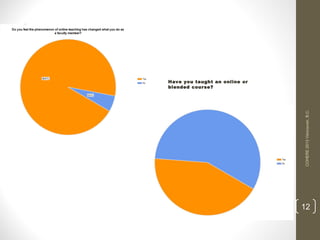
Have you taught an online or
blended course?

12
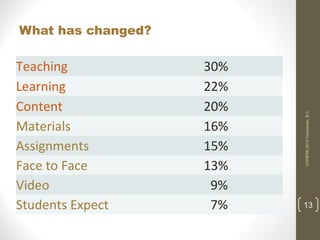
Teaching
Learning
Content
Materials
Assignments
Face to Face
Video
Students Expect

30%
22%
20%
16%
15%
13%
9%
7%

COHERE 2013 Vancouver, B.C.

What has changed?

13
14

COHERE 2013 Vancouver, B.C.
15

COHERE 2013 Vancouver, B.C.
16

COHERE 2013 Vancouver, B.C.
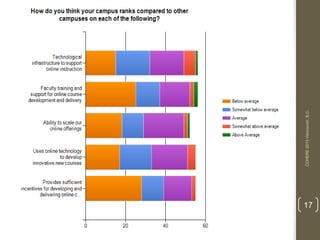
17

COHERE 2013 Vancouver, B.C.
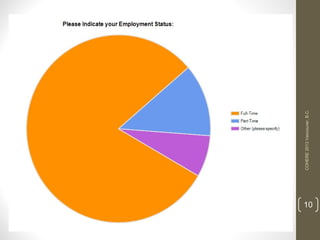
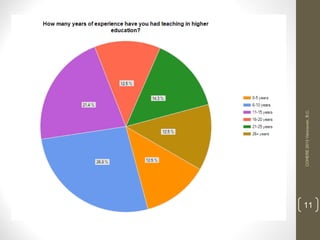
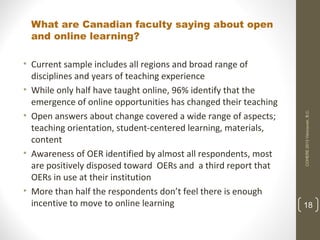
• Current sample includes all regions and broad range of
disciplines and years of teaching experience
• While only half have taught online, 96% identify that the
emergence of online opportunities has changed their teaching
• Open answers about change covered a wide range of aspects;
teaching orientation, student-centered learning, materials,
content
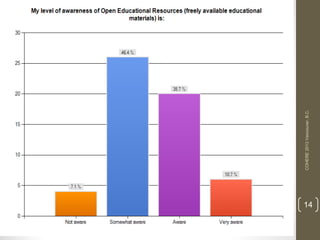
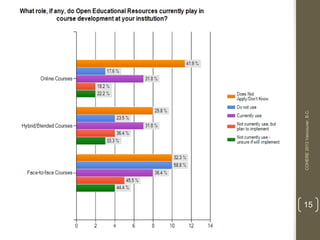
• Awareness of OER identified by almost all respondents, most
are positively disposed toward OERs and a third report that
OERs in use at their institution
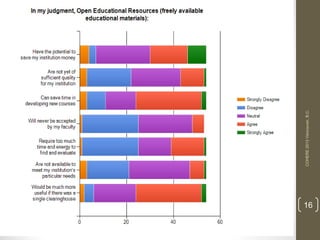
• More than half the respondents don’t feel there is enough
incentive to move to online learning

COHERE 2013 Vancouver, B.C.

What are Canadian faculty saying about open
and online learning?

18
Workshops,
presentations,
publications

COHERE 2013 Vancouver, B.C.

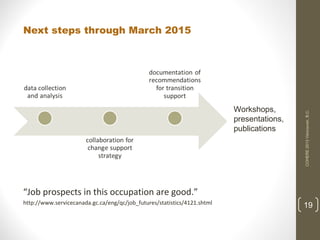
Next steps through March 2015

“Job prospects in this occupation are good.”
http://www.servicecanada.gc.ca/eng/qc/job_futures/statistics/4121.shtml

19
Thank you
I would like to acknowledge the support of the Academic Research
Committee at Athabasca University in the form of a Mission Critical
Research Grant and the Social Sciences and Humanities Research
Council for their support of this research.

Pedagogical change

  • 1.
    M. Cleveland-Innes, PhD Professorand Chair Centre for Distance Education Athabasca University Guest Professor, Department of Learning KTH Royal Institute of Technology Stockholm, Sweden COHERE 2013 Vancouver, B.C. FACULTY VIEWS ON OPEN EDUCATION RESOURCES AND ONLINE TEACHING 1
  • 2.
    Questions guiding this presentation Whatis the current context of higher education and why is this work important? What is the purpose of this research in reference to the above? What are Canadian faculty saying about open and online learning? COHERE 2013 Vancouver, B.C. Who am I and what work do I do in the transition to online and blended learning? 2
  • 3.
    COHERE 2013 Vancouver,B.C. Who am I and what work do I do in the transition to online and blended learning? 3
  • 4.
    Co-Researcher (with D.Briton, M. Gismondi & C. Ives) “MOOC instructional design principles: ensuring quality across scale and diversity” 2013 Bill and Melinda Gates Foundation. Research Principal “Community of Inquiry Research Integration and Practice Alliance” Research Principal “Teaching with technology: New role identity and function for faculty” 2011 Social Sciences and Humanities Research Council of Canada. Co-Researcher (with Mohamed Ally) “Using mobile communication devices to support online learning communities” 2010 Social Sciences and Humanities Research Council of Canada. COHERE 2013 Vancouver, B.C. 2013 Athabasca University Mission Critical Research Fund. 4
  • 5.
    What is thecurrent context of higher education? Financial and funding support Information explosion Globalization of human activities 21st Century core capabilities Costs Employment sector transformations Technology Quality of instruction Student demographics COHERE 2013 Vancouver, B.C. Demands for accountability Inter-institutional competition 5
  • 6.
    Over budget andunder-funded The rivalry intensifies Setting priorities Moving at the speed of cyberspace Rethinking infrastructure Linking programs to outcomes The best and the brightest A sustainable future Education for all Regulations and reporting COHERE 2013 Vancouver, B.C. • • • • • • • • • • 6 Deloitte & Touche http://www.deloitte.com/view/en_CA/ca/pressroom/ca-pressreleasesn/a81e9430d7c6f210VgnV
  • 7.
    and why isthis work important? “An academic is responsible for …..”
  • 8.
    “…. institutional challengesinclude economics issues, changing demographics, the demand for accountability, new teaching and learning models and emerging technology. Net-based educational opportunities, the result of the last two of these institutional challenges listed here, emerged in the early 90s, most often with a promise of ameliorating problems within education. What occurred has been called an educational revolution, in response to demands for education reform, particularly in reference to teaching and learning (Kanuka & Brooks, 2010). This reform can begin with faculty role change.” Adapted from Cleveland-Innes, M., Hrastinski, S., Balter, O., & Wiseman, C. (in press). Faculty, teaching with technology and leadership. In Ally, M. (Ed.), International Handbook of eLearning. Hershey, PA., IGI Global. COHERE 2013 Vancouver, B.C. What is the purpose of this research in reference to the above? 8
  • 9.
    COHERE 2013 Vancouver,B.C. What are Canadian faculty saying about open and online learning? 9
  • 10.
  • 11.
  • 12.
    2 COHERE 2013 Vancouver,B.C. Have you taught an online or blended course? 12
  • 13.
    Teaching Learning Content Materials Assignments Face to Face Video StudentsExpect 30% 22% 20% 16% 15% 13% 9% 7% COHERE 2013 Vancouver, B.C. What has changed? 13
  • 14.
  • 15.
  • 16.
  • 17.
  • 18.
    • Current sampleincludes all regions and broad range of disciplines and years of teaching experience • While only half have taught online, 96% identify that the emergence of online opportunities has changed their teaching • Open answers about change covered a wide range of aspects; teaching orientation, student-centered learning, materials, content • Awareness of OER identified by almost all respondents, most are positively disposed toward OERs and a third report that OERs in use at their institution • More than half the respondents don’t feel there is enough incentive to move to online learning COHERE 2013 Vancouver, B.C. What are Canadian faculty saying about open and online learning? 18
  • 19.
    Workshops, presentations, publications COHERE 2013 Vancouver,B.C. Next steps through March 2015 “Job prospects in this occupation are good.” http://www.servicecanada.gc.ca/eng/qc/job_futures/statistics/4121.shtml 19
  • 20.
    Thank you I wouldlike to acknowledge the support of the Academic Research Committee at Athabasca University in the form of a Mission Critical Research Grant and the Social Sciences and Humanities Research Council for their support of this research.

Editor's Notes

  • #7 Over budget and under-funded: As funding declines, cost management is key The rivalry intensifies: Competition to attract the best students heats up Setting priorities: The danger of making decisions in the dark Moving at the speed of cyberspace: Technology upgrades are needed across the board Rethinking infrastructure: A renewed focus on asset optimization Linking programs to outcomes: Where training and market demand intersect The best and the brightest: Attracting and retaining talented faculty A sustainable future: Enhancing environmental performance Education for all: Tackling diversity, accessibility and affordability Regulations and reporting: New responsibilities require better disclosure
  • #8 “An academic is responsible for the delivery, maintenance and development of programs and course or study in his/her area within the Faculty, and for the maintenance and furtherance of his/her role in research and participation in the life of the University and the community of which it is a part.”rained as scholars, researchers …have to learn to teach and lead. Now, teaching context is undergoing significant change as are mny other aspects of the mileu in which this work takes place.
  • #10 “Even before the imposition of new technology, both excellent teaching and excellent research records were difficult to achieve. Fairweather’s (2002) research suggests that new ways of teaching will make it more difficult for faculty to be exemplars of research and teaching. This study examines the myth of the "complete faculty member" – that is one who can sustain high levels of productivity in both research and teaching at the same time.”