

Learning design & learning 
analytics – building the links 
Rebecca Ferguson 
The Open University 
What the Research Says: November 2014
Why learning design? 
• Provides a set of tools and information to support a 
learner-activity based approach 
• Helps to show the costs and performance outcomes of 
design decisions 
• Puts the learning journey at the heart of the design 
process 
• Enables the sharing of best practice 
• Helps partners choose and integrate a coherent range of 
media, technologies and pedagogies 
• Enables a consistent and structured approach to review 
and analytics
Advantages of design for analytics 
Helps to frame and focus analytics questions 
What did they learn?… in relation to learning outcomes 
Were they social?... when they were collaborating 
Did they share links?... when encouraged to browse 
Did they return to steps?... when encouraged to reflect 
Helps to identify appropriate forms of analysis 
The same step, but with a focus on 
• Number of visits if content 
• Length, quality, number of comments if conversational 
• Dwell time and repeat visits if reflection
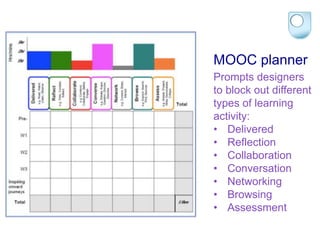
MOOC planner 
Prompts designers 
to block out different 
types of learning 
activity: 
• Delivered 
• Reflection 
• Collaboration 
• Conversation 
• Networking 
• Browsing 
• Assessment
Planner and analytics 
Delivered Content 
(reading, watching, listening and observing) 
Analytics: amount of content viewed, dwell time 
Reflection 
(thinking, considering and reflecting) 
Analytics: returns to the same material, reflection 
exercises completed, quality of reflection 
Collaboration 
(constructing, collaborating, defining and engaging) 
Analytics: collaboration exercises completed, quality 
of collaboration
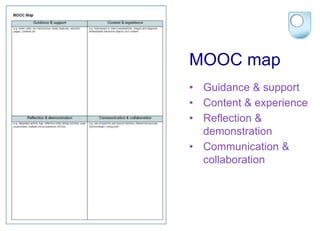
MOOC map 
• Guidance & support 
• Content & experience 
• Reflection & 
demonstration 
• Communication & 
collaboration
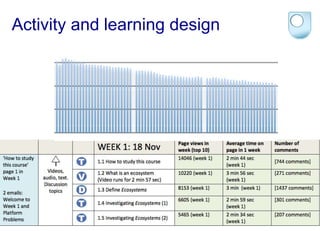
Activity and learning design
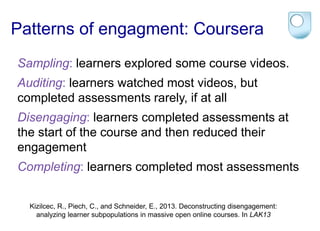
Patterns of engagment: Coursera 
Sampling: learners explored some course videos. 
Auditing: learners watched most videos, but 
completed assessments rarely, if at all 
Disengaging: learners completed assessments at 
the start of the course and then reduced their 
engagement 
Completing: learners completed most assessments 
Kizilcec, R., Piech, C., and Schneider, E., 2013. Deconstructing disengagement: 
analyzing learner subpopulations in massive open online courses. In LAK13
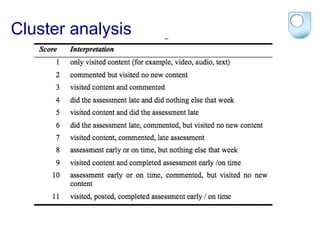
Cluster analysis
Patterns of engagement 
On an eight-week MOOC 
Samplers visit only briefly 
[1, 0, 0, 0, 0, 0, 0, 0] 
Strong starters do first assessment 
[9, 1, 0, 0, 0, 0, 0, 0] 
Returners come back in Week 2 
[9, 9, 0, 0, 0, 0, 0, 0] 
Mid-way Dropouts 
[9, 9, 9, 4, 1, 1, 0, 0] 
Nearly There drop out near the end 
[11, 11, 9, 11, 9, 9, 8, 0] 
Late Completers finish 
[5, 5, 5, 5, 5, 5, 9, 9, 9] 
Keen Completers do almost 
everything [11, 11, 9, 9, 11, 11, 9, 9] Patterns vary with pedagogy 
and learning design
Short MOOCs 
Surgers concentrate their effort after the first week of a three-week 
course. They do little in Week 1 other than submit their 
assessment late, engage more in Week 2, but still submit their 
assessment late (working on it in Week 3), and engage but do not 
submit in Week 3. On average, they post one or two comments. 
A typical engagement profile for this cluster is: [4, 6, 2] 
Improvers fall behind in Week 1, submitting their first assessment 
late. However, they engage more in Week 2 and by Week 3 they 
are on schedule and submit their assessment on time. They view 
the majority of steps on the course and typically post more than 
one comment. 
A typical engagement profile for this cluster is: [5, 6, 9]
Developing this work
Learning design and learning analytics

Learning design and learning analytics

  • 1.
    Learning design &learning analytics – building the links Rebecca Ferguson The Open University What the Research Says: November 2014
  • 2.
    Why learning design? • Provides a set of tools and information to support a learner-activity based approach • Helps to show the costs and performance outcomes of design decisions • Puts the learning journey at the heart of the design process • Enables the sharing of best practice • Helps partners choose and integrate a coherent range of media, technologies and pedagogies • Enables a consistent and structured approach to review and analytics
  • 3.
    Advantages of designfor analytics Helps to frame and focus analytics questions What did they learn?… in relation to learning outcomes Were they social?... when they were collaborating Did they share links?... when encouraged to browse Did they return to steps?... when encouraged to reflect Helps to identify appropriate forms of analysis The same step, but with a focus on • Number of visits if content • Length, quality, number of comments if conversational • Dwell time and repeat visits if reflection
  • 4.
    MOOC planner Promptsdesigners to block out different types of learning activity: • Delivered • Reflection • Collaboration • Conversation • Networking • Browsing • Assessment
  • 5.
    Planner and analytics Delivered Content (reading, watching, listening and observing) Analytics: amount of content viewed, dwell time Reflection (thinking, considering and reflecting) Analytics: returns to the same material, reflection exercises completed, quality of reflection Collaboration (constructing, collaborating, defining and engaging) Analytics: collaboration exercises completed, quality of collaboration
  • 6.
    MOOC map •Guidance & support • Content & experience • Reflection & demonstration • Communication & collaboration
  • 7.
  • 8.
    Patterns of engagment:Coursera Sampling: learners explored some course videos. Auditing: learners watched most videos, but completed assessments rarely, if at all Disengaging: learners completed assessments at the start of the course and then reduced their engagement Completing: learners completed most assessments Kizilcec, R., Piech, C., and Schneider, E., 2013. Deconstructing disengagement: analyzing learner subpopulations in massive open online courses. In LAK13
  • 9.
  • 10.
    Patterns of engagement On an eight-week MOOC Samplers visit only briefly [1, 0, 0, 0, 0, 0, 0, 0] Strong starters do first assessment [9, 1, 0, 0, 0, 0, 0, 0] Returners come back in Week 2 [9, 9, 0, 0, 0, 0, 0, 0] Mid-way Dropouts [9, 9, 9, 4, 1, 1, 0, 0] Nearly There drop out near the end [11, 11, 9, 11, 9, 9, 8, 0] Late Completers finish [5, 5, 5, 5, 5, 5, 9, 9, 9] Keen Completers do almost everything [11, 11, 9, 9, 11, 11, 9, 9] Patterns vary with pedagogy and learning design
  • 11.
    Short MOOCs Surgersconcentrate their effort after the first week of a three-week course. They do little in Week 1 other than submit their assessment late, engage more in Week 2, but still submit their assessment late (working on it in Week 3), and engage but do not submit in Week 3. On average, they post one or two comments. A typical engagement profile for this cluster is: [4, 6, 2] Improvers fall behind in Week 1, submitting their first assessment late. However, they engage more in Week 2 and by Week 3 they are on schedule and submit their assessment on time. They view the majority of steps on the course and typically post more than one comment. A typical engagement profile for this cluster is: [5, 6, 9]
  • 12.