By: Mr. Bhavin D. Pandya
M.Pharm. (Pharmaceutical Technology)
Assistant Professor
Department of Pharmaceutics
Krishna School of Pharmacy & Research (KSP)
Drs. Kiran & Pallavi Patel Global University (KPGU)
Contents
• Introduction
• Classification of Monophasic liquid
• Formulation Consideration
• Manufacturing Consideration
• Recent advance in monophasic liquid
• Recent approach in monophasic liquid formulation
Introduction
• Monophasic dosage form refers to liquid preparation containing two
or more components in one phase system, it is represent by true
solution.
• A true solution is a clear homogenous mixture that is prepared by
dissolving solute in a suitable solvent.
• The component of the solution which is present in a large quantity is
known as “SOLVENT” where as the component present in small
quantity is termed as “SOLUTE”.
Advantage
• It is easier to swallow, therefore easier for children and old age people.
• Facilitate absorption of drug faster than solid dosage form as drug is
already in solution form.
• It is homogenous therefore give uniform dose than suspension or
emulsion which need shaking.
• Simple and fast to formulate
• It can be administered by various routes :
Oral, Parenteral (injection),enema for rectal use, otic(ear), nasal and
ophthalmic preparation.
Disadvantage
• They are bulky, so difficult to transport and store.
• Water is commonly use vehicle, which is prone to microbial growth.
So addition of preservative is needed.
• When expose to direct sunlight it may undergo hydrolysis, so need to
store in cool and dark place.
• Drug stability reduce by hydrolysis or oxidation. So, they have shorter
expire date than solid dosage form.
• Other major sign of drug instability are color change, Precipitation,
microbial growth etc.
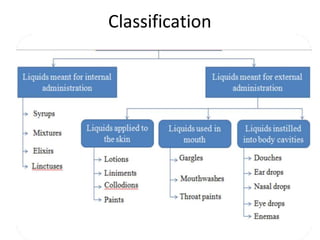
Classification
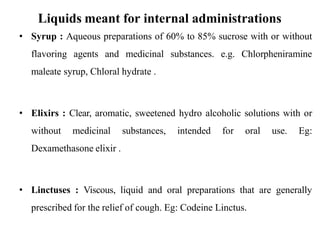
Liquids meant for internal administrations
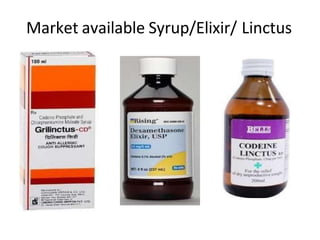
• Syrup : Aqueous preparations of 60% to 85% sucrose with or without
flavoring agents and medicinal substances. e.g. Chlorpheniramine
maleate syrup, Chloral hydrate .
• Elixirs : Clear, aromatic, sweetened hydro alcoholic solutions with or
without medicinal substances, intended for oral use. Eg:
Dexamethasone elixir .
• Linctuses : Viscous, liquid and oral preparations that are generally
prescribed for the relief of cough. Eg: Codeine Linctus.
Market available Syrup/Elixir/ Linctus
Liquids meant for external administration
Liquids used in the mouth
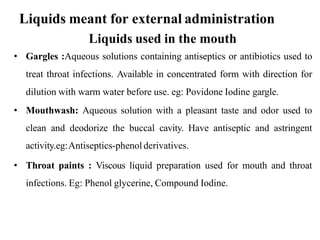
• Gargles :Aqueous solutions containing antiseptics or antibiotics used to
treat throat infections. Available in concentrated form with direction for
dilution with warm water before use. eg: Povidone Iodine gargle.
• Mouthwash: Aqueous solution with a pleasant taste and odor used to
clean and deodorize the buccal cavity. Have antiseptic and astringent
activity.eg:Antiseptics-phenol derivatives.
• Throat paints : Viscous liquid preparation used for mouth and throat
infections. Eg: Phenol glycerine, Compound Iodine.
Market available Gargle, Mouthwash
and Throat paints
Liquids meant for external administration
Liquids instill into body cavity
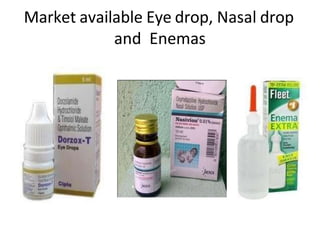
• Eye drops: Sterile, aqueous/oily solutions intended for instillation in
eye. Eg: Timolol maleate eye drops.
• Nasal drops Administered through the nose to obtain local effect. Used
during nasal congestion and upper-respiratory tract problem. Eg:
Oxymetazolin Hydrochloride nasal drops.
• Enemas: Aqueous or oily solution that is introduced into the rectum and
colon via the anus for cleansing, therapeutic or diagnostic purposes.
Market available Eye drop, Nasal drop
and Enemas
Liquids meant for external administration
Liquid meant for skin
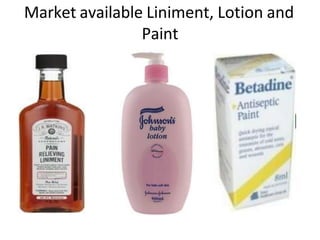
• Liniments : Oily liquid preparations, intended for external application
with rubbing action to the affected area. Use to relief pain and stiffness,
such as from muscles spasm and arthritis.
• Lotions : Topical preparation with a low to medium viscosity. Use to
moisturize dry skin. Eg: Calamine Lotion, baby lotion
• Paints : Solutions used to sterilize the skin. Eg. Betadine antiseptic
paint, Magenta paint
Market available Liniment, Lotion and
Paint
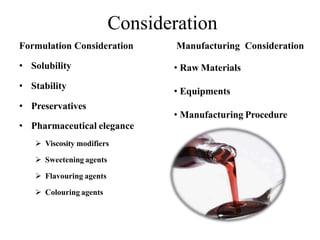
Consideration
• Solubility
• Stability
• Preservatives
• Pharmaceutical elegance
 Viscosity modifiers
 Sweetening agents
 Flavouring agents
 Colouring agents
Formulation Consideration Manufacturing Consideration
• Raw Materials
• Equipments
• Manufacturing Procedure
Approaches to increase the solubility of the drug
 pH adjustment : By addition of buffer to the formulation .
 Co-solvency: By addition of water miscible solvent in which drug
has good solubility. The solvent known as co-solvent.
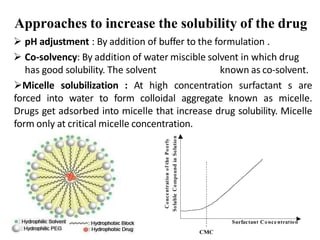
Micelle solubilization : At high concentration surfactant s are
forced into water to form colloidal aggregate known as micelle.
Drugs get adsorbed into micelle that increase drug solubility. Micelle
form only at critical micelle concentration.
Complexation: Drug-complexing agent complexation formed when
complexing agent is added to solution. It increase solubility of drug on
the basis of Le Chatelier’s principle or “ The equilibrium law”.
Micronization:
The process involve size reduction of drug particle 1 to 10microns
either by spray drying or fluid energy mill.
Hydrotrophy : Drug dissolve in the cluster of hydrotropic agent. Also
there is drug- hydrotrophy agent complexation formation to increase
drug solubility.
Preservative
Preservatives must have following criteria:
• Effective against broad spectrum of microorganisms.
• Physically, chemicaly and microbiologically stable for lifetime of the product.
• Non toxic, non sensitizing, soluble, compatible and with acceptable taste and
odour.
Types of Preservatives
• Acidic : phenol, benzoic acid, sorbic acid
• Neutral preservatives : chlorobutanol, benzyl alcohol
• Quarternary ammonium compounds : Benzalkoniumchloride
Stability
Chemical Stability
 Chemical stability of a formulation
is affected by:
 pH
 Temperature
 Ionic Strength
 Solvent effects
 Light
 Oxygen
Instability can be prevented by
use of:
o Buffering agents
o Antioxidants
o Proper packaging
(eg: use of amber bottle for light
sensitive products)
Physical Stability
 A stable formulation retains its
viscosity, color
, clarity, taste,
and odour throughout its shelf
life
Objective
evaluation
 Colour can be measured
spectrophotometrically.
 Clarity can be
determined by
measurement of its
turbidity or light
scattering equipment.
 Viscosity can be
measured by use of
viscometers.
Subjective evaluation
 Taste and odour can be
determined either by
pharmaceutical
investigator or by a panel
of unbiased, taste sensitive
individuals.
Pharmaceutical Elegance
Viscositymodifiers
Sweeteningagents
Flavouring agents
Colouring agents
Enhance viscosity. Eg: Povidone, hydroxyethylcellulose
To enhance palatability and mask the taste of the
drugs. Eg : Sucrose, saccharin, aspartame
Taste Sensation Recommended flavour
Salt Butter scotch, maple, apricot, peach, vanilla,
Bitter Wild cherry, walnut, chocolate, mint.
Sweet Fruit and berry, vanilla.
Sour Citrus flavours, liquorice, raspberry.
To enhance the appearance of the vehicle; which
matches well with the flavor employed in the
preparation .Eg: green with mint, brown with
chocolate flavor etc.
Manufacturing Consideration
Raw Materials : Incoming raw materials should be tested as per specifications
that is identity, purity, uniformity and microbial contamination .
Equipments :
The following types of equipments may be used in the manufacture of
liquid formulations:-
1. Mixing tanks (SS 316 Stainless Steel) equipped with anagitator.
2. Measuring devices for large and small amount of solids and liquids.
3. Afiltration system e.g. filterpress
Cleaning of equipments
 All equipments must be thoroughly cleaned and sanitized beforeuse.
Disinfectants used: Dilute solutions of H2O2, phenolderivatives.
Sterilized by:Alcohol, boiling water, autoclaving, steam or dryheat.
Manufacturing of Monophasic Liquid
Recent Advance in Monophasic Liquid
• Recently developed method for the enhancement
of solubility of drugs.
– Nanocrystal
– Nanomorph
– Sonocrystallization
– Supercritical Fluid Process
• Recent advances for the delivery of liquid dosage
form
– Novel Parenteral drug delivery
– Novel ophthalmic drug delivery
Monophasic Liquid Dosage Forms, syrup, solution, elixir

Monophasic Liquid Dosage Forms, syrup, solution, elixir

  • 1.
    By: Mr. BhavinD. Pandya M.Pharm. (Pharmaceutical Technology) Assistant Professor Department of Pharmaceutics Krishna School of Pharmacy & Research (KSP) Drs. Kiran & Pallavi Patel Global University (KPGU)
  • 2.
    Contents • Introduction • Classificationof Monophasic liquid • Formulation Consideration • Manufacturing Consideration • Recent advance in monophasic liquid • Recent approach in monophasic liquid formulation
  • 3.
    Introduction • Monophasic dosageform refers to liquid preparation containing two or more components in one phase system, it is represent by true solution. • A true solution is a clear homogenous mixture that is prepared by dissolving solute in a suitable solvent. • The component of the solution which is present in a large quantity is known as “SOLVENT” where as the component present in small quantity is termed as “SOLUTE”.
  • 4.
    Advantage • It iseasier to swallow, therefore easier for children and old age people. • Facilitate absorption of drug faster than solid dosage form as drug is already in solution form. • It is homogenous therefore give uniform dose than suspension or emulsion which need shaking. • Simple and fast to formulate • It can be administered by various routes : Oral, Parenteral (injection),enema for rectal use, otic(ear), nasal and ophthalmic preparation.
  • 5.
    Disadvantage • They arebulky, so difficult to transport and store. • Water is commonly use vehicle, which is prone to microbial growth. So addition of preservative is needed. • When expose to direct sunlight it may undergo hydrolysis, so need to store in cool and dark place. • Drug stability reduce by hydrolysis or oxidation. So, they have shorter expire date than solid dosage form. • Other major sign of drug instability are color change, Precipitation, microbial growth etc.
  • 6.
  • 7.
    Liquids meant forinternal administrations • Syrup : Aqueous preparations of 60% to 85% sucrose with or without flavoring agents and medicinal substances. e.g. Chlorpheniramine maleate syrup, Chloral hydrate . • Elixirs : Clear, aromatic, sweetened hydro alcoholic solutions with or without medicinal substances, intended for oral use. Eg: Dexamethasone elixir . • Linctuses : Viscous, liquid and oral preparations that are generally prescribed for the relief of cough. Eg: Codeine Linctus.
  • 8.
  • 10.
    Liquids meant forexternal administration Liquids used in the mouth • Gargles :Aqueous solutions containing antiseptics or antibiotics used to treat throat infections. Available in concentrated form with direction for dilution with warm water before use. eg: Povidone Iodine gargle. • Mouthwash: Aqueous solution with a pleasant taste and odor used to clean and deodorize the buccal cavity. Have antiseptic and astringent activity.eg:Antiseptics-phenol derivatives. • Throat paints : Viscous liquid preparation used for mouth and throat infections. Eg: Phenol glycerine, Compound Iodine.
  • 11.
    Market available Gargle,Mouthwash and Throat paints
  • 12.
    Liquids meant forexternal administration Liquids instill into body cavity • Eye drops: Sterile, aqueous/oily solutions intended for instillation in eye. Eg: Timolol maleate eye drops. • Nasal drops Administered through the nose to obtain local effect. Used during nasal congestion and upper-respiratory tract problem. Eg: Oxymetazolin Hydrochloride nasal drops. • Enemas: Aqueous or oily solution that is introduced into the rectum and colon via the anus for cleansing, therapeutic or diagnostic purposes.
  • 13.
    Market available Eyedrop, Nasal drop and Enemas
  • 14.
    Liquids meant forexternal administration Liquid meant for skin • Liniments : Oily liquid preparations, intended for external application with rubbing action to the affected area. Use to relief pain and stiffness, such as from muscles spasm and arthritis. • Lotions : Topical preparation with a low to medium viscosity. Use to moisturize dry skin. Eg: Calamine Lotion, baby lotion • Paints : Solutions used to sterilize the skin. Eg. Betadine antiseptic paint, Magenta paint
  • 15.
  • 16.
    Consideration • Solubility • Stability •Preservatives • Pharmaceutical elegance  Viscosity modifiers  Sweetening agents  Flavouring agents  Colouring agents Formulation Consideration Manufacturing Consideration • Raw Materials • Equipments • Manufacturing Procedure
  • 17.
    Approaches to increasethe solubility of the drug  pH adjustment : By addition of buffer to the formulation .  Co-solvency: By addition of water miscible solvent in which drug has good solubility. The solvent known as co-solvent. Micelle solubilization : At high concentration surfactant s are forced into water to form colloidal aggregate known as micelle. Drugs get adsorbed into micelle that increase drug solubility. Micelle form only at critical micelle concentration.
  • 18.
    Complexation: Drug-complexing agentcomplexation formed when complexing agent is added to solution. It increase solubility of drug on the basis of Le Chatelier’s principle or “ The equilibrium law”. Micronization: The process involve size reduction of drug particle 1 to 10microns either by spray drying or fluid energy mill. Hydrotrophy : Drug dissolve in the cluster of hydrotropic agent. Also there is drug- hydrotrophy agent complexation formation to increase drug solubility.
  • 19.
    Preservative Preservatives must havefollowing criteria: • Effective against broad spectrum of microorganisms. • Physically, chemicaly and microbiologically stable for lifetime of the product. • Non toxic, non sensitizing, soluble, compatible and with acceptable taste and odour. Types of Preservatives • Acidic : phenol, benzoic acid, sorbic acid • Neutral preservatives : chlorobutanol, benzyl alcohol • Quarternary ammonium compounds : Benzalkoniumchloride
  • 20.
    Stability Chemical Stability  Chemicalstability of a formulation is affected by:  pH  Temperature  Ionic Strength  Solvent effects  Light  Oxygen Instability can be prevented by use of: o Buffering agents o Antioxidants o Proper packaging (eg: use of amber bottle for light sensitive products) Physical Stability  A stable formulation retains its viscosity, color , clarity, taste, and odour throughout its shelf life Objective evaluation  Colour can be measured spectrophotometrically.  Clarity can be determined by measurement of its turbidity or light scattering equipment.  Viscosity can be measured by use of viscometers. Subjective evaluation  Taste and odour can be determined either by pharmaceutical investigator or by a panel of unbiased, taste sensitive individuals.
  • 21.
    Pharmaceutical Elegance Viscositymodifiers Sweeteningagents Flavouring agents Colouringagents Enhance viscosity. Eg: Povidone, hydroxyethylcellulose To enhance palatability and mask the taste of the drugs. Eg : Sucrose, saccharin, aspartame Taste Sensation Recommended flavour Salt Butter scotch, maple, apricot, peach, vanilla, Bitter Wild cherry, walnut, chocolate, mint. Sweet Fruit and berry, vanilla. Sour Citrus flavours, liquorice, raspberry. To enhance the appearance of the vehicle; which matches well with the flavor employed in the preparation .Eg: green with mint, brown with chocolate flavor etc.
  • 22.
    Manufacturing Consideration Raw Materials: Incoming raw materials should be tested as per specifications that is identity, purity, uniformity and microbial contamination . Equipments : The following types of equipments may be used in the manufacture of liquid formulations:- 1. Mixing tanks (SS 316 Stainless Steel) equipped with anagitator. 2. Measuring devices for large and small amount of solids and liquids. 3. Afiltration system e.g. filterpress Cleaning of equipments  All equipments must be thoroughly cleaned and sanitized beforeuse. Disinfectants used: Dilute solutions of H2O2, phenolderivatives. Sterilized by:Alcohol, boiling water, autoclaving, steam or dryheat.
  • 23.
  • 25.
    Recent Advance inMonophasic Liquid • Recently developed method for the enhancement of solubility of drugs. – Nanocrystal – Nanomorph – Sonocrystallization – Supercritical Fluid Process • Recent advances for the delivery of liquid dosage form – Novel Parenteral drug delivery – Novel ophthalmic drug delivery