MONOPHASIC LIQUID
DOSAGE FORM
Presented by:- Mr. Dinesh Shakya
Assistant Professor
Jain College, Gwalior
Contents
• Introduction
• Classification of Monophasic liquid
• Formulation Consideration
• Manufacturing Consideration
• Recent advance in monophasic liquid
• Recent approach in monophasic liquid formulation
• Conclusion
• Recommendation
Introduction
• Monophasic dosage form refers to liquid preparation containing two
or more components in one phase system, it is repi'esent by true
solution.
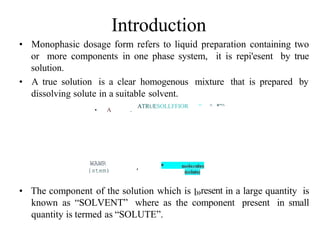
• A true solution is a clear homogenous mixture that is prepared by
dissolving solute in a suitable solvent.
• A .
ATRUESOLLFFIOR “ ^ *”^
WAWR
{stem) ’
• The component of the solution which is l»resent in a large quantity is
known as “SOLVENT” where as the component present in small
quantity is termed as “SOLUTE”.
Advantage
• It is easier to swallow, therefore easier for children and old age people.
• Facilitate absorption of drug faster than solid dosage form as dug is
already in solution form.
• It is homogenous therefore give uniform dose than suspension or
emulsion which need shaking.
• Simple and fast to formulate
• It can be adnunisteied by various routes :
Oral, Paienteral (injection),enema for rectal use, otic(ear), nasal and
ophthalmic preparation.
Disadvantage
• They are bulky, so difficult to transport and store.
• Water is commonly use vehicle, which is prone to microbial growth.
So addition of preservative is needed.
• When expose to direct sunlight it may undergo hydrolysis, so need to
store in cool and dark place.
• Drug stability reduce by hydrolysis or oxidation. So, they have shorter
exriredate than solid dosage form.
• Other major sign of drug instability are color change, Precipitation,
microbial growth etc.
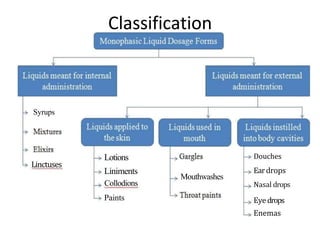
Syrups
Linctuses
Classification
Lotions
Liniments
Collodions
Paints
Mouthwashes
Douches
Eardrops
Nasal drops
Eyedrops
Enemas
Liquids meant for internal administrations
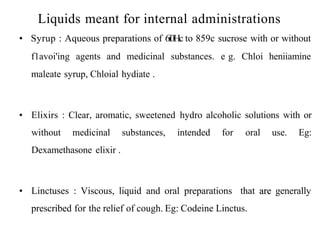
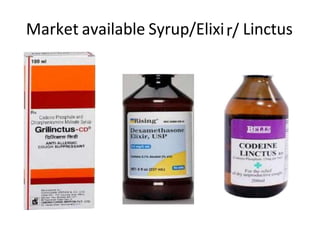
• Syrup : Aqueous preparations of 6i0Hc to 859c sucrose with or without
f1avoi'ing agents and medicinal substances. e g. Chloi heniiamine
maleate syrup, Chloial hydiate .
• Elixirs : Clear, aromatic, sweetened hydro alcoholic solutions with or
without medicinal substances, intended for oral use. Eg:
Dexamethasone elixir .
• Linctuses : Viscous, liquid and oral preparations that are generally
prescribed for the relief of cough. Eg: Codeine Linctus.

Market available Syrup/Elixi Linctus
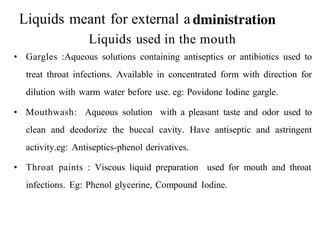
Liquids meant for external a
Liquids used in the mouth
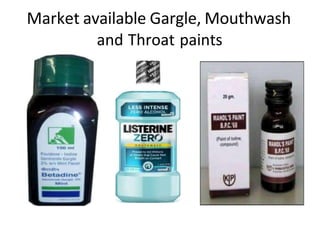
• Gargles :Aqueous solutions containing antiseptics or antibiotics used to
treat throat infections. Available in concentrated form with direction for
dilution with warm water before use. eg: Povidone Iodine gargle.
• Mouthwash: Aqueous solution with a pleasant taste and odor used to
clean and deodorize the buccal cavity. Have antiseptic and astringent
activity.eg: Antiseptics-phenol derivatives.
• Throat paints : Viscous liquid preparation used for mouth and throat
infections. Eg: Phenol glycerine, Compound Iodine.
Market available Gargle, Mouthwash
and Throat paints
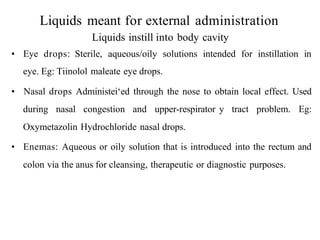
Liquids meant for external administration
Liquids instill into body cavity
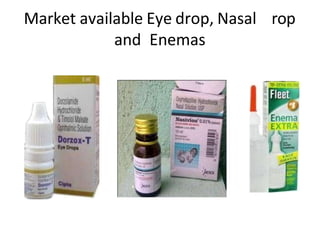
• Eye drops: Sterile, aqueous/oily solutions intended for instillation in
eye. Eg: Tiinolol maleate eye drops.
• Nasal drops Administei‘ed through the nose to obtain local effect. Used
during nasal congestion and upper-respirator y tract problem. Eg:
Oxymetazolin Hydrochloride nasal drops.
• Enemas: Aqueous or oily solution that is introduced into the rectum and
colon via the anus for cleansing, therapeutic or diagnostic purposes.
Market available Eye drop, Nasal rop
and Enemas
Liquids meant for external administration
Liquid meant for skin
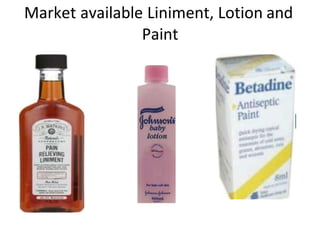
• Liniments : Oily liquid preparations, intended for external application
with rubbing action to the affected area. Use to relief pain and stiffness,
such as from muscles spasm and arthritis.
• Lotions : Topical preparation with a low to medium viscosity. Use to
moisturize dry skin. Eg: Calamine Lotion, baby lotion
• Paints : Solutions used to sterilize the skin. Eg. Betadine antiseptic
paint, Magento paint
Market available Liniment, Lotion and
Paint
Consideration
Formulation Consideration Manufacturing Consideration
• Solubility
• Stability
• Preservatives
• Pharmaceutical elegance
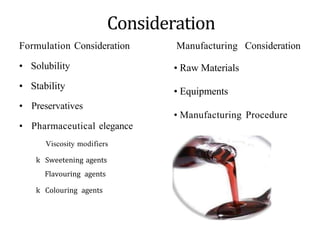
Viscosity modifiers
k Sweetening agents
Flavouring agents
k Colouring agents
• Raw Materials
• Equipments
• Manufacturing Procedure
Approaches to increase the solubility of the drug
& pH adjustment : By addition of buffer to the formulation .
& Co-solvency: By addition of water miscible solvent in which drug
has good solubility. The solvent known as co-solvent.
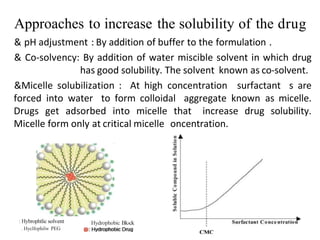
&Micelle solubilization : At high concentration surfactant s are
forced into water to form colloidal aggregate known as micelle.
Drugs get adsorbed into micelle that increase drug solubility.
Micelle form only at critical micelle oncentration.
: Hybrophtlic solvent
. Hyclfophilw PEG
Hydrophobic Bk›ck
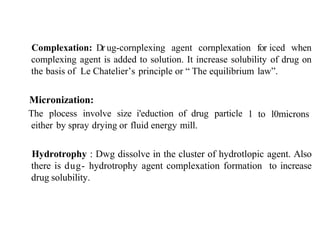
Complexation: Dr ug-cornplexing agent cornplexation for iced when
complexing agent is added to solution. It increase solubility of drug on
the basis of Le Chatelier’s principle or “ The equilibrium law”.
Micronization:
The plocess involve size i'eduction of drug particle
either by spray drying or fluid energy mill.
l to l0microns
Hydrotrophy : Dwg dissolve in the cluster of hydrotlopic agent. Also
there is dug- hydrotrophy agent complexation formation to increase
drug solubility.
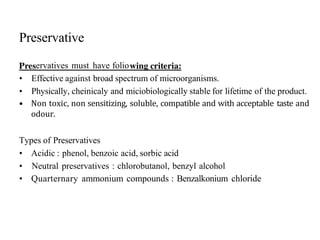
Preservative
ervatives must have folio
• Effective against broad spectrum of microorganisms.
• Physically, cheinicaly and miciobiologically stable for lifetime of the product.
• Non toxic, non sensitizing, soluble, compatible and with acceptable taste and
odour.
Types of Preservatives
• Acidic : phenol, benzoic acid, sorbic acid
• Neutral preservatives : chlorobutanol, benzyl alcohol
• Quarternary ammonium compounds : Benzalkonium chloride
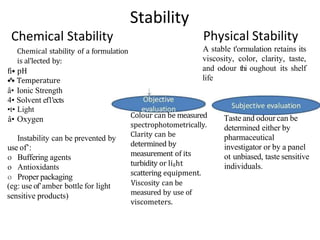
Chemical Stability
Chemical stability of a formulation
is al'lected by:
fi• pH
•*• Temperature
â• Ionic Strength
4• Solvent ef1'ects
•t• Light
â• Oxygen
Instability can be prevented by
use of’:
o Buffering agents
o Antioxidants
o Proper packaging
(eg: use of’amber bottle for light
sensitive products)
Stability
Physical Stability
A stable t'ormulation retains its
viscosity, color, clarity, taste,
and odour thi oughout its shelf
life
Colour can be measured
spectrophotometrically.
Clarity can be
determined by
measurement of its
turbidity or light
scattering equipment.
Viscosity can be
measured by use of
viscometers.
Taste and odour can be
determined either by
pharmaceutical
investigator or by a panel
ot unbiased, taste sensitive
individuals.
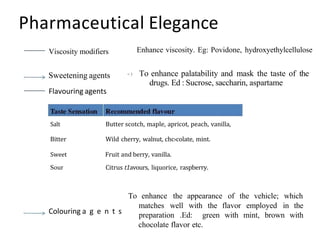
Pharmaceutical Elegance
Viscosity modifiers Enhance viscosity. Eg: Povidone, hydroxyethylcellulose
Sweetening agents -› To enhance palatability and mask the taste of the
drugs. Ed : Sucrose, saccharin, aspartame
Flavouring agents
Salt
Bitter
Sweet
Sour
Butter scotch, maple, apricot, peach, vanilla,
Wild cherry, walnut, chc›colate, mint.
Fruit and berry, vanilla.
Citrus t1avours, liquorice, raspberry.
Colouring a g e n t s
To enhance the appearance of the vehicle; which
matches well with the flavor employed in the
preparation .Ed: green with mint, brown with
chocolate flavor etc.
Manufacturing Consideration
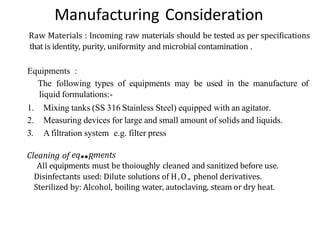
Raw Materials : Incoming raw materials should be tested as per specifications
that is identity, purity, uniformity and microbial contamination .
Equipments :
The following types of equipments may be used in the manufacture of
liquid formulations:-
1. Mixing tanks (SS 316 Stainless Steel) equipped with an agitator.
2. Measuring devices for large and small amount of solids and liquids.
3. Afiltration system e.g. filter press
Cleaning of eq••Rments
All equipments must be thoioughly cleaned and sanitized before use.
Disinfectants used: Dilute solutions of H,O„ phenol derivatives.
Sterilized by: Alcohol, boiling water, autoclaving, steam or dry heat.
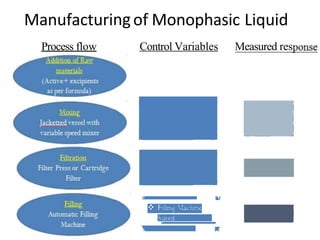
Manufacturingof Monophasic Liquid
Process flow Control Variables Measured res
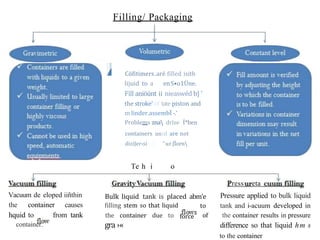
Cöfitimers .aré filled isith
lijuid to a enS•o1Üne.
Fill aniöünt ii nieaswéd b} '
the stroke'of tate piston and
m linder.assembÏ -.'
Problems zna drïse Ï*ben
containers uscd are not
diziJer›si nÏ ”ur JÏorn
Vacuum de eloped iiñthin
the container causes
hquid to from tank
container.
Filling/ Packaging
Te h i o
Bulk liquid tank is placed abm'e
force
filling stem so that liquid
the container due to
gra ›«
ress eta
Pressure applied to bulk liquid
to tank and i-acuum developed in
of the container results in pressure
difference so that liquid hm s
to the container
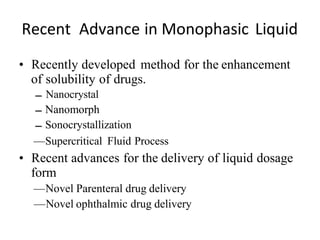
Recent Advance in Monophasic Liquid
• Recently developed method for the enhancement
of solubility of drugs.
Nanocrystal
Nanomorph
Sonocrystallization
—Supercritical Fluid Process
• Recent advances for the delivery of liquid dosage
form
—Novel Parenteral drug delivery
—Novel ophthalmic drug delivery
Nanocrystal
• A nanocrystal is a crystalline material whose
dimension is in nanometers.
• It reduce drug particles size in range of 1-1000
nm.
• Two methods used for producing nanocrystals;
‘bottom-up’ and ‘top-down’ development.
• The top-down methods (i.e. Milling and High
pressure homogenization) start milling down from
macroscopic level.
• In bottom-up methods (i.e. Precipitation and
Cryo-vacuum method) nanoscale materials are
chemically composed from atomic and molecular
components.
NanoMorph
• The NanoMorph technology convert
having low water-solubility from a
drug
coarse
crystalline state into amorphous nanoparticles.
• A suspension of drug substance in solvent is fed
into a chamber, where it is rapidly mixed with
another solvent which converted it into a true
solution.
• The polymer keeps the drug substance particles
in their nanoparticulate state and prevents them
from Aggregation or growth.
Sonocrystallization
• Recrystallization of poorly soluble materials
using liquid solvents and antisolvents has also
been employed successfully to reduce particle
size.
• The novel approach for particle size reduction
based on crystallization by using ulaasound.
• It utilizes ultrasound power characterized by a
frequency range of 20-100 kHz for inducing
crystallization.
• It reduce the drug particle size to micro level.
Supercritical Fluid Process
• Supercritical fluids : fluids whose temperature and pressure are
greater than its critical temperature (Tc) and critical pressure
(Tp), allowing it to assume the properties of both a liquid and a
gas.
• SCFs have properties of liquid-like density, gas-like
compressibilityand viscosity and higher diffusivity
• Once the drug particles are solubilized within SCF, they may be
recrystallised at greatly reduced particle sizes to sub-micron
levels.
• Commonly used supercritical solvents include carbon dioxide,
nitrous oxide, ethylene etc.
Novel Parenteral Drug Delivery
• It use dendromers as drug carriers to achieve
administration of poorly water-soluble drugs.
• Dendromers are hyperbranched polymers with
well-defined structure and molecular weight.
• They have a globular shape, and large void
internal spaces that can be used for the
encapsulation and delivery of drugs.
• Like cyclodexoins, dendomers have ability to
deliver poorly soluble drugs.
Novel ophthalmic drug delivery
• Small colloidal carrier particles such as liposomes,
microcapsules, nanoparticles are used to deliver
precorneal short half life drugs.
• Drugs can be incorporated into the core of the carrier
by dissolved in the polymer matrix.
• Colloidal carrier systems have the advantage that they
may be applied in liquid form, just like eye drop
solutions, because of their low viscosity.
• Nanoparticles have a particle size range from 10 to
1000 nm.
Novel ophthalmic drug delivery
• Drug release from polymer either by degradation of
the polymer or through diffusion from polymeric
matrix.
• Various synthetic and natural biocompatible polymers
have been used to prepare nanoparticles.
• Example of biodegradable polymer : Polylactic acid
Examples of nonbiodegradable polymers : Poly cyano
acrylate derivatives.
Recent Advancement
Recent Approach in formulation of Syrup
Pre arm alatable tastin cou h s of Nosca me
Present invention involves formulation of Noscapine to
obtain a cough syrup.
Method:
Preparing an aqueous liquid syrup type carrier solution & buffer
to maintain the pH of 7 at all times.
Aqueous liquid carrier comprises of sucrose,
presevatives and glycerin.
Mixing noscapine alkaloid with liquid carrier.
sorbitol,
Reference: Process of making cough ss rup s ith nnsked noscapine, bs-S’irgil D.
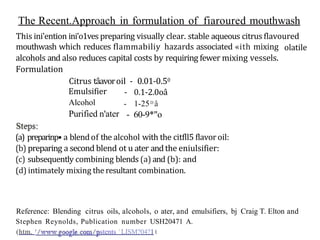
The Recent.Approach in formulation of fiaroured mouthwash
This ini'ention ini'o1ves preparing visually clear. stable aqueous citrus flavoured
olatile
mouthwash which reduces flammabiliy hazards associated «ith mixing
alcohols and also reduces capital costs by requiring fewer mixing vessels.
Formulation
Citrus tâavoroil - 0.01-0.50
- 0.1-2.0oâ
- 1-25D
â
Emulsifier
Alcohol
Purified n'ater - 60-9*"o
(a) preparinp• a blendof the alcohol with the citfll5 flavoroil:
(b) preparing a second blend ot u ater andthe eniulsifier:
(c) subsequently combining blends (a) and (b): and
(d) intimately mixing theresultant combination.
Reference: Blending citrus oils, alcohols, o ater, and emulsifiers, bj Craig T. Elton and
Stephen Reynolds, Publication number USH20471 A.
(htm. stents ' LISM?04?1t
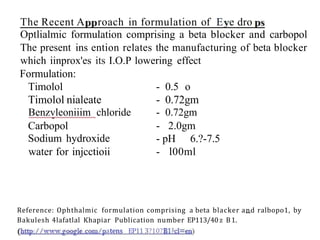
The Recent A roach in formulation of E e dro
Optlialmic formulation comprising a beta blocker and carbopol
The present ins ention relates the manufacturing of beta blocker
which iinprox'es its I.O.P lowering effect
Formulation:
- 0.5 o
- 0.72gm
- 0.72gm
Timolol
Timolol nialeate
Benzvleoniiim chloride
Carbopol
Sodium hydroxide
water for injcctioii
- 2.0gm
- pH 6.?-7.5
- l00ml
Reference: Ophthalmic formulation comprising a beta blacker and ralbopo1, by
Bakulesh 4lafatlal Khapiar Publication number EP113/40z B1.
atens EP11 3?10?
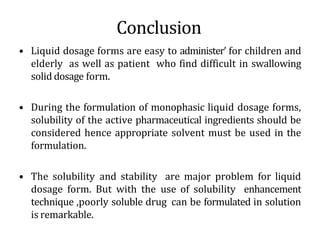
Conclusion
• Liquid dosage forms are easy to administer’ for children and
elderly as well as patient who find difficult in swallowing
solid dosage form.
• During the formulation of monophasic liquid dosage forms,
solubility of the active pharmaceutical ingredients should be
considered hence appropriate solvent must be used in the
formulation.
• The solubility and stability are major problem for liquid
dosage form. But with the use of solubility enhancement
technique ,poorly soluble drug can be formulated in solution
is remarkable.
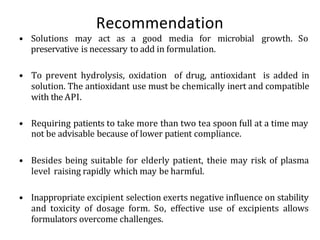
Recommendation
• Solutions may act as a good media for microbial growth. So
preservative is necessary to add in formulation.
• To prevent hydrolysis, oxidation of drug, antioxidant is added in
solution. The antioxidant use must be chemically inert and compatible
with the API.
• Requiring patients to take more than two tea spoon full at a time may
not be advisable because of lower patient compliance.
• Besides being suitable for elderly patient, theie may risk of plasma
level raising rapidly which may be harmful.
• Inappropriate excipient selection exerts negative influence on stability
and toxicity of dosage form. So, effective use of excipients allows
formulators overcome challenges.
Reference
• Ansel H. C.; “Introduction ta Pharmaceutical Dosage Farms”, 4‘h edition, K. M. Varghese
Company, Bombay, 1985, pp-17a-zos.
• Aulton, M.E.; “Pharmaceutics, The Science a/ Dosage Form Design”, 2’d edition, Churchill
Livingstone, London, 2002, pp 309-322.
• Carter S. J.; “Dispensing for Pharmaceutical Students”, 12th edition, CBS Publishers and
Distributors, Delhi (India), 1987, pp 67-99.
• Florence A. T. and Attwood D.; “Physicochemical Principles of Pharmacy”, 4’h edition,
Pharmaceutical Press, London, 2006, pp-113-123.
• Gennaro A. R.; “Remington: The Science and Practice of Pharmacy”, 20th edition, B. I.
Publication Pvt. Ltd., 2004 pp-721-737.
• Jones D.; “Pharmaceutics- Dosage Form and Design ,” Pharmaceutical Press, London, 2008,
pp 1-24.
• Lachman. L, Lieberman.H.A. Kanig J. L.; “The Theory and Practice of Industrial Pharmacy”,
3’d edition, Varghese Publishing House, Bombav. 1991, pp 457-477.
• Leuenberger H; Spray freeze drying: The process of choice for low water soluble drugs. J
Nanoparticle Res 2002; 4:111-119.
• Mheta. R.M.; “Dispensing Pharmacy”, 1s‘edition, Vallabh Prakashan, pp 143-169.
• Niazi S. K.; “Handbook of Pharmaceutical Manufacturing Formulation: Liquid products”,
CRC Press LLC, 2004.
• Phillips E.M., Stella V.J. Rapid expansion from supercritical solutions: application to
pharmaceutical processes.Int.J.Pharm.1993;94:1-10.
• Subramaniam B, Rajewski R A, Snavely K; Pharmaceutical processing with supercritical
carbon dioxide. J. Pharm. Sci. 1997; is: ass-sso.
monophasic dosage form.pptx pharmaceutics

monophasic dosage form.pptx pharmaceutics

  • 1.
    MONOPHASIC LIQUID DOSAGE FORM Presentedby:- Mr. Dinesh Shakya Assistant Professor Jain College, Gwalior
  • 2.
    Contents • Introduction • Classificationof Monophasic liquid • Formulation Consideration • Manufacturing Consideration • Recent advance in monophasic liquid • Recent approach in monophasic liquid formulation • Conclusion • Recommendation
  • 3.
    Introduction • Monophasic dosageform refers to liquid preparation containing two or more components in one phase system, it is repi'esent by true solution. • A true solution is a clear homogenous mixture that is prepared by dissolving solute in a suitable solvent. • A . ATRUESOLLFFIOR “ ^ *”^ WAWR {stem) ’ • The component of the solution which is l»resent in a large quantity is known as “SOLVENT” where as the component present in small quantity is termed as “SOLUTE”.
  • 4.
    Advantage • It iseasier to swallow, therefore easier for children and old age people. • Facilitate absorption of drug faster than solid dosage form as dug is already in solution form. • It is homogenous therefore give uniform dose than suspension or emulsion which need shaking. • Simple and fast to formulate • It can be adnunisteied by various routes : Oral, Paienteral (injection),enema for rectal use, otic(ear), nasal and ophthalmic preparation.
  • 5.
    Disadvantage • They arebulky, so difficult to transport and store. • Water is commonly use vehicle, which is prone to microbial growth. So addition of preservative is needed. • When expose to direct sunlight it may undergo hydrolysis, so need to store in cool and dark place. • Drug stability reduce by hydrolysis or oxidation. So, they have shorter exriredate than solid dosage form. • Other major sign of drug instability are color change, Precipitation, microbial growth etc.
  • 6.
  • 7.
    Liquids meant forinternal administrations • Syrup : Aqueous preparations of 6i0Hc to 859c sucrose with or without f1avoi'ing agents and medicinal substances. e g. Chloi heniiamine maleate syrup, Chloial hydiate . • Elixirs : Clear, aromatic, sweetened hydro alcoholic solutions with or without medicinal substances, intended for oral use. Eg: Dexamethasone elixir . • Linctuses : Viscous, liquid and oral preparations that are generally prescribed for the relief of cough. Eg: Codeine Linctus.
  • 8.
  • 9.
    Liquids meant forexternal a Liquids used in the mouth • Gargles :Aqueous solutions containing antiseptics or antibiotics used to treat throat infections. Available in concentrated form with direction for dilution with warm water before use. eg: Povidone Iodine gargle. • Mouthwash: Aqueous solution with a pleasant taste and odor used to clean and deodorize the buccal cavity. Have antiseptic and astringent activity.eg: Antiseptics-phenol derivatives. • Throat paints : Viscous liquid preparation used for mouth and throat infections. Eg: Phenol glycerine, Compound Iodine.
  • 10.
    Market available Gargle,Mouthwash and Throat paints
  • 11.
    Liquids meant forexternal administration Liquids instill into body cavity • Eye drops: Sterile, aqueous/oily solutions intended for instillation in eye. Eg: Tiinolol maleate eye drops. • Nasal drops Administei‘ed through the nose to obtain local effect. Used during nasal congestion and upper-respirator y tract problem. Eg: Oxymetazolin Hydrochloride nasal drops. • Enemas: Aqueous or oily solution that is introduced into the rectum and colon via the anus for cleansing, therapeutic or diagnostic purposes.
  • 12.
    Market available Eyedrop, Nasal rop and Enemas
  • 13.
    Liquids meant forexternal administration Liquid meant for skin • Liniments : Oily liquid preparations, intended for external application with rubbing action to the affected area. Use to relief pain and stiffness, such as from muscles spasm and arthritis. • Lotions : Topical preparation with a low to medium viscosity. Use to moisturize dry skin. Eg: Calamine Lotion, baby lotion • Paints : Solutions used to sterilize the skin. Eg. Betadine antiseptic paint, Magento paint
  • 14.
  • 15.
    Consideration Formulation Consideration ManufacturingConsideration • Solubility • Stability • Preservatives • Pharmaceutical elegance Viscosity modifiers k Sweetening agents Flavouring agents k Colouring agents • Raw Materials • Equipments • Manufacturing Procedure
  • 16.
    Approaches to increasethe solubility of the drug & pH adjustment : By addition of buffer to the formulation . & Co-solvency: By addition of water miscible solvent in which drug has good solubility. The solvent known as co-solvent. &Micelle solubilization : At high concentration surfactant s are forced into water to form colloidal aggregate known as micelle. Drugs get adsorbed into micelle that increase drug solubility. Micelle form only at critical micelle oncentration. : Hybrophtlic solvent . Hyclfophilw PEG Hydrophobic Bk›ck
  • 17.
    Complexation: Dr ug-cornplexingagent cornplexation for iced when complexing agent is added to solution. It increase solubility of drug on the basis of Le Chatelier’s principle or “ The equilibrium law”. Micronization: The plocess involve size i'eduction of drug particle either by spray drying or fluid energy mill. l to l0microns Hydrotrophy : Dwg dissolve in the cluster of hydrotlopic agent. Also there is dug- hydrotrophy agent complexation formation to increase drug solubility.
  • 18.
    Preservative ervatives must havefolio • Effective against broad spectrum of microorganisms. • Physically, cheinicaly and miciobiologically stable for lifetime of the product. • Non toxic, non sensitizing, soluble, compatible and with acceptable taste and odour. Types of Preservatives • Acidic : phenol, benzoic acid, sorbic acid • Neutral preservatives : chlorobutanol, benzyl alcohol • Quarternary ammonium compounds : Benzalkonium chloride
  • 19.
    Chemical Stability Chemical stabilityof a formulation is al'lected by: fi• pH •*• Temperature â• Ionic Strength 4• Solvent ef1'ects •t• Light â• Oxygen Instability can be prevented by use of’: o Buffering agents o Antioxidants o Proper packaging (eg: use of’amber bottle for light sensitive products) Stability Physical Stability A stable t'ormulation retains its viscosity, color, clarity, taste, and odour thi oughout its shelf life Colour can be measured spectrophotometrically. Clarity can be determined by measurement of its turbidity or light scattering equipment. Viscosity can be measured by use of viscometers. Taste and odour can be determined either by pharmaceutical investigator or by a panel ot unbiased, taste sensitive individuals.
  • 20.
    Pharmaceutical Elegance Viscosity modifiersEnhance viscosity. Eg: Povidone, hydroxyethylcellulose Sweetening agents -› To enhance palatability and mask the taste of the drugs. Ed : Sucrose, saccharin, aspartame Flavouring agents Salt Bitter Sweet Sour Butter scotch, maple, apricot, peach, vanilla, Wild cherry, walnut, chc›colate, mint. Fruit and berry, vanilla. Citrus t1avours, liquorice, raspberry. Colouring a g e n t s To enhance the appearance of the vehicle; which matches well with the flavor employed in the preparation .Ed: green with mint, brown with chocolate flavor etc.
  • 21.
    Manufacturing Consideration Raw Materials: Incoming raw materials should be tested as per specifications that is identity, purity, uniformity and microbial contamination . Equipments : The following types of equipments may be used in the manufacture of liquid formulations:- 1. Mixing tanks (SS 316 Stainless Steel) equipped with an agitator. 2. Measuring devices for large and small amount of solids and liquids. 3. Afiltration system e.g. filter press Cleaning of eq••Rments All equipments must be thoioughly cleaned and sanitized before use. Disinfectants used: Dilute solutions of H,O„ phenol derivatives. Sterilized by: Alcohol, boiling water, autoclaving, steam or dry heat.
  • 22.
    Manufacturingof Monophasic Liquid Processflow Control Variables Measured res
  • 23.
    Cöfitimers .aré filledisith lijuid to a enS•o1Üne. Fill aniöünt ii nieaswéd b} ' the stroke'of tate piston and m linder.assembÏ -.' Problems zna drïse Ï*ben containers uscd are not diziJer›si nÏ ”ur JÏorn Vacuum de eloped iiñthin the container causes hquid to from tank container. Filling/ Packaging Te h i o Bulk liquid tank is placed abm'e force filling stem so that liquid the container due to gra ›« ress eta Pressure applied to bulk liquid to tank and i-acuum developed in of the container results in pressure difference so that liquid hm s to the container
  • 24.
    Recent Advance inMonophasic Liquid • Recently developed method for the enhancement of solubility of drugs. Nanocrystal Nanomorph Sonocrystallization —Supercritical Fluid Process • Recent advances for the delivery of liquid dosage form —Novel Parenteral drug delivery —Novel ophthalmic drug delivery
  • 25.
    Nanocrystal • A nanocrystalis a crystalline material whose dimension is in nanometers. • It reduce drug particles size in range of 1-1000 nm. • Two methods used for producing nanocrystals; ‘bottom-up’ and ‘top-down’ development. • The top-down methods (i.e. Milling and High pressure homogenization) start milling down from macroscopic level. • In bottom-up methods (i.e. Precipitation and Cryo-vacuum method) nanoscale materials are chemically composed from atomic and molecular components.
  • 26.
    NanoMorph • The NanoMorphtechnology convert having low water-solubility from a drug coarse crystalline state into amorphous nanoparticles. • A suspension of drug substance in solvent is fed into a chamber, where it is rapidly mixed with another solvent which converted it into a true solution. • The polymer keeps the drug substance particles in their nanoparticulate state and prevents them from Aggregation or growth.
  • 27.
    Sonocrystallization • Recrystallization ofpoorly soluble materials using liquid solvents and antisolvents has also been employed successfully to reduce particle size. • The novel approach for particle size reduction based on crystallization by using ulaasound. • It utilizes ultrasound power characterized by a frequency range of 20-100 kHz for inducing crystallization. • It reduce the drug particle size to micro level.
  • 28.
    Supercritical Fluid Process •Supercritical fluids : fluids whose temperature and pressure are greater than its critical temperature (Tc) and critical pressure (Tp), allowing it to assume the properties of both a liquid and a gas. • SCFs have properties of liquid-like density, gas-like compressibilityand viscosity and higher diffusivity • Once the drug particles are solubilized within SCF, they may be recrystallised at greatly reduced particle sizes to sub-micron levels. • Commonly used supercritical solvents include carbon dioxide, nitrous oxide, ethylene etc.
  • 29.
    Novel Parenteral DrugDelivery • It use dendromers as drug carriers to achieve administration of poorly water-soluble drugs. • Dendromers are hyperbranched polymers with well-defined structure and molecular weight. • They have a globular shape, and large void internal spaces that can be used for the encapsulation and delivery of drugs. • Like cyclodexoins, dendomers have ability to deliver poorly soluble drugs.
  • 30.
    Novel ophthalmic drugdelivery • Small colloidal carrier particles such as liposomes, microcapsules, nanoparticles are used to deliver precorneal short half life drugs. • Drugs can be incorporated into the core of the carrier by dissolved in the polymer matrix. • Colloidal carrier systems have the advantage that they may be applied in liquid form, just like eye drop solutions, because of their low viscosity. • Nanoparticles have a particle size range from 10 to 1000 nm.
  • 31.
    Novel ophthalmic drugdelivery • Drug release from polymer either by degradation of the polymer or through diffusion from polymeric matrix. • Various synthetic and natural biocompatible polymers have been used to prepare nanoparticles. • Example of biodegradable polymer : Polylactic acid Examples of nonbiodegradable polymers : Poly cyano acrylate derivatives.
  • 32.
    Recent Advancement Recent Approachin formulation of Syrup Pre arm alatable tastin cou h s of Nosca me Present invention involves formulation of Noscapine to obtain a cough syrup. Method: Preparing an aqueous liquid syrup type carrier solution & buffer to maintain the pH of 7 at all times. Aqueous liquid carrier comprises of sucrose, presevatives and glycerin. Mixing noscapine alkaloid with liquid carrier. sorbitol, Reference: Process of making cough ss rup s ith nnsked noscapine, bs-S’irgil D.
  • 33.
    The Recent.Approach informulation of fiaroured mouthwash This ini'ention ini'o1ves preparing visually clear. stable aqueous citrus flavoured olatile mouthwash which reduces flammabiliy hazards associated «ith mixing alcohols and also reduces capital costs by requiring fewer mixing vessels. Formulation Citrus tâavoroil - 0.01-0.50 - 0.1-2.0oâ - 1-25D â Emulsifier Alcohol Purified n'ater - 60-9*"o (a) preparinp• a blendof the alcohol with the citfll5 flavoroil: (b) preparing a second blend ot u ater andthe eniulsifier: (c) subsequently combining blends (a) and (b): and (d) intimately mixing theresultant combination. Reference: Blending citrus oils, alcohols, o ater, and emulsifiers, bj Craig T. Elton and Stephen Reynolds, Publication number USH20471 A. (htm. stents ' LISM?04?1t
  • 34.
    The Recent Aroach in formulation of E e dro Optlialmic formulation comprising a beta blocker and carbopol The present ins ention relates the manufacturing of beta blocker which iinprox'es its I.O.P lowering effect Formulation: - 0.5 o - 0.72gm - 0.72gm Timolol Timolol nialeate Benzvleoniiim chloride Carbopol Sodium hydroxide water for injcctioii - 2.0gm - pH 6.?-7.5 - l00ml Reference: Ophthalmic formulation comprising a beta blacker and ralbopo1, by Bakulesh 4lafatlal Khapiar Publication number EP113/40z B1. atens EP11 3?10?
  • 35.
    Conclusion • Liquid dosageforms are easy to administer’ for children and elderly as well as patient who find difficult in swallowing solid dosage form. • During the formulation of monophasic liquid dosage forms, solubility of the active pharmaceutical ingredients should be considered hence appropriate solvent must be used in the formulation. • The solubility and stability are major problem for liquid dosage form. But with the use of solubility enhancement technique ,poorly soluble drug can be formulated in solution is remarkable.
  • 36.
    Recommendation • Solutions mayact as a good media for microbial growth. So preservative is necessary to add in formulation. • To prevent hydrolysis, oxidation of drug, antioxidant is added in solution. The antioxidant use must be chemically inert and compatible with the API. • Requiring patients to take more than two tea spoon full at a time may not be advisable because of lower patient compliance. • Besides being suitable for elderly patient, theie may risk of plasma level raising rapidly which may be harmful. • Inappropriate excipient selection exerts negative influence on stability and toxicity of dosage form. So, effective use of excipients allows formulators overcome challenges.
  • 37.
    Reference • Ansel H.C.; “Introduction ta Pharmaceutical Dosage Farms”, 4‘h edition, K. M. Varghese Company, Bombay, 1985, pp-17a-zos. • Aulton, M.E.; “Pharmaceutics, The Science a/ Dosage Form Design”, 2’d edition, Churchill Livingstone, London, 2002, pp 309-322. • Carter S. J.; “Dispensing for Pharmaceutical Students”, 12th edition, CBS Publishers and Distributors, Delhi (India), 1987, pp 67-99. • Florence A. T. and Attwood D.; “Physicochemical Principles of Pharmacy”, 4’h edition, Pharmaceutical Press, London, 2006, pp-113-123. • Gennaro A. R.; “Remington: The Science and Practice of Pharmacy”, 20th edition, B. I. Publication Pvt. Ltd., 2004 pp-721-737. • Jones D.; “Pharmaceutics- Dosage Form and Design ,” Pharmaceutical Press, London, 2008, pp 1-24. • Lachman. L, Lieberman.H.A. Kanig J. L.; “The Theory and Practice of Industrial Pharmacy”, 3’d edition, Varghese Publishing House, Bombav. 1991, pp 457-477. • Leuenberger H; Spray freeze drying: The process of choice for low water soluble drugs. J Nanoparticle Res 2002; 4:111-119. • Mheta. R.M.; “Dispensing Pharmacy”, 1s‘edition, Vallabh Prakashan, pp 143-169. • Niazi S. K.; “Handbook of Pharmaceutical Manufacturing Formulation: Liquid products”, CRC Press LLC, 2004. • Phillips E.M., Stella V.J. Rapid expansion from supercritical solutions: application to pharmaceutical processes.Int.J.Pharm.1993;94:1-10. • Subramaniam B, Rajewski R A, Snavely K; Pharmaceutical processing with supercritical carbon dioxide. J. Pharm. Sci. 1997; is: ass-sso.