GEOMETRY OF
MOLECULES & POLARITY
OF COMPOUNDS
Prepared by: Mrs. Eden C. Sanchez
Learning Objectives
1. Apply the Valence Shell Electron Pair
Repulsion Theory to predict the geometry
of simple molecules.
2. Define dipole moment.
3. Predict the polarity of molecules
2
Keywords
a. Molecular geometry
b. Valence Shell Electron Pair
Repulsion Theory
c. Bond angle
d. linear
e. trigonal planar
f. tetrahedral
3
Keywords
g. trigonal bipyramidal
h. octahedral
i. dipole moment
j. polar bond
k. polar molecule
4
Motivation
▰ What is tetrahedron, a
trigonal bipyramid, and an
octahedron?
5
Molecular Geometry
▰ pertains to the three-dimensional
arrangement of atoms in a molecule.
▰ affects the physical and chemical properties
of molecules and their reactivity towards
other molecules.
6
▰ Molecular geometry can be determined by
experiment such as x-ray diffraction
▰ the geometry of simple molecules can be
predicted even without experimentation
7
▰ the results of the prediction is only
qualitative and not as accurate as
experiment, but they still help in explaining
the properties of chemical substances.
8
▰ The prediction rests on the assumption that
all electron pairs in the valence shell
around a central atom repel one another.
They want to be as far apart from one
another as possible. These valence shell
electron pairs are the ones involved in
bonding.
9
▰ They assume a geometry or orientation that
will minimize the repulsions. This is the
stable orientation and the one with lowest
energy. This approach in predicting
molecular geometry is called the Valence
Shell Electron Pair Repulsion Theory
(VSEPR).
10
Key ideas of the VSEPR theory
are:
1. Electron pairs stay as far apart from each
other as possible to minimize repulsions.
2. Molecular shape is determined by the
number of bond pairs and lone pairs
around the central atom.
3. Treat multiple bonds as if they were single
bonds (in making the prediction).
11
Key ideas of the VSEPR theory
are:
4. Lone pairs occupy more volume than bond
pairs. Lone pair-lone pair repulsions are
greater than lone pair-bond pair repulsions
which in turn are greater than bond pair-
bond pair repulsions
12
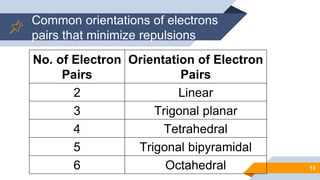
Common orientations of electrons
pairs that minimize repulsions
13
No. of Electron
Pairs
Orientation of Electron
Pairs
2 Linear
3 Trigonal planar
4 Tetrahedral
5 Trigonal bipyramidal
6 Octahedral
Molecular Geometry of Sample
Molecules
▰ For this lesson, notation is adopted:
▰ A refers to the central atom and X refers to
another atom bonded to it. If there are lone
pairs attached to the central atom, this is
indicated by the letter E.
▰ Example: AX2E2 means that A has two atoms
of X bonded to it and A also has two lone
pairs of electrons.
14
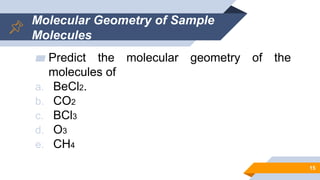
Molecular Geometry of Sample
Molecules
▰ Predict the molecular geometry of the
molecules of
a. BeCl2.
b. CO2
c. BCl3
d. O3
e. CH4
15
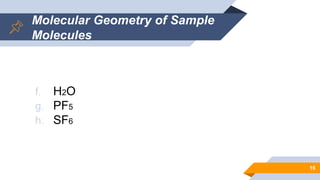
Molecular Geometry of Sample
Molecules
f. H2O
g. PF5
h. SF6
16
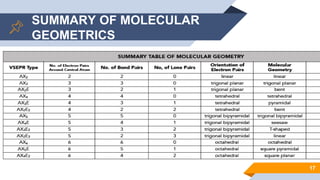
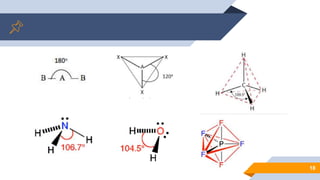
SUMMARY OF MOLECULAR
GEOMETRICS
17
18
Exercises:
1. Using the VSEPR theory, give the electron pair
orientation and predict the geometry of the
following:
a. CH3I
b. SiH4
c. NF3
d. SCN– (C is the middle atom)
e. H2S
19
Exercises:
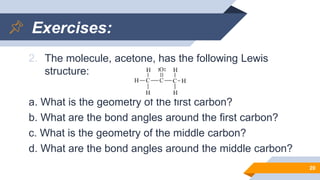
2. The molecule, acetone, has the following Lewis
structure:
a. What is the geometry of the first carbon?
b. What are the bond angles around the first carbon?
c. What is the geometry of the middle carbon?
d. What are the bond angles around the middle carbon?
20
Dipole Moments and Polarity
of Molecules
 polar covalent bonds, the electrons are not equally
shared by the bonding atoms
 there is a shift in electron density towards the more
electronegative atom.
 shift is symbolized by a crossed arrow with the arrow
pointing toward the direction of the shift.
21
Dipole Moments and Polarity
of Molecules
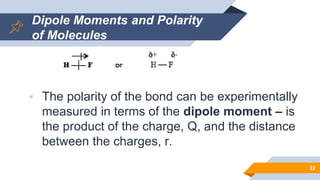
 The polarity of the bond can be experimentally
measured in terms of the dipole moment – is
the product of the charge, Q, and the distance
between the charges, r.
22
Dipole Moments and Polarity
of Molecules
 To maintain neutrality, the charges on
the ends of the molecule must be equal
in magnitude but opposite in sign.
 The unit of the dipole moment is in
terms of the Debye¸D¸
23
Exercises
1. Is carbon dioxide a polar molecule or not?
2. Is ammonia a polar molecule?
24
25
Thank You!
Any questions?
CREDITS
Special thanks to all the people who made
and released these awesome resources for
free:
▰ Presentation template by SlidesCarnival
▰ Photographs by Startup Stock Photos
26

Molecular geometry

  • 1.
    GEOMETRY OF MOLECULES &POLARITY OF COMPOUNDS Prepared by: Mrs. Eden C. Sanchez
  • 2.
    Learning Objectives 1. Applythe Valence Shell Electron Pair Repulsion Theory to predict the geometry of simple molecules. 2. Define dipole moment. 3. Predict the polarity of molecules 2
  • 3.
    Keywords a. Molecular geometry b.Valence Shell Electron Pair Repulsion Theory c. Bond angle d. linear e. trigonal planar f. tetrahedral 3
  • 4.
    Keywords g. trigonal bipyramidal h.octahedral i. dipole moment j. polar bond k. polar molecule 4
  • 5.
    Motivation ▰ What istetrahedron, a trigonal bipyramid, and an octahedron? 5
  • 6.
    Molecular Geometry ▰ pertainsto the three-dimensional arrangement of atoms in a molecule. ▰ affects the physical and chemical properties of molecules and their reactivity towards other molecules. 6
  • 7.
    ▰ Molecular geometrycan be determined by experiment such as x-ray diffraction ▰ the geometry of simple molecules can be predicted even without experimentation 7
  • 8.
    ▰ the resultsof the prediction is only qualitative and not as accurate as experiment, but they still help in explaining the properties of chemical substances. 8
  • 9.
    ▰ The predictionrests on the assumption that all electron pairs in the valence shell around a central atom repel one another. They want to be as far apart from one another as possible. These valence shell electron pairs are the ones involved in bonding. 9
  • 10.
    ▰ They assumea geometry or orientation that will minimize the repulsions. This is the stable orientation and the one with lowest energy. This approach in predicting molecular geometry is called the Valence Shell Electron Pair Repulsion Theory (VSEPR). 10
  • 11.
    Key ideas ofthe VSEPR theory are: 1. Electron pairs stay as far apart from each other as possible to minimize repulsions. 2. Molecular shape is determined by the number of bond pairs and lone pairs around the central atom. 3. Treat multiple bonds as if they were single bonds (in making the prediction). 11
  • 12.
    Key ideas ofthe VSEPR theory are: 4. Lone pairs occupy more volume than bond pairs. Lone pair-lone pair repulsions are greater than lone pair-bond pair repulsions which in turn are greater than bond pair- bond pair repulsions 12
  • 13.
    Common orientations ofelectrons pairs that minimize repulsions 13 No. of Electron Pairs Orientation of Electron Pairs 2 Linear 3 Trigonal planar 4 Tetrahedral 5 Trigonal bipyramidal 6 Octahedral
  • 14.
    Molecular Geometry ofSample Molecules ▰ For this lesson, notation is adopted: ▰ A refers to the central atom and X refers to another atom bonded to it. If there are lone pairs attached to the central atom, this is indicated by the letter E. ▰ Example: AX2E2 means that A has two atoms of X bonded to it and A also has two lone pairs of electrons. 14
  • 15.
    Molecular Geometry ofSample Molecules ▰ Predict the molecular geometry of the molecules of a. BeCl2. b. CO2 c. BCl3 d. O3 e. CH4 15
  • 16.
    Molecular Geometry ofSample Molecules f. H2O g. PF5 h. SF6 16
  • 17.
  • 18.
  • 19.
    Exercises: 1. Using theVSEPR theory, give the electron pair orientation and predict the geometry of the following: a. CH3I b. SiH4 c. NF3 d. SCN– (C is the middle atom) e. H2S 19
  • 20.
    Exercises: 2. The molecule,acetone, has the following Lewis structure: a. What is the geometry of the first carbon? b. What are the bond angles around the first carbon? c. What is the geometry of the middle carbon? d. What are the bond angles around the middle carbon? 20
  • 21.
    Dipole Moments andPolarity of Molecules  polar covalent bonds, the electrons are not equally shared by the bonding atoms  there is a shift in electron density towards the more electronegative atom.  shift is symbolized by a crossed arrow with the arrow pointing toward the direction of the shift. 21
  • 22.
    Dipole Moments andPolarity of Molecules  The polarity of the bond can be experimentally measured in terms of the dipole moment – is the product of the charge, Q, and the distance between the charges, r. 22
  • 23.
    Dipole Moments andPolarity of Molecules  To maintain neutrality, the charges on the ends of the molecule must be equal in magnitude but opposite in sign.  The unit of the dipole moment is in terms of the Debye¸D¸ 23
  • 24.
    Exercises 1. Is carbondioxide a polar molecule or not? 2. Is ammonia a polar molecule? 24
  • 25.
  • 26.
    CREDITS Special thanks toall the people who made and released these awesome resources for free: ▰ Presentation template by SlidesCarnival ▰ Photographs by Startup Stock Photos 26

Editor's Notes

  • #15 Only valence electrons are included in Lewis structures.
  • #16 Only valence electrons are included in Lewis structures.
  • #17 Only valence electrons are included in Lewis structures.