CHE 2060: Principles of Organic Chem
. Introduction to organic structure & bonding
1.1: Drawing organic structures
A. Formal charge
B. Common bonding patterns
C. Using ‘line structure’ (aka line-bond) convention
D. Constitutional (aka structural) isomers
1.2: Functional groups & organic nomenclature
A. Functional groups in organic compounds
B. Naming organic compounds
C. Abbreviating structural drawings
1.3: Structures of some important biological molecules
A. Lipids
B. Biopolymer basics
C. Carbohydrates
D. Amino acids & proteins
E. Nucleic acids (DNA & RNA)
1. Intro to organic structure & bonding
Big ideas:
1. Functional groups are where the action is.
2. Drawing and understanding molecular
structures is a critical skill.
1. Intro to organic structure & bonding
1.2 Functional groups and organic nomenclature
A. Functional groups in organic compounds
B. Naming organic compounds
C. Abbreviating structural drawings
1. Intro to organic structure & bonding
1.2A: Functional groups in organic compounds
See tables posted on Module 1 webpage.
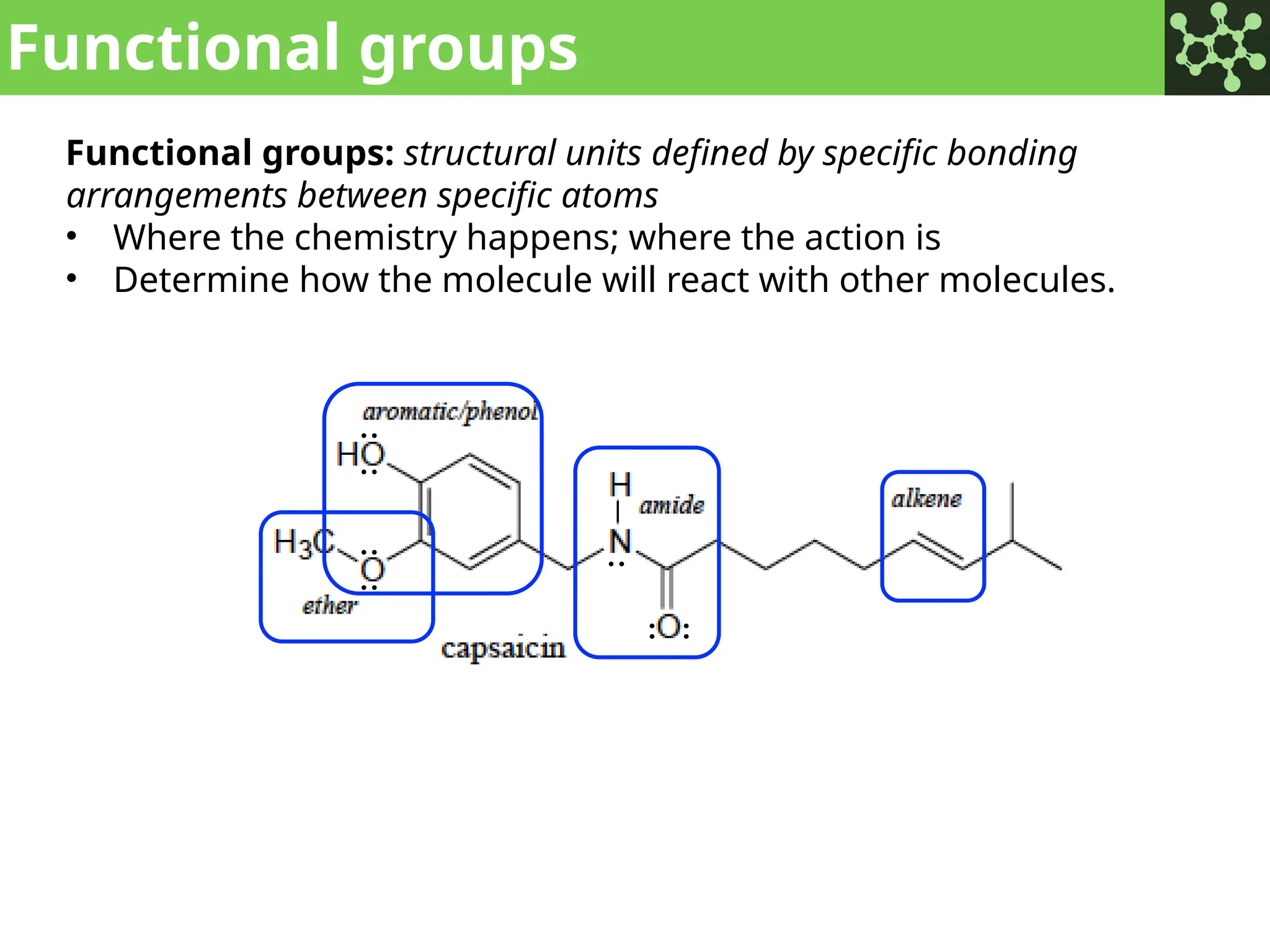
Functional groups
Functional groups: structural units defined by specific bonding
arrangements between specific atoms
• Where the chemistry happens; where the action is
• Determine how the molecule will react with other molecules.
: :
:
:
:
:
:
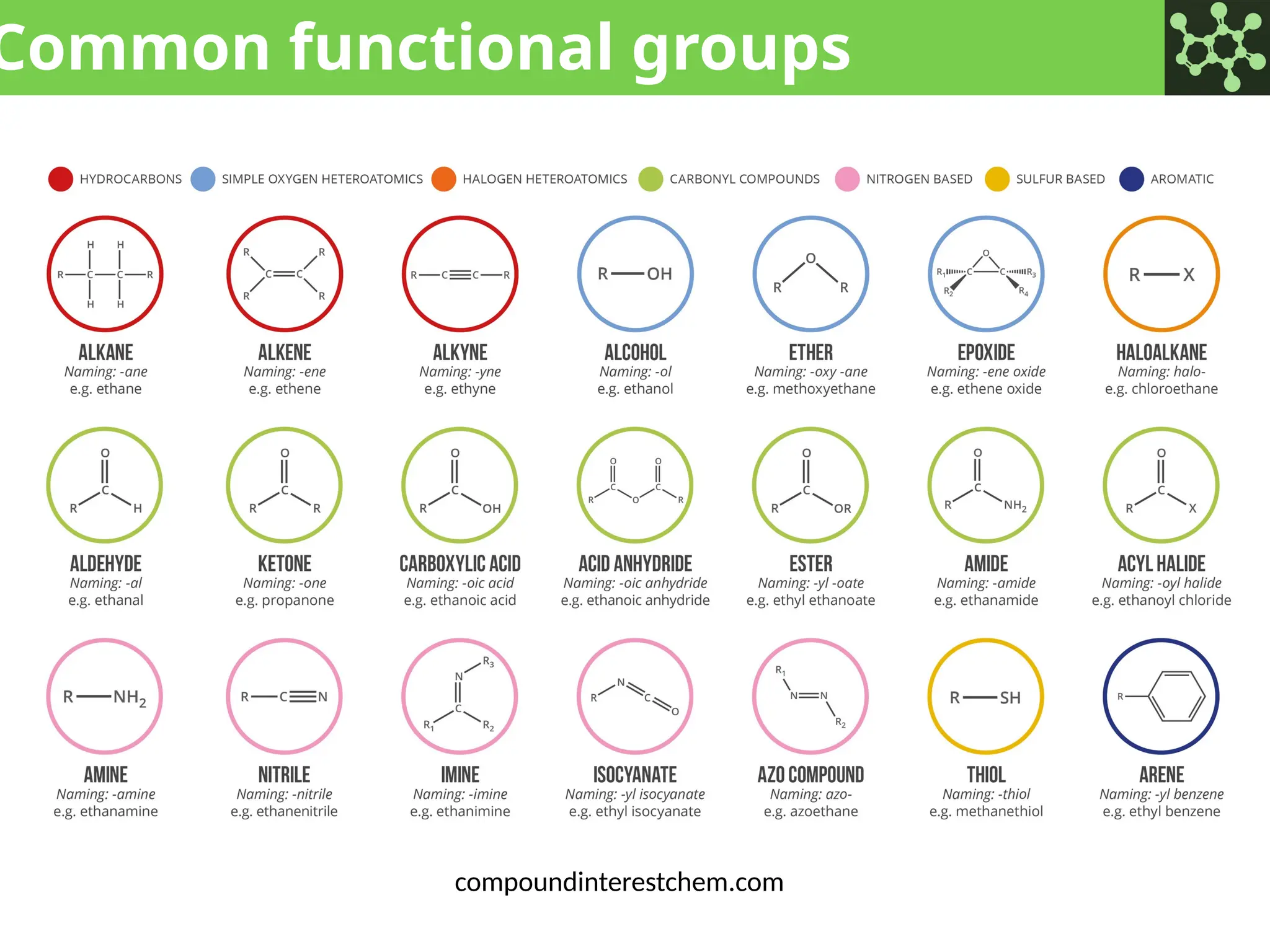
Common functional groups
compoundinterestchem.com
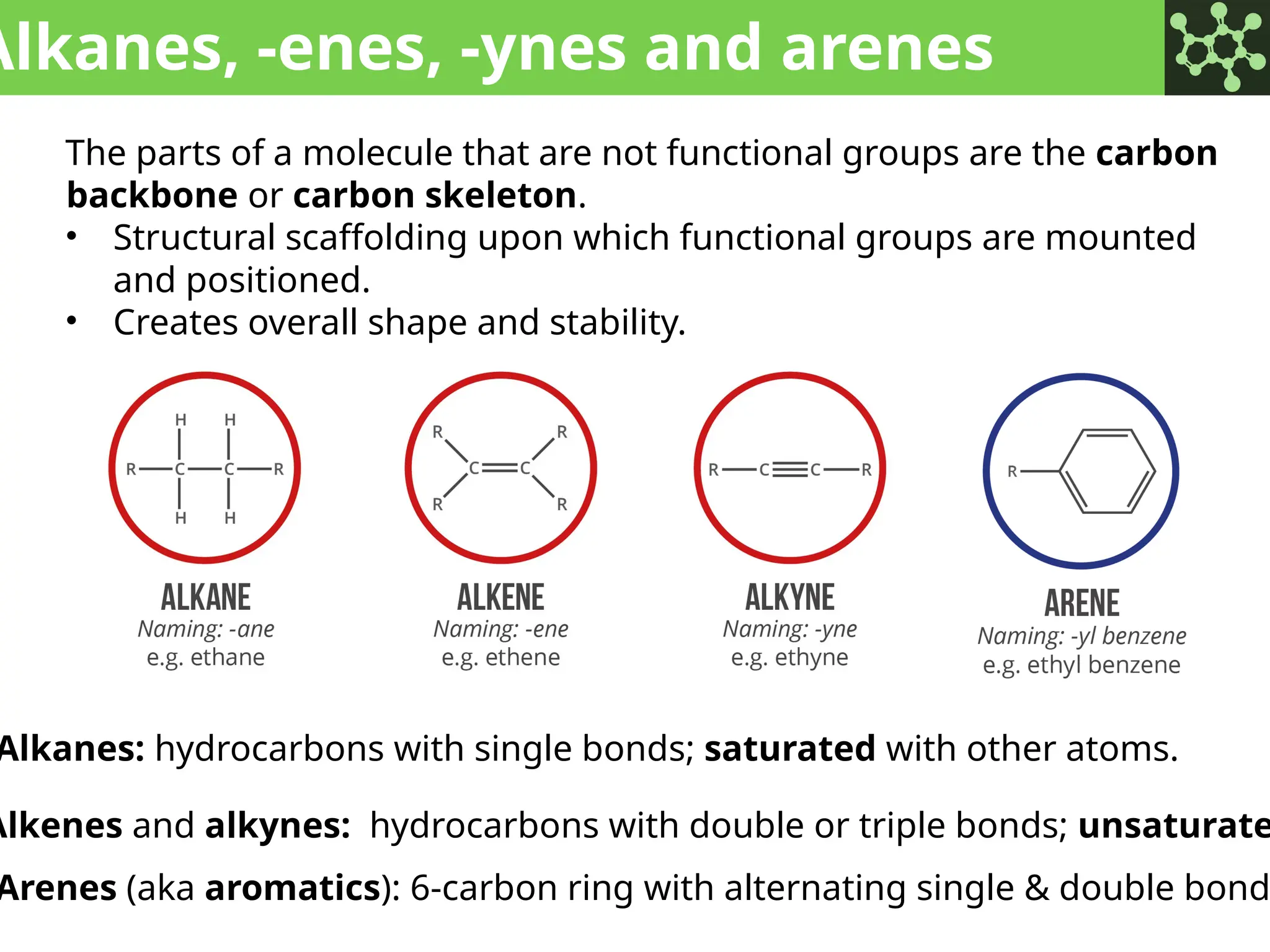
Alkanes, -enes, -ynes and arenes
The parts of a molecule that are not functional groups are the carbon
backbone or carbon skeleton.
• Structural scaffolding upon which functional groups are mounted
and positioned.
• Creates overall shape and stability.
Alkanes: hydrocarbons with single bonds; saturated with other atoms.
Alkenes and alkynes: hydrocarbons with double or triple bonds; unsaturate
Arenes (aka aromatics): 6-carbon ring with alternating single & double bond
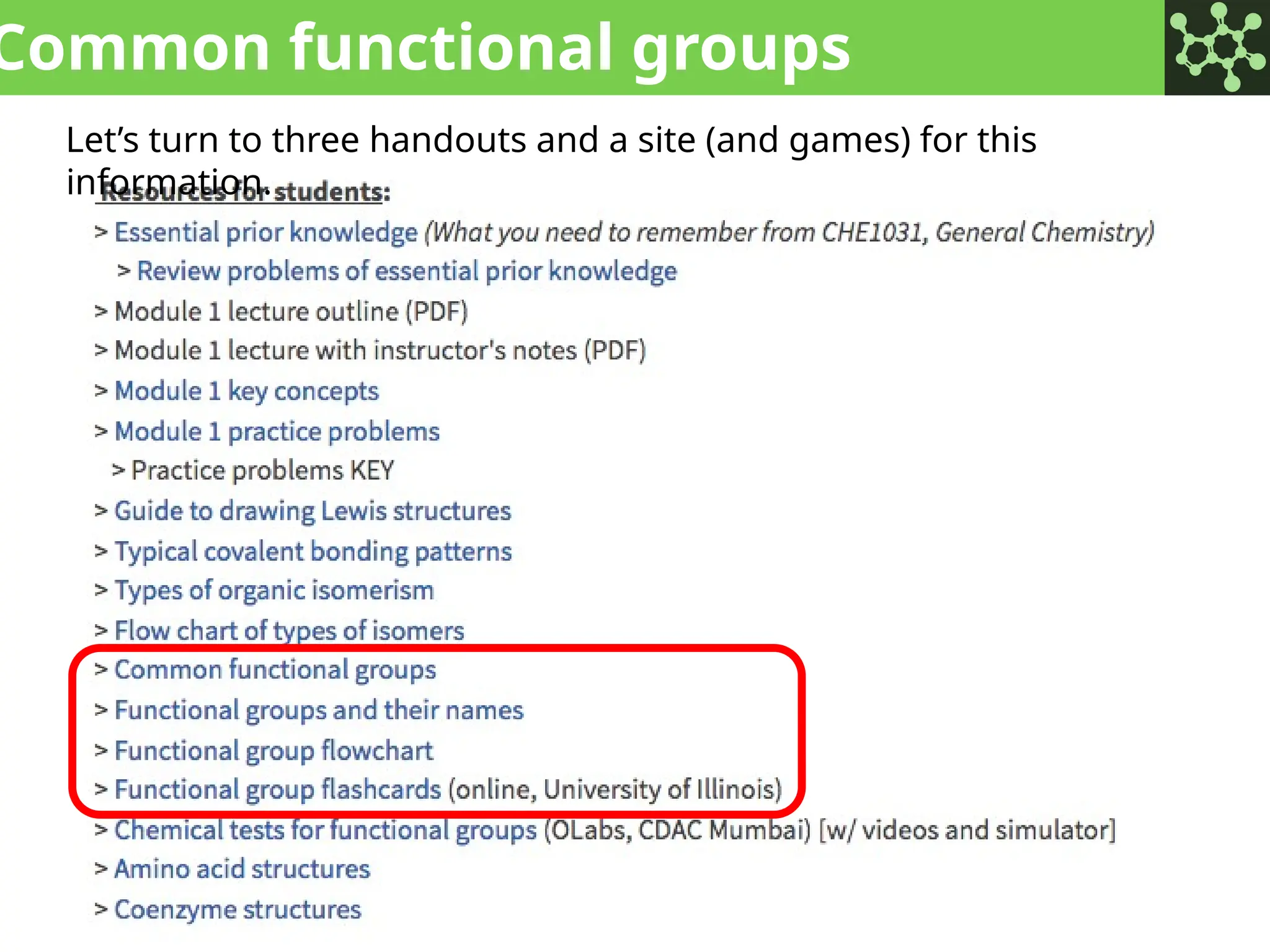
Common functional groups
Let’s turn to three handouts and a site (and games) for this
information.
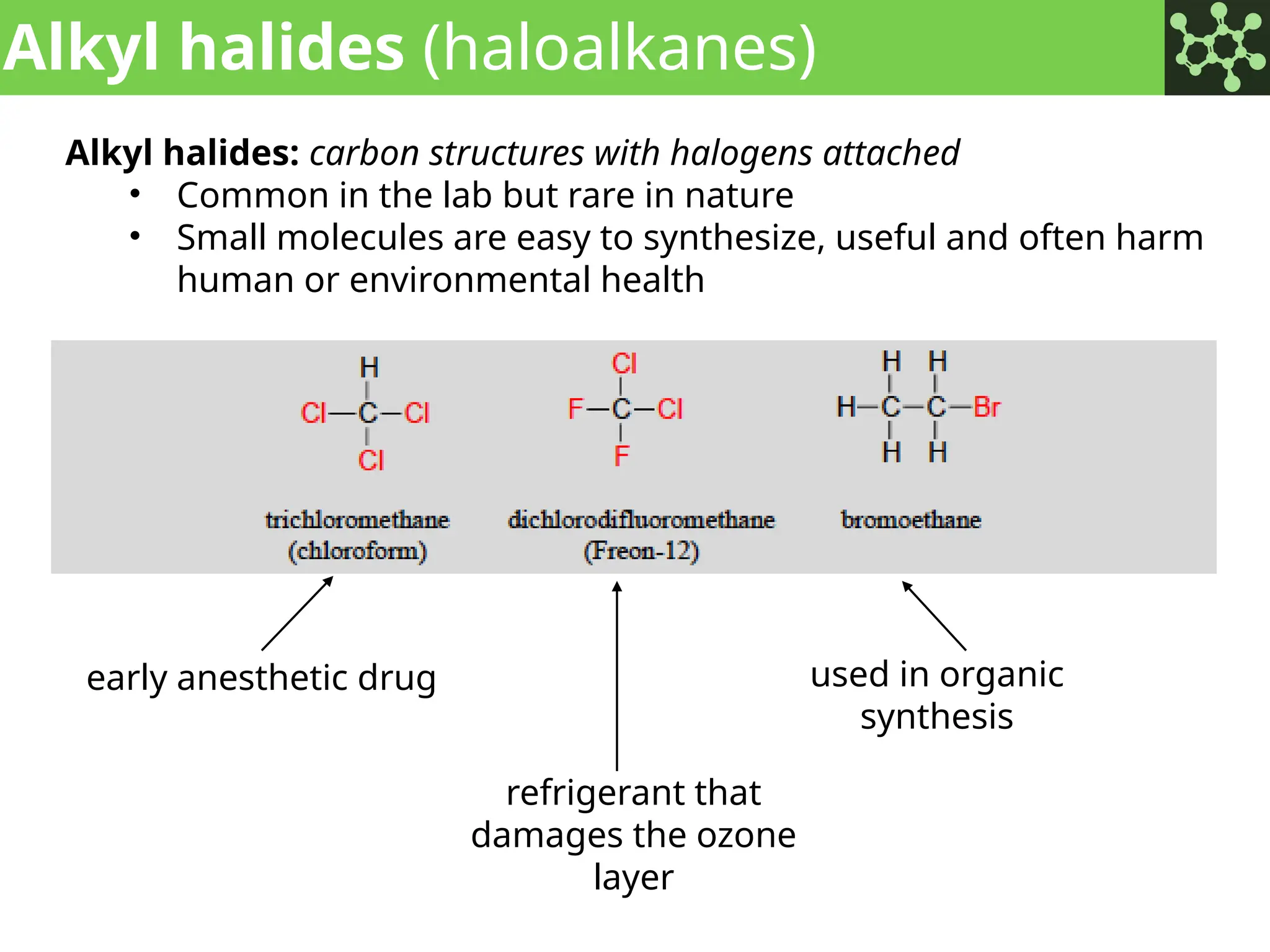
Alkyl halides (haloalkanes)
Alkyl halides: carbon structures with halogens attached
• Common in the lab but rare in nature
• Small molecules are easy to synthesize, useful and often harm
human or environmental health
early anesthetic drug
refrigerant that
damages the ozone
layer
used in organic
synthesis
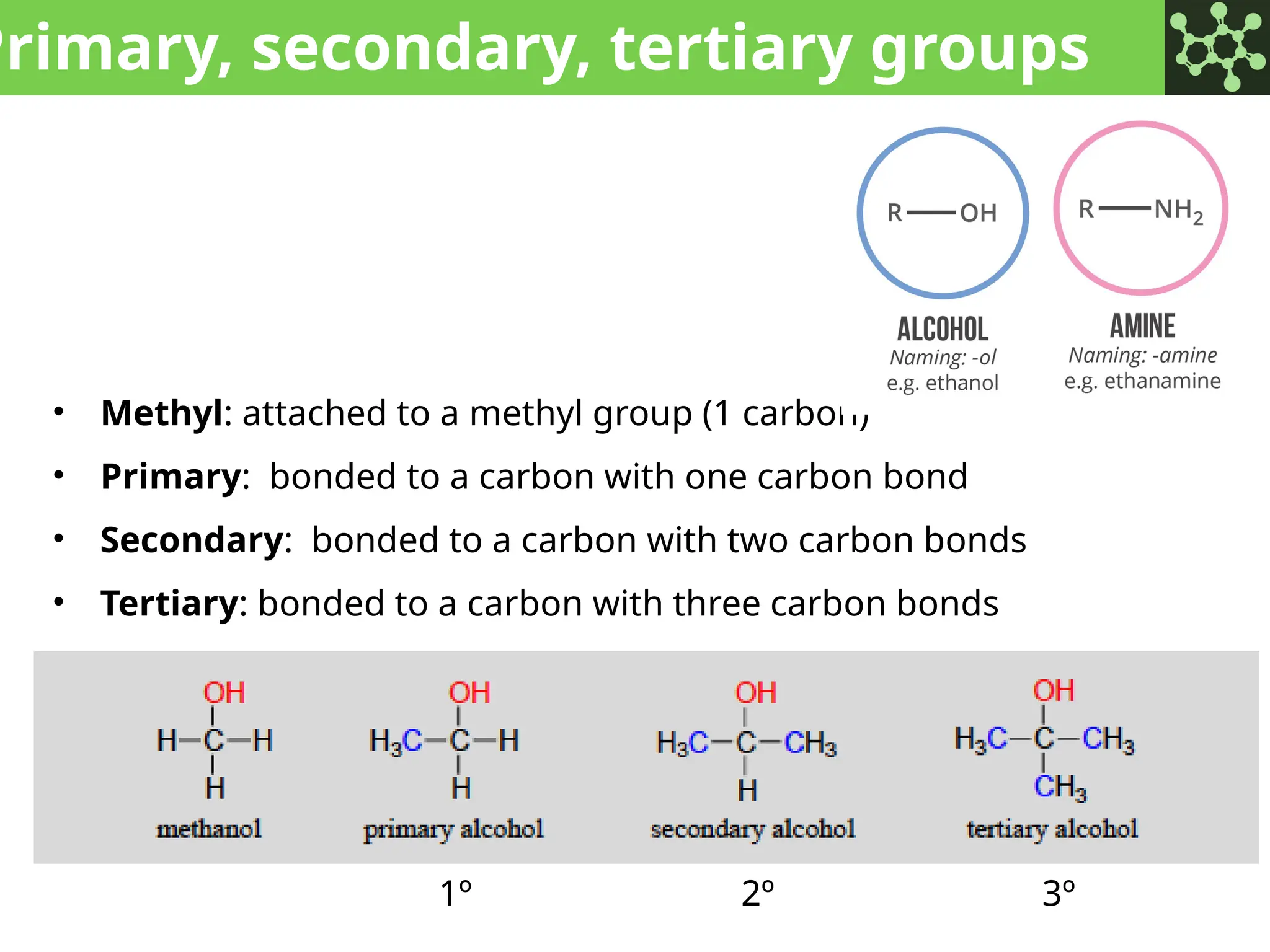
Primary, secondary, tertiary groups
• Methyl: attached to a methyl group (1 carbon)
• Primary: bonded to a carbon with one carbon bond
• Secondary: bonded to a carbon with two carbon bonds
• Tertiary: bonded to a carbon with three carbon bonds
1º 2º 3º
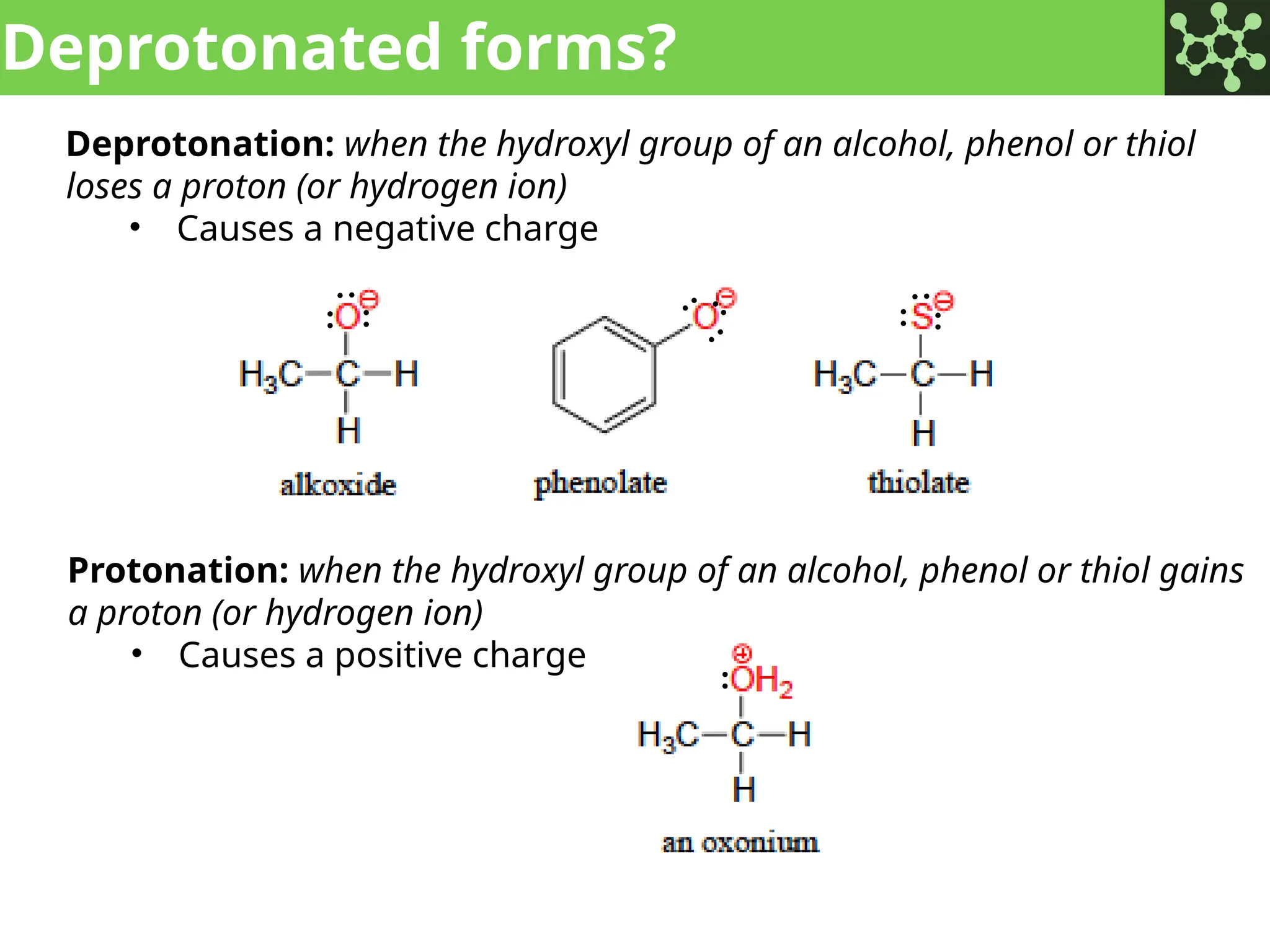
Deprotonated forms?
Deprotonation: when the hydroxyl group of an alcohol, phenol or thiol
loses a proton (or hydrogen ion)
• Causes a negative charge
Protonation: when the hydroxyl group of an alcohol, phenol or thiol gains
a proton (or hydrogen ion)
• Causes a positive charge
: : : :
:
:
:
:
:
:
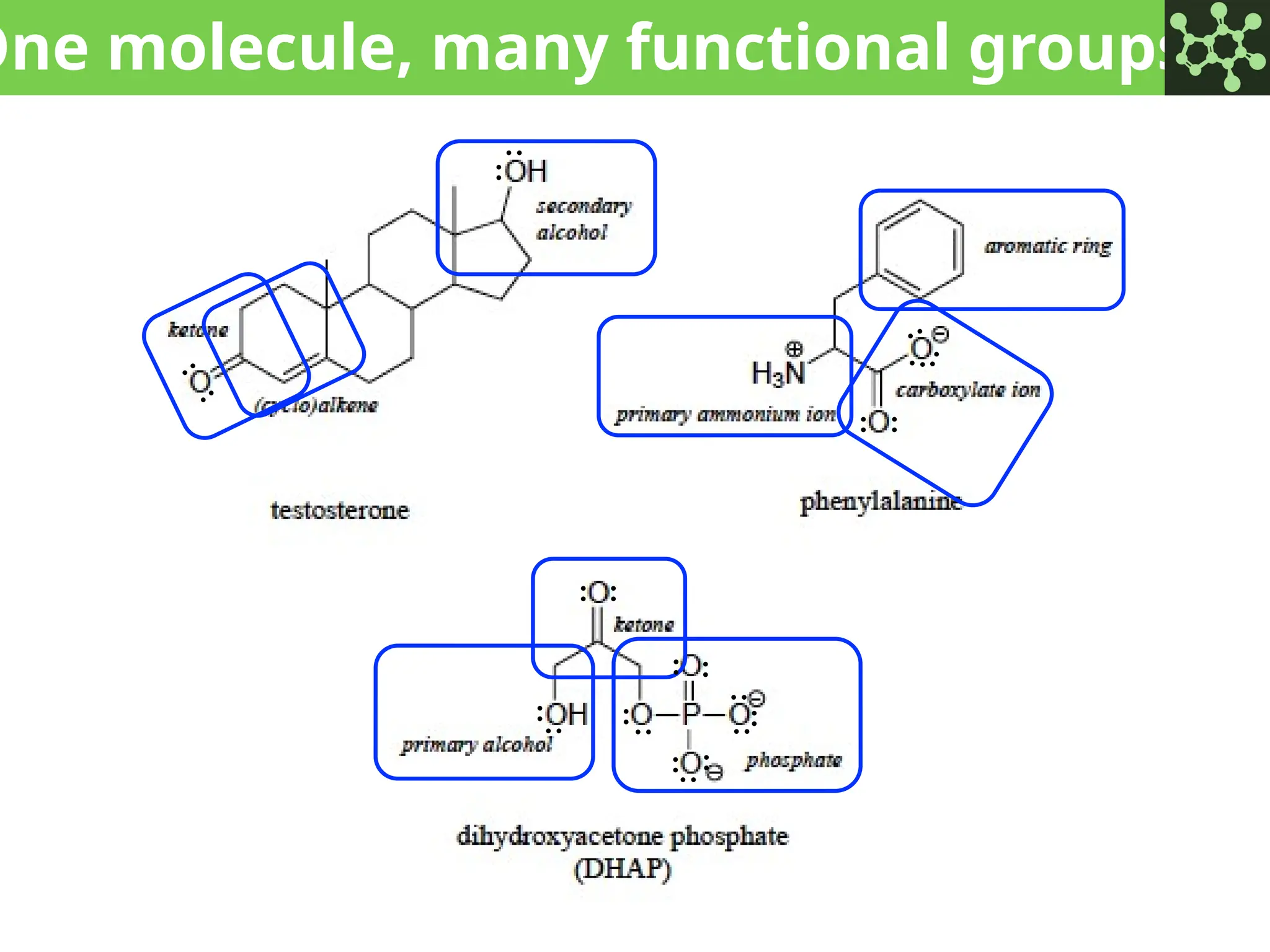
One molecule, many functional groups
:
:
:
: :
:
:
:
:
: :
:
:
:
:
: :
:
:
:
:
:
:
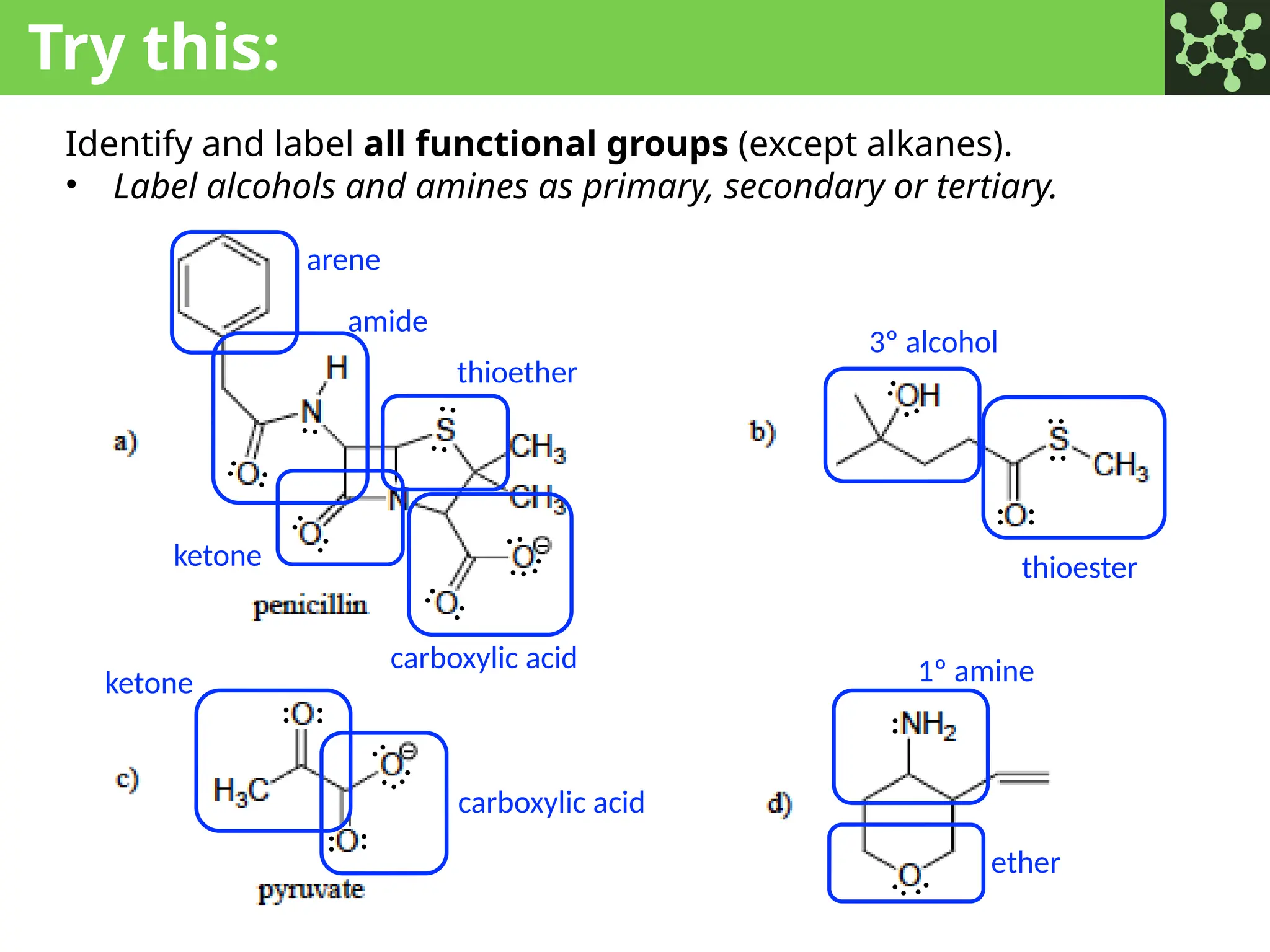
Try this:
Identify and label all functional groups (except alkanes).
• Label alcohols and amines as primary, secondary or tertiary.
3º alcohol
1º amine
: :
:
:
:
:
:
:
:
:
:
:
:
:
: :
:
:
:
:
:
:
:
:
: :
:
:
arene
amide
thioether
carboxylic acid
ketone
ketone
carboxylic acid
ether
thioester
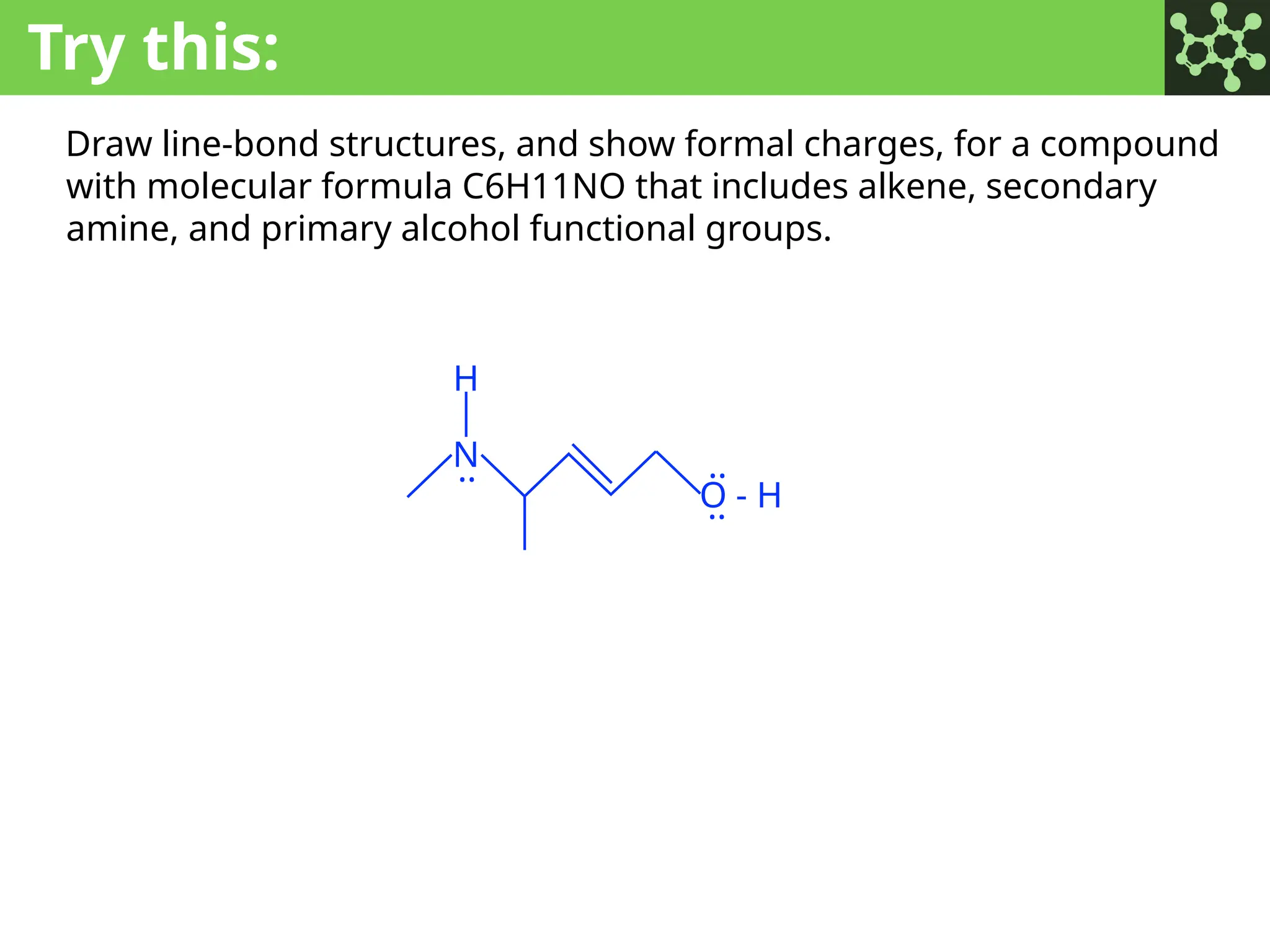
Try this:
Draw line-bond structures, and show formal charges, for a compound
with molecular formula C6H11NO that includes alkene, secondary
amine, and primary alcohol functional groups.
N
O - H
..
..
..
H
Can you?
(1) Define the term ’functional group’?
(2) Explain the importance of functional groups? Contrast the roles of
functional groups and carbon skeletons?
(3) Name all functional groups? (and protonated and deprotonated?)
(4) Name all functional groups containing _______ atoms? (O, N, S, P,
aromatic rings)
(5) Draw functional groups?
(6) Identify and name functional groups in larger molecules?
1. Intro to organic structure & bonding
1.2B: Naming organic compounds
• Emphasis on drawing structures from IUPAC names
Naming systems
We’ll be focusing on the IUPAC (International Union of Pure and
Applied Chemistry) naming system here.
• Note that most chemical compounds have scores of aliases or
common names. We’ll cover a few, but focus on IUPAC.
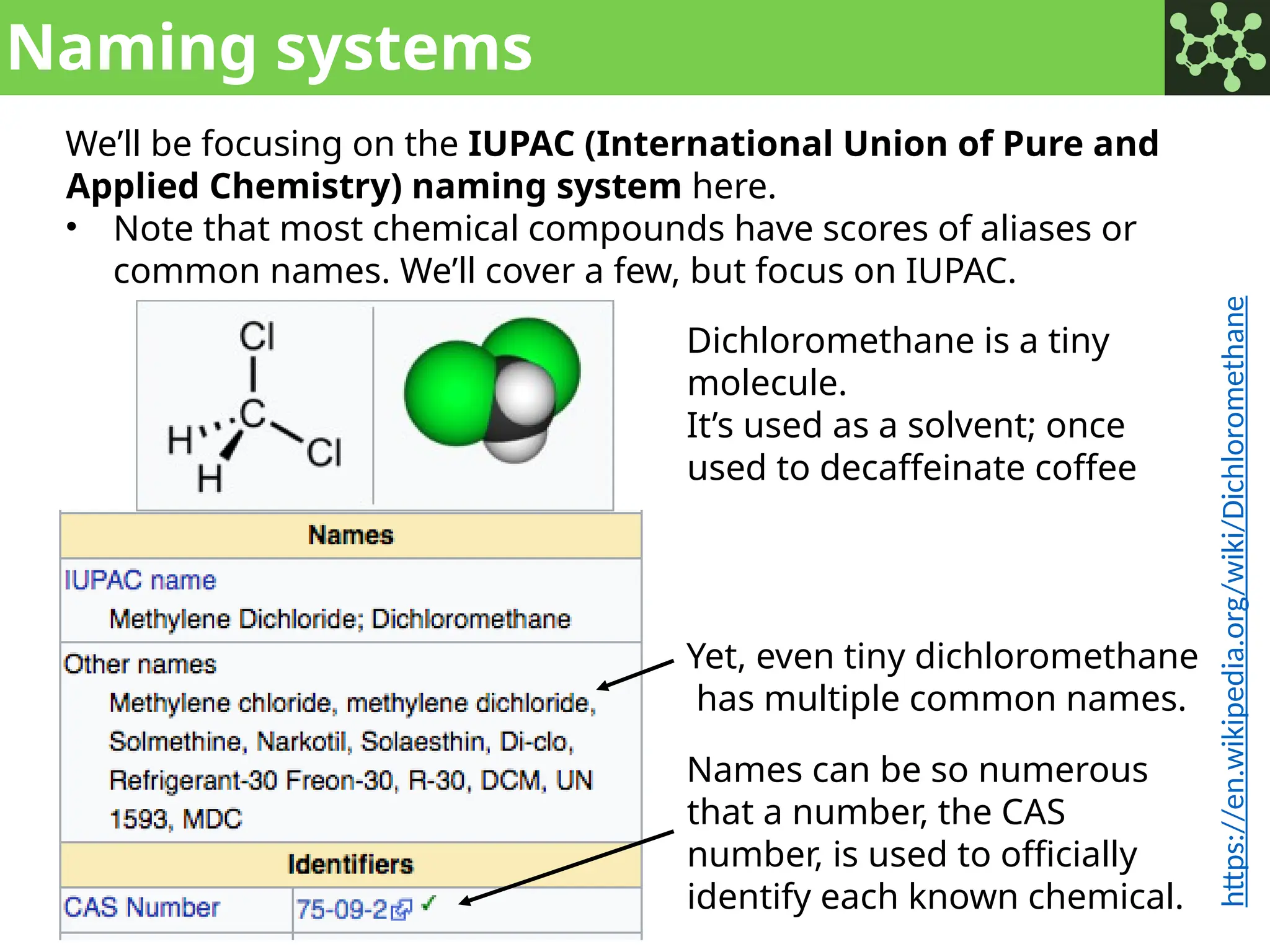
Dichloromethane is a tiny
molecule.
It’s used as a solvent; once
used to decaffeinate coffee
Yet, even tiny dichloromethane
has multiple common names.
Names can be so numerous
that a number, the CAS
number, is used to officially
identify each known chemical.
https://en.wikipedia.org/wiki/Dichloromethane
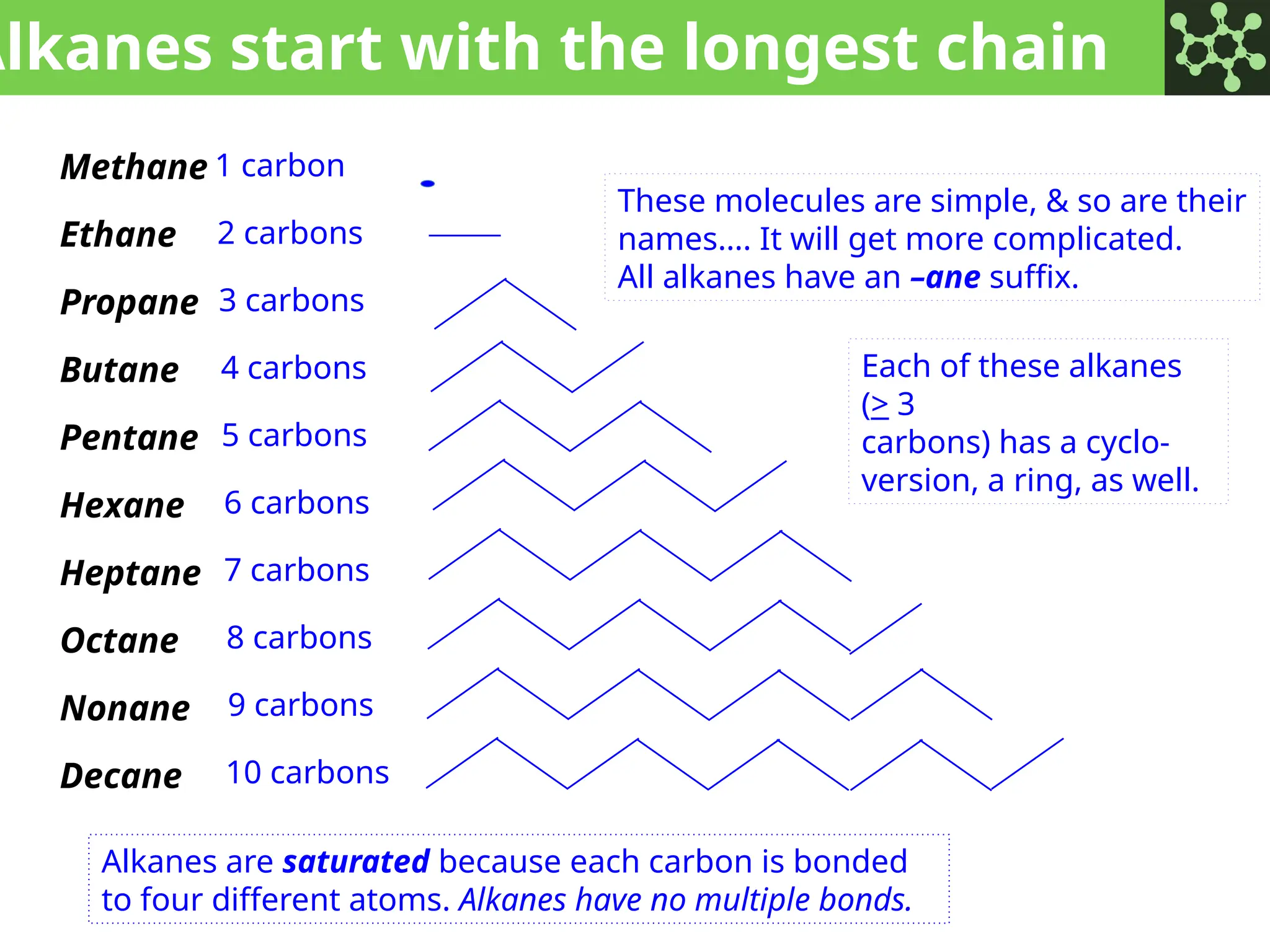
Alkanes start with the longest chain
Methane
Ethane
Propane
Butane
Pentane
Hexane
Heptane
Octane
Nonane
Decane
1 carbon
2 carbons
3 carbons
4 carbons
5 carbons
6 carbons
7 carbons
8 carbons
9 carbons
10 carbons
Each of these alkanes
(> 3
carbons) has a cyclo-
version, a ring, as well.
These molecules are simple, & so are their
names…. It will get more complicated.
All alkanes have an –ane suffix.
Alkanes are saturated because each carbon is bonded
to four different atoms. Alkanes have no multiple bonds.
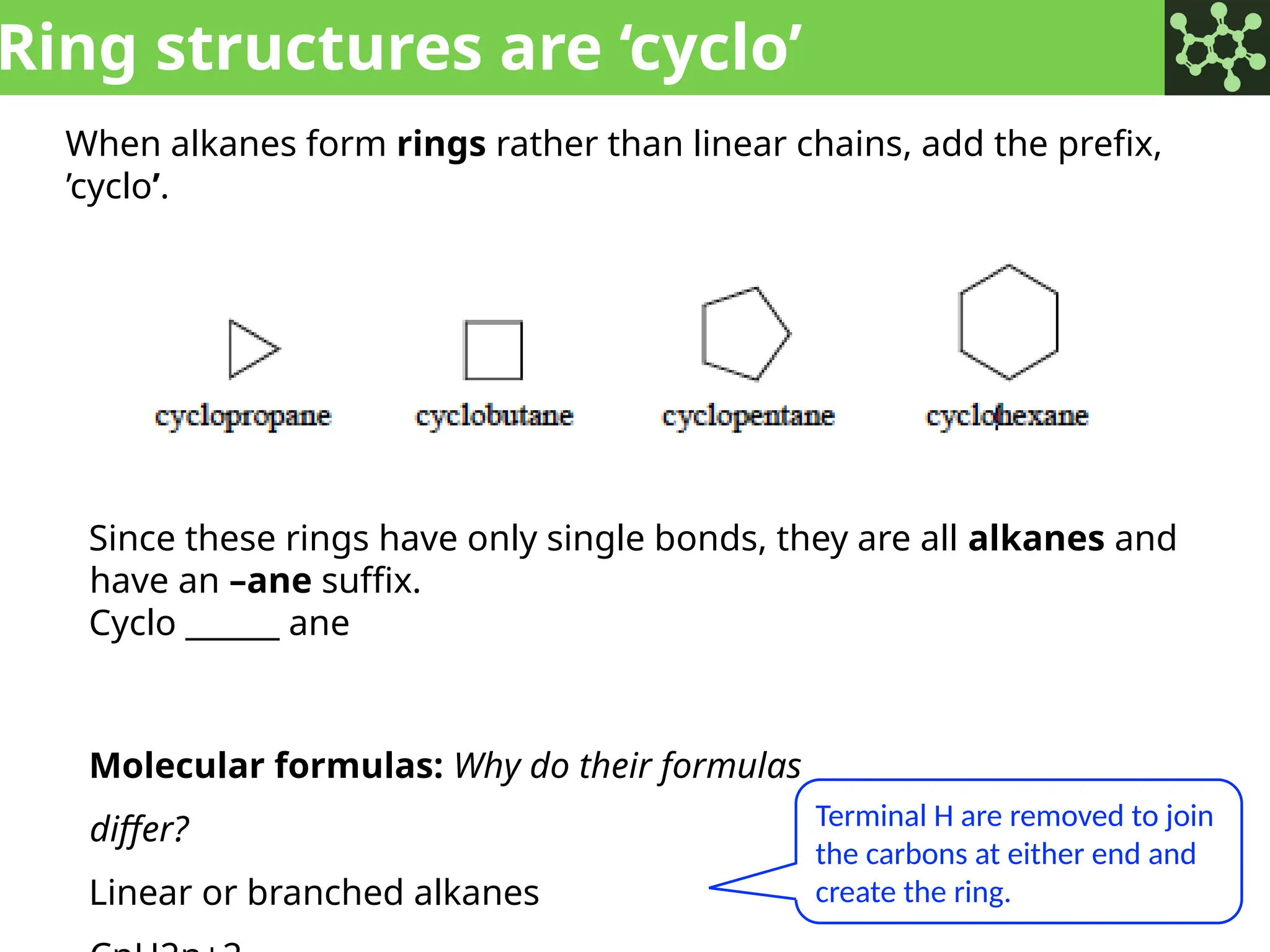
Ring structures are ‘cyclo’
When alkanes form rings rather than linear chains, add the prefix,
’cyclo’.
Since these rings have only single bonds, they are all alkanes and
have an –ane suffix.
Cyclo ______ ane
Molecular formulas: Why do their formulas
differ?
Linear or branched alkanes
Terminal H are removed to join
the carbons at either end and
create the ring.
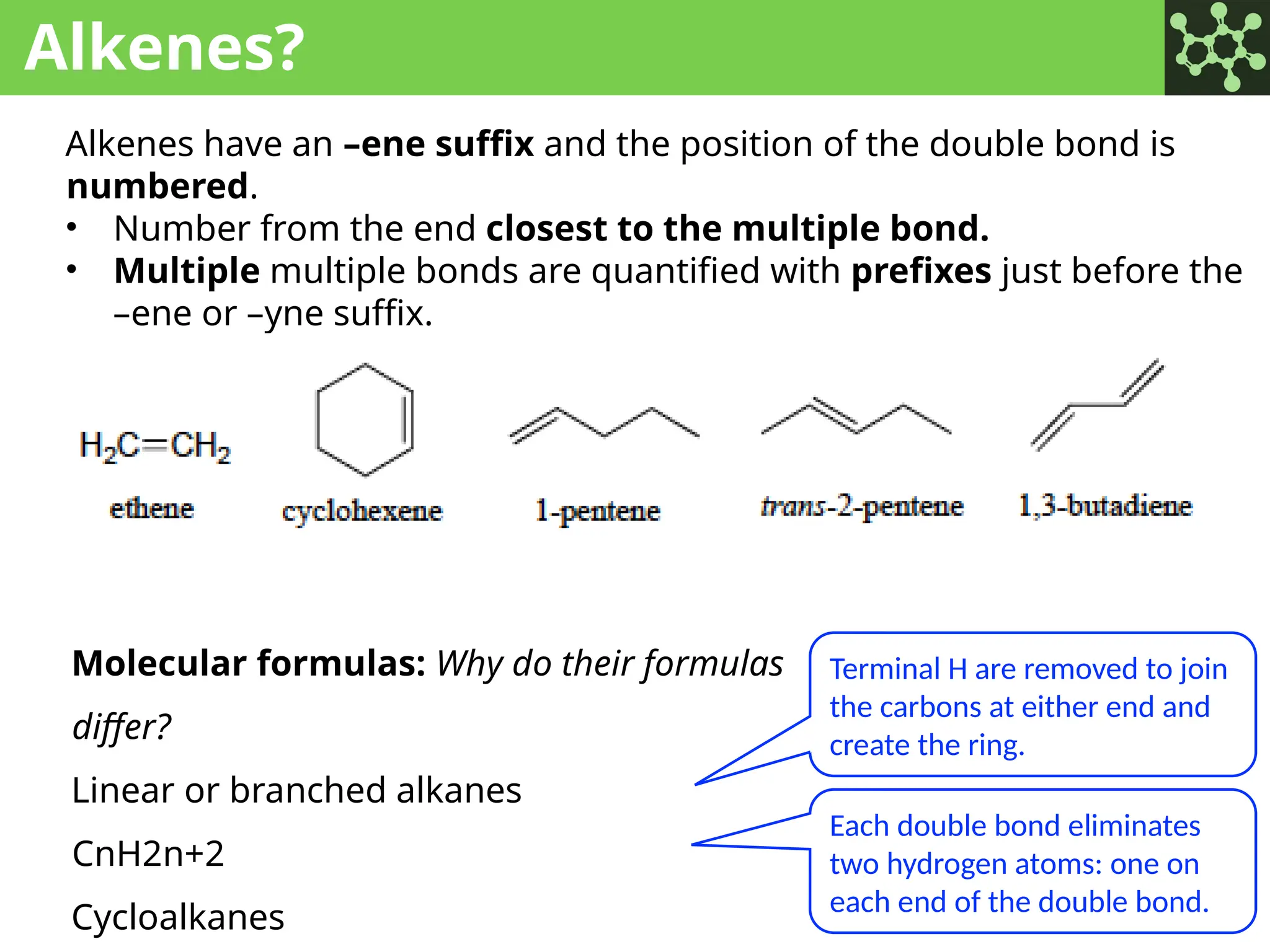
Alkenes?
Alkenes have an –ene suffix and the position of the double bond is
numbered.
• Number from the end closest to the multiple bond.
• Multiple multiple bonds are quantified with prefixes just before the
–ene or –yne suffix.
Molecular formulas: Why do their formulas
differ?
Linear or branched alkanes
CnH2n+2
Cycloalkanes
Terminal H are removed to join
the carbons at either end and
create the ring.
Each double bond eliminates
two hydrogen atoms: one on
each end of the double bond.
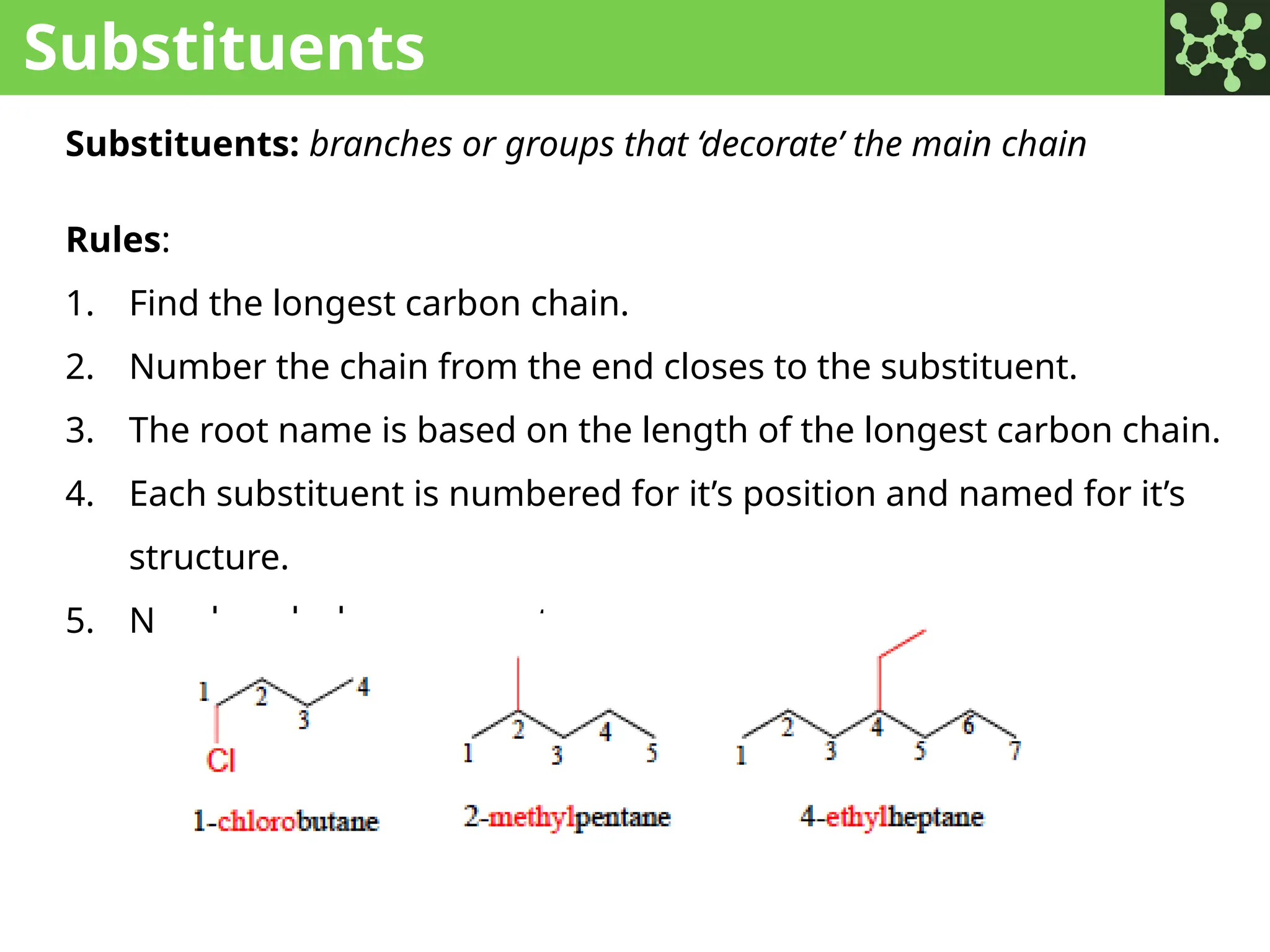
Substituents
Substituents: branches or groups that ‘decorate’ the main chain
Rules:
1. Find the longest carbon chain.
2. Number the chain from the end closes to the substituent.
3. The root name is based on the length of the longest carbon chain.
4. Each substituent is numbered for it’s position and named for it’s
structure.
5. Number-dash-name_root
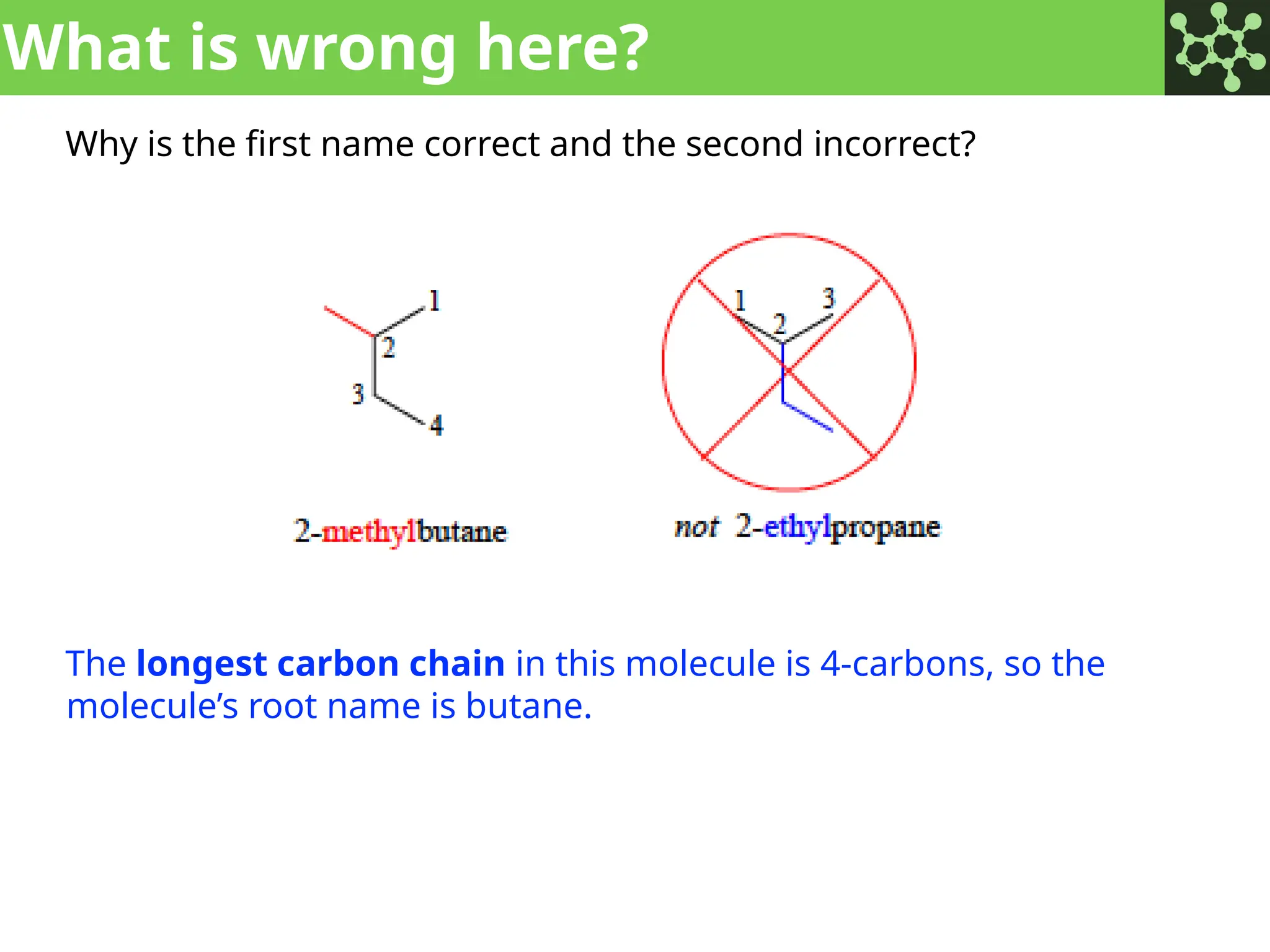
What is wrong here?
Why is the first name correct and the second incorrect?
The longest carbon chain in this molecule is 4-carbons, so the
molecule’s root name is butane.
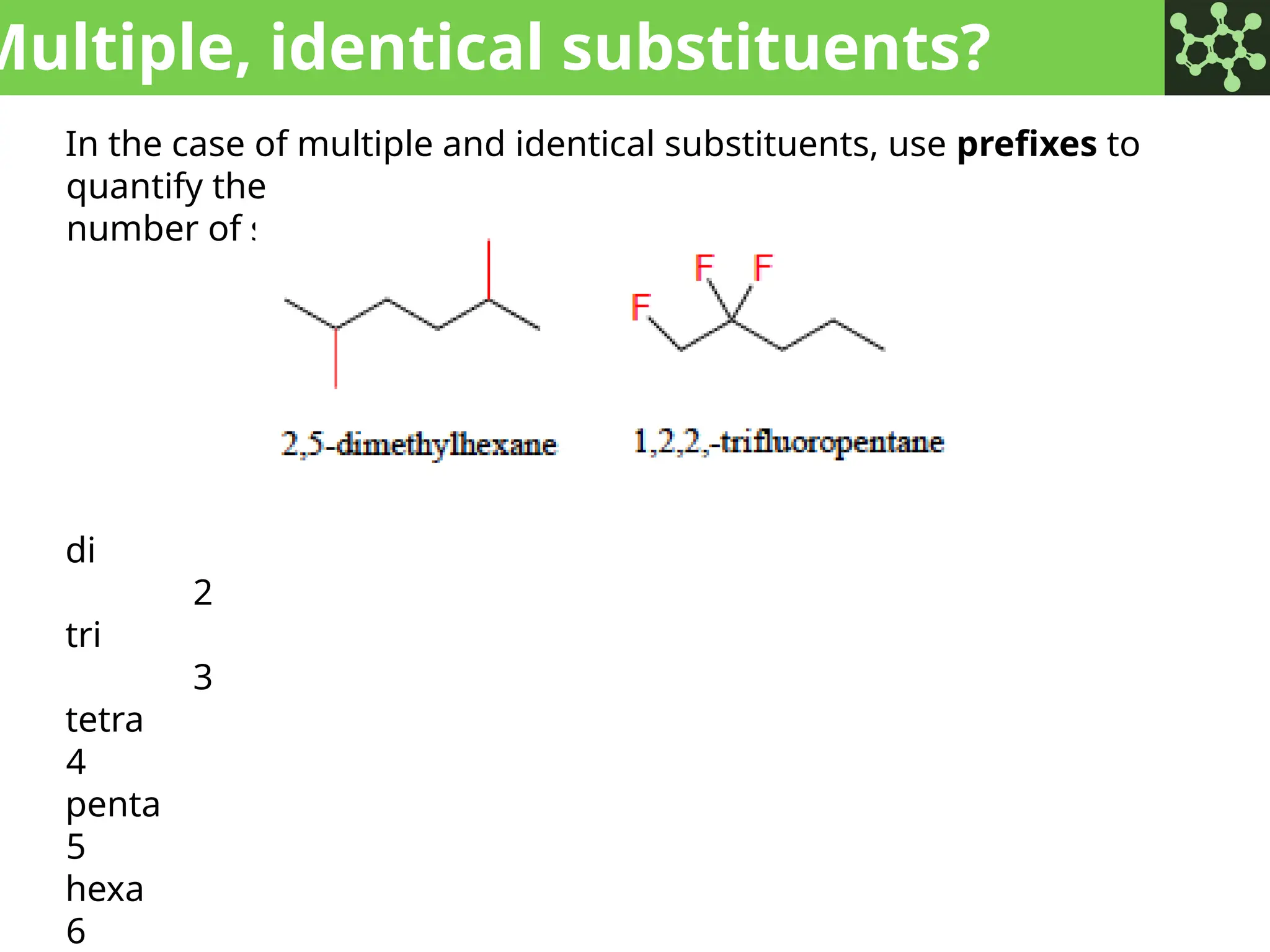
Multiple, identical substituents?
In the case of multiple and identical substituents, use prefixes to
quantify the
number of substituents.
di
2
tri
3
tetra
4
penta
5
hexa
6
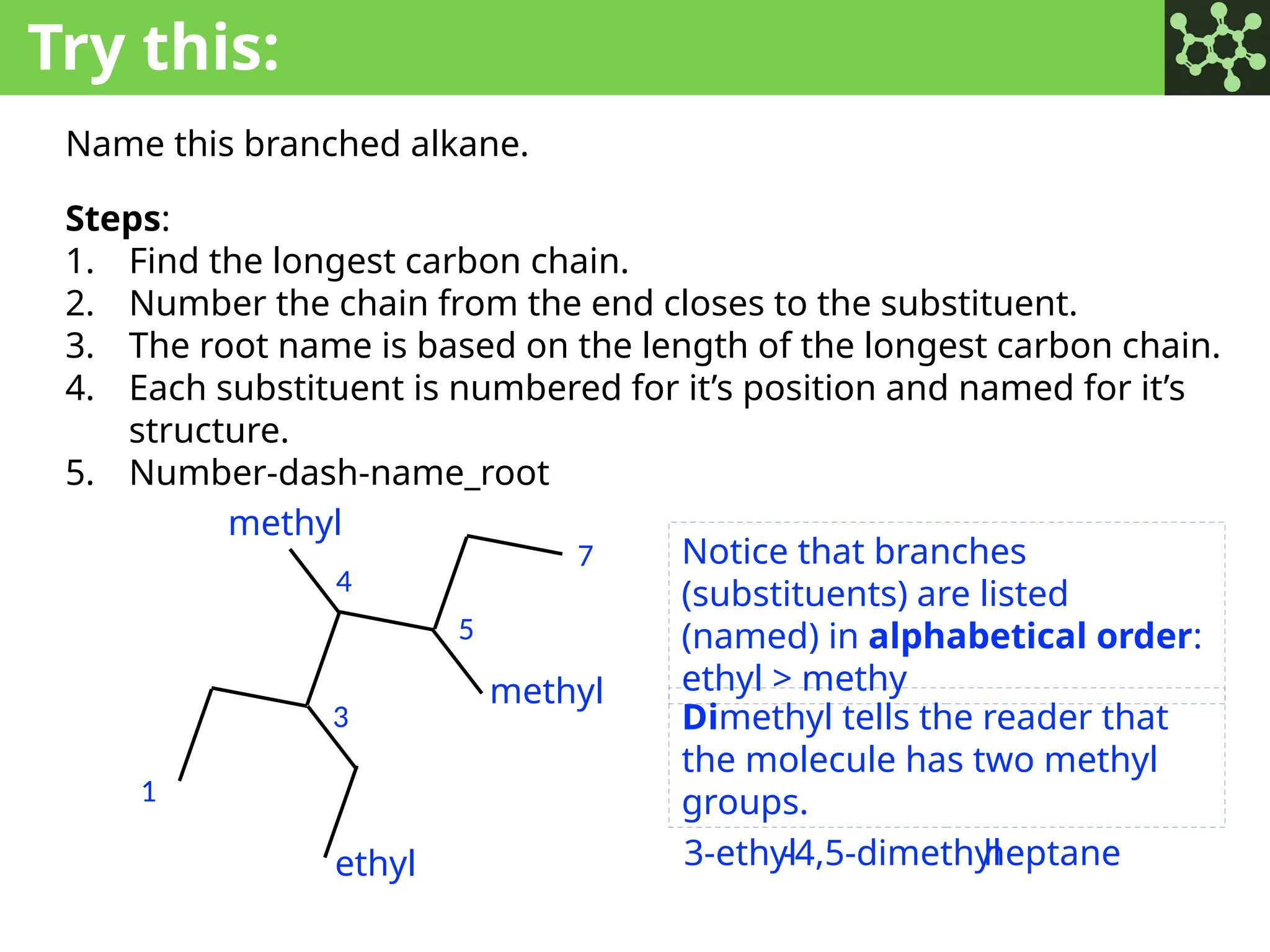
Try this:
Name this branched alkane.
Steps:
1. Find the longest carbon chain.
2. Number the chain from the end closes to the substituent.
3. The root name is based on the length of the longest carbon chain.
4. Each substituent is numbered for it’s position and named for it’s
structure.
5. Number-dash-name_root
1
7
3
4
5
heptane
methyl
methyl
ethyl 3-ethyl
-4,5-dimethyl
Notice that branches
(substituents) are listed
(named) in alphabetical order:
ethyl > methy
Dimethyl tells the reader that
the molecule has two methyl
groups.
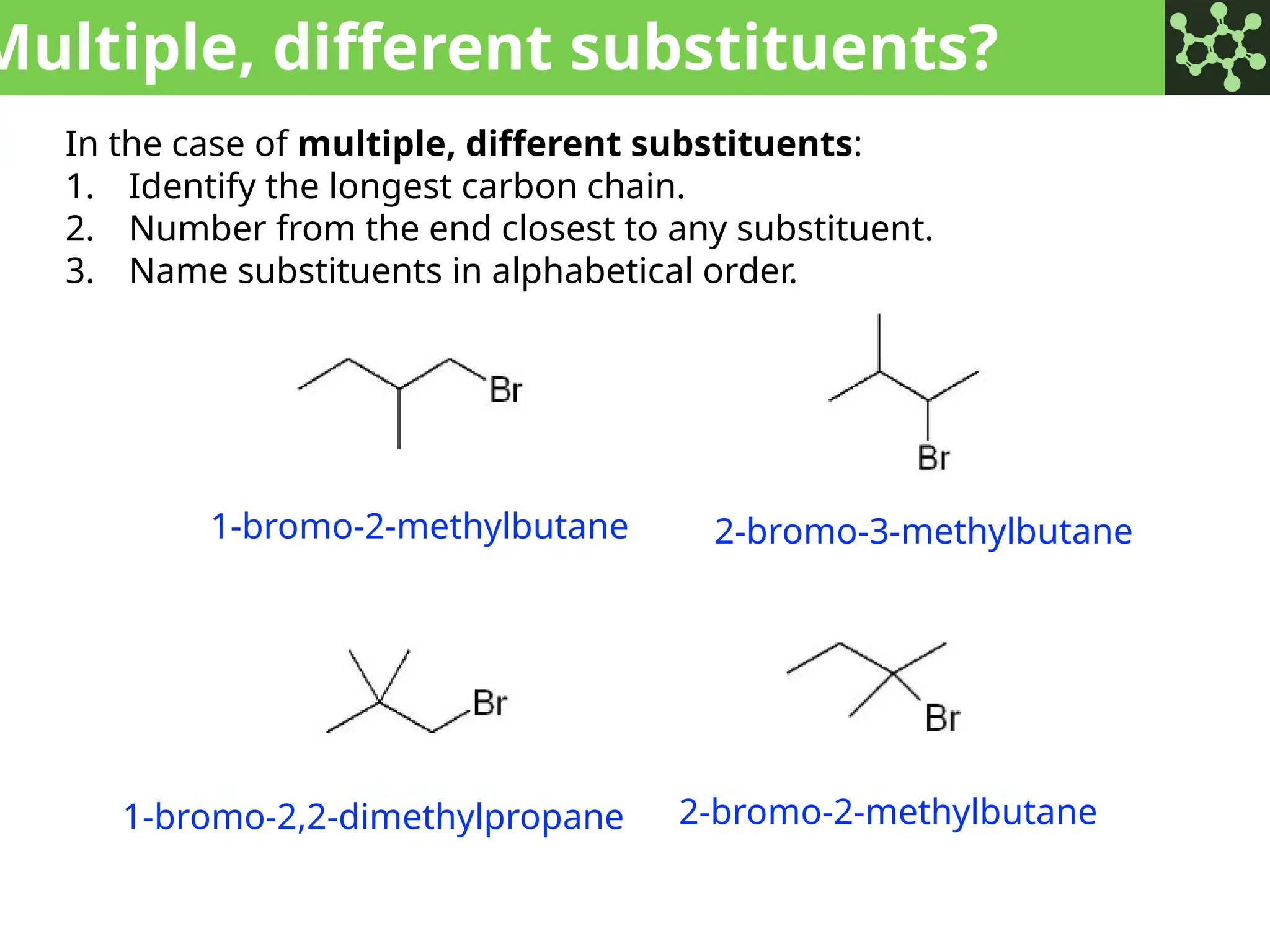
Multiple, different substituents?
In the case of multiple, different substituents:
1. Identify the longest carbon chain.
2. Number from the end closest to any substituent.
3. Name substituents in alphabetical order.
1-bromo-2-methylbutane 2-bromo-3-methylbutane
1-bromo-2,2-dimethylpropane 2-bromo-2-methylbutane
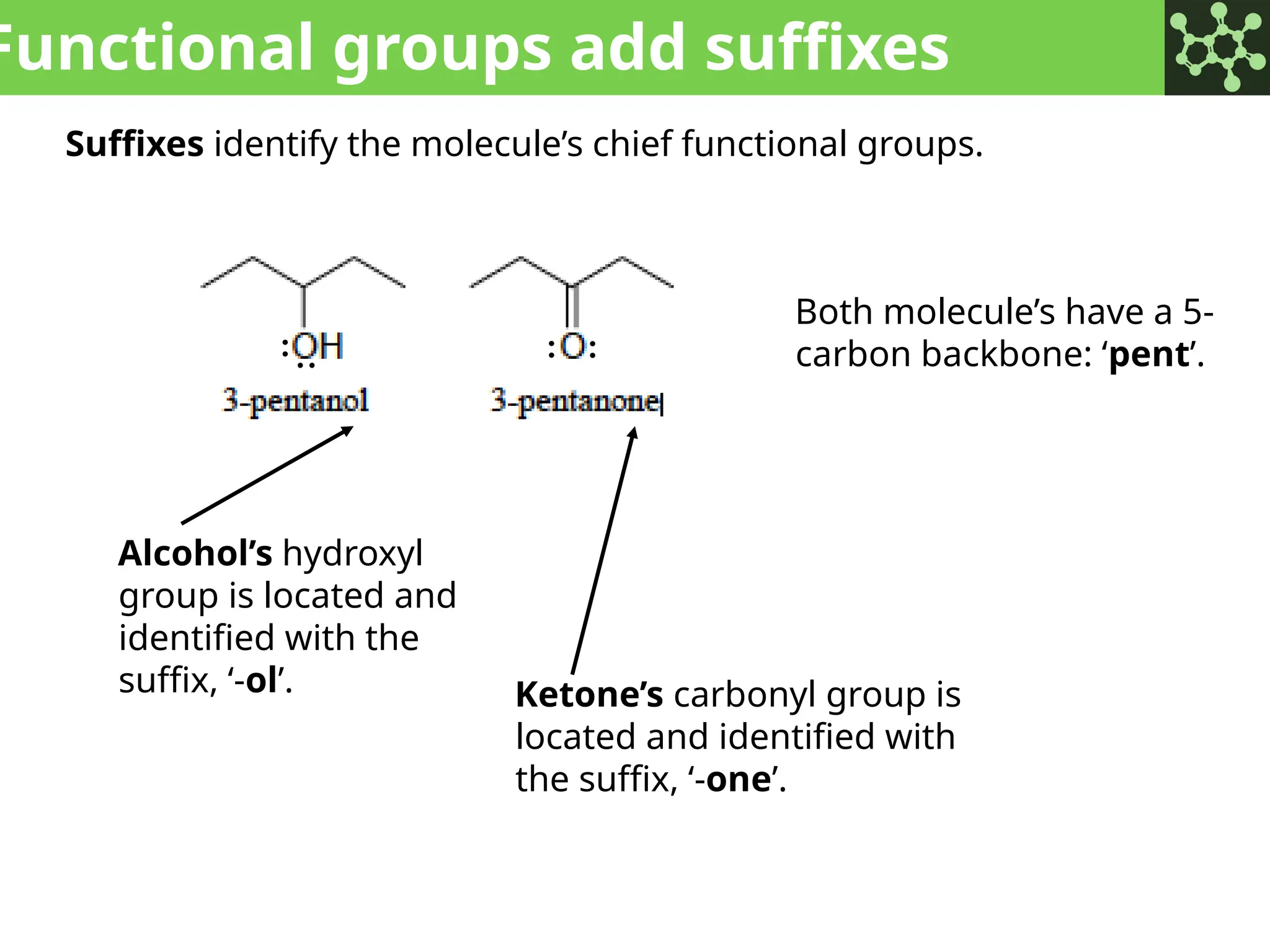
Functional groups add suffixes
Suffixes identify the molecule’s chief functional groups.
Alcohol’s hydroxyl
group is located and
identified with the
suffix, ‘-ol’. Ketone’s carbonyl group is
located and identified with
the suffix, ‘-one’.
Both molecule’s have a 5-
carbon backbone: ‘pent’.
:
:
: :
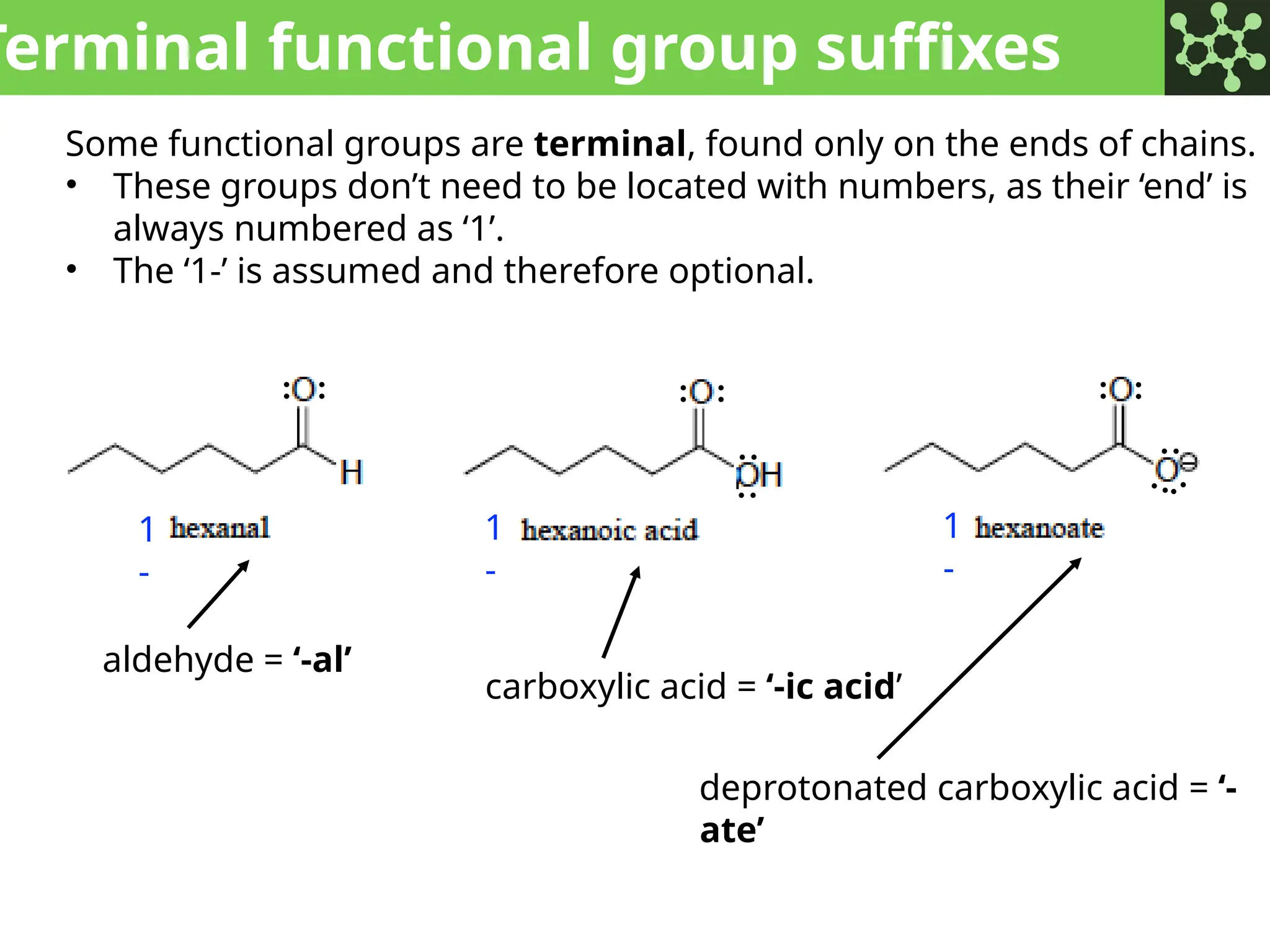
Terminal functional group suffixes
Some functional groups are terminal, found only on the ends of chains.
• These groups don’t need to be located with numbers, as their ‘end’ is
always numbered as ‘1’.
• The ‘1-’ is assumed and therefore optional.
aldehyde = ‘-al’
carboxylic acid = ‘-ic acid’
deprotonated carboxylic acid = ‘-
ate’
1
-
1
-
1
-
: : : :
:
:
:
:
:
: :
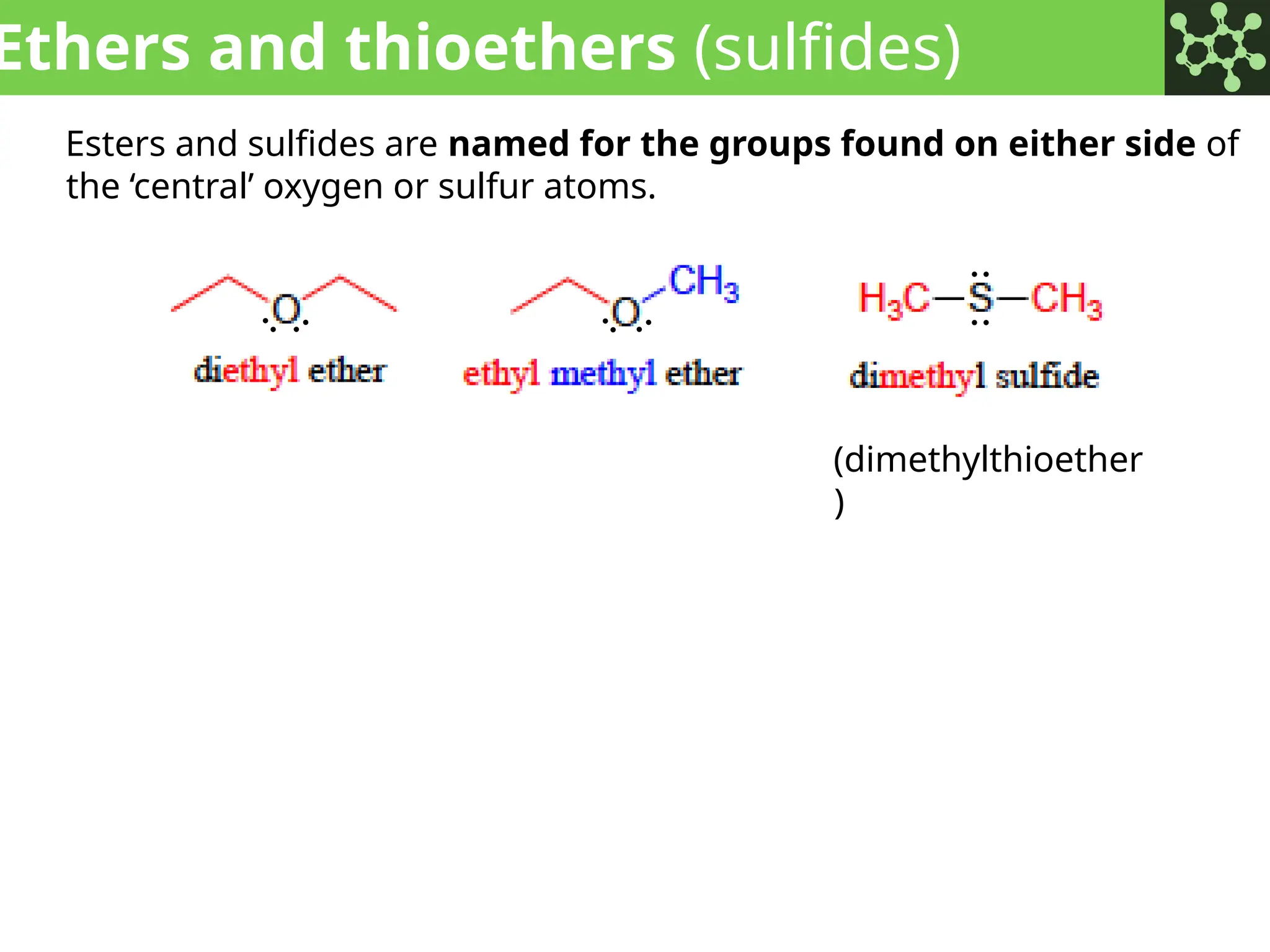
Ethers and thioethers (sulfides)
Esters and sulfides are named for the groups found on either side of
the ‘central’ oxygen or sulfur atoms.
(dimethylthioether
)
:
:
:
:
:
:
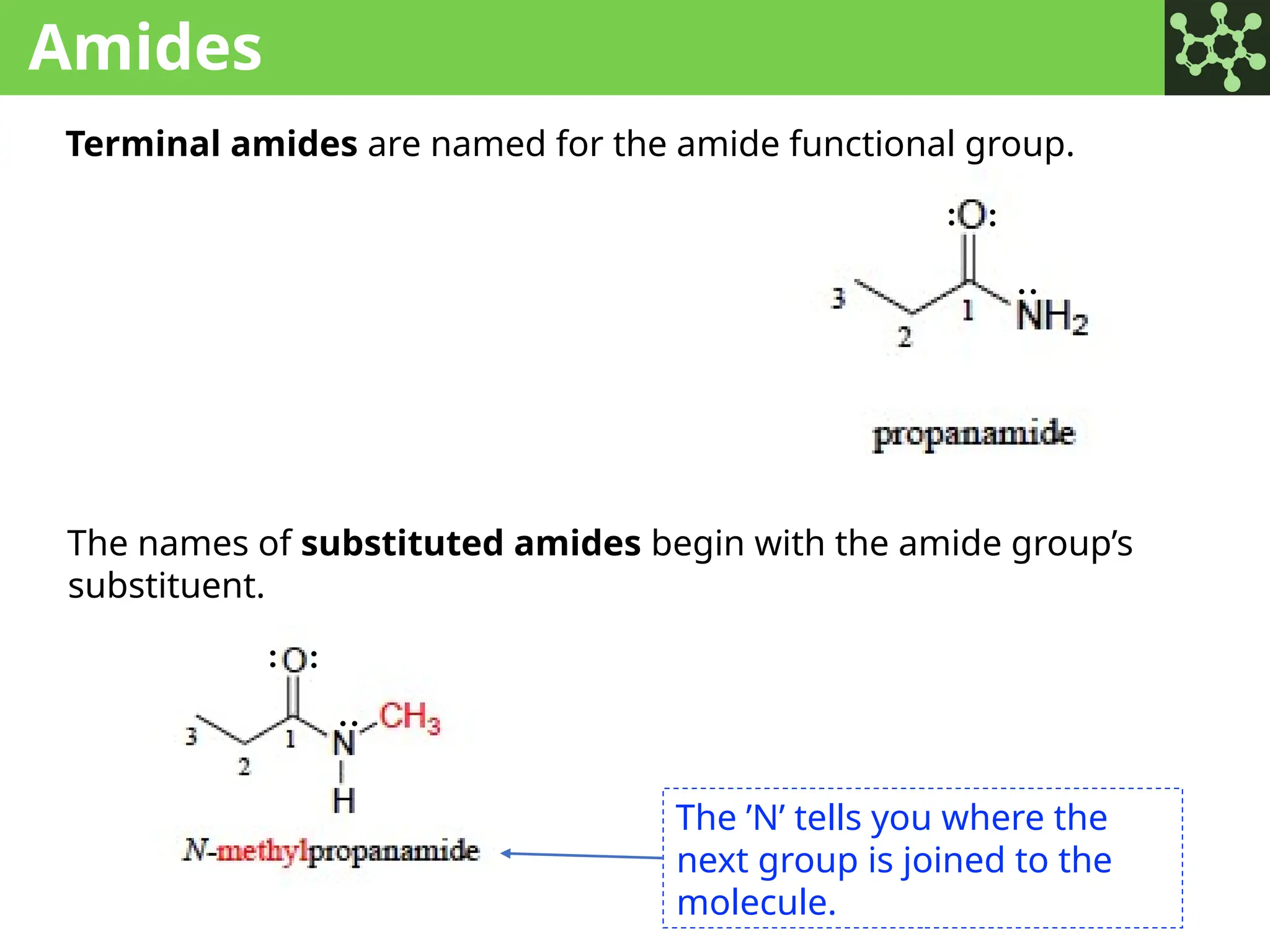
Amides
Terminal amides are named for the amide functional group.
The names of substituted amides begin with the amide group’s
substituent.
: :
:
:
: :
The ’N’ tells you where the
next group is joined to the
molecule.
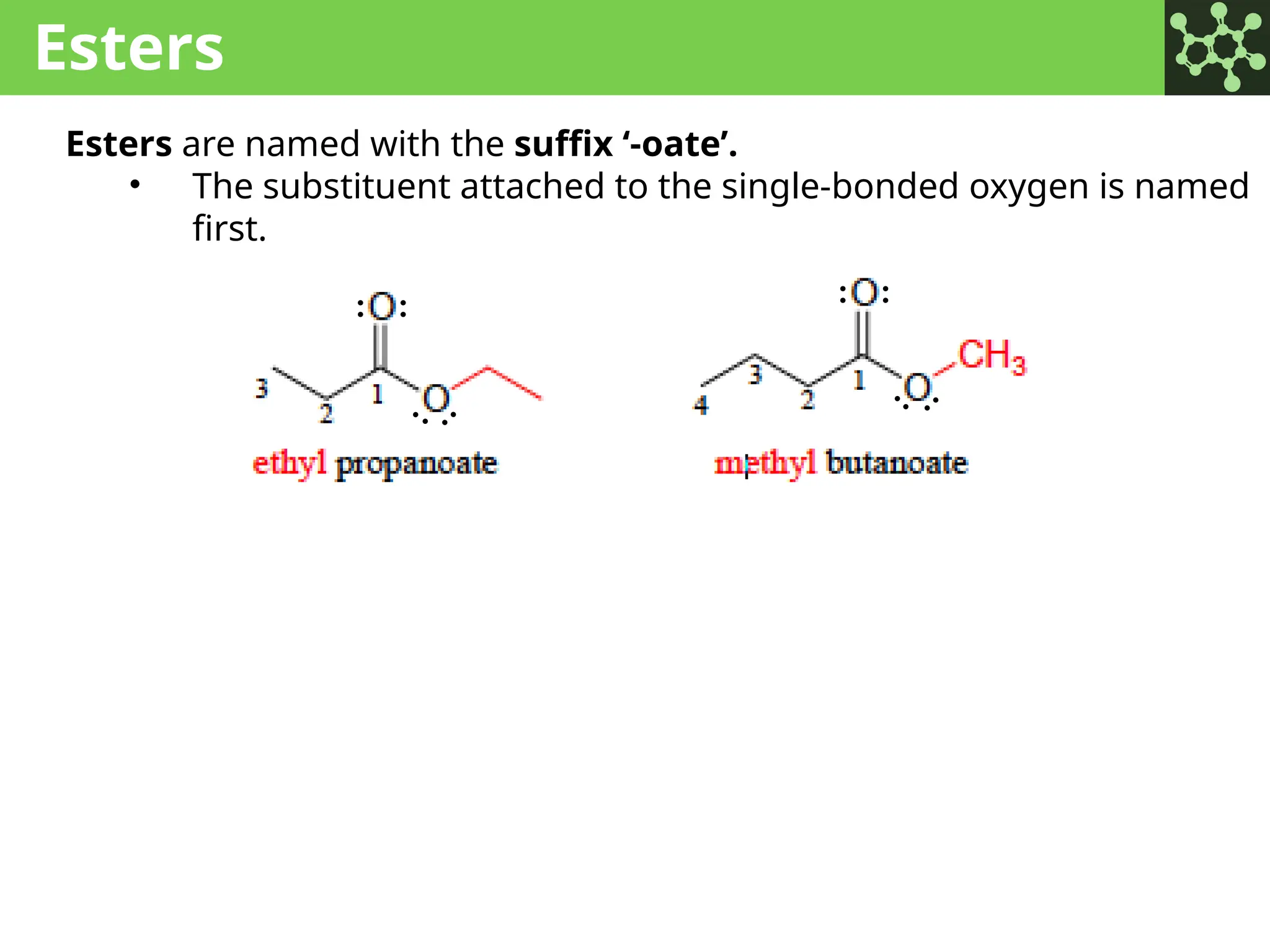
Esters
Esters are named with the suffix ‘-oate’.
• The substituent attached to the single-bonded oxygen is named
first.
: :
:
:
:
:
: :
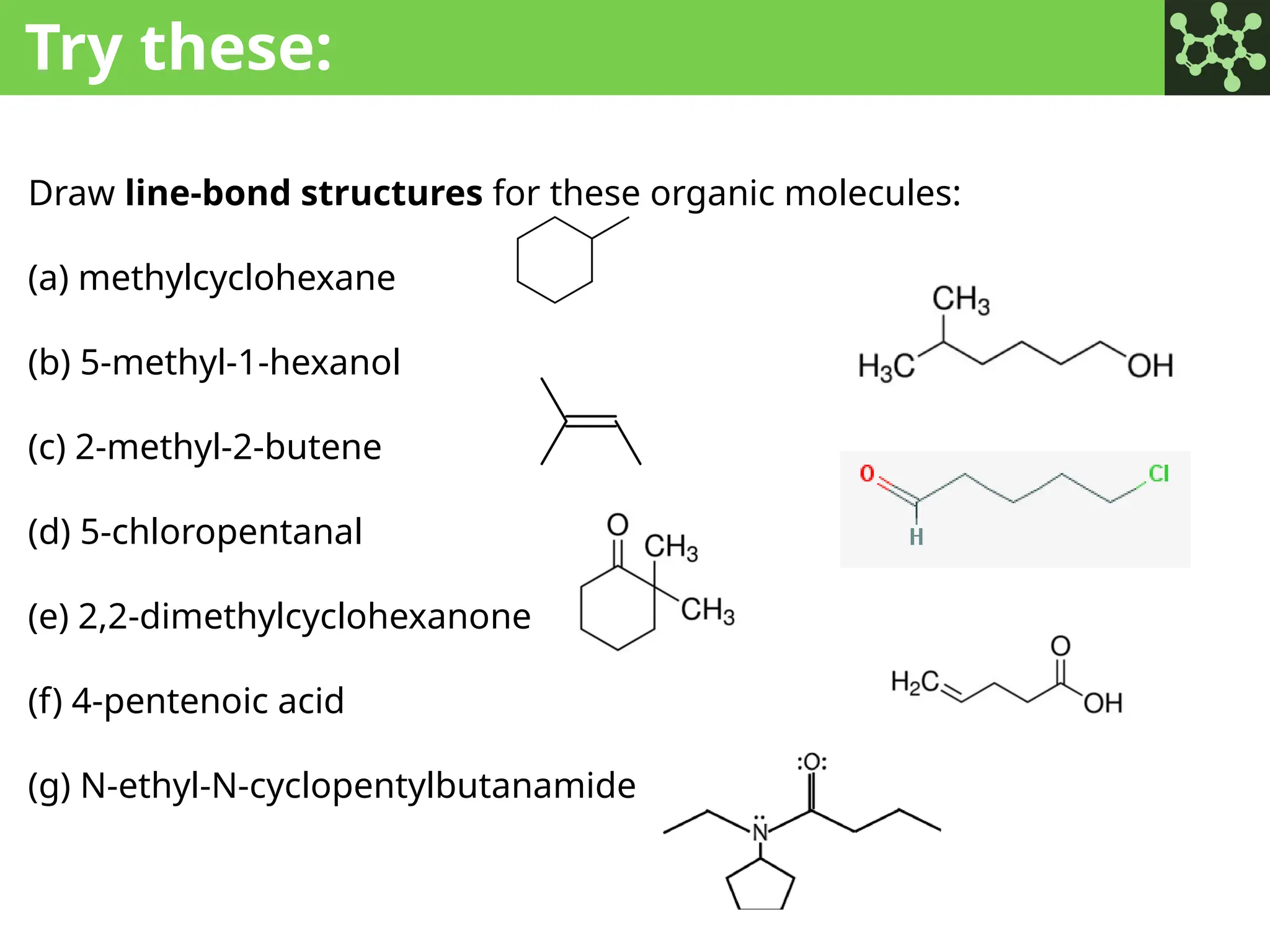
Try these:
Draw line-bond structures for these organic molecules:
(a) methylcyclohexane
(b) 5-methyl-1-hexanol
(c) 2-methyl-2-butene
(d) 5-chloropentanal
(e) 2,2-dimethylcyclohexanone
(f) 4-pentenoic acid
(g) N-ethyl-N-cyclopentylbutanamide
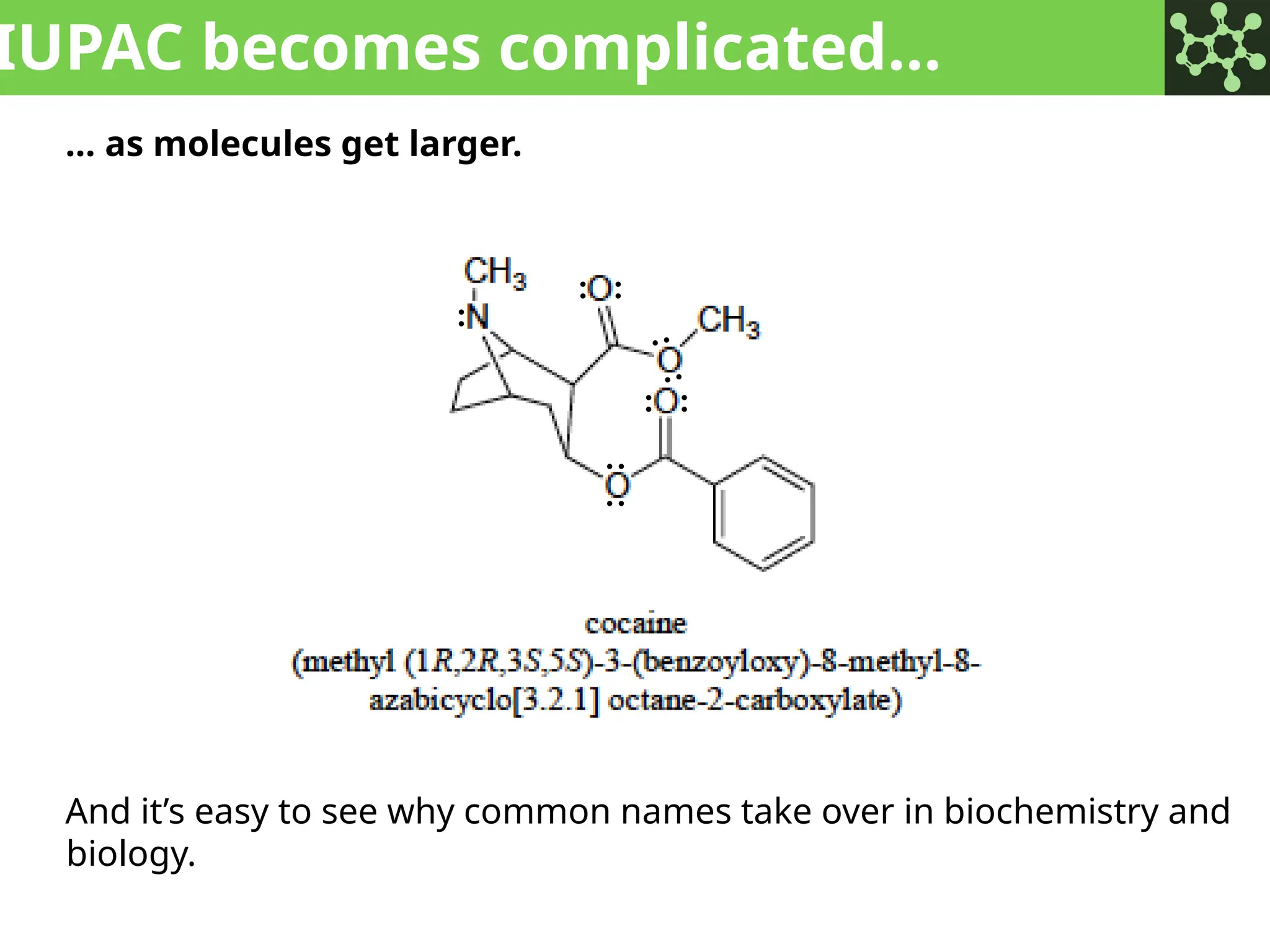
IUPAC becomes complicated…
… as molecules get larger.
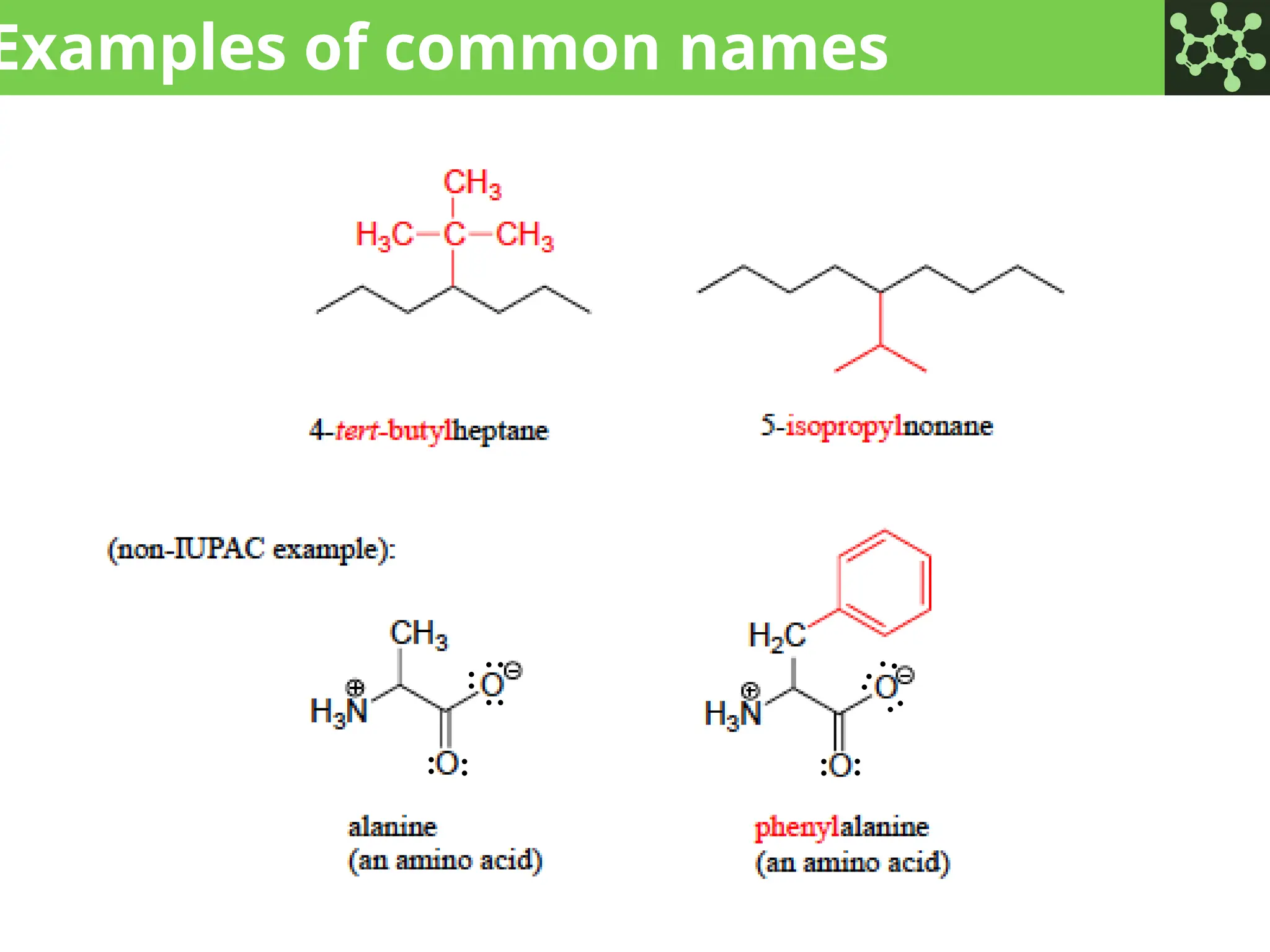
And it’s easy to see why common names take over in biochemistry and
biology.
:
: :
:
:
:
:
:
:
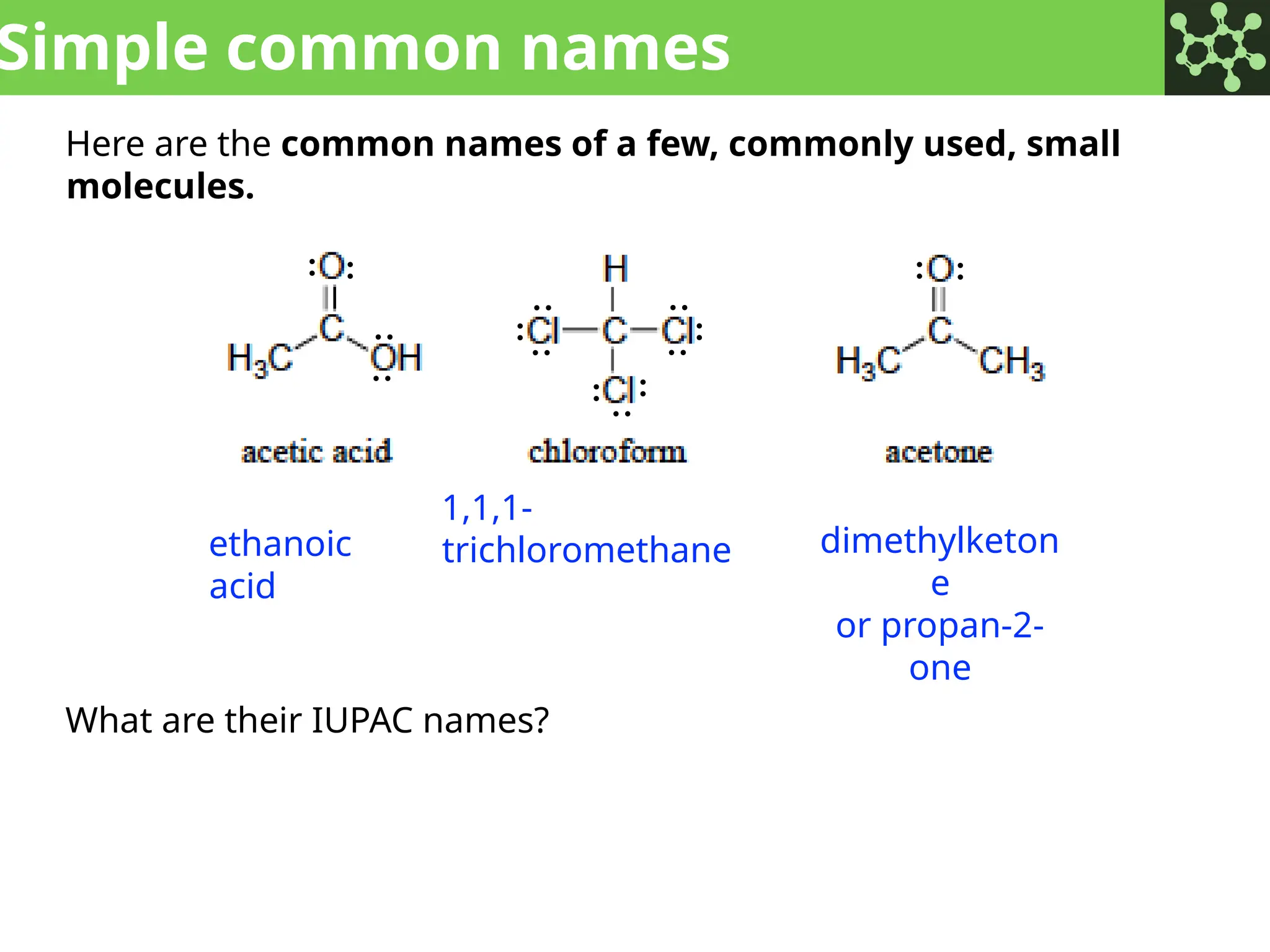
Simple common names
Here are the common names of a few, commonly used, small
molecules.
What are their IUPAC names?
ethanoic
acid
1,1,1-
trichloromethane dimethylketon
e
or propan-2-
one
: :
:
:
:
:
:
:
:
:
:
:
:
: :
Examples of common names
:
:
:
: : : :
:
:
:
Can you?
(1) Explain the basic rules for naming alkanes, cycloalkanes, alkenes
and alkynes?
(2) Explain which has priority in naming: longest chain, substituents,
numbers,
letters?
(3) Associate functional groups with their suffices?
**(4) Draw line-bond structures from IUPAC names?
(5) Understand that common names also exist?
1. Intro to organic structure & bonding
1.2C: Abbreviated organic structures
• R
• breaks
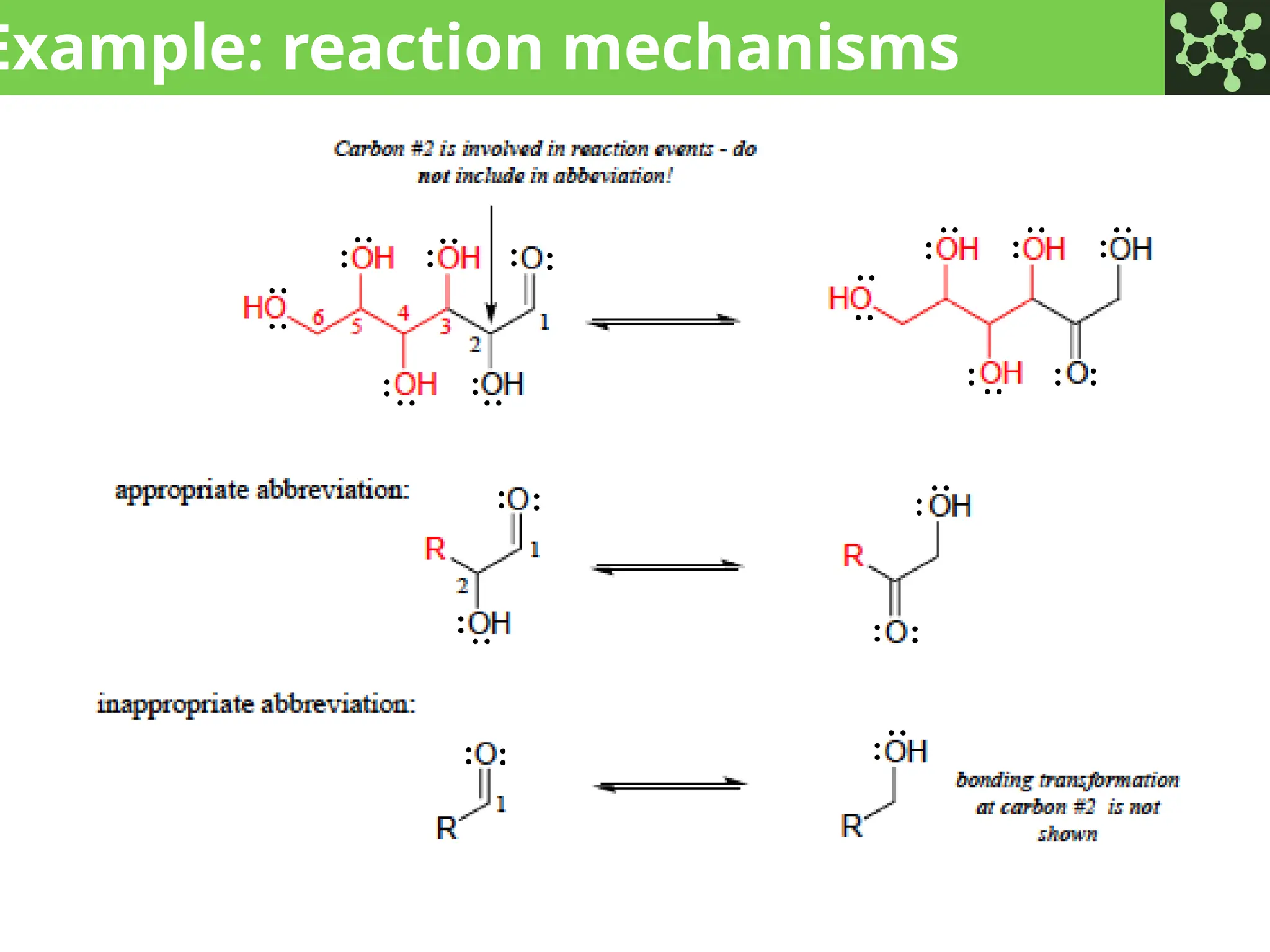
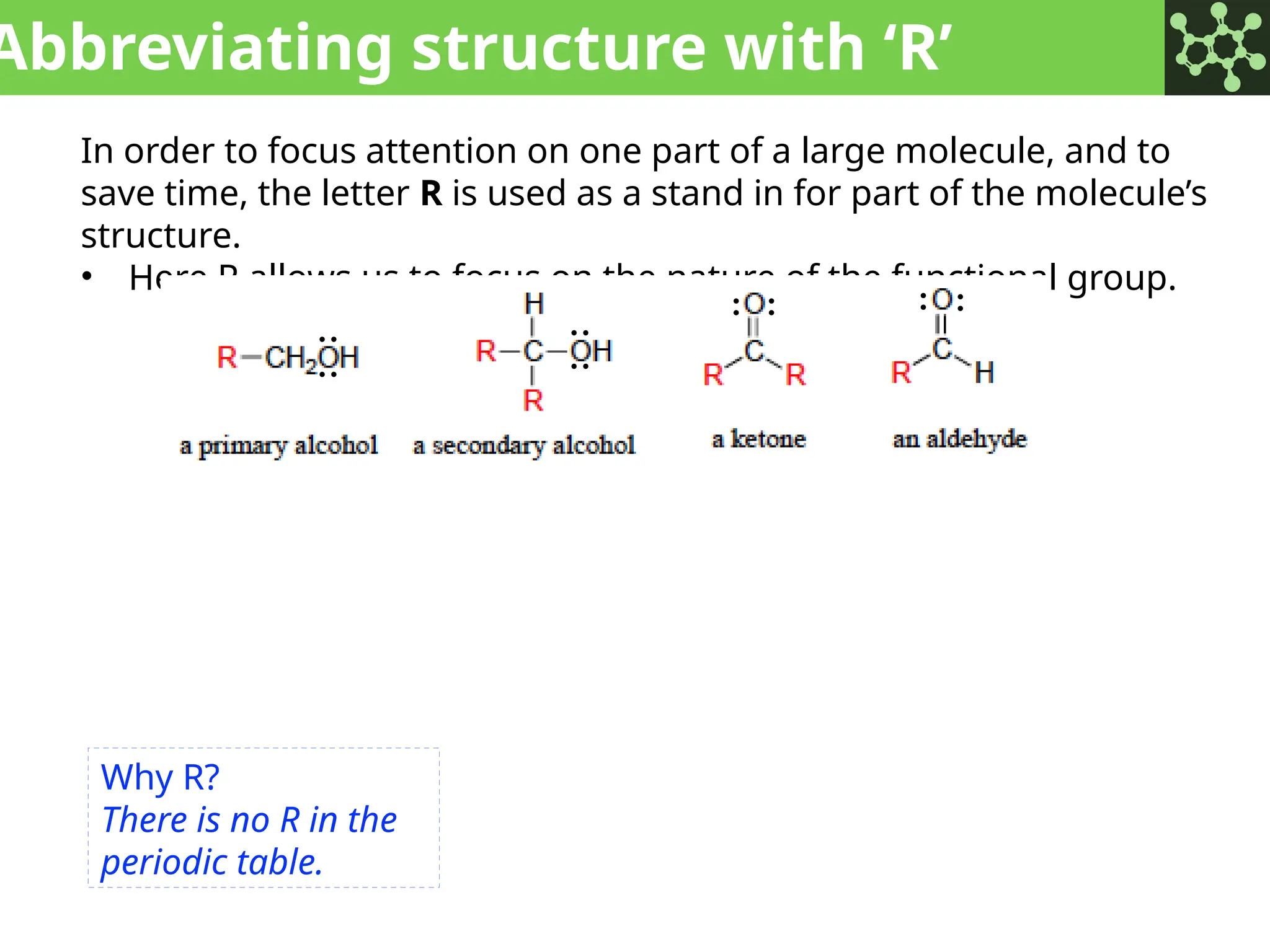
Abbreviating structure with ‘R’
In order to focus attention on one part of a large molecule, and to
save time, the letter R is used as a stand in for part of the molecule’s
structure.
• Here R allows us to focus on the nature of the functional group.
:
:
:
:
: : : :
:
:
:
:
:
:
:
:
:
:
:
:
:
:
:
:
:
:
:
:
:
:
:
:
:
:
:
:
:
:
:
:
:
:
: : : :
:
:
:
:
:
:
:
:
: :
Why R?
There is no R in the
periodic table.
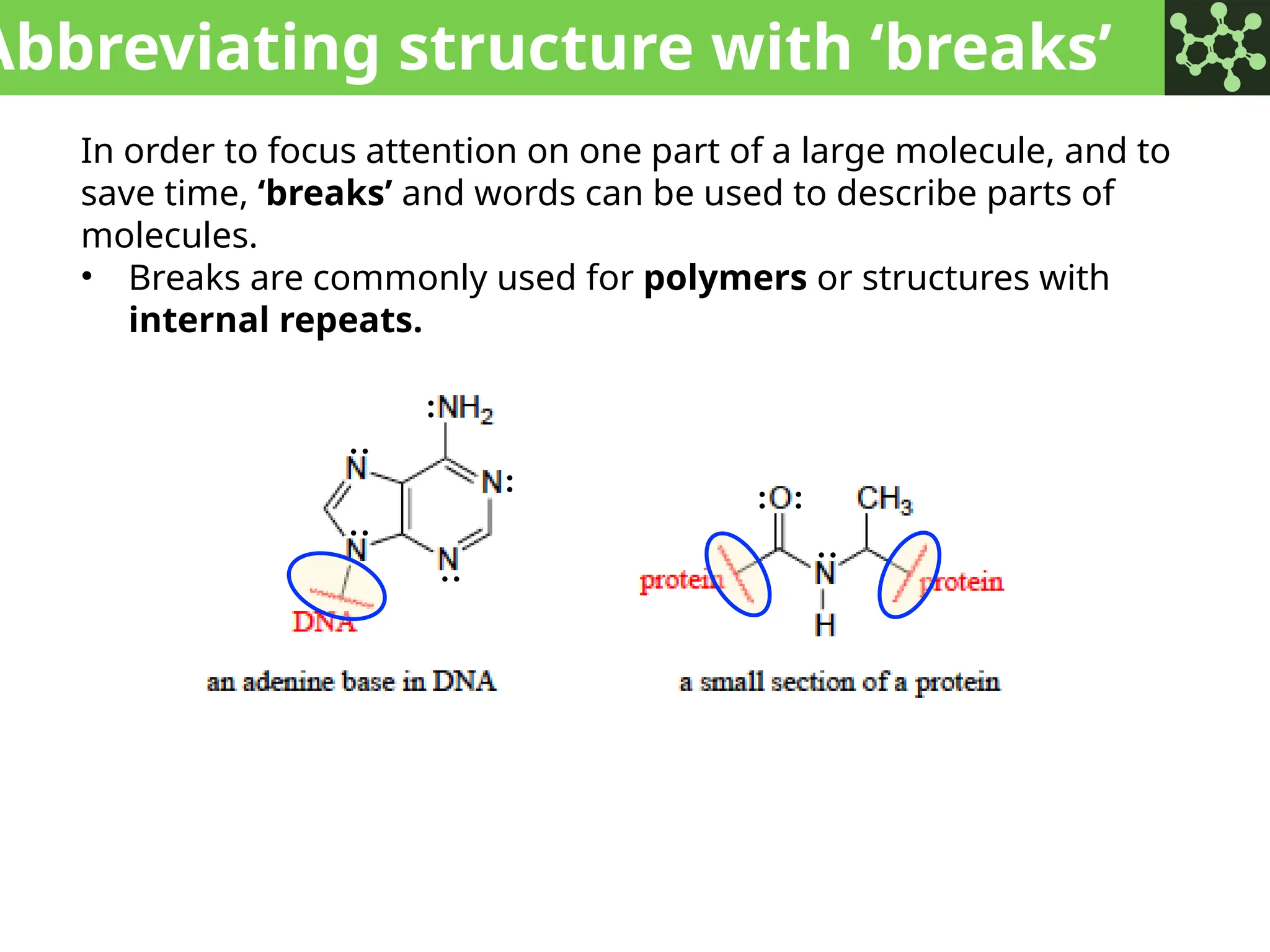
Abbreviating structure with ‘breaks’
In order to focus attention on one part of a large molecule, and to
save time, ‘breaks’ and words can be used to describe parts of
molecules.
• Breaks are commonly used for polymers or structures with
internal repeats.
:
:
: :
:
:
:
:
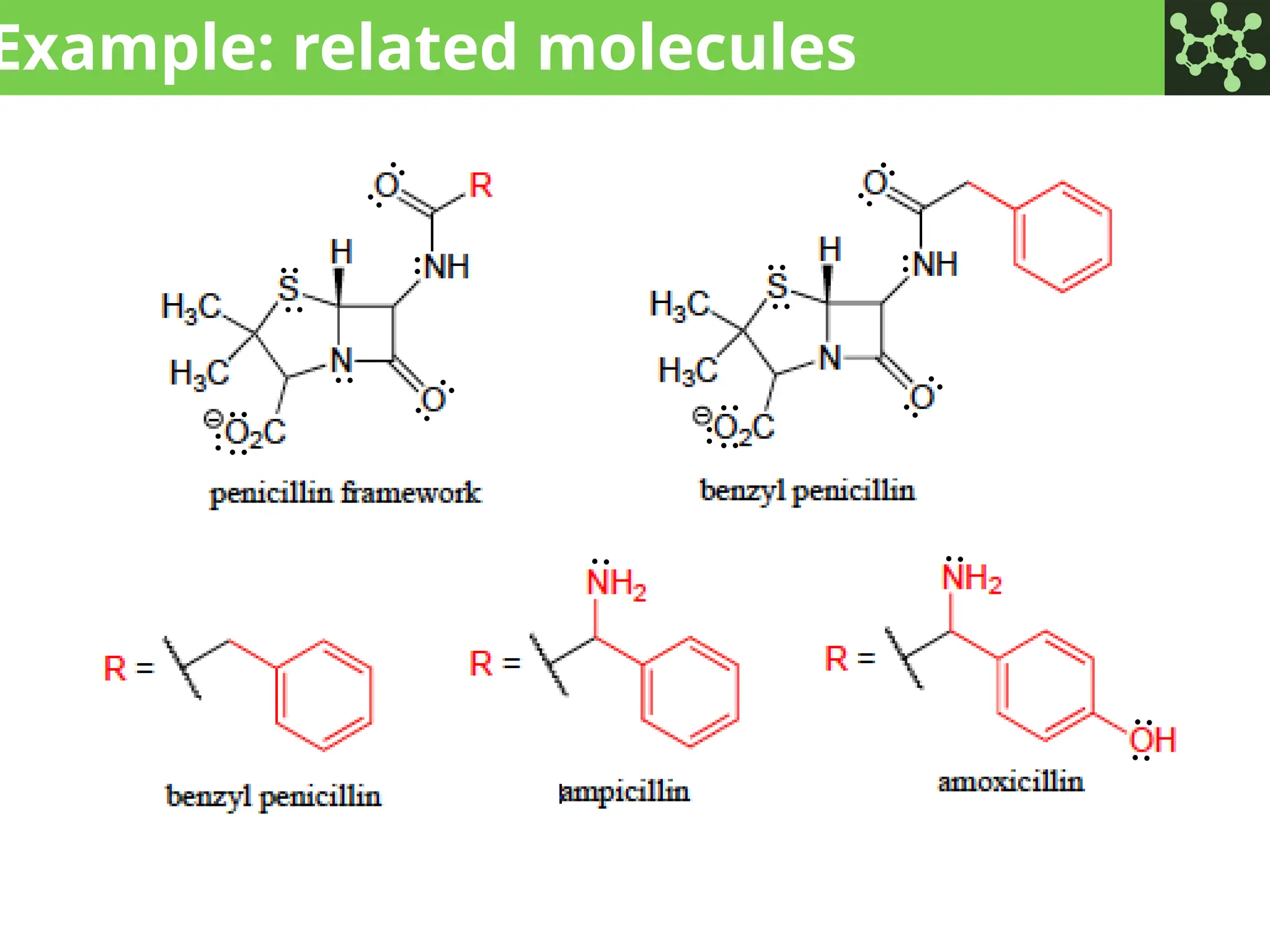
Example: related molecules
:
:
:
:
:
:
:
:
:
:
:
:
:
:
:
:
:
:
:
:
:
:
:
:
:
Example: reaction mechanisms
:
:
:
:
:
:
:
:
:
:
:
:
:
:
:
:
: :
: :
:
:
: :
: : : : : :
:
: :
:
: :
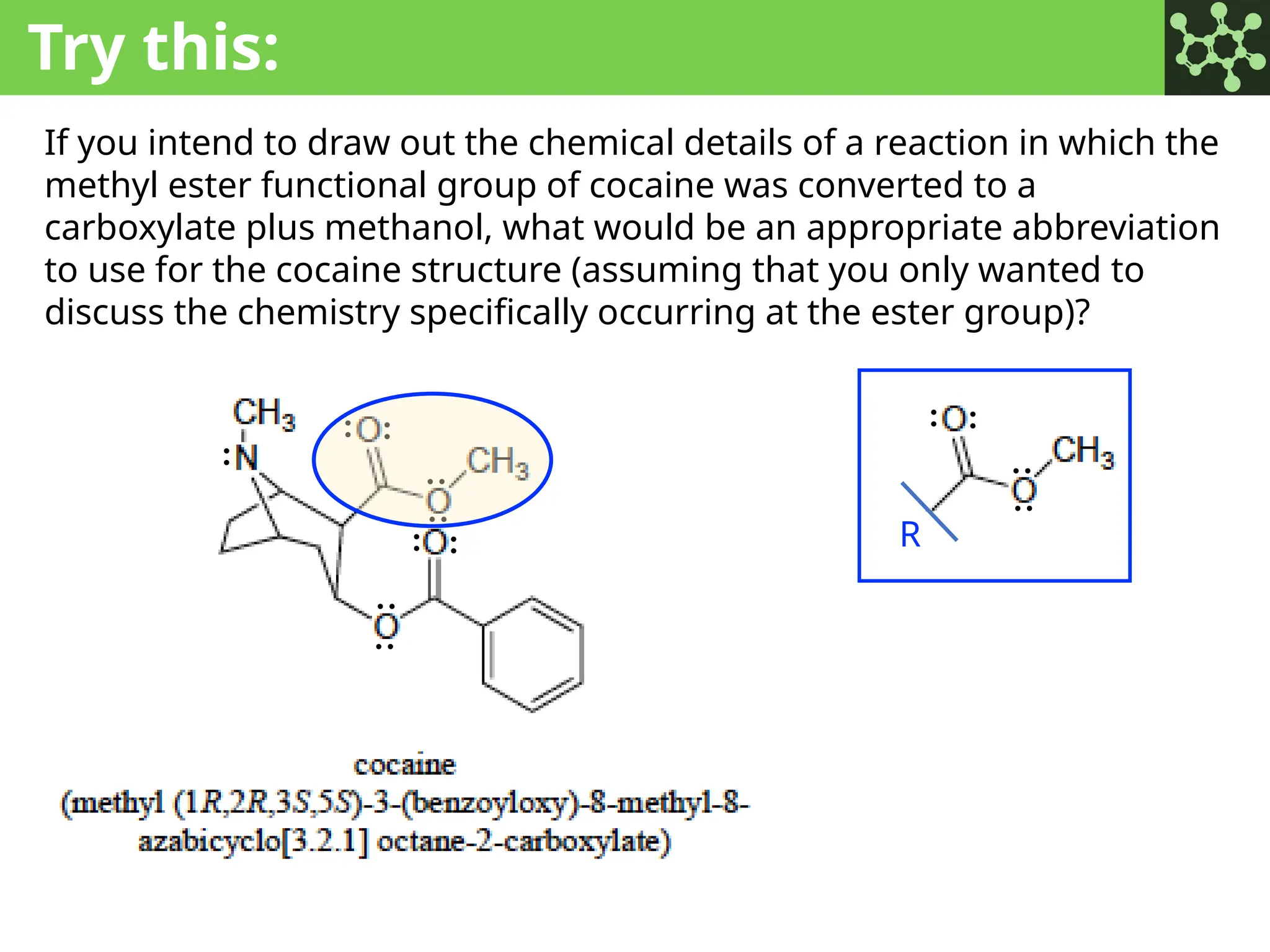
Try this:
If you intend to draw out the chemical details of a reaction in which the
methyl ester functional group of cocaine was converted to a
carboxylate plus methanol, what would be an appropriate abbreviation
to use for the cocaine structure (assuming that you only wanted to
discuss the chemistry specifically occurring at the ester group)?
:
: : :
:
:
:
: :
: :
:
:
R
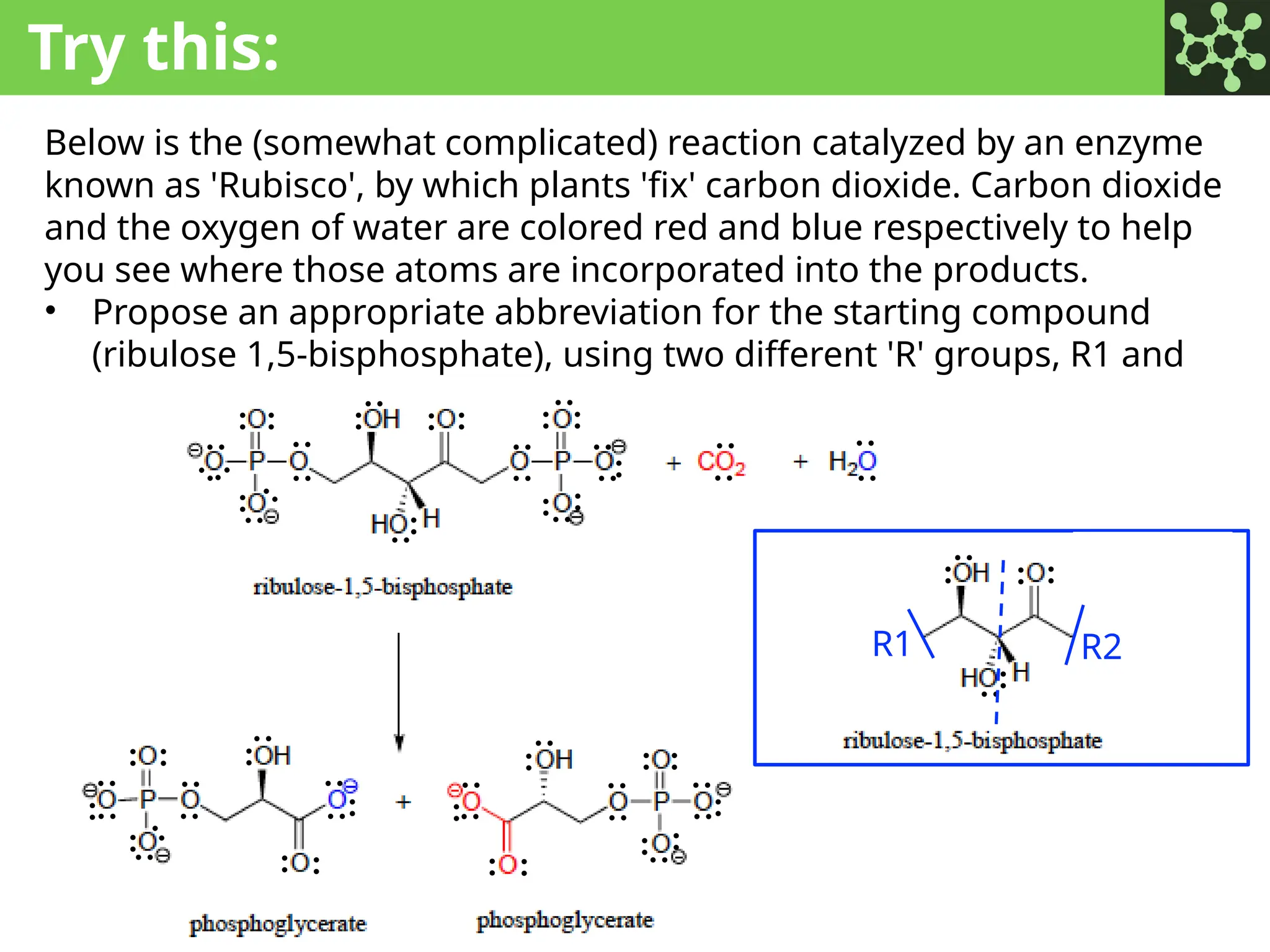
Try this:
Below is the (somewhat complicated) reaction catalyzed by an enzyme
known as 'Rubisco', by which plants 'fix' carbon dioxide. Carbon dioxide
and the oxygen of water are colored red and blue respectively to help
you see where those atoms are incorporated into the products.
• Propose an appropriate abbreviation for the starting compound
(ribulose 1,5-bisphosphate), using two different 'R' groups, R1 and
R2.
:
:
:
:
:
:
:
:
:
:
:
:
:
:
::
: :
:
:
: :
:
:
: :
:
:
:
:
:
:
:
:
:
:
:
:
:
:
:
:
:
:
:
:
:
: :
:
: :
:
:
:
: : : :
: : :
:
:
:
:
:
:
:
:
:
:
:
:
:
:
:
:
:
::
: :
:
:
: :
:
:
: :
:
R1 R2
Can you?
(1) Explain why ‘R’ or breaks are used to abbreviate large, complicated
structures?
(2) Explain when breaks are more appropriate than R?
(3) Abbreviate large molecules while showing the critical structures
involved in
reactions?

soderberg_lecture_1_234567891236677.pptx

  • 1.
    CHE 2060: Principlesof Organic Chem . Introduction to organic structure & bonding 1.1: Drawing organic structures A. Formal charge B. Common bonding patterns C. Using ‘line structure’ (aka line-bond) convention D. Constitutional (aka structural) isomers 1.2: Functional groups & organic nomenclature A. Functional groups in organic compounds B. Naming organic compounds C. Abbreviating structural drawings 1.3: Structures of some important biological molecules A. Lipids B. Biopolymer basics C. Carbohydrates D. Amino acids & proteins E. Nucleic acids (DNA & RNA)
  • 2.
    1. Intro toorganic structure & bonding Big ideas: 1. Functional groups are where the action is. 2. Drawing and understanding molecular structures is a critical skill.
  • 3.
    1. Intro toorganic structure & bonding 1.2 Functional groups and organic nomenclature A. Functional groups in organic compounds B. Naming organic compounds C. Abbreviating structural drawings
  • 4.
    1. Intro toorganic structure & bonding 1.2A: Functional groups in organic compounds See tables posted on Module 1 webpage.
  • 5.
    Functional groups Functional groups:structural units defined by specific bonding arrangements between specific atoms • Where the chemistry happens; where the action is • Determine how the molecule will react with other molecules. : : : : : : :
  • 6.
  • 7.
    Alkanes, -enes, -ynesand arenes The parts of a molecule that are not functional groups are the carbon backbone or carbon skeleton. • Structural scaffolding upon which functional groups are mounted and positioned. • Creates overall shape and stability. Alkanes: hydrocarbons with single bonds; saturated with other atoms. Alkenes and alkynes: hydrocarbons with double or triple bonds; unsaturate Arenes (aka aromatics): 6-carbon ring with alternating single & double bond
  • 8.
    Common functional groups Let’sturn to three handouts and a site (and games) for this information.
  • 9.
    Alkyl halides (haloalkanes) Alkylhalides: carbon structures with halogens attached • Common in the lab but rare in nature • Small molecules are easy to synthesize, useful and often harm human or environmental health early anesthetic drug refrigerant that damages the ozone layer used in organic synthesis
  • 10.
    Primary, secondary, tertiarygroups • Methyl: attached to a methyl group (1 carbon) • Primary: bonded to a carbon with one carbon bond • Secondary: bonded to a carbon with two carbon bonds • Tertiary: bonded to a carbon with three carbon bonds 1º 2º 3º
  • 11.
    Deprotonated forms? Deprotonation: whenthe hydroxyl group of an alcohol, phenol or thiol loses a proton (or hydrogen ion) • Causes a negative charge Protonation: when the hydroxyl group of an alcohol, phenol or thiol gains a proton (or hydrogen ion) • Causes a positive charge : : : : : : : : : :
  • 12.
    One molecule, manyfunctional groups : : : : : : : : : : : : : : : : : : : : : : :
  • 13.
    Try this: Identify andlabel all functional groups (except alkanes). • Label alcohols and amines as primary, secondary or tertiary. 3º alcohol 1º amine : : : : : : : : : : : : : : : : : : : : : : : : : : : : arene amide thioether carboxylic acid ketone ketone carboxylic acid ether thioester
  • 14.
    Try this: Draw line-bondstructures, and show formal charges, for a compound with molecular formula C6H11NO that includes alkene, secondary amine, and primary alcohol functional groups. N O - H .. .. .. H
  • 15.
    Can you? (1) Definethe term ’functional group’? (2) Explain the importance of functional groups? Contrast the roles of functional groups and carbon skeletons? (3) Name all functional groups? (and protonated and deprotonated?) (4) Name all functional groups containing _______ atoms? (O, N, S, P, aromatic rings) (5) Draw functional groups? (6) Identify and name functional groups in larger molecules?
  • 16.
    1. Intro toorganic structure & bonding 1.2B: Naming organic compounds • Emphasis on drawing structures from IUPAC names
  • 17.
    Naming systems We’ll befocusing on the IUPAC (International Union of Pure and Applied Chemistry) naming system here. • Note that most chemical compounds have scores of aliases or common names. We’ll cover a few, but focus on IUPAC. Dichloromethane is a tiny molecule. It’s used as a solvent; once used to decaffeinate coffee Yet, even tiny dichloromethane has multiple common names. Names can be so numerous that a number, the CAS number, is used to officially identify each known chemical. https://en.wikipedia.org/wiki/Dichloromethane
  • 18.
    Alkanes start withthe longest chain Methane Ethane Propane Butane Pentane Hexane Heptane Octane Nonane Decane 1 carbon 2 carbons 3 carbons 4 carbons 5 carbons 6 carbons 7 carbons 8 carbons 9 carbons 10 carbons Each of these alkanes (> 3 carbons) has a cyclo- version, a ring, as well. These molecules are simple, & so are their names…. It will get more complicated. All alkanes have an –ane suffix. Alkanes are saturated because each carbon is bonded to four different atoms. Alkanes have no multiple bonds.
  • 19.
    Ring structures are‘cyclo’ When alkanes form rings rather than linear chains, add the prefix, ’cyclo’. Since these rings have only single bonds, they are all alkanes and have an –ane suffix. Cyclo ______ ane Molecular formulas: Why do their formulas differ? Linear or branched alkanes Terminal H are removed to join the carbons at either end and create the ring.
  • 20.
    Alkenes? Alkenes have an–ene suffix and the position of the double bond is numbered. • Number from the end closest to the multiple bond. • Multiple multiple bonds are quantified with prefixes just before the –ene or –yne suffix. Molecular formulas: Why do their formulas differ? Linear or branched alkanes CnH2n+2 Cycloalkanes Terminal H are removed to join the carbons at either end and create the ring. Each double bond eliminates two hydrogen atoms: one on each end of the double bond.
  • 21.
    Substituents Substituents: branches orgroups that ‘decorate’ the main chain Rules: 1. Find the longest carbon chain. 2. Number the chain from the end closes to the substituent. 3. The root name is based on the length of the longest carbon chain. 4. Each substituent is numbered for it’s position and named for it’s structure. 5. Number-dash-name_root
  • 22.
    What is wronghere? Why is the first name correct and the second incorrect? The longest carbon chain in this molecule is 4-carbons, so the molecule’s root name is butane.
  • 23.
    Multiple, identical substituents? Inthe case of multiple and identical substituents, use prefixes to quantify the number of substituents. di 2 tri 3 tetra 4 penta 5 hexa 6
  • 24.
    Try this: Name thisbranched alkane. Steps: 1. Find the longest carbon chain. 2. Number the chain from the end closes to the substituent. 3. The root name is based on the length of the longest carbon chain. 4. Each substituent is numbered for it’s position and named for it’s structure. 5. Number-dash-name_root 1 7 3 4 5 heptane methyl methyl ethyl 3-ethyl -4,5-dimethyl Notice that branches (substituents) are listed (named) in alphabetical order: ethyl > methy Dimethyl tells the reader that the molecule has two methyl groups.
  • 25.
    Multiple, different substituents? Inthe case of multiple, different substituents: 1. Identify the longest carbon chain. 2. Number from the end closest to any substituent. 3. Name substituents in alphabetical order. 1-bromo-2-methylbutane 2-bromo-3-methylbutane 1-bromo-2,2-dimethylpropane 2-bromo-2-methylbutane
  • 26.
    Functional groups addsuffixes Suffixes identify the molecule’s chief functional groups. Alcohol’s hydroxyl group is located and identified with the suffix, ‘-ol’. Ketone’s carbonyl group is located and identified with the suffix, ‘-one’. Both molecule’s have a 5- carbon backbone: ‘pent’. : : : :
  • 27.
    Terminal functional groupsuffixes Some functional groups are terminal, found only on the ends of chains. • These groups don’t need to be located with numbers, as their ‘end’ is always numbered as ‘1’. • The ‘1-’ is assumed and therefore optional. aldehyde = ‘-al’ carboxylic acid = ‘-ic acid’ deprotonated carboxylic acid = ‘- ate’ 1 - 1 - 1 - : : : : : : : : : : :
  • 28.
    Ethers and thioethers(sulfides) Esters and sulfides are named for the groups found on either side of the ‘central’ oxygen or sulfur atoms. (dimethylthioether ) : : : : : :
  • 29.
    Amides Terminal amides arenamed for the amide functional group. The names of substituted amides begin with the amide group’s substituent. : : : : : : The ’N’ tells you where the next group is joined to the molecule.
  • 30.
    Esters Esters are namedwith the suffix ‘-oate’. • The substituent attached to the single-bonded oxygen is named first. : : : : : : : :
  • 31.
    Try these: Draw line-bondstructures for these organic molecules: (a) methylcyclohexane (b) 5-methyl-1-hexanol (c) 2-methyl-2-butene (d) 5-chloropentanal (e) 2,2-dimethylcyclohexanone (f) 4-pentenoic acid (g) N-ethyl-N-cyclopentylbutanamide
  • 32.
    IUPAC becomes complicated… …as molecules get larger. And it’s easy to see why common names take over in biochemistry and biology. : : : : : : : : :
  • 33.
    Simple common names Hereare the common names of a few, commonly used, small molecules. What are their IUPAC names? ethanoic acid 1,1,1- trichloromethane dimethylketon e or propan-2- one : : : : : : : : : : : : : : :
  • 34.
    Examples of commonnames : : : : : : : : : :
  • 35.
    Can you? (1) Explainthe basic rules for naming alkanes, cycloalkanes, alkenes and alkynes? (2) Explain which has priority in naming: longest chain, substituents, numbers, letters? (3) Associate functional groups with their suffices? **(4) Draw line-bond structures from IUPAC names? (5) Understand that common names also exist?
  • 36.
    1. Intro toorganic structure & bonding 1.2C: Abbreviated organic structures • R • breaks
  • 37.
    Abbreviating structure with‘R’ In order to focus attention on one part of a large molecule, and to save time, the letter R is used as a stand in for part of the molecule’s structure. • Here R allows us to focus on the nature of the functional group. : : : : : : : : : : : : : : : : : : : : : : : : : : : : : : : : : : : : : : : : : : : : : : : : : : : : : : : : Why R? There is no R in the periodic table.
  • 38.
    Abbreviating structure with‘breaks’ In order to focus attention on one part of a large molecule, and to save time, ‘breaks’ and words can be used to describe parts of molecules. • Breaks are commonly used for polymers or structures with internal repeats. : : : : : : : :
  • 39.
  • 40.
  • 41.
    Try this: If youintend to draw out the chemical details of a reaction in which the methyl ester functional group of cocaine was converted to a carboxylate plus methanol, what would be an appropriate abbreviation to use for the cocaine structure (assuming that you only wanted to discuss the chemistry specifically occurring at the ester group)? : : : : : : : : : : : : : R
  • 42.
    Try this: Below isthe (somewhat complicated) reaction catalyzed by an enzyme known as 'Rubisco', by which plants 'fix' carbon dioxide. Carbon dioxide and the oxygen of water are colored red and blue respectively to help you see where those atoms are incorporated into the products. • Propose an appropriate abbreviation for the starting compound (ribulose 1,5-bisphosphate), using two different 'R' groups, R1 and R2. : : : : : : : : : : : : : : :: : : : : : : : : : : : : : : : : : : : : : : : : : : : : : : : : : : : : : : : : : : : : : : : : : : : : : : : : : : : : : : : :: : : : : : : : : : : : R1 R2
  • 43.
    Can you? (1) Explainwhy ‘R’ or breaks are used to abbreviate large, complicated structures? (2) Explain when breaks are more appropriate than R? (3) Abbreviate large molecules while showing the critical structures involved in reactions?