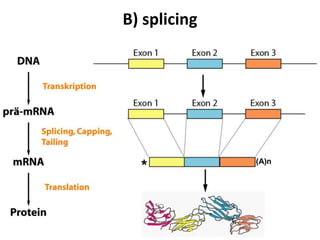
B) splicing
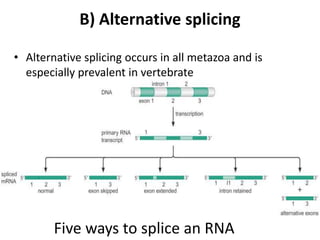
B) Alternative splicing
• Alternative splicing occurs in all metazoa and is
especially prevalent in vertebrate
Five ways to splice an RNA
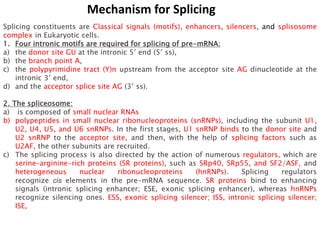
Splicing constituents are Classical signals (motifs), enhancers, silencers, and splisosome
complex in Eukaryotic cells.
1. Four intronic motifs are required for splicing of pre-mRNA:
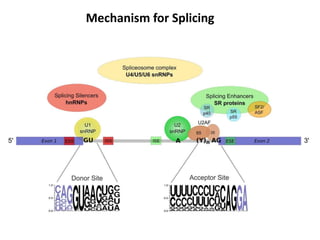
a) the donor site GU at the intronic 5′ end (5′ ss),
b) the branch point A,
c) the polypyrimidine tract (Y)n upstream from the acceptor site AG dinucleotide at the
intronic 3′ end,
d) and the acceptor splice site AG (3′ ss).
2. The spliceosome:
a) is composed of small nuclear RNAs
b) polypeptides in small nuclear ribonucleoproteins (snRNPs), including the subunit U1,
U2, U4, U5, and U6 snRNPs. In the first stages, U1 snRNP binds to the donor site and
U2 snRNP to the acceptor site, and then, with the help of splicing factors such as
U2AF, the other subunits are recruited.
c) The splicing process is also directed by the action of numerous regulators, which are
serine–arginine-rich proteins (SR proteins), such as SRp40, SRp55, and SF2/ASF, and
heterogeneous nuclear ribonucleoproteins (hnRNPs). Splicing regulators
recognize cis elements in the pre-mRNA sequence. SR proteins bind to enhancing
signals (intronic splicing enhancer; ESE, exonic splicing enhancer), whereas hnRNPs
recognize silencing ones. ESS, exonic splicing silencer; ISS, intronic splicing silencer;
ISE,
Mechanism for Splicing
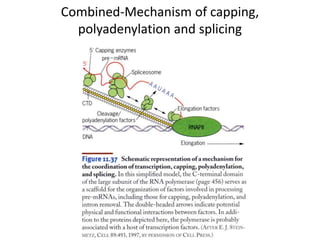
Combined-Mechanism of capping,
polyadenylation and splicing

RNA splicing.....

  • 1.
  • 2.
    B) Alternative splicing •Alternative splicing occurs in all metazoa and is especially prevalent in vertebrate Five ways to splice an RNA
  • 3.
    Splicing constituents areClassical signals (motifs), enhancers, silencers, and splisosome complex in Eukaryotic cells. 1. Four intronic motifs are required for splicing of pre-mRNA: a) the donor site GU at the intronic 5′ end (5′ ss), b) the branch point A, c) the polypyrimidine tract (Y)n upstream from the acceptor site AG dinucleotide at the intronic 3′ end, d) and the acceptor splice site AG (3′ ss). 2. The spliceosome: a) is composed of small nuclear RNAs b) polypeptides in small nuclear ribonucleoproteins (snRNPs), including the subunit U1, U2, U4, U5, and U6 snRNPs. In the first stages, U1 snRNP binds to the donor site and U2 snRNP to the acceptor site, and then, with the help of splicing factors such as U2AF, the other subunits are recruited. c) The splicing process is also directed by the action of numerous regulators, which are serine–arginine-rich proteins (SR proteins), such as SRp40, SRp55, and SF2/ASF, and heterogeneous nuclear ribonucleoproteins (hnRNPs). Splicing regulators recognize cis elements in the pre-mRNA sequence. SR proteins bind to enhancing signals (intronic splicing enhancer; ESE, exonic splicing enhancer), whereas hnRNPs recognize silencing ones. ESS, exonic splicing silencer; ISS, intronic splicing silencer; ISE, Mechanism for Splicing
  • 4.
  • 5.