Amity Business School MBA Class of 2010, Semester IV Strategic Financial Management Prof Akhil Swami/Anuj Srivastava
M&As: Overview
Concept Growth   of a company can be thru: -  organic / internal channels / capital budgeting exercises  -  inorganic  growth/  external channels / M&As Merger : combining of two or more companies into a single Company Acquisition : of one company by another - acquisition of  assets  or of  entire company  or of only  intangible assets  (brand/ goodwill) - can be  friendly or hostile  depending upon target’s reaction
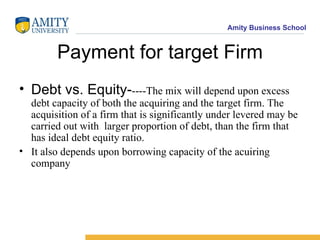
Payment for target Firm Debt vs. Equity- ----The mix will depend upon excess debt capacity of both the acquiring and the target firm. The acquisition of a firm that is significantly under levered may be carried out with  larger proportion of debt, than the firm that has ideal debt equity ratio. It also depends upon borrowing capacity of the acuiring company
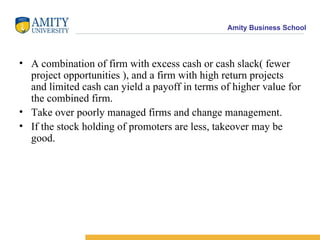
A combination of firm with excess cash or cash slack( fewer project opportunities ), and a firm with high return projects and limited cash can yield a payoff in terms of higher value for the combined firm. Take over poorly managed firms and change management. If the stock holding of promoters are less, takeover may be good.
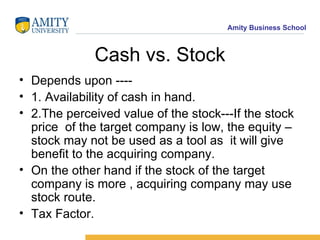
Cash vs. Stock Depends upon ---- 1. Availability of cash in hand. 2.The perceived value of the stock---If the stock price  of the target company is low, the equity –stock may not be used as a tool as  it will give benefit to the acquiring company. On the other hand if the stock of the target company is more , acquiring company may use stock route. Tax Factor.
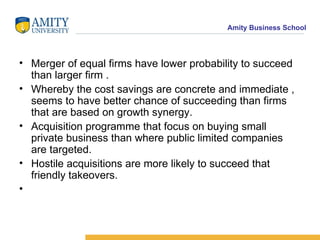
Merger of equal firms have lower probability to succeed than larger firm . Whereby the cost savings are concrete and immediate , seems to have better chance of succeeding than firms that are based on growth synergy. Acquisition programme that focus on buying small private business than where public limited companies are targeted. Hostile acquisitions are more likely to succeed that friendly takeovers.
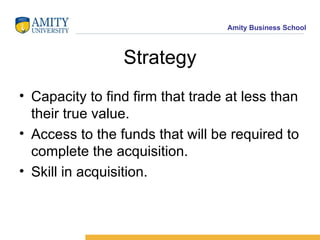
Strategy Capacity to find firm that trade at less than their true value. Access to the funds that will be required to complete the acquisition. Skill in acquisition.
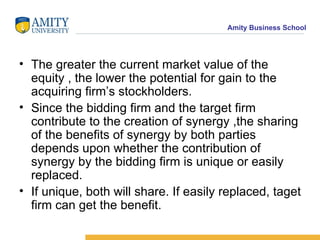
The greater the current market value of the equity , the lower the potential for gain to the acquiring firm’s stockholders. Since the bidding firm and the target firm contribute to the creation of synergy ,the sharing of the benefits of synergy by both parties depends upon whether the contribution of synergy by the bidding firm is unique or easily replaced. If unique, both will share. If easily replaced, taget firm can get the benefit.
If bidders are more, target firm gets the benefit.
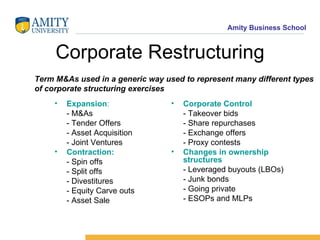
Corporate Restructuring Expansion : - M&As - Tender Offers - Asset Acquisition - Joint Ventures Contraction: - Spin offs - Split offs - Divestitures - Equity Carve outs - Asset Sale Corporate Control - Takeover bids - Share repurchases - Exchange offers  - Proxy contests Changes in ownership structures - Leveraged buyouts (LBOs) - Junk bonds - Going private - ESOPs and MLPs Term M&As used in a generic way used to represent many different types of corporate structuring exercises
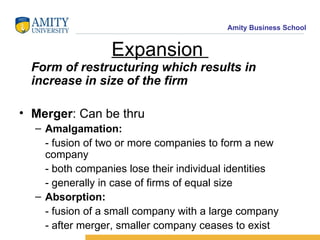
Expansion  Form of restructuring which results in increase in size of the firm Merger : Can be thru Amalgamation:  - fusion of two or more companies to form a new company - both companies lose their individual identities - generally in case of firms of equal size Absorption:  - fusion of a small company with a large company - after merger, smaller company ceases to exist
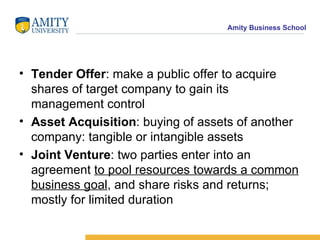
Tender Offer : make a public offer to acquire shares of target company to gain its  management control Asset Acquisition : buying of assets of another company: tangible or intangible assets Joint Venture : two parties enter into an agreement  to pool resources towards a common business goal , and share risks and returns; mostly for limited duration
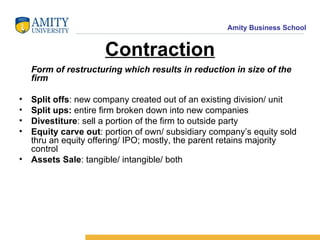
Contraction Form of restructuring which results in reduction in size of the firm Split offs : new company created out of an existing division/ unit Split   ups:  entire firm broken down into new companies Divestiture : sell a portion of the firm to outside party Equity carve out : portion of own/ subsidiary company’s equity sold thru an equity offering/ IPO; mostly, the parent retains majority control Assets Sale : tangible/ intangible/ both
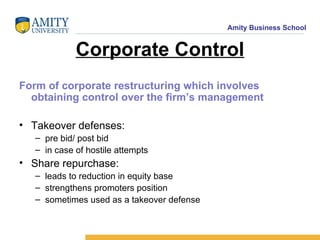
Corporate Control Form of corporate restructuring which involves obtaining control over the firm’s management Takeover defenses:  pre bid/ post bid in case of hostile attempts Share repurchase:  leads to reduction in equity base strengthens promoters position sometimes used as a takeover defense
Exchange offers:  of one class with another class of securities normally of higher market value changes leverage structure Proxy Contests :  support to pass own resolution/ change management
Changes in Ownership Structure Form of corporate restructuring which results in change in ownership pattern/ structure Leveraged Buyout : use of debt to finance an acquisition transaction Going Private : transformation of public corporation into private by sale of equity interest to small group of investors ESOPs MLPs : combines benefits of partnership form and company form of entity
Merger Waves in USA The First wave: 1897-1904 - mainly of horizontal mergers - resulted in formation of monopolies - financial factors/ stock market crash of 1904 led to its end The Second wave: 1916-1929 - several industries consolidated - resulted in oligopolistic industry structure - again ended with stock market crash of 1929 - investment bankers played a key role in both the above waves The Third wave: 1965-1969 - conglomerate merger period, diversifications  - due to tougher antitrust enforcement - many failed due to little knowledge of acquired industries - mostly financed thru equity
Merger Waves in USA The Fourth wave: 1981-1989 - period of mega mergers, more of hostile variety - deregulation in industries led to large number of players and hence their consolidation - Investment bankers/ merger specialists played an active role in advising and syndicating funds - concept of LBOs, debt financing, emerged - junk bond market emerged The Fifth wave: 1992 till date - emphasis on strategy: strategic mergers - globalisation led to cross border M&As - consolidation , hence oligopolistic structure Each wave began with upturn of economic activity in the country and ended with the crash/downturn
Indian Scenario During licensing era, companies indulged in unrelated diversifications depending upon availability of licenses Became conglomerates with sub optimal portfolio of assorted businesses Takeover bids/ corporate bids common Active arrangement of takeover of sick undertakings Liberalization led to more streamlined M&A activity Globalization led to more cross border deals Active involvement of SEBI  More friendly Competition Act has replaced MRTP Act
M&As: Objectives Economies of scale: operating cost advantage thru increased volume of operations in terms of production activity/ R&D activity/ marketing and distribution/ transport, storage, inventories/ managerial economies Synergies: from complementary activities/ resources, thus combined value = stand alone value of acquiring firm+ stand alone value of acquired firm + value of synergy Increase market share, consolidate market position Economies of scope: widening of portfolio of products and services Increase geographical coverage Faster growth : reduce gestation period of setting up a new project Tax advantages : accumulated losses set off to reduce tax liability In case of global mergers, their Indian setups merge by default Acquire intangible asset advantage, brands
M&As: Objectives (contd.) Vertical Integration: backward or forward Acquire key customer profile of the target Acquire a company with key managerial/ workforce talents Replace weaker management of a company by acquiring management control Acquire a company with key technology/ knowledge processes Thus primary objective is to create a strategic advantage by paying a price for the target that is lower than total resources required for internal development of a similar strategic position; also value of the combined entity to be more  than sum of independent values of the merging entities
Concept of Synergy Results from complimentary activities.Two firms strong in two different areas complimentary to each other.Hence, provide added advantage.Thus, combined strength/value of merged entity is  more than sum of the two individual/ standalone firms Eg.  Strong R&D team of one firm , efficiently organised production department of another, can be used together One firm has well established brands but lacks marketing organisation, can merge with another having strong marketing set up Combined value = value of two firms + value of synergy Net gain from merger (exclusive of costs)
M&As : Dubious Reasons Diversification : stated reason to achieve risk reduction thru diversification; but this can be done by investor himself by adjusting his portfolio, and with more flexibility; however, may be useful if merging company not listed or if corporate cost of diversification is less than that of personal diversification Lower Financing Costs: more debt raising capacity at lower costs available to merged entity due to enhanced equity base, however benefit nullified due to larger debt servicing required to be done by shareholders, means more debt burden Earnings Growth: merger may create appearance of growth in earnings and may command higher P/E multiple if market is not smart; however such discrepancies removed in the long run
Reasons for failure of M&As Payment of higher price: can dilute shareholders’ earnings Cultural clash: conflicting management styles, differing expectations, communication channels, formal/ participative….. Overstated/ overestimated synergies Failure to integrate operations Inconsistent strategy Poor business fit: product/service of acquired company does not fit into acquirer’s sales, distribution systems or geographic requirements Inadequate due diligence: some of the financial and business risks of seller may go undetected Over leverage/ inappropriate financing structure: may create liquidity/ servicing problems Boardroom split: lack of compatibility amongst directors of two companies merged Regulatory/ unexpected delays in implementation of merger: can lead to loss of valuable employees, customer, supplier relationships Hence proper planning and execution of M&A transaction is a must for it to succeed and not backfire
M&As: Types and Procedure: Doing a Deal
Types of M&As Horizontal Mergers : when two or more firms dealing in similar lines of activity/ product/ service, combine together; rationale: elimination/reduction in competition increase market share strategy to end price cutting/ price wars economies of scale in production, R&D, marketing  and management May create conditions triggering  concentration of economic power and monopoly
Types of M&As (contd.) Vertical Mergers : involves two or more stages of production/ distribution that are usually separate Can be: upstream/ backward integration: extends to firms supplying raw materials downstream/ forward integration: extends to firms that sell eventually to the consumer Rationale: lower buying cost of materials lower distribution costs assured supply of raw materials assured markets/ customer base increasing or creating barriers to entry for potential competitors placing competitors at a cost disadvantage
Types of M&As (contd.) Conglomerate merger : firms engaged in different unrelated activities combine together product extension mergers/ concentric mergers: merger of firms in related business lines geographic market extensions: merger of firms operating in different geographic areas also called diversification elimination of risks by acquiring diversified portfolio is the main motive encash on the boom in a certain product line is also the rationale at times, as mergers are faster routes to growth could also be financial conglomerates or managerial conglomerates
Procedure in structuring an M&A Transaction Develop the business plan : define overall strategic direction for the business, key objectives, available resources: communicate mission/vision for the firm and strategy for achieving that mission; SWOT analysis Develop an acquisition plan : based on the business plan, define tactics/strategies for completing an acquisition, resource assessment, timeframe (realistic and aggressive), persons responsible for it, assess capacity to bear risks Search phase:   first stage is primary screening process, define primary criteria like industry, size of transaction, geographic location, maximum purchase price firm is willing to pay second stage: develop search strategy using various database to identify prospective candidates; take help of lawyers, banking, accounting firms, investment bankers
Procedure (contd.) The Screening Process : short list the initial list of potential candidates by primary criteria like size and type of industry, and by secondary selection criteria like specific market segment, product line, firm’s profitability, its financial structure, market share……. First Contact : meet the acquisition candidate and put forward the acquisition proposal: - Alternative approach strategies: directly or thru an intermediary or thru a letter expressing interest in a joint venture/market alliance - Discussing Value: based on various valuation methods, weighted average of all - preliminary legal documents:  Confidentiality agreement for non disclosure of data provided by buyer and seller to each other Letter of intent: parties’ preliminary agreement to agree covering major terms and conditions, respective responsibilities, fee payment, expiration date etc.
Procedure (contd.) Negotiation:  develop financial model for projected cash flows based on past profitability data determine the actual purchase consideration, including cash, stock/ debt issue, based on its enterprise value; the exchange ratio for shareholders of acquired firm, or for all in the merged entity refine valuation considering non recurring expenses and gains structure the deal by constructing an appropriate set of compensation, legal, tax and accounting structures, to meet the risk/return profile and objectives of both the parties Total consideration = cash + PV of stock issued + PV of new debt issued Total purchase price/Enterprise Value = Total consideration + PV of assumed debt of the target Net purchase price = Enterprise value – PV of sale of discretionary or redundant assets
Procedure (contd.) Due Diligence : to assess the benefits and costs of proposed deal by enquiring into all relevant aspects of past, present and predictable future of the target company Buyer due diligence: is thorough and extensive, covers all aspects of business like financial, legal, technical, human resources, operations, marketing, supplier/ customer profile etc.; may take help of specialists Seller due diligence: to ensure that buyer has resources to finance the deal and establish his credibility; process is more tedious for buyer
Procedure (contd.) Developing the Financing Plan : thru cash, equity or debt obtain bridge/ interim financing from banks, FIs, insurance companies, PE firms etc. mezzanine financing: subordinate debt, more risky and hence more expensive long term bonds like Junk Bonds, thru private placements by investment bankers PE/ VC funding: can undertake more risks for higher returns seller financing: when seller agrees to defer portion of the purchase price until a future date
Procedure (contd.) Developing the Integration Plan : to absorb the resources and systems of seller company into the merged entity, critical factors like key managers, vendors, customers to be identified and plan made to retain these : very critical to ensure success of acquisition deal Closing : is the final legal procedure where the company changes hands all necessary shareholders’, regulatory and third party consents taken: non compliance of law may lead to delays/ fallout of the deal closing document prepared containing various clauses on purpose of acquisition, price, allocation of price for tax purposes, payment mechanism, assumption of liabilities, representations and warranties, covenants, conditions for closing, indemnification
Procedure (contd.) Post Closing Integration : of acquired company in the combined entity, very crucial to success of merger plan, takes care of all aspects of business: operational, human, cultural, communication issues Post Closing Evaluation : to determine if acquisition is meeting expectations, to determine corrective actions, evaluate actual performance after merger against anticipated performance as per plan, helps outline lessons for future actions, why and how the deal succeeded or failed
Participants  Investment bankers:  assist in identification of areas for restructuring; buyer/seller identification; structuring the deal and valuation; negotiations; legal compliance Lawyers:  cover areas of tax, employee benefits, real estate, antitrust, securities and intellectual property, ensure proper documentation Accountants : tax accountants to determine appropriate tax structure of the deal, also perform role of auditors to review accounts, ensure proper accounting treatment of the deal Valuation Experts : build financial models for costs and benefits to arise from the transaction Institutional Investors : to finance the deal, include banks, FIs, PE/VC firms, mutual funds etc., may get voting rights Arbitrageurs : bid price for a target normally higher than its market price, arbitrageurs buy the stock in anticipation of the deal fructifying and thus make profits; may also get to influence the outcome of the deal

Module4 Sfm

  • 1.
    Amity Business SchoolMBA Class of 2010, Semester IV Strategic Financial Management Prof Akhil Swami/Anuj Srivastava
  • 2.
  • 3.
    Concept Growth of a company can be thru: - organic / internal channels / capital budgeting exercises - inorganic growth/ external channels / M&As Merger : combining of two or more companies into a single Company Acquisition : of one company by another - acquisition of assets or of entire company or of only intangible assets (brand/ goodwill) - can be friendly or hostile depending upon target’s reaction
  • 4.
    Payment for targetFirm Debt vs. Equity- ----The mix will depend upon excess debt capacity of both the acquiring and the target firm. The acquisition of a firm that is significantly under levered may be carried out with larger proportion of debt, than the firm that has ideal debt equity ratio. It also depends upon borrowing capacity of the acuiring company
  • 5.
    A combination offirm with excess cash or cash slack( fewer project opportunities ), and a firm with high return projects and limited cash can yield a payoff in terms of higher value for the combined firm. Take over poorly managed firms and change management. If the stock holding of promoters are less, takeover may be good.
  • 6.
    Cash vs. StockDepends upon ---- 1. Availability of cash in hand. 2.The perceived value of the stock---If the stock price of the target company is low, the equity –stock may not be used as a tool as it will give benefit to the acquiring company. On the other hand if the stock of the target company is more , acquiring company may use stock route. Tax Factor.
  • 7.
    Merger of equalfirms have lower probability to succeed than larger firm . Whereby the cost savings are concrete and immediate , seems to have better chance of succeeding than firms that are based on growth synergy. Acquisition programme that focus on buying small private business than where public limited companies are targeted. Hostile acquisitions are more likely to succeed that friendly takeovers.
  • 8.
    Strategy Capacity tofind firm that trade at less than their true value. Access to the funds that will be required to complete the acquisition. Skill in acquisition.
  • 9.
    The greater thecurrent market value of the equity , the lower the potential for gain to the acquiring firm’s stockholders. Since the bidding firm and the target firm contribute to the creation of synergy ,the sharing of the benefits of synergy by both parties depends upon whether the contribution of synergy by the bidding firm is unique or easily replaced. If unique, both will share. If easily replaced, taget firm can get the benefit.
  • 10.
    If bidders aremore, target firm gets the benefit.
  • 11.
    Corporate Restructuring Expansion: - M&As - Tender Offers - Asset Acquisition - Joint Ventures Contraction: - Spin offs - Split offs - Divestitures - Equity Carve outs - Asset Sale Corporate Control - Takeover bids - Share repurchases - Exchange offers - Proxy contests Changes in ownership structures - Leveraged buyouts (LBOs) - Junk bonds - Going private - ESOPs and MLPs Term M&As used in a generic way used to represent many different types of corporate structuring exercises
  • 12.
    Expansion Formof restructuring which results in increase in size of the firm Merger : Can be thru Amalgamation: - fusion of two or more companies to form a new company - both companies lose their individual identities - generally in case of firms of equal size Absorption: - fusion of a small company with a large company - after merger, smaller company ceases to exist
  • 13.
    Tender Offer :make a public offer to acquire shares of target company to gain its management control Asset Acquisition : buying of assets of another company: tangible or intangible assets Joint Venture : two parties enter into an agreement to pool resources towards a common business goal , and share risks and returns; mostly for limited duration
  • 14.
    Contraction Form ofrestructuring which results in reduction in size of the firm Split offs : new company created out of an existing division/ unit Split ups: entire firm broken down into new companies Divestiture : sell a portion of the firm to outside party Equity carve out : portion of own/ subsidiary company’s equity sold thru an equity offering/ IPO; mostly, the parent retains majority control Assets Sale : tangible/ intangible/ both
  • 15.
    Corporate Control Formof corporate restructuring which involves obtaining control over the firm’s management Takeover defenses: pre bid/ post bid in case of hostile attempts Share repurchase: leads to reduction in equity base strengthens promoters position sometimes used as a takeover defense
  • 16.
    Exchange offers: of one class with another class of securities normally of higher market value changes leverage structure Proxy Contests : support to pass own resolution/ change management
  • 17.
    Changes in OwnershipStructure Form of corporate restructuring which results in change in ownership pattern/ structure Leveraged Buyout : use of debt to finance an acquisition transaction Going Private : transformation of public corporation into private by sale of equity interest to small group of investors ESOPs MLPs : combines benefits of partnership form and company form of entity
  • 18.
    Merger Waves inUSA The First wave: 1897-1904 - mainly of horizontal mergers - resulted in formation of monopolies - financial factors/ stock market crash of 1904 led to its end The Second wave: 1916-1929 - several industries consolidated - resulted in oligopolistic industry structure - again ended with stock market crash of 1929 - investment bankers played a key role in both the above waves The Third wave: 1965-1969 - conglomerate merger period, diversifications - due to tougher antitrust enforcement - many failed due to little knowledge of acquired industries - mostly financed thru equity
  • 19.
    Merger Waves inUSA The Fourth wave: 1981-1989 - period of mega mergers, more of hostile variety - deregulation in industries led to large number of players and hence their consolidation - Investment bankers/ merger specialists played an active role in advising and syndicating funds - concept of LBOs, debt financing, emerged - junk bond market emerged The Fifth wave: 1992 till date - emphasis on strategy: strategic mergers - globalisation led to cross border M&As - consolidation , hence oligopolistic structure Each wave began with upturn of economic activity in the country and ended with the crash/downturn
  • 20.
    Indian Scenario Duringlicensing era, companies indulged in unrelated diversifications depending upon availability of licenses Became conglomerates with sub optimal portfolio of assorted businesses Takeover bids/ corporate bids common Active arrangement of takeover of sick undertakings Liberalization led to more streamlined M&A activity Globalization led to more cross border deals Active involvement of SEBI More friendly Competition Act has replaced MRTP Act
  • 21.
    M&As: Objectives Economiesof scale: operating cost advantage thru increased volume of operations in terms of production activity/ R&D activity/ marketing and distribution/ transport, storage, inventories/ managerial economies Synergies: from complementary activities/ resources, thus combined value = stand alone value of acquiring firm+ stand alone value of acquired firm + value of synergy Increase market share, consolidate market position Economies of scope: widening of portfolio of products and services Increase geographical coverage Faster growth : reduce gestation period of setting up a new project Tax advantages : accumulated losses set off to reduce tax liability In case of global mergers, their Indian setups merge by default Acquire intangible asset advantage, brands
  • 22.
    M&As: Objectives (contd.)Vertical Integration: backward or forward Acquire key customer profile of the target Acquire a company with key managerial/ workforce talents Replace weaker management of a company by acquiring management control Acquire a company with key technology/ knowledge processes Thus primary objective is to create a strategic advantage by paying a price for the target that is lower than total resources required for internal development of a similar strategic position; also value of the combined entity to be more than sum of independent values of the merging entities
  • 23.
    Concept of SynergyResults from complimentary activities.Two firms strong in two different areas complimentary to each other.Hence, provide added advantage.Thus, combined strength/value of merged entity is more than sum of the two individual/ standalone firms Eg. Strong R&D team of one firm , efficiently organised production department of another, can be used together One firm has well established brands but lacks marketing organisation, can merge with another having strong marketing set up Combined value = value of two firms + value of synergy Net gain from merger (exclusive of costs)
  • 24.
    M&As : DubiousReasons Diversification : stated reason to achieve risk reduction thru diversification; but this can be done by investor himself by adjusting his portfolio, and with more flexibility; however, may be useful if merging company not listed or if corporate cost of diversification is less than that of personal diversification Lower Financing Costs: more debt raising capacity at lower costs available to merged entity due to enhanced equity base, however benefit nullified due to larger debt servicing required to be done by shareholders, means more debt burden Earnings Growth: merger may create appearance of growth in earnings and may command higher P/E multiple if market is not smart; however such discrepancies removed in the long run
  • 25.
    Reasons for failureof M&As Payment of higher price: can dilute shareholders’ earnings Cultural clash: conflicting management styles, differing expectations, communication channels, formal/ participative….. Overstated/ overestimated synergies Failure to integrate operations Inconsistent strategy Poor business fit: product/service of acquired company does not fit into acquirer’s sales, distribution systems or geographic requirements Inadequate due diligence: some of the financial and business risks of seller may go undetected Over leverage/ inappropriate financing structure: may create liquidity/ servicing problems Boardroom split: lack of compatibility amongst directors of two companies merged Regulatory/ unexpected delays in implementation of merger: can lead to loss of valuable employees, customer, supplier relationships Hence proper planning and execution of M&A transaction is a must for it to succeed and not backfire
  • 26.
    M&As: Types andProcedure: Doing a Deal
  • 27.
    Types of M&AsHorizontal Mergers : when two or more firms dealing in similar lines of activity/ product/ service, combine together; rationale: elimination/reduction in competition increase market share strategy to end price cutting/ price wars economies of scale in production, R&D, marketing and management May create conditions triggering concentration of economic power and monopoly
  • 28.
    Types of M&As(contd.) Vertical Mergers : involves two or more stages of production/ distribution that are usually separate Can be: upstream/ backward integration: extends to firms supplying raw materials downstream/ forward integration: extends to firms that sell eventually to the consumer Rationale: lower buying cost of materials lower distribution costs assured supply of raw materials assured markets/ customer base increasing or creating barriers to entry for potential competitors placing competitors at a cost disadvantage
  • 29.
    Types of M&As(contd.) Conglomerate merger : firms engaged in different unrelated activities combine together product extension mergers/ concentric mergers: merger of firms in related business lines geographic market extensions: merger of firms operating in different geographic areas also called diversification elimination of risks by acquiring diversified portfolio is the main motive encash on the boom in a certain product line is also the rationale at times, as mergers are faster routes to growth could also be financial conglomerates or managerial conglomerates
  • 30.
    Procedure in structuringan M&A Transaction Develop the business plan : define overall strategic direction for the business, key objectives, available resources: communicate mission/vision for the firm and strategy for achieving that mission; SWOT analysis Develop an acquisition plan : based on the business plan, define tactics/strategies for completing an acquisition, resource assessment, timeframe (realistic and aggressive), persons responsible for it, assess capacity to bear risks Search phase: first stage is primary screening process, define primary criteria like industry, size of transaction, geographic location, maximum purchase price firm is willing to pay second stage: develop search strategy using various database to identify prospective candidates; take help of lawyers, banking, accounting firms, investment bankers
  • 31.
    Procedure (contd.) TheScreening Process : short list the initial list of potential candidates by primary criteria like size and type of industry, and by secondary selection criteria like specific market segment, product line, firm’s profitability, its financial structure, market share……. First Contact : meet the acquisition candidate and put forward the acquisition proposal: - Alternative approach strategies: directly or thru an intermediary or thru a letter expressing interest in a joint venture/market alliance - Discussing Value: based on various valuation methods, weighted average of all - preliminary legal documents: Confidentiality agreement for non disclosure of data provided by buyer and seller to each other Letter of intent: parties’ preliminary agreement to agree covering major terms and conditions, respective responsibilities, fee payment, expiration date etc.
  • 32.
    Procedure (contd.) Negotiation: develop financial model for projected cash flows based on past profitability data determine the actual purchase consideration, including cash, stock/ debt issue, based on its enterprise value; the exchange ratio for shareholders of acquired firm, or for all in the merged entity refine valuation considering non recurring expenses and gains structure the deal by constructing an appropriate set of compensation, legal, tax and accounting structures, to meet the risk/return profile and objectives of both the parties Total consideration = cash + PV of stock issued + PV of new debt issued Total purchase price/Enterprise Value = Total consideration + PV of assumed debt of the target Net purchase price = Enterprise value – PV of sale of discretionary or redundant assets
  • 33.
    Procedure (contd.) DueDiligence : to assess the benefits and costs of proposed deal by enquiring into all relevant aspects of past, present and predictable future of the target company Buyer due diligence: is thorough and extensive, covers all aspects of business like financial, legal, technical, human resources, operations, marketing, supplier/ customer profile etc.; may take help of specialists Seller due diligence: to ensure that buyer has resources to finance the deal and establish his credibility; process is more tedious for buyer
  • 34.
    Procedure (contd.) Developingthe Financing Plan : thru cash, equity or debt obtain bridge/ interim financing from banks, FIs, insurance companies, PE firms etc. mezzanine financing: subordinate debt, more risky and hence more expensive long term bonds like Junk Bonds, thru private placements by investment bankers PE/ VC funding: can undertake more risks for higher returns seller financing: when seller agrees to defer portion of the purchase price until a future date
  • 35.
    Procedure (contd.) Developingthe Integration Plan : to absorb the resources and systems of seller company into the merged entity, critical factors like key managers, vendors, customers to be identified and plan made to retain these : very critical to ensure success of acquisition deal Closing : is the final legal procedure where the company changes hands all necessary shareholders’, regulatory and third party consents taken: non compliance of law may lead to delays/ fallout of the deal closing document prepared containing various clauses on purpose of acquisition, price, allocation of price for tax purposes, payment mechanism, assumption of liabilities, representations and warranties, covenants, conditions for closing, indemnification
  • 36.
    Procedure (contd.) PostClosing Integration : of acquired company in the combined entity, very crucial to success of merger plan, takes care of all aspects of business: operational, human, cultural, communication issues Post Closing Evaluation : to determine if acquisition is meeting expectations, to determine corrective actions, evaluate actual performance after merger against anticipated performance as per plan, helps outline lessons for future actions, why and how the deal succeeded or failed
  • 37.
    Participants Investmentbankers: assist in identification of areas for restructuring; buyer/seller identification; structuring the deal and valuation; negotiations; legal compliance Lawyers: cover areas of tax, employee benefits, real estate, antitrust, securities and intellectual property, ensure proper documentation Accountants : tax accountants to determine appropriate tax structure of the deal, also perform role of auditors to review accounts, ensure proper accounting treatment of the deal Valuation Experts : build financial models for costs and benefits to arise from the transaction Institutional Investors : to finance the deal, include banks, FIs, PE/VC firms, mutual funds etc., may get voting rights Arbitrageurs : bid price for a target normally higher than its market price, arbitrageurs buy the stock in anticipation of the deal fructifying and thus make profits; may also get to influence the outcome of the deal

Editor's Notes