Mergers and
Acquisitions
Prepared by :
Abdullah Aqeel
Mohammed Albasha
Supervised by :
Dr.Nagat Gumaan
Why This Matters to You
• ACCOUNTING You need to understand mergers, leveraged buyouts, and divestitures of assets to record and
report these organizational changes; you also need to understand bankruptcy procedures because you will play a
large part in any reorganization or liquidation.
• MANAGEMENT You need to understand the motives for mergers so that you will know when and why a merger is
a good idea. Also, you may need to know how to fend off an unwelcome takeover attempt, when to divest the firm
of assets for strategic reasons, and what options are available in the case of business failure.
• MARKETING You need to understand mergers and divestitures, which may enable the firm to grow, diversify, or
achieve synergy and therefore require changes in the firm’s marketing organization, plans, and goals.
• OPERATIONS You need to understand mergers and divestitures because ongoing operations will be significantly
affected by these organizational changes. Also, you should know that business failure may result in reorganization
of the firm to provide adequate financing for ongoing operations.
Learning Objectives:
1. Understand merger fundamentals,
2. motives for merging,
3. types of mergers.
4. Acquisitions , definition and types
5. LBOs and Divestitures
6. Analyzing and Negotiating Mergers
Fundamentals
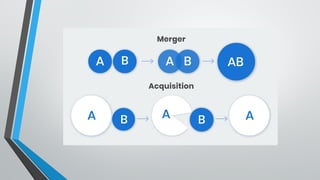
• Mergers and acquisitions are transactions of shifting ownership
between two companies, wherein a merger is a fusing or combining
of two companies and acquisition is one company acquiring or
buying another. The ultimate goal of mergers and acquisitions is to
create synergy, which typically makes the two combined companies
worth more valuable than the two separate companies.
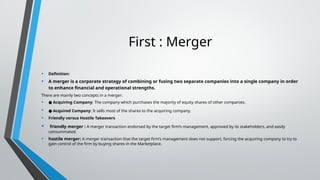
First : Merger
• Definition:
• A merger is a corporate strategy of combining or fusing two separate companies into a single company in order
to enhance financial and operational strengths.
There are mainly two concepts in a merger:
• ● Acquiring Company: The company which purchases the majority of equity shares of other companies.
• ● Acquired Company: It sells most of the shares to the acquiring company.
• Friendly versus Hostile Takeovers
• friendly merger : A merger transaction endorsed by the target firm’s management, approved by its stakeholders, and easily
consummated.
• hostile merger: A merger transaction that the target firm’s management does not support, forcing the acquiring company to try to
gain control of the firm by buying shares in the Marketplace.
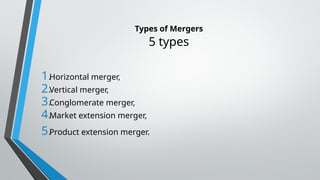
Types of Mergers
5 types
1.Horizontal merger,
2.Vertical merger,
3.Conglomerate merger,
4.Market extension merger,
5.Product extension merger.
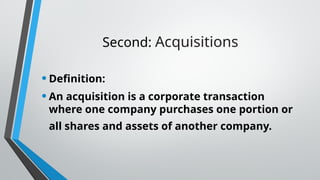
Second: Acquisitions
•Definition:
•An acquisition is a corporate transaction
where one company purchases one portion or
all shares and assets of another company.
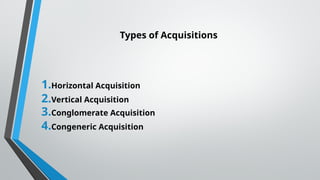
Types of Acquisitions
1.Horizontal Acquisition
2.Vertical Acquisition
3.Conglomerate Acquisition
4.Congeneric Acquisition
Forms of Acquisition
• Generally, there are two forms of acquisition- stock purchase and asset purchase.
• Stock Purchase
• In a stock purchase, the acquiring company pays cash or shares to the shareholders of the target firm for the shares of the
target company. Here the target company's shareholders receive compensation.
• In this case;
• ● The acquirer company takes all the assets and liabilities from the target company.
• ● Shareholders must approve the transaction through a majority vote to receive the
• compensation by the acquirer. This can be a long process.
• ● Shareholders bear tax responsibility as they receive the compensation.
• Asset Purchase
• Asset purchase means the acquirer purchases the target company's assets and pays the target directly.
• Here;
• ● The acquirer will avoid assuming any of the acquired company's liabilities, as it
• purchases only the assets.
• ● In this purchase, no shareholder approval is needed unless the assets are significant.
Motives and Benefits of Mergers and Acquisitions
• Unlocking Synergies
The most common goal of M&A is to create synergies, in which the merged company is worth
more than two individual companies.
• Economies of scale
When two companies merge together, it becomes more potent with abundant resources. After
merging, the newly developed company will get access to a more skilled workforce that will help
in increasing its scale of operations. Economies of scale will occur when a company uses its
resources efficiently and has an optimum distribution of networks, research, and development
facilities.
• Higher Growth
Mergers and acquisitions are the faster ways for a company to get higher revenues as
compared to growing organically and individually.
Motives and Benefits of Mergers and
Acquisitions
• Diversification of Products and Services
One of the most significant reasons for M&A is to introduce diversification into the products and services of a
company. Sometimes it reduces the risk of failure as it facilitates a company to merge with a company that is already
established. It also allows the former to explore new business operations.
• Eliminations of Competition
M&A of two or more companies eliminate competition in an industry. It saves the advertising cost of the company,
and it enables the merged company to reduce the cost of its products and services. It will also favor the customers
since they will get the products at lower prices.
• Stronger Market Power
The merged or acquired companies will attain a higher market share and will gain the power to manipulate prices
due to cost-cutting.
• Best Financial Planning
When one or more companies decide for a merger or acquisition, they can plan to utilize their resources in the best
possible way. The funds and finances of a merged or acquired company will be more and their utilization may
accordingly be better than in the separate units.
LBOs and Divestitures
• leveraged buyout (LBO) An acquisition technique involving the use of a large amount of debt to purchase a firm; an example of a financial
merger..
• operating unit A part of a business, such as a plant, division, product line, or subsidiary, that contributes to the actual operations of the firm.
• Divestiture The selling of some of a firm’s assets for various strategic reasons.
• spin-off A form of divestiture in which an operating unit becomes an independent company through the issuance of shares in it, on a pro rata
basis, to the parent
company’s shareholders An attractive candidate for acquisition via a leveraged buyout should possess
three key attributes:
1. It must have a good position in its industry, with a solid profit history and
reasonable expectations of growth.
2. The firm should have a relatively low level of debt and a high level of “bankable”
assets that can be used as loan collateral.
3. It must have stable and predictable cash flows that are adequate to meet
interest and principal payments on the debt and provide adequate working
capital.
• Four methods companies used to divest themselves of operating units
 the sale of a product line to another firm.
The sale of the unit to existing management through the use of leveraged buyout (LBO)
spin-off, which results in an operating unit becoming an independent company
 liquidation of the operating unit’s individual assets.
breakup value The value of a firm measured as the sum of the values of its operating units if each were
sold separately.
LBOs and Divestitures
Acquisitions of Assets
Occasionally, a firm is acquired not for its income-earning potential but as a collection
of assets (generally fixed assets) that the acquiring company needs.
Acquisitions of Going Concerns
Acquisitions of target companies that are going concerns are best analyzed by
using capital budgeting techniques similar to those described for asset acquisitions.
The methods of estimating expected cash flows from an acquisition are
similar to those used in estimating capital budgeting cash flows.
Analyzing and Negotiating
Mergers
• stock swap transaction
An acquisition method in which the acquiring firm exchanges its shares for shares of the
target company according to a predetermined ratio.
ratio of exchange
The ratio of the amount paid per share of the target company to the market price per share
of the acquiring firm
Analyzing and Negotiating
Mergers
Initial Effect When the ratio of exchange is equal to 1 and both the
acquiring firm and the target firm have the same premerger earnings per share,
the merged firm’s earnings per share will initially remain constant. In this rare
instance, both the acquiring firm and the target firm would also have equal
price/earnings (P/E) ratios. In actuality, the earnings per share of the merged firm
are generally above the premerger earnings per share of one firm and below the
premerger earnings per share of the other, after the necessary adjustment has been
made for the ratio of exchange.
Analyzing and Negotiating
Mergers
Long-Run Effect The long-run effect of a merger on the earnings per share of
the merged company depends largely on whether the earnings of the merged firm
grow. Often, although an initial decrease in the per-share earnings of the stock held
by the original owners of the acquiring firm is expected, the long-run effects of the
merger on earnings per share are quite favorable. Because firms generally expect
growth in earnings, the key factor enabling the acquiring company to experience
higher future EPS than it would have without the merger is that the earnings attributable
to the target company’s assets grow more rapidly than those resulting from
the acquiring company’s premerger assets. An example will clarify this point..
Analyzing and Negotiating
Mergers
Effect on Market Price per Share
The market price per share does not necessarily remain constant after the acquisition
of one firm by another. Adjustments occur in the marketplace in response
to changes in expected earnings, the dilution of ownership, changes in risk, and
certain other operating and financial changes
RE = ratio of exchange
MP target = market price per share of the target firm
MP acquiring = market price per share of the acquiring firm
MPR = market price ratio of exchange
MPR = MP acquiring*RE/MP target
Analyzing and Negotiating
Mergers
THANK YOU

Mergers and Acquistion-lect presentation

  • 1.
    Mergers and Acquisitions Prepared by: Abdullah Aqeel Mohammed Albasha Supervised by : Dr.Nagat Gumaan
  • 2.
    Why This Mattersto You • ACCOUNTING You need to understand mergers, leveraged buyouts, and divestitures of assets to record and report these organizational changes; you also need to understand bankruptcy procedures because you will play a large part in any reorganization or liquidation. • MANAGEMENT You need to understand the motives for mergers so that you will know when and why a merger is a good idea. Also, you may need to know how to fend off an unwelcome takeover attempt, when to divest the firm of assets for strategic reasons, and what options are available in the case of business failure. • MARKETING You need to understand mergers and divestitures, which may enable the firm to grow, diversify, or achieve synergy and therefore require changes in the firm’s marketing organization, plans, and goals. • OPERATIONS You need to understand mergers and divestitures because ongoing operations will be significantly affected by these organizational changes. Also, you should know that business failure may result in reorganization of the firm to provide adequate financing for ongoing operations.
  • 3.
    Learning Objectives: 1. Understandmerger fundamentals, 2. motives for merging, 3. types of mergers. 4. Acquisitions , definition and types 5. LBOs and Divestitures 6. Analyzing and Negotiating Mergers
  • 4.
    Fundamentals • Mergers andacquisitions are transactions of shifting ownership between two companies, wherein a merger is a fusing or combining of two companies and acquisition is one company acquiring or buying another. The ultimate goal of mergers and acquisitions is to create synergy, which typically makes the two combined companies worth more valuable than the two separate companies.
  • 6.
    First : Merger •Definition: • A merger is a corporate strategy of combining or fusing two separate companies into a single company in order to enhance financial and operational strengths. There are mainly two concepts in a merger: • ● Acquiring Company: The company which purchases the majority of equity shares of other companies. • ● Acquired Company: It sells most of the shares to the acquiring company. • Friendly versus Hostile Takeovers • friendly merger : A merger transaction endorsed by the target firm’s management, approved by its stakeholders, and easily consummated. • hostile merger: A merger transaction that the target firm’s management does not support, forcing the acquiring company to try to gain control of the firm by buying shares in the Marketplace.
  • 7.
    Types of Mergers 5types 1.Horizontal merger, 2.Vertical merger, 3.Conglomerate merger, 4.Market extension merger, 5.Product extension merger.
  • 8.
    Second: Acquisitions •Definition: •An acquisitionis a corporate transaction where one company purchases one portion or all shares and assets of another company.
  • 9.
    Types of Acquisitions 1.HorizontalAcquisition 2.Vertical Acquisition 3.Conglomerate Acquisition 4.Congeneric Acquisition
  • 10.
    Forms of Acquisition •Generally, there are two forms of acquisition- stock purchase and asset purchase. • Stock Purchase • In a stock purchase, the acquiring company pays cash or shares to the shareholders of the target firm for the shares of the target company. Here the target company's shareholders receive compensation. • In this case; • ● The acquirer company takes all the assets and liabilities from the target company. • ● Shareholders must approve the transaction through a majority vote to receive the • compensation by the acquirer. This can be a long process. • ● Shareholders bear tax responsibility as they receive the compensation. • Asset Purchase • Asset purchase means the acquirer purchases the target company's assets and pays the target directly. • Here; • ● The acquirer will avoid assuming any of the acquired company's liabilities, as it • purchases only the assets. • ● In this purchase, no shareholder approval is needed unless the assets are significant.
  • 11.
    Motives and Benefitsof Mergers and Acquisitions • Unlocking Synergies The most common goal of M&A is to create synergies, in which the merged company is worth more than two individual companies. • Economies of scale When two companies merge together, it becomes more potent with abundant resources. After merging, the newly developed company will get access to a more skilled workforce that will help in increasing its scale of operations. Economies of scale will occur when a company uses its resources efficiently and has an optimum distribution of networks, research, and development facilities. • Higher Growth Mergers and acquisitions are the faster ways for a company to get higher revenues as compared to growing organically and individually.
  • 12.
    Motives and Benefitsof Mergers and Acquisitions • Diversification of Products and Services One of the most significant reasons for M&A is to introduce diversification into the products and services of a company. Sometimes it reduces the risk of failure as it facilitates a company to merge with a company that is already established. It also allows the former to explore new business operations. • Eliminations of Competition M&A of two or more companies eliminate competition in an industry. It saves the advertising cost of the company, and it enables the merged company to reduce the cost of its products and services. It will also favor the customers since they will get the products at lower prices. • Stronger Market Power The merged or acquired companies will attain a higher market share and will gain the power to manipulate prices due to cost-cutting. • Best Financial Planning When one or more companies decide for a merger or acquisition, they can plan to utilize their resources in the best possible way. The funds and finances of a merged or acquired company will be more and their utilization may accordingly be better than in the separate units.
  • 13.
    LBOs and Divestitures •leveraged buyout (LBO) An acquisition technique involving the use of a large amount of debt to purchase a firm; an example of a financial merger.. • operating unit A part of a business, such as a plant, division, product line, or subsidiary, that contributes to the actual operations of the firm. • Divestiture The selling of some of a firm’s assets for various strategic reasons. • spin-off A form of divestiture in which an operating unit becomes an independent company through the issuance of shares in it, on a pro rata basis, to the parent company’s shareholders An attractive candidate for acquisition via a leveraged buyout should possess three key attributes: 1. It must have a good position in its industry, with a solid profit history and reasonable expectations of growth. 2. The firm should have a relatively low level of debt and a high level of “bankable” assets that can be used as loan collateral. 3. It must have stable and predictable cash flows that are adequate to meet interest and principal payments on the debt and provide adequate working capital.
  • 14.
    • Four methodscompanies used to divest themselves of operating units  the sale of a product line to another firm. The sale of the unit to existing management through the use of leveraged buyout (LBO) spin-off, which results in an operating unit becoming an independent company  liquidation of the operating unit’s individual assets. breakup value The value of a firm measured as the sum of the values of its operating units if each were sold separately. LBOs and Divestitures
  • 15.
    Acquisitions of Assets Occasionally,a firm is acquired not for its income-earning potential but as a collection of assets (generally fixed assets) that the acquiring company needs. Acquisitions of Going Concerns Acquisitions of target companies that are going concerns are best analyzed by using capital budgeting techniques similar to those described for asset acquisitions. The methods of estimating expected cash flows from an acquisition are similar to those used in estimating capital budgeting cash flows. Analyzing and Negotiating Mergers
  • 16.
    • stock swaptransaction An acquisition method in which the acquiring firm exchanges its shares for shares of the target company according to a predetermined ratio. ratio of exchange The ratio of the amount paid per share of the target company to the market price per share of the acquiring firm Analyzing and Negotiating Mergers
  • 17.
    Initial Effect Whenthe ratio of exchange is equal to 1 and both the acquiring firm and the target firm have the same premerger earnings per share, the merged firm’s earnings per share will initially remain constant. In this rare instance, both the acquiring firm and the target firm would also have equal price/earnings (P/E) ratios. In actuality, the earnings per share of the merged firm are generally above the premerger earnings per share of one firm and below the premerger earnings per share of the other, after the necessary adjustment has been made for the ratio of exchange. Analyzing and Negotiating Mergers
  • 18.
    Long-Run Effect Thelong-run effect of a merger on the earnings per share of the merged company depends largely on whether the earnings of the merged firm grow. Often, although an initial decrease in the per-share earnings of the stock held by the original owners of the acquiring firm is expected, the long-run effects of the merger on earnings per share are quite favorable. Because firms generally expect growth in earnings, the key factor enabling the acquiring company to experience higher future EPS than it would have without the merger is that the earnings attributable to the target company’s assets grow more rapidly than those resulting from the acquiring company’s premerger assets. An example will clarify this point.. Analyzing and Negotiating Mergers
  • 19.
    Effect on MarketPrice per Share The market price per share does not necessarily remain constant after the acquisition of one firm by another. Adjustments occur in the marketplace in response to changes in expected earnings, the dilution of ownership, changes in risk, and certain other operating and financial changes RE = ratio of exchange MP target = market price per share of the target firm MP acquiring = market price per share of the acquiring firm MPR = market price ratio of exchange MPR = MP acquiring*RE/MP target Analyzing and Negotiating Mergers

  • 20.