Indian Financial System
Capital Markets: These include treasury bill market, call money market, inter bank market, bill market, government securities (gilt-edged) market, Industrial Securities market, Public debt market, etc. Range of services: Management Marketing and underwriting of new issues Project promotion services and project finance Syndication of credit and other facilities Leasing, including project leasing Corporate advisory services Investment advisory services Bought out deals Venture capital Mutual funds and offshore funds Investment Management including Discretionary Management Assistance for technical or financial collaboration and joint ventures Investment services for Non- Indians Commercial paper- Management and dealing, etc
SECONDARY MARKET Introduction Control over Secondary Market i.  Recognition of Stock Exchange Listing of Securities Registration of Broker Functions/ Services of Stock Exchanges Liquidity and Marketability of Securities Safety of Funds Supply of Long Term Funds Flow of Capital to Profitable Ventures Motivation for Improved Performance Promotion of Investment
Reflection of Business Cycle Marketing of New Issues Miscellaneous Services- Wider Portfolio Choices RECOGNITION PROCEDURE Recognized by the Central Government under SCRA and SEBI Grant of Recognition Renewal of Recognition Organization of Stock Exchanges in India Traditional Structure of Stock Exchanges Demutualization of Stock Exchanges Management Membership
Listing of Securities Group A, Group B and Group C Shares (BSE) Group A shares (Specified Shares or Cleared securities)  Group B shares (Non-Specified Shares or Non-Cleared Securities) Group C shares (Only ODD Lots) ADVANTAGES OF LISTING Facilitates Buying and Selling Secrities Ensures Liquidity Offers Publicity Assures Finance Enables Borrowing Protects Investors
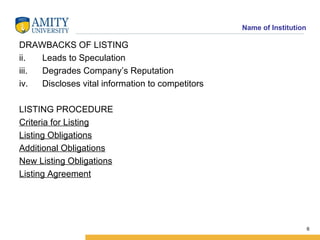
DRAWBACKS OF LISTING Leads to Speculation Degrades Company’s Reputation Discloses vital information to competitors LISTING PROCEDURE Criteria for Listing Listing Obligations Additional Obligations New Listing Obligations Listing Agreement
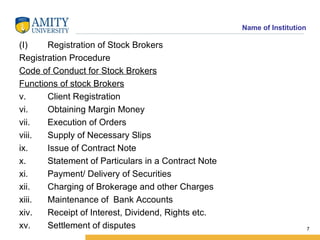
Registration of Stock Brokers Registration Procedure Code of Conduct for Stock Brokers Functions of stock Brokers Client Registration Obtaining Margin Money Execution of Orders Supply of Necessary Slips Issue of Contract Note Statement of Particulars in a Contract Note Payment/ Delivery of Securities Charging of Brokerage and other Charges Maintenance of  Bank Accounts Receipt of Interest, Dividend, Rights etc. Settlement of disputes
REGISTRATION OF SUB-BROKERS KINDS OF BROKERS AND THEIR ASSISTANTS Jobbers Tara Waril Walas Commission Brokers Sub-Brokers/ Remisiers Authorized Clerks Method of Trading in a Stock Exchange Choice of a Broker Placement of Order At Best Order Limit order Immediate or Cancel Order Discretionary Order Limited Discretionary Order Open Order Stop Loss Order
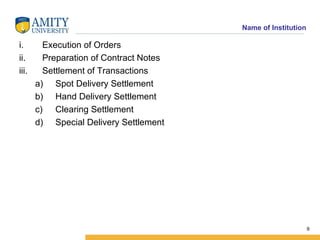
Execution of Orders Preparation of Contract Notes Settlement of Transactions Spot Delivery Settlement Hand Delivery Settlement Clearing Settlement Special Delivery Settlement
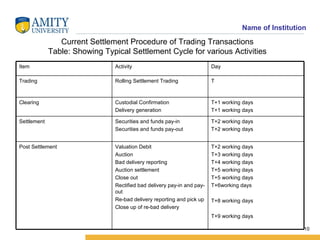
Current Settlement Procedure of Trading Transactions Table: Showing Typical Settlement Cycle for various Activities T+2 working days T+2 working days Securities and funds pay-in Securities and funds pay-out Settlement T+2 working days T+3 working days T+4 working days T+5 working days T+5 working days T+6working days T+8 working days T+9 working days Valuation Debit Auction Bad delivery reporting Auction settlement Close out Rectified bad delivery pay-in and pay-out Re-bad delivery reporting and pick up Close up of re-bad delivery Post Settlement T+1 working days T+1 working days Custodial Confirmation Delivery generation Clearing T Rolling Settlement Trading Trading Day Activity Item
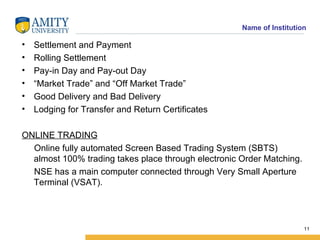
Settlement and Payment Rolling Settlement Pay-in Day and Pay-out Day “ Market Trade” and “Off Market Trade” Good Delivery and Bad Delivery Lodging for Transfer and Return Certificates ONLINE TRADING Online fully automated Screen Based Trading System (SBTS) almost 100% trading takes place through electronic Order Matching. NSE has a main computer connected through Very Small Aperture Terminal (VSAT).
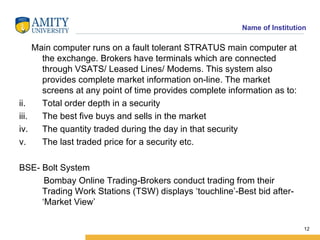
Main computer runs on a fault tolerant STRATUS main computer at the exchange. Brokers have terminals which are connected through VSATS/ Leased Lines/ Modems. This system also provides complete market information on-line. The market screens at any point of time provides complete information as to: Total order depth in a security The best five buys and sells in the market The quantity traded during the day in that security  The last traded price for a security etc. BSE- Bolt System Bombay Online Trading-Brokers conduct trading from their Trading Work Stations (TSW) displays ‘touchline’-Best bid after- ‘Market View’
Merits of Online Trading Faster Trading  Accessible to All Faster Incorporation of Price Sensitive Information Widening the market Saving of time and cost Fully transparent No errors and frauds Perfect audit trial Types Of Stock Market Orders (NSE – NEAT SYSTEM) NEAT – National Exchange for automated trading Time conditions Quantity conditions Price conditions Quantity freezes
Time Conditions Day order GTC- A Good Till Cancelled GTD – A Good Till Days IOC – Immediate or cancel order Quantity Conditions DQ – Disclosed Quantity MF – Minimum Fill Order AON – All or non order
Price Conditions STOP – Loss order MKT Order – Market Order. For which the price is specified on ‘MKT’ ATO – At the Open – Market orders entered during pre – open stage ABO – At Best Order DO – Discretionary order Quantity Price Freezes Quantity Freeze – Quantity ordered in greater than 10% of the issue size of the security Price Freeze
Carry over or Badla Transactions Badla and Short Selling Badla and Stock Landing SEBI Guidelines Genuine Trading vs Speculative Trading Kind of Speculators
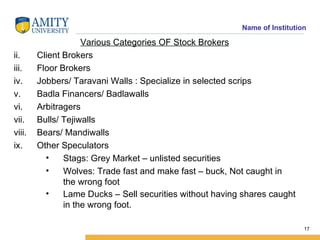
Various Categories OF Stock Brokers Client Brokers Floor Brokers Jobbers/ Taravani Walls : Specialize in selected scrips Badla Financers/ Badlawalls Arbitragers Bulls/ Tejiwalls Bears/ Mandiwalls Other Speculators Stags: Grey Market – unlisted securities Wolves: Trade fast and make fast – buck, Not caught in the wrong foot Lame Ducks – Sell securities without having shares caught in the wrong foot.
Speculative Transactions Option Dealing Wash Sales Arbitrage Cornering Rigging the Market Blank Transfers Margin Trading
OPTION DEALING When the option gives the option holder a right to buy securities at a predetermined price – It is called Call Option, on the other hand when the option gives the option holder a right to sell securities at a predetermined price, it is called Put Option. When both rights are given it is called Double Option. OPTIONS FOR HEADING Wash Sales – Speculator sells a security and then buys the same at a higher price through another broker. There is severe penalty for such sales. Arbitrage Cornering – Process of holding entire supply of a particular security. Ragging the market – Market value of a particular share is pushed up – Speculators buy and sell to ‘ make a market’ and gradually sell the holdings to get huge profits.
Blank Transfers When seller simply signs the transfer form without specifying the name of the buyer. Margin Trading It is carried on by the clients with funds borrowed from their brokers.
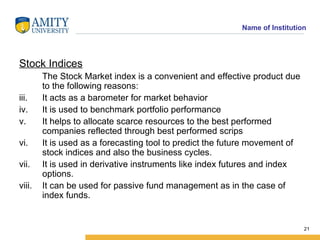
Stock Indices The Stock Market index is a convenient and effective product due to the following reasons: It acts as a barometer for market behavior It is used to benchmark portfolio performance It helps to allocate scarce resources to the best performed companies reflected through best performed scrips It is used as a forecasting tool to predict the future movement of stock indices and also the business cycles. It is used in derivative instruments like index futures and index options. It can be used for passive fund management as in the case of index funds.
Stock Indices of BSE NSE Indices of BSE : The base year for this index is April 1979. Sensex – Launched on 2 nd  January, 1986. Originally 30 companies representing various sectors on the exchange. At present, all scrips are selected from specified groups only. This index is available online and it is updated continuously.
BSE National Index : This trade up of 100 scrips with 1982-84 as base year. It includes prices of scrips of Delhi, Calcutta, Ahmedabad and Madras. The average price of the scrip is taken for the compilation of the index. BSE-200 :  Introduced in May, 1994 with 1989-90 as the base year. Consists of equity shares of 200 companies selected on the basis of market capitalization, volume of turnover and strength of the companies fundamentals. It comprises of scrips of both specified and non specified groups.
Dollex : It is BSE-200 expressed in Dollar values so that it may be useful to foreign investors. In Dollex, the BSE-200 is modified by dividing the current rupee market value by rupee – dollar conversion rate. BSE-500 :  Introduced in 1999 with the base year 1999. It is treated to be standard index covering all sections of the economy as well as the major part of the capital.
The Indian Financial system at present INTERMEDIARIES: Banking: RBI, Commercial banks, Co operative credit societies and banks, Post office saving banks  Non- Banking: Provident funds, Pension funds, LIC,GIC,UTI, Mutual funds, Investment companies, Finance corporations, Hire purchase and lease finance companies, National housing bank and other housing finance companies, HUDCO, Venture capital funds, National cooperative  bank of India
Special Development : Industrial finance corporation of India (IFCI),ICICI,IDBI,IRBI,NABARD,IFCI, EXIM Bank, Agriculture finance Consultancy ltd., National Co operative Development corporation, NIDC,NSIC, State industrial Investment Corporations, SSIDCs, Power finance Corporation (PFC)
Regulatory and Others: I. Regulatory: RBI, SEBI, BFIR, Board for financial supervision, Insurance regulatory authority II. Others: Deposit insurance and credit guarantee corporation, Export credit guarantee corporation, Stock holding corporation of India, CRISIL, ICRA, Merchant banks, Factoring companies, Depositories, Custodians
Instruments & Markets: Instruments :Equity shares, preference shares, Industrial debentures or bonds, Capital gains bonds, National development bonds, NSCs, CDs, CPs, Treasury bills, commercial bills, Social Security certificates, GDRs, foreign bonds, Floating rate notes (FRNs), Foreign currency convertible bonds, Zero coupon bonds, Non- voting shares, Indexed bonds, Future, option ,swaps and other financial derivatives Markets: Call money market, Treasury bills market, Government securities market, Foreign exchange market, Industrial securities market (stock market), OTCE, NSE, Derivatives market, Equity market
Services: Hire purchase and  installment credit, Merchant banking, Factoring, Stock holding, discounting and rediscounting, Underwriting, Leasing, Financial and performance guarantees, Acceptances, Fund transfer, Credit cards, Loan syndicating, Portfolio management, Managing Capital issues, Custodial services, Depository services

D55b3 Indian Financial System

  • 1.
  • 2.
    Capital Markets: Theseinclude treasury bill market, call money market, inter bank market, bill market, government securities (gilt-edged) market, Industrial Securities market, Public debt market, etc. Range of services: Management Marketing and underwriting of new issues Project promotion services and project finance Syndication of credit and other facilities Leasing, including project leasing Corporate advisory services Investment advisory services Bought out deals Venture capital Mutual funds and offshore funds Investment Management including Discretionary Management Assistance for technical or financial collaboration and joint ventures Investment services for Non- Indians Commercial paper- Management and dealing, etc
  • 3.
    SECONDARY MARKET IntroductionControl over Secondary Market i. Recognition of Stock Exchange Listing of Securities Registration of Broker Functions/ Services of Stock Exchanges Liquidity and Marketability of Securities Safety of Funds Supply of Long Term Funds Flow of Capital to Profitable Ventures Motivation for Improved Performance Promotion of Investment
  • 4.
    Reflection of BusinessCycle Marketing of New Issues Miscellaneous Services- Wider Portfolio Choices RECOGNITION PROCEDURE Recognized by the Central Government under SCRA and SEBI Grant of Recognition Renewal of Recognition Organization of Stock Exchanges in India Traditional Structure of Stock Exchanges Demutualization of Stock Exchanges Management Membership
  • 5.
    Listing of SecuritiesGroup A, Group B and Group C Shares (BSE) Group A shares (Specified Shares or Cleared securities) Group B shares (Non-Specified Shares or Non-Cleared Securities) Group C shares (Only ODD Lots) ADVANTAGES OF LISTING Facilitates Buying and Selling Secrities Ensures Liquidity Offers Publicity Assures Finance Enables Borrowing Protects Investors
  • 6.
    DRAWBACKS OF LISTINGLeads to Speculation Degrades Company’s Reputation Discloses vital information to competitors LISTING PROCEDURE Criteria for Listing Listing Obligations Additional Obligations New Listing Obligations Listing Agreement
  • 7.
    Registration of StockBrokers Registration Procedure Code of Conduct for Stock Brokers Functions of stock Brokers Client Registration Obtaining Margin Money Execution of Orders Supply of Necessary Slips Issue of Contract Note Statement of Particulars in a Contract Note Payment/ Delivery of Securities Charging of Brokerage and other Charges Maintenance of Bank Accounts Receipt of Interest, Dividend, Rights etc. Settlement of disputes
  • 8.
    REGISTRATION OF SUB-BROKERSKINDS OF BROKERS AND THEIR ASSISTANTS Jobbers Tara Waril Walas Commission Brokers Sub-Brokers/ Remisiers Authorized Clerks Method of Trading in a Stock Exchange Choice of a Broker Placement of Order At Best Order Limit order Immediate or Cancel Order Discretionary Order Limited Discretionary Order Open Order Stop Loss Order
  • 9.
    Execution of OrdersPreparation of Contract Notes Settlement of Transactions Spot Delivery Settlement Hand Delivery Settlement Clearing Settlement Special Delivery Settlement
  • 10.
    Current Settlement Procedureof Trading Transactions Table: Showing Typical Settlement Cycle for various Activities T+2 working days T+2 working days Securities and funds pay-in Securities and funds pay-out Settlement T+2 working days T+3 working days T+4 working days T+5 working days T+5 working days T+6working days T+8 working days T+9 working days Valuation Debit Auction Bad delivery reporting Auction settlement Close out Rectified bad delivery pay-in and pay-out Re-bad delivery reporting and pick up Close up of re-bad delivery Post Settlement T+1 working days T+1 working days Custodial Confirmation Delivery generation Clearing T Rolling Settlement Trading Trading Day Activity Item
  • 11.
    Settlement and PaymentRolling Settlement Pay-in Day and Pay-out Day “ Market Trade” and “Off Market Trade” Good Delivery and Bad Delivery Lodging for Transfer and Return Certificates ONLINE TRADING Online fully automated Screen Based Trading System (SBTS) almost 100% trading takes place through electronic Order Matching. NSE has a main computer connected through Very Small Aperture Terminal (VSAT).
  • 12.
    Main computer runson a fault tolerant STRATUS main computer at the exchange. Brokers have terminals which are connected through VSATS/ Leased Lines/ Modems. This system also provides complete market information on-line. The market screens at any point of time provides complete information as to: Total order depth in a security The best five buys and sells in the market The quantity traded during the day in that security The last traded price for a security etc. BSE- Bolt System Bombay Online Trading-Brokers conduct trading from their Trading Work Stations (TSW) displays ‘touchline’-Best bid after- ‘Market View’
  • 13.
    Merits of OnlineTrading Faster Trading Accessible to All Faster Incorporation of Price Sensitive Information Widening the market Saving of time and cost Fully transparent No errors and frauds Perfect audit trial Types Of Stock Market Orders (NSE – NEAT SYSTEM) NEAT – National Exchange for automated trading Time conditions Quantity conditions Price conditions Quantity freezes
  • 14.
    Time Conditions Dayorder GTC- A Good Till Cancelled GTD – A Good Till Days IOC – Immediate or cancel order Quantity Conditions DQ – Disclosed Quantity MF – Minimum Fill Order AON – All or non order
  • 15.
    Price Conditions STOP– Loss order MKT Order – Market Order. For which the price is specified on ‘MKT’ ATO – At the Open – Market orders entered during pre – open stage ABO – At Best Order DO – Discretionary order Quantity Price Freezes Quantity Freeze – Quantity ordered in greater than 10% of the issue size of the security Price Freeze
  • 16.
    Carry over orBadla Transactions Badla and Short Selling Badla and Stock Landing SEBI Guidelines Genuine Trading vs Speculative Trading Kind of Speculators
  • 17.
    Various Categories OFStock Brokers Client Brokers Floor Brokers Jobbers/ Taravani Walls : Specialize in selected scrips Badla Financers/ Badlawalls Arbitragers Bulls/ Tejiwalls Bears/ Mandiwalls Other Speculators Stags: Grey Market – unlisted securities Wolves: Trade fast and make fast – buck, Not caught in the wrong foot Lame Ducks – Sell securities without having shares caught in the wrong foot.
  • 18.
    Speculative Transactions OptionDealing Wash Sales Arbitrage Cornering Rigging the Market Blank Transfers Margin Trading
  • 19.
    OPTION DEALING Whenthe option gives the option holder a right to buy securities at a predetermined price – It is called Call Option, on the other hand when the option gives the option holder a right to sell securities at a predetermined price, it is called Put Option. When both rights are given it is called Double Option. OPTIONS FOR HEADING Wash Sales – Speculator sells a security and then buys the same at a higher price through another broker. There is severe penalty for such sales. Arbitrage Cornering – Process of holding entire supply of a particular security. Ragging the market – Market value of a particular share is pushed up – Speculators buy and sell to ‘ make a market’ and gradually sell the holdings to get huge profits.
  • 20.
    Blank Transfers Whenseller simply signs the transfer form without specifying the name of the buyer. Margin Trading It is carried on by the clients with funds borrowed from their brokers.
  • 21.
    Stock Indices TheStock Market index is a convenient and effective product due to the following reasons: It acts as a barometer for market behavior It is used to benchmark portfolio performance It helps to allocate scarce resources to the best performed companies reflected through best performed scrips It is used as a forecasting tool to predict the future movement of stock indices and also the business cycles. It is used in derivative instruments like index futures and index options. It can be used for passive fund management as in the case of index funds.
  • 22.
    Stock Indices ofBSE NSE Indices of BSE : The base year for this index is April 1979. Sensex – Launched on 2 nd January, 1986. Originally 30 companies representing various sectors on the exchange. At present, all scrips are selected from specified groups only. This index is available online and it is updated continuously.
  • 23.
    BSE National Index: This trade up of 100 scrips with 1982-84 as base year. It includes prices of scrips of Delhi, Calcutta, Ahmedabad and Madras. The average price of the scrip is taken for the compilation of the index. BSE-200 : Introduced in May, 1994 with 1989-90 as the base year. Consists of equity shares of 200 companies selected on the basis of market capitalization, volume of turnover and strength of the companies fundamentals. It comprises of scrips of both specified and non specified groups.
  • 24.
    Dollex : Itis BSE-200 expressed in Dollar values so that it may be useful to foreign investors. In Dollex, the BSE-200 is modified by dividing the current rupee market value by rupee – dollar conversion rate. BSE-500 : Introduced in 1999 with the base year 1999. It is treated to be standard index covering all sections of the economy as well as the major part of the capital.
  • 25.
    The Indian Financialsystem at present INTERMEDIARIES: Banking: RBI, Commercial banks, Co operative credit societies and banks, Post office saving banks Non- Banking: Provident funds, Pension funds, LIC,GIC,UTI, Mutual funds, Investment companies, Finance corporations, Hire purchase and lease finance companies, National housing bank and other housing finance companies, HUDCO, Venture capital funds, National cooperative bank of India
  • 26.
    Special Development :Industrial finance corporation of India (IFCI),ICICI,IDBI,IRBI,NABARD,IFCI, EXIM Bank, Agriculture finance Consultancy ltd., National Co operative Development corporation, NIDC,NSIC, State industrial Investment Corporations, SSIDCs, Power finance Corporation (PFC)
  • 27.
    Regulatory and Others:I. Regulatory: RBI, SEBI, BFIR, Board for financial supervision, Insurance regulatory authority II. Others: Deposit insurance and credit guarantee corporation, Export credit guarantee corporation, Stock holding corporation of India, CRISIL, ICRA, Merchant banks, Factoring companies, Depositories, Custodians
  • 28.
    Instruments & Markets:Instruments :Equity shares, preference shares, Industrial debentures or bonds, Capital gains bonds, National development bonds, NSCs, CDs, CPs, Treasury bills, commercial bills, Social Security certificates, GDRs, foreign bonds, Floating rate notes (FRNs), Foreign currency convertible bonds, Zero coupon bonds, Non- voting shares, Indexed bonds, Future, option ,swaps and other financial derivatives Markets: Call money market, Treasury bills market, Government securities market, Foreign exchange market, Industrial securities market (stock market), OTCE, NSE, Derivatives market, Equity market
  • 29.
    Services: Hire purchaseand installment credit, Merchant banking, Factoring, Stock holding, discounting and rediscounting, Underwriting, Leasing, Financial and performance guarantees, Acceptances, Fund transfer, Credit cards, Loan syndicating, Portfolio management, Managing Capital issues, Custodial services, Depository services