


כנס מיזוגים ורכישות ה 8 - 
M&A Best Practices
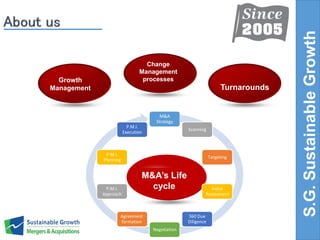
Turnarounds 
Change 
Management 
processes 
P.M.I. 
Execution 
M&A’s Life 
cycle 
Growth 
Management 
M&A 
Strategy 
Scanning 
Targeting 
Initial 
Assessment 
360 Due 
Diligence 
Negotiation 
P.M.I. 
Planning 
P.M.I. 
Approach 
Agreement 
formation 
S.G. Sustainable Growth
• We are an international partnership of consultancies 
specialising in Post-Merger Integration advisory services 
• We advise our clients on the integration / separation of domestic 
or cross-border acquisitions / divestitures 
• We work alongside our international clients in lean, highly 
experienced executive teams, focusing on transferring the 
benefits of our skills and experiences over to the internal 
staff. 
• We can support you with everything from training course and 
integration capability enhancements through to setting up and 
managing your global integration programme 
• We are the only global consulting network dedicated to merger 
and acquisition programmes 
• With top firm consultancy and industry backgrounds, our 
team brings a richness of knowledge, skills and experiences 
• We have a global network of experienced M&A consultants 
with functional expertise 
• We are 10 member firms, in 8 countries and over 20 
consultants 
Global P.M.I. Partners 
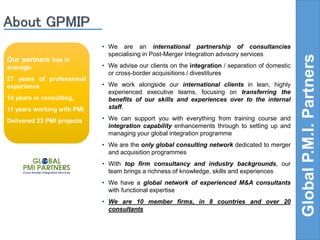
Our partners has in 
average: 
27 years of professional 
experience 
14 years in consulting, 
11 years working with PMI 
Delivered 23 PMI projects
4
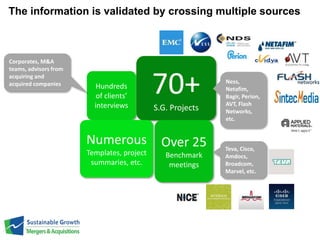
The information is validated by crossing multiple sources 
5 
Hundreds 
of clients’ 
interviews 
70+ 
S.G. Projects 
Numerous 
Templates, project 
summaries, etc. 
Corporates, M&A 
teams, advisors from 
acquiring and 
acquired companies 
Over 25 
Benchmark 
meetings 
Ness, 
Netafim, 
Bagir, Perion, 
AVT, Flash 
Networks, 
etc. 
Teva, Cisco, 
Amdocs, 
Broadcom, 
Marvel, etc.
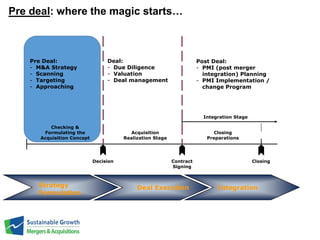
Pre deal: where the magic starts… 
Checking & 
Formulating the 
Acquisition Concept 
Decision Contract 
Signing 
Closing 
Acquisition 
Realization Stage 
Integration Stage 
Closing 
Preparations 
Pre Deal: 
- M&A Strategy 
- Scanning 
- Targeting 
- Approaching 
Deal: 
- Due Diligence 
- Valuation 
- Deal management 
Post Deal: 
- PMI (post merger 
integration) Planning 
- PMI Implementation / 
change Program 
Strategy 
Formulation 
Deal Execution Integration
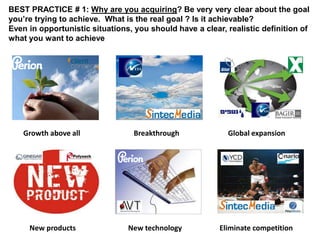
BEST PRACTICE # 1: Why are you acquiring? Be very very clear about the goal 
you’re trying to achieve. What is the real goal ? Is it achievable? 
Even in opportunistic situations, you should have a clear, realistic definition of 
what you want to achieve 
Growth above all Breakthrough Global expansion 
New products New technology Eliminate competition
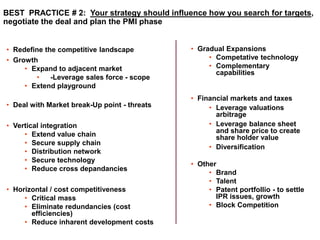
BEST PRACTICE # 2: Your strategy should influence how you search for targets, 
negotiate the deal and plan the PMI phase 
• Redefine the competitive landscape 
• Growth 
• Expand to adjacent market 
• -Leverage sales force - scope 
• Extend playground 
• Deal with Market break-Up point - threats 
• Vertical integration 
• Extend value chain 
• Secure supply chain 
• Distribution network 
• Secure technology 
• Reduce cross depandancies 
• Horizontal / cost competitiveness 
• Critical mass 
• Eliminate redundancies (cost 
efficiencies) 
• Reduce inharent development costs 
• Gradual Expansions 
• Competative technology 
• Complementary 
capabilities 
• Financial markets and taxes 
• Leverage valuations 
arbitrage 
• Leverage balance sheet 
and share price to create 
share holder value 
• Diversification 
• Other 
• Brand 
• Talent 
• Patent portfollio - to settle 
IPR issues, growth 
• Block Competition
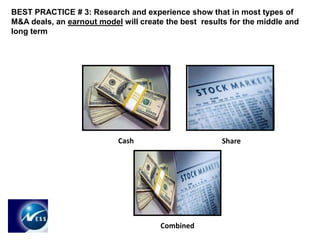
BEST PRACTICE # 3: Research and experience show that in most types of 
M&A deals, an earnout model will create the best results for the middle and 
long term 
Cash Share 
Combined
BEST PRACTICE #4: (start) buying Small, especially if you have limited M&A 
experience. Small deals are much more successful 
Making Your Drinks Come True
BEST PRACTICE #5: Synergies are overestimated. Try not to fall in love with the 
deal and not be overly optimistic. Remind your self that in 12 months you will 
have to explain to the board why the synergies you promised were not achieved.
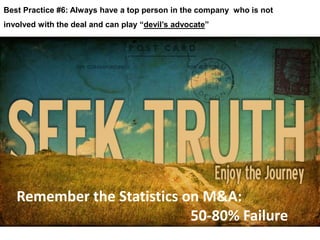
Best Practice #6: Always have a top person in the company who is not 
involved with the deal and can play “devil’s advocate” 
Remember the Statistics on M&A: 
50-80% Failure
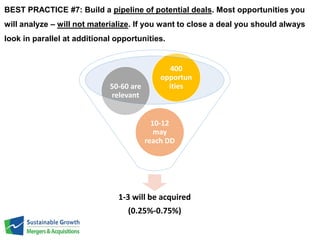
BEST PRACTICE #7: Build a pipeline of potential deals. Most opportunities you 
will analyze – will not materialize. If you want to close a deal you should always 
look in parallel at additional opportunities. 
400 
opportun 
ities 
10-12 
may 
reach DD 
50-60 are 
relevant 
1-3 will be acquired 
(0.25%-0.75%)
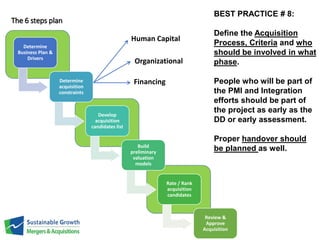
The 6 steps plan 
Determine 
Business Plan & 
Drivers 
Determine 
acquisition 
constraints 
Develop 
acquisition 
candidates list 
Human Capital 
Build 
preliminary 
valuation 
models 
Rate / Rank 
acquisition 
candidates 
Review & 
Approve 
Acquisition 
Organizational 
Financing 
BEST PRACTICE # 8: 
Define the Acquisition 
Process, Criteria and who 
should be involved in what 
phase. 
People who will be part of 
the PMI and Integration 
efforts should be part of 
the project as early as the 
DD or early assessment. 
Proper handover should 
be planned as well.
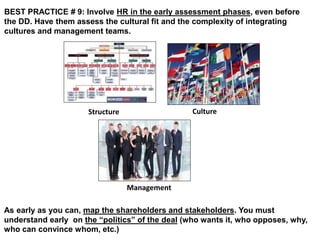
BEST PRACTICE # 9: Involve HR in the early assessment phases, even before 
the DD. Have them assess the cultural fit and the complexity of integrating 
cultures and management teams. 
Structure Culture 
Management 
As early as you can, map the shareholders and stakeholders. You must 
understand early on the “politics” of the deal (who wants it, who opposes, why, 
who can convince whom, etc.)
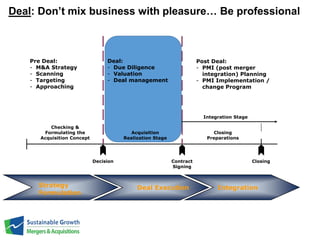
Deal: Don’t mix business with pleasure… Be professional 
Checking & 
Formulating the 
Acquisition Concept 
Decision Contract 
Signing 
Closing 
Acquisition 
Realization Stage 
Integration Stage 
Closing 
Preparations 
Pre Deal: 
- M&A Strategy 
- Scanning 
- Targeting 
- Approaching 
Deal: 
- Due Diligence 
- Valuation 
- Deal management 
Post Deal: 
- PMI (post merger 
integration) Planning 
- PMI Implementation / 
change Program 
Strategy 
Formulation 
Deal Execution Integration
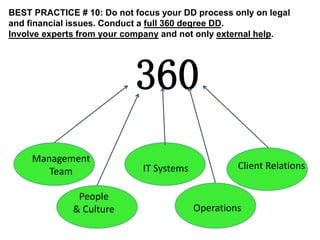
BEST PRACTICE # 10: Do not focus your DD process only on legal 
and financial issues. Conduct a full 360 degree DD. 
Involve experts from your company and not only external help. 
360 
Management 
Team IT Systems 
Client Relations 
People 
& Culture Operations
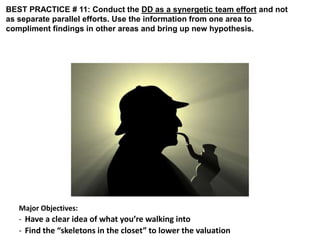
BEST PRACTICE # 11: Conduct the DD as a synergetic team effort and not 
as separate parallel efforts. Use the information from one area to 
compliment findings in other areas and bring up new hypothesis. 
Major Objectives: 
- Have a clear idea of what you’re walking into 
- Find the “skeletons in the closet” to lower the valuation
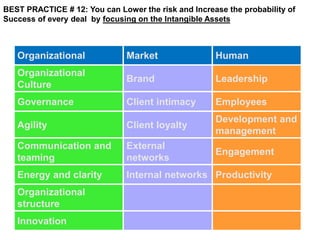
BEST PRACTICE # 12: You can Lower the risk and Increase the probability of 
Success of every deal by focusing on the Intangible Assets 
Organizational Market Human 
Organizational 
Source : 
Culture 
Brand Leadership 
Governance Client intimacy Employees 
Agility Client loyalty 
Development and 
management 
Communication and 
teaming 
External 
networks 
Engagement 
Energy and clarity Internal networks Productivity 
Organizational 
structure 
Innovation
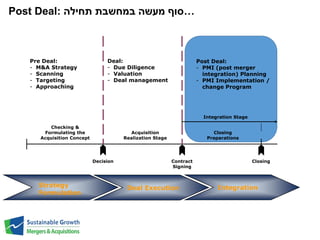
Post Deal: …סוף מעשה במחשבת תחילה 
Checking & 
Formulating the 
Acquisition Concept 
Decision Contract 
Signing 
Closing 
Acquisition 
Realization Stage 
Integration Stage 
Closing 
Preparations 
Pre Deal: 
- M&A Strategy 
- Scanning 
- Targeting 
- Approaching 
Deal: 
- Due Diligence 
- Valuation 
- Deal management 
Post Deal: 
- PMI (post merger 
integration) Planning 
- PMI Implementation / 
change Program 
Strategy 
Formulation 
Deal Execution Integration
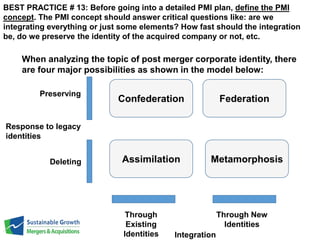
BEST PRACTICE # 13: Before going into a detailed PMI plan, define the PMI 
concept. The PMI concept should answer critical questions like: are we 
integrating everything or just some elements? How fast should the integration 
be, do we preserve the identity of the acquired company or not, etc. 
When analyzing the topic of post merger corporate identity, there 
are four major possibilities as shown in the model below: 
Preserving 
Deleting 
Through 
Existing 
Identities 
Through New 
Identities 
Confederation 
Assimilation 
Federation 
Metamorphosis 
Response to legacy 
identities 
Integration
BEST PRACTICE # 14: Most books on M&A say you must do things quickly, 
“finish the integration process in 100 days”. Experience shows that certain 
aspects need to be handled fast and others need to take more time. You 
need to differentiate between them. 
“In M&As sometimes fast is slow and slow is fast”
© 2008 
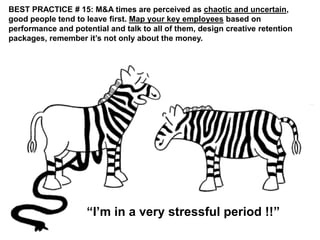
BEST PRACTICE # 15: M&A times are perceived as chaotic and uncertain, 
good people tend to leave first. Map your key employees based on 
performance and potential and talk to all of them, design creative retention 
packages, remember it’s not only about the money. 
“I’m in a very stressful period !!”
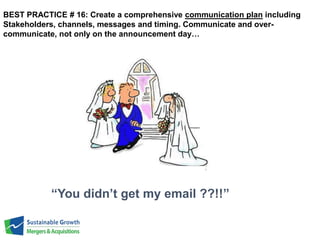
BEST PRACTICE # 16: Create a comprehensive communication plan including 
Stakeholders, channels, messages and timing. Communicate and over-communicate, 
not only on the announcement day… 
“You didn’t get my email ??!!”
BEST PRACTICE # 17: Throughout M&As “Me issues” dominate both companies 
at all levels... 
Will I have a job? 
Will my pay and benefits change? 
Who will I report to? 
Will I have to move? 
What will ‘they’ be like to work for? 
Others... 
Example “Me Issues”
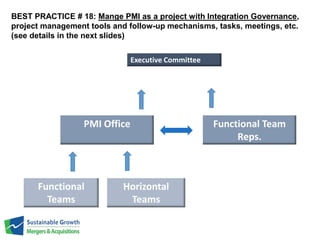
BEST PRACTICE # 18: Mange PMI as a project with Integration Governance, 
project management tools and follow-up mechanisms, tasks, meetings, etc. 
(see details in the next slides) 
Executive Committee 
PMI Office 
Functional 
Teams 
Horizontal 
Teams 
Functional Team 
Reps.
Quick Summary on M&A Value…. 
eitan@sg-ltd.com

M&a convention 2014 m&a best practices

  • 1.
    כנס מיזוגים ורכישותה 8 - M&A Best Practices
  • 2.
    Turnarounds Change Management processes P.M.I. Execution M&A’s Life cycle Growth Management M&A Strategy Scanning Targeting Initial Assessment 360 Due Diligence Negotiation P.M.I. Planning P.M.I. Approach Agreement formation S.G. Sustainable Growth
  • 3.
    • We arean international partnership of consultancies specialising in Post-Merger Integration advisory services • We advise our clients on the integration / separation of domestic or cross-border acquisitions / divestitures • We work alongside our international clients in lean, highly experienced executive teams, focusing on transferring the benefits of our skills and experiences over to the internal staff. • We can support you with everything from training course and integration capability enhancements through to setting up and managing your global integration programme • We are the only global consulting network dedicated to merger and acquisition programmes • With top firm consultancy and industry backgrounds, our team brings a richness of knowledge, skills and experiences • We have a global network of experienced M&A consultants with functional expertise • We are 10 member firms, in 8 countries and over 20 consultants Global P.M.I. Partners Our partners has in average: 27 years of professional experience 14 years in consulting, 11 years working with PMI Delivered 23 PMI projects
  • 4.
  • 5.
    The information isvalidated by crossing multiple sources 5 Hundreds of clients’ interviews 70+ S.G. Projects Numerous Templates, project summaries, etc. Corporates, M&A teams, advisors from acquiring and acquired companies Over 25 Benchmark meetings Ness, Netafim, Bagir, Perion, AVT, Flash Networks, etc. Teva, Cisco, Amdocs, Broadcom, Marvel, etc.
  • 6.
    Pre deal: wherethe magic starts… Checking & Formulating the Acquisition Concept Decision Contract Signing Closing Acquisition Realization Stage Integration Stage Closing Preparations Pre Deal: - M&A Strategy - Scanning - Targeting - Approaching Deal: - Due Diligence - Valuation - Deal management Post Deal: - PMI (post merger integration) Planning - PMI Implementation / change Program Strategy Formulation Deal Execution Integration
  • 7.
    BEST PRACTICE #1: Why are you acquiring? Be very very clear about the goal you’re trying to achieve. What is the real goal ? Is it achievable? Even in opportunistic situations, you should have a clear, realistic definition of what you want to achieve Growth above all Breakthrough Global expansion New products New technology Eliminate competition
  • 8.
    BEST PRACTICE #2: Your strategy should influence how you search for targets, negotiate the deal and plan the PMI phase • Redefine the competitive landscape • Growth • Expand to adjacent market • -Leverage sales force - scope • Extend playground • Deal with Market break-Up point - threats • Vertical integration • Extend value chain • Secure supply chain • Distribution network • Secure technology • Reduce cross depandancies • Horizontal / cost competitiveness • Critical mass • Eliminate redundancies (cost efficiencies) • Reduce inharent development costs • Gradual Expansions • Competative technology • Complementary capabilities • Financial markets and taxes • Leverage valuations arbitrage • Leverage balance sheet and share price to create share holder value • Diversification • Other • Brand • Talent • Patent portfollio - to settle IPR issues, growth • Block Competition
  • 9.
    BEST PRACTICE #3: Research and experience show that in most types of M&A deals, an earnout model will create the best results for the middle and long term Cash Share Combined
  • 10.
    BEST PRACTICE #4:(start) buying Small, especially if you have limited M&A experience. Small deals are much more successful Making Your Drinks Come True
  • 11.
    BEST PRACTICE #5:Synergies are overestimated. Try not to fall in love with the deal and not be overly optimistic. Remind your self that in 12 months you will have to explain to the board why the synergies you promised were not achieved.
  • 12.
    Best Practice #6:Always have a top person in the company who is not involved with the deal and can play “devil’s advocate” Remember the Statistics on M&A: 50-80% Failure
  • 13.
    BEST PRACTICE #7:Build a pipeline of potential deals. Most opportunities you will analyze – will not materialize. If you want to close a deal you should always look in parallel at additional opportunities. 400 opportun ities 10-12 may reach DD 50-60 are relevant 1-3 will be acquired (0.25%-0.75%)
  • 14.
    The 6 stepsplan Determine Business Plan & Drivers Determine acquisition constraints Develop acquisition candidates list Human Capital Build preliminary valuation models Rate / Rank acquisition candidates Review & Approve Acquisition Organizational Financing BEST PRACTICE # 8: Define the Acquisition Process, Criteria and who should be involved in what phase. People who will be part of the PMI and Integration efforts should be part of the project as early as the DD or early assessment. Proper handover should be planned as well.
  • 15.
    BEST PRACTICE #9: Involve HR in the early assessment phases, even before the DD. Have them assess the cultural fit and the complexity of integrating cultures and management teams. Structure Culture Management As early as you can, map the shareholders and stakeholders. You must understand early on the “politics” of the deal (who wants it, who opposes, why, who can convince whom, etc.)
  • 16.
    Deal: Don’t mixbusiness with pleasure… Be professional Checking & Formulating the Acquisition Concept Decision Contract Signing Closing Acquisition Realization Stage Integration Stage Closing Preparations Pre Deal: - M&A Strategy - Scanning - Targeting - Approaching Deal: - Due Diligence - Valuation - Deal management Post Deal: - PMI (post merger integration) Planning - PMI Implementation / change Program Strategy Formulation Deal Execution Integration
  • 17.
    BEST PRACTICE #10: Do not focus your DD process only on legal and financial issues. Conduct a full 360 degree DD. Involve experts from your company and not only external help. 360 Management Team IT Systems Client Relations People & Culture Operations
  • 18.
    BEST PRACTICE #11: Conduct the DD as a synergetic team effort and not as separate parallel efforts. Use the information from one area to compliment findings in other areas and bring up new hypothesis. Major Objectives: - Have a clear idea of what you’re walking into - Find the “skeletons in the closet” to lower the valuation
  • 19.
    BEST PRACTICE #12: You can Lower the risk and Increase the probability of Success of every deal by focusing on the Intangible Assets Organizational Market Human Organizational Source : Culture Brand Leadership Governance Client intimacy Employees Agility Client loyalty Development and management Communication and teaming External networks Engagement Energy and clarity Internal networks Productivity Organizational structure Innovation
  • 20.
    Post Deal: …סוףמעשה במחשבת תחילה Checking & Formulating the Acquisition Concept Decision Contract Signing Closing Acquisition Realization Stage Integration Stage Closing Preparations Pre Deal: - M&A Strategy - Scanning - Targeting - Approaching Deal: - Due Diligence - Valuation - Deal management Post Deal: - PMI (post merger integration) Planning - PMI Implementation / change Program Strategy Formulation Deal Execution Integration
  • 21.
    BEST PRACTICE #13: Before going into a detailed PMI plan, define the PMI concept. The PMI concept should answer critical questions like: are we integrating everything or just some elements? How fast should the integration be, do we preserve the identity of the acquired company or not, etc. When analyzing the topic of post merger corporate identity, there are four major possibilities as shown in the model below: Preserving Deleting Through Existing Identities Through New Identities Confederation Assimilation Federation Metamorphosis Response to legacy identities Integration
  • 22.
    BEST PRACTICE #14: Most books on M&A say you must do things quickly, “finish the integration process in 100 days”. Experience shows that certain aspects need to be handled fast and others need to take more time. You need to differentiate between them. “In M&As sometimes fast is slow and slow is fast”
  • 23.
    © 2008 BESTPRACTICE # 15: M&A times are perceived as chaotic and uncertain, good people tend to leave first. Map your key employees based on performance and potential and talk to all of them, design creative retention packages, remember it’s not only about the money. “I’m in a very stressful period !!”
  • 24.
    BEST PRACTICE #16: Create a comprehensive communication plan including Stakeholders, channels, messages and timing. Communicate and over-communicate, not only on the announcement day… “You didn’t get my email ??!!”
  • 25.
    BEST PRACTICE #17: Throughout M&As “Me issues” dominate both companies at all levels... Will I have a job? Will my pay and benefits change? Who will I report to? Will I have to move? What will ‘they’ be like to work for? Others... Example “Me Issues”
  • 26.
    BEST PRACTICE #18: Mange PMI as a project with Integration Governance, project management tools and follow-up mechanisms, tasks, meetings, etc. (see details in the next slides) Executive Committee PMI Office Functional Teams Horizontal Teams Functional Team Reps.
  • 27.
    Quick Summary onM&A Value…. eitan@sg-ltd.com