Amity Business School MBA Class of 2010, Semester IV Strategic Financial Management Prof Akhil Swami/Anuj Srivastava
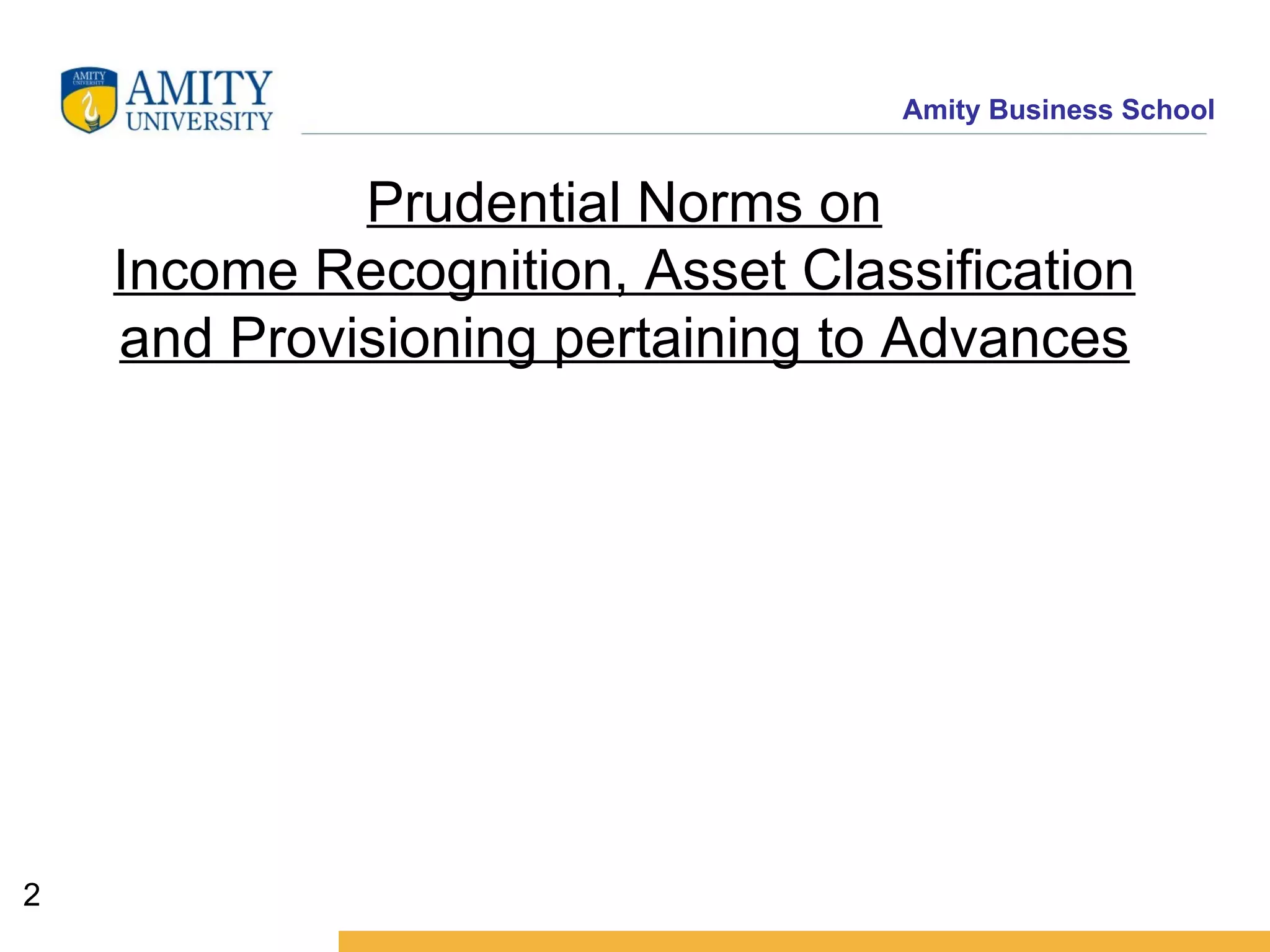
Prudential Norms on Income Recognition, Asset Classification and Provisioning pertaining to Advances
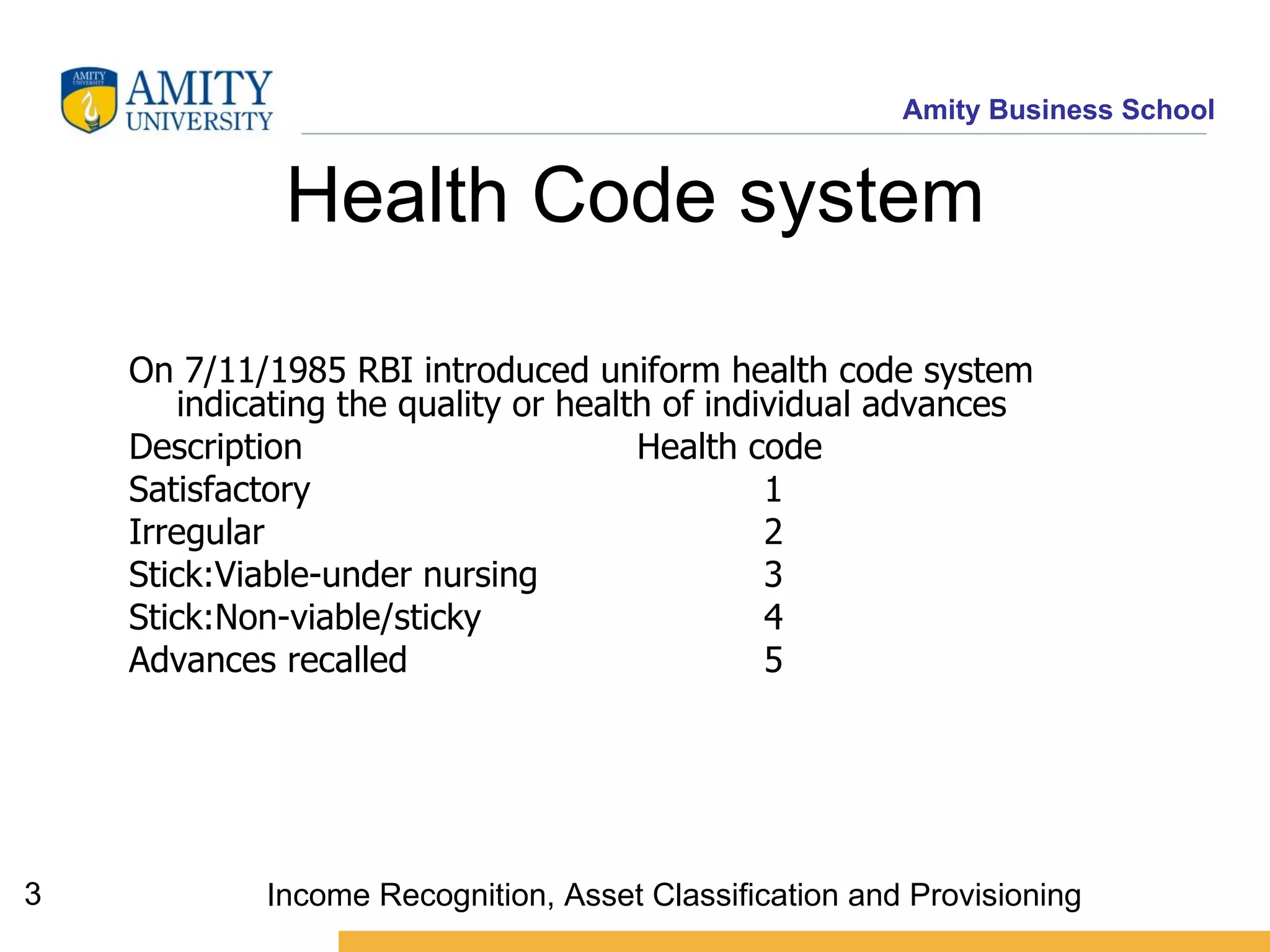
Health Code system On 7/11/1985 RBI introduced uniform health code system indicating the quality or health of individual advances  Description  Health code  Satisfactory 1 Irregular 2 Stick:Viable-under nursing 3 Stick:Non-viable/sticky 4 Advances recalled 5 Income Recognition, Asset Classification and Provisioning
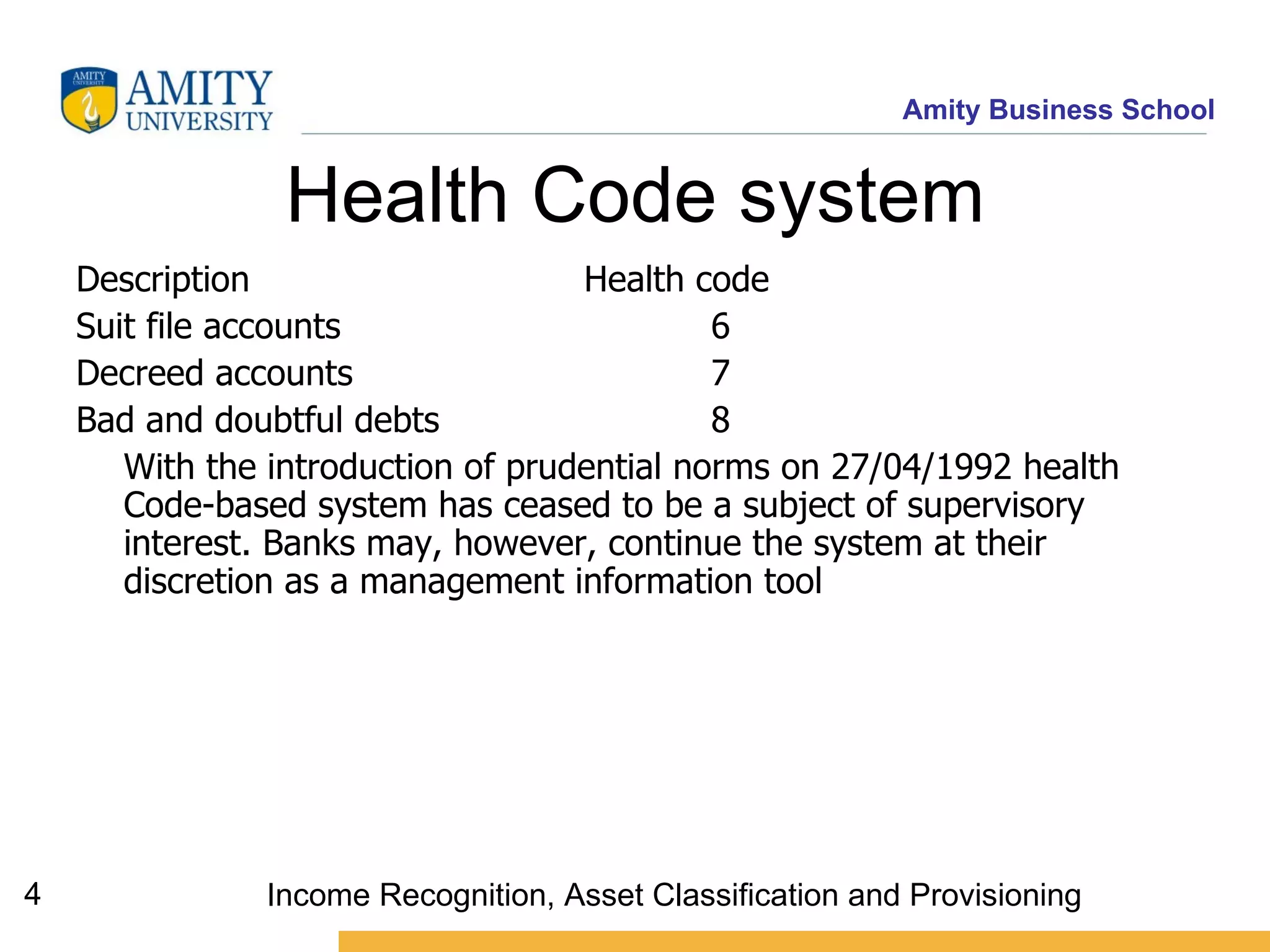
Health Code system Description  Health code  Suit file accounts 6 Decreed accounts 7 Bad and doubtful debts 8 With the introduction of prudential norms on 27/04/1992 health Code-based system has ceased to be a subject of supervisory interest. Banks may, however, continue the system at their discretion as a management information tool  Income Recognition, Asset Classification and Provisioning
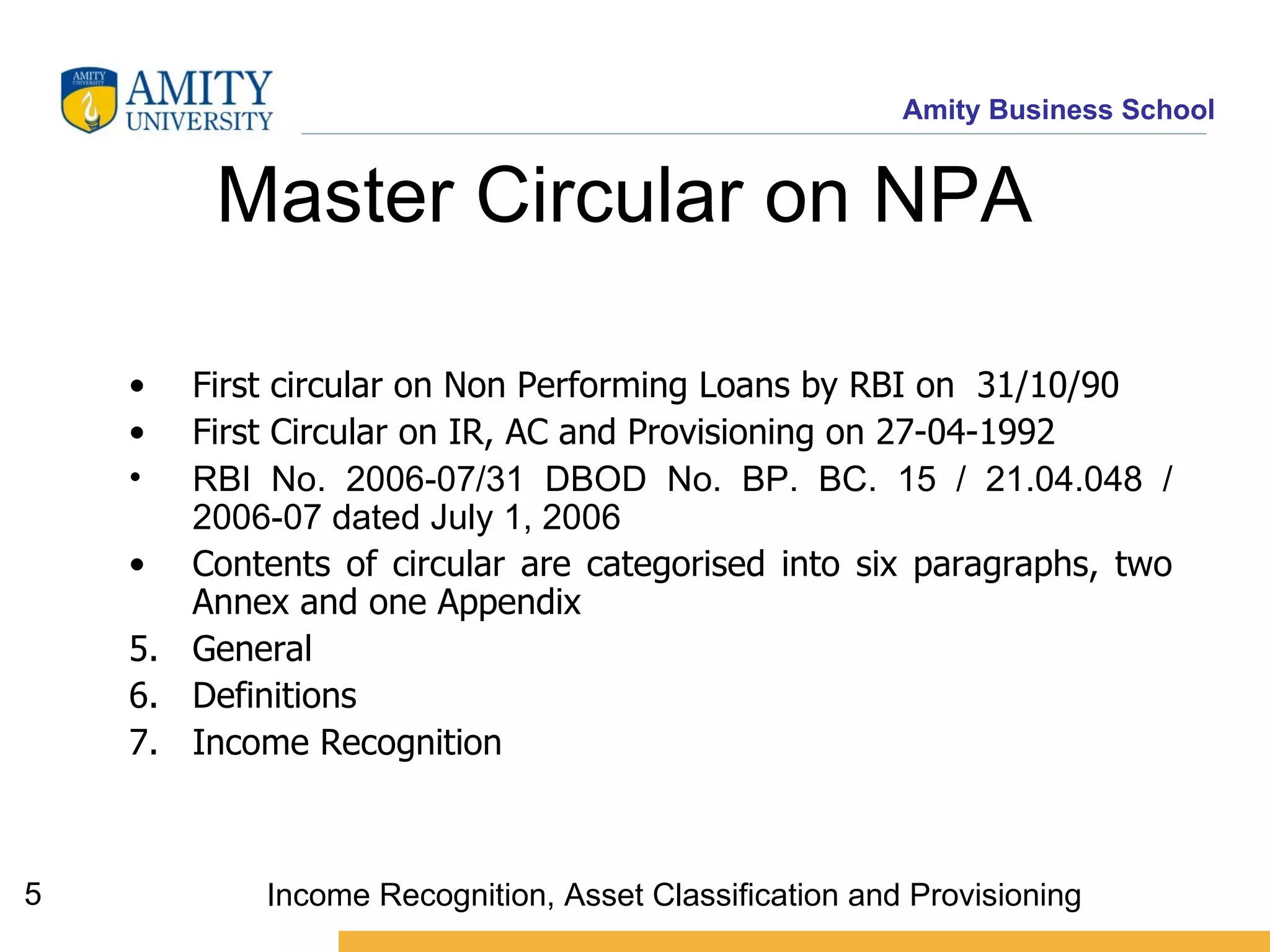
Master Circular on NPA  First circular on Non Performing Loans by RBI on  31/10/90 First Circular on IR, AC and Provisioning on 27-04-1992 RBI No. 2006-07/31 DBOD No. BP. BC. 15 / 21.04.048 / 2006-07 dated July 1, 2006 Contents of circular are categorised into six paragraphs, two Annex and one Appendix General  Definitions Income Recognition  Income Recognition, Asset Classification and Provisioning
Master Circular on NPA  Assets Classification  Provisioning norms Writing-off of NPAs Annex I on reporting format of NPA Annex II on list of agricultural advances Appendix Income Recognition, Asset Classification and Provisioning
General  Norms as per the international practice and on recommendation of  Narasimham  Committee Policy of income recognition should be objective and based on record of recovery While granting loans and advances, realistic repayment schedules may be fixed on the basis of cash flows with borrowers   Income Recognition, Asset Classification and Provisioning
Definition of NPA An asset, including a leased asset, becomes non-performing when it ceases to generate income for the bank   A non-performing asset (NPA) is a loan or an advance where;  interest and/ or installment of principal remain overdue for a period of more than 90 days in respect of a term loan the account remains ‘out of order’  in respect of an Overdraft/Cash Credit (OD/CC)  Income Recognition, Asset Classification and Provisioning
Definition of NPA  the bill remains overdue for a period of more than 90 days in the case of bills purchased and discounted a loan granted for short duration crops will be treated as NPA, if the installment of principal or interest thereon remains overdue for two crop seasons.  a loan granted for long duration crops will be treated as NPA, if the installment of principal or interest thereon remains overdue for one crop season.  Income Recognition, Asset Classification and Provisioning
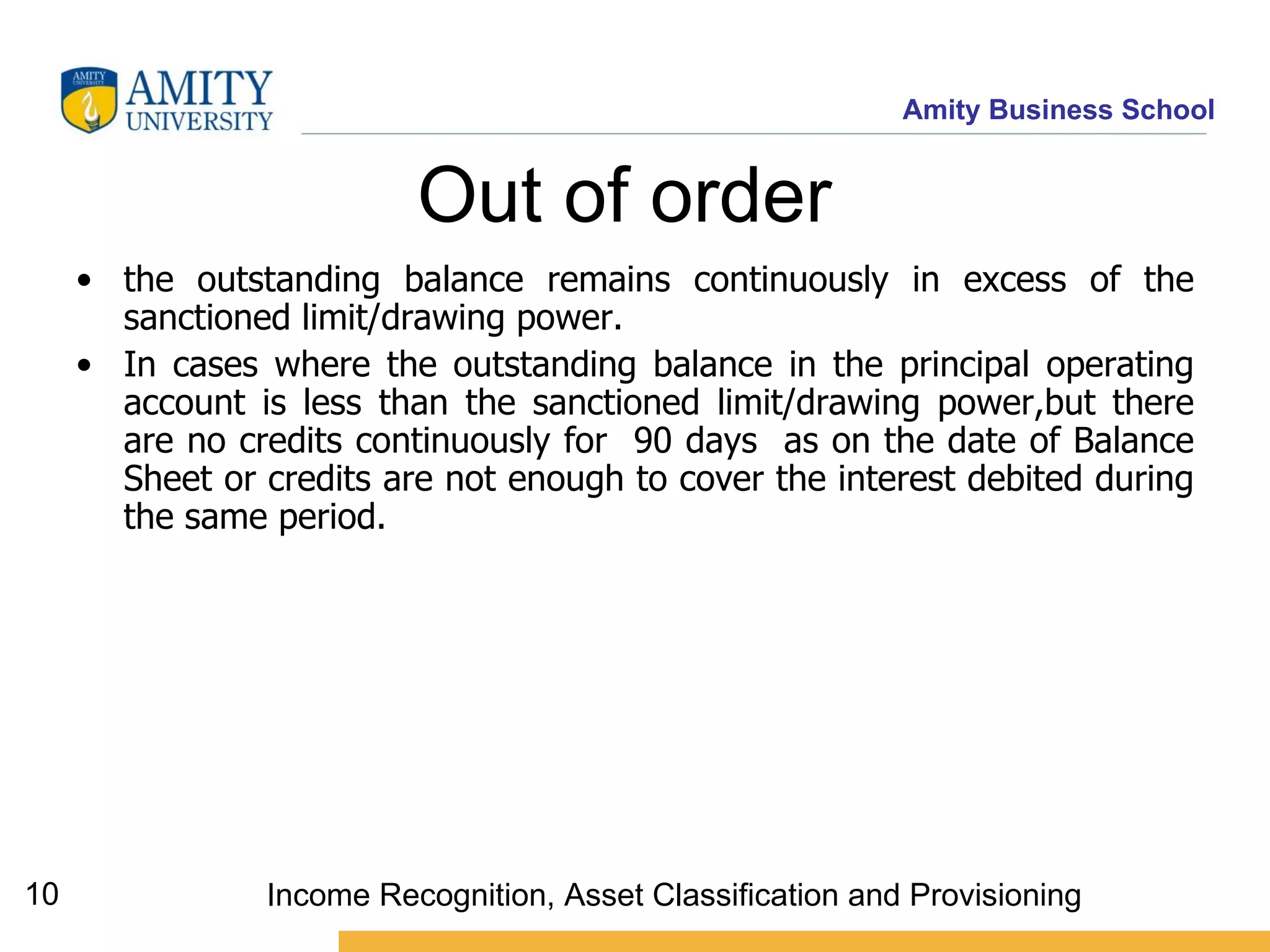
Out of order  the outstanding balance remains continuously in excess of the sanctioned limit/drawing power.  In cases where the outstanding balance in the principal operating account is less than the sanctioned limit/drawing power,but there are no credits continuously for  90 days  as on the date of Balance Sheet or credits are not enough to cover the interest debited during the same period.  Income Recognition, Asset Classification and Provisioning
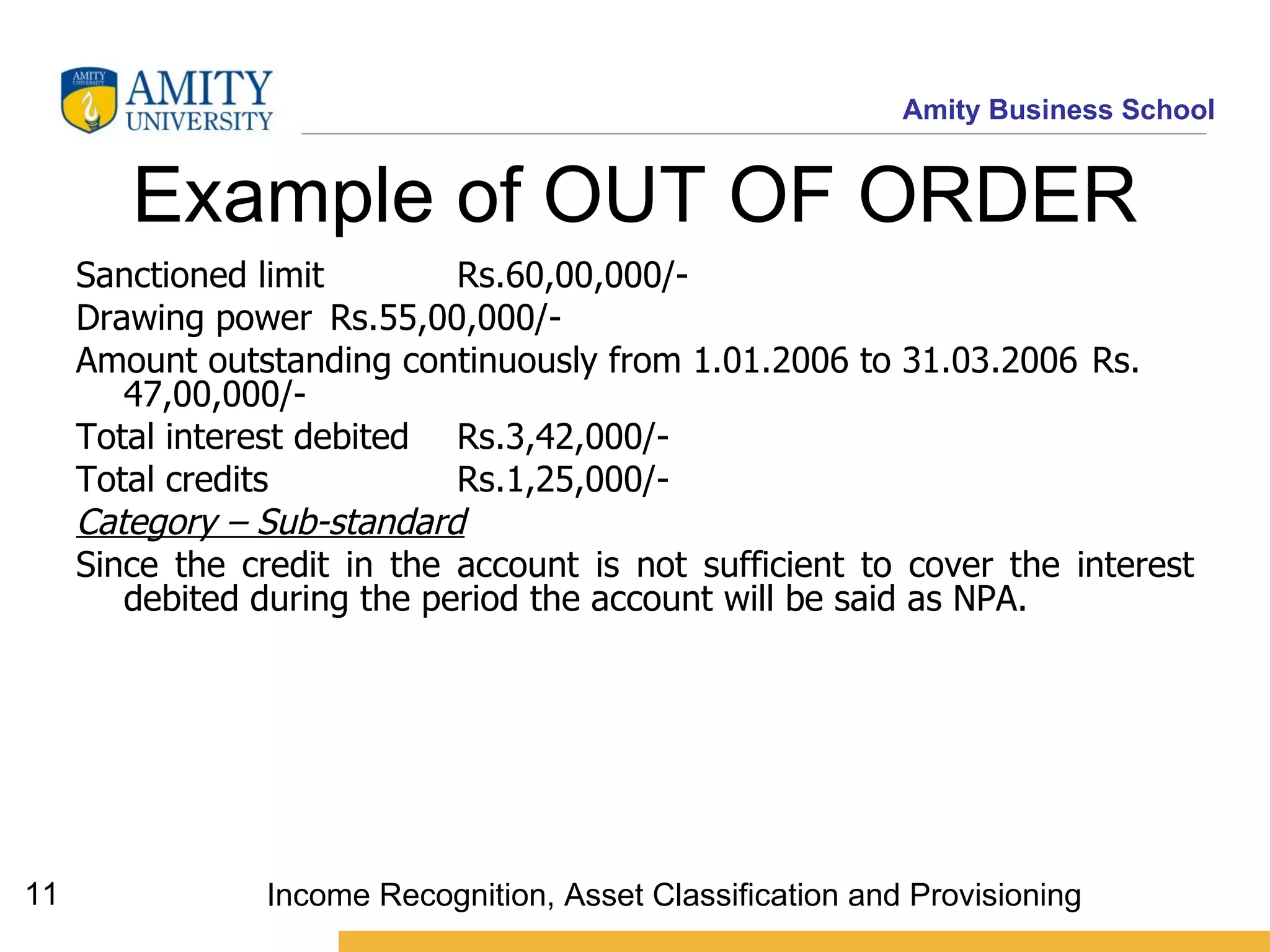
Example of OUT OF ORDER Sanctioned limit  Rs.60,00,000/- Drawing power Rs.55,00,000/- Amount outstanding continuously from 1.01.2006 to 31.03.2006  Rs. 47,00,000/- Total interest debited  Rs.3,42,000/- Total credits  Rs.1,25,000/- Category – Sub-standard Since the credit in the account is not sufficient to cover the interest debited during the period the account will be said as NPA. Income Recognition, Asset Classification and Provisioning
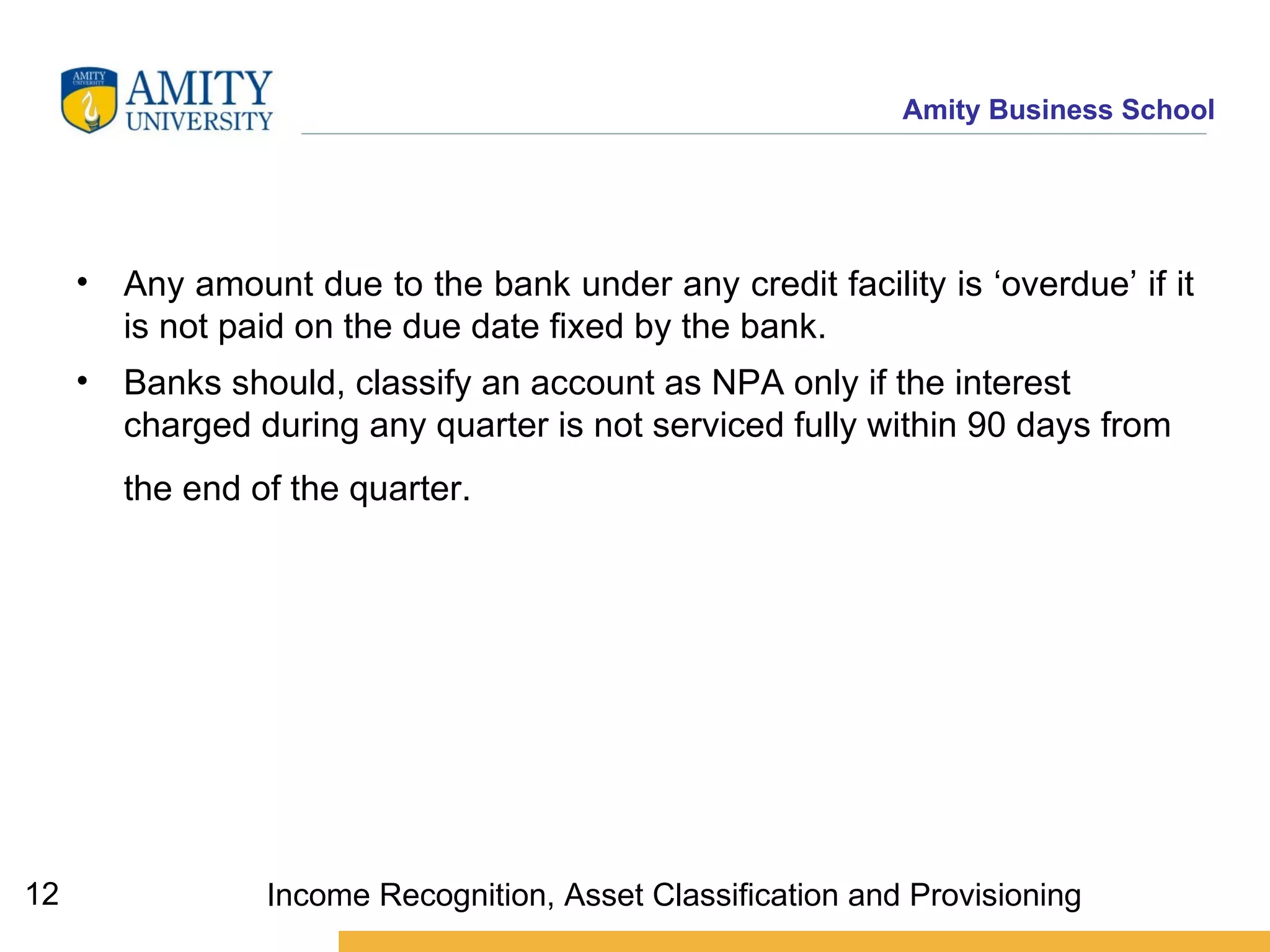
Any amount due to the bank under any credit facility is ‘overdue’ if it is not paid on the due date fixed by the bank. Banks should, classify an account as NPA only if the interest charged during any quarter is not serviced fully within 90 days from the end of the quarter.   Income Recognition, Asset Classification and Provisioning
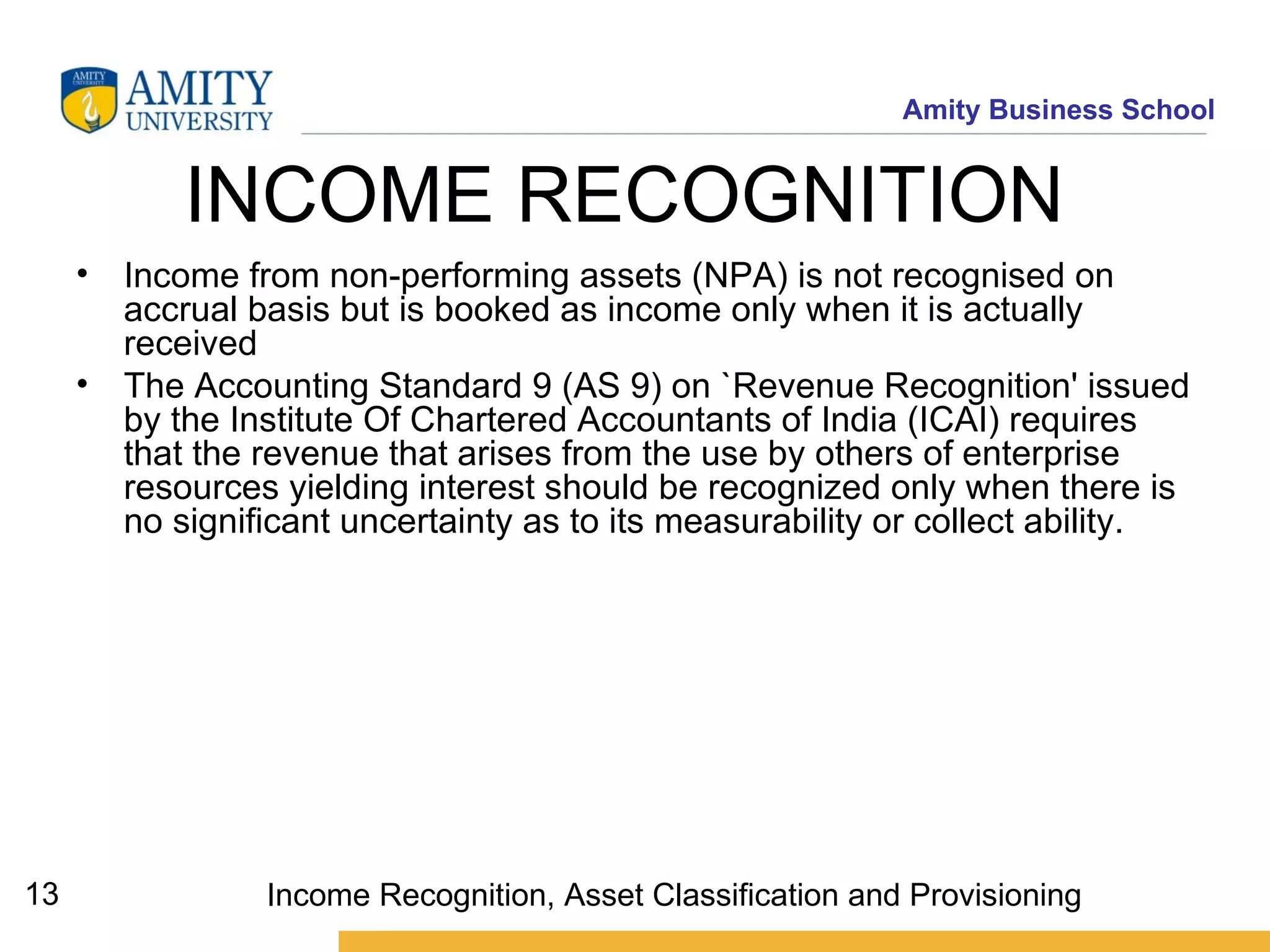
INCOME RECOGNITION   Income from non-performing assets (NPA) is not recognised on accrual basis but is booked as income only when it is actually received The Accounting Standard 9 (AS 9) on `Revenue Recognition' issued by the Institute Of Chartered Accountants of India (ICAI) requires that the revenue that arises from the use by others of enterprise resources yielding interest should be recognized only when there is no significant uncertainty as to its measurability or collect ability.   Income Recognition, Asset Classification and Provisioning
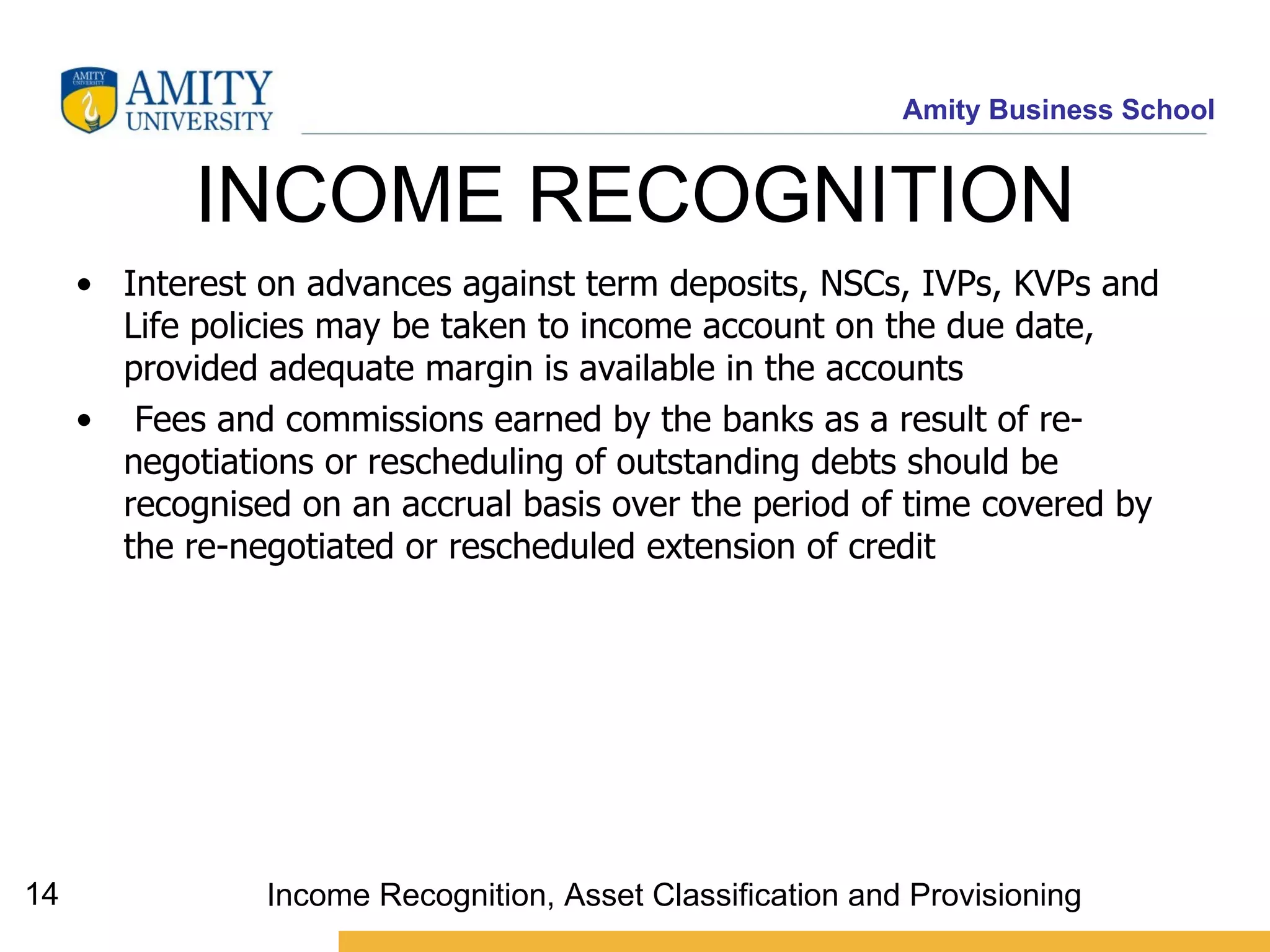
INCOME RECOGNITION Interest on advances against term deposits, NSCs, IVPs, KVPs and Life policies may be taken to income account on the due date, provided adequate margin is available in the accounts   Fees and commissions earned by the banks as a result of re-negotiations or rescheduling of outstanding debts should be recognised on an accrual basis over the period of time covered by the re-negotiated or rescheduled extension of credit   Income Recognition, Asset Classification and Provisioning
Reversal of income  The  finance charge  component of finance income  [as defined in ‘AS 19 - Leases’ issued by the Council of the Institute of Chartered Accountants of India (ICAI)] on the leased asset which has accrued and was credited to income account before the asset became non-performing, and remaining unrealised, should be reversed or provided for in the current accounting period.   Income Recognition, Asset Classification and Provisioning
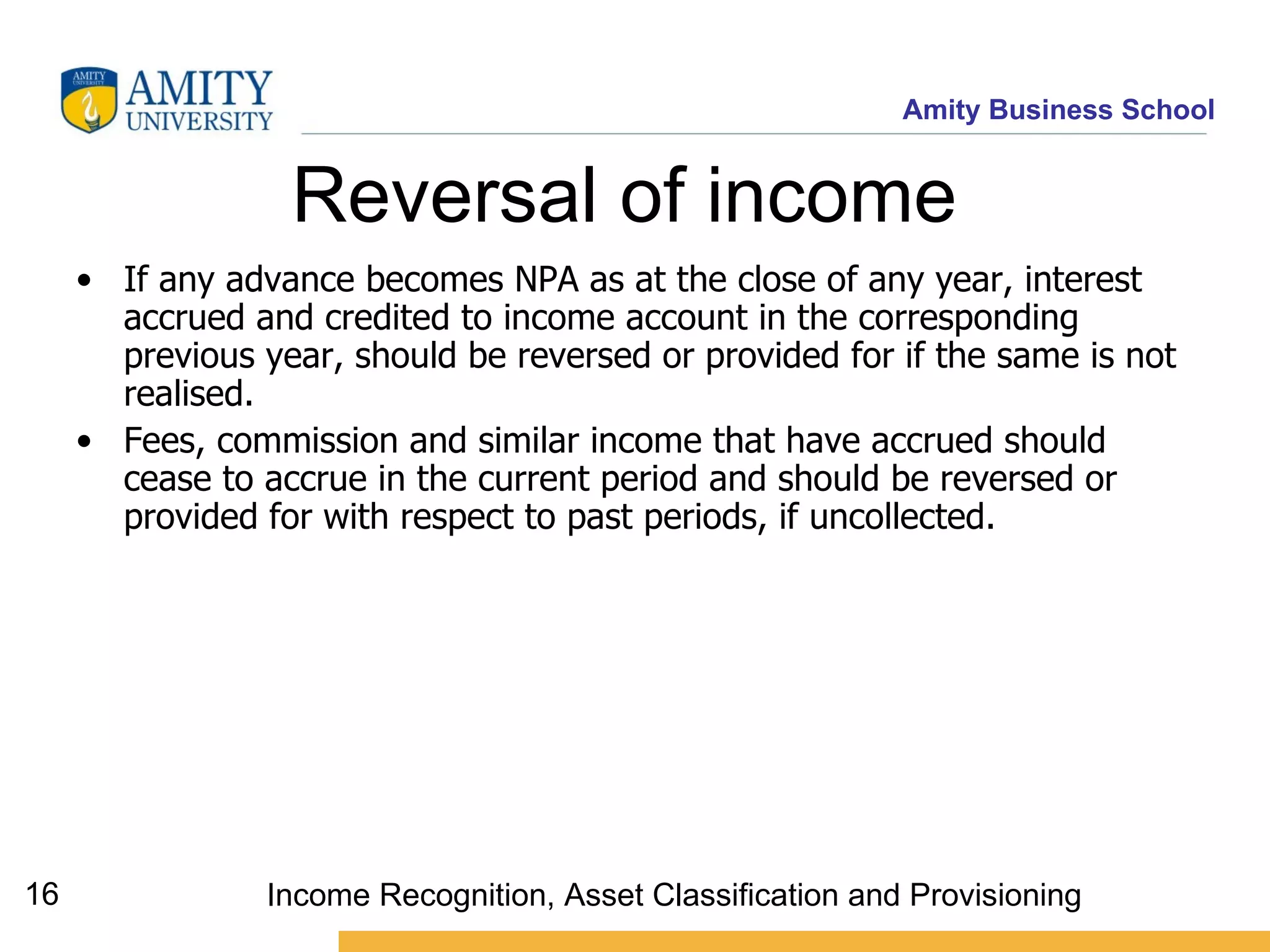
Reversal of income  If any advance becomes NPA as at the close of any year, interest accrued and credited to income account in the corresponding previous year, should be reversed or provided for if the same is not realised.  Fees, commission and similar income that have accrued should cease to accrue in the current period and should be reversed or provided for with respect to past periods, if uncollected.   Income Recognition, Asset Classification and Provisioning
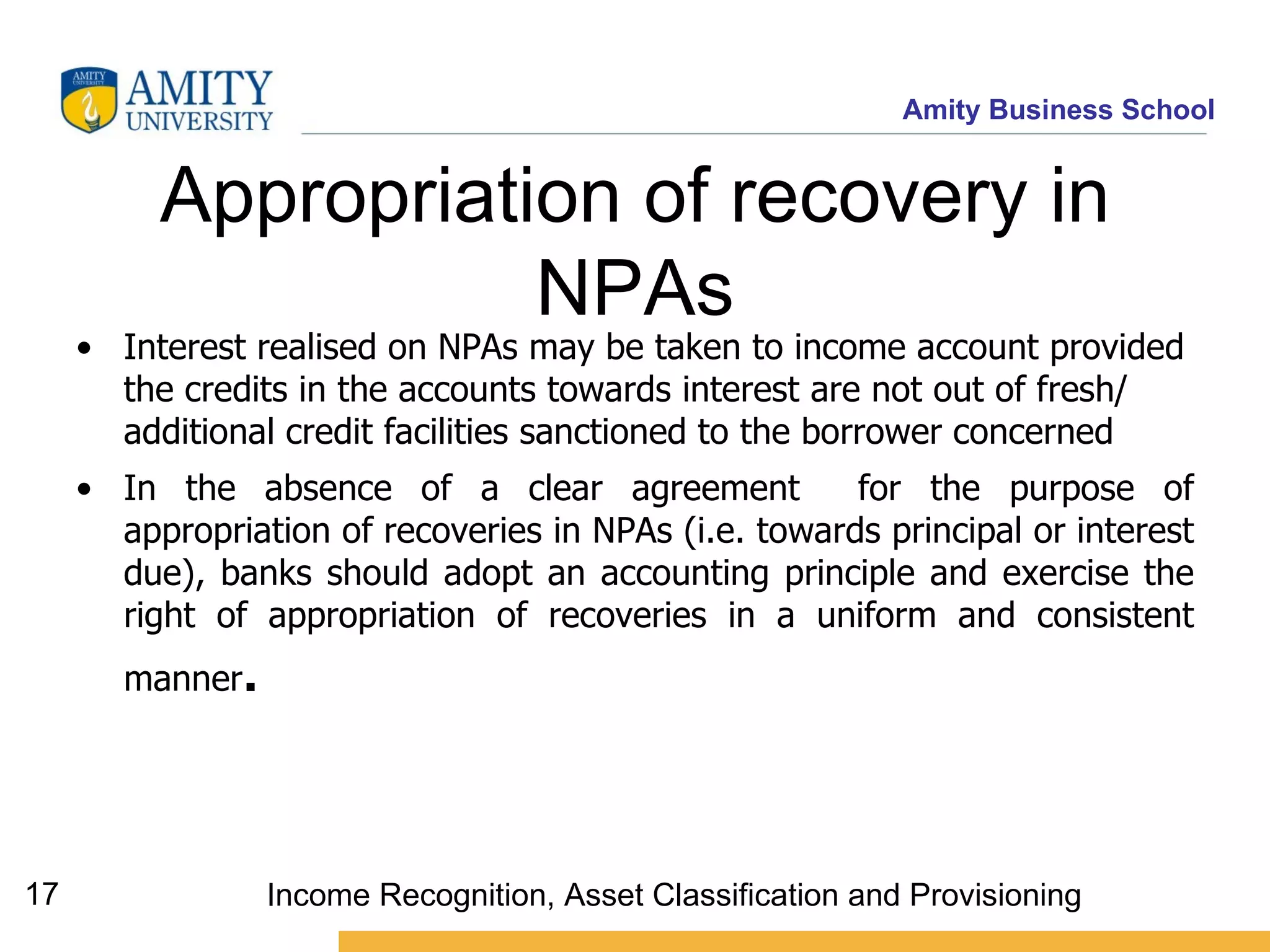
Appropriation of recovery in NPAs Interest realised on NPAs may be taken to income account provided the credits in the accounts towards interest are not out of fresh/ additional credit facilities sanctioned to the borrower concerned   In the absence of a clear agreement  for the purpose of appropriation of recoveries in NPAs (i.e. towards principal or interest due), banks should adopt an accounting principle and exercise the right of appropriation of recoveries in a uniform and consistent manner . Income Recognition, Asset Classification and Provisioning
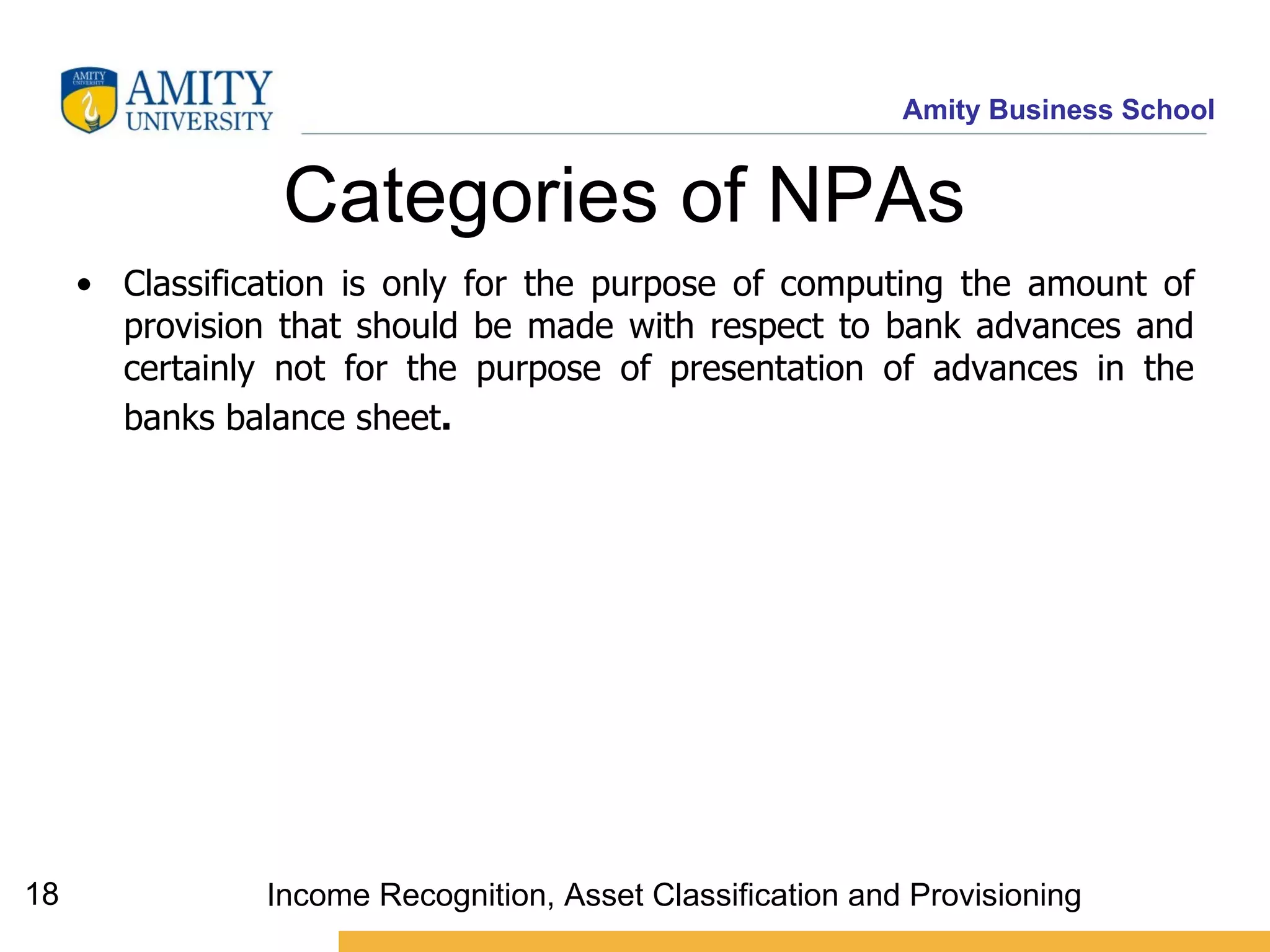
Categories of NPAs   Classification is only for the purpose of computing the amount of provision that should be made with respect to bank advances and certainly not for the purpose of presentation of advances in the banks balance sheet .     Income Recognition, Asset Classification and Provisioning
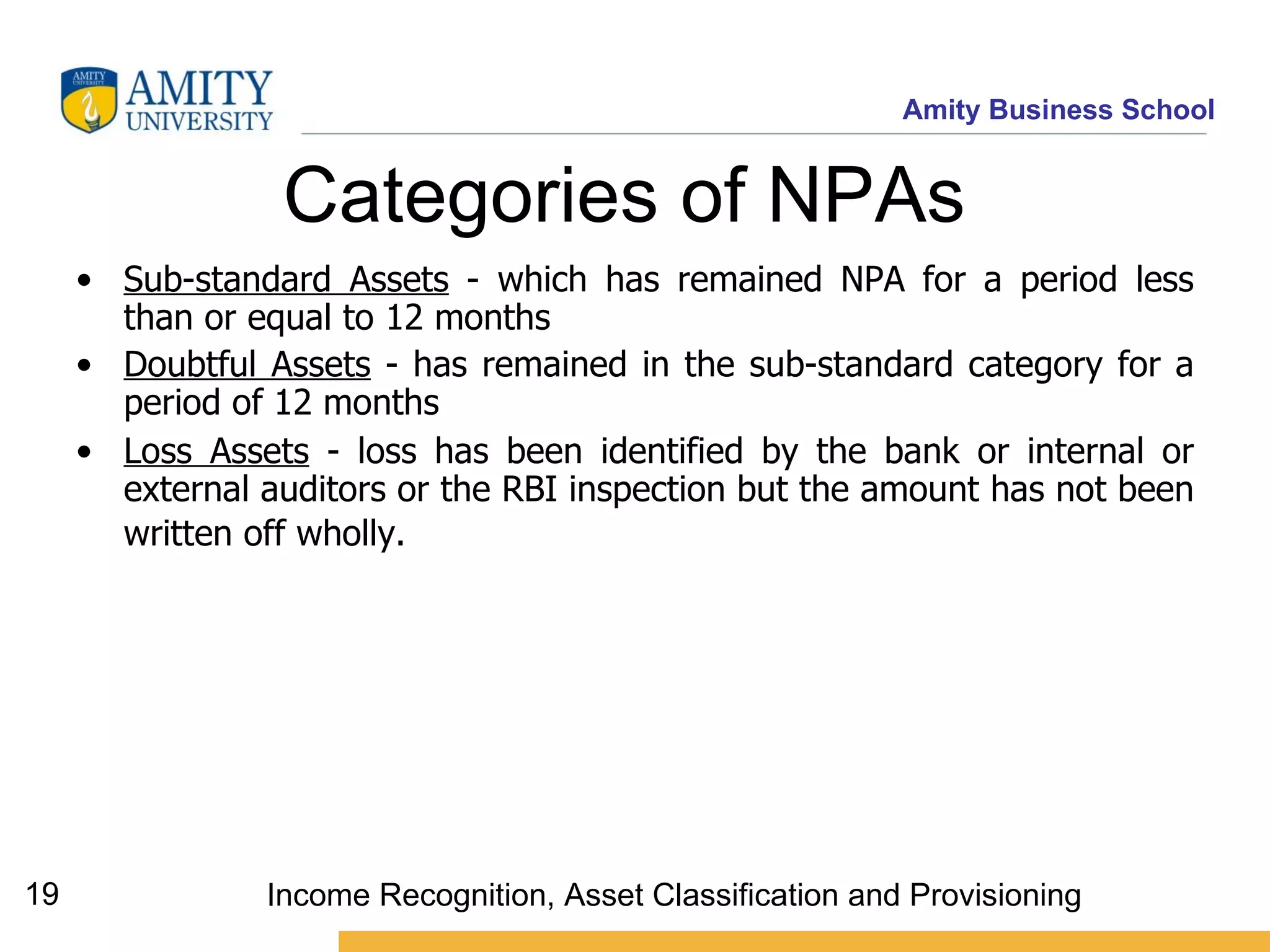
Categories of NPAs   Sub-standard Assets  -  which has remained NPA for a period less than or equal to 12 months   Doubtful Assets  -  has remained in the sub-standard category for a period of 12 months   Loss Assets  -  loss has been identified by the bank or internal or external auditors or the RBI inspection but the amount has not been written off wholly.     Income Recognition, Asset Classification and Provisioning
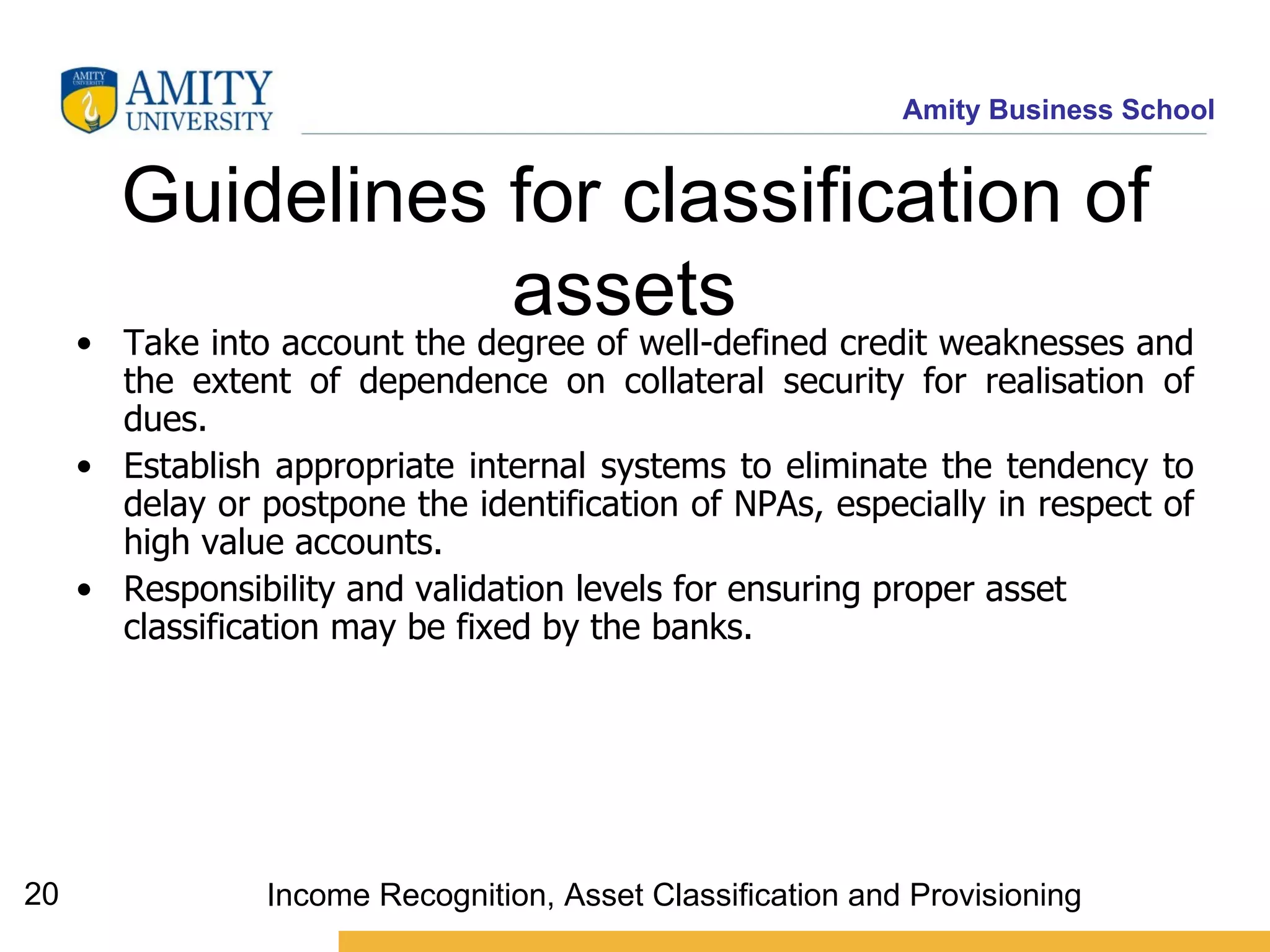
Guidelines for classification of assets   Take into account the degree of well-defined credit weaknesses and the extent of dependence on collateral security for realisation of dues.  Establish appropriate internal systems to eliminate the tendency to delay or postpone the identification of NPAs, especially in respect of high value accounts.   Responsibility and validation levels for ensuring proper asset classification may be fixed by the banks.  Income Recognition, Asset Classification and Provisioning
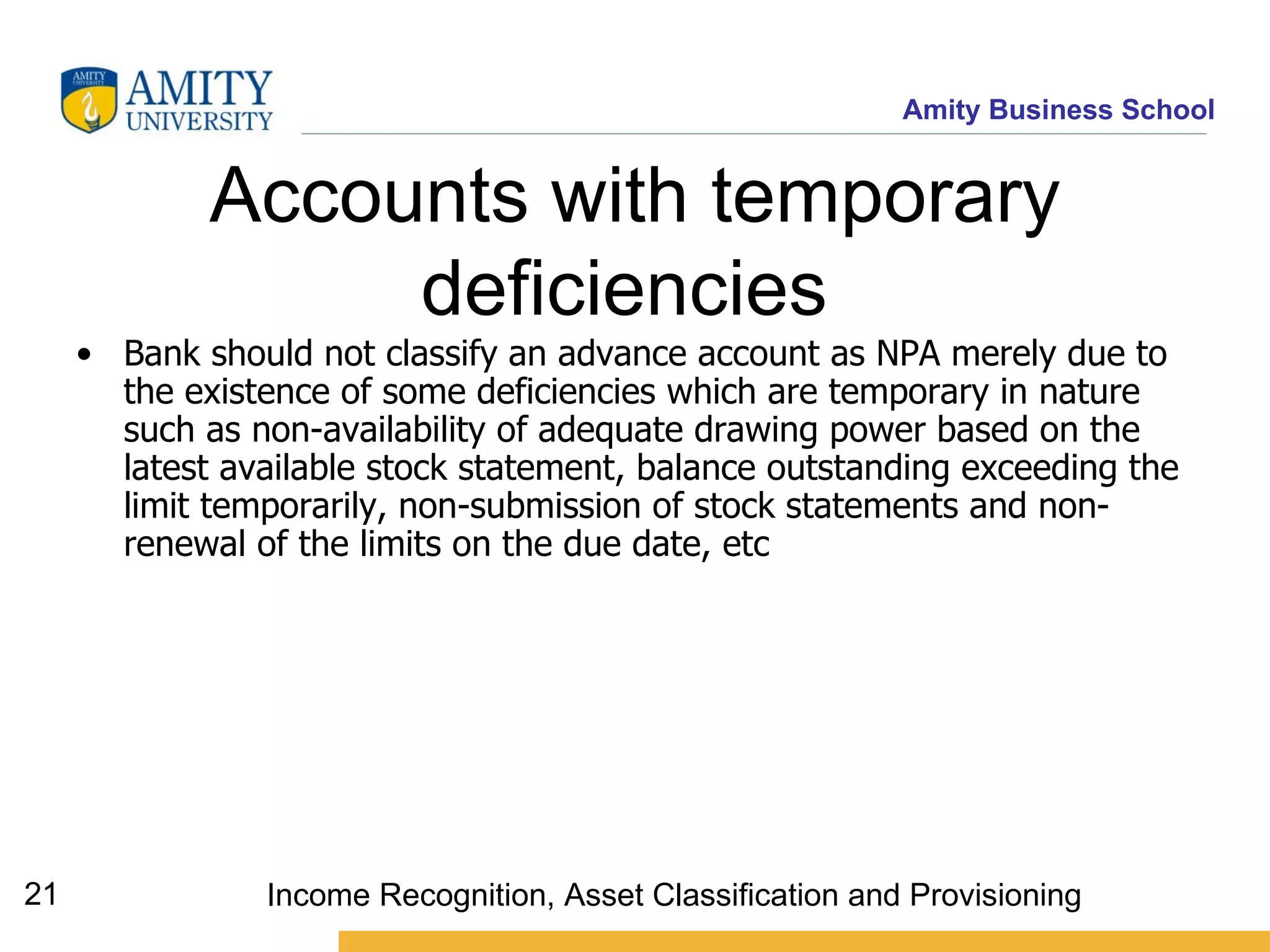
Accounts with temporary deficiencies   Bank should not classify an advance account as NPA merely due to the existence of some deficiencies which are temporary in nature such as non-availability of adequate drawing power based on the latest available stock statement, balance outstanding exceeding the limit temporarily, non-submission of stock statements and non-renewal of the limits on the due date, etc   Income Recognition, Asset Classification and Provisioning
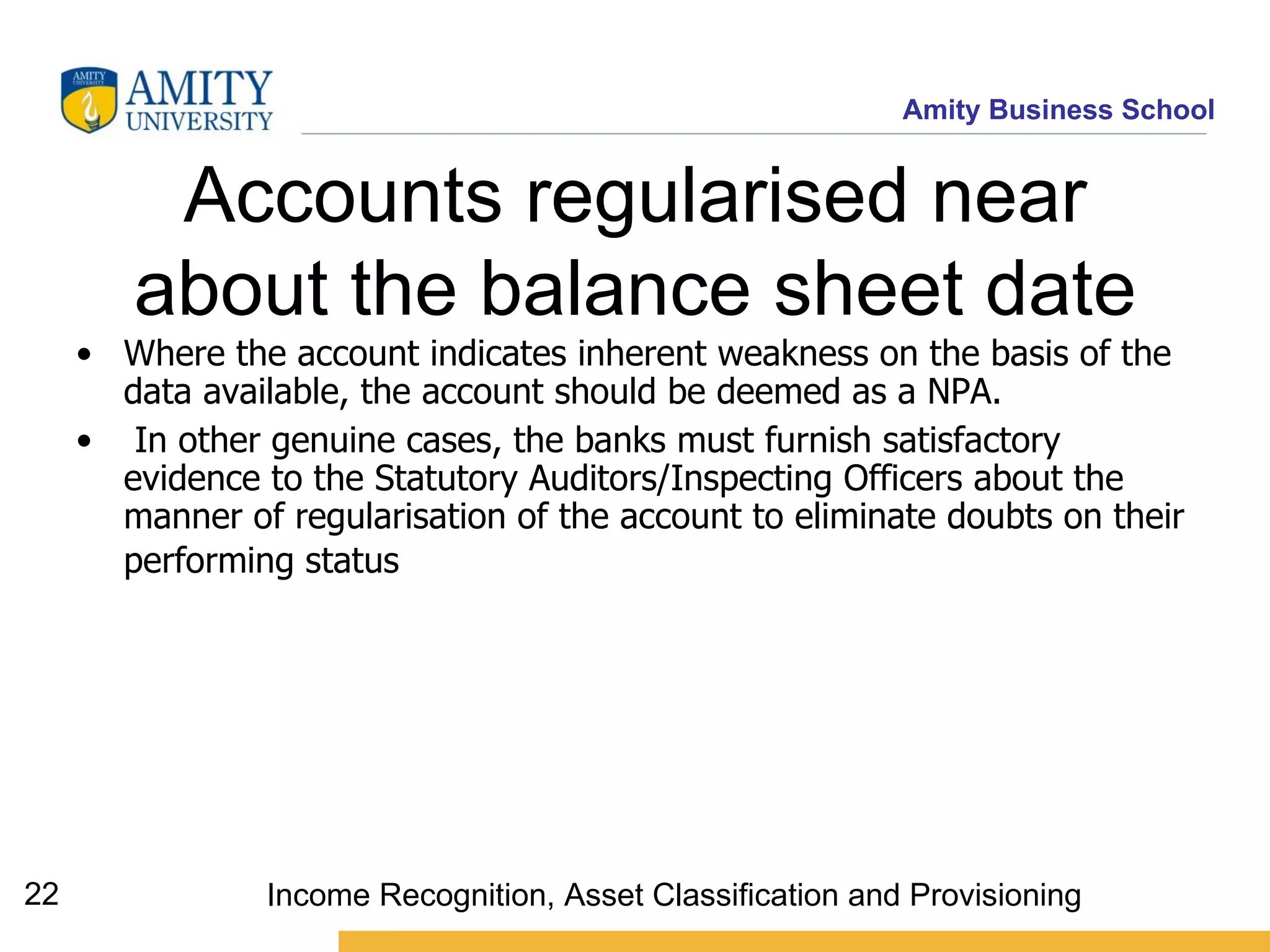
Accounts regularised near about the balance sheet date Where the account indicates inherent weakness on the basis of the data available, the account should be deemed as a NPA.  In other genuine cases, the banks must furnish satisfactory evidence to the Statutory Auditors/Inspecting Officers about the manner of regularisation of the account to eliminate doubts on their performing status   Income Recognition, Asset Classification and Provisioning
Asset Classification to be borrower-wise and not facility-wise   It is difficult to envisage a situation when only one facility to a borrower/one investment in any of the securities issued by the borrower becomes a problem credit/investment and not others.  All the facilities granted by a bank to a borrower and investment in all the securities issued by the borrower  will have to be treated as NPA and not the particular facility/investment or part thereof which has become irregular   Income Recognition, Asset Classification and Provisioning
Advances under consortium arrangements   Asset classification of accounts should be based on the record of recovery of the individual member banks  Where the remittances by the borrower are pooled with one bank and/or where the bank receiving remittances is not parting with the share of other member banks, the account will be treated as not serviced in the books of the other member banks and therefore, be treated as NPA.  Income Recognition, Asset Classification and Provisioning
Advances under consortium arrangements The banks should, therefore, arrange to get their share of recovery transferred from the lead bank or get an express consent from the lead bank for the transfer of their share of recovery, to ensure proper asset classification in their respective books Income Recognition, Asset Classification and Provisioning
Erosion in the value of security/frauds committed by borrowers Such accounts should not go through various stages of asset classification.  The realisable value of the security is less than 50 per cent of outstanding in the borrowal accounts such NPAs may be straightaway classified under doubtful category  The realisable value of the security, as assessed by the bank is less than 10 per cent of the outstanding in the borrowal accounts, the asset should be straightaway classified as loss asset  Income Recognition, Asset Classification and Provisioning
Loans with moratorium for payment of interest Bank finance given for industrial projects or for agricultural plantations etc. where moratorium is available for payment of interest, payment of interest becomes 'due' only after the moratorium or gestation period is ove r In case of loans granted to staff members where interest is payable after recovery of principal, interest need not be considered as overdue from the first quarter onwards. NPA only when there is a default in repayment of installment of principal or payment of interest on the respective due dates   Income Recognition, Asset Classification and Provisioning
Agricultural advances   A loan granted for short duration crops will be treated as NPA, if the installment of principal or interest thereon remains overdue for two crop seasons   A loan granted for long duration crops will be treated as NPA, if the installment of principal or interest thereon remains overdue for one crop season.  The crop season for each crop means the period up to harvesting of the crops raised as  would be determined by the State Level Bankers’ Committee in each State   Income Recognition, Asset Classification and Provisioning
Agricultural advances Long duration  crops would be crops with crop season longer than one year  Crops, which are not long duration crops, would be treated as short duration crops   Where natural calamities impair the repaying capacity of agricultural borrowers, banks may decide on their own as a relief measure - conversion of the short-term production loan into a term loan or re-schedulement of the repayment period and the sanctioning of fresh short-term loan   Income Recognition, Asset Classification and Provisioning
Government guaranteed advances   The credit facilities backed by guarantee of the  Central Government  though overdue may be treated as NPA only when the Government repudiates its guarantee when invoked.  State Government  guaranteed advances and investments in State Government guaranteed securities would attract asset classification and provisioning norms if interest and/or  principal or any other amount due to the bank remains overdue for more than 90 days   Income Recognition, Asset Classification and Provisioning
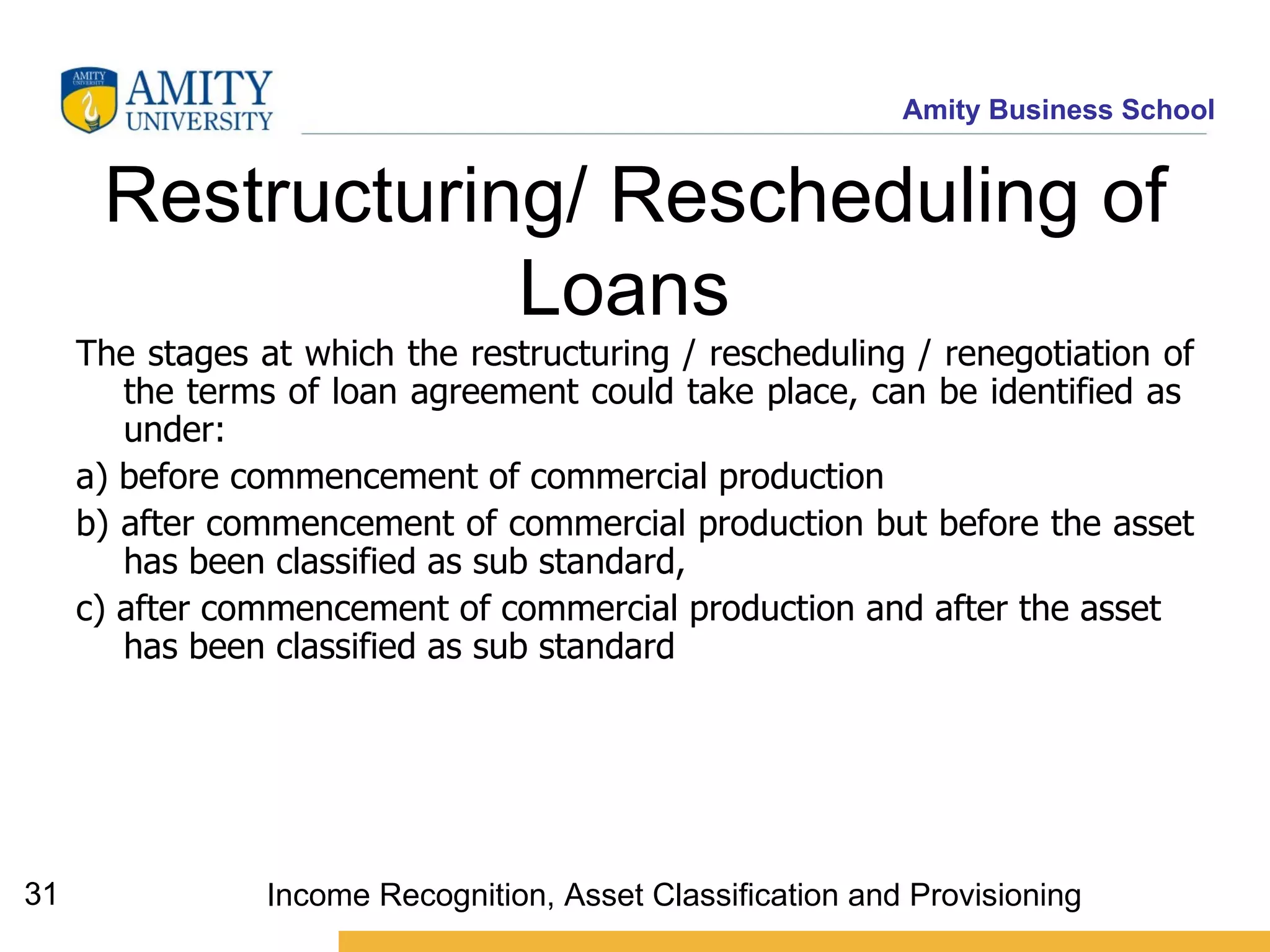
Restructuring/ Rescheduling of Loans   The stages at which the restructuring / rescheduling / renegotiation of the terms of loan agreement could take place, can be identified as  under: a) before commencement of commercial production b) after commencement of commercial production but before the asset has been classified as sub standard, c) after commencement of commercial production and after the asset has been classified as sub standard   Income Recognition, Asset Classification and Provisioning
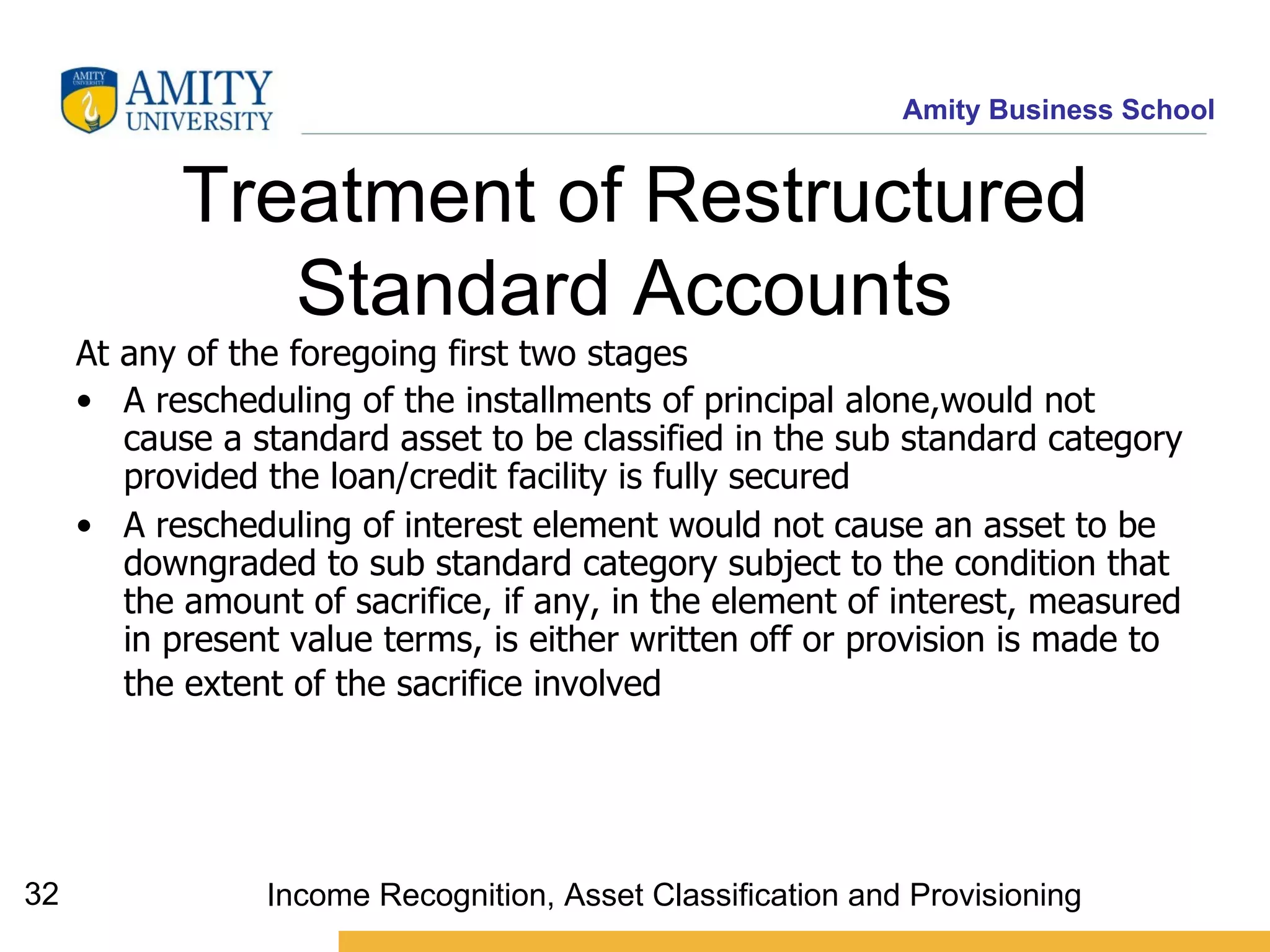
Treatment of Restructured Standard Accounts   At any of the foregoing first two stages A rescheduling of the installments of principal alone,would not cause a standard asset to be classified in the sub standard category provided the loan/credit facility is fully secured   A rescheduling of interest element would not cause an asset to be downgraded to sub standard category subject to the condition that the amount of sacrifice, if any, in the element of interest, measured in present value terms, is either written off or provision is made to the extent of the sacrifice involved   Income Recognition, Asset Classification and Provisioning
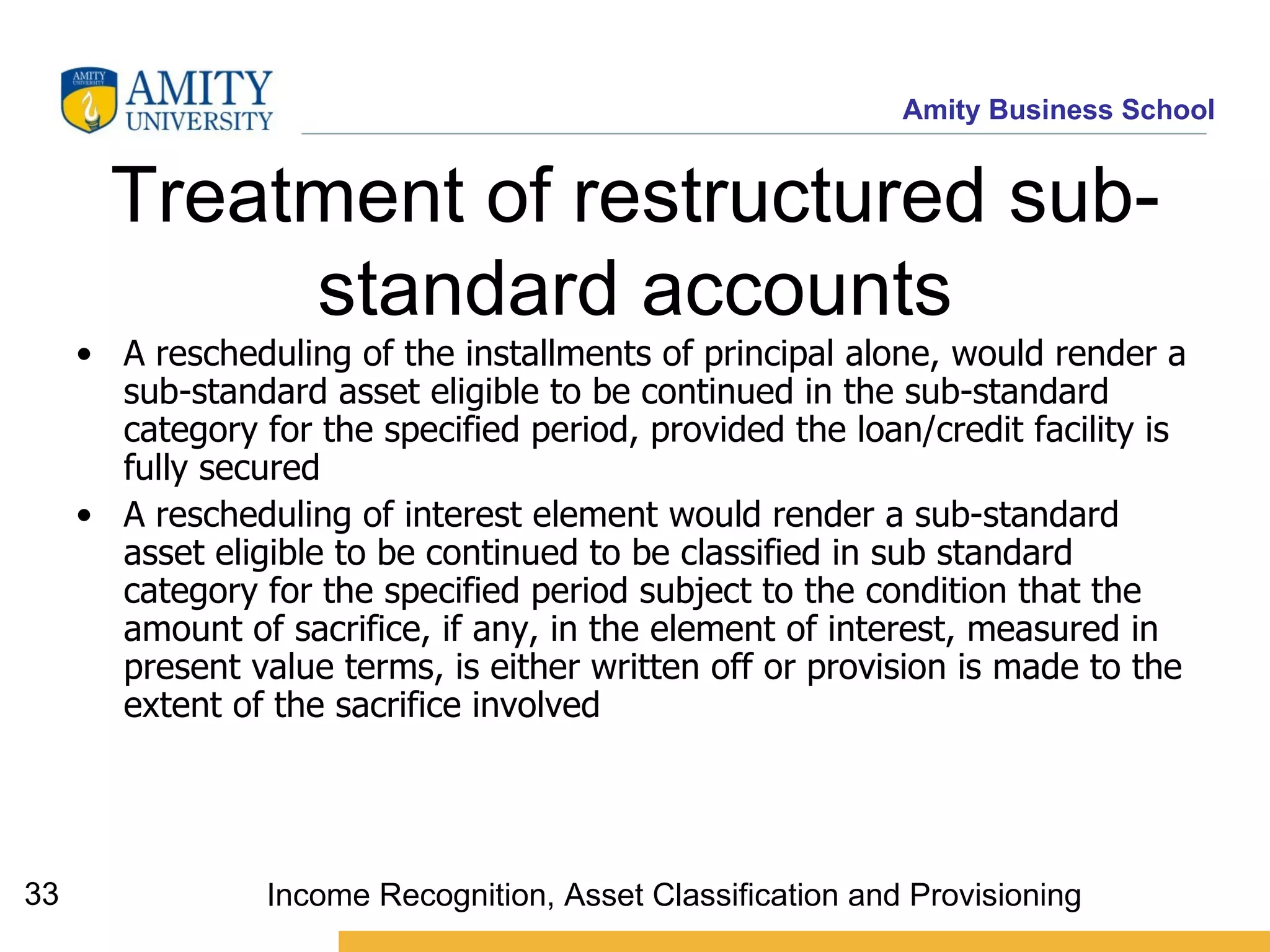
Treatment of restructured sub-standard accounts A rescheduling of the installments of principal alone, would render a sub-standard asset eligible to be continued in the sub-standard category for the specified period, provided the loan/credit facility is fully secured   A rescheduling of interest element would render a sub-standard asset eligible to be continued to be classified in sub standard category for the specified period subject to the condition that the amount of sacrifice, if any, in the element of interest, measured in present value terms, is either written off or provision is made to the extent of the sacrifice involved   Income Recognition, Asset Classification and Provisioning
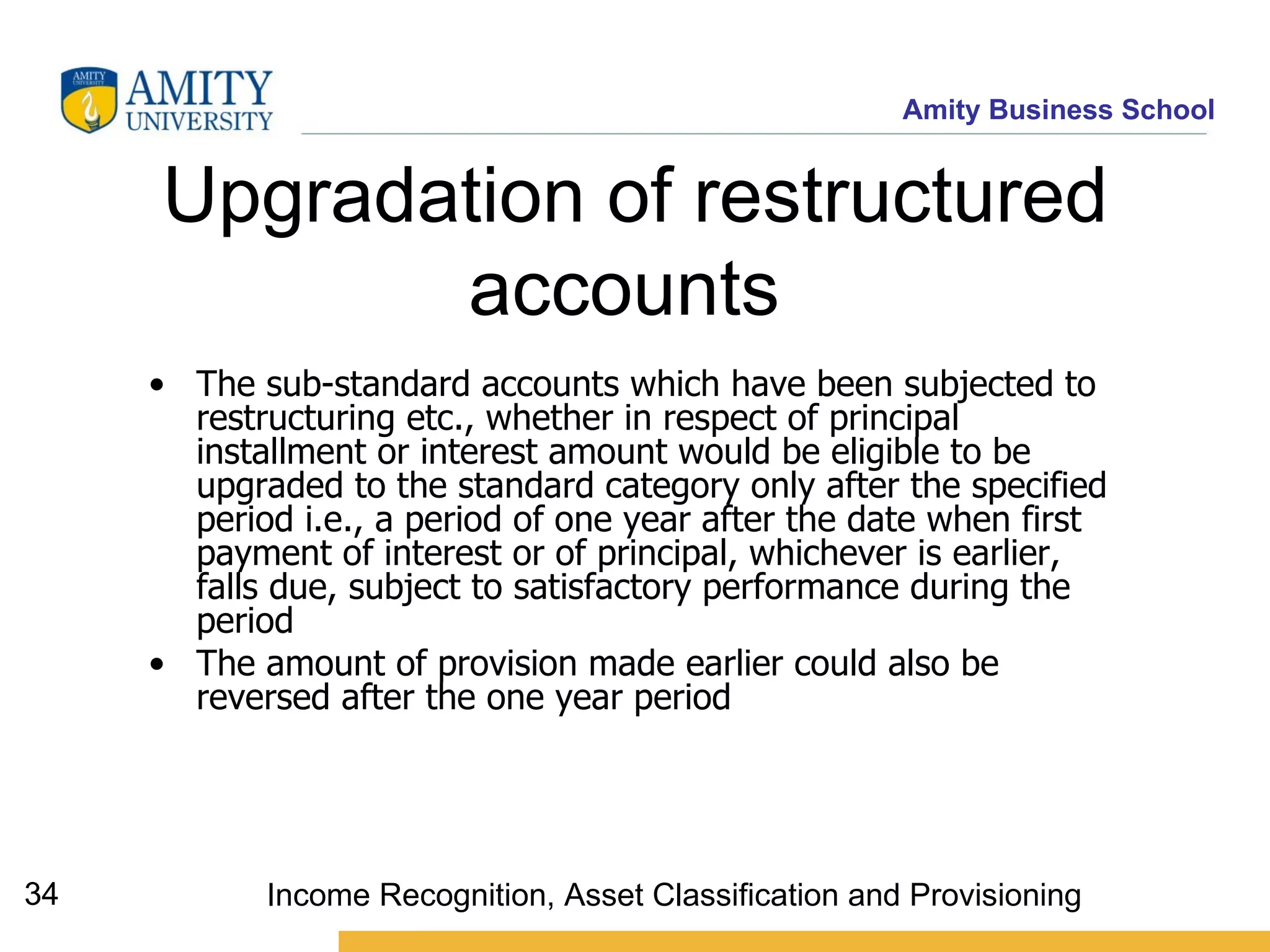
Upgradation of restructured accounts   The sub-standard accounts which have been subjected to restructuring etc., whether in respect of principal installment or interest amount would be eligible to be upgraded to the standard category only after the specified period i.e., a period of one year after the date when first payment of interest or of principal, whichever is earlier, falls due, subject to satisfactory performance during the period   The amount of provision made earlier could also be reversed after the one year period   Income Recognition, Asset Classification and Provisioning
Availability of security / net worth of borrower/ guarantor   The availability of security or net worth of borrower/ guarantor should not be taken into account for the purpose of treating an advance as NPA or otherwise, as income recognition is based on record of recovery. Income Recognition, Asset Classification and Provisioning
Take-out Finance   Used for  funding of long-term infrastructure projects The norms of asset classification will have to be followed by the concerned bank/financial institution in whose books the account stands as balance sheet item as on the relevant date   Taking over institution, on taking over such assets, should make provisions treating the account as NPA from the actual date of it becoming NPA even though the account was not in its books as on that date   Income Recognition, Asset Classification and Provisioning
Export Project Finance There could be instances where the actual importer has paid the dues to the bank abroad but the bank in turn is unable to remit the amount due to political developments such as war, strife, UN embargo, etc.  Where the lending bank is able to establish through documentary evidence the above fact, the asset classification may be made after a period of one year from the date the amount was deposited by the importer in the bank abroad.   Income Recognition, Asset Classification and Provisioning
Provisioning norms   The primary responsibility for making adequate provisions for any diminution in the value of loan assets, investment or other assets is that of the bank managements and  the statutory auditors .  The assessment made by the inspecting officer of the RBI is furnished to the bank to assist the bank management and the statutory auditors in taking a decision in regard to making adequate and necessary provisions in terms of prudential guidelines. Income Recognition, Asset Classification and Provisioning
Provision on Loss assets Loss assets should be written off. If loss assets are permitted to remain in the books for any reason, 100 percent of the outstanding should be provided for   Income Recognition, Asset Classification and Provisioning
Provision on Doubtful assets  100 percent of the extent to which the advance is not covered by the realisable value of the security  In regard to the secured portion, provision may be made on, at the rates ranging from 20 percent to 100 percent of the secured portion depending upon the period for which the asset has remained doubtful   Income Recognition, Asset Classification and Provisioning
Provision on sub standard assets A general provision of 10 percent on total outstanding should be made  The ‘unsecured exposures’ which are identified as ‘substandard’ would attract additional provision of 10 per cent. The provisioning requirement for unsecured ‘doubtful’ assets is 100 per cent. Unsecured exposure is defined as an exposure where the realisable value of the security, as assessed by the bank is not more than 10 percent Income Recognition, Asset Classification and Provisioning
Provision on standard assets  The banks should make a general provision of a minimum of 0.25 percent on standard assets on global loan portfolio basis   All scheduled commercial banks are required to increase the general provision on standard advances from 0.25 percent to 0.40 percent except for direct advances to agricultural and SME sectors   (as per circular issued by RBI on 8 th  of Nov 2005) Income Recognition, Asset Classification and Provisioning
Advances granted under rehabilitation packages approved by BIFR Provision should continue to be made in respect of dues to the bank on the existing credit facilities as per their classification as sub-standard or doubtful assets Additional facilities sanctioned as per package finalised by BIFR and/or term lending institutions, provision on additional facilities sanctioned need not be made for a period of one year from the date of disbursement   Income Recognition, Asset Classification and Provisioning
General points  Advances against term deposits, NSCs eligible for surrender, IVPs, KVPs, and life policies would attract provisioning requirements as applicable to their asset classification status   Advances against gold ornaments, government securities and all other kinds of securities are not exempted from provisioning requirements   Income Recognition, Asset Classification and Provisioning
Advances covered by ECGC guarantee   Provision should be made only for the balance in excess of the amount guaranteed by the Corporation. While arriving at the provision required to be made for doubtful assets, realisable value of the securities should first be deducted from the outstanding balance in respect of the amount guaranteed by the Corporation   Income Recognition, Asset Classification and Provisioning
NPA AND CRM  NPAs are a result of past action whose effects are realized in the present i.e they represent credit risk that has already materialized and default has already taken place CRM is a much more forward-looking approach and is mainly concerned with managing the quality of credit portfolio before default takes place.An attempt is made to avoid possible default by properly managing credit risk   Income Recognition, Asset Classification and Provisioning
NPA AND CREDIT RATING  Credit Rating implies evaluating the creditworthiness of a borrower by an independent rating agency.  Credit rating agencies generally slot companies into risk buckets  Credit rating is not fool-proof   Enron was rated investment grade till as late as a month prior to it's filing for bankruptcy when it was assigned an in-default status by the rating agencies   Income Recognition, Asset Classification and Provisioning
NPA AND STOCK PRICES  Stock prices are an important ( but not the sole ) indicator of the credit risk involved.  Stock prices are much more forward looking in assessing the creditworthiness of a business enterprise. Historical data proves that stock prices of companies such as Enron and WorldCom had started showing a falling trend many months prior to it being downgraded by credit rating agencies. Income Recognition, Asset Classification and Provisioning
REDUCTION IN NPA  The main purpose of this notice is to inform the borrower that either the sum due to the bank be paid by the borrower or else the former will take action by way of taking over the possession of assets.  Banks can also takeover the management of the company.  Thus the bankers under the aforementioned Act will have the much needed authority to either sell the assets of the defaulting companies or change their management   Income Recognition, Asset Classification and Provisioning
REDUCTION IN NPA  With the enactment of the Securitisation and Reconstruction of Financial Assets and Enforcement of Security Interest Act, 2002, banks can issue notices to the defaulters to pay up the dues Once the borrower receives a notice from the concerned bank  the secured assets mentioned in the notice cannot be sold or transferred without the consent of the lenders. Income Recognition, Asset Classification and Provisioning
REDUCTION IN NPA  Banks can now clean up their books by selling assets to ARCs at a discounted price or taking over the assets of a defaulter and selling them to recover their dues without resorting to long-winded legal procedures.  They can also generate funds locked in the existing assets through securitisation – that is, issuing bonds against the security of assets   Income Recognition, Asset Classification and Provisioning
REDUCTION IN NPA  Any willful defaulter with an outstanding balance of Rs 25 Lakh or more attracts a severe penalty.  He does not get any new loans from financial intermediaries. Promoters are not allowed to raise resources for floating new ventures for five years from the date of the RBI publishing their names in the list of wilful defaulters.  Income Recognition, Asset Classification and Provisioning
THANK YOU Income Recognition, Asset Classification and Provisioning

D6161 Turnaround Management 3

  • 1.
    Amity Business SchoolMBA Class of 2010, Semester IV Strategic Financial Management Prof Akhil Swami/Anuj Srivastava
  • 2.
    Prudential Norms onIncome Recognition, Asset Classification and Provisioning pertaining to Advances
  • 3.
    Health Code systemOn 7/11/1985 RBI introduced uniform health code system indicating the quality or health of individual advances Description Health code Satisfactory 1 Irregular 2 Stick:Viable-under nursing 3 Stick:Non-viable/sticky 4 Advances recalled 5 Income Recognition, Asset Classification and Provisioning
  • 4.
    Health Code systemDescription Health code Suit file accounts 6 Decreed accounts 7 Bad and doubtful debts 8 With the introduction of prudential norms on 27/04/1992 health Code-based system has ceased to be a subject of supervisory interest. Banks may, however, continue the system at their discretion as a management information tool Income Recognition, Asset Classification and Provisioning
  • 5.
    Master Circular onNPA First circular on Non Performing Loans by RBI on 31/10/90 First Circular on IR, AC and Provisioning on 27-04-1992 RBI No. 2006-07/31 DBOD No. BP. BC. 15 / 21.04.048 / 2006-07 dated July 1, 2006 Contents of circular are categorised into six paragraphs, two Annex and one Appendix General Definitions Income Recognition Income Recognition, Asset Classification and Provisioning
  • 6.
    Master Circular onNPA Assets Classification Provisioning norms Writing-off of NPAs Annex I on reporting format of NPA Annex II on list of agricultural advances Appendix Income Recognition, Asset Classification and Provisioning
  • 7.
    General Normsas per the international practice and on recommendation of Narasimham Committee Policy of income recognition should be objective and based on record of recovery While granting loans and advances, realistic repayment schedules may be fixed on the basis of cash flows with borrowers Income Recognition, Asset Classification and Provisioning
  • 8.
    Definition of NPAAn asset, including a leased asset, becomes non-performing when it ceases to generate income for the bank A non-performing asset (NPA) is a loan or an advance where; interest and/ or installment of principal remain overdue for a period of more than 90 days in respect of a term loan the account remains ‘out of order’ in respect of an Overdraft/Cash Credit (OD/CC)  Income Recognition, Asset Classification and Provisioning
  • 9.
    Definition of NPA the bill remains overdue for a period of more than 90 days in the case of bills purchased and discounted a loan granted for short duration crops will be treated as NPA, if the installment of principal or interest thereon remains overdue for two crop seasons. a loan granted for long duration crops will be treated as NPA, if the installment of principal or interest thereon remains overdue for one crop season. Income Recognition, Asset Classification and Provisioning
  • 10.
    Out of order the outstanding balance remains continuously in excess of the sanctioned limit/drawing power. In cases where the outstanding balance in the principal operating account is less than the sanctioned limit/drawing power,but there are no credits continuously for 90 days as on the date of Balance Sheet or credits are not enough to cover the interest debited during the same period. Income Recognition, Asset Classification and Provisioning
  • 11.
    Example of OUTOF ORDER Sanctioned limit Rs.60,00,000/- Drawing power Rs.55,00,000/- Amount outstanding continuously from 1.01.2006 to 31.03.2006 Rs. 47,00,000/- Total interest debited Rs.3,42,000/- Total credits Rs.1,25,000/- Category – Sub-standard Since the credit in the account is not sufficient to cover the interest debited during the period the account will be said as NPA. Income Recognition, Asset Classification and Provisioning
  • 12.
    Any amount dueto the bank under any credit facility is ‘overdue’ if it is not paid on the due date fixed by the bank. Banks should, classify an account as NPA only if the interest charged during any quarter is not serviced fully within 90 days from the end of the quarter. Income Recognition, Asset Classification and Provisioning
  • 13.
    INCOME RECOGNITION Income from non-performing assets (NPA) is not recognised on accrual basis but is booked as income only when it is actually received The Accounting Standard 9 (AS 9) on `Revenue Recognition' issued by the Institute Of Chartered Accountants of India (ICAI) requires that the revenue that arises from the use by others of enterprise resources yielding interest should be recognized only when there is no significant uncertainty as to its measurability or collect ability. Income Recognition, Asset Classification and Provisioning
  • 14.
    INCOME RECOGNITION Intereston advances against term deposits, NSCs, IVPs, KVPs and Life policies may be taken to income account on the due date, provided adequate margin is available in the accounts Fees and commissions earned by the banks as a result of re-negotiations or rescheduling of outstanding debts should be recognised on an accrual basis over the period of time covered by the re-negotiated or rescheduled extension of credit Income Recognition, Asset Classification and Provisioning
  • 15.
    Reversal of income The finance charge component of finance income [as defined in ‘AS 19 - Leases’ issued by the Council of the Institute of Chartered Accountants of India (ICAI)] on the leased asset which has accrued and was credited to income account before the asset became non-performing, and remaining unrealised, should be reversed or provided for in the current accounting period. Income Recognition, Asset Classification and Provisioning
  • 16.
    Reversal of income If any advance becomes NPA as at the close of any year, interest accrued and credited to income account in the corresponding previous year, should be reversed or provided for if the same is not realised. Fees, commission and similar income that have accrued should cease to accrue in the current period and should be reversed or provided for with respect to past periods, if uncollected. Income Recognition, Asset Classification and Provisioning
  • 17.
    Appropriation of recoveryin NPAs Interest realised on NPAs may be taken to income account provided the credits in the accounts towards interest are not out of fresh/ additional credit facilities sanctioned to the borrower concerned In the absence of a clear agreement for the purpose of appropriation of recoveries in NPAs (i.e. towards principal or interest due), banks should adopt an accounting principle and exercise the right of appropriation of recoveries in a uniform and consistent manner . Income Recognition, Asset Classification and Provisioning
  • 18.
    Categories of NPAs Classification is only for the purpose of computing the amount of provision that should be made with respect to bank advances and certainly not for the purpose of presentation of advances in the banks balance sheet .   Income Recognition, Asset Classification and Provisioning
  • 19.
    Categories of NPAs Sub-standard Assets - which has remained NPA for a period less than or equal to 12 months Doubtful Assets - has remained in the sub-standard category for a period of 12 months Loss Assets - loss has been identified by the bank or internal or external auditors or the RBI inspection but the amount has not been written off wholly.   Income Recognition, Asset Classification and Provisioning
  • 20.
    Guidelines for classificationof assets Take into account the degree of well-defined credit weaknesses and the extent of dependence on collateral security for realisation of dues. Establish appropriate internal systems to eliminate the tendency to delay or postpone the identification of NPAs, especially in respect of high value accounts. Responsibility and validation levels for ensuring proper asset classification may be fixed by the banks. Income Recognition, Asset Classification and Provisioning
  • 21.
    Accounts with temporarydeficiencies Bank should not classify an advance account as NPA merely due to the existence of some deficiencies which are temporary in nature such as non-availability of adequate drawing power based on the latest available stock statement, balance outstanding exceeding the limit temporarily, non-submission of stock statements and non-renewal of the limits on the due date, etc Income Recognition, Asset Classification and Provisioning
  • 22.
    Accounts regularised nearabout the balance sheet date Where the account indicates inherent weakness on the basis of the data available, the account should be deemed as a NPA. In other genuine cases, the banks must furnish satisfactory evidence to the Statutory Auditors/Inspecting Officers about the manner of regularisation of the account to eliminate doubts on their performing status Income Recognition, Asset Classification and Provisioning
  • 23.
    Asset Classification tobe borrower-wise and not facility-wise It is difficult to envisage a situation when only one facility to a borrower/one investment in any of the securities issued by the borrower becomes a problem credit/investment and not others. All the facilities granted by a bank to a borrower and investment in all the securities issued by the borrower will have to be treated as NPA and not the particular facility/investment or part thereof which has become irregular Income Recognition, Asset Classification and Provisioning
  • 24.
    Advances under consortiumarrangements Asset classification of accounts should be based on the record of recovery of the individual member banks Where the remittances by the borrower are pooled with one bank and/or where the bank receiving remittances is not parting with the share of other member banks, the account will be treated as not serviced in the books of the other member banks and therefore, be treated as NPA. Income Recognition, Asset Classification and Provisioning
  • 25.
    Advances under consortiumarrangements The banks should, therefore, arrange to get their share of recovery transferred from the lead bank or get an express consent from the lead bank for the transfer of their share of recovery, to ensure proper asset classification in their respective books Income Recognition, Asset Classification and Provisioning
  • 26.
    Erosion in thevalue of security/frauds committed by borrowers Such accounts should not go through various stages of asset classification. The realisable value of the security is less than 50 per cent of outstanding in the borrowal accounts such NPAs may be straightaway classified under doubtful category The realisable value of the security, as assessed by the bank is less than 10 per cent of the outstanding in the borrowal accounts, the asset should be straightaway classified as loss asset Income Recognition, Asset Classification and Provisioning
  • 27.
    Loans with moratoriumfor payment of interest Bank finance given for industrial projects or for agricultural plantations etc. where moratorium is available for payment of interest, payment of interest becomes 'due' only after the moratorium or gestation period is ove r In case of loans granted to staff members where interest is payable after recovery of principal, interest need not be considered as overdue from the first quarter onwards. NPA only when there is a default in repayment of installment of principal or payment of interest on the respective due dates Income Recognition, Asset Classification and Provisioning
  • 28.
    Agricultural advances A loan granted for short duration crops will be treated as NPA, if the installment of principal or interest thereon remains overdue for two crop seasons A loan granted for long duration crops will be treated as NPA, if the installment of principal or interest thereon remains overdue for one crop season. The crop season for each crop means the period up to harvesting of the crops raised as would be determined by the State Level Bankers’ Committee in each State Income Recognition, Asset Classification and Provisioning
  • 29.
    Agricultural advances Longduration crops would be crops with crop season longer than one year Crops, which are not long duration crops, would be treated as short duration crops Where natural calamities impair the repaying capacity of agricultural borrowers, banks may decide on their own as a relief measure - conversion of the short-term production loan into a term loan or re-schedulement of the repayment period and the sanctioning of fresh short-term loan Income Recognition, Asset Classification and Provisioning
  • 30.
    Government guaranteed advances The credit facilities backed by guarantee of the Central Government though overdue may be treated as NPA only when the Government repudiates its guarantee when invoked. State Government guaranteed advances and investments in State Government guaranteed securities would attract asset classification and provisioning norms if interest and/or principal or any other amount due to the bank remains overdue for more than 90 days Income Recognition, Asset Classification and Provisioning
  • 31.
    Restructuring/ Rescheduling ofLoans The stages at which the restructuring / rescheduling / renegotiation of the terms of loan agreement could take place, can be identified as under: a) before commencement of commercial production b) after commencement of commercial production but before the asset has been classified as sub standard, c) after commencement of commercial production and after the asset has been classified as sub standard Income Recognition, Asset Classification and Provisioning
  • 32.
    Treatment of RestructuredStandard Accounts At any of the foregoing first two stages A rescheduling of the installments of principal alone,would not cause a standard asset to be classified in the sub standard category provided the loan/credit facility is fully secured A rescheduling of interest element would not cause an asset to be downgraded to sub standard category subject to the condition that the amount of sacrifice, if any, in the element of interest, measured in present value terms, is either written off or provision is made to the extent of the sacrifice involved Income Recognition, Asset Classification and Provisioning
  • 33.
    Treatment of restructuredsub-standard accounts A rescheduling of the installments of principal alone, would render a sub-standard asset eligible to be continued in the sub-standard category for the specified period, provided the loan/credit facility is fully secured A rescheduling of interest element would render a sub-standard asset eligible to be continued to be classified in sub standard category for the specified period subject to the condition that the amount of sacrifice, if any, in the element of interest, measured in present value terms, is either written off or provision is made to the extent of the sacrifice involved Income Recognition, Asset Classification and Provisioning
  • 34.
    Upgradation of restructuredaccounts The sub-standard accounts which have been subjected to restructuring etc., whether in respect of principal installment or interest amount would be eligible to be upgraded to the standard category only after the specified period i.e., a period of one year after the date when first payment of interest or of principal, whichever is earlier, falls due, subject to satisfactory performance during the period The amount of provision made earlier could also be reversed after the one year period Income Recognition, Asset Classification and Provisioning
  • 35.
    Availability of security/ net worth of borrower/ guarantor The availability of security or net worth of borrower/ guarantor should not be taken into account for the purpose of treating an advance as NPA or otherwise, as income recognition is based on record of recovery. Income Recognition, Asset Classification and Provisioning
  • 36.
    Take-out Finance Used for funding of long-term infrastructure projects The norms of asset classification will have to be followed by the concerned bank/financial institution in whose books the account stands as balance sheet item as on the relevant date Taking over institution, on taking over such assets, should make provisions treating the account as NPA from the actual date of it becoming NPA even though the account was not in its books as on that date Income Recognition, Asset Classification and Provisioning
  • 37.
    Export Project FinanceThere could be instances where the actual importer has paid the dues to the bank abroad but the bank in turn is unable to remit the amount due to political developments such as war, strife, UN embargo, etc. Where the lending bank is able to establish through documentary evidence the above fact, the asset classification may be made after a period of one year from the date the amount was deposited by the importer in the bank abroad. Income Recognition, Asset Classification and Provisioning
  • 38.
    Provisioning norms The primary responsibility for making adequate provisions for any diminution in the value of loan assets, investment or other assets is that of the bank managements and the statutory auditors . The assessment made by the inspecting officer of the RBI is furnished to the bank to assist the bank management and the statutory auditors in taking a decision in regard to making adequate and necessary provisions in terms of prudential guidelines. Income Recognition, Asset Classification and Provisioning
  • 39.
    Provision on Lossassets Loss assets should be written off. If loss assets are permitted to remain in the books for any reason, 100 percent of the outstanding should be provided for Income Recognition, Asset Classification and Provisioning
  • 40.
    Provision on Doubtfulassets 100 percent of the extent to which the advance is not covered by the realisable value of the security In regard to the secured portion, provision may be made on, at the rates ranging from 20 percent to 100 percent of the secured portion depending upon the period for which the asset has remained doubtful Income Recognition, Asset Classification and Provisioning
  • 41.
    Provision on substandard assets A general provision of 10 percent on total outstanding should be made The ‘unsecured exposures’ which are identified as ‘substandard’ would attract additional provision of 10 per cent. The provisioning requirement for unsecured ‘doubtful’ assets is 100 per cent. Unsecured exposure is defined as an exposure where the realisable value of the security, as assessed by the bank is not more than 10 percent Income Recognition, Asset Classification and Provisioning
  • 42.
    Provision on standardassets The banks should make a general provision of a minimum of 0.25 percent on standard assets on global loan portfolio basis All scheduled commercial banks are required to increase the general provision on standard advances from 0.25 percent to 0.40 percent except for direct advances to agricultural and SME sectors (as per circular issued by RBI on 8 th of Nov 2005) Income Recognition, Asset Classification and Provisioning
  • 43.
    Advances granted underrehabilitation packages approved by BIFR Provision should continue to be made in respect of dues to the bank on the existing credit facilities as per their classification as sub-standard or doubtful assets Additional facilities sanctioned as per package finalised by BIFR and/or term lending institutions, provision on additional facilities sanctioned need not be made for a period of one year from the date of disbursement Income Recognition, Asset Classification and Provisioning
  • 44.
    General points Advances against term deposits, NSCs eligible for surrender, IVPs, KVPs, and life policies would attract provisioning requirements as applicable to their asset classification status Advances against gold ornaments, government securities and all other kinds of securities are not exempted from provisioning requirements Income Recognition, Asset Classification and Provisioning
  • 45.
    Advances covered byECGC guarantee Provision should be made only for the balance in excess of the amount guaranteed by the Corporation. While arriving at the provision required to be made for doubtful assets, realisable value of the securities should first be deducted from the outstanding balance in respect of the amount guaranteed by the Corporation Income Recognition, Asset Classification and Provisioning
  • 46.
    NPA AND CRM NPAs are a result of past action whose effects are realized in the present i.e they represent credit risk that has already materialized and default has already taken place CRM is a much more forward-looking approach and is mainly concerned with managing the quality of credit portfolio before default takes place.An attempt is made to avoid possible default by properly managing credit risk Income Recognition, Asset Classification and Provisioning
  • 47.
    NPA AND CREDITRATING Credit Rating implies evaluating the creditworthiness of a borrower by an independent rating agency. Credit rating agencies generally slot companies into risk buckets Credit rating is not fool-proof Enron was rated investment grade till as late as a month prior to it's filing for bankruptcy when it was assigned an in-default status by the rating agencies Income Recognition, Asset Classification and Provisioning
  • 48.
    NPA AND STOCKPRICES Stock prices are an important ( but not the sole ) indicator of the credit risk involved. Stock prices are much more forward looking in assessing the creditworthiness of a business enterprise. Historical data proves that stock prices of companies such as Enron and WorldCom had started showing a falling trend many months prior to it being downgraded by credit rating agencies. Income Recognition, Asset Classification and Provisioning
  • 49.
    REDUCTION IN NPA The main purpose of this notice is to inform the borrower that either the sum due to the bank be paid by the borrower or else the former will take action by way of taking over the possession of assets. Banks can also takeover the management of the company. Thus the bankers under the aforementioned Act will have the much needed authority to either sell the assets of the defaulting companies or change their management Income Recognition, Asset Classification and Provisioning
  • 50.
    REDUCTION IN NPA With the enactment of the Securitisation and Reconstruction of Financial Assets and Enforcement of Security Interest Act, 2002, banks can issue notices to the defaulters to pay up the dues Once the borrower receives a notice from the concerned bank the secured assets mentioned in the notice cannot be sold or transferred without the consent of the lenders. Income Recognition, Asset Classification and Provisioning
  • 51.
    REDUCTION IN NPA Banks can now clean up their books by selling assets to ARCs at a discounted price or taking over the assets of a defaulter and selling them to recover their dues without resorting to long-winded legal procedures. They can also generate funds locked in the existing assets through securitisation – that is, issuing bonds against the security of assets Income Recognition, Asset Classification and Provisioning
  • 52.
    REDUCTION IN NPA Any willful defaulter with an outstanding balance of Rs 25 Lakh or more attracts a severe penalty. He does not get any new loans from financial intermediaries. Promoters are not allowed to raise resources for floating new ventures for five years from the date of the RBI publishing their names in the list of wilful defaulters. Income Recognition, Asset Classification and Provisioning
  • 53.
    THANK YOU IncomeRecognition, Asset Classification and Provisioning

Editor's Notes

  • #2 Amity Business School