1
Analyzing Privately
Held Companies
2
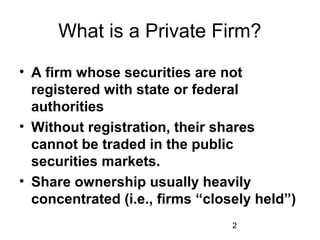
What is a Private Firm?
• A firm whose securities are not
registered with state or federal
authorities
• Without registration, their shares
cannot be traded in the public
securities markets.
• Share ownership usually heavily
concentrated (i.e., firms “closely held”)
3
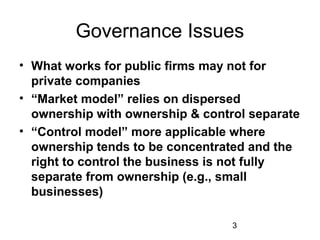
Governance Issues
• What works for public firms may not for
private companies
• “Market model” relies on dispersed
ownership with ownership & control separate
• “Control model” more applicable where
ownership tends to be concentrated and the
right to control the business is not fully
separate from ownership (e.g., small
businesses)
4
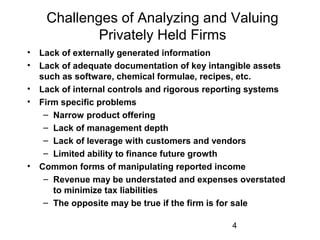
Challenges of Analyzing and Valuing
Privately Held Firms
• Lack of externally generated information
• Lack of adequate documentation of key intangible assets
such as software, chemical formulae, recipes, etc.
• Lack of internal controls and rigorous reporting systems
• Firm specific problems
– Narrow product offering
– Lack of management depth
– Lack of leverage with customers and vendors
– Limited ability to finance future growth
• Common forms of manipulating reported income
– Revenue may be understated and expenses overstated
to minimize tax liabilities
– The opposite may be true if the firm is for sale
5
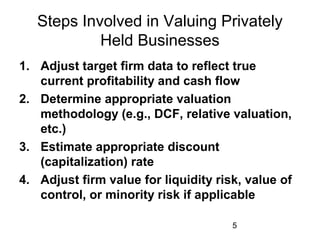
Steps Involved in Valuing Privately
Held Businesses
1. Adjust target firm data to reflect true
current profitability and cash flow
2. Determine appropriate valuation
methodology (e.g., DCF, relative valuation,
etc.)
3. Estimate appropriate discount
(capitalization) rate
4. Adjust firm value for liquidity risk, value of
control, or minority risk if applicable
6
Step 1: Adjusting the Income
Statement
• Owner/officer’s salaries
• Benefits
• Travel and entertainment
• Auto expenses and personal life insurance
• Family members
• Rent or lease payments in excess of fair market
value
• Professional service fees
• Depreciation expense
• Reserves
7
Areas Commonly Understated
• When a business is being sold, the following
expense categories are often understated by the
seller:
– The marketing and advertising expenditures
required to support an aggressive revenue growth
forecast
– Training sales forces to market new products
– Environmental clean-up (“long-tailed” liabilities)
– Employee safety
– Pending litigation
8
Areas Commonly Overlooked
• When a business is being sold, the following
asset categories are often overlooked by the
buyer as potential sources of value:1
– Customer lists
– Intellectual property
– Licenses
– Distributorship agreements
– Leases
– Regulatory approvals
– Employment contracts
– Non-compete agreements
How might you value each of the above items?
1
For these items to represent sources of incremental value they must represent sources of
revenue or cost reduction not already reflected in the target’s cash flows.
9
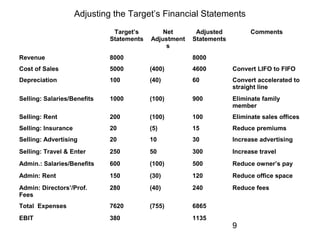
Adjusting the Target’s Financial Statements
Target’s
Statements
Net
Adjustment
s
Adjusted
Statements
Comments
Revenue 8000 8000
Cost of Sales 5000 (400) 4600 Convert LIFO to FIFO
Depreciation 100 (40) 60 Convert accelerated to
straight line
Selling: Salaries/Benefits 1000 (100) 900 Eliminate family
member
Selling: Rent 200 (100) 100 Eliminate sales offices
Selling: Insurance 20 (5) 15 Reduce premiums
Selling: Advertising 20 10 30 Increase advertising
Selling: Travel & Enter 250 50 300 Increase travel
Admin.: Salaries/Benefits 600 (100) 500 Reduce owner’s pay
Admin: Rent 150 (30) 120 Reduce office space
Admin: Directors’/Prof.
Fees
280 (40) 240 Reduce fees
Total Expenses 7620 (755) 6865
EBIT 380 1135
10
Step 2: Determine Appropriate
Valuation Methodology
• Income or DCF approach
• Relative or market-based
approach
• Replacement cost approach
• Asset-oriented approach
11
Step 3: Select Appropriate Discount
(Capitalization) Rates
• Capital asset pricing model (CAPM)
– Estimate firm’s beta based on comparable
publicly listed firms1
– Adjust for specific business risk2
• Cost of capital
– Cost of debt based on what public firms of
comparable risk are paying3
– Weights reflect management’s target debt to
equity ratio or industry average ratio1U
se industry average ratio assuming firm’s target D/E will move to industry
average..
2
Difference between junk bond rate and risk-free rate,
3
Assuming firms with similar interest coverage ratios will have similar credit
ratings, estimate what private firm’s credit rating would be and base its pre-tax
cost of borrowing on a comparably rated public firm’s cost of borrowing.
12
Step 4: Adjust Firm Value for
Liquidity Risk, Value of Control, or
Minority Risk
Discount Applied to Firm Value
• Liquidity risk: Reflects potential loss in value when
an asset is sold in an illiquid market
• Minority risk: Reflects lack of control associated
with minority ownership. Risk varies with size of
ownership position
Premium Applied to Firm Value
• Value of control: Ability to direct activities of the firm
13
Liquidity Discount
• Liquidity is the ease with which investors can sell
their stock without a serious loss in the value of
their investment.
• A liquidity discount is a reduction in the offer price
for the target firm by an amount equal to the
potential loss of value when sold due to the lack of
liquidity in the market.
14
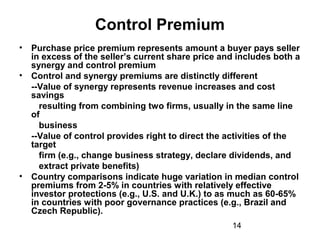
Control Premium
• Purchase price premium represents amount a buyer pays seller
in excess of the seller’s current share price and includes both a
synergy and control premium
• Control and synergy premiums are distinctly different
--Value of synergy represents revenue increases and cost
savings
resulting from combining two firms, usually in the same line
of
business
--Value of control provides right to direct the activities of the
target
firm (e.g., change business strategy, declare dividends, and
extract private benefits)
• Country comparisons indicate huge variation in median control
premiums from 2-5% in countries with relatively effective
investor protections (e.g., U.S. and U.K.) to as much as 60-65%
in countries with poor governance practices (e.g., Brazil and
Czech Republic).
15
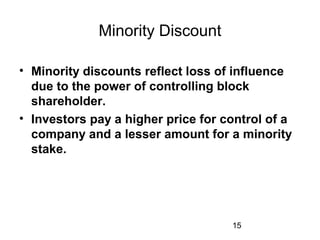
Minority Discount
• Minority discounts reflect loss of influence
due to the power of controlling block
shareholder.
• Investors pay a higher price for control of a
company and a lesser amount for a minority
stake.
16
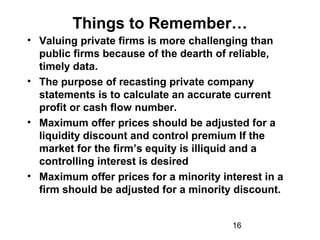
Things to Remember…
• Valuing private firms is more challenging than
public firms because of the dearth of reliable,
timely data.
• The purpose of recasting private company
statements is to calculate an accurate current
profit or cash flow number.
• Maximum offer prices should be adjusted for a
liquidity discount and control premium If the
market for the firm’s equity is illiquid and a
controlling interest is desired
• Maximum offer prices for a minority interest in a
firm should be adjusted for a minority discount.

10~chapter 10 analyzing_privately_held_companies

  • 1.
  • 2.
    2 What is aPrivate Firm? • A firm whose securities are not registered with state or federal authorities • Without registration, their shares cannot be traded in the public securities markets. • Share ownership usually heavily concentrated (i.e., firms “closely held”)
  • 3.
    3 Governance Issues • Whatworks for public firms may not for private companies • “Market model” relies on dispersed ownership with ownership & control separate • “Control model” more applicable where ownership tends to be concentrated and the right to control the business is not fully separate from ownership (e.g., small businesses)
  • 4.
    4 Challenges of Analyzingand Valuing Privately Held Firms • Lack of externally generated information • Lack of adequate documentation of key intangible assets such as software, chemical formulae, recipes, etc. • Lack of internal controls and rigorous reporting systems • Firm specific problems – Narrow product offering – Lack of management depth – Lack of leverage with customers and vendors – Limited ability to finance future growth • Common forms of manipulating reported income – Revenue may be understated and expenses overstated to minimize tax liabilities – The opposite may be true if the firm is for sale
  • 5.
    5 Steps Involved inValuing Privately Held Businesses 1. Adjust target firm data to reflect true current profitability and cash flow 2. Determine appropriate valuation methodology (e.g., DCF, relative valuation, etc.) 3. Estimate appropriate discount (capitalization) rate 4. Adjust firm value for liquidity risk, value of control, or minority risk if applicable
  • 6.
    6 Step 1: Adjustingthe Income Statement • Owner/officer’s salaries • Benefits • Travel and entertainment • Auto expenses and personal life insurance • Family members • Rent or lease payments in excess of fair market value • Professional service fees • Depreciation expense • Reserves
  • 7.
    7 Areas Commonly Understated •When a business is being sold, the following expense categories are often understated by the seller: – The marketing and advertising expenditures required to support an aggressive revenue growth forecast – Training sales forces to market new products – Environmental clean-up (“long-tailed” liabilities) – Employee safety – Pending litigation
  • 8.
    8 Areas Commonly Overlooked •When a business is being sold, the following asset categories are often overlooked by the buyer as potential sources of value:1 – Customer lists – Intellectual property – Licenses – Distributorship agreements – Leases – Regulatory approvals – Employment contracts – Non-compete agreements How might you value each of the above items? 1 For these items to represent sources of incremental value they must represent sources of revenue or cost reduction not already reflected in the target’s cash flows.
  • 9.
    9 Adjusting the Target’sFinancial Statements Target’s Statements Net Adjustment s Adjusted Statements Comments Revenue 8000 8000 Cost of Sales 5000 (400) 4600 Convert LIFO to FIFO Depreciation 100 (40) 60 Convert accelerated to straight line Selling: Salaries/Benefits 1000 (100) 900 Eliminate family member Selling: Rent 200 (100) 100 Eliminate sales offices Selling: Insurance 20 (5) 15 Reduce premiums Selling: Advertising 20 10 30 Increase advertising Selling: Travel & Enter 250 50 300 Increase travel Admin.: Salaries/Benefits 600 (100) 500 Reduce owner’s pay Admin: Rent 150 (30) 120 Reduce office space Admin: Directors’/Prof. Fees 280 (40) 240 Reduce fees Total Expenses 7620 (755) 6865 EBIT 380 1135
  • 10.
    10 Step 2: DetermineAppropriate Valuation Methodology • Income or DCF approach • Relative or market-based approach • Replacement cost approach • Asset-oriented approach
  • 11.
    11 Step 3: SelectAppropriate Discount (Capitalization) Rates • Capital asset pricing model (CAPM) – Estimate firm’s beta based on comparable publicly listed firms1 – Adjust for specific business risk2 • Cost of capital – Cost of debt based on what public firms of comparable risk are paying3 – Weights reflect management’s target debt to equity ratio or industry average ratio1U se industry average ratio assuming firm’s target D/E will move to industry average.. 2 Difference between junk bond rate and risk-free rate, 3 Assuming firms with similar interest coverage ratios will have similar credit ratings, estimate what private firm’s credit rating would be and base its pre-tax cost of borrowing on a comparably rated public firm’s cost of borrowing.
  • 12.
    12 Step 4: AdjustFirm Value for Liquidity Risk, Value of Control, or Minority Risk Discount Applied to Firm Value • Liquidity risk: Reflects potential loss in value when an asset is sold in an illiquid market • Minority risk: Reflects lack of control associated with minority ownership. Risk varies with size of ownership position Premium Applied to Firm Value • Value of control: Ability to direct activities of the firm
  • 13.
    13 Liquidity Discount • Liquidityis the ease with which investors can sell their stock without a serious loss in the value of their investment. • A liquidity discount is a reduction in the offer price for the target firm by an amount equal to the potential loss of value when sold due to the lack of liquidity in the market.
  • 14.
    14 Control Premium • Purchaseprice premium represents amount a buyer pays seller in excess of the seller’s current share price and includes both a synergy and control premium • Control and synergy premiums are distinctly different --Value of synergy represents revenue increases and cost savings resulting from combining two firms, usually in the same line of business --Value of control provides right to direct the activities of the target firm (e.g., change business strategy, declare dividends, and extract private benefits) • Country comparisons indicate huge variation in median control premiums from 2-5% in countries with relatively effective investor protections (e.g., U.S. and U.K.) to as much as 60-65% in countries with poor governance practices (e.g., Brazil and Czech Republic).
  • 15.
    15 Minority Discount • Minoritydiscounts reflect loss of influence due to the power of controlling block shareholder. • Investors pay a higher price for control of a company and a lesser amount for a minority stake.
  • 16.
    16 Things to Remember… •Valuing private firms is more challenging than public firms because of the dearth of reliable, timely data. • The purpose of recasting private company statements is to calculate an accurate current profit or cash flow number. • Maximum offer prices should be adjusted for a liquidity discount and control premium If the market for the firm’s equity is illiquid and a controlling interest is desired • Maximum offer prices for a minority interest in a firm should be adjusted for a minority discount.