Presentation By-
Anshu Singh

 Corporate restructuring is the process of redesigning
one or more aspects of a company. The process of
reorganizing a company may be implemented due to
a number of different factors, such as positioning the
company to be more competitive, survive a currently
adverse economic climate, or poise the corporation
to move in an entirely new direction. Here are some
examples of why corporate restructuring may take
place and what it can mean for the company.
Corporate restructuring
 Corporate restructuring refers to the changes in
ownership, business mix, assets mix and alliances with a
view to enhance the shareholder value.
 Hence, corporate restructuring may involve ownership
restructuring, business restructuring and assets
restructuring.

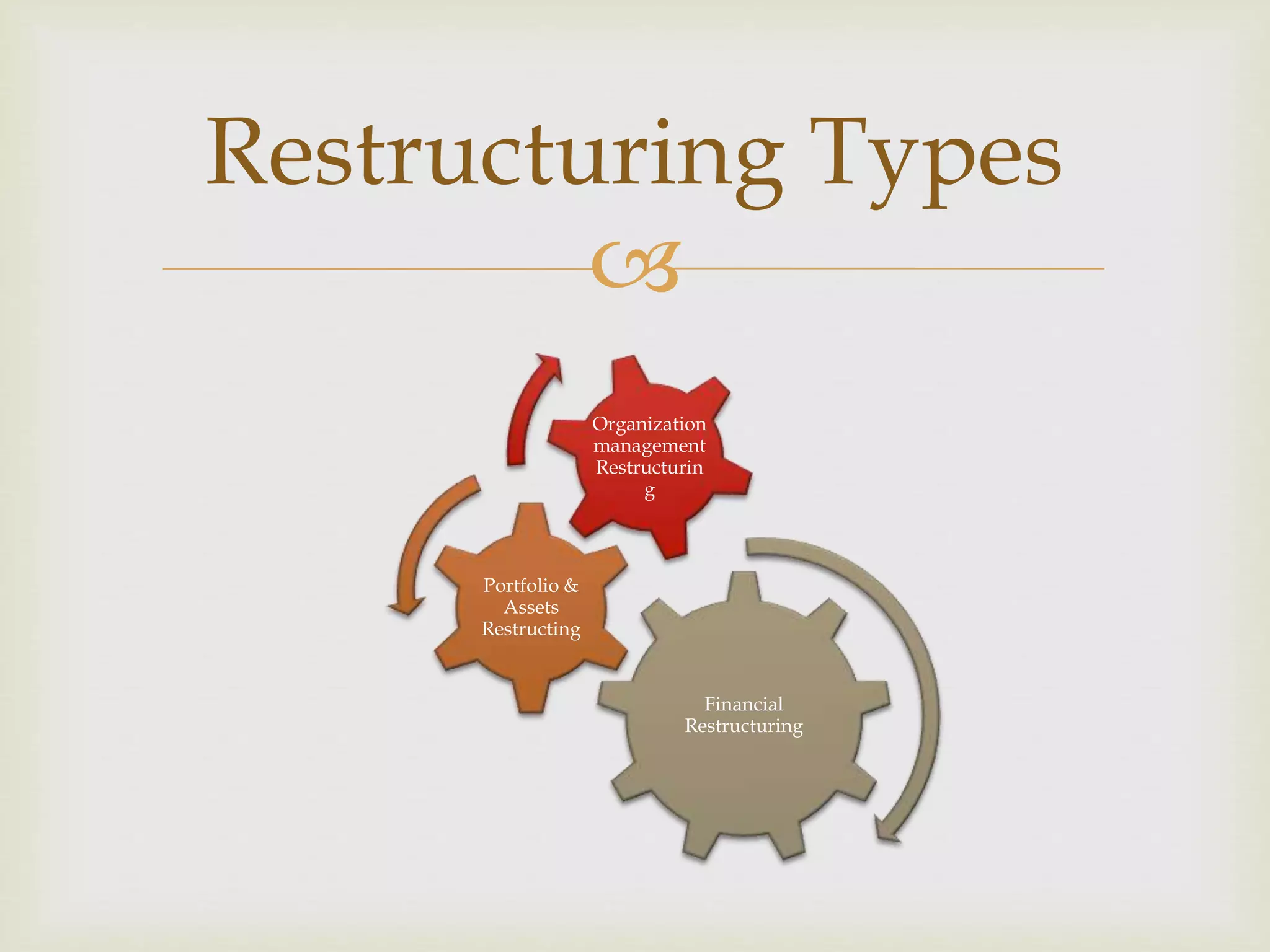
Restructuring Types
Financial
Restructuring
Portfolio &
Assets
Restructing
Organization
management
Restructurin
g

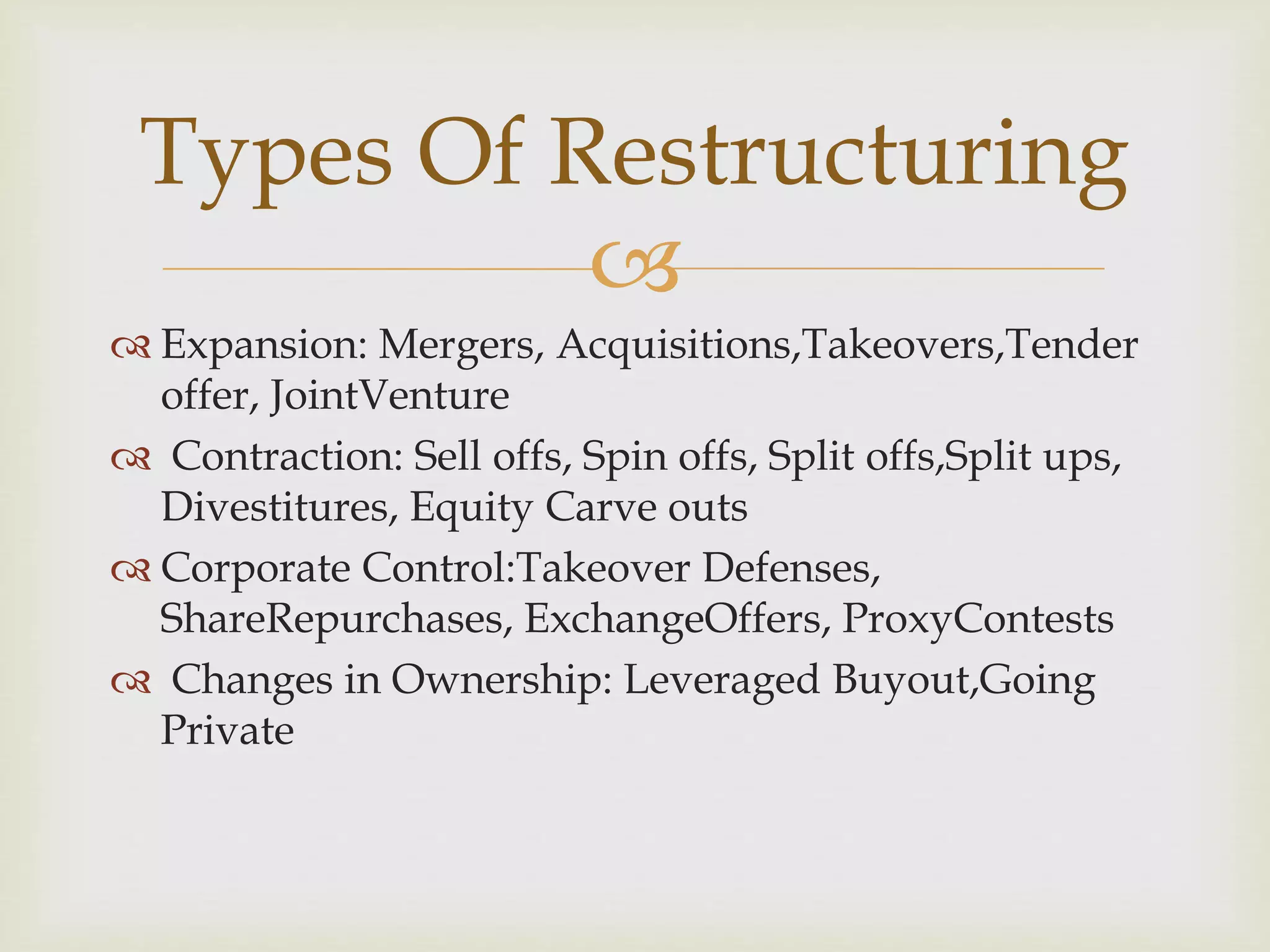
 Expansion: Mergers, Acquisitions,Takeovers,Tender
offer, JointVenture
 Contraction: Sell offs, Spin offs, Split offs,Split ups,
Divestitures, Equity Carve outs
 Corporate Control:Takeover Defenses,
ShareRepurchases, ExchangeOffers, ProxyContests
 Changes in Ownership: Leveraged Buyout,Going
Private
Types Of Restructuring

 A merger refers to the process whereby at leasttwo
companies combine to form one singlecompany.
Business firms make use of mergersand acquisitions
for consolidation of markets aswell as for gaining a
competitive edge in theindustry. Merger is a
financial tool that is usedfor enhancing long-term
profitability byexpanding their operations. Mergers
occur whenthe merging companies have their
mutualconsent as different from acquisitions, which
cantake the form of a hostile takeover.
Merger

Absorption Consolidation
Mergers or amalgamation
may take 2 forms

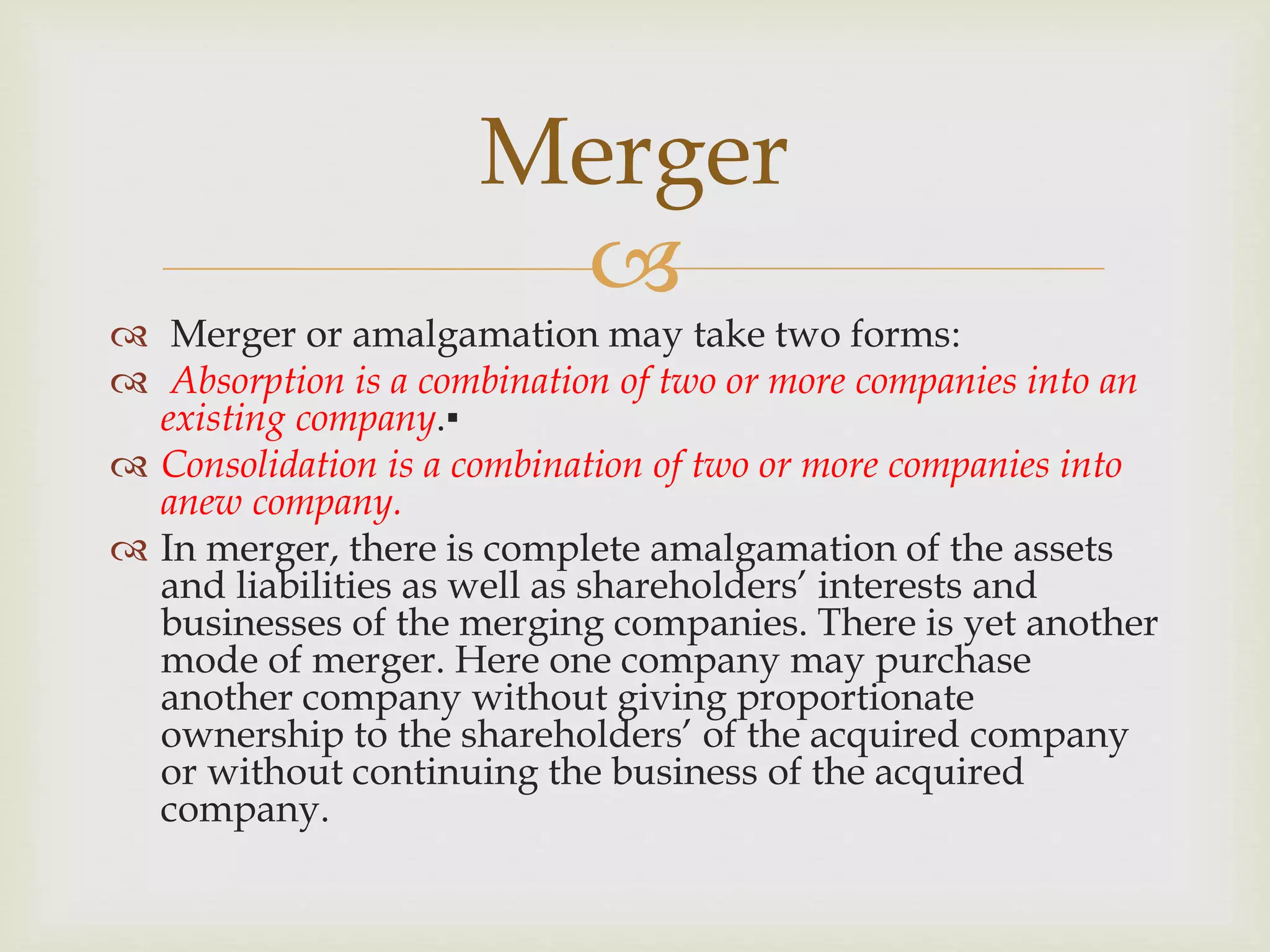
 Merger or amalgamation may take two forms:
 Absorption is a combination of two or more companies into an
existing company.▪
 Consolidation is a combination of two or more companies into
anew company.
 In merger, there is complete amalgamation of the assets
and liabilities as well as shareholders’ interests and
businesses of the merging companies. There is yet another
mode of merger. Here one company may purchase
another company without giving proportionate
ownership to the shareholders’ of the acquired company
or without continuing the business of the acquired
company.
Merger

 Strategic benefit: competition, entry, risk and cost
reduction Complementary resources e.g. Technology
and Marketing
 Tax benefits :accumulated losses, unabsorbed
depreciation, government incentives, sales and excise
duty benefits
 Utilization of surplus funds
 Managerial effectiveness
 Diversification
 Lower financing costs Earnings growth etc
Reasons For Mergers

Horizontal
Vertical
Concentric
Conglomerate
Types Of Merger

 A Type of Merger occurred when two companies
competing in the same line of Business Activities.
 The Effect on the Market Would be Either Large or a
little to No Effects. Number of firms in an industry
will be reduced due to Horizontal Mergers and this
may lead firms to Earn huge monopoly profits.
Horizontal mergers are regulated by government for
their negative effect on competition .Eg:In May 2010
Bank of Rajasthan with ICICI bankACC cementWith
Damodar cement
Horizontal Merger

(1) Horizontal Merger
 Acquisition of a company in the same industry
in which the acquiring firm competes increases a
firm’s market power by exploiting

 A Merger between two companies producing different
goods or services for one Specific Finished Products.
 It refer to a situation where a product manufacturer
merges with the supplier of Inputs or Raw Materials. Also
Known as Vertical Foreclosure´.
 Cost Reduction and Minimization Of Transportation cost.
 Two Types Of Vertical Mergers
 Backward Vertical Mergers. HLL &TATA tea with tea
gardens in Assam & west Bengal. BPL. with Uptorn color
picture.
 ForwardVertical Mergers Oil companies buying up
service stations Disney’s With American Broadcasting Co.
Vertical Merger

 A type of merger where the two companies coming
together to share some common expertise that may
posses mutually advantageous. The Common
Expertise may be Managerial or Technological
Know How that may not be Industry or Product
Specific.
 In short combining two or more businesses in order
to pool expertise.
 A Merger between a Motor cycle Manufacturer and
an Automobile Manufacturer would be an Example
Concentric Merger

 Analysis of merger offer-motive ,impact on stock
price ,effect on brand image .
 Approval form Board of Directors of both the
companies for the merger.
 Approval of merger by shareholders ,bankers,
trustees
 Intimation to stock Exchange where these firms are
listed
Legal Procedure For
Merger

 Submission of application to the court.
 Submission of general meeting report of the
chairman to court.
 Hearing the petition & confirmation of merger.
 Filling Court Order with ROC by the firms.
 Integration of assets and liabilities

 This involves fusion of one or more companies
where the companies lose their individual identity
and the new company comes into existence to take
over the business of companies being liquidated.
 The merger of Brook Bond India Limited and Lipton
India Limited resulted in formation of a new
company Brook Bond Lipton India Limited.
Amalgamation

 The term takeover is understood to connote hostility.
When an acquisition is a ‘forced’ or‘ unwilling’
acquisition, it is called a takeover.
 A holding company is a company that holds more
than half of the nominal value of the equity capital of
another company, called a subsidiary company, or
controls the composition of its Board of Directors.
Both holding and subsidiary companies retain their
separate legal entities and maintain their separate
books of accounts.
Takeover

 This involves fusion of a small company with a large
company where the smaller company ceases to exist
after the merger.
 The merger of TATA OIL MILLS company limited
(TOMCO) with Hindustan lever limited.(HLL) is an
example of absorption
Absorption

 A tender offer is a formal offer to purchase agiven
number of a company’s shares at aspecific price.
Tender offer can be used in two situations. First,
the acquiring company may directly approach
thetarget company for its takeover. If the target
companydoes not agree, then the acquiring company
may directlyapproach the shareholders by means of
a tender offer. Second, the tender offer may be used
without anynegotiations, and it may be tantamount
to a hostiletakeover
Tender Offer

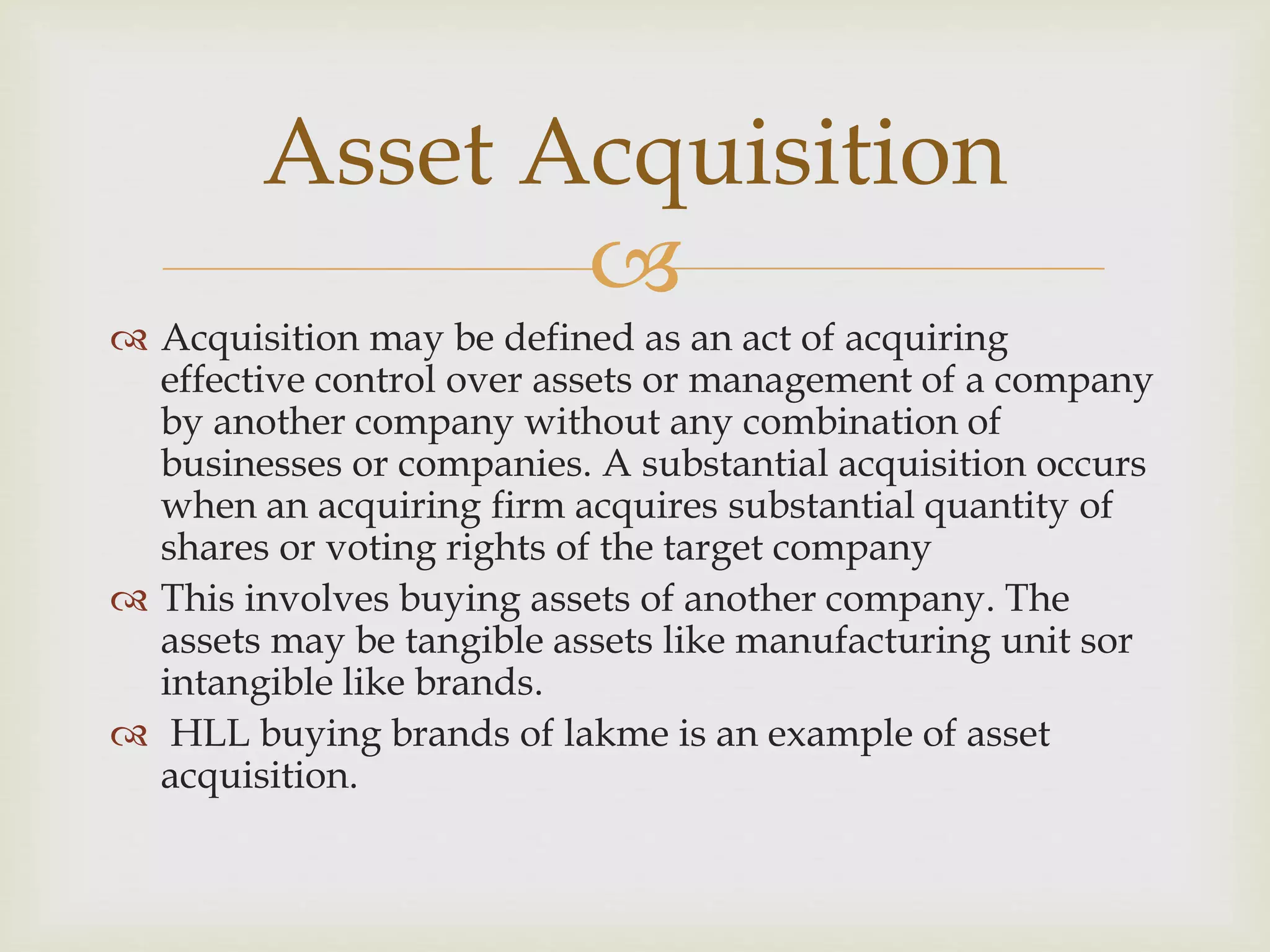
 Acquisition may be defined as an act of acquiring
effective control over assets or management of a company
by another company without any combination of
businesses or companies. A substantial acquisition occurs
when an acquiring firm acquires substantial quantity of
shares or voting rights of the target company
 This involves buying assets of another company. The
assets may be tangible assets like manufacturing unit sor
intangible like brands.
 HLL buying brands of lakme is an example of asset
acquisition.
Asset Acquisition

 his Involves two companies coming together and
forming a new company whose ownership is
changed. Generally this strategy is adopted by
MNC’s to enter into foreign companies.
 DCM Group and Daewoo Motors entered into a joint
venture to form DCM Daewoo Limited to
manufacture auto mobiles in India
Joint Venture

 Demergers means split or division of a company.
Such divisions may take place for various internal or
external factors. Internal factors generally consist of
split in the family rather than lack of competition on
the part of management.
 For Example DCM Limited was divided into four
separate companies which are being managed by
different family members of Late Shri ram
Demergers

 This type of demerger involves division of company
into wholly owned subsidiary of parent company by
distribution of all its shares of subsidiary company
on a pro-rata basis.
 For Example Kotak Mahindra finance limited
formed a subsidiary called Kotak Mahindra Capital
Corporation by spinning off its investment banking
division.
Spin Off

 Spin offs are a distribution of subsidiary shares to parent
company shareholders
 As such, no money (necessarily) comes into the parent
company as a result
 No shares (or assets) of the subsidiary are sold to the
market(IPO) or to acquirer.
 Eg;Dr.Reddy formed new drug development company
“Perlecan Pharma”
 Sun Pharma demerged its R&D as a separate entity Sun
Pharma Advance Research company to reduce R&D cost.
Central Features of Spin off

 The firm sell a part (20% or less) of its wholly owned
subsidiary’s common stock in the market. This is
similar to spin –offs, expect that some part of share
holders of this subsidiary company is offered to
public through a public issue and the parent
company continues to enjoy control over the
subsidiary company by holding controlling interest
in it.
Equity Carve outs

 his type of demerger involves the division of the
parent company into two or more separate
companies where parent company ceases to exist
after the demerger. New business entities took place
for parent firm.
Splits Ups

 These are sale of segment of a company for cash or
for securities to an outside party.
 Selling assets, divisions, subsidiaries to another
corporation or combination of corporations or
individuals
Divestitures

 Selling corporation typically receives consideration
for the assets sold
 cash
 securities
 other assets
 Divestitures are typically taxable events for selling
corporation (new basis for purchaser)
Features of Divestitures

 This involves sale of tangible or intangible assets of a
company to generate cash.
Asset Sale

 In the conventional method, thus a company is absorbed
by the profitable one (called normal merger). On the other
hand, if reverse situation takes place i.e. if sick company
extends its embracing arm to the profitable company and
in turn absorbs it in it sfold, this action is called reverse
merger. It’s a merger of healthy company into a loss
making company as compared to a normal merger where
weaker units merge into stronger one.
 The first case of reverse merger formulated by BIFR
envisaged the merger of healthy company Sagar Real
Estate Developer Limited with sick textile company SLM
Maneklal industries limited.
Reverse Mergers

Motives of Corporate
Restructuring
 Limit competition.
 Utilise under-utilised market power.
 Overcome the problem of slow growth and profitability in
one’s own industry.
 Achieve diversification.
 Gain economies of scale and increase income with
proportionately less investment.
 Establish a transnational bridgehead without excessive
start-up costs to gain access to a foreign market
Utilise under-utilised resources–human and physical
and managerial skills.
Displace existing management.
Circumvent government regulations.
Reap speculative gains attendant upon new security
issue or change in P/E ratio.
Create an image of aggressiveness and strategic
opportunism, empire building and to amass vast
economic powers of the company.
Motives of Corporate Restructuring (Cont..)
Corporate restructuring

Corporate restructuring

  • 1.
  • 2.
      Corporate restructuringis the process of redesigning one or more aspects of a company. The process of reorganizing a company may be implemented due to a number of different factors, such as positioning the company to be more competitive, survive a currently adverse economic climate, or poise the corporation to move in an entirely new direction. Here are some examples of why corporate restructuring may take place and what it can mean for the company. Corporate restructuring
  • 3.
     Corporate restructuringrefers to the changes in ownership, business mix, assets mix and alliances with a view to enhance the shareholder value.  Hence, corporate restructuring may involve ownership restructuring, business restructuring and assets restructuring.
  • 4.
  • 5.
      Expansion: Mergers,Acquisitions,Takeovers,Tender offer, JointVenture  Contraction: Sell offs, Spin offs, Split offs,Split ups, Divestitures, Equity Carve outs  Corporate Control:Takeover Defenses, ShareRepurchases, ExchangeOffers, ProxyContests  Changes in Ownership: Leveraged Buyout,Going Private Types Of Restructuring
  • 6.
      A mergerrefers to the process whereby at leasttwo companies combine to form one singlecompany. Business firms make use of mergersand acquisitions for consolidation of markets aswell as for gaining a competitive edge in theindustry. Merger is a financial tool that is usedfor enhancing long-term profitability byexpanding their operations. Mergers occur whenthe merging companies have their mutualconsent as different from acquisitions, which cantake the form of a hostile takeover. Merger
  • 7.
     Absorption Consolidation Mergers oramalgamation may take 2 forms
  • 8.
      Merger oramalgamation may take two forms:  Absorption is a combination of two or more companies into an existing company.▪  Consolidation is a combination of two or more companies into anew company.  In merger, there is complete amalgamation of the assets and liabilities as well as shareholders’ interests and businesses of the merging companies. There is yet another mode of merger. Here one company may purchase another company without giving proportionate ownership to the shareholders’ of the acquired company or without continuing the business of the acquired company. Merger
  • 9.
      Strategic benefit:competition, entry, risk and cost reduction Complementary resources e.g. Technology and Marketing  Tax benefits :accumulated losses, unabsorbed depreciation, government incentives, sales and excise duty benefits  Utilization of surplus funds  Managerial effectiveness  Diversification  Lower financing costs Earnings growth etc Reasons For Mergers
  • 10.
  • 11.
      A Typeof Merger occurred when two companies competing in the same line of Business Activities.  The Effect on the Market Would be Either Large or a little to No Effects. Number of firms in an industry will be reduced due to Horizontal Mergers and this may lead firms to Earn huge monopoly profits. Horizontal mergers are regulated by government for their negative effect on competition .Eg:In May 2010 Bank of Rajasthan with ICICI bankACC cementWith Damodar cement Horizontal Merger
  • 12.
     (1) Horizontal Merger Acquisition of a company in the same industry in which the acquiring firm competes increases a firm’s market power by exploiting
  • 13.
      A Mergerbetween two companies producing different goods or services for one Specific Finished Products.  It refer to a situation where a product manufacturer merges with the supplier of Inputs or Raw Materials. Also Known as Vertical Foreclosure´.  Cost Reduction and Minimization Of Transportation cost.  Two Types Of Vertical Mergers  Backward Vertical Mergers. HLL &TATA tea with tea gardens in Assam & west Bengal. BPL. with Uptorn color picture.  ForwardVertical Mergers Oil companies buying up service stations Disney’s With American Broadcasting Co. Vertical Merger
  • 14.
      A typeof merger where the two companies coming together to share some common expertise that may posses mutually advantageous. The Common Expertise may be Managerial or Technological Know How that may not be Industry or Product Specific.  In short combining two or more businesses in order to pool expertise.  A Merger between a Motor cycle Manufacturer and an Automobile Manufacturer would be an Example Concentric Merger
  • 15.
      Analysis ofmerger offer-motive ,impact on stock price ,effect on brand image .  Approval form Board of Directors of both the companies for the merger.  Approval of merger by shareholders ,bankers, trustees  Intimation to stock Exchange where these firms are listed Legal Procedure For Merger
  • 16.
      Submission ofapplication to the court.  Submission of general meeting report of the chairman to court.  Hearing the petition & confirmation of merger.  Filling Court Order with ROC by the firms.  Integration of assets and liabilities
  • 17.
      This involvesfusion of one or more companies where the companies lose their individual identity and the new company comes into existence to take over the business of companies being liquidated.  The merger of Brook Bond India Limited and Lipton India Limited resulted in formation of a new company Brook Bond Lipton India Limited. Amalgamation
  • 18.
      The termtakeover is understood to connote hostility. When an acquisition is a ‘forced’ or‘ unwilling’ acquisition, it is called a takeover.  A holding company is a company that holds more than half of the nominal value of the equity capital of another company, called a subsidiary company, or controls the composition of its Board of Directors. Both holding and subsidiary companies retain their separate legal entities and maintain their separate books of accounts. Takeover
  • 19.
      This involvesfusion of a small company with a large company where the smaller company ceases to exist after the merger.  The merger of TATA OIL MILLS company limited (TOMCO) with Hindustan lever limited.(HLL) is an example of absorption Absorption
  • 20.
      A tenderoffer is a formal offer to purchase agiven number of a company’s shares at aspecific price. Tender offer can be used in two situations. First, the acquiring company may directly approach thetarget company for its takeover. If the target companydoes not agree, then the acquiring company may directlyapproach the shareholders by means of a tender offer. Second, the tender offer may be used without anynegotiations, and it may be tantamount to a hostiletakeover Tender Offer
  • 21.
      Acquisition maybe defined as an act of acquiring effective control over assets or management of a company by another company without any combination of businesses or companies. A substantial acquisition occurs when an acquiring firm acquires substantial quantity of shares or voting rights of the target company  This involves buying assets of another company. The assets may be tangible assets like manufacturing unit sor intangible like brands.  HLL buying brands of lakme is an example of asset acquisition. Asset Acquisition
  • 22.
      his Involvestwo companies coming together and forming a new company whose ownership is changed. Generally this strategy is adopted by MNC’s to enter into foreign companies.  DCM Group and Daewoo Motors entered into a joint venture to form DCM Daewoo Limited to manufacture auto mobiles in India Joint Venture
  • 23.
      Demergers meanssplit or division of a company. Such divisions may take place for various internal or external factors. Internal factors generally consist of split in the family rather than lack of competition on the part of management.  For Example DCM Limited was divided into four separate companies which are being managed by different family members of Late Shri ram Demergers
  • 24.
      This typeof demerger involves division of company into wholly owned subsidiary of parent company by distribution of all its shares of subsidiary company on a pro-rata basis.  For Example Kotak Mahindra finance limited formed a subsidiary called Kotak Mahindra Capital Corporation by spinning off its investment banking division. Spin Off
  • 25.
      Spin offsare a distribution of subsidiary shares to parent company shareholders  As such, no money (necessarily) comes into the parent company as a result  No shares (or assets) of the subsidiary are sold to the market(IPO) or to acquirer.  Eg;Dr.Reddy formed new drug development company “Perlecan Pharma”  Sun Pharma demerged its R&D as a separate entity Sun Pharma Advance Research company to reduce R&D cost. Central Features of Spin off
  • 26.
      The firmsell a part (20% or less) of its wholly owned subsidiary’s common stock in the market. This is similar to spin –offs, expect that some part of share holders of this subsidiary company is offered to public through a public issue and the parent company continues to enjoy control over the subsidiary company by holding controlling interest in it. Equity Carve outs
  • 27.
      his typeof demerger involves the division of the parent company into two or more separate companies where parent company ceases to exist after the demerger. New business entities took place for parent firm. Splits Ups
  • 28.
      These aresale of segment of a company for cash or for securities to an outside party.  Selling assets, divisions, subsidiaries to another corporation or combination of corporations or individuals Divestitures
  • 29.
      Selling corporationtypically receives consideration for the assets sold  cash  securities  other assets  Divestitures are typically taxable events for selling corporation (new basis for purchaser) Features of Divestitures
  • 30.
      This involvessale of tangible or intangible assets of a company to generate cash. Asset Sale
  • 31.
      In theconventional method, thus a company is absorbed by the profitable one (called normal merger). On the other hand, if reverse situation takes place i.e. if sick company extends its embracing arm to the profitable company and in turn absorbs it in it sfold, this action is called reverse merger. It’s a merger of healthy company into a loss making company as compared to a normal merger where weaker units merge into stronger one.  The first case of reverse merger formulated by BIFR envisaged the merger of healthy company Sagar Real Estate Developer Limited with sick textile company SLM Maneklal industries limited. Reverse Mergers
  • 32.
     Motives of Corporate Restructuring Limit competition.  Utilise under-utilised market power.  Overcome the problem of slow growth and profitability in one’s own industry.  Achieve diversification.  Gain economies of scale and increase income with proportionately less investment.  Establish a transnational bridgehead without excessive start-up costs to gain access to a foreign market
  • 33.
    Utilise under-utilised resources–humanand physical and managerial skills. Displace existing management. Circumvent government regulations. Reap speculative gains attendant upon new security issue or change in P/E ratio. Create an image of aggressiveness and strategic opportunism, empire building and to amass vast economic powers of the company. Motives of Corporate Restructuring (Cont..)