Needs-Based Selling
Cindy Wasowski & Dave Carrithers
October 7, 1998
“If I can listen to what he tells me, if I can
understand how it seems to him, if I can
sense the emotional flavor which it has for
him, then I will be releasing potent forces of
change within him.”
- Carl Rogers
What Is Needs-Based Selling
Listening and defining the problem first then
developing a solution to the need
More consultative than price
Value, history and knowledge
Steps, processes, experience and results based
Not always a single answer
Starts strategic and moves to tactical
Fluid not fixed
Examples
Financial services / estate planning
Insurance
Legal
Health Care
Construction
Technology
A Mind-set Change
“A banker interviews customers about their
financial needs and then discusses what
products might fit them. In the past a new
customer might have simply opened a
savings account. These days, customers are
shown ways to add more value to their
savings.”
- Kansas City Business Journal
Keys To Success
Find the clients fear, pain, worry, issue, concern
and provide a shield against
Be knowledgeable about their industries and
competitors
Listen, ask question, then listen and ask more
questions
More communications, more interaction
Integrate product solutions into recommendations,
but we are not always the only source of a solution
Insight
Take the high road
Strategic thinking to reassess the positioning of
sales to deliver value through higher-end solutions
to targeted customers
Aligning and integrating the functional or process
activities to deliver value through sales
A products vale must be identified, demonstrated,
and delivered by the sales agent not sought by the
customer
Entrepreneurial, value-adding in nature
Goal
The Right Message
Understand client situation/needs
The right audience
Unveil/unfold the solution over time
The right presentation - customized to your
audience and their industry
Pre-work and follow-up
Appropriateness of response
Value in EVERYTHING we do/say/think/provide
Keep In Mind As A Team
Do you treat different
customers differently?
Do you create a
learning relationship
with customers?
Do you keep your
customers?
Do you organize
around customers?
Typical Client Needs
Direct Clients
– Getting a distributors sales force to focus on
their products
– Competitive market action
– Poor response to product/offer
– Better understanding of mission and objectives
– Inventory stocking or reduction
– Product launch
– Cross selling
– Honor and recognition
Typical Client Needs
AVAR
– Product support and knowledge
– Creative solutions to their client problems
– Fast answers to pricing and product functions
– Presentation support
– Trends and competitive insight
– Leads and awareness building support
– Comfort level and sense of “partnership”
Gathering Client Information
Sales Incentive
Program Tool
Employee Program
Tool
Consumer/Customer
Tool
Know Thy Competition
Why Non-Cash
– Memorable
– Promotable
– Impact is more
Award Comparison Matrix
Selling Against The Competition
– Their one size solution doesn’t fit all
– What are their hidden agendas
– How easy are their solutions
Program Management Basics
Establishing program objectives
Set & manage budget
Determine performance criteria
Develop communications plan
Select rewards
Program administration
Sell program to management/co-funding partners,
participants
Ongoing program evaluation
Celebrate success
Program Management Is A
Requirement
Self-administered or
out-sourced
Any participant
audience
Across all rewards
Across all types of
programs
All program lengths
Any budget
Either the client
does it, or a
AVAR or us
(indirectly)
Good Programs Just
Don’t Happen
Common Mistakes
Poor design - unmotivating/unfair
Unrealistic goals
Lack of management support
Poor communications, both at the launch
and the follow up
No ongoing evaluation/input
Too complicated
Establishing Program Objectives
Tie to company objectives
Must be meaningful, measurable and
movable
Reality based
Keep them simple
Clearly communicate
Budgeting
Consider costs Vs projected ROI
Awards should represent 3-5% of a
participant's normal income for long-term
programs (at least 6 months)
Awards should represent 6-8% for a short
term “spurt” activity (60-90 days)
Fixed Vs open budgets - or combination
70% awards; 20% promotions; 10% admin
Open-Ended Budget
More motivating to participants
Funded by financial incremental results
Types of structures:
– Awards per unit
– Awards per dollar
– Dollar one
– Over objective (incremental)
– Over objective - retro to dollar one
– Accelerators - graduated earnings
– Top stops
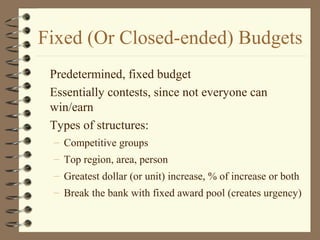
Fixed (Or Closed-ended) Budgets
Predetermined, fixed budget
Essentially contests, since not everyone can
win/earn
Types of structures:
– Competitive groups
– Top region, area, person
– Greatest dollar (or unit) increase, % of increase or both
– Break the bank with fixed award pool (creates urgency)
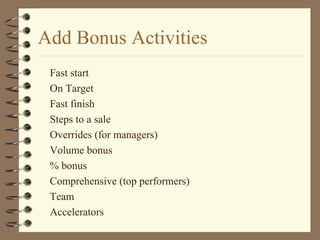
Add Bonus Activities
Fast start
On Target
Fast finish
Steps to a sale
Overrides (for managers)
Volume bonus
% bonus
Comprehensive (top performers)
Team
Accelerators
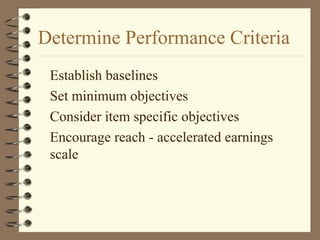
Determine Performance Criteria
Establish baselines
Set minimum objectives
Consider item specific objectives
Encourage reach - accelerated earnings
scale
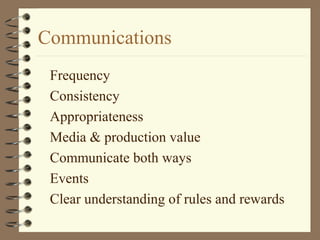
Communications
Frequency
Consistency
Appropriateness
Media & production value
Communicate both ways
Events
Clear understanding of rules and rewards
Selecting Rewards
Demographics - age, income, location
Lifestyle
Budget
Past history with awards
Diversity
Program length
Required effort
Selling To Management
Justify investment (ROI)
Demonstrate accountability
Create excitement
Document it’s what participants want and
need
Share info on other successful programs
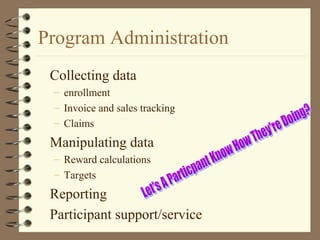
Program Administration
Collecting data
– enrollment
– Invoice and sales tracking
– Claims
Manipulating data
– Reward calculations
– Targets
Reporting
Participant support/service
Program Evaluations
Ongoing
Before a program starts
Critical to continues improvement
Provide feedback mechanisms - data &
attitudes
Do something with the feedback
Analyze ROI
Celebrating Success
Budget for it
Make sure it’s motivating
Just do it!

Needs Based Selling

  • 1.
    Needs-Based Selling Cindy Wasowski& Dave Carrithers October 7, 1998
  • 2.
    “If I canlisten to what he tells me, if I can understand how it seems to him, if I can sense the emotional flavor which it has for him, then I will be releasing potent forces of change within him.” - Carl Rogers
  • 3.
    What Is Needs-BasedSelling Listening and defining the problem first then developing a solution to the need More consultative than price Value, history and knowledge Steps, processes, experience and results based Not always a single answer Starts strategic and moves to tactical Fluid not fixed
  • 4.
    Examples Financial services /estate planning Insurance Legal Health Care Construction Technology
  • 5.
    A Mind-set Change “Abanker interviews customers about their financial needs and then discusses what products might fit them. In the past a new customer might have simply opened a savings account. These days, customers are shown ways to add more value to their savings.” - Kansas City Business Journal
  • 6.
    Keys To Success Findthe clients fear, pain, worry, issue, concern and provide a shield against Be knowledgeable about their industries and competitors Listen, ask question, then listen and ask more questions More communications, more interaction Integrate product solutions into recommendations, but we are not always the only source of a solution
  • 7.
    Insight Take the highroad Strategic thinking to reassess the positioning of sales to deliver value through higher-end solutions to targeted customers Aligning and integrating the functional or process activities to deliver value through sales A products vale must be identified, demonstrated, and delivered by the sales agent not sought by the customer Entrepreneurial, value-adding in nature
  • 8.
  • 9.
    The Right Message Understandclient situation/needs The right audience Unveil/unfold the solution over time The right presentation - customized to your audience and their industry Pre-work and follow-up Appropriateness of response Value in EVERYTHING we do/say/think/provide
  • 10.
    Keep In MindAs A Team Do you treat different customers differently? Do you create a learning relationship with customers? Do you keep your customers? Do you organize around customers?
  • 11.
    Typical Client Needs DirectClients – Getting a distributors sales force to focus on their products – Competitive market action – Poor response to product/offer – Better understanding of mission and objectives – Inventory stocking or reduction – Product launch – Cross selling – Honor and recognition
  • 12.
    Typical Client Needs AVAR –Product support and knowledge – Creative solutions to their client problems – Fast answers to pricing and product functions – Presentation support – Trends and competitive insight – Leads and awareness building support – Comfort level and sense of “partnership”
  • 13.
    Gathering Client Information SalesIncentive Program Tool Employee Program Tool Consumer/Customer Tool
  • 14.
    Know Thy Competition WhyNon-Cash – Memorable – Promotable – Impact is more Award Comparison Matrix Selling Against The Competition – Their one size solution doesn’t fit all – What are their hidden agendas – How easy are their solutions
  • 15.
    Program Management Basics Establishingprogram objectives Set & manage budget Determine performance criteria Develop communications plan Select rewards Program administration Sell program to management/co-funding partners, participants Ongoing program evaluation Celebrate success
  • 16.
    Program Management IsA Requirement Self-administered or out-sourced Any participant audience Across all rewards Across all types of programs All program lengths Any budget Either the client does it, or a AVAR or us (indirectly) Good Programs Just Don’t Happen
  • 17.
    Common Mistakes Poor design- unmotivating/unfair Unrealistic goals Lack of management support Poor communications, both at the launch and the follow up No ongoing evaluation/input Too complicated
  • 18.
    Establishing Program Objectives Tieto company objectives Must be meaningful, measurable and movable Reality based Keep them simple Clearly communicate
  • 19.
    Budgeting Consider costs Vsprojected ROI Awards should represent 3-5% of a participant's normal income for long-term programs (at least 6 months) Awards should represent 6-8% for a short term “spurt” activity (60-90 days) Fixed Vs open budgets - or combination 70% awards; 20% promotions; 10% admin
  • 20.
    Open-Ended Budget More motivatingto participants Funded by financial incremental results Types of structures: – Awards per unit – Awards per dollar – Dollar one – Over objective (incremental) – Over objective - retro to dollar one – Accelerators - graduated earnings – Top stops
  • 21.
    Fixed (Or Closed-ended)Budgets Predetermined, fixed budget Essentially contests, since not everyone can win/earn Types of structures: – Competitive groups – Top region, area, person – Greatest dollar (or unit) increase, % of increase or both – Break the bank with fixed award pool (creates urgency)
  • 22.
    Add Bonus Activities Faststart On Target Fast finish Steps to a sale Overrides (for managers) Volume bonus % bonus Comprehensive (top performers) Team Accelerators
  • 23.
    Determine Performance Criteria Establishbaselines Set minimum objectives Consider item specific objectives Encourage reach - accelerated earnings scale
  • 24.
    Communications Frequency Consistency Appropriateness Media & productionvalue Communicate both ways Events Clear understanding of rules and rewards
  • 25.
    Selecting Rewards Demographics -age, income, location Lifestyle Budget Past history with awards Diversity Program length Required effort
  • 26.
    Selling To Management Justifyinvestment (ROI) Demonstrate accountability Create excitement Document it’s what participants want and need Share info on other successful programs
  • 27.
    Program Administration Collecting data –enrollment – Invoice and sales tracking – Claims Manipulating data – Reward calculations – Targets Reporting Participant support/service
  • 28.
    Program Evaluations Ongoing Before aprogram starts Critical to continues improvement Provide feedback mechanisms - data & attitudes Do something with the feedback Analyze ROI
  • 29.
    Celebrating Success Budget forit Make sure it’s motivating Just do it!