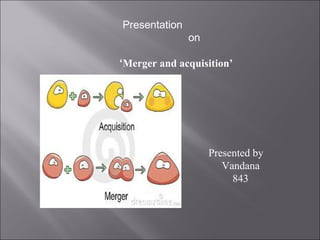
Presentation
               on

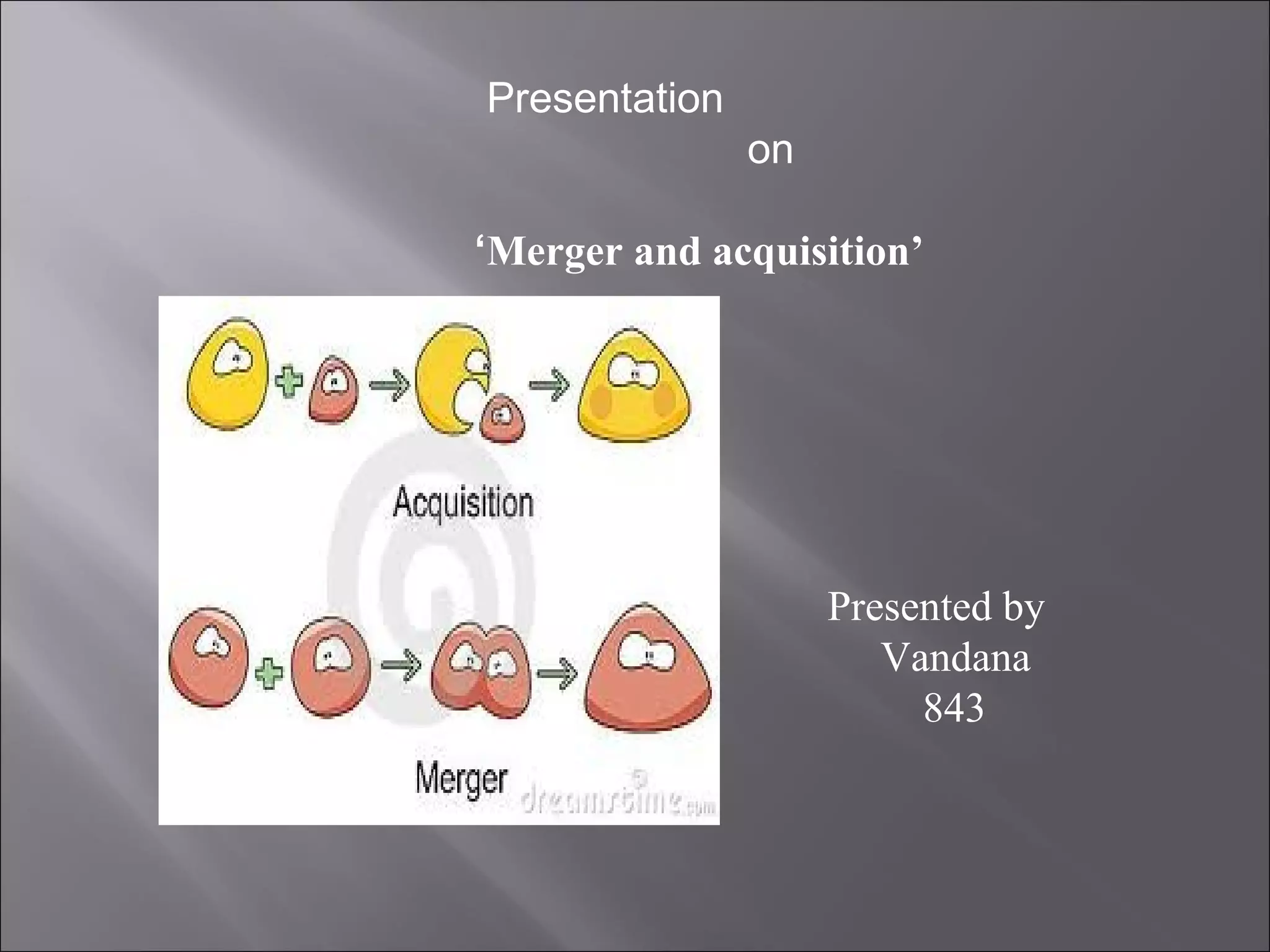
‘Merger and acquisition’


                    Presented by
                       Vandana
                         843
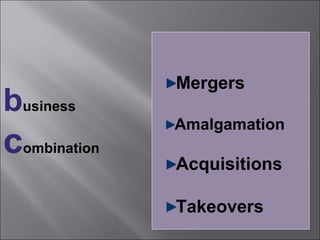
Mergers
business
                 Amalgamation
c   ombination
                 Acquisitions

                 Takeovers
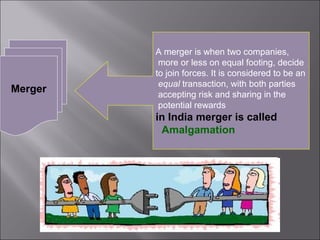
A merger is when two companies,
          more or less on equal footing, decide
         to join forces. It is considered to be an
          equal transaction, with both parties
Merger    accepting risk and sharing in the
          potential rewards
         in India merger is called
          Amalgamation
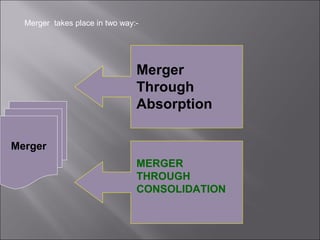
Merger takes place in two way:-


                                Merger
                                Through
                                Absorption

Merger
                                MERGER
                                THROUGH
                                CONSOLIDATION
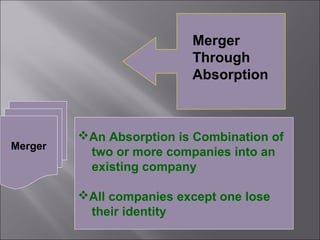
Merger
                          Through
                          Absorption


         An Absorption is Combination of
Merger
          two or more companies into an
          existing company

         All companies except one lose
          their identity
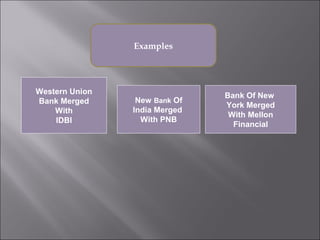
Examples


Western Union                  Bank Of New
Bank Merged      New Bank Of
                               York Merged
    With        India Merged
                                With Mellon
    IDBI          With PNB
                                 Financial
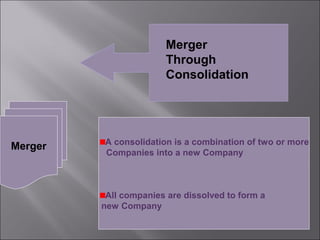
Merger
                       Through
                       Consolidation


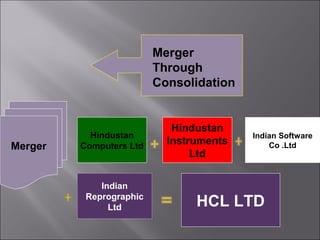
         A consolidation is a combination of two or more
Merger
         Companies into a new Company


          All companies are dissolved to form a
         new Company
Merger
                         Through
                         Consolidation


                            Hindustan
           Hindustan                     Indian Software
                           Instruments
Merger   Computers Ltd                       Co .Ltd
                                Ltd

             Indian
          Reprographic
               Ltd              HCL LTD
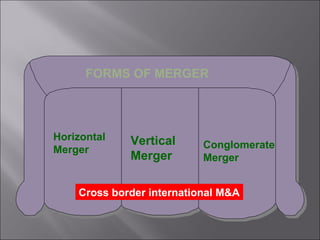
FORMS OF MERGER


Horizontal   Vertical
Merger                     Conglomerate
             Merger        Merger


    Cross border international M&A
1. Horizontal
   •   A merger in which two firms in the same industry
       combine.
   •   Often in an attempt to achieve economies of scale and/or
       scope.
   For example, combining of two book publishers or two
      luggage manufacturing companies to gain dominant
      market share
2. Vertical
   •   A merger in which one firm acquires a supplier or
       another firm that is closer to its existing customers.
   •   Often in an attempt to control supply or distribution
       channels.
   For example, joining of a TV manufacturing(assembling)
      company and a TV marketing company or joining of a
      spinning company and a weaving company.
3. Conglomerate
   •   A merger in which two firms in unrelated
       businesses combine.
   •   Purpose is often to ‘diversify’ the company by
       combining uncorrelated assets and income
       streams
    For example, merging of different businesses like
       manufacturing of cement products, fertilizer
       products, electronic products, insurance
       investment and advertising agencies. L&T and
       Voltas Ltd are examples of such mergers.
4. Cross-border (International) M&As
   •   A merger or acquisition involving a Indian and a
       foreign firm a either the acquiring or target
       company.
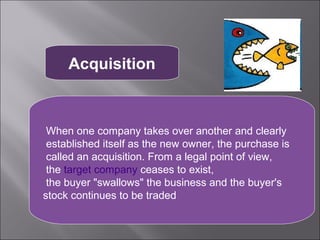
Acquisition


 When one company takes over another and clearly
 established itself as the new owner, the purchase is
 called an acquisition. From a legal point of view,
 the target company ceases to exist,
 the buyer "swallows" the business and the buyer's
stock continues to be traded
Acquisition & Takeover


When Acquisition is unfriendly or hostile
      It may be called Takeover
Faster Growth
             Improving Profitability
             Managerial
  M&A
             Effectiveness
Objectives   Gaining Market Power
             Leadership
             Cost Reduction
Are there any alternatives to Mergers or acquisitions?
Joint Venture
               Strategic Alliance
               Eliminating Inefficient
                Operations
 Merger        Productivity Improvement
Alternatives   Hiring Capable
                Managers
Limit Competition
                     Market Power
                     Diversification
                     Growth
                     Economy of Scale
                     Access to Foreign Market
                     Resources
                     Displace existing Management
MOTIVES & BENEFITS   Aggressiveness
      OF             Diversifying Risk
  MERGERS            Profitability
Accelerated Growth


MOTIVES & BENEFITS   Expanding Existing Markets
      OF             Entering New Markets
  MERGERS            Expand Internally
                     Expand Externally
                     Developing Operating Facilities
                     Price Paid for Merger
Enhanced Profitability


MOTIVES & BENEFITS
      OF
  MERGERS            Economies of Scale
                     Operating Economies
                     Synergy
Reduction in Tax Liability


MOTIVES & BENEFITS
      OF
                     Carry forward Losses
  MERGERS
                     Tax on Share
Financial Benefits


                     Eliminating Financial Constraints
MOTIVES & BENEFITS   Deploying Surplus Cash
      OF
  MERGERS            Enhancing Debt Capacity

                     Lowering Financial Costs
Increased Market Power


                     Market Share

MOTIVES & BENEFITS   Bargaining Power
      OF
  MERGERS            Technological Advancement

                     Pricing

                     Limiting Competition
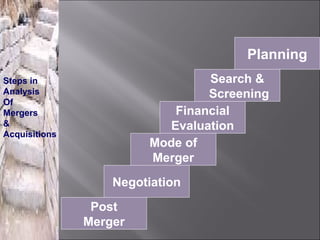
Planning
Steps in                        Search &
Analysis                        Screening
Of
Mergers                    Financial
&                         Evaluation
Acquisitions
                        Mode of
                        Merger
                   Negotiation
                Post
               Merger
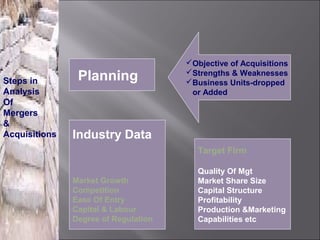
Objective of Acquisitions

Steps in        Planning              Strengths & Weaknesses
                                      Business Units-dropped
Analysis                               or Added
Of
Mergers
&
Acquisitions   Industry Data
                                         Target Firm

                                         Quality Of Mgt
               Market Growth             Market Share Size
               Competition               Capital Structure
               Ease Of Entry             Profitability
               Capital & Labour          Production &Marketing
               Degree of Regulation      Capabilities etc
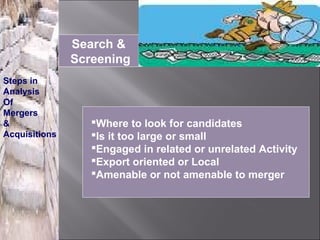
Search &
               Screening
Steps in
Analysis
Of
Mergers
&                 Where to look for candidates
Acquisitions      Is it too large or small
                  Engaged in related or unrelated Activity
                  Export oriented or Local
                  Amenable or not amenable to merger
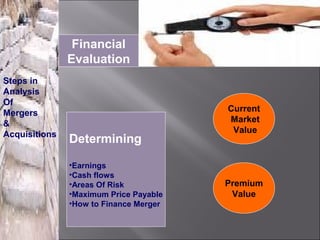
Financial
               Evaluation
Steps in
Analysis
Of
Mergers                                 Current
&                                       Market
Acquisitions                             Value
               Determining

               •Earnings
               •Cash flows
               •Areas Of Risk           Premium
               •Maximum Price Payable    Value
               •How to Finance Merger
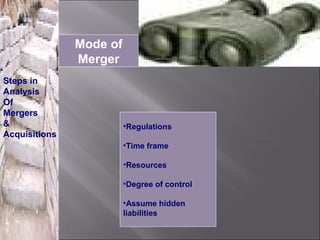
Mode of
               Merger
Steps in
Analysis
Of
Mergers
&                        •Regulations
Acquisitions
                         •Time frame

                         •Resources

                         •Degree of control

                         •Assume hidden
                         liabilities
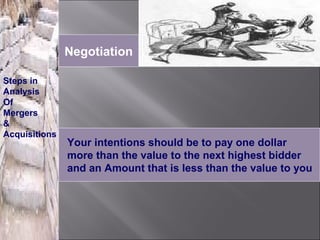
Negotiation

Steps in
Analysis
Of
Mergers
&
Acquisitions
               Your intentions should be to pay one dollar
               more than the value to the next highest bidder
               and an Amount that is less than the value to you
Post
                Merger
Steps in
Analysis
Of             Check Hostility
Mergers
&              Anticipate Problems
Acquisitions                          “Art of taking over
               Solve Problems             Company
                                      Without overtaking
               Treat people
                                               It”
                With Dignity
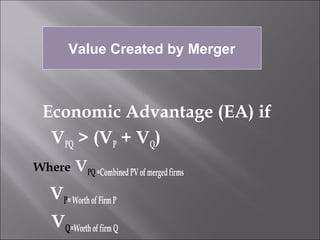
Value Created by Merger


 Economic Advantage (EA) if
  VPQ > (VP + VQ)
Where    VPQ =Combined PV of merged firms
  VP= Worth of Firm P
  VQ=Worth of firm Q
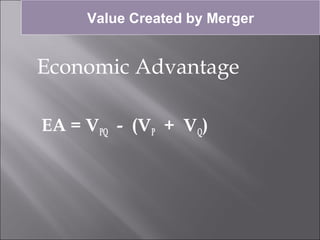
Value Created by Merger


Economic Advantage

EA = VPQ - (VP + VQ)
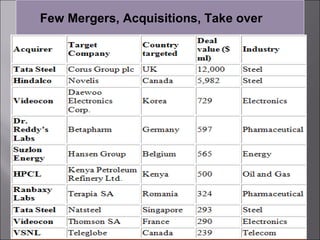
Few Mergers, Acquisitions, Take over
Merger & acquisition

Merger & acquisition

  • 1.
    Presentation on ‘Merger and acquisition’ Presented by Vandana 843
  • 2.
    Mergers business Amalgamation c ombination Acquisitions Takeovers
  • 3.
    A merger iswhen two companies, more or less on equal footing, decide to join forces. It is considered to be an equal transaction, with both parties Merger accepting risk and sharing in the potential rewards in India merger is called Amalgamation
  • 4.
    Merger takes placein two way:- Merger Through Absorption Merger MERGER THROUGH CONSOLIDATION
  • 5.
    Merger Through Absorption An Absorption is Combination of Merger two or more companies into an existing company All companies except one lose their identity
  • 6.
    Examples Western Union Bank Of New Bank Merged New Bank Of York Merged With India Merged With Mellon IDBI With PNB Financial
  • 7.
    Merger Through Consolidation A consolidation is a combination of two or more Merger Companies into a new Company All companies are dissolved to form a new Company
  • 8.
    Merger Through Consolidation Hindustan Hindustan Indian Software Instruments Merger Computers Ltd Co .Ltd Ltd Indian Reprographic Ltd HCL LTD
  • 9.
    FORMS OF MERGER Horizontal Vertical Merger Conglomerate Merger Merger Cross border international M&A
  • 10.
    1. Horizontal • A merger in which two firms in the same industry combine. • Often in an attempt to achieve economies of scale and/or scope. For example, combining of two book publishers or two luggage manufacturing companies to gain dominant market share 2. Vertical • A merger in which one firm acquires a supplier or another firm that is closer to its existing customers. • Often in an attempt to control supply or distribution channels. For example, joining of a TV manufacturing(assembling) company and a TV marketing company or joining of a spinning company and a weaving company.
  • 11.
    3. Conglomerate • A merger in which two firms in unrelated businesses combine. • Purpose is often to ‘diversify’ the company by combining uncorrelated assets and income streams For example, merging of different businesses like manufacturing of cement products, fertilizer products, electronic products, insurance investment and advertising agencies. L&T and Voltas Ltd are examples of such mergers. 4. Cross-border (International) M&As • A merger or acquisition involving a Indian and a foreign firm a either the acquiring or target company.
  • 12.
    Acquisition When onecompany takes over another and clearly established itself as the new owner, the purchase is called an acquisition. From a legal point of view, the target company ceases to exist, the buyer "swallows" the business and the buyer's stock continues to be traded
  • 13.
    Acquisition & Takeover WhenAcquisition is unfriendly or hostile It may be called Takeover
  • 14.
    Faster Growth Improving Profitability Managerial M&A Effectiveness Objectives Gaining Market Power Leadership Cost Reduction
  • 15.
    Are there anyalternatives to Mergers or acquisitions?
  • 16.
    Joint Venture Strategic Alliance Eliminating Inefficient Operations Merger Productivity Improvement Alternatives Hiring Capable Managers
  • 17.
    Limit Competition Market Power Diversification Growth Economy of Scale Access to Foreign Market Resources Displace existing Management MOTIVES & BENEFITS Aggressiveness OF Diversifying Risk MERGERS Profitability
  • 18.
    Accelerated Growth MOTIVES &BENEFITS Expanding Existing Markets OF Entering New Markets MERGERS Expand Internally Expand Externally Developing Operating Facilities Price Paid for Merger
  • 19.
    Enhanced Profitability MOTIVES &BENEFITS OF MERGERS Economies of Scale Operating Economies Synergy
  • 20.
    Reduction in TaxLiability MOTIVES & BENEFITS OF Carry forward Losses MERGERS Tax on Share
  • 21.
    Financial Benefits Eliminating Financial Constraints MOTIVES & BENEFITS Deploying Surplus Cash OF MERGERS Enhancing Debt Capacity Lowering Financial Costs
  • 22.
    Increased Market Power Market Share MOTIVES & BENEFITS Bargaining Power OF MERGERS Technological Advancement Pricing Limiting Competition
  • 23.
    Planning Steps in Search & Analysis Screening Of Mergers Financial & Evaluation Acquisitions Mode of Merger Negotiation Post Merger
  • 24.
    Objective of Acquisitions Stepsin Planning Strengths & Weaknesses Business Units-dropped Analysis or Added Of Mergers & Acquisitions Industry Data Target Firm Quality Of Mgt Market Growth Market Share Size Competition Capital Structure Ease Of Entry Profitability Capital & Labour Production &Marketing Degree of Regulation Capabilities etc
  • 25.
    Search & Screening Steps in Analysis Of Mergers & Where to look for candidates Acquisitions Is it too large or small Engaged in related or unrelated Activity Export oriented or Local Amenable or not amenable to merger
  • 26.
    Financial Evaluation Steps in Analysis Of Mergers Current & Market Acquisitions Value Determining •Earnings •Cash flows •Areas Of Risk Premium •Maximum Price Payable Value •How to Finance Merger
  • 27.
    Mode of Merger Steps in Analysis Of Mergers & •Regulations Acquisitions •Time frame •Resources •Degree of control •Assume hidden liabilities
  • 28.
    Negotiation Steps in Analysis Of Mergers & Acquisitions Your intentions should be to pay one dollar more than the value to the next highest bidder and an Amount that is less than the value to you
  • 29.
    Post Merger Steps in Analysis Of Check Hostility Mergers & Anticipate Problems Acquisitions “Art of taking over Solve Problems Company Without overtaking Treat people It” With Dignity
  • 30.
    Value Created byMerger Economic Advantage (EA) if VPQ > (VP + VQ) Where VPQ =Combined PV of merged firms VP= Worth of Firm P VQ=Worth of firm Q
  • 31.
    Value Created byMerger Economic Advantage EA = VPQ - (VP + VQ)
  • 33.