More – Coordinate Plane, Midpoint, and Relations and FunctionsModule 4 Topic 1
Example 1Remember that the quadrants are I, II, III, or IV.Quadrant I = (positive x-value, positive y-value)Quadrant II = (negative x-value, positive y-value)Quadrant III = (negative x-value, negative y-value)Quadrant IV = (positive x-value, negative y-value)
Example 2Similar Problem: Find the coordinates of the midpoint of M(-3, 0) and N(-7, -5).Midpoint is the average of the x-values and the average of the y-values.Midpoint = (x2 + x1) ÷ 2 , (y2 + y1) ÷ 2Midpoint = (-7 + -3) ÷ 2 , (-5 + 0) ÷ 2Midpoint = -10 ÷ 2 , -5 ÷ 2Midpoint = -5, -2.5 so we write it as an ordered pair (-5, -2.5)
Example 3Similar Problem: Use the following relation to answer questions 7 - 9.{(2, 4), (7, 8), (-5, 4), (-2, -8), (0, 0)}Is the relation a function?Yes - because the x-values do not repeat!
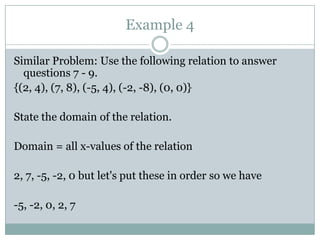
Example 4Similar Problem: Use the following relation to answer questions 7 - 9.{(2, 4), (7, 8), (-5, 4), (-2, -8), (0, 0)}State the domain of the relation.Domain = all x-values of the relation2, 7, -5, -2, 0 but let's put these in order so we have-5, -2, 0, 2, 7
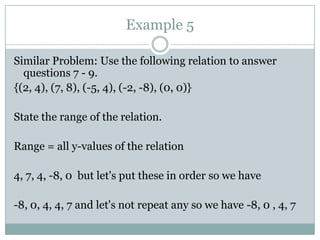
Example 5Similar Problem: Use the following relation to answer questions 7 - 9.{(2, 4), (7, 8), (-5, 4), (-2, -8), (0, 0)}State the range of the relation.Range = all y-values of the relation4, 7, 4, -8, 0  but let's put these in order so we have-8, 0, 4, 4, 7 and let's not repeat any so we have -8, 0 , 4, 7
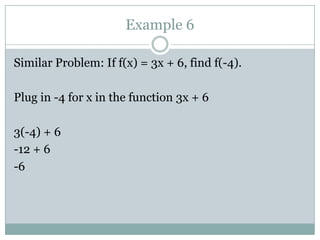
Example 6Similar Problem: If f(x) = 3x + 6, find f(-4).Plug in -4 for x in the function 3x + 63(-4) + 6-12 + 6-6

Module 4 topic 1 2nd

  • 1.
    More – CoordinatePlane, Midpoint, and Relations and FunctionsModule 4 Topic 1
  • 2.
    Example 1Remember thatthe quadrants are I, II, III, or IV.Quadrant I = (positive x-value, positive y-value)Quadrant II = (negative x-value, positive y-value)Quadrant III = (negative x-value, negative y-value)Quadrant IV = (positive x-value, negative y-value)
  • 3.
    Example 2Similar Problem:Find the coordinates of the midpoint of M(-3, 0) and N(-7, -5).Midpoint is the average of the x-values and the average of the y-values.Midpoint = (x2 + x1) ÷ 2 , (y2 + y1) ÷ 2Midpoint = (-7 + -3) ÷ 2 , (-5 + 0) ÷ 2Midpoint = -10 ÷ 2 , -5 ÷ 2Midpoint = -5, -2.5 so we write it as an ordered pair (-5, -2.5)
  • 4.
    Example 3Similar Problem:Use the following relation to answer questions 7 - 9.{(2, 4), (7, 8), (-5, 4), (-2, -8), (0, 0)}Is the relation a function?Yes - because the x-values do not repeat!
  • 5.
    Example 4Similar Problem:Use the following relation to answer questions 7 - 9.{(2, 4), (7, 8), (-5, 4), (-2, -8), (0, 0)}State the domain of the relation.Domain = all x-values of the relation2, 7, -5, -2, 0 but let's put these in order so we have-5, -2, 0, 2, 7
  • 6.
    Example 5Similar Problem:Use the following relation to answer questions 7 - 9.{(2, 4), (7, 8), (-5, 4), (-2, -8), (0, 0)}State the range of the relation.Range = all y-values of the relation4, 7, 4, -8, 0 but let's put these in order so we have-8, 0, 4, 4, 7 and let's not repeat any so we have -8, 0 , 4, 7
  • 7.
    Example 6Similar Problem:If f(x) = 3x + 6, find f(-4).Plug in -4 for x in the function 3x + 63(-4) + 6-12 + 6-6