Pedagogy of Mathematics – Part II
continuation
BY
DR. I. UMA MAHESWARI
PRINCIPAL
PENIEL RURAL COLLEGE OF EDUCATION, VEMPARALI, DINDIGUL
DISTRICT
IUMA_MAHESWARI@YAHOO.CO.IN
Std IX
Chapter 1 – Set Language
Ex - 1.2
Problem
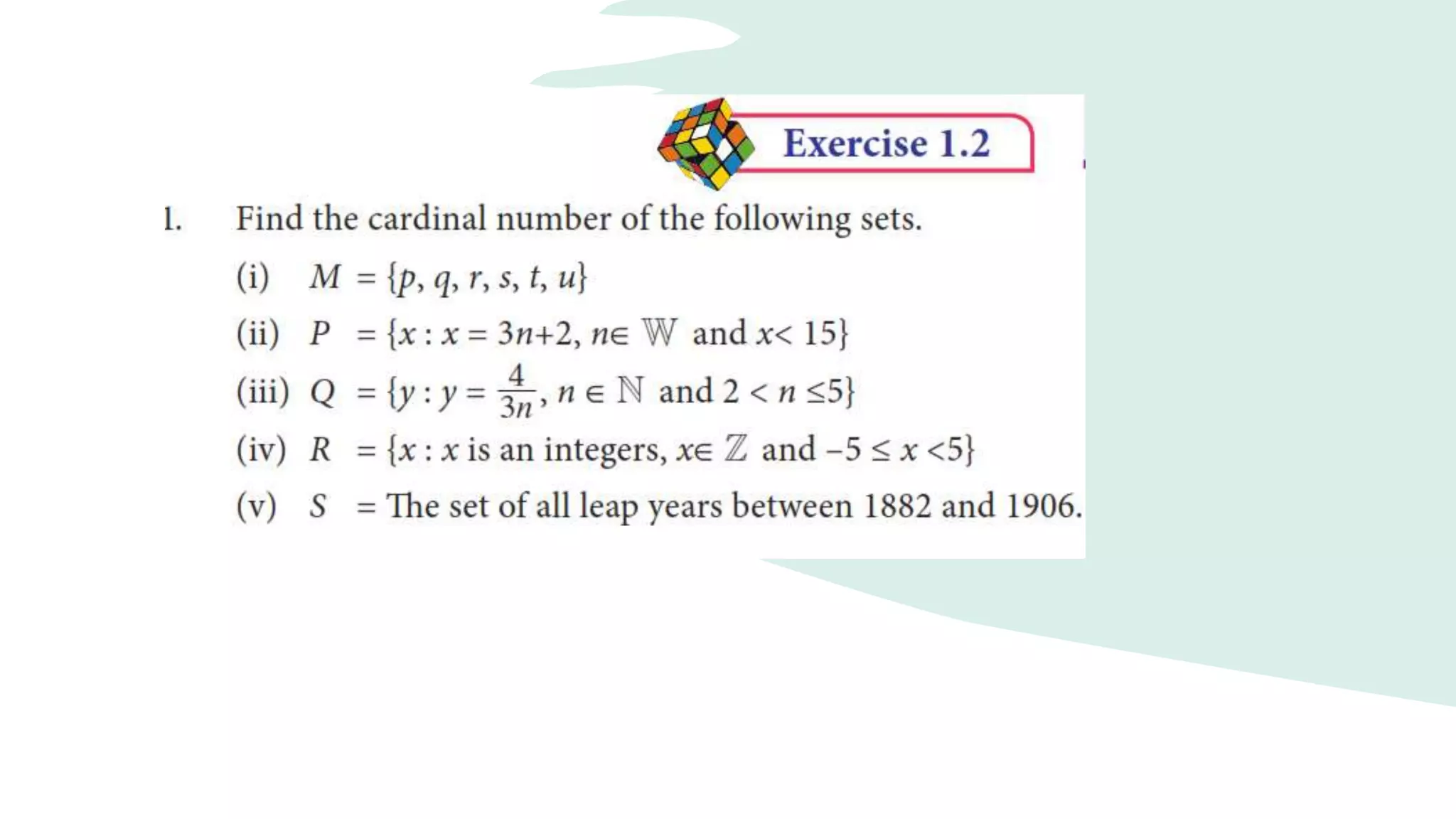
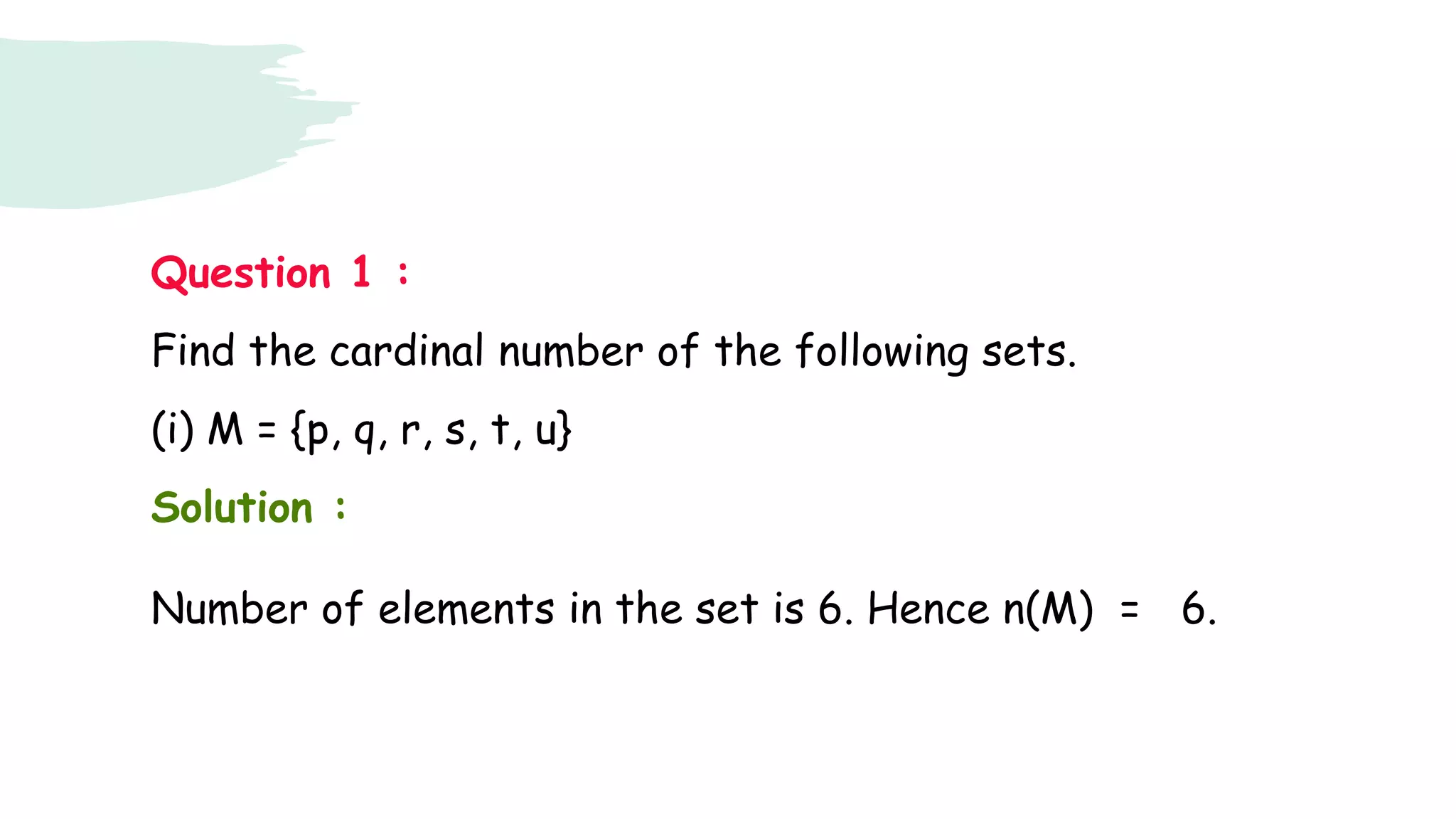
Question 1 :
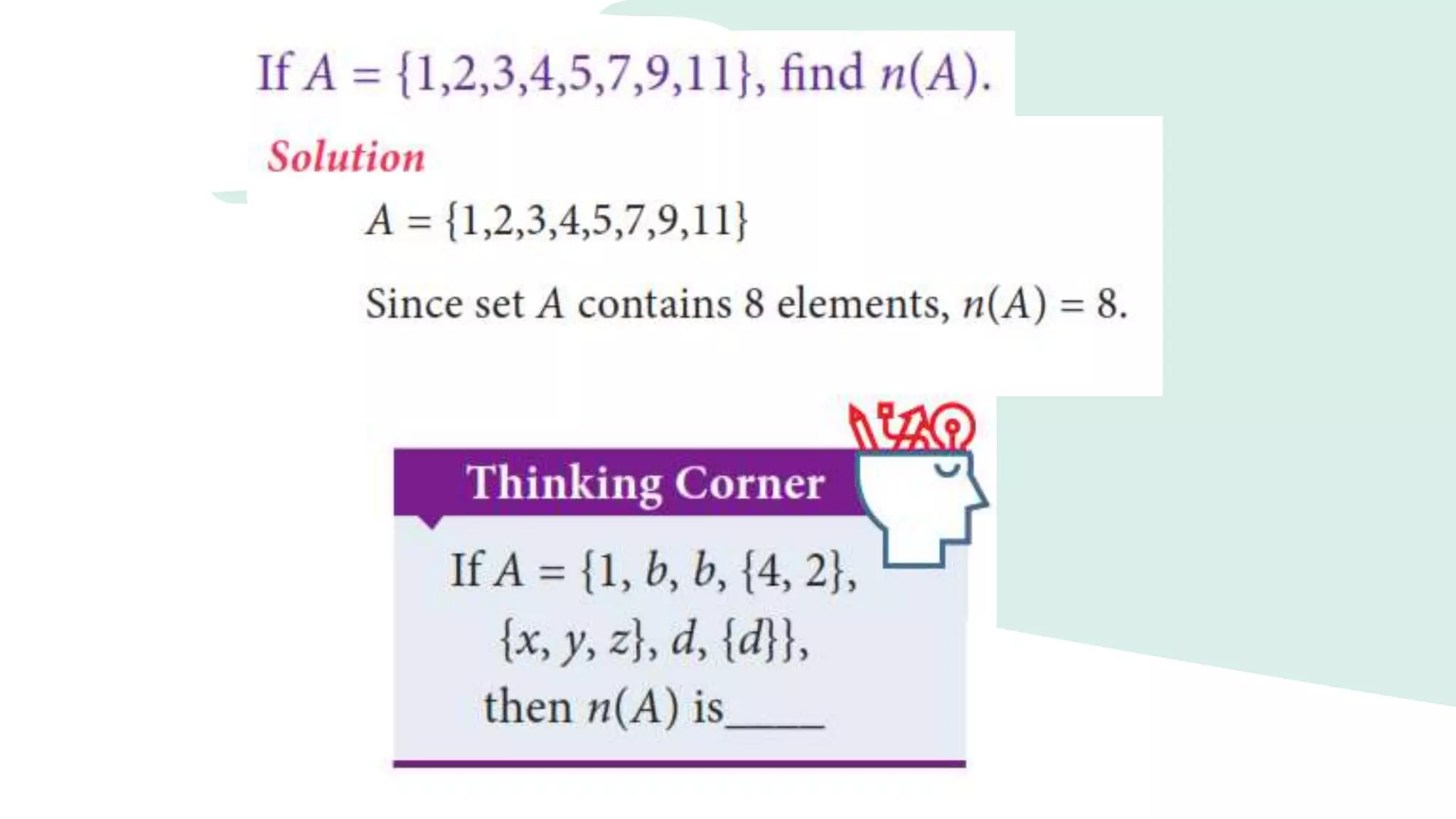
Find the cardinal number of the following sets.
(i) M = {p, q, r, s, t, u}
Solution :
Number of elements in the set is 6. Hence n(M) = 6.
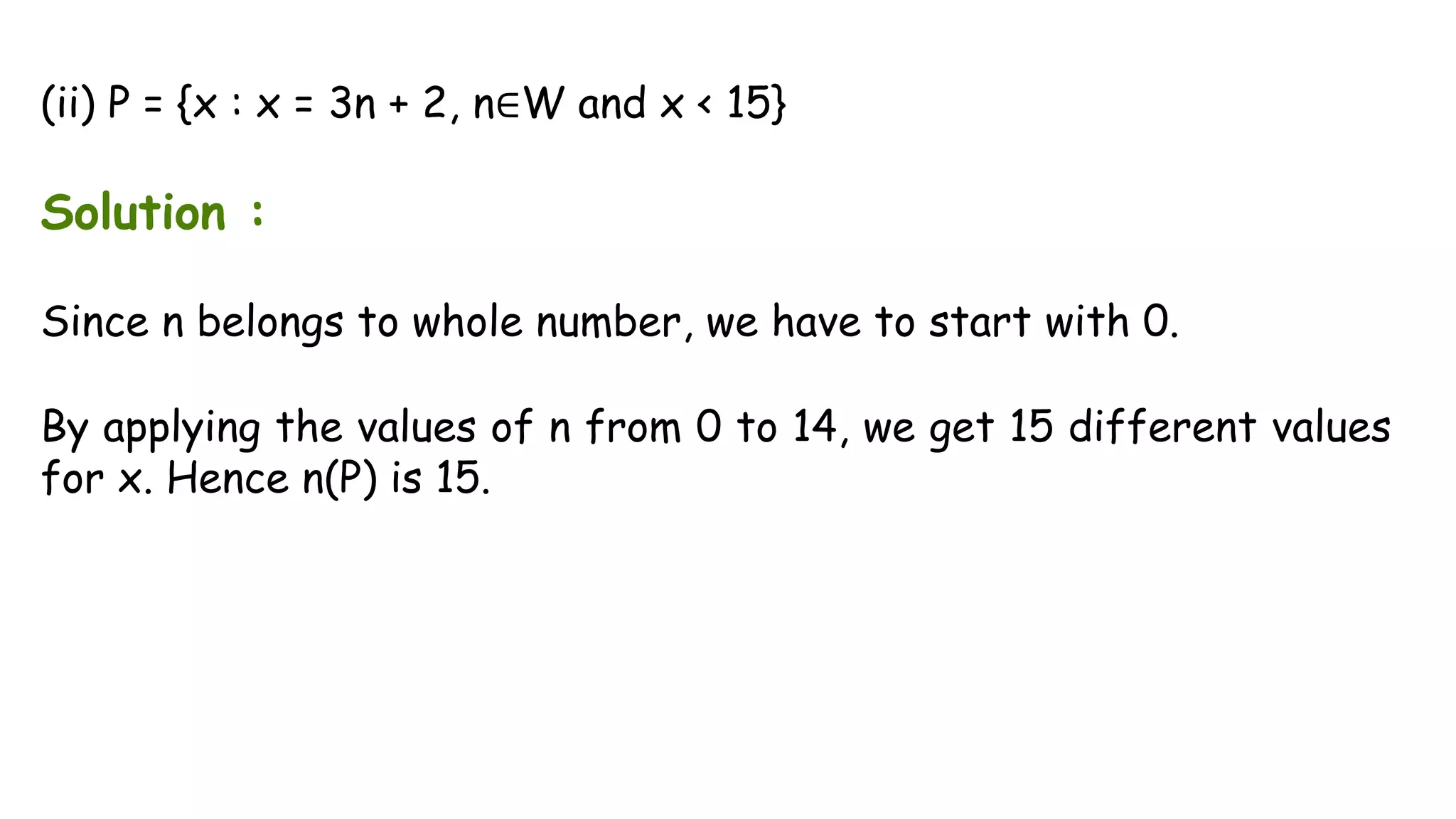
(ii) P = {x : x = 3n + 2, n∈W and x < 15}
Solution :
Since n belongs to whole number, we have to start with 0.
By applying the values of n from 0 to 14, we get 15 different values
for x. Hence n(P) is 15.
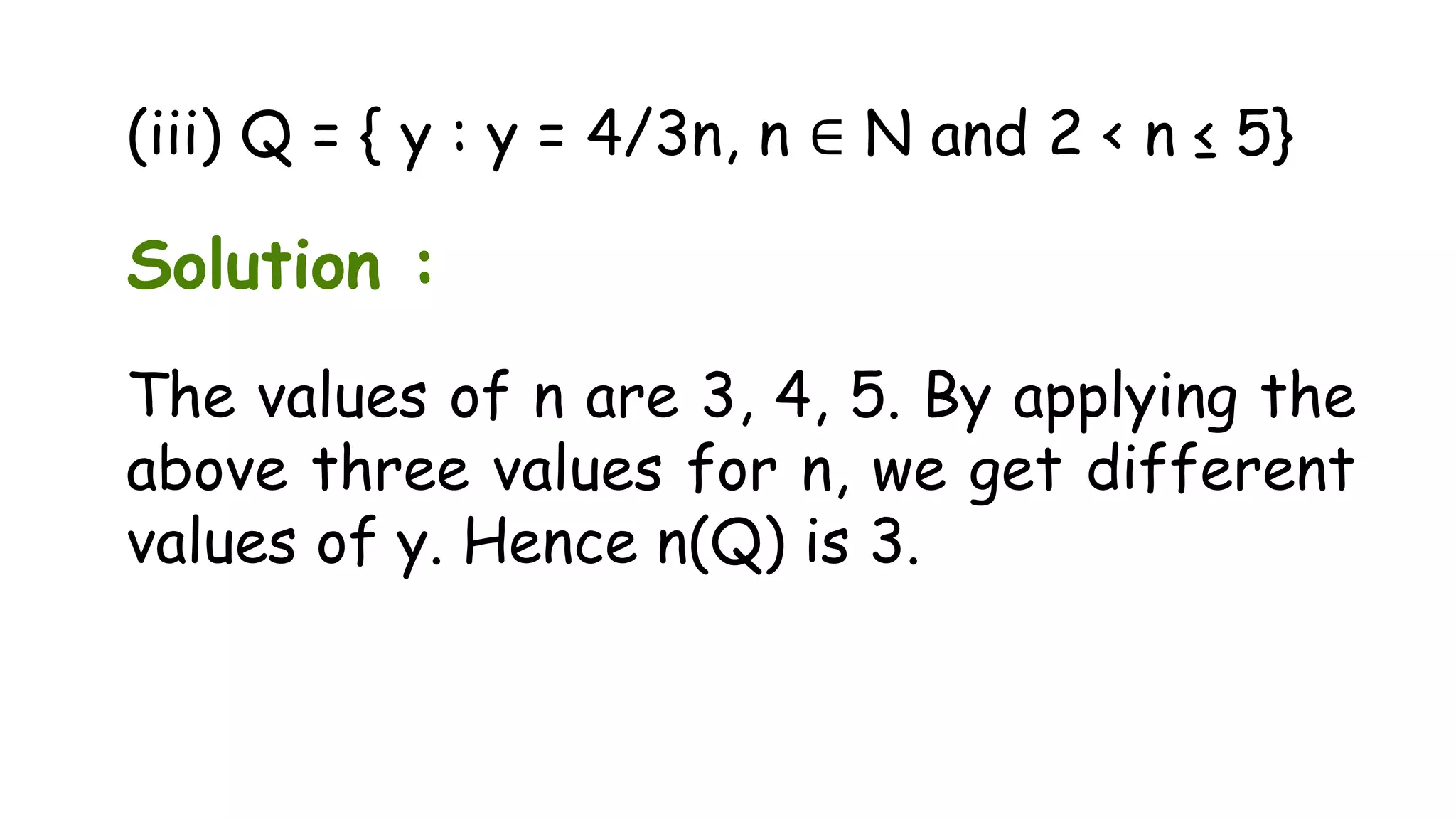
(iii) Q = { y : y = 4/3n, n ∈ N and 2 < n ≤ 5}
Solution :
The values of n are 3, 4, 5. By applying the
above three values for n, we get different
values of y. Hence n(Q) is 3.
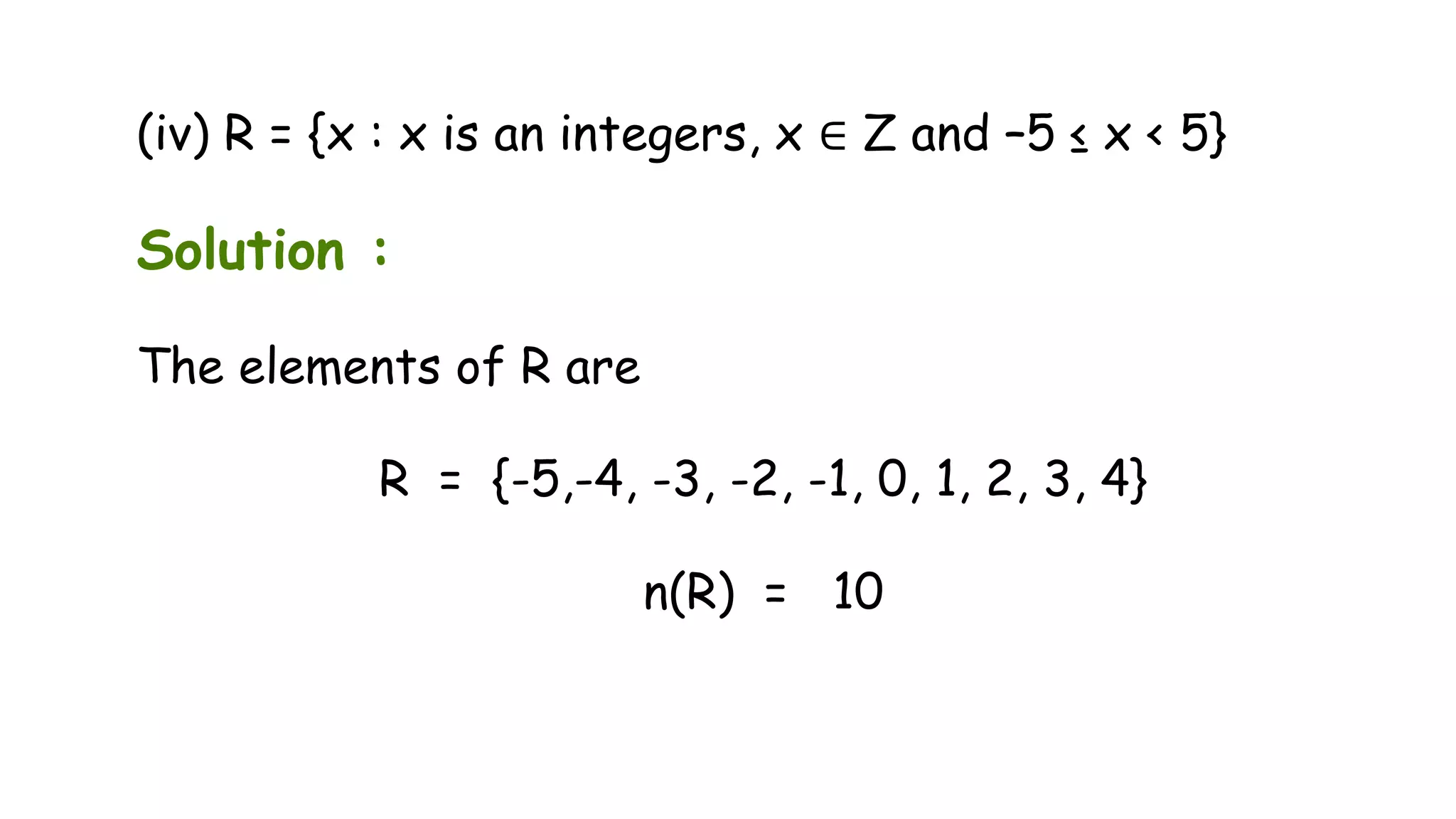
(iv) R = {x : x is an integers, x ∈ Z and –5 ≤ x < 5}
Solution :
The elements of R are
R = {-5,-4, -3, -2, -1, 0, 1, 2, 3, 4}
n(R) = 10
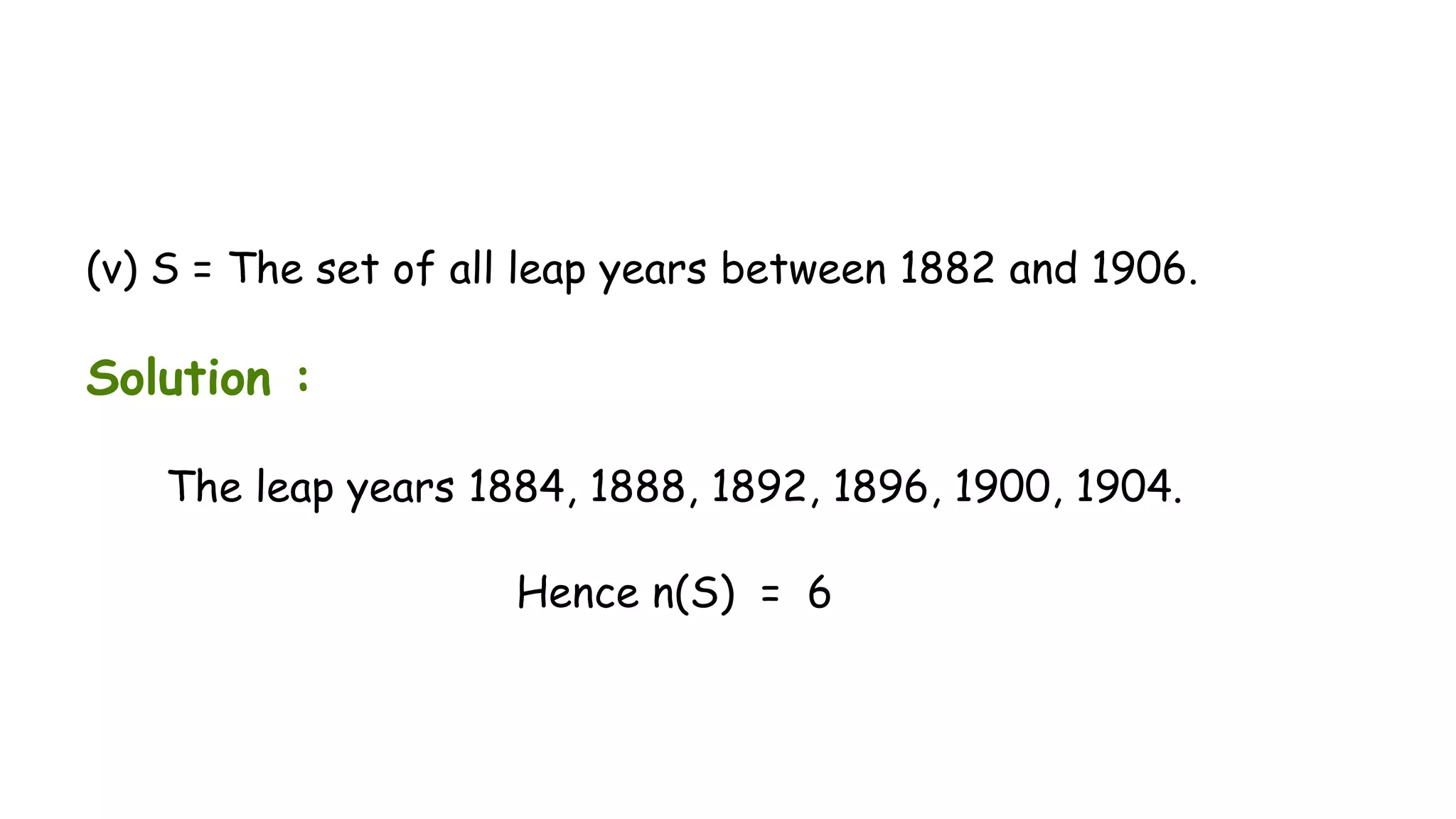
(v) S = The set of all leap years between 1882 and 1906.
Solution :
The leap years 1884, 1888, 1892, 1896, 1900, 1904.
Hence n(S) = 6
Question 2 :
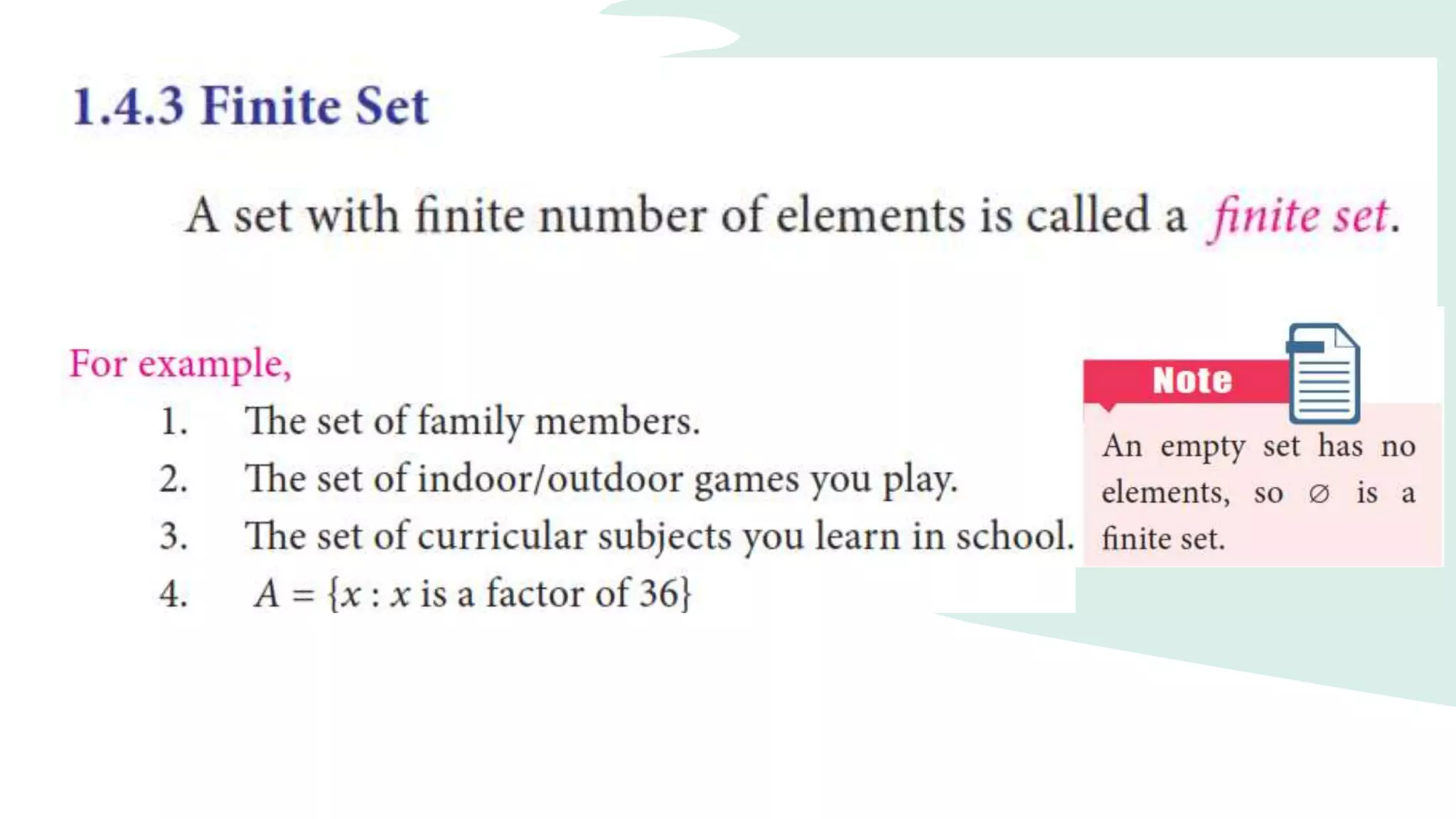
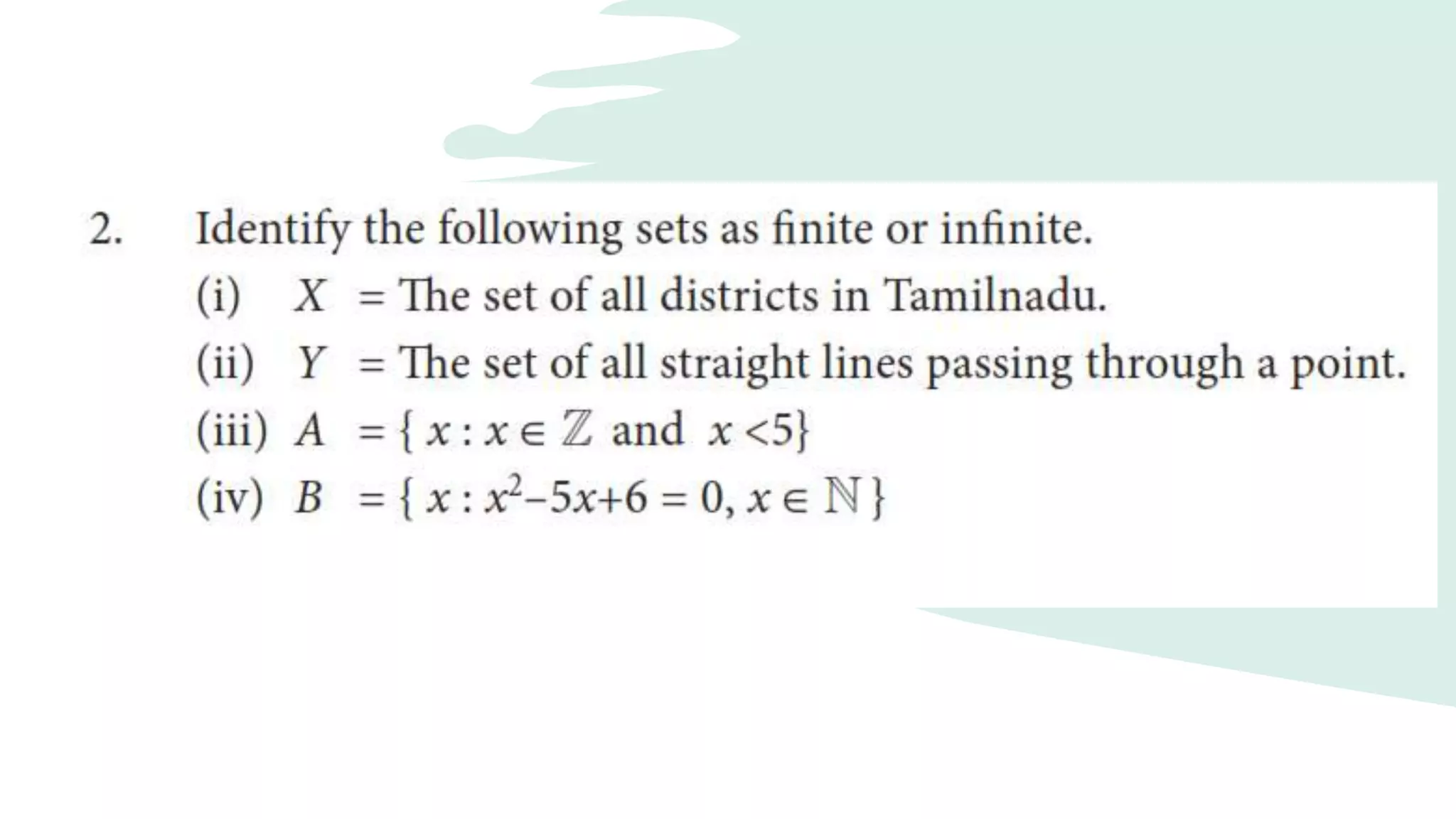
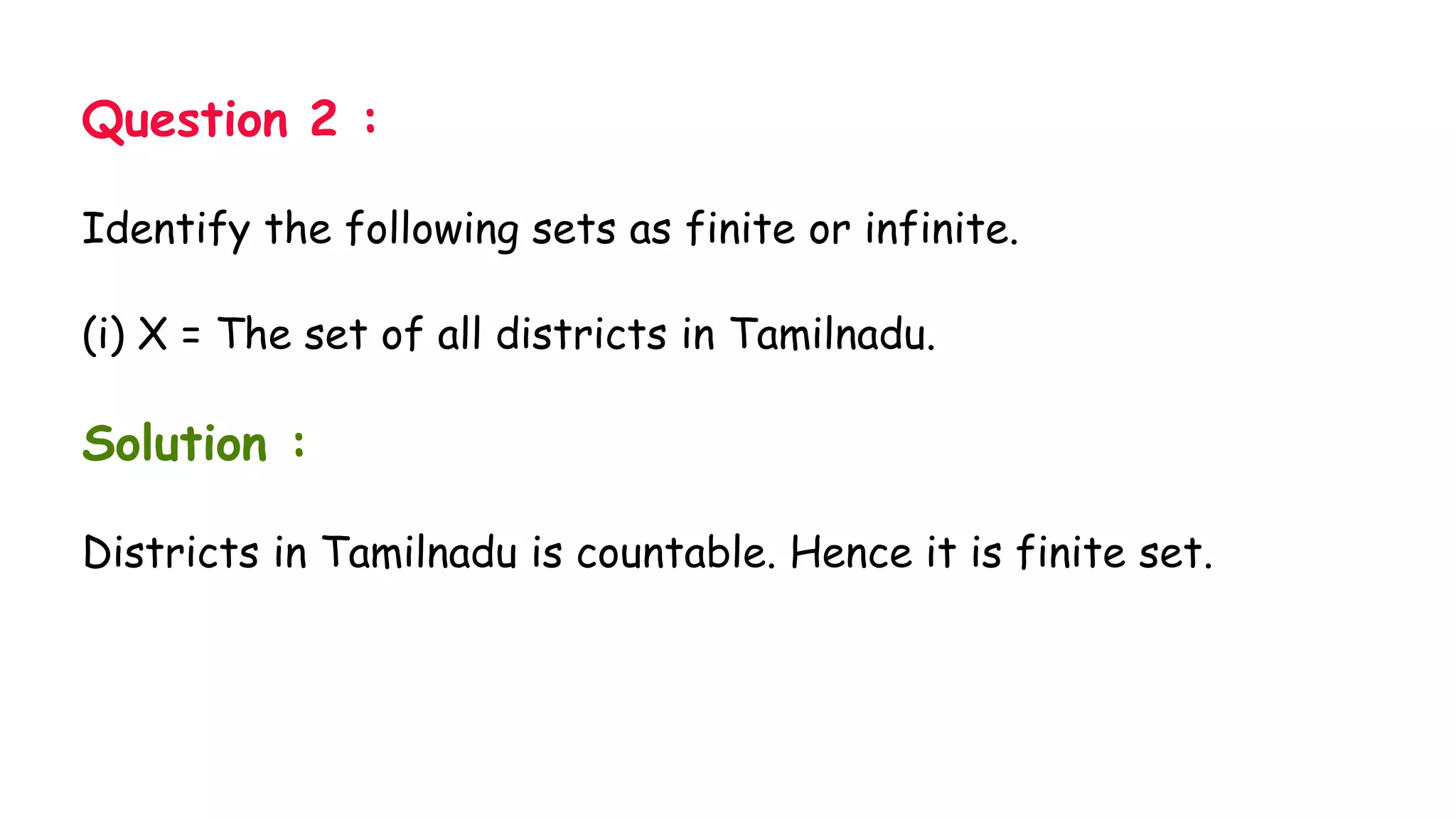
Identify the following sets as finite or infinite.
(i) X = The set of all districts in Tamilnadu.
Solution :
Districts in Tamilnadu is countable. Hence it is finite set.
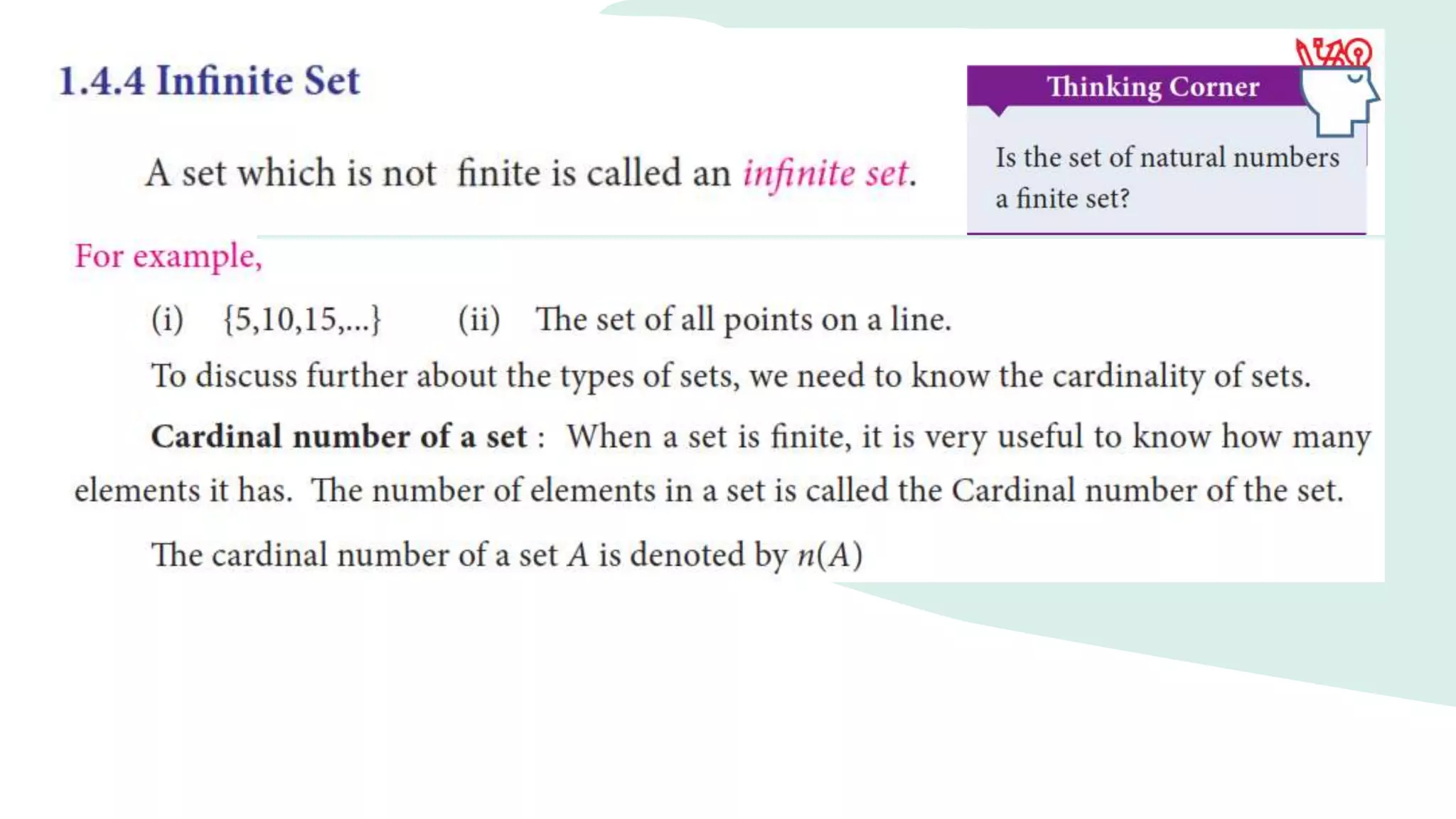
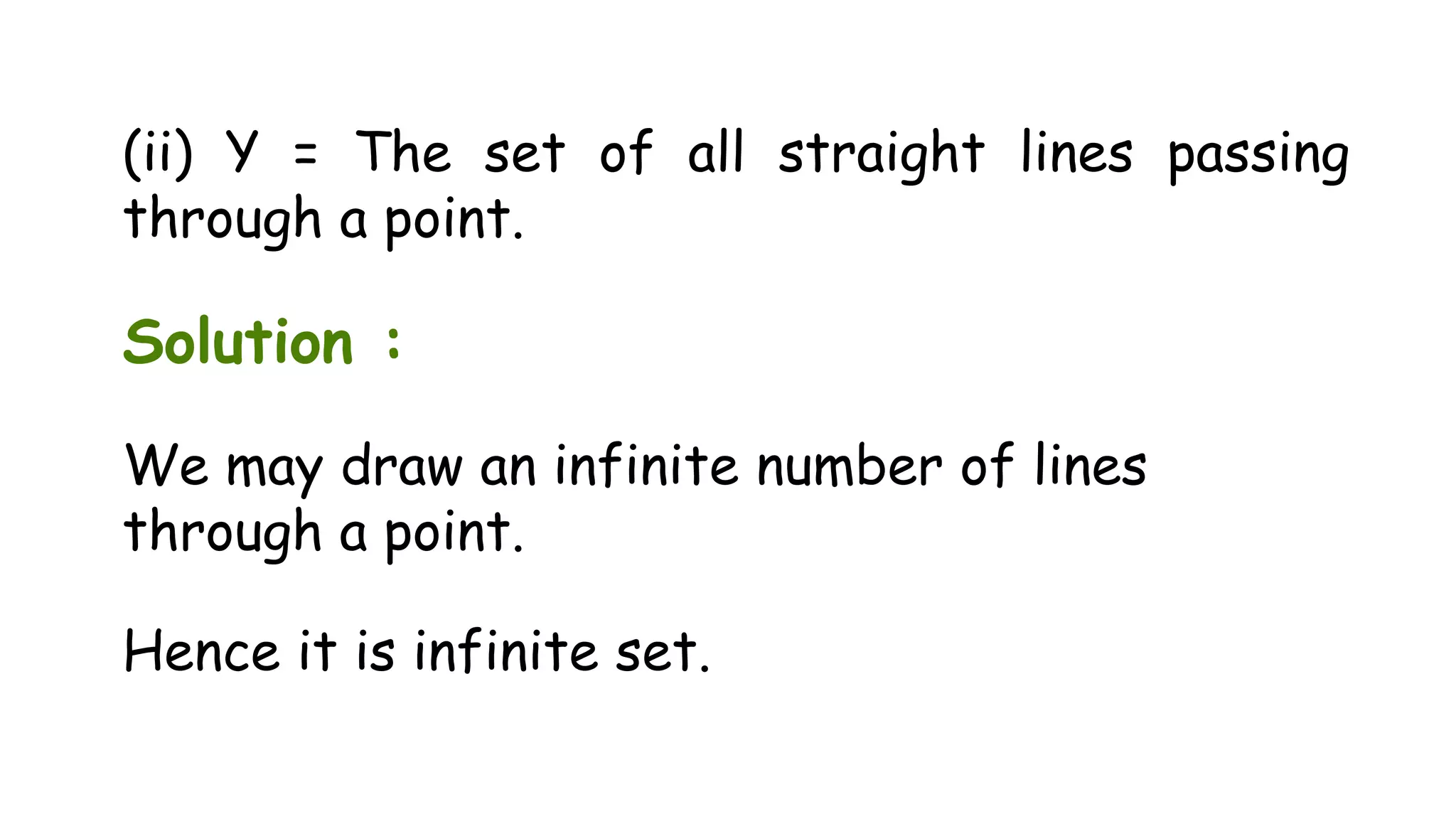
(ii) Y = The set of all straight lines passing
through a point.
Solution :
We may draw an infinite number of lines
through a point.
Hence it is infinite set.
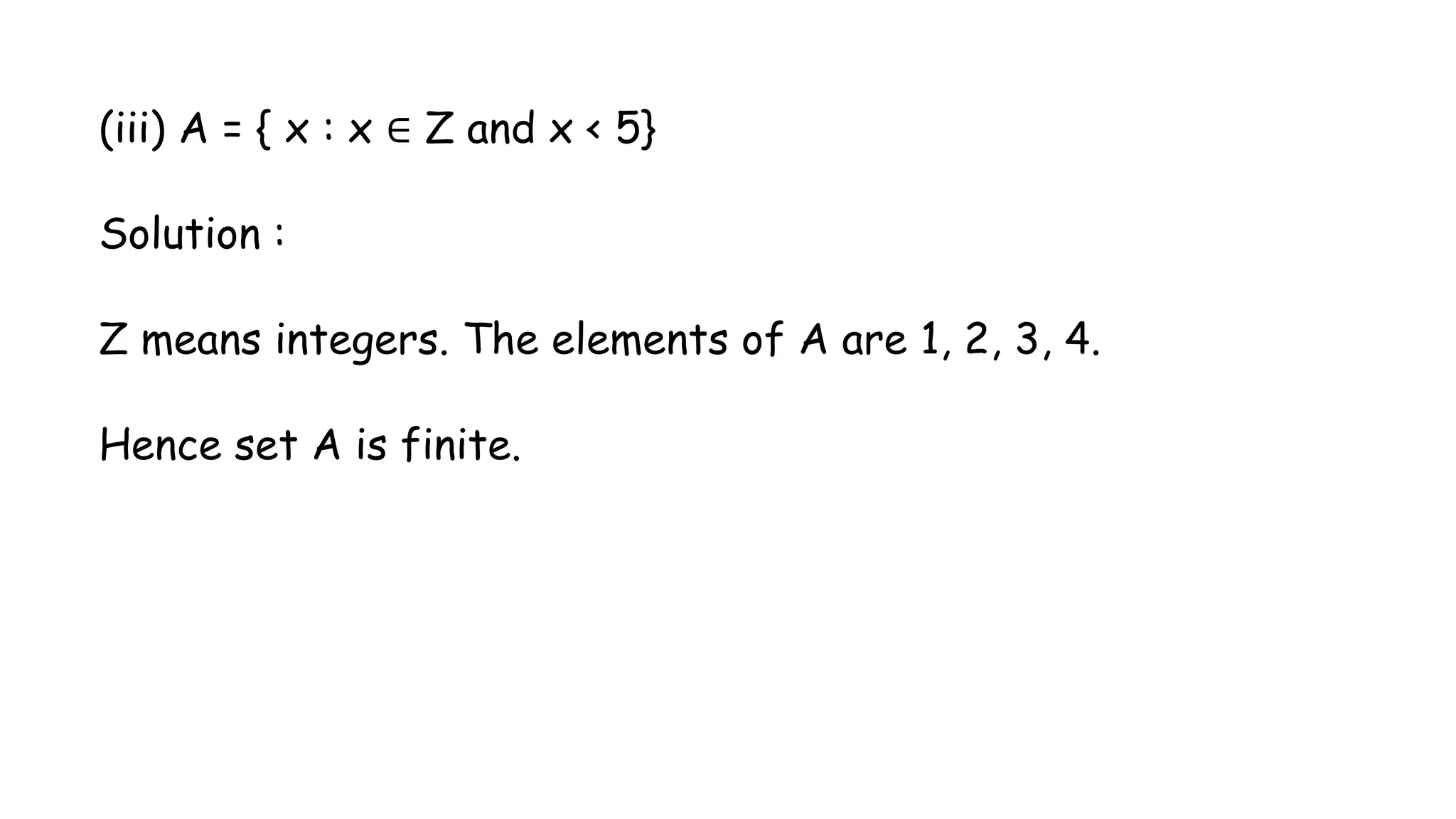
(iii) A = { x : x ∈ Z and x < 5}
Solution :
Z means integers. The elements of A are 1, 2, 3, 4.
Hence set A is finite.
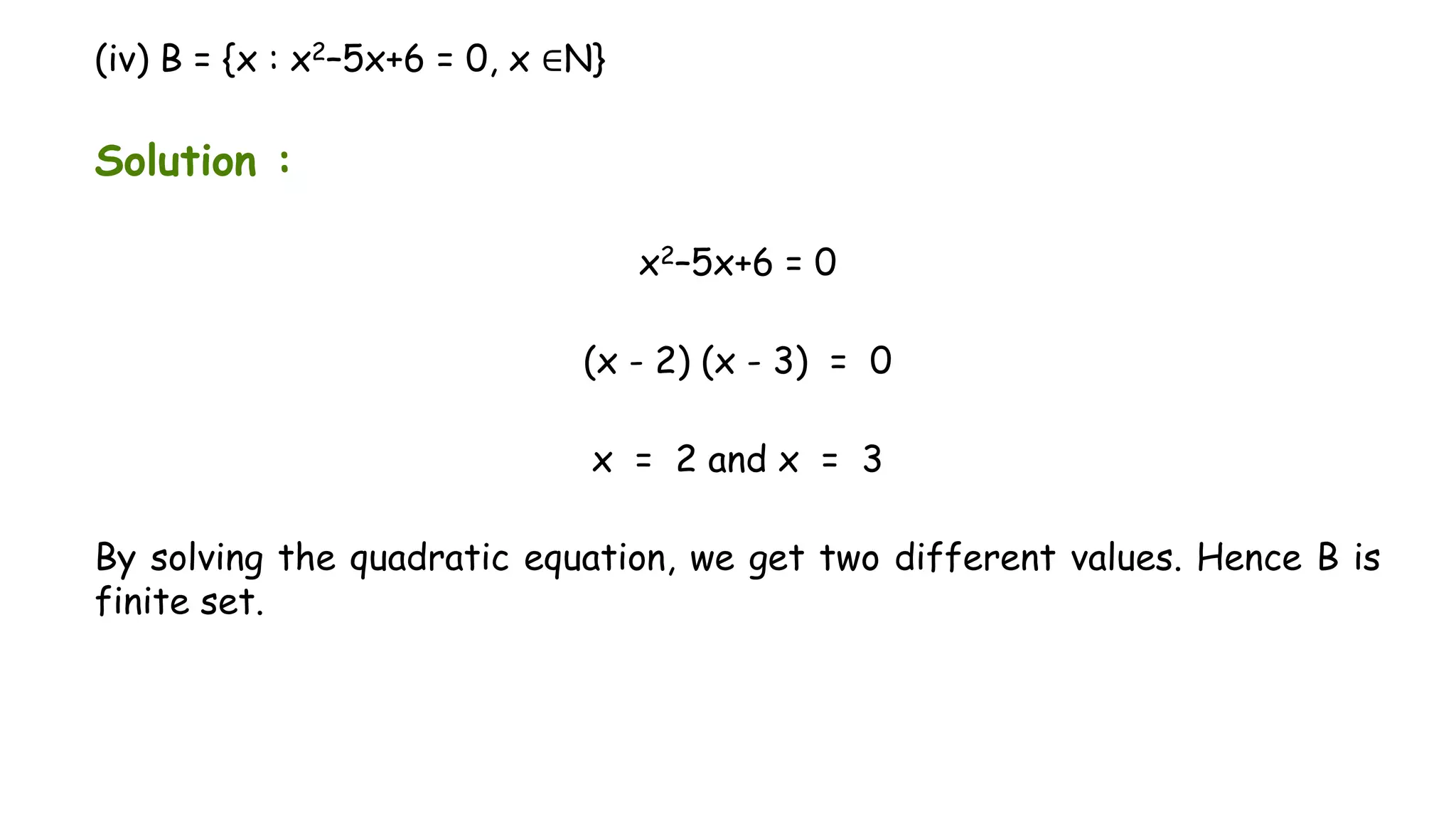
(iv) B = {x : x2–5x+6 = 0, x ∈N}
Solution :
x2–5x+6 = 0
(x - 2) (x - 3) = 0
x = 2 and x = 3
By solving the quadratic equation, we get two different values. Hence B is
finite set.
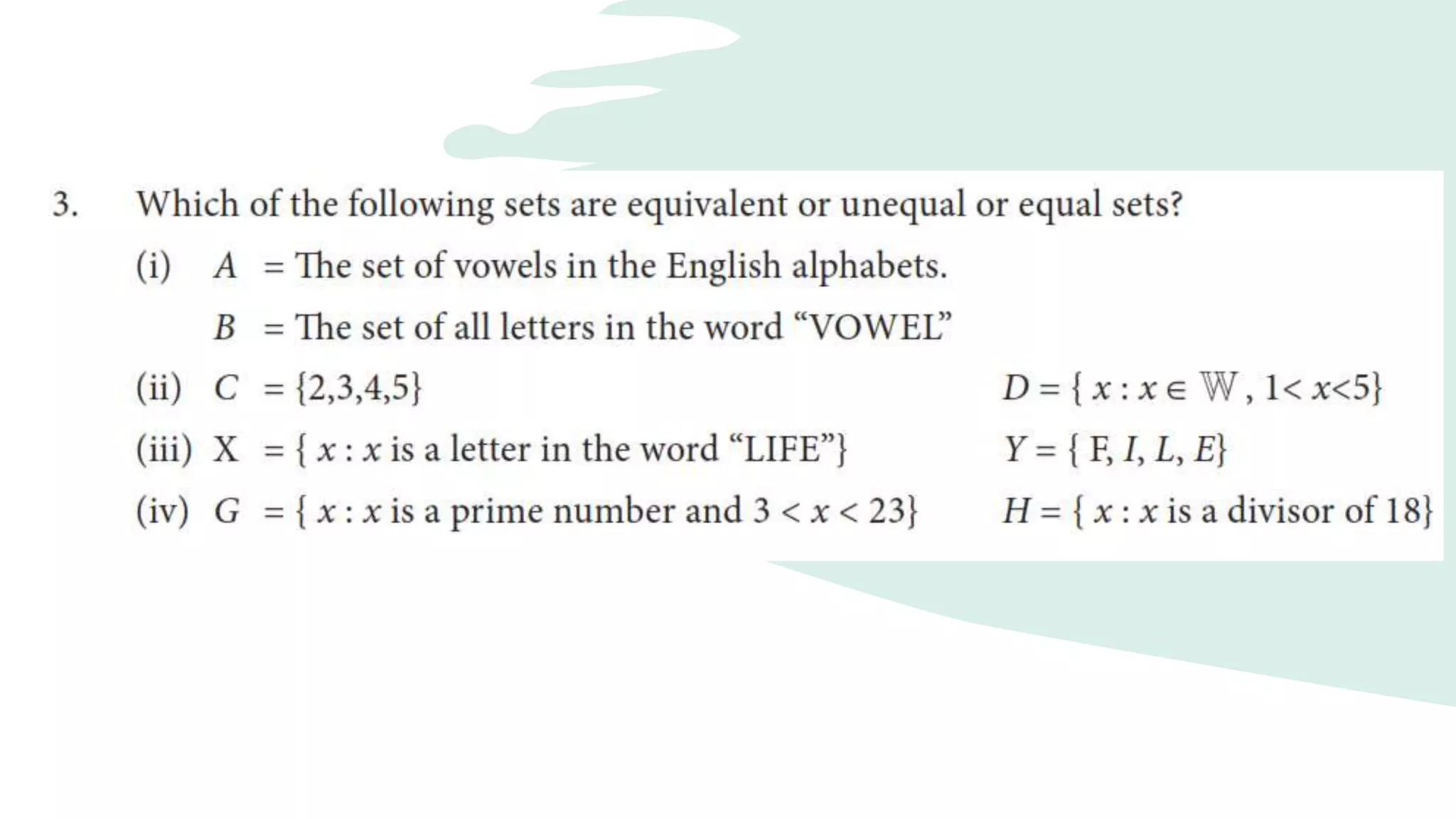
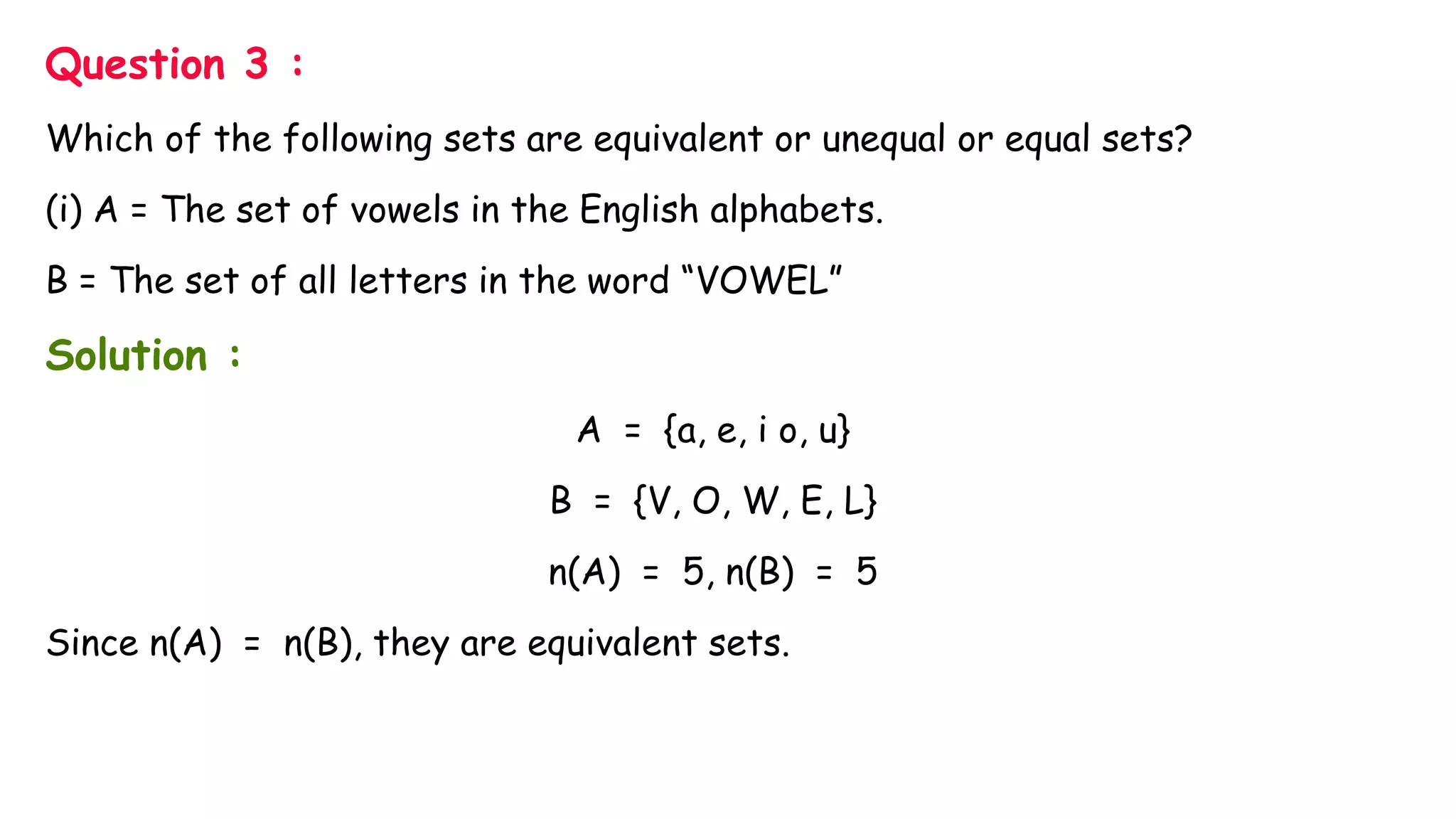
Question 3 :
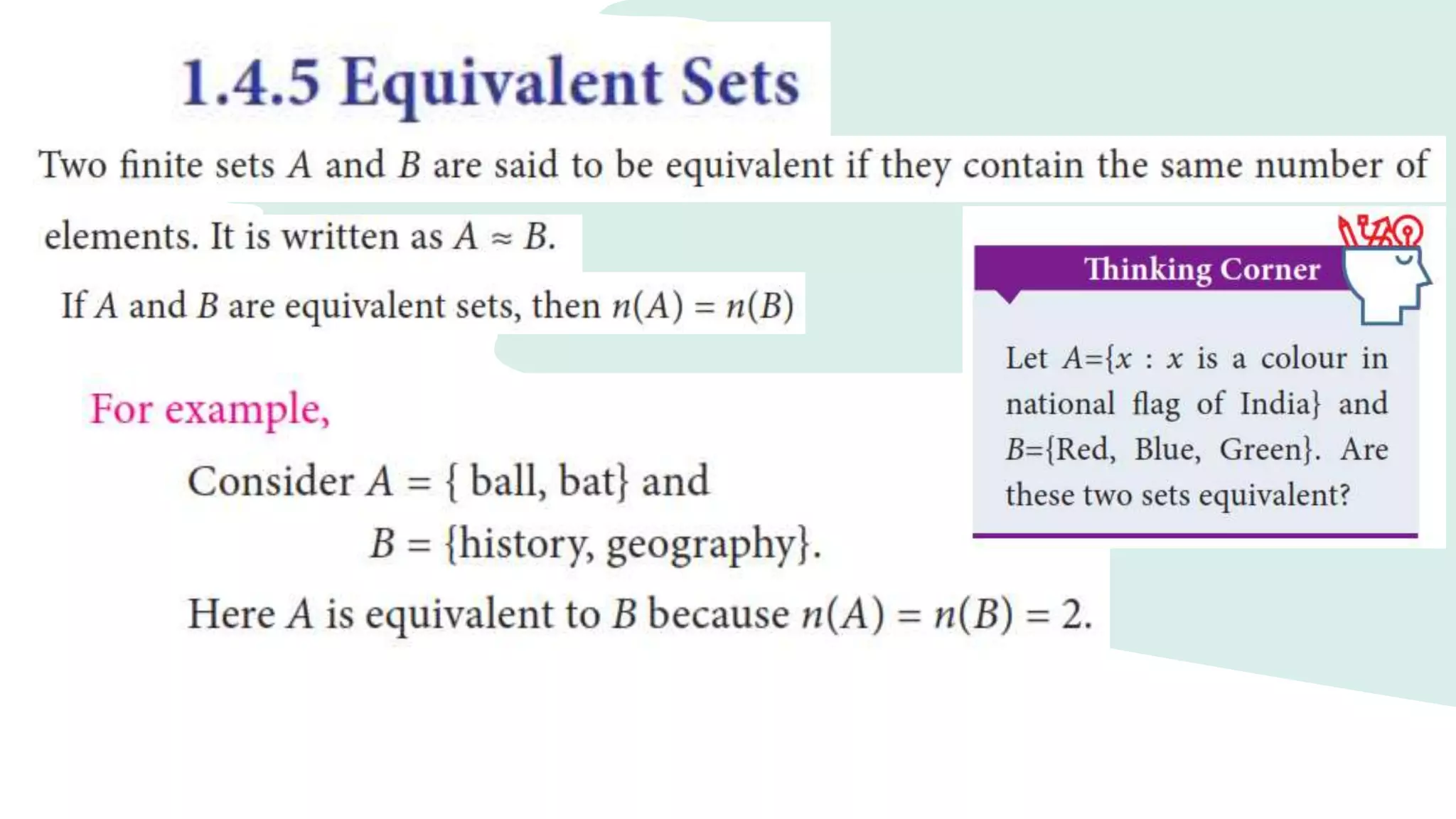
Which of the following sets are equivalent or unequal or equal sets?
(i) A = The set of vowels in the English alphabets.
B = The set of all letters in the word “VOWEL”
Solution :
A = {a, e, i o, u}
B = {V, O, W, E, L}
n(A) = 5, n(B) = 5
Since n(A) = n(B), they are equivalent sets.
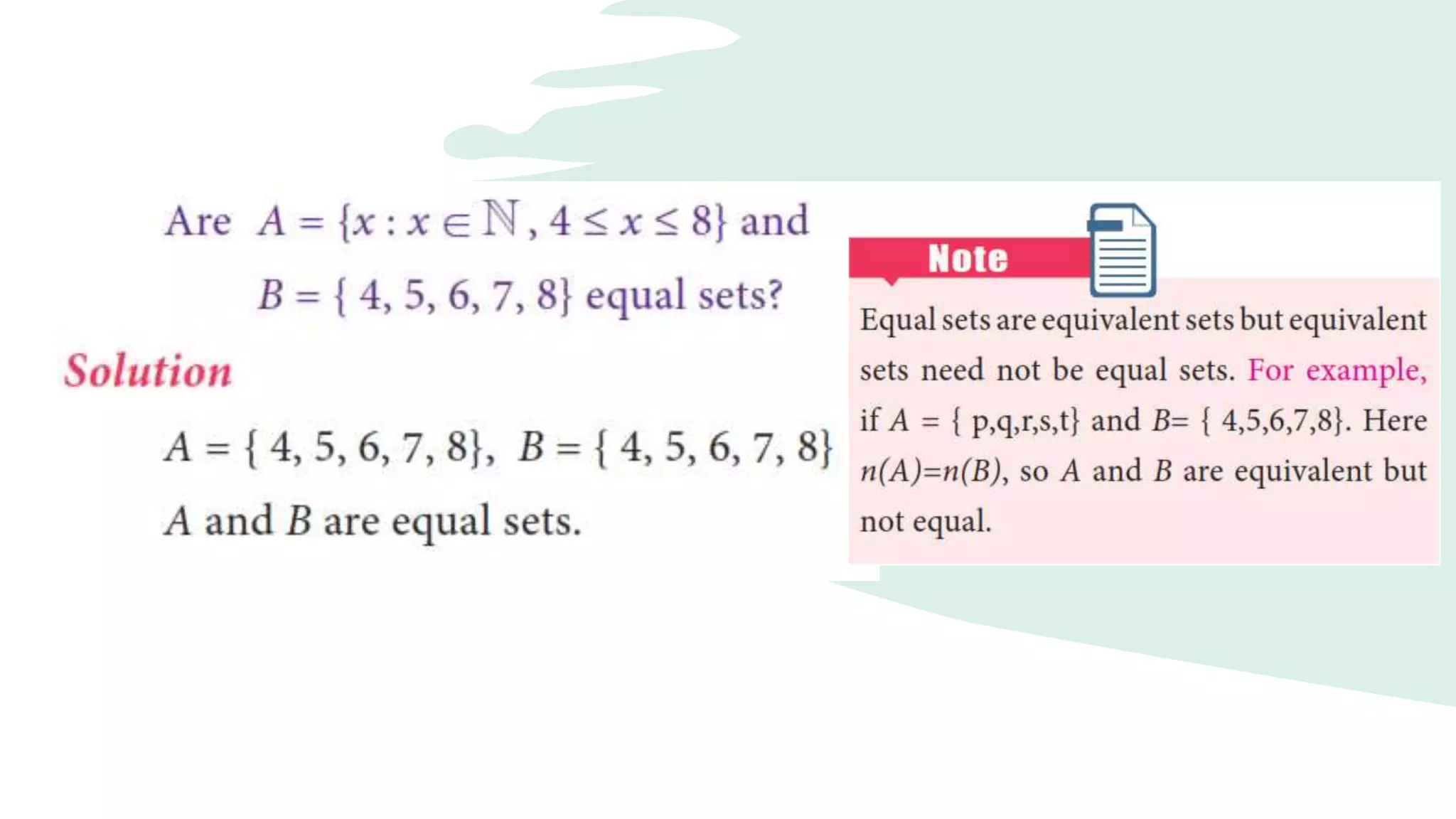
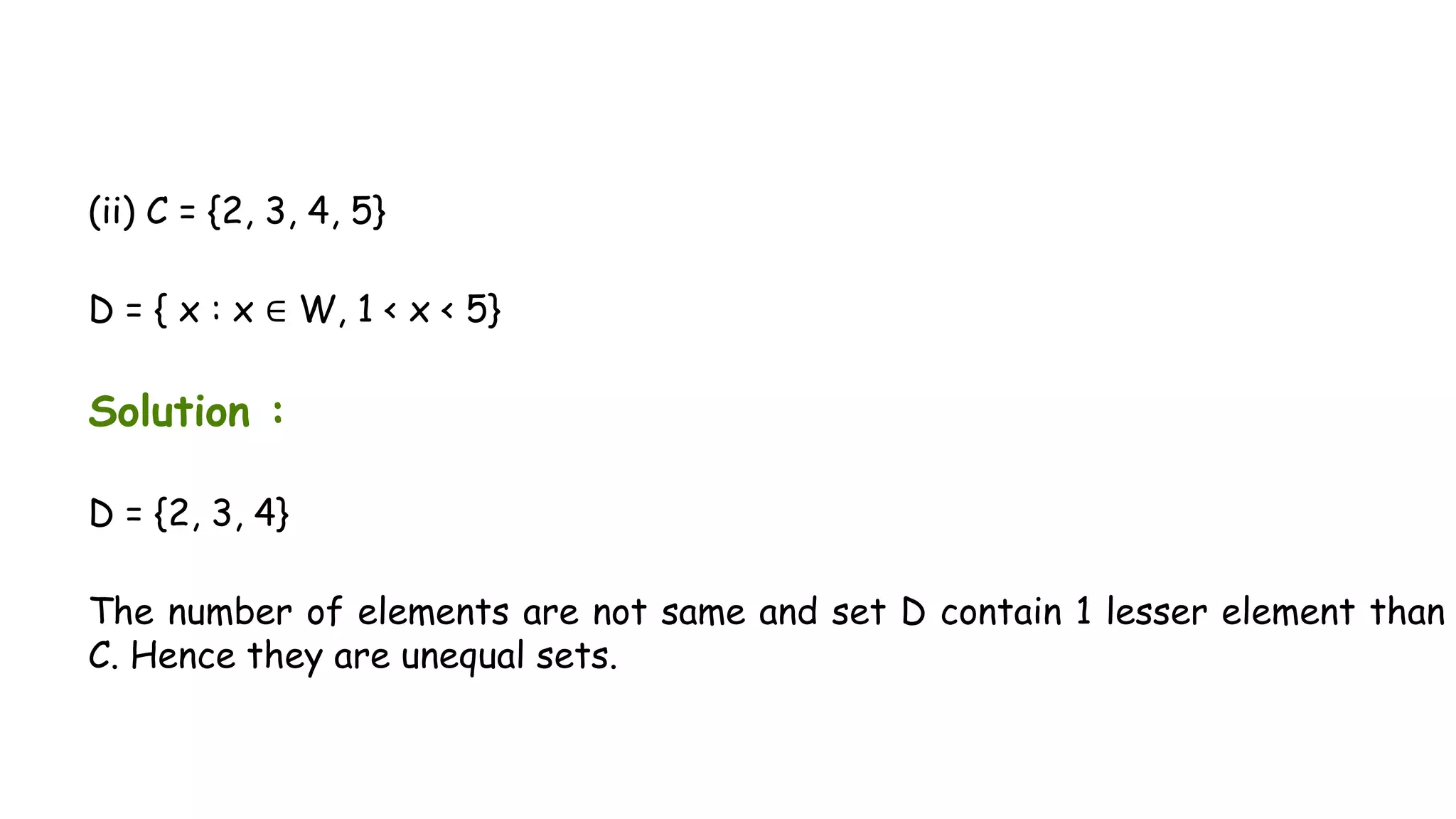
(ii) C = {2, 3, 4, 5}
D = { x : x ∈ W, 1 < x < 5}
Solution :
D = {2, 3, 4}
The number of elements are not same and set D contain 1 lesser element than
C. Hence they are unequal sets.
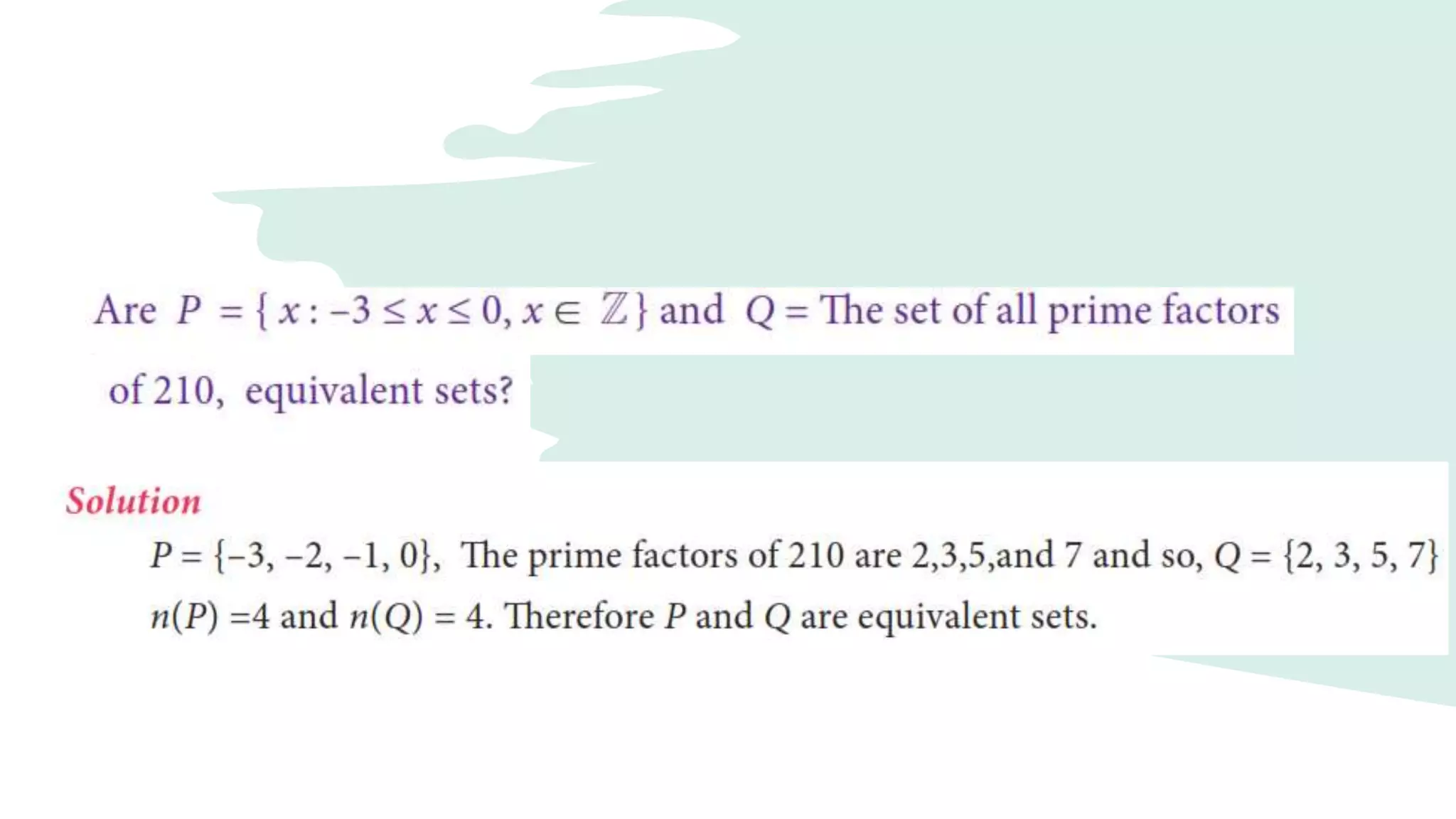
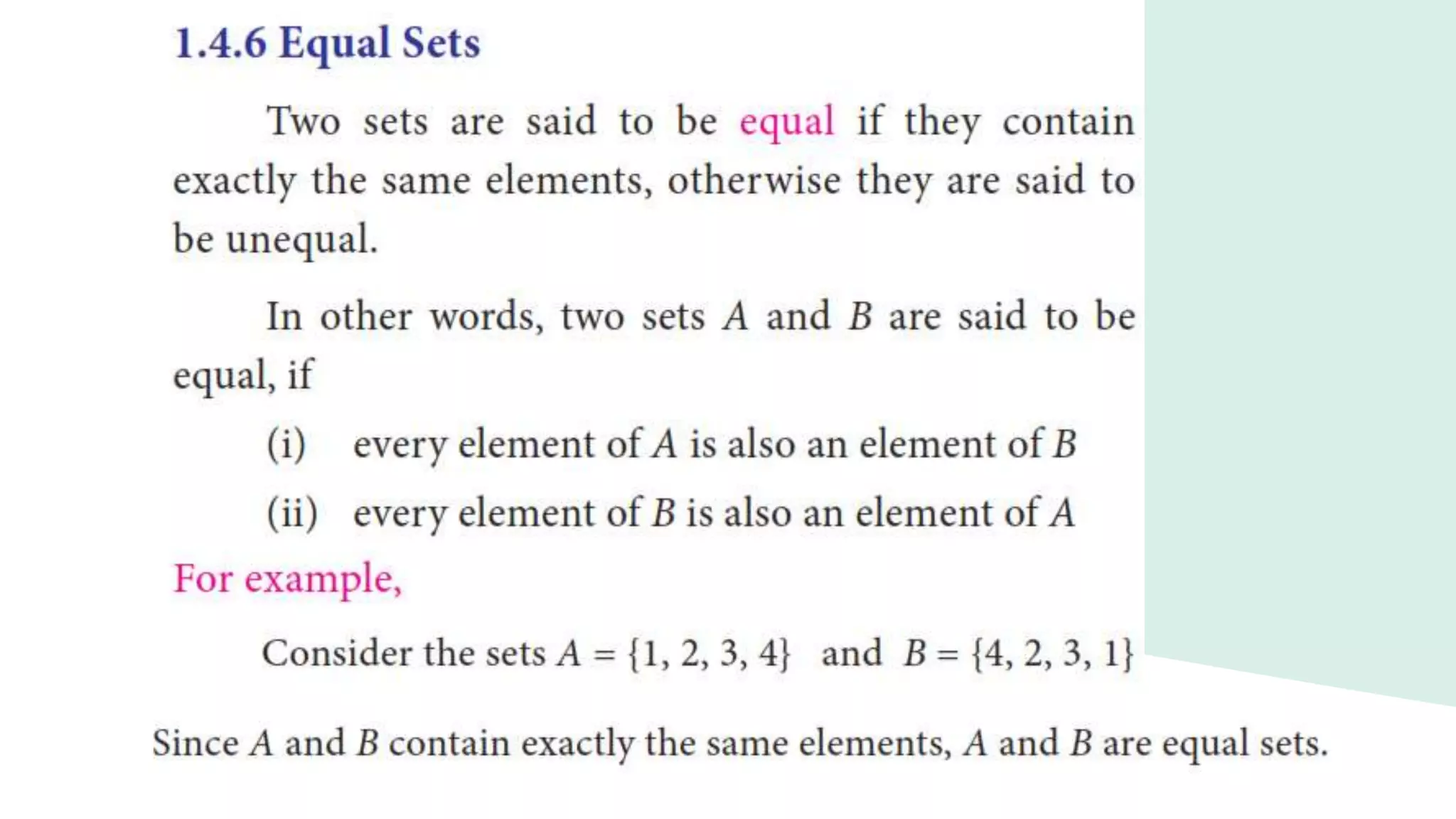
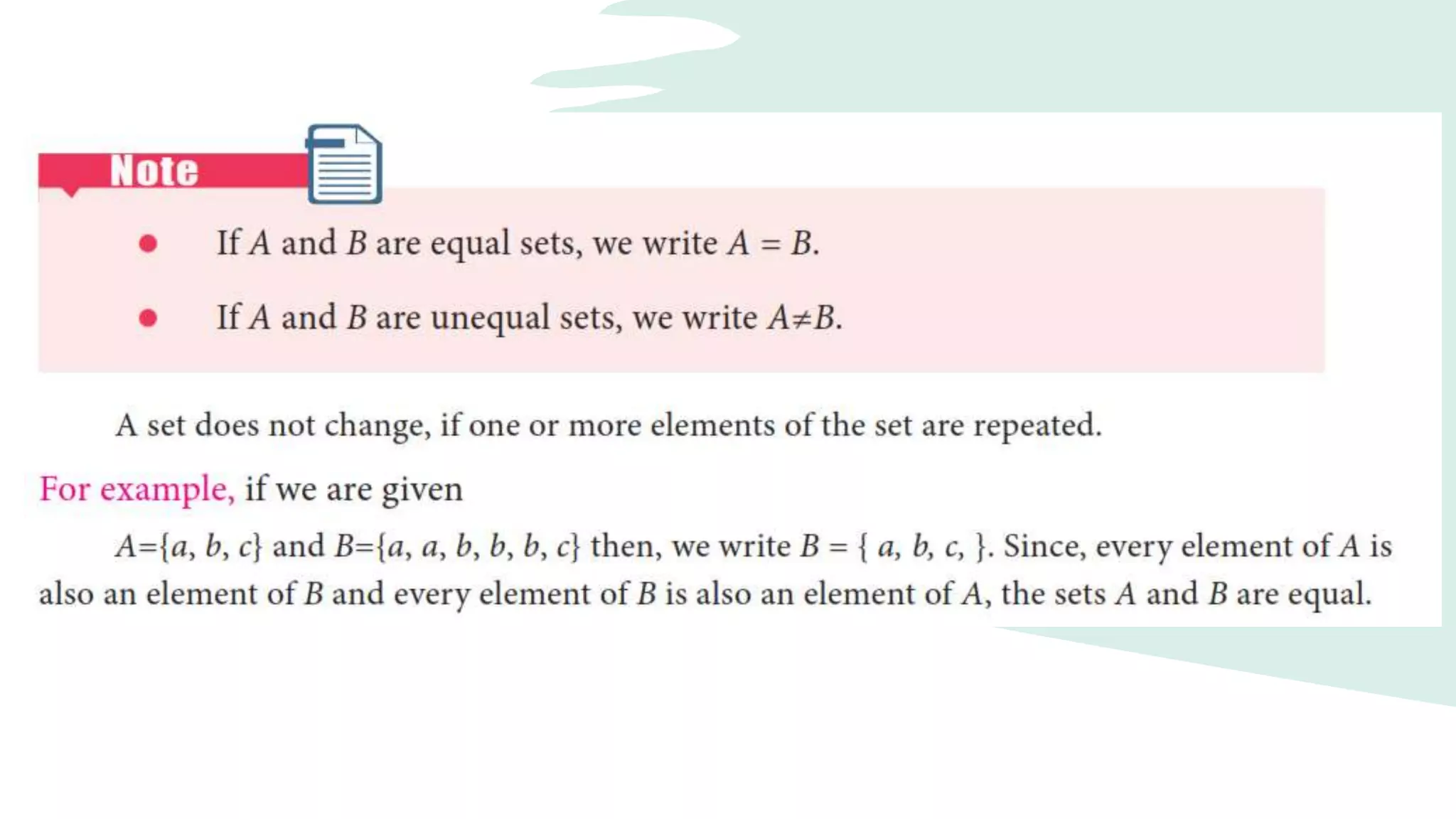
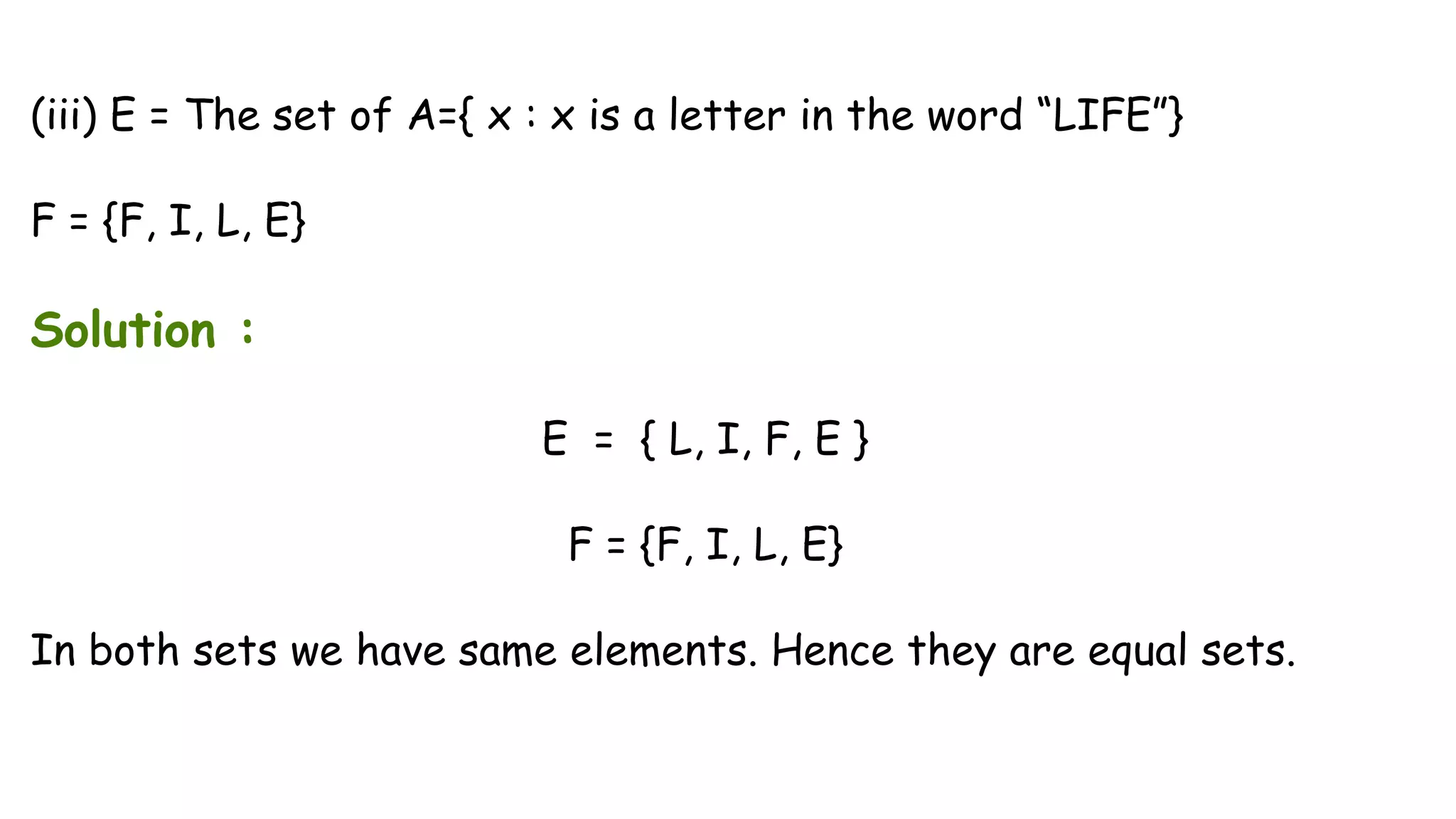
(iii) E = The set of A={ x : x is a letter in the word “LIFE”}
F = {F, I, L, E}
Solution :
E = { L, I, F, E }
F = {F, I, L, E}
In both sets we have same elements. Hence they are equal sets.
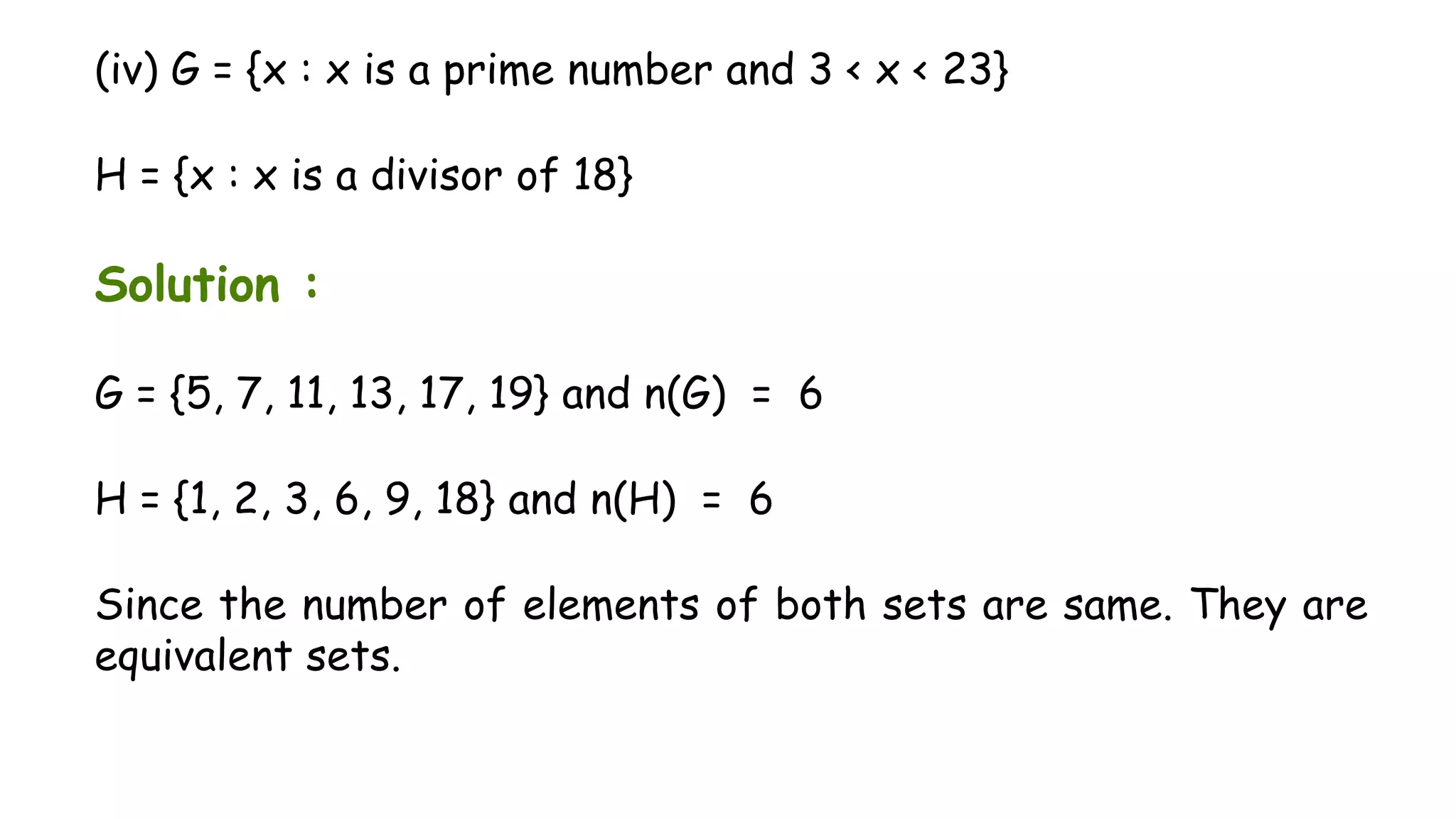
(iv) G = {x : x is a prime number and 3 < x < 23}
H = {x : x is a divisor of 18}
Solution :
G = {5, 7, 11, 13, 17, 19} and n(G) = 6
H = {1, 2, 3, 6, 9, 18} and n(H) = 6
Since the number of elements of both sets are same. They are
equivalent sets.
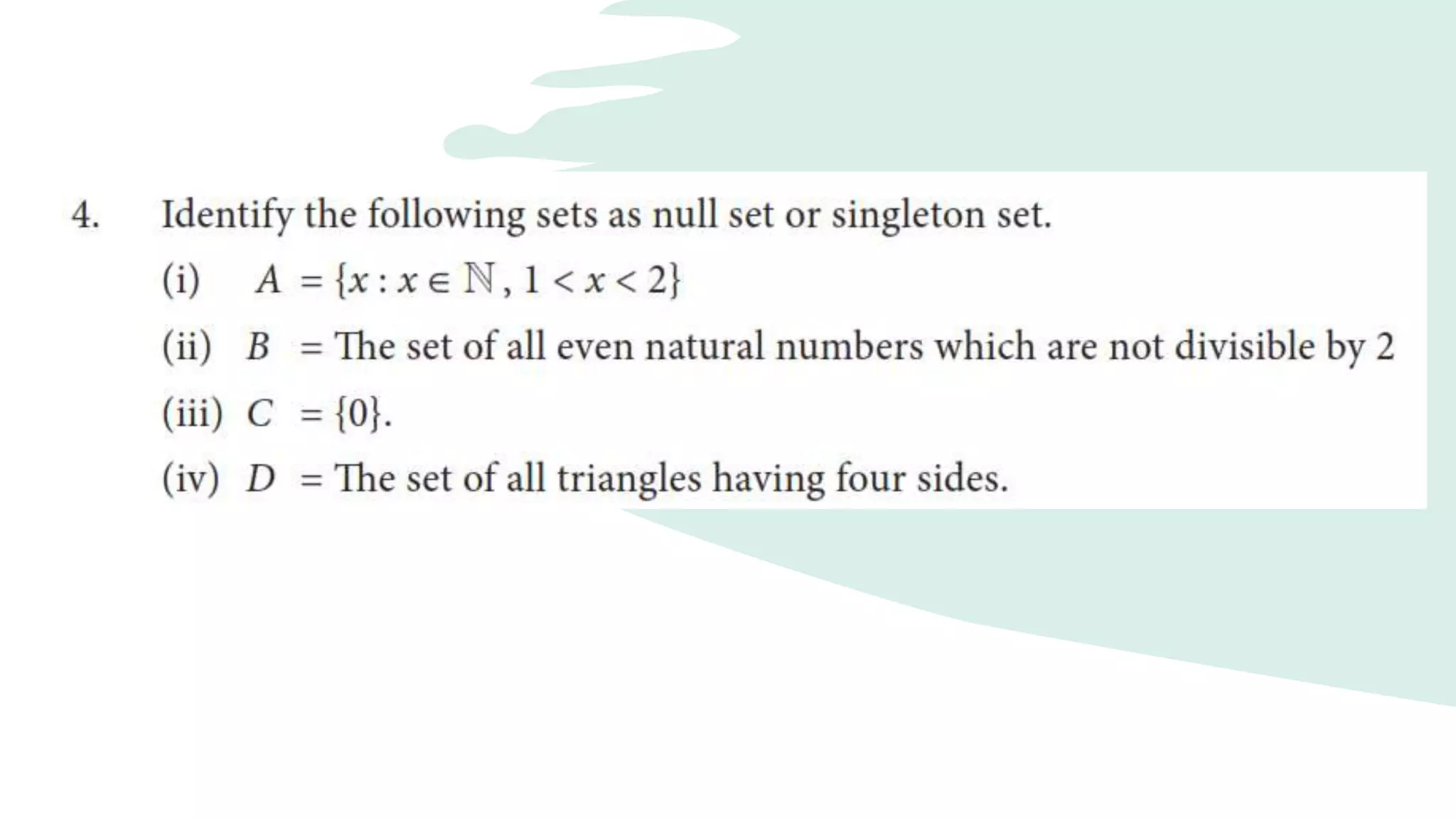
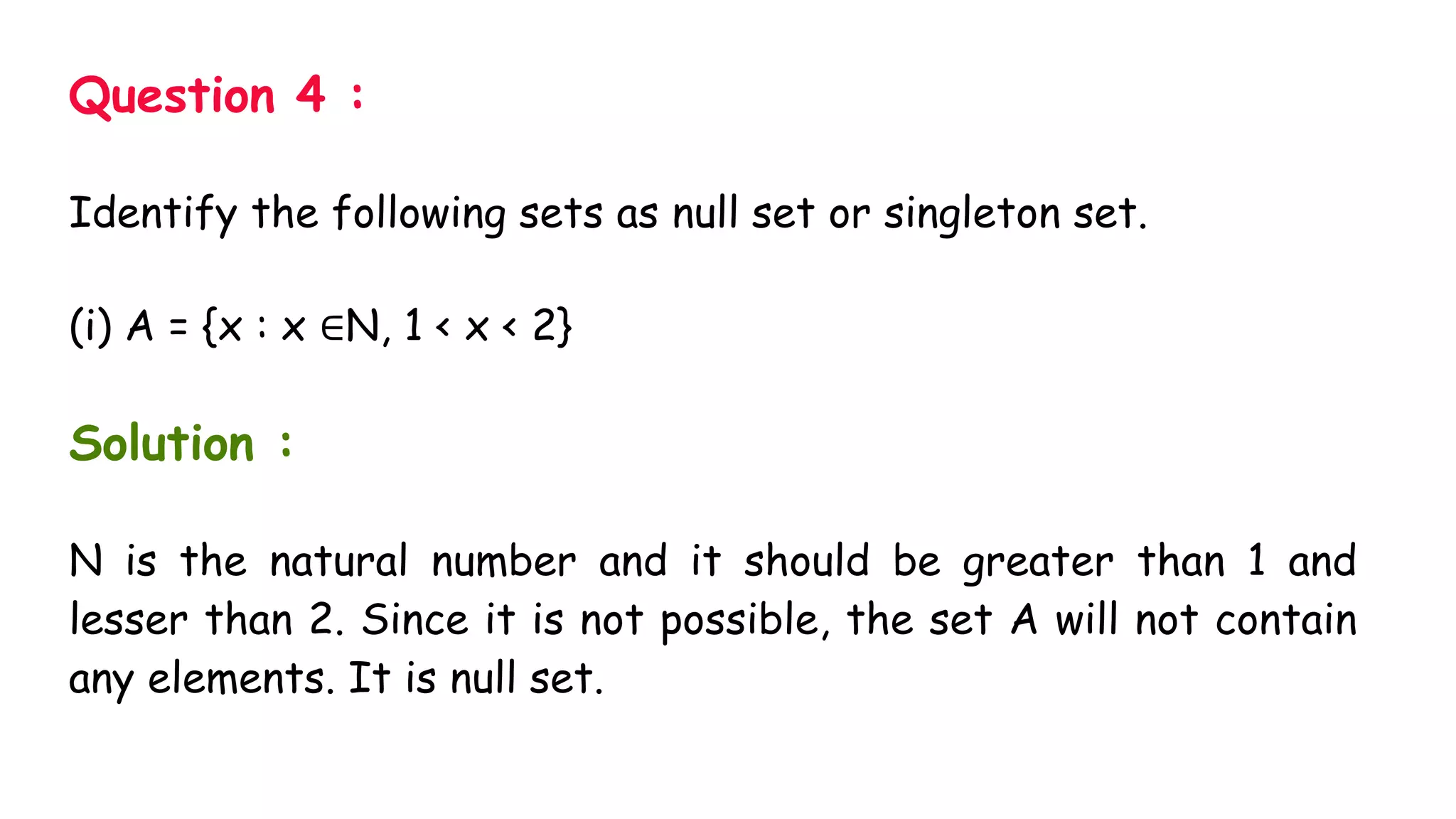
Question 4 :
Identify the following sets as null set or singleton set.
(i) A = {x : x ∈N, 1 < x < 2}
Solution :
N is the natural number and it should be greater than 1 and
lesser than 2. Since it is not possible, the set A will not contain
any elements. It is null set.
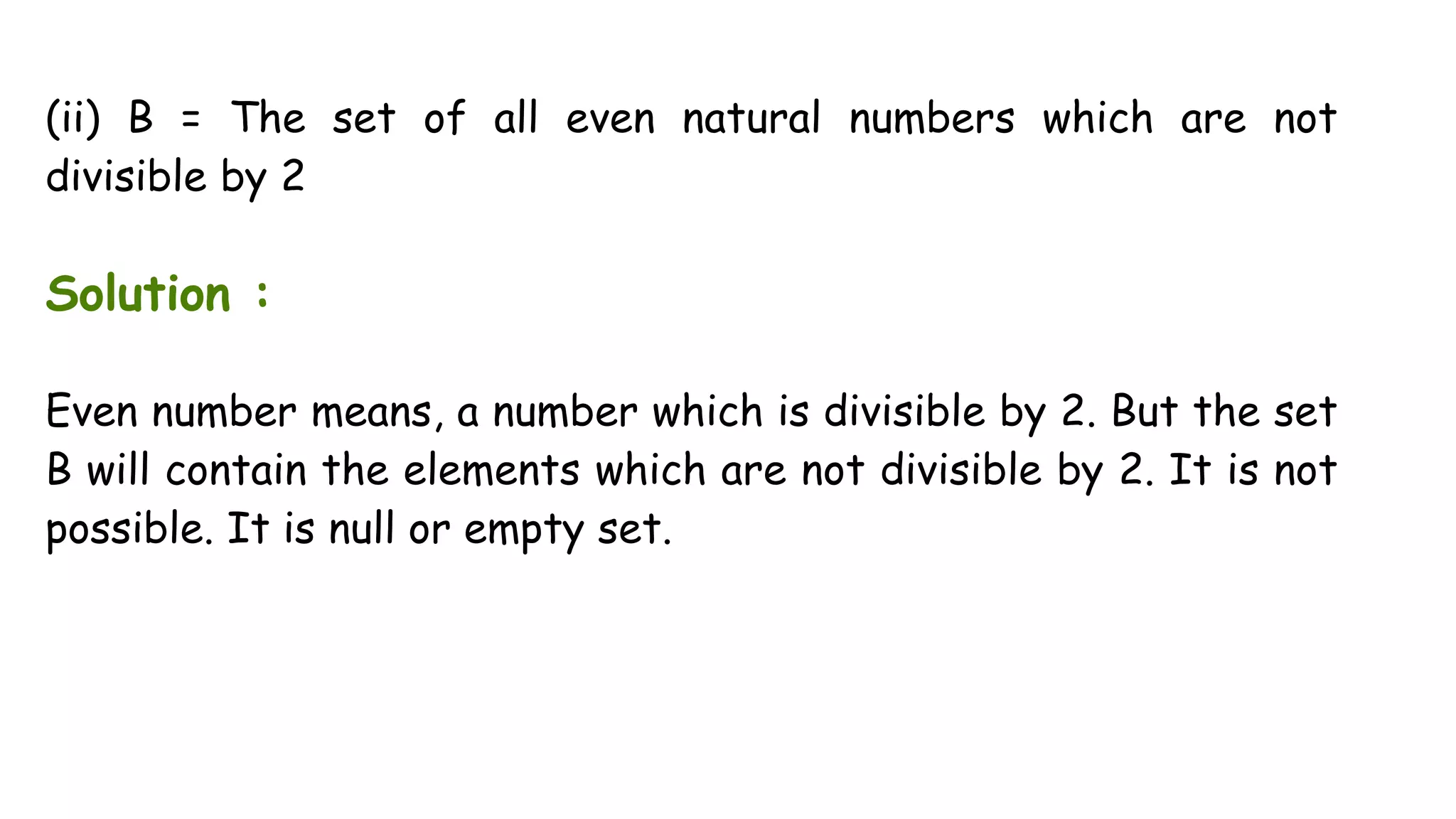
(ii) B = The set of all even natural numbers which are not
divisible by 2
Solution :
Even number means, a number which is divisible by 2. But the set
B will contain the elements which are not divisible by 2. It is not
possible. It is null or empty set.
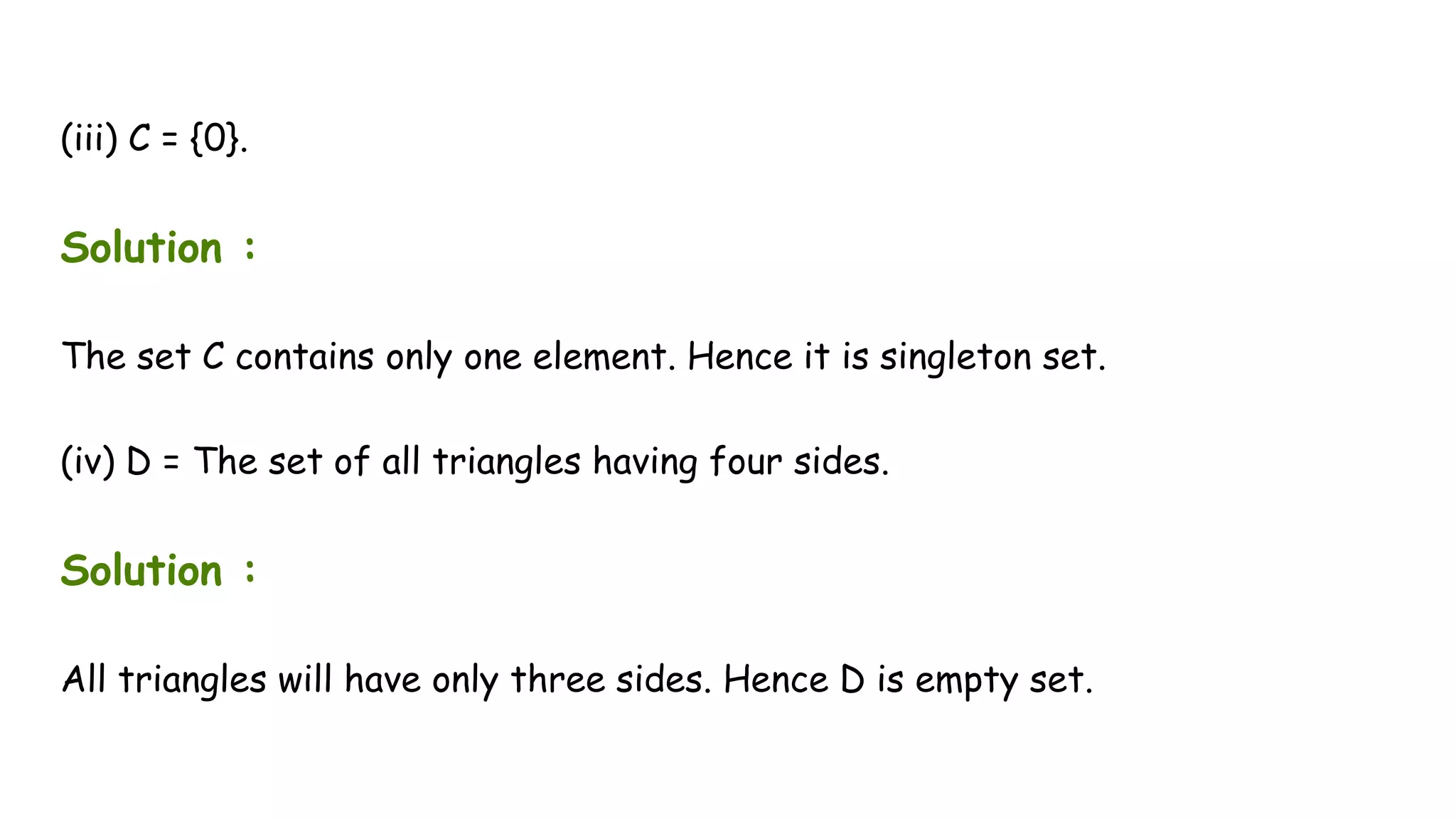
(iii) C = {0}.
Solution :
The set C contains only one element. Hence it is singleton set.
(iv) D = The set of all triangles having four sides.
Solution :
All triangles will have only three sides. Hence D is empty set.
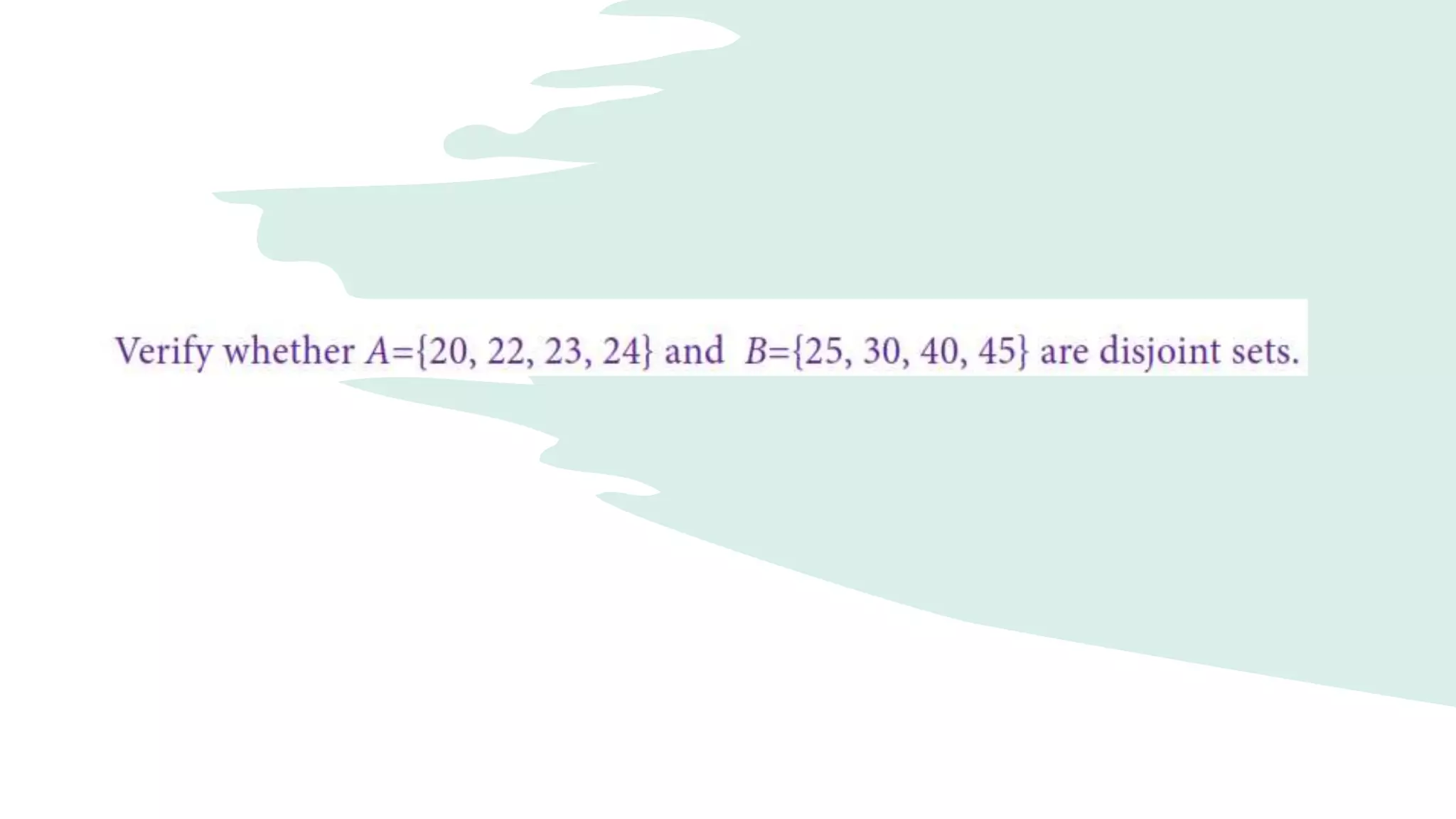
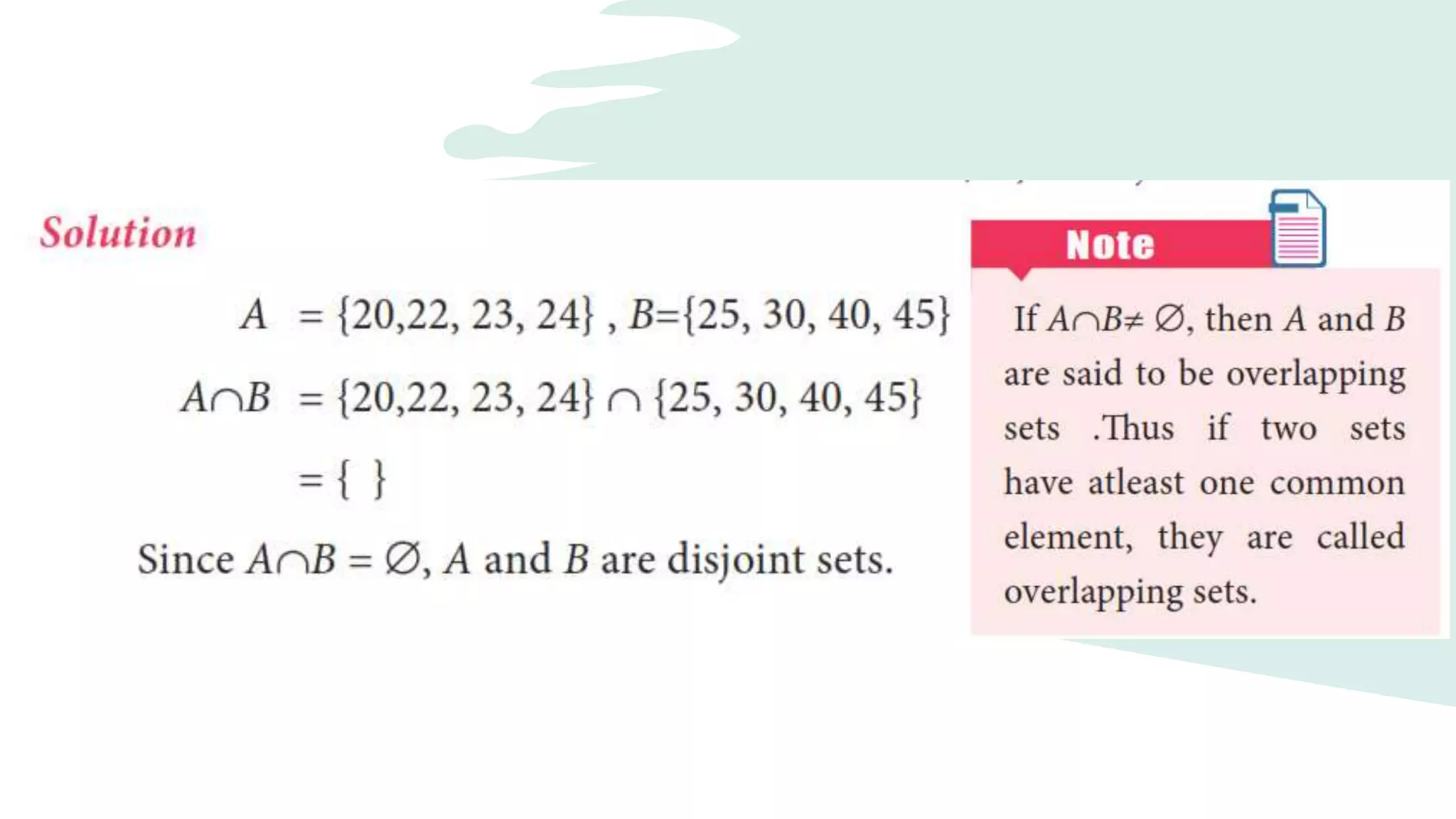
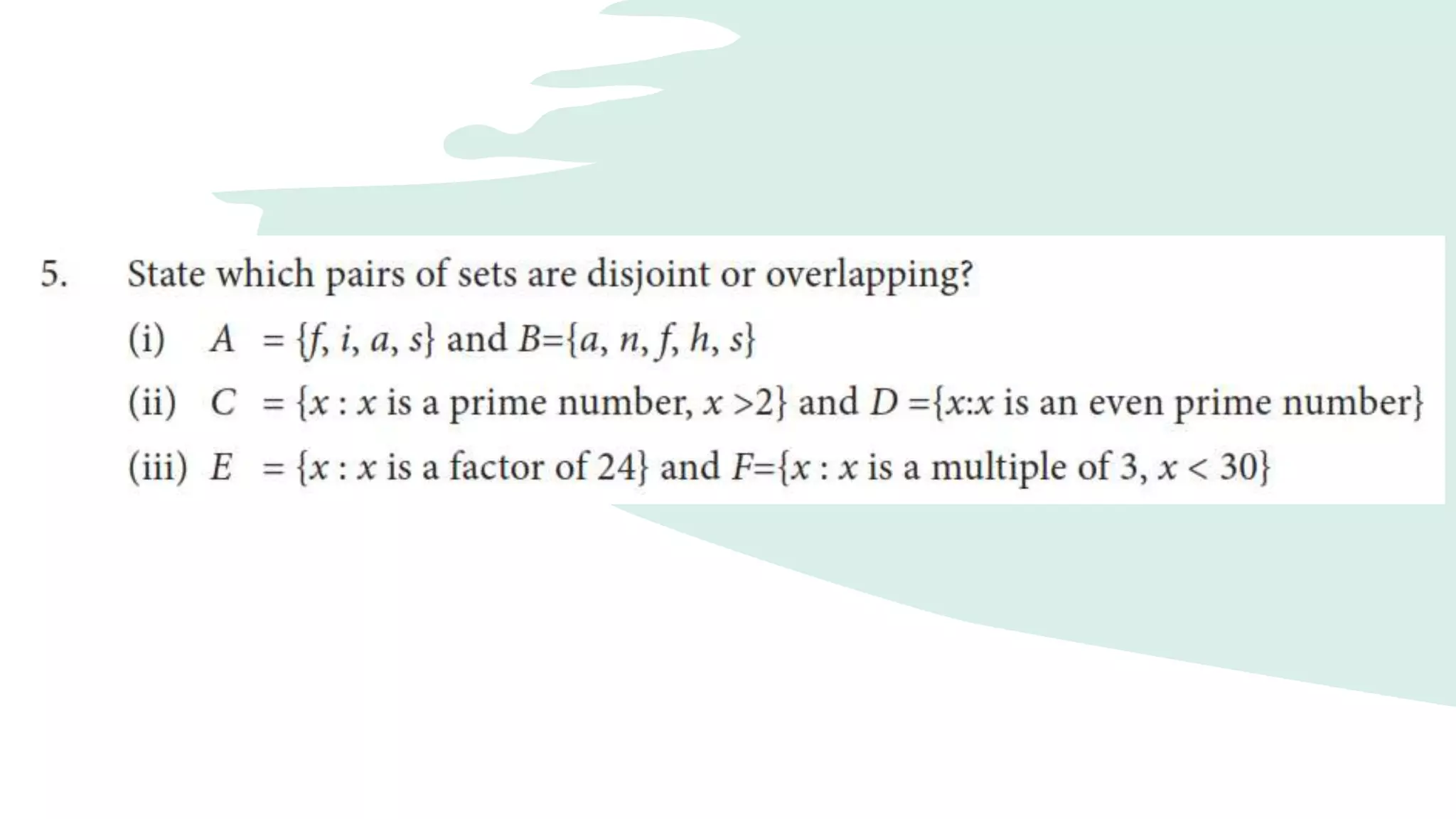
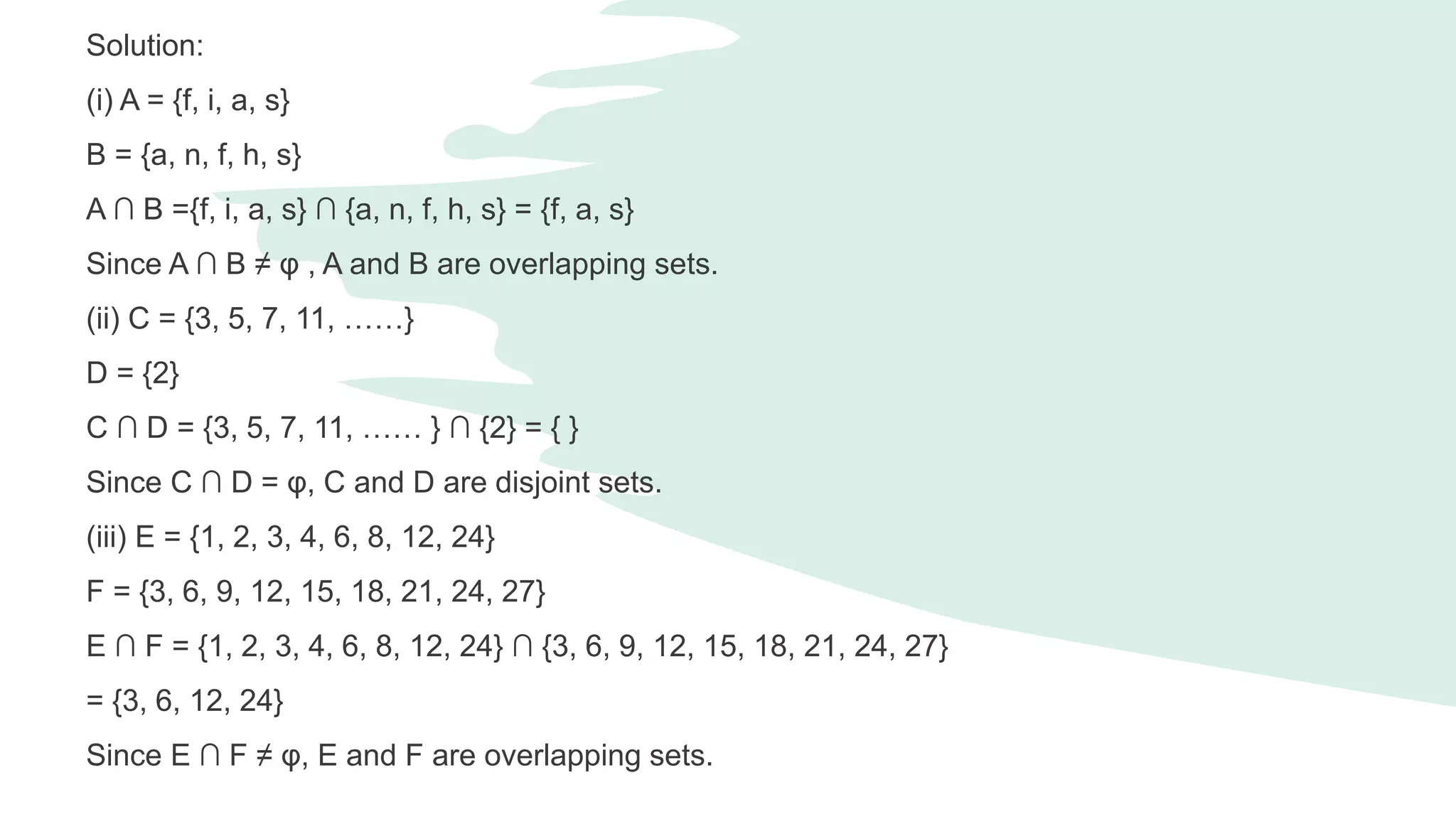
Solution:
(i) A = {f, i, a, s}
B = {a, n, f, h, s}
A ∩ B ={f, i, a, s} ∩ {a, n, f, h, s} = {f, a, s}
Since A ∩ B ≠ φ , A and B are overlapping sets.
(ii) C = {3, 5, 7, 11, ……}
D = {2}
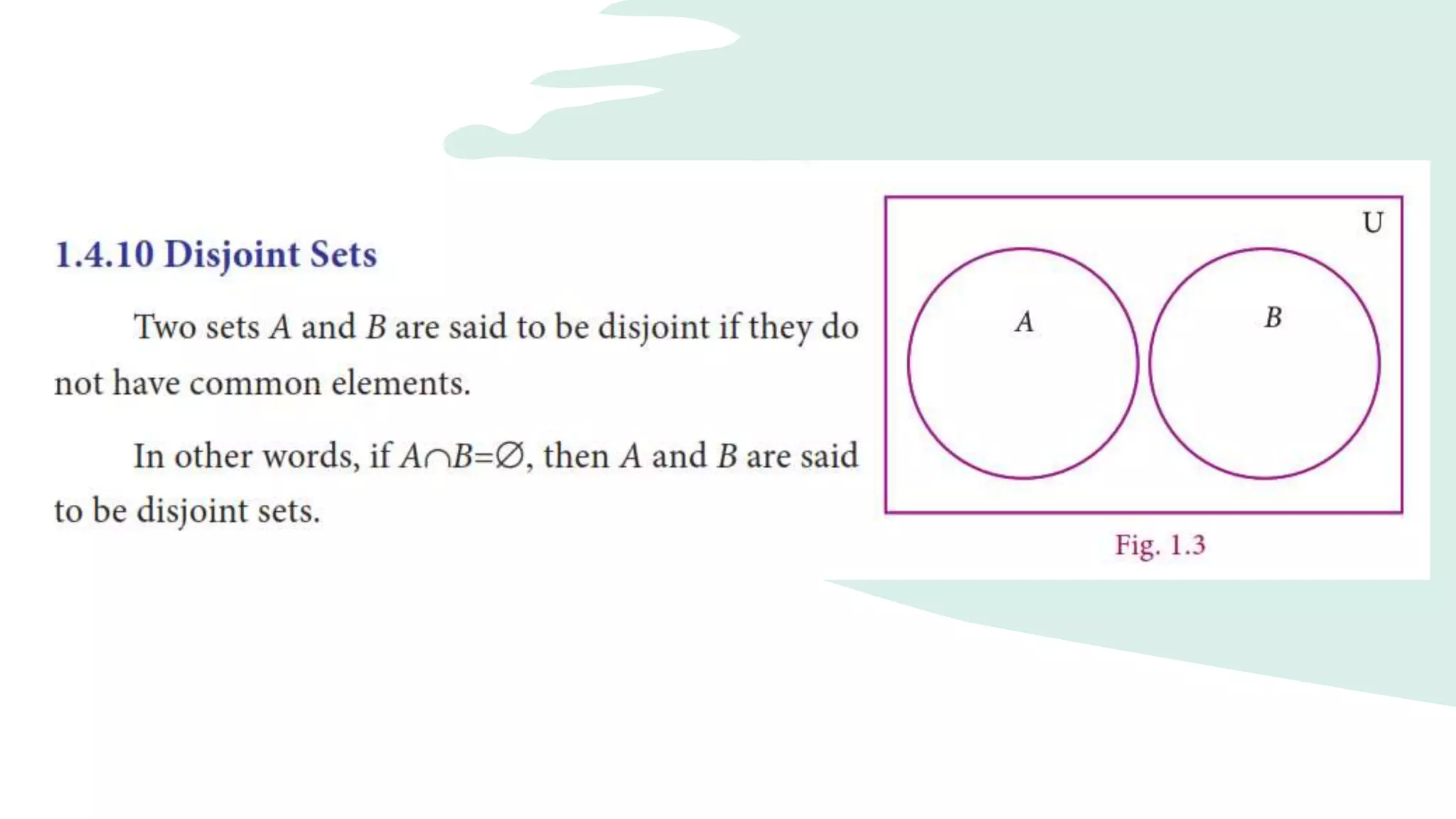
C ∩ D = {3, 5, 7, 11, …… } ∩ {2} = { }
Since C ∩ D = φ, C and D are disjoint sets.
(iii) E = {1, 2, 3, 4, 6, 8, 12, 24}
F = {3, 6, 9, 12, 15, 18, 21, 24, 27}
E ∩ F = {1, 2, 3, 4, 6, 8, 12, 24} ∩ {3, 6, 9, 12, 15, 18, 21, 24, 27}
= {3, 6, 12, 24}
Since E ∩ F ≠ φ, E and F are overlapping sets.
Question 6 :
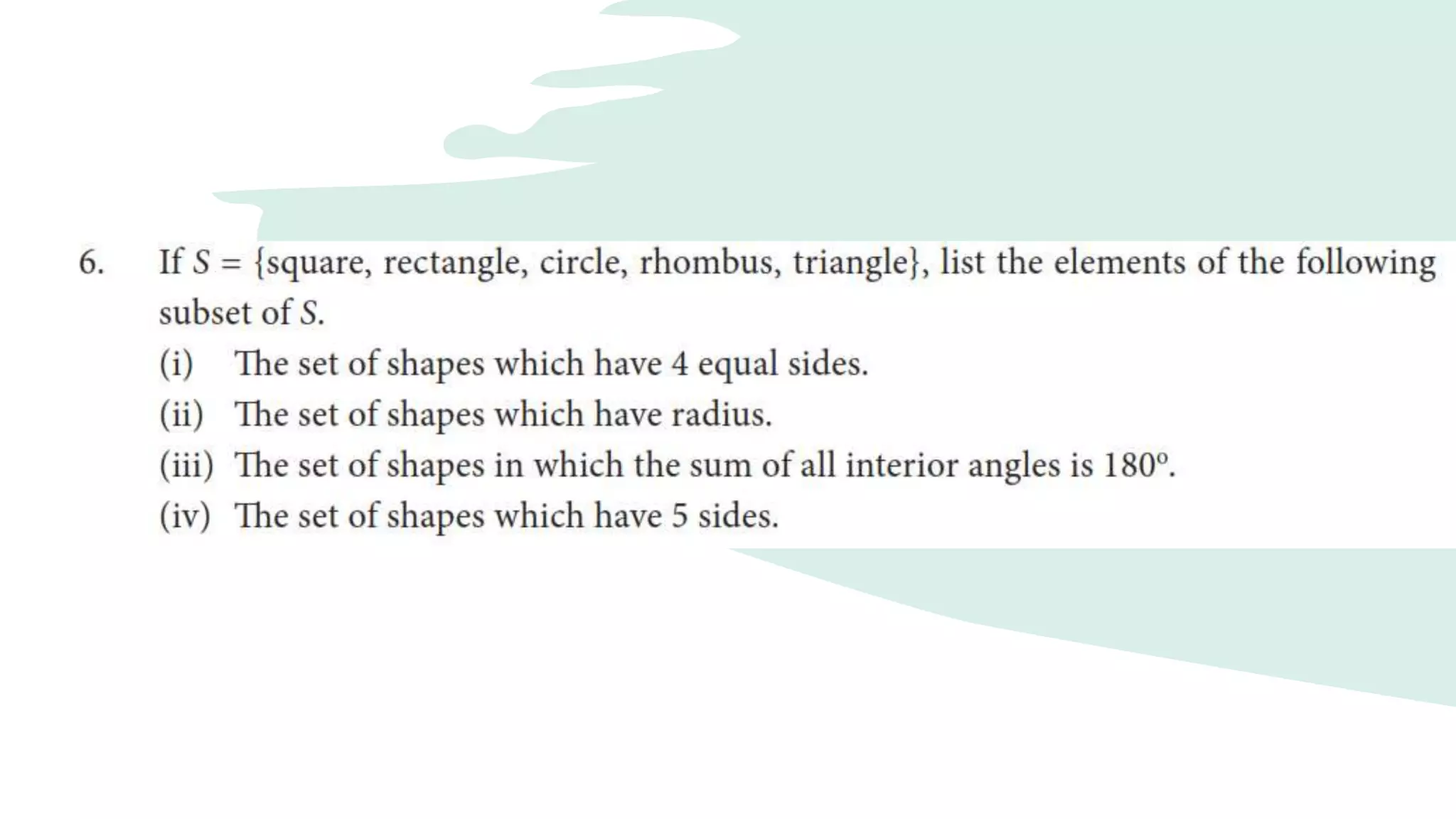
If S = {square, rectangle, circle, rhombus, triangle}, list the elements of
the following subset of S.
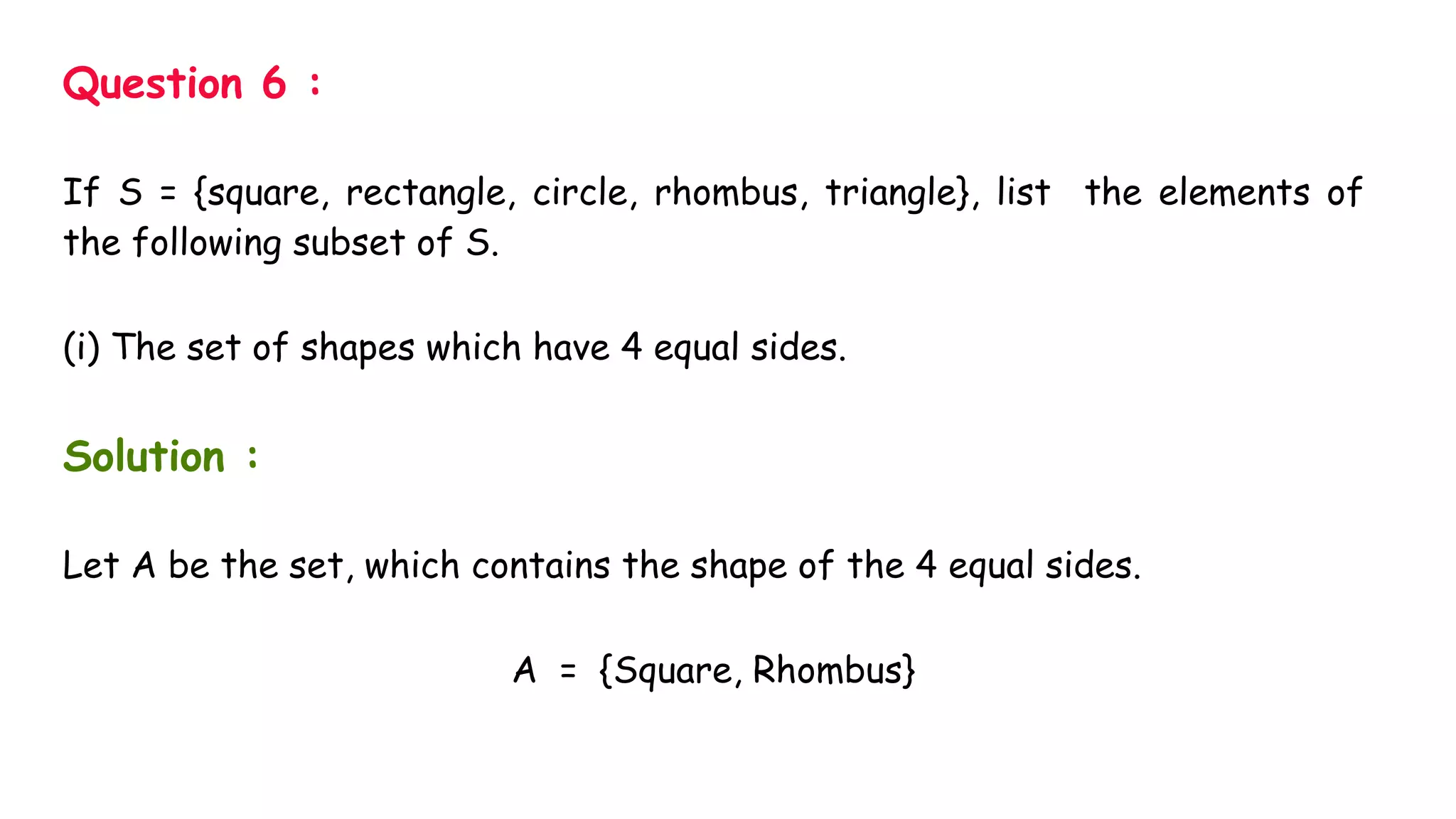
(i) The set of shapes which have 4 equal sides.
Solution :
Let A be the set, which contains the shape of the 4 equal sides.
A = {Square, Rhombus}
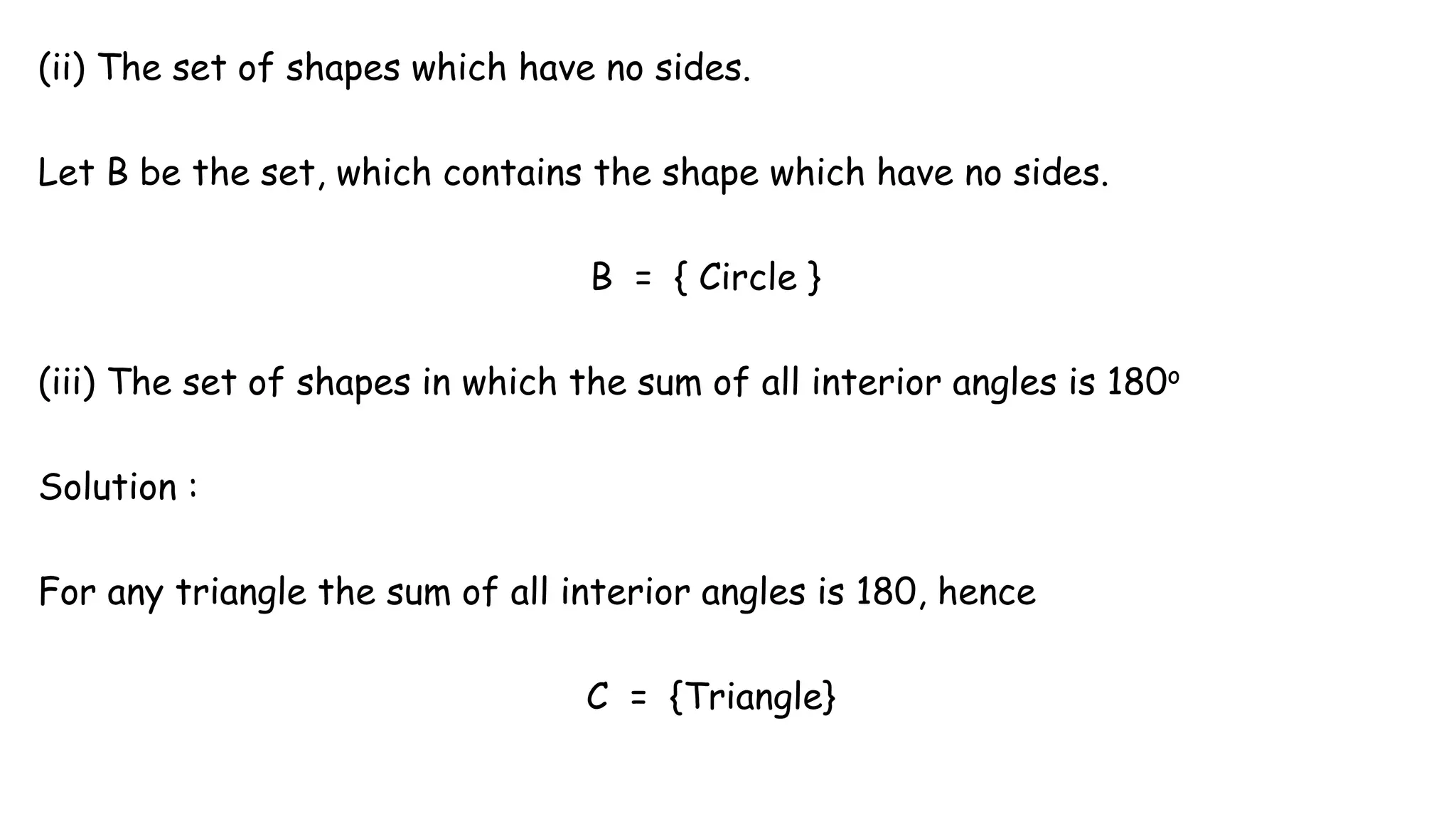
(ii) The set of shapes which have no sides.
Let B be the set, which contains the shape which have no sides.
B = { Circle }
(iii) The set of shapes in which the sum of all interior angles is 180o
Solution :
For any triangle the sum of all interior angles is 180, hence
C = {Triangle}
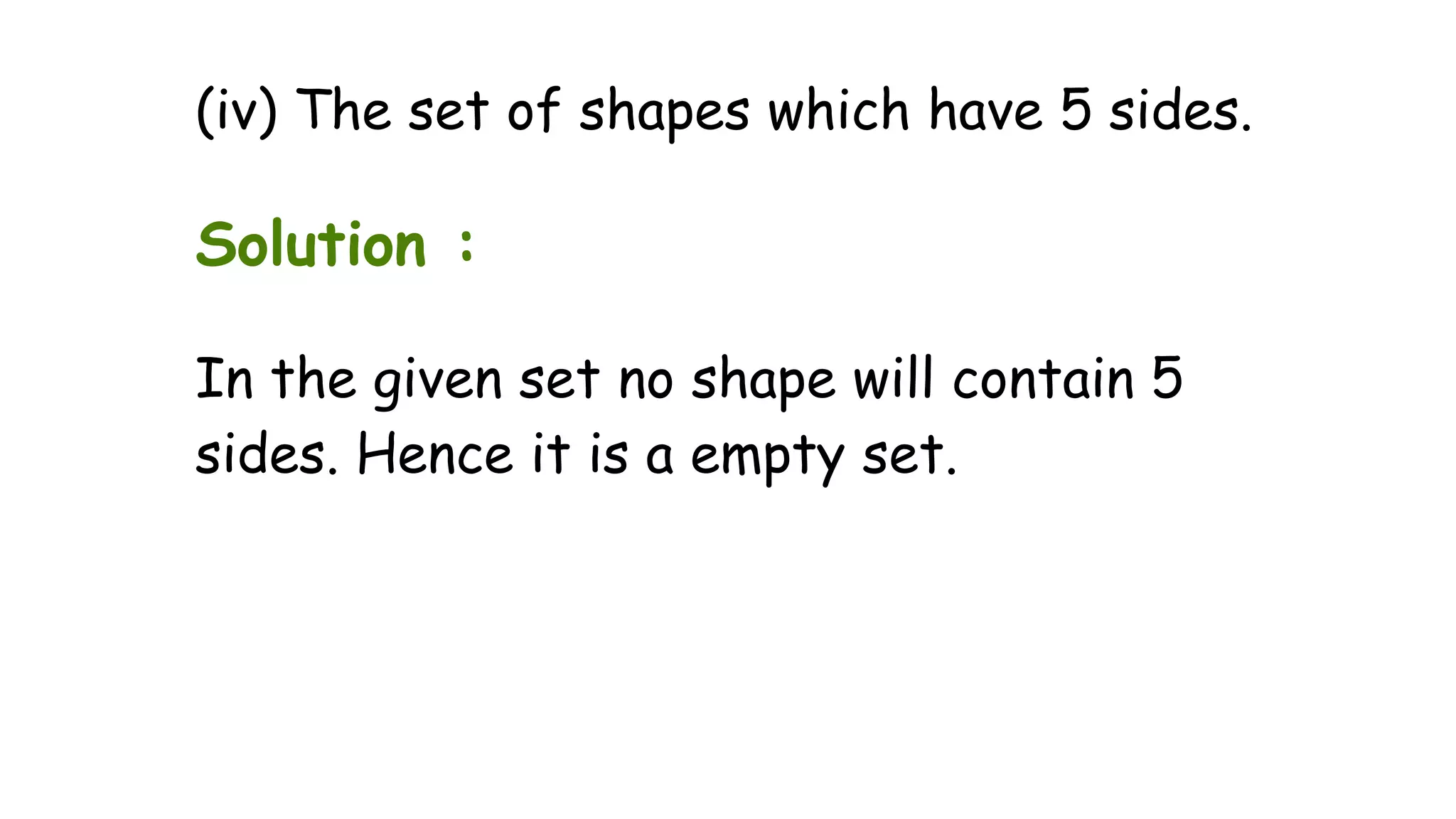
(iv) The set of shapes which have 5 sides.
Solution :
In the given set no shape will contain 5
sides. Hence it is a empty set.
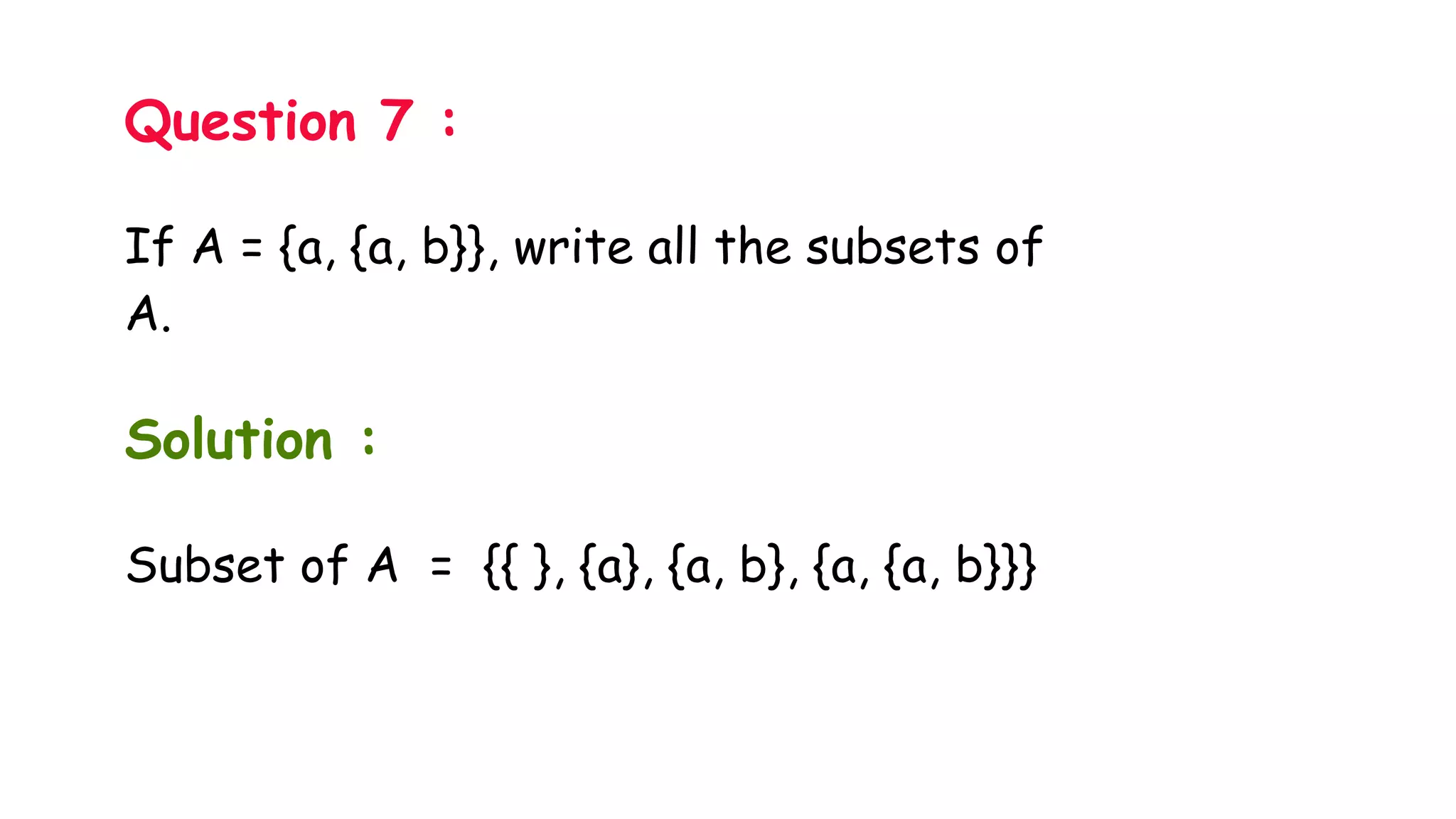
Question 7 :
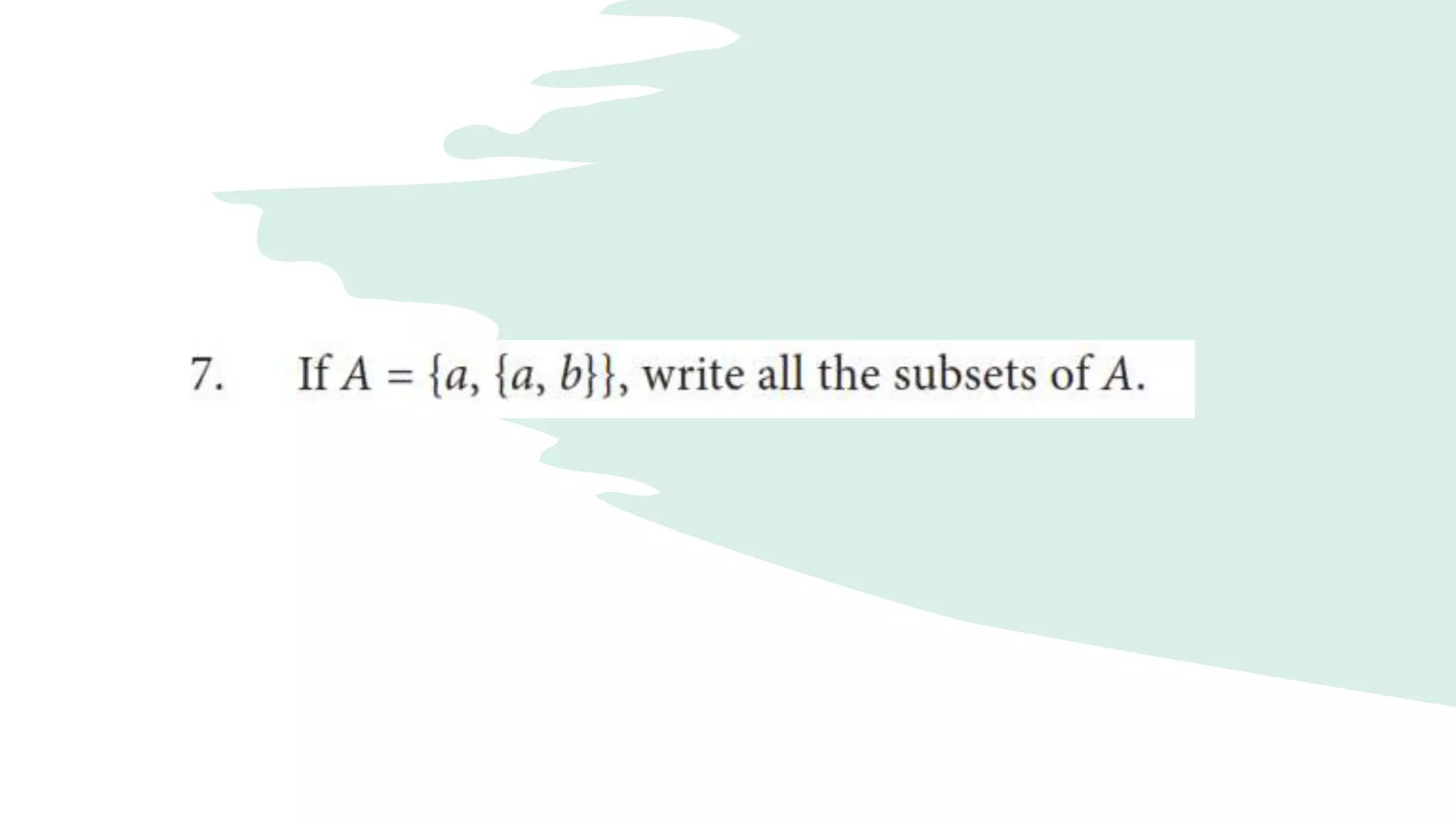
If A = {a, {a, b}}, write all the subsets of
A.
Solution :
Subset of A = {{ }, {a}, {a, b}, {a, {a, b}}}
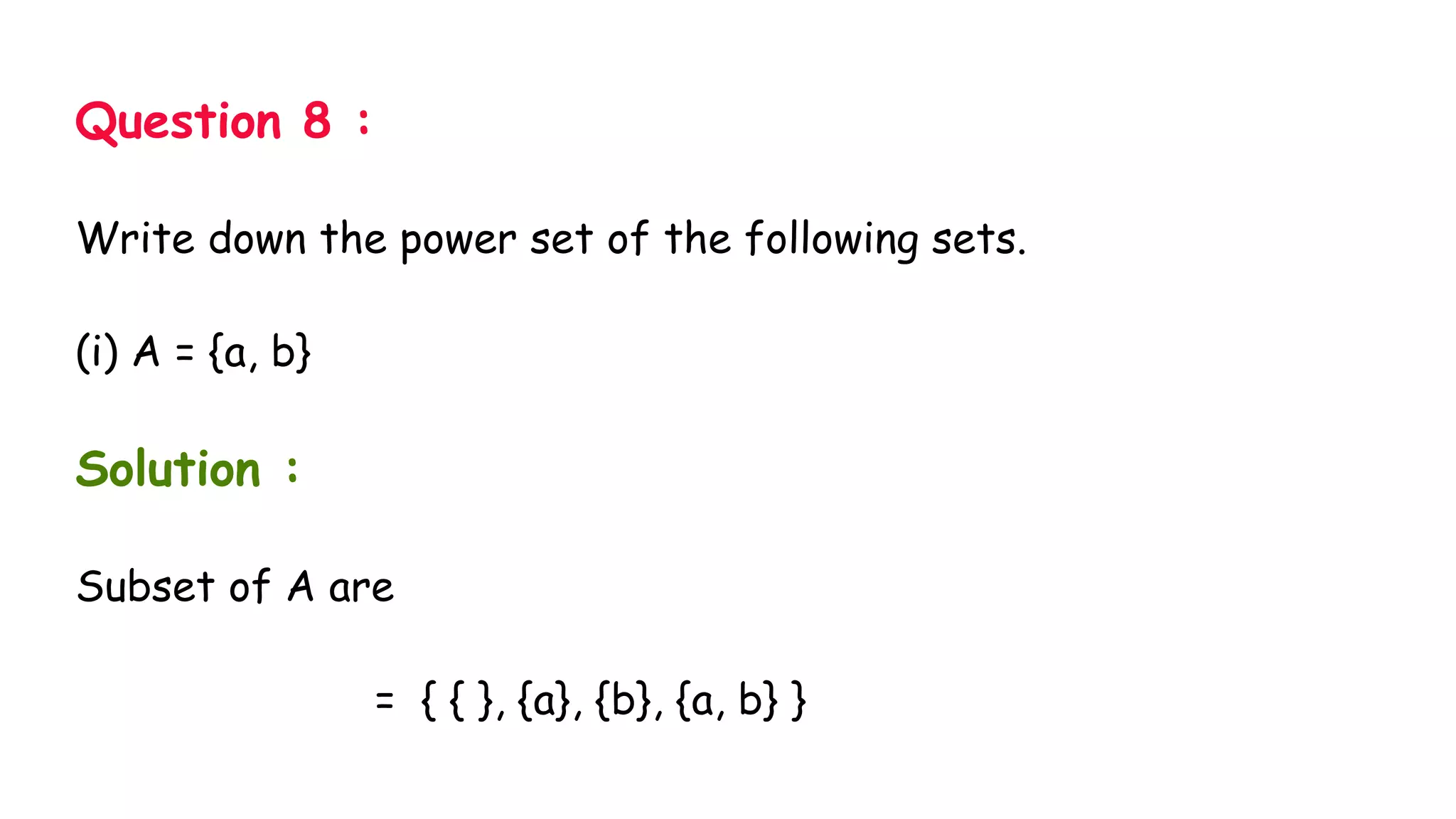
Question 8 :
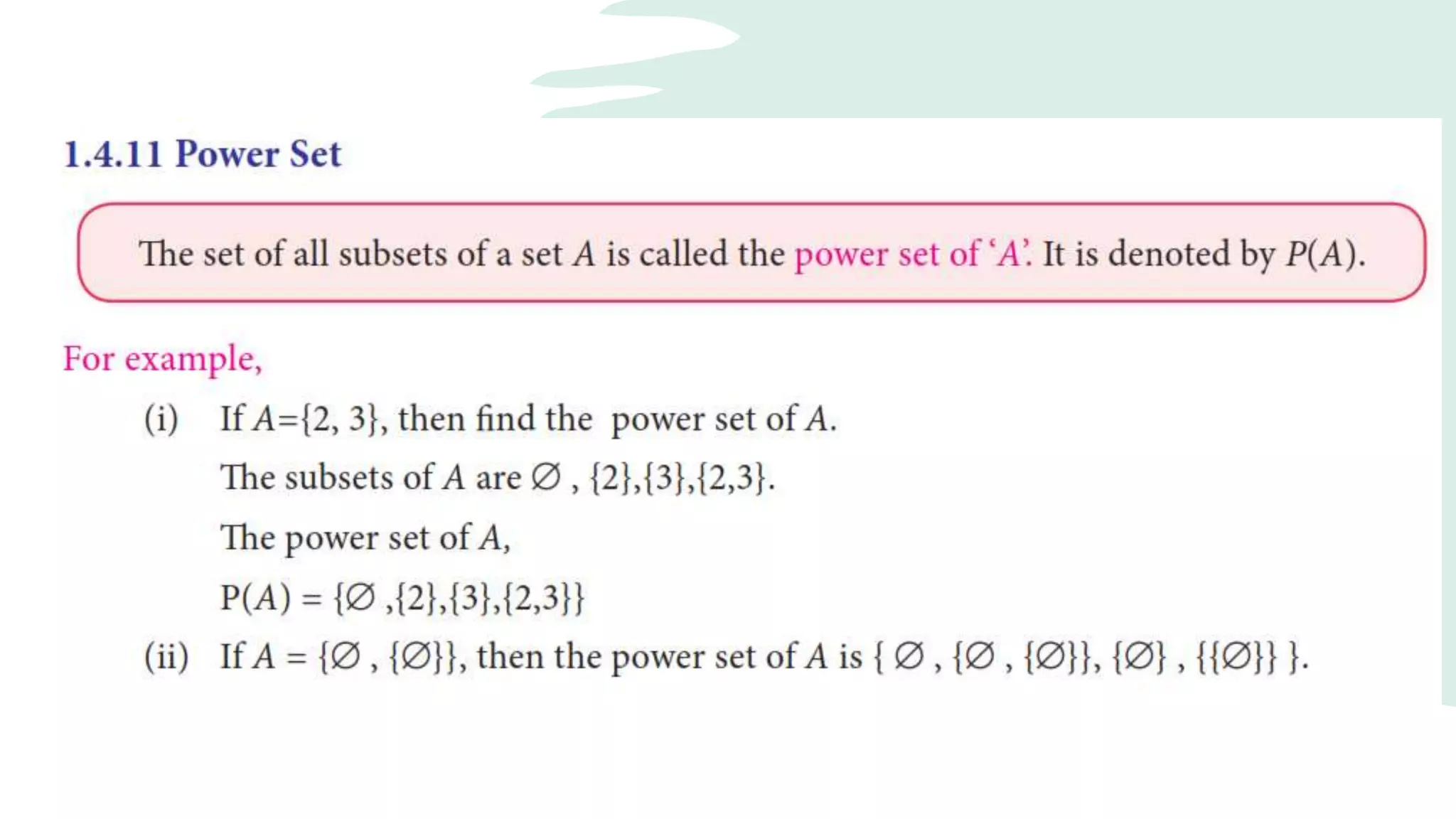
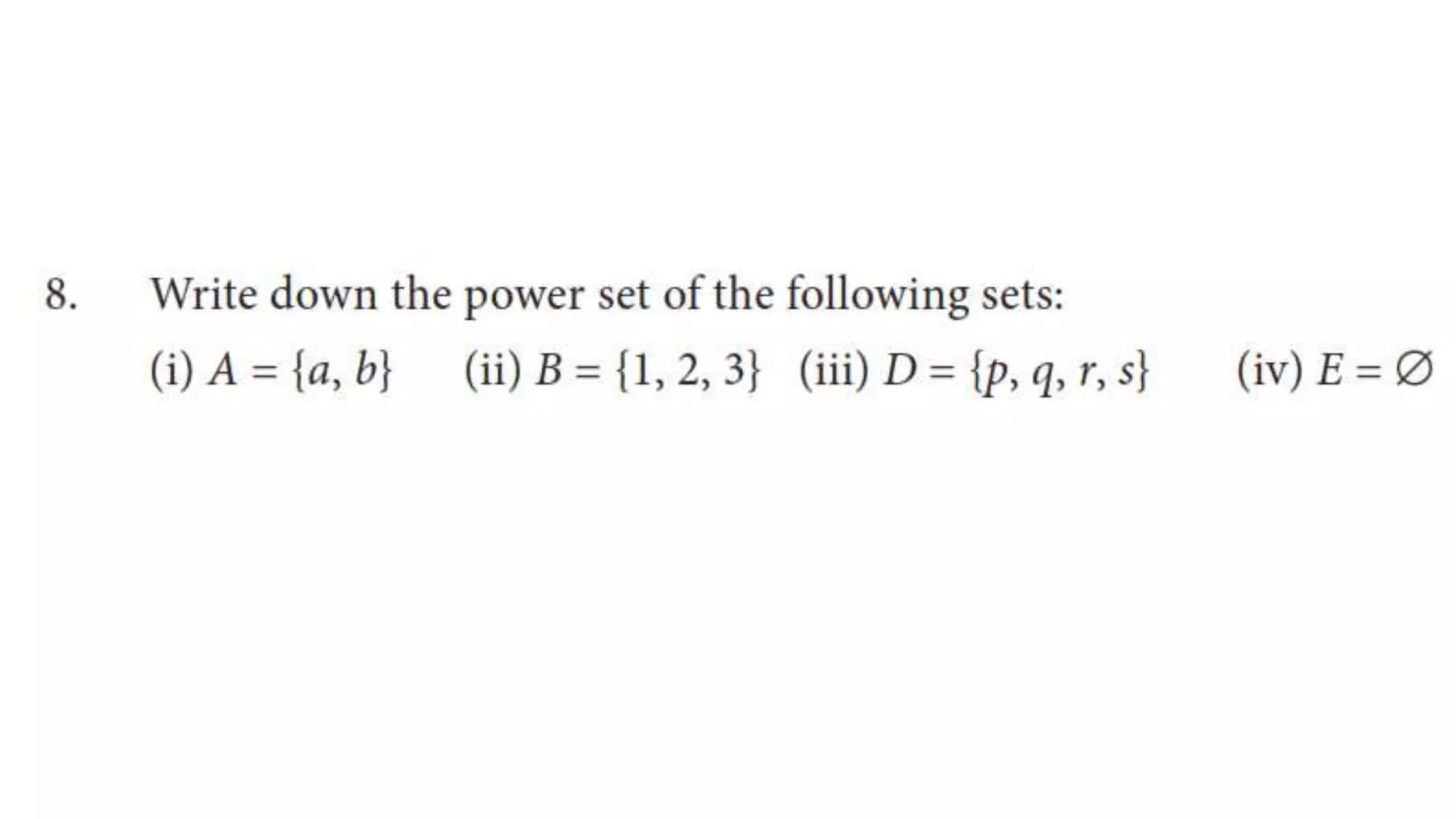
Write down the power set of the following sets.
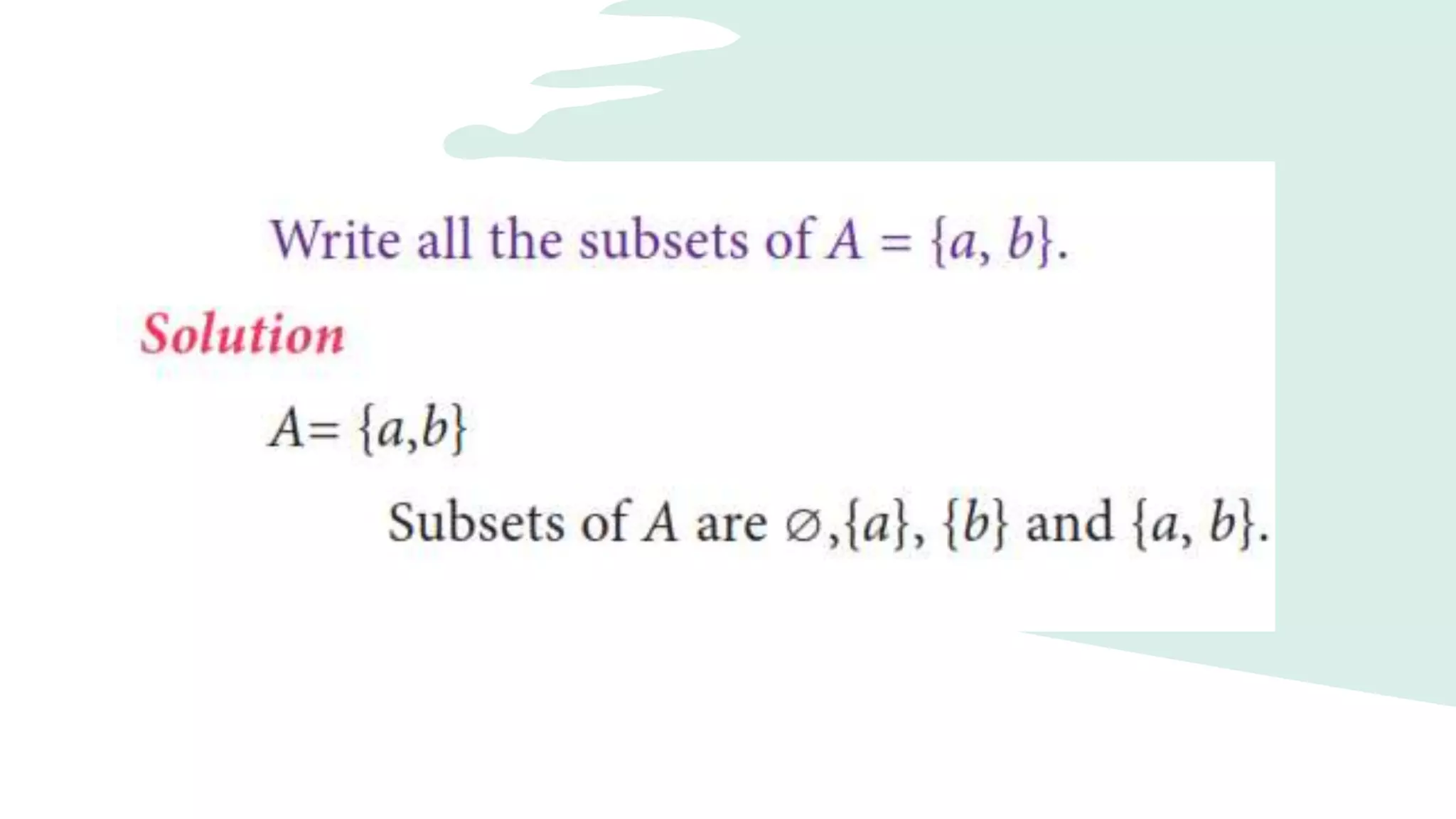
(i) A = {a, b}
Solution :
Subset of A are
= { { }, {a}, {b}, {a, b} }
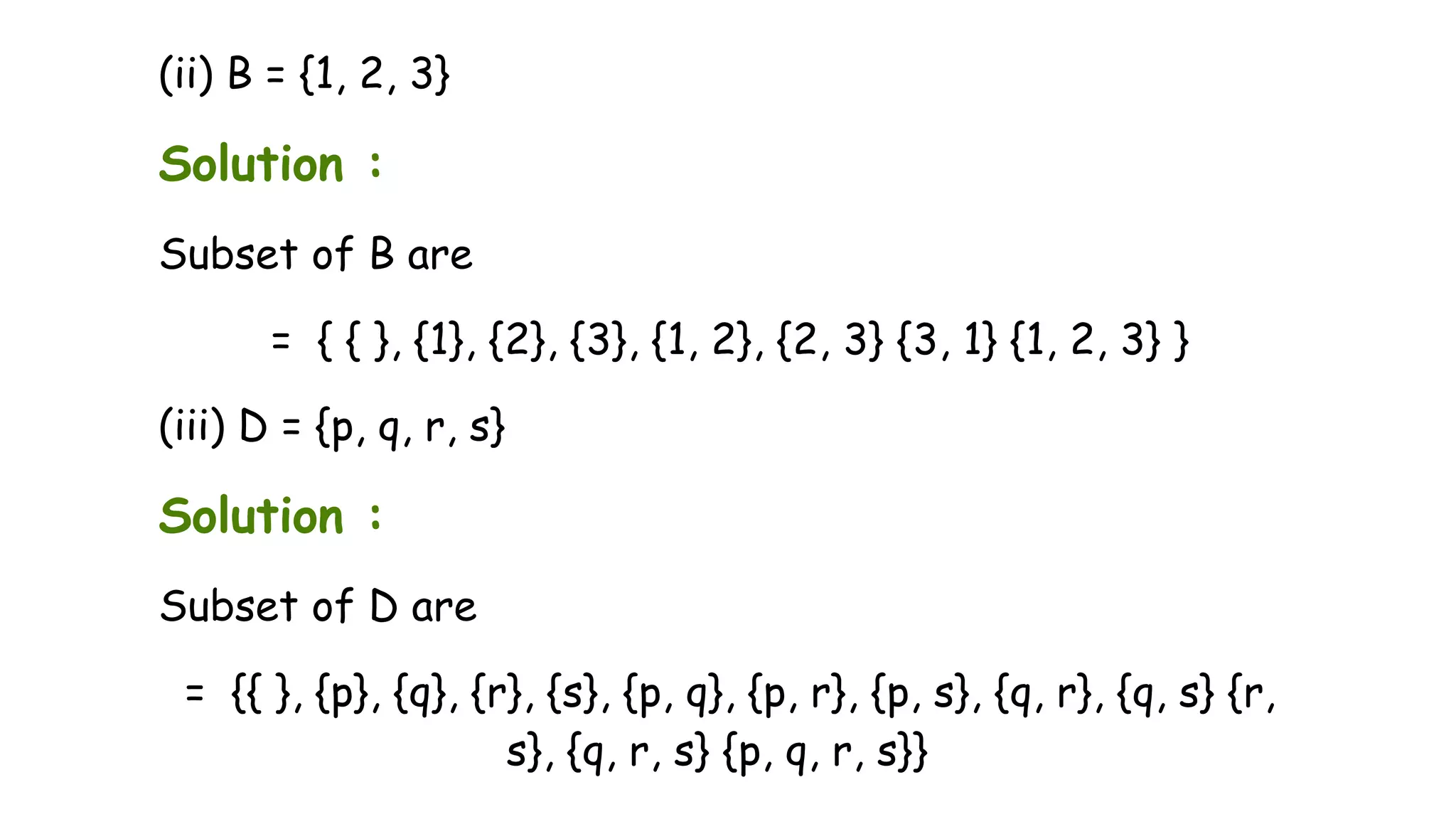
(ii) B = {1, 2, 3}
Solution :
Subset of B are
= { { }, {1}, {2}, {3}, {1, 2}, {2, 3} {3, 1} {1, 2, 3} }
(iii) D = {p, q, r, s}
Solution :
Subset of D are
= {{ }, {p}, {q}, {r}, {s}, {p, q}, {p, r}, {p, s}, {q, r}, {q, s} {r,
s}, {q, r, s} {p, q, r, s}}
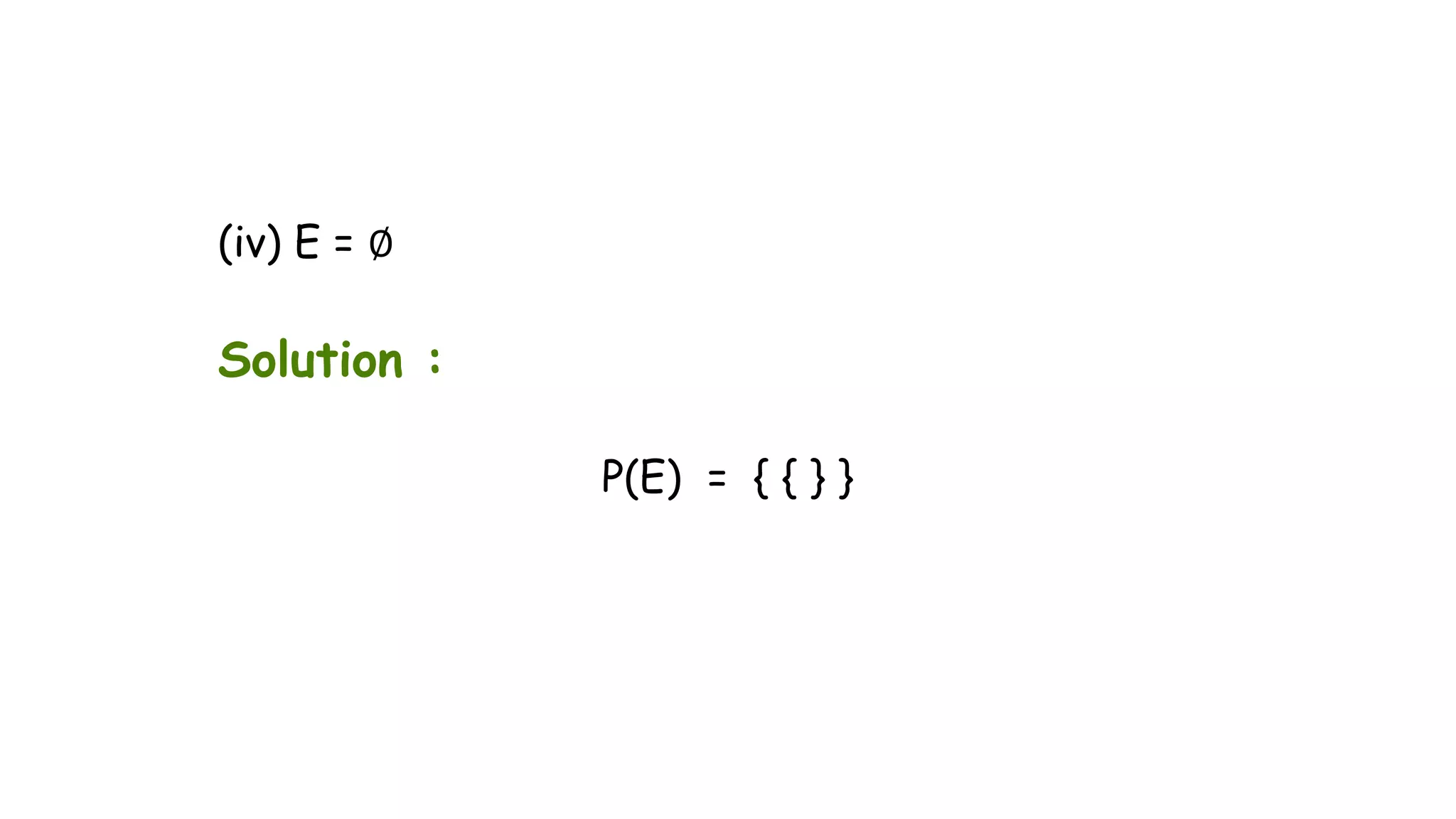
(iv) E = ∅
Solution :
P(E) = { { } }
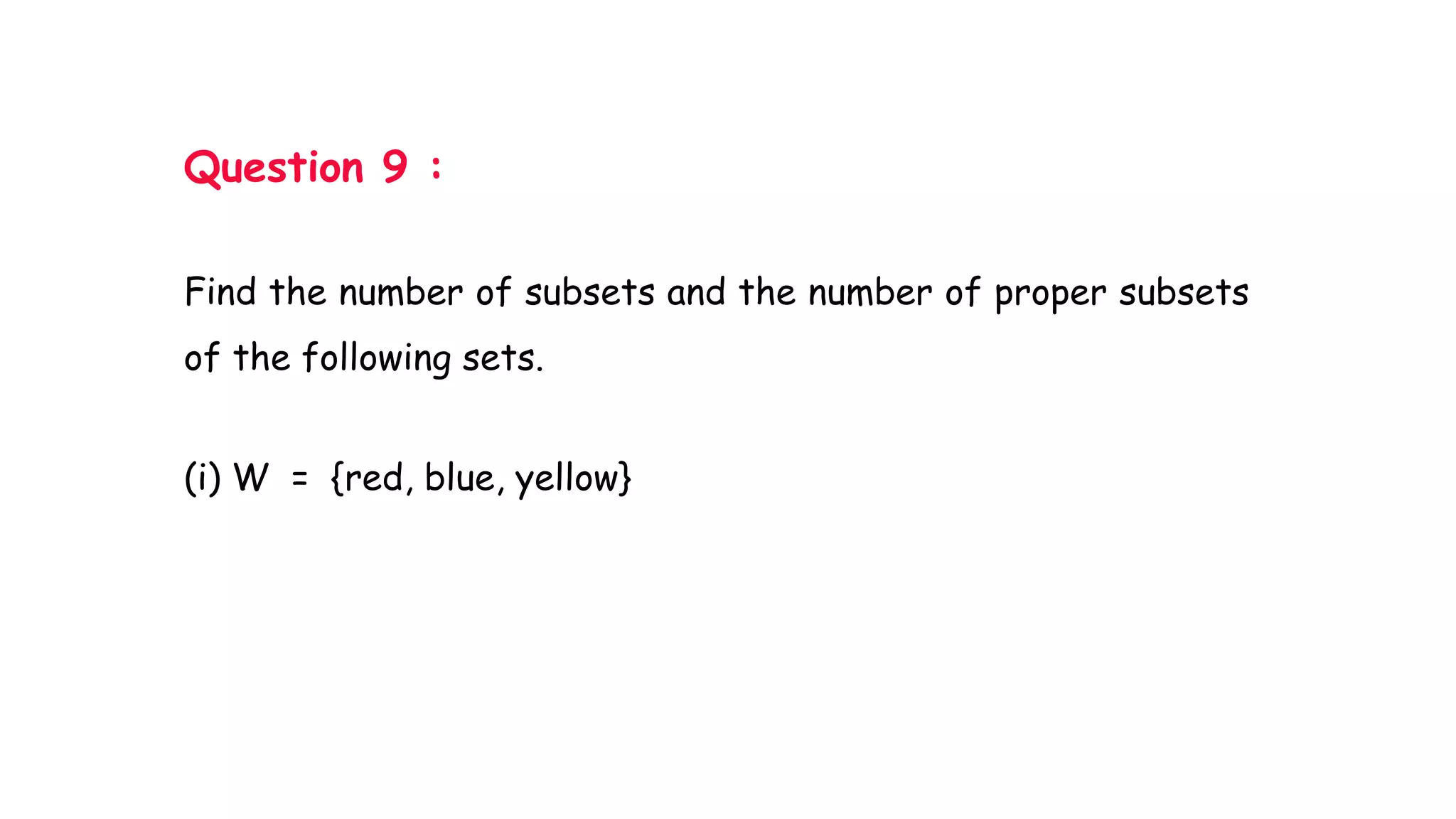
Question 9 :
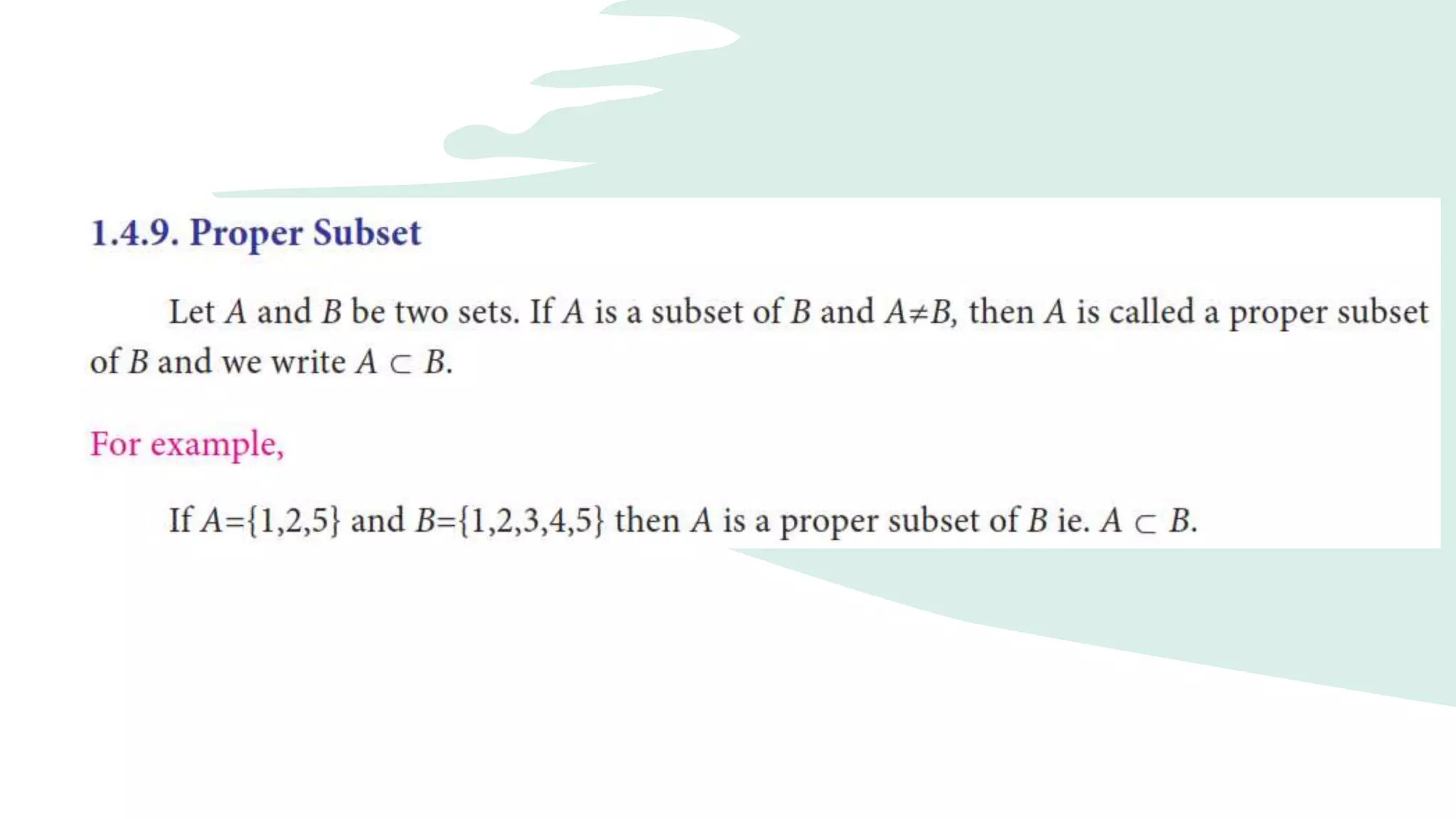
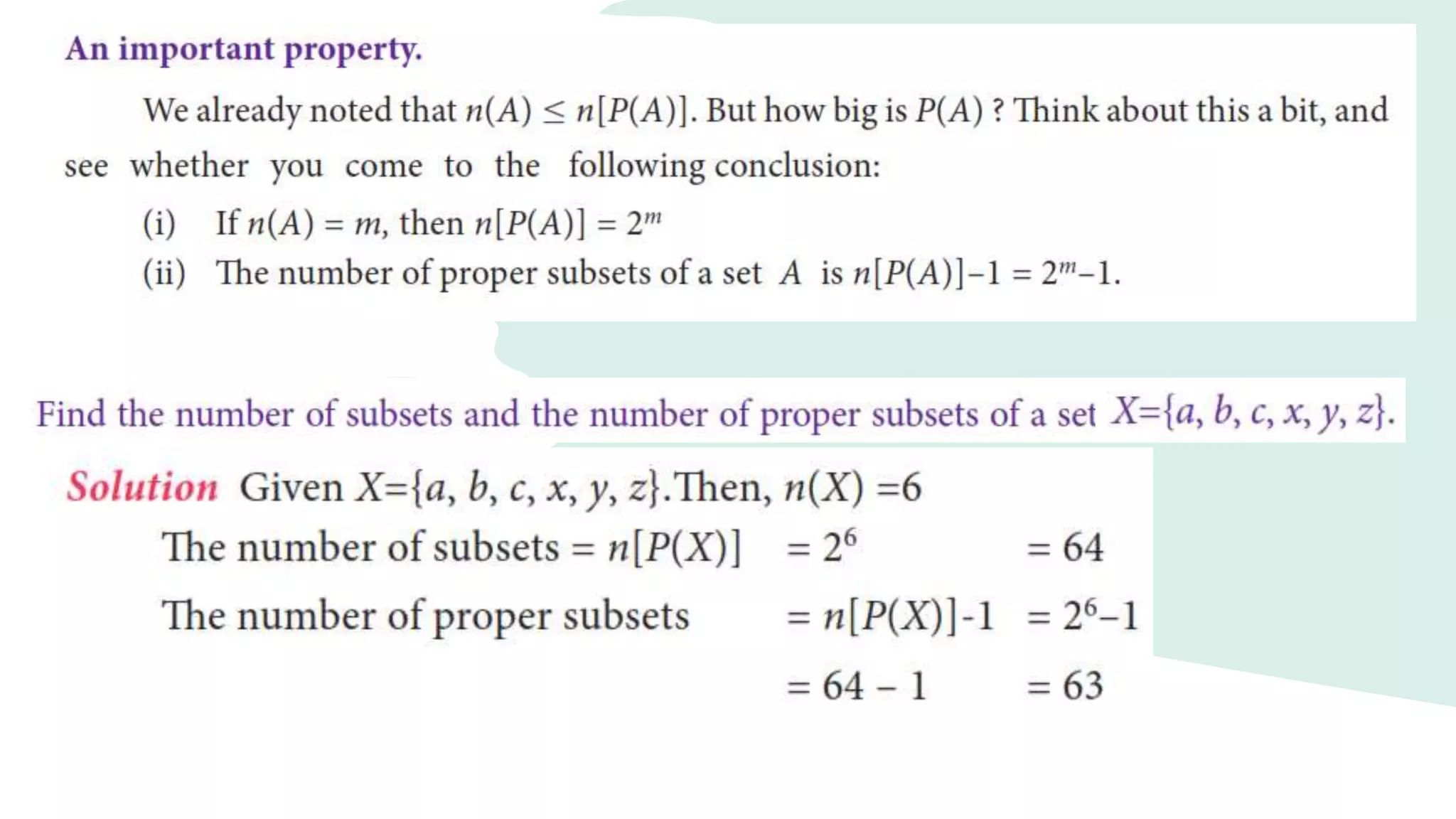
Find the number of subsets and the number of proper subsets
of the following sets.
(i) W = {red, blue, yellow}
Solution :
The number of proper subsets of a set A is
n [P(A)] – 1 = 2m–1
n(A) = 3
n [P(A)] – 1 = 23–1
= 8 - 1
Number of proper subset :
n [P(A)] – 1 = 7
(ii) X = { x2 : x ∈ N, x2 ≤ 100}
X = {22, 32, 42, 52, 62, 72, 82, 92, 102}
n (X) = 10
n [P(A)] – 1 = 210 – 1
n [P(A)] = 1024
Number of proper subset :
Number of proper subset = 1024 - 1 = 1023
Question 10 :
(i) If n(A) = 4, find n [P(A)].
Solution :
n(A) = 4, find n [P(A)]
n [P(A)] = 24
= 16
(ii) If n(A) = 0, find n [P(A)].
Solution :
n [P(A)] = 2m
= 20
= 1
(iii) If n[P(A)] = 256, find n(A).
n [P(A)] = 256
2m = 256
2m = 28
m = 8
1b. Pedagogy of Mathematics (Part II) - Set language introduction and ex.1.2

1b. Pedagogy of Mathematics (Part II) - Set language introduction and ex.1.2

  • 1.
    Pedagogy of Mathematics– Part II continuation BY DR. I. UMA MAHESWARI PRINCIPAL PENIEL RURAL COLLEGE OF EDUCATION, VEMPARALI, DINDIGUL DISTRICT IUMA_MAHESWARI@YAHOO.CO.IN
  • 2.
    Std IX Chapter 1– Set Language Ex - 1.2
  • 15.
  • 26.
    Question 1 : Findthe cardinal number of the following sets. (i) M = {p, q, r, s, t, u} Solution : Number of elements in the set is 6. Hence n(M) = 6.
  • 27.
    (ii) P ={x : x = 3n + 2, n∈W and x < 15} Solution : Since n belongs to whole number, we have to start with 0. By applying the values of n from 0 to 14, we get 15 different values for x. Hence n(P) is 15.
  • 28.
    (iii) Q ={ y : y = 4/3n, n ∈ N and 2 < n ≤ 5} Solution : The values of n are 3, 4, 5. By applying the above three values for n, we get different values of y. Hence n(Q) is 3.
  • 29.
    (iv) R ={x : x is an integers, x ∈ Z and –5 ≤ x < 5} Solution : The elements of R are R = {-5,-4, -3, -2, -1, 0, 1, 2, 3, 4} n(R) = 10
  • 30.
    (v) S =The set of all leap years between 1882 and 1906. Solution : The leap years 1884, 1888, 1892, 1896, 1900, 1904. Hence n(S) = 6
  • 32.
    Question 2 : Identifythe following sets as finite or infinite. (i) X = The set of all districts in Tamilnadu. Solution : Districts in Tamilnadu is countable. Hence it is finite set.
  • 33.
    (ii) Y =The set of all straight lines passing through a point. Solution : We may draw an infinite number of lines through a point. Hence it is infinite set.
  • 34.
    (iii) A ={ x : x ∈ Z and x < 5} Solution : Z means integers. The elements of A are 1, 2, 3, 4. Hence set A is finite.
  • 35.
    (iv) B ={x : x2–5x+6 = 0, x ∈N} Solution : x2–5x+6 = 0 (x - 2) (x - 3) = 0 x = 2 and x = 3 By solving the quadratic equation, we get two different values. Hence B is finite set.
  • 37.
    Question 3 : Whichof the following sets are equivalent or unequal or equal sets? (i) A = The set of vowels in the English alphabets. B = The set of all letters in the word “VOWEL” Solution : A = {a, e, i o, u} B = {V, O, W, E, L} n(A) = 5, n(B) = 5 Since n(A) = n(B), they are equivalent sets.
  • 38.
    (ii) C ={2, 3, 4, 5} D = { x : x ∈ W, 1 < x < 5} Solution : D = {2, 3, 4} The number of elements are not same and set D contain 1 lesser element than C. Hence they are unequal sets.
  • 39.
    (iii) E =The set of A={ x : x is a letter in the word “LIFE”} F = {F, I, L, E} Solution : E = { L, I, F, E } F = {F, I, L, E} In both sets we have same elements. Hence they are equal sets.
  • 40.
    (iv) G ={x : x is a prime number and 3 < x < 23} H = {x : x is a divisor of 18} Solution : G = {5, 7, 11, 13, 17, 19} and n(G) = 6 H = {1, 2, 3, 6, 9, 18} and n(H) = 6 Since the number of elements of both sets are same. They are equivalent sets.
  • 42.
    Question 4 : Identifythe following sets as null set or singleton set. (i) A = {x : x ∈N, 1 < x < 2} Solution : N is the natural number and it should be greater than 1 and lesser than 2. Since it is not possible, the set A will not contain any elements. It is null set.
  • 43.
    (ii) B =The set of all even natural numbers which are not divisible by 2 Solution : Even number means, a number which is divisible by 2. But the set B will contain the elements which are not divisible by 2. It is not possible. It is null or empty set.
  • 44.
    (iii) C ={0}. Solution : The set C contains only one element. Hence it is singleton set. (iv) D = The set of all triangles having four sides. Solution : All triangles will have only three sides. Hence D is empty set.
  • 46.
    Solution: (i) A ={f, i, a, s} B = {a, n, f, h, s} A ∩ B ={f, i, a, s} ∩ {a, n, f, h, s} = {f, a, s} Since A ∩ B ≠ φ , A and B are overlapping sets. (ii) C = {3, 5, 7, 11, ……} D = {2} C ∩ D = {3, 5, 7, 11, …… } ∩ {2} = { } Since C ∩ D = φ, C and D are disjoint sets. (iii) E = {1, 2, 3, 4, 6, 8, 12, 24} F = {3, 6, 9, 12, 15, 18, 21, 24, 27} E ∩ F = {1, 2, 3, 4, 6, 8, 12, 24} ∩ {3, 6, 9, 12, 15, 18, 21, 24, 27} = {3, 6, 12, 24} Since E ∩ F ≠ φ, E and F are overlapping sets.
  • 48.
    Question 6 : IfS = {square, rectangle, circle, rhombus, triangle}, list the elements of the following subset of S. (i) The set of shapes which have 4 equal sides. Solution : Let A be the set, which contains the shape of the 4 equal sides. A = {Square, Rhombus}
  • 49.
    (ii) The setof shapes which have no sides. Let B be the set, which contains the shape which have no sides. B = { Circle } (iii) The set of shapes in which the sum of all interior angles is 180o Solution : For any triangle the sum of all interior angles is 180, hence C = {Triangle}
  • 50.
    (iv) The setof shapes which have 5 sides. Solution : In the given set no shape will contain 5 sides. Hence it is a empty set.
  • 52.
    Question 7 : IfA = {a, {a, b}}, write all the subsets of A. Solution : Subset of A = {{ }, {a}, {a, b}, {a, {a, b}}}
  • 54.
    Question 8 : Writedown the power set of the following sets. (i) A = {a, b} Solution : Subset of A are = { { }, {a}, {b}, {a, b} }
  • 55.
    (ii) B ={1, 2, 3} Solution : Subset of B are = { { }, {1}, {2}, {3}, {1, 2}, {2, 3} {3, 1} {1, 2, 3} } (iii) D = {p, q, r, s} Solution : Subset of D are = {{ }, {p}, {q}, {r}, {s}, {p, q}, {p, r}, {p, s}, {q, r}, {q, s} {r, s}, {q, r, s} {p, q, r, s}}
  • 56.
    (iv) E =∅ Solution : P(E) = { { } }
  • 57.
    Question 9 : Findthe number of subsets and the number of proper subsets of the following sets. (i) W = {red, blue, yellow}
  • 58.
    Solution : The numberof proper subsets of a set A is n [P(A)] – 1 = 2m–1 n(A) = 3 n [P(A)] – 1 = 23–1 = 8 - 1 Number of proper subset : n [P(A)] – 1 = 7
  • 59.
    (ii) X ={ x2 : x ∈ N, x2 ≤ 100} X = {22, 32, 42, 52, 62, 72, 82, 92, 102} n (X) = 10 n [P(A)] – 1 = 210 – 1 n [P(A)] = 1024 Number of proper subset : Number of proper subset = 1024 - 1 = 1023
  • 60.
    Question 10 : (i)If n(A) = 4, find n [P(A)]. Solution : n(A) = 4, find n [P(A)] n [P(A)] = 24 = 16
  • 61.
    (ii) If n(A)= 0, find n [P(A)]. Solution : n [P(A)] = 2m = 20 = 1
  • 62.
    (iii) If n[P(A)]= 256, find n(A). n [P(A)] = 256 2m = 256 2m = 28 m = 8