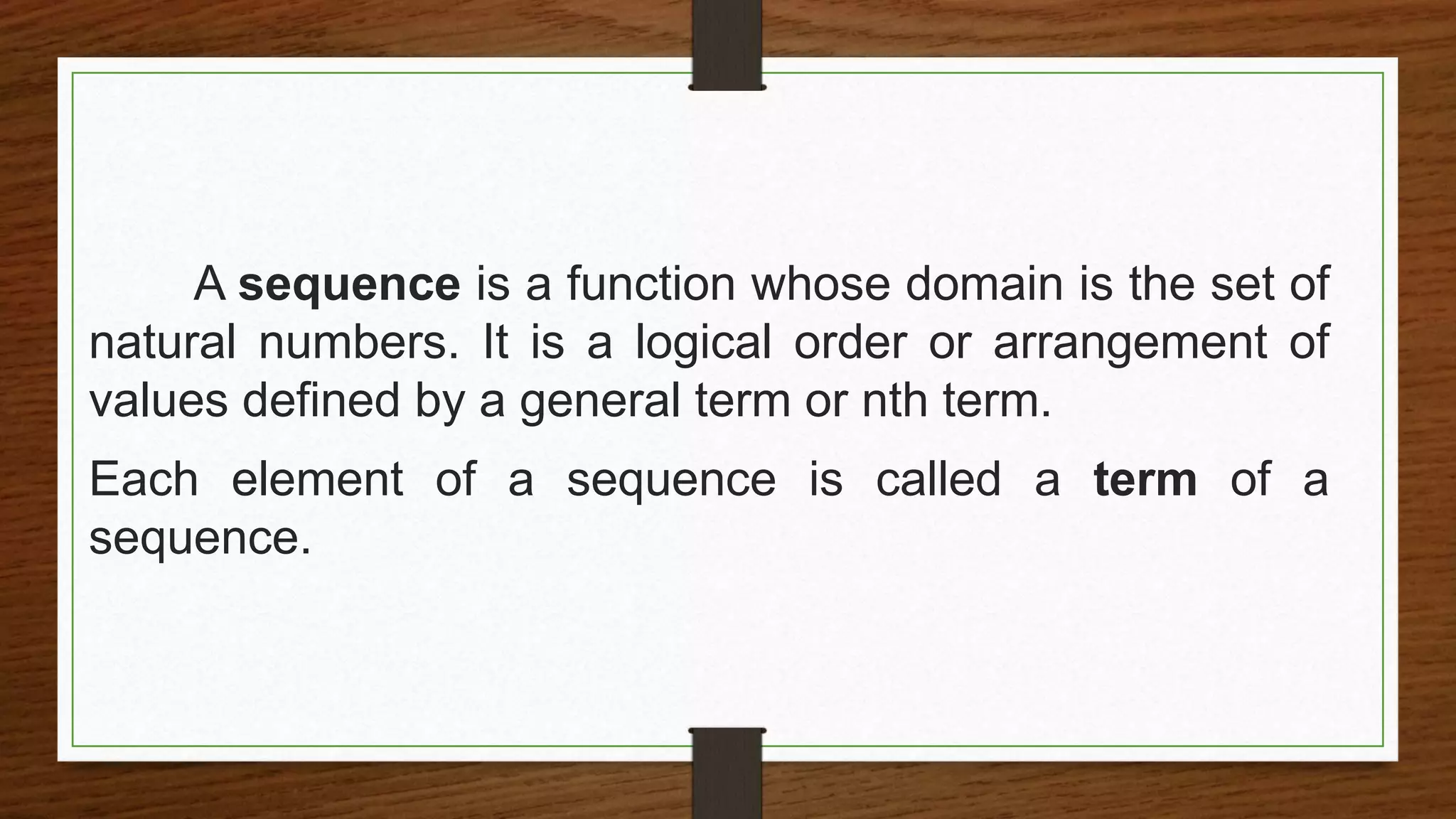
A sequence is a function whose domain is the set of
natural numbers. It is a logical order or arrangement of
values defined by a general term or nth term.
Each element of a sequence is called a term of a
sequence.
Lets Learn!
Jam saves Php50 from her monthly allowance on the first
month, Php100 on the second month, Php150 on the third
month, Php200 on the fourth month. If she will save
continuously in this manner, how much will she save on the
tenth month?
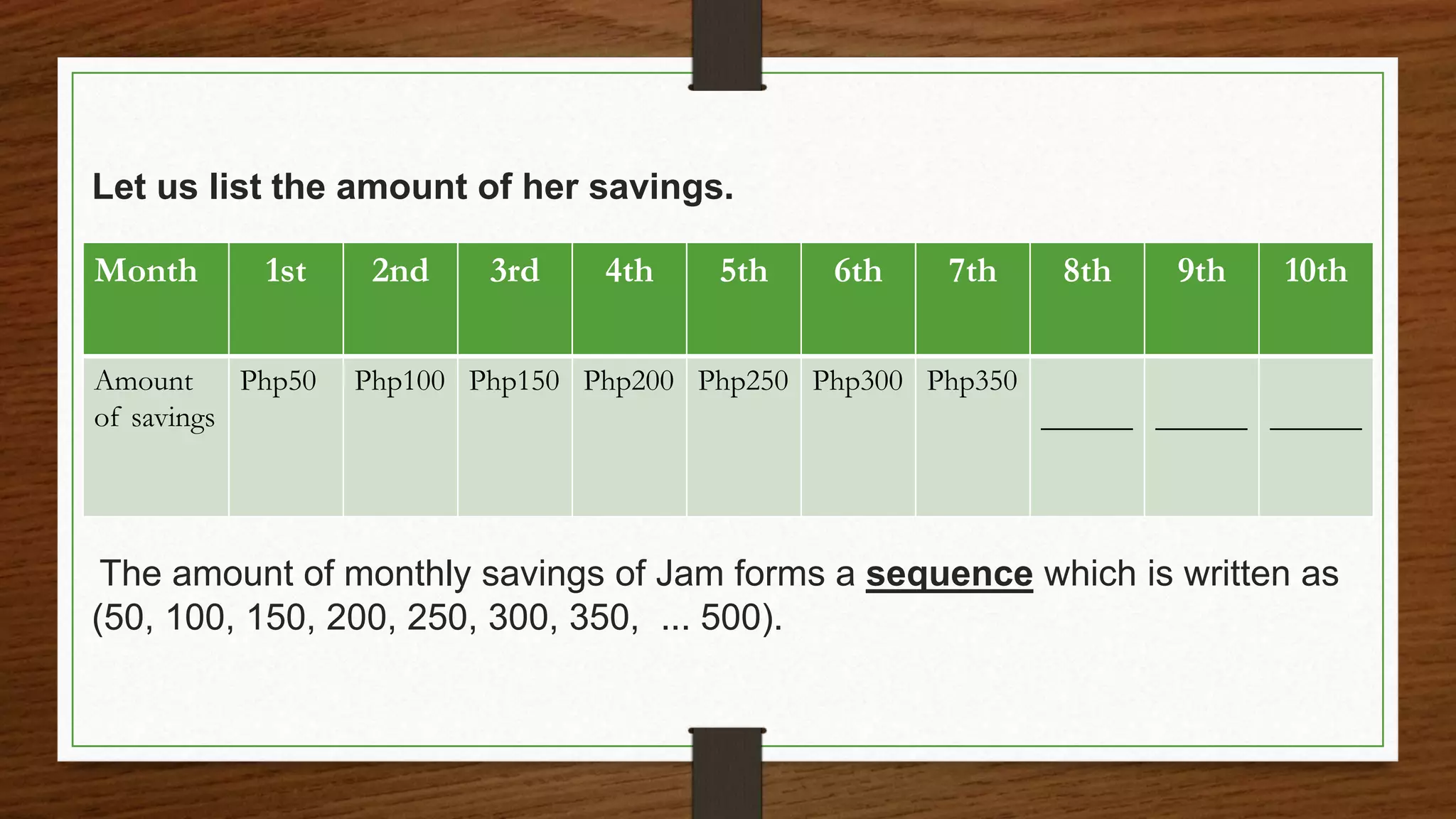
Let us list the amount of her savings.
The amount of monthly savings of Jam forms a sequence which is written as
(50, 100, 150, 200, 250, 300, 350, ... 500).
Month 1st 2nd 3rd 4th 5th 6th 7th 8th 9th 10th
Amount
of savings
Php50 Php100 Php150 Php200 Php250 Php300 Php350
______ ______ ______
Example 1. The following are examples
of sequences.
a. 1, 3, 5 7, 9, ...
b. 2, 4, 6, 8, 10, ...
c. 3, -2, -7, -12, -17
d. 5, 8, 11, 14, 17
Each member or element is called as term. So, 1, 3, 5, 7, 9 are
terms of a sequence and denoted as a symbol of A1, A2, A3, ...
and so on.
In example number 1,
A1= 1, A2= 3, A3= 5, A4= 7, A5= 9.
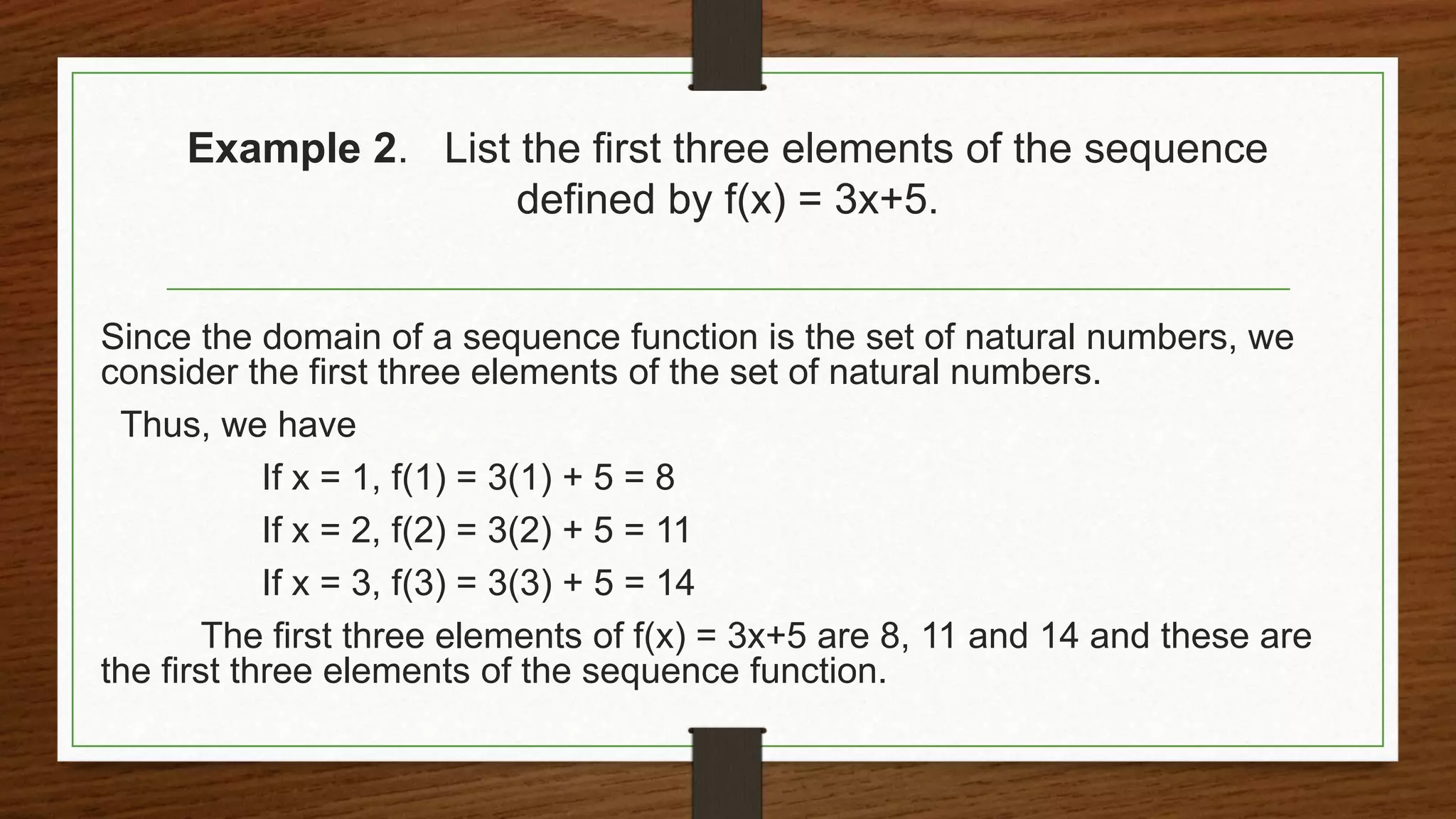
Example 2. List the first three elements of the sequence
defined by f(x) = 3x+5.
Since the domain of a sequence function is the set of natural numbers, we
consider the first three elements of the set of natural numbers.
Thus, we have
If x = 1, f(1) = 3(1) + 5 = 8
If x = 2, f(2) = 3(2) + 5 = 11
If x = 3, f(3) = 3(3) + 5 = 14
The first three elements of f(x) = 3x+5 are 8, 11 and 14 and these are
the first three elements of the sequence function.
Example 3. Give the first five elements of the sequence defined by
f(x) = 3x – 10.
f(x) = 3x – 10 f(x) = 3x – 10 f(x) = 3x - 10
f(1) = 3(1) – 10 f(2) = 3(2) – 10 f(3) = 3(3) - 10
= 3 – 10 = -7 = 6 – 10 = -4 = 9 – 10 = -1
f(x) = 3x - 10 f(x) = 3x - 10
f(4) = 3(4) - 10 f(5) = 3(5) - 10
= 12 – 10 = 2 = 15 – 10 = 5
Therefore the first five elements of f(x) = 3x – 10 are, -7, -4, -1, 2, 5.
Example 4. Give the first five elements of the sequence
defined by 3n2 - 1
f(n) = 3n2 – 1
f(1) = 3(1)2 – 1
= 3(1) – 1
= 3 – 1
= 2
f(n) = 3n2 - 1
f(2) = 3(2)2 – 1
= 3(4) – 1
= 12 – 1
= 11
f(n) = 3n2 – 1
f(3) = 3(3)2 – 1
= 3(9) – 1
= 27 – 1
= 26
f(n) = 3n2 – 1
f(4) = 3(4)2 – 1
= 3(16) – 1
= 48 – 1
= 47
f(n) = 3n2 – 1
f(5) = 3(5)2 – 1
= 3(25) – 1
= 75 – 1
= 74
A sequence can be finite or infinite.
• A finite sequence is a sequence whose number of terms is discrete and
has a last term. Thus, 3 -2, -7, -12 -17 and -2, -5, -8, -11, -13 are finite
sequence. Since it has a last term of 17 and -13.
• An infinite sequence is sequence whose terms are continuous and
does not have a last term. An ellipsis or three dots (...) at the end of any
sequence signifies the continuity of the terms. So 1, 3, 5, 7, 9, ... and 2, 4,
6, 8, 10, ... are infinite sequence.

Exploring sequences

  • 2.
    A sequence isa function whose domain is the set of natural numbers. It is a logical order or arrangement of values defined by a general term or nth term. Each element of a sequence is called a term of a sequence.
  • 3.
    Lets Learn! Jam savesPhp50 from her monthly allowance on the first month, Php100 on the second month, Php150 on the third month, Php200 on the fourth month. If she will save continuously in this manner, how much will she save on the tenth month?
  • 4.
    Let us listthe amount of her savings. The amount of monthly savings of Jam forms a sequence which is written as (50, 100, 150, 200, 250, 300, 350, ... 500). Month 1st 2nd 3rd 4th 5th 6th 7th 8th 9th 10th Amount of savings Php50 Php100 Php150 Php200 Php250 Php300 Php350 ______ ______ ______
  • 5.
    Example 1. Thefollowing are examples of sequences. a. 1, 3, 5 7, 9, ... b. 2, 4, 6, 8, 10, ... c. 3, -2, -7, -12, -17 d. 5, 8, 11, 14, 17
  • 6.
    Each member orelement is called as term. So, 1, 3, 5, 7, 9 are terms of a sequence and denoted as a symbol of A1, A2, A3, ... and so on. In example number 1, A1= 1, A2= 3, A3= 5, A4= 7, A5= 9.
  • 7.
    Example 2. Listthe first three elements of the sequence defined by f(x) = 3x+5. Since the domain of a sequence function is the set of natural numbers, we consider the first three elements of the set of natural numbers. Thus, we have If x = 1, f(1) = 3(1) + 5 = 8 If x = 2, f(2) = 3(2) + 5 = 11 If x = 3, f(3) = 3(3) + 5 = 14 The first three elements of f(x) = 3x+5 are 8, 11 and 14 and these are the first three elements of the sequence function.
  • 8.
    Example 3. Givethe first five elements of the sequence defined by f(x) = 3x – 10. f(x) = 3x – 10 f(x) = 3x – 10 f(x) = 3x - 10 f(1) = 3(1) – 10 f(2) = 3(2) – 10 f(3) = 3(3) - 10 = 3 – 10 = -7 = 6 – 10 = -4 = 9 – 10 = -1 f(x) = 3x - 10 f(x) = 3x - 10 f(4) = 3(4) - 10 f(5) = 3(5) - 10 = 12 – 10 = 2 = 15 – 10 = 5 Therefore the first five elements of f(x) = 3x – 10 are, -7, -4, -1, 2, 5.
  • 9.
    Example 4. Givethe first five elements of the sequence defined by 3n2 - 1 f(n) = 3n2 – 1 f(1) = 3(1)2 – 1 = 3(1) – 1 = 3 – 1 = 2 f(n) = 3n2 - 1 f(2) = 3(2)2 – 1 = 3(4) – 1 = 12 – 1 = 11 f(n) = 3n2 – 1 f(3) = 3(3)2 – 1 = 3(9) – 1 = 27 – 1 = 26 f(n) = 3n2 – 1 f(4) = 3(4)2 – 1 = 3(16) – 1 = 48 – 1 = 47 f(n) = 3n2 – 1 f(5) = 3(5)2 – 1 = 3(25) – 1 = 75 – 1 = 74
  • 10.
    A sequence canbe finite or infinite. • A finite sequence is a sequence whose number of terms is discrete and has a last term. Thus, 3 -2, -7, -12 -17 and -2, -5, -8, -11, -13 are finite sequence. Since it has a last term of 17 and -13. • An infinite sequence is sequence whose terms are continuous and does not have a last term. An ellipsis or three dots (...) at the end of any sequence signifies the continuity of the terms. So 1, 3, 5, 7, 9, ... and 2, 4, 6, 8, 10, ... are infinite sequence.