Download to read offline

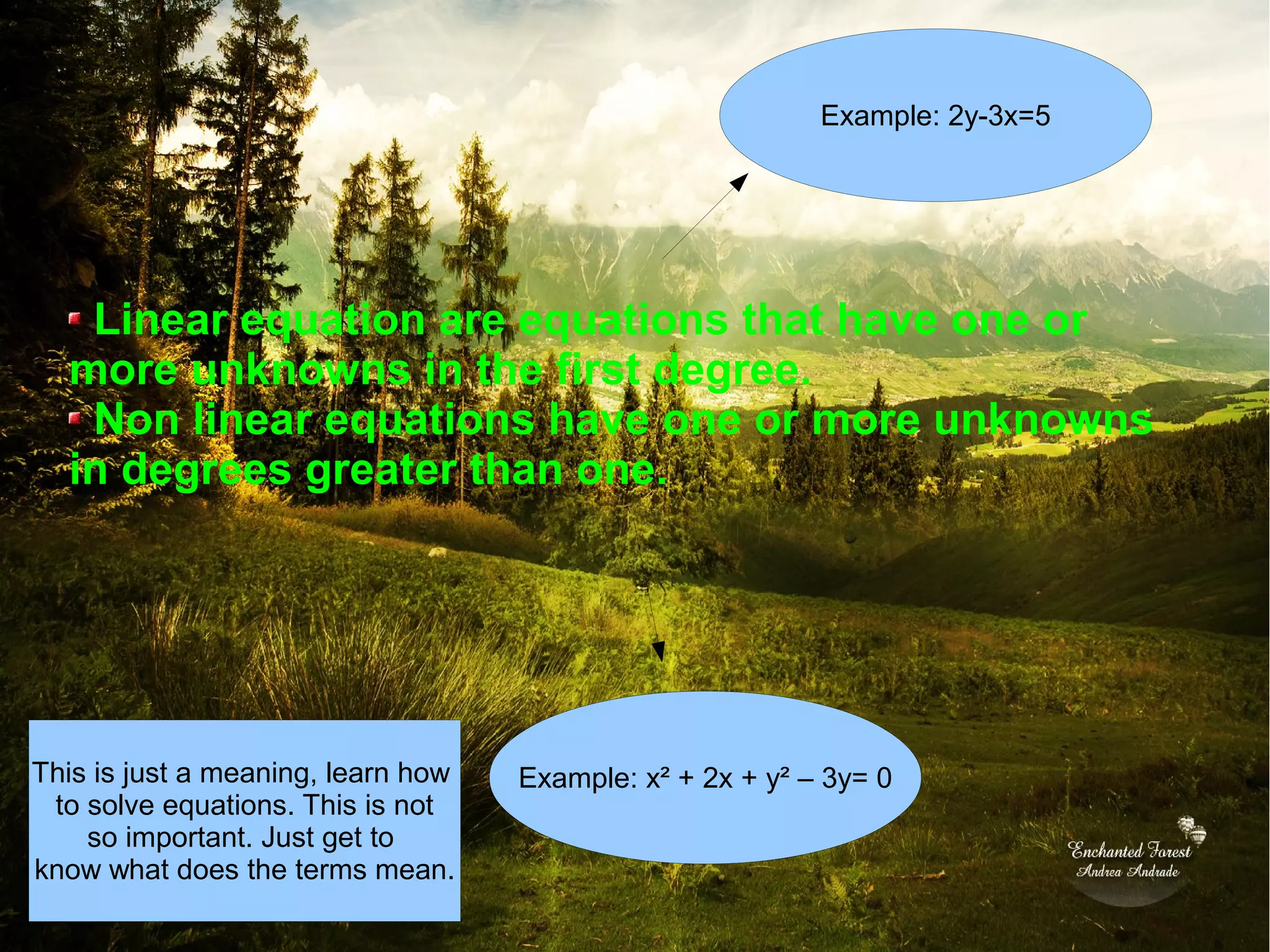


This document discusses solving simultaneous linear and quadratic equations. It explains that for a linear equation and a non-linear equation, an unknown can be expressed in terms of the other unknown from the linear equation. This forms a quadratic equation that can then be solved using factorisation or the quadratic formula to obtain the values for both unknowns. As an example, it shows choosing x as the easier unknown from the linear equation x+2y=4 to get x=4-2y, then substituting this into the quadratic equation x^2+xy+y^2=7. This results in a quadratic equation that can be factorised to solve for y and back substitute to find x.


