Solar PV Module Technologies
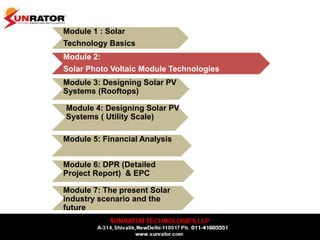
Module 1 : Solar
Technology Basics
Module 2:
Solar Photo Voltaic Module Technologies
Module 3: Designing Solar PV
Systems (Rooftops)
Module 4: Designing Solar PV
Systems ( Utility Scale)
Module 5: Financial Analysis
Module 6: DPR (Detailed
Project Report) & EPC
Module 7: The present Solar
industry scenario and the
future
Semiconductors used
for solar cells
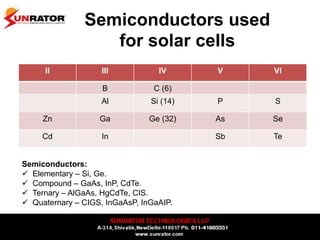
II III IV V VI
B C (6)
Al Si (14) P S
Zn Ga Ge (32) As Se
Cd In Sb Te
Semiconductors:
 Elementary – Si, Ge.
 Compound – GaAs, InP, CdTe.
 Ternary – AlGaAs, HgCdTe, CIS.
 Quaternary – CIGS, InGaAsP, InGaAIP.
Cell Technologies
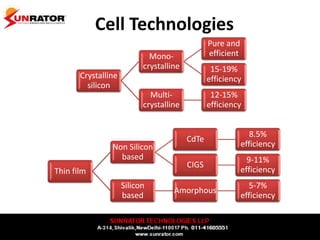
Crystalline
silicon
Mono-
crystalline
Pure and
efficient
15-19%
efficiency
Multi-
crystalline
12-15%
efficiency
Thin film
Non Silicon
based
CdTe
8.5%
efficiency
CIGS
9-11%
efficiency
Silicon
based
Amorphous
5-7%
efficiency
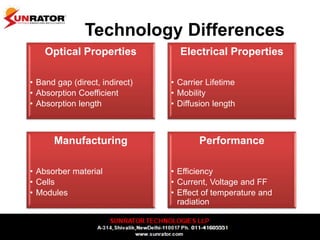
Technology Differences
Optical Properties
• Band gap (direct, indirect)
• Absorption Coefficient
• Absorption length
Electrical Properties
• Carrier Lifetime
• Mobility
• Diffusion length
Manufacturing
• Absorber material
• Cells
• Modules
Performance
• Efficiency
• Current, Voltage and FF
• Effect of temperature and
radiation
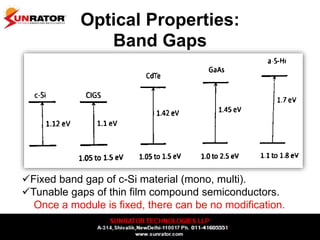
Optical Properties:
Band Gaps
Fixed band gap of c-Si material (mono, multi).
Tunable gaps of thin film compound semiconductors.
Once a module is fixed, there can be no modification.
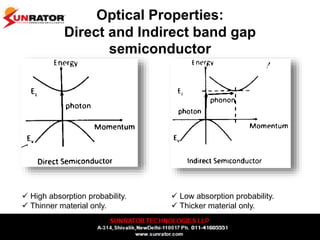
Optical Properties:
Direct and Indirect band gap
semiconductor
 High absorption probability.
 Thinner material only.
 Low absorption probability.
 Thicker material only.
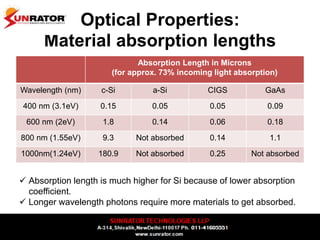
Optical Properties:
Material absorption lengths
Absorption Length in Microns
(for approx. 73% incoming light absorption)
Wavelength (nm) c-Si a-Si CIGS GaAs
400 nm (3.1eV) 0.15 0.05 0.05 0.09
600 nm (2eV) 1.8 0.14 0.06 0.18
800 nm (1.55eV) 9.3 Not absorbed 0.14 1.1
1000nm(1.24eV) 180.9 Not absorbed 0.25 Not absorbed
 Absorption length is much higher for Si because of lower absorption
coefficient.
 Longer wavelength photons require more materials to get absorbed.
Electrical Properties:
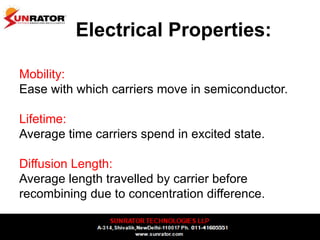
Mobility:
Ease with which carriers move in semiconductor.
Lifetime:
Average time carriers spend in excited state.
Diffusion Length:
Average length travelled by carrier before
recombining due to concentration difference.
Electrical Properties:
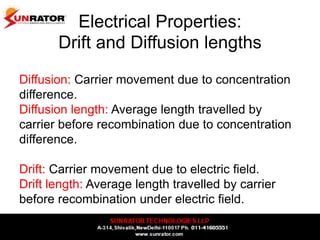
Drift and Diffusion lengths
Diffusion: Carrier movement due to concentration
difference.
Diffusion length: Average length travelled by
carrier before recombination due to concentration
difference.
Drift: Carrier movement due to electric field.
Drift length: Average length travelled by carrier
before recombination under electric field.
Electrical Properties:
Drift and Diffusion lengths
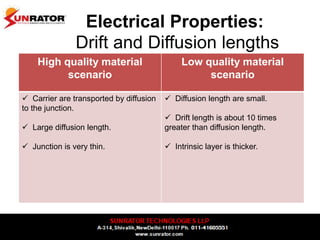
High quality material
scenario
Low quality material
scenario
 Carrier are transported by diffusion
to the junction.
 Large diffusion length.
 Junction is very thin.
 Diffusion length are small.
 Drift length is about 10 times
greater than diffusion length.
 Intrinsic layer is thicker.
Manufacturing:
The difference
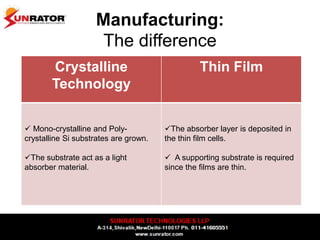
Crystalline
Technology
Thin Film
 Mono-crystalline and Poly-
crystalline Si substrates are grown.
The substrate act as a light
absorber material.
The absorber layer is deposited in
the thin film cells.
 A supporting substrate is required
since the films are thin.
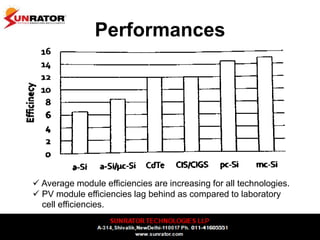
Performances
 Average module efficiencies are increasing for all technologies.
 PV module efficiencies lag behind as compared to laboratory
cell efficiencies.
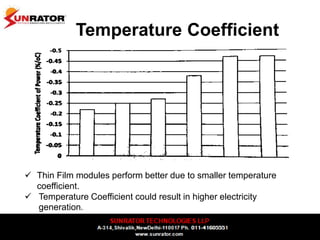
Temperature Coefficient
 Thin Film modules perform better due to smaller temperature
coefficient.
 Temperature Coefficient could result in higher electricity
generation.
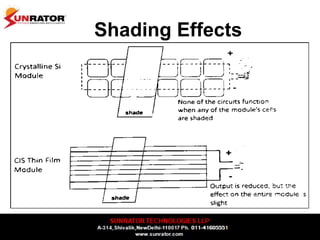
Shading Effects
Thank You!!
Need Help?
Feel Free To Get In Touch
contact@sunrator.com
011-41605551

Solar PV Module Technologies

  • 1.
    Solar PV ModuleTechnologies
  • 2.
    Module 1 :Solar Technology Basics Module 2: Solar Photo Voltaic Module Technologies Module 3: Designing Solar PV Systems (Rooftops) Module 4: Designing Solar PV Systems ( Utility Scale) Module 5: Financial Analysis Module 6: DPR (Detailed Project Report) & EPC Module 7: The present Solar industry scenario and the future
  • 3.
    Semiconductors used for solarcells II III IV V VI B C (6) Al Si (14) P S Zn Ga Ge (32) As Se Cd In Sb Te Semiconductors:  Elementary – Si, Ge.  Compound – GaAs, InP, CdTe.  Ternary – AlGaAs, HgCdTe, CIS.  Quaternary – CIGS, InGaAsP, InGaAIP.
  • 4.
    Cell Technologies Crystalline silicon Mono- crystalline Pure and efficient 15-19% efficiency Multi- crystalline 12-15% efficiency Thinfilm Non Silicon based CdTe 8.5% efficiency CIGS 9-11% efficiency Silicon based Amorphous 5-7% efficiency
  • 5.
    Technology Differences Optical Properties •Band gap (direct, indirect) • Absorption Coefficient • Absorption length Electrical Properties • Carrier Lifetime • Mobility • Diffusion length Manufacturing • Absorber material • Cells • Modules Performance • Efficiency • Current, Voltage and FF • Effect of temperature and radiation
  • 6.
    Optical Properties: Band Gaps Fixedband gap of c-Si material (mono, multi). Tunable gaps of thin film compound semiconductors. Once a module is fixed, there can be no modification.
  • 7.
    Optical Properties: Direct andIndirect band gap semiconductor  High absorption probability.  Thinner material only.  Low absorption probability.  Thicker material only.
  • 8.
    Optical Properties: Material absorptionlengths Absorption Length in Microns (for approx. 73% incoming light absorption) Wavelength (nm) c-Si a-Si CIGS GaAs 400 nm (3.1eV) 0.15 0.05 0.05 0.09 600 nm (2eV) 1.8 0.14 0.06 0.18 800 nm (1.55eV) 9.3 Not absorbed 0.14 1.1 1000nm(1.24eV) 180.9 Not absorbed 0.25 Not absorbed  Absorption length is much higher for Si because of lower absorption coefficient.  Longer wavelength photons require more materials to get absorbed.
  • 9.
    Electrical Properties: Mobility: Ease withwhich carriers move in semiconductor. Lifetime: Average time carriers spend in excited state. Diffusion Length: Average length travelled by carrier before recombining due to concentration difference.
  • 10.
    Electrical Properties: Drift andDiffusion lengths Diffusion: Carrier movement due to concentration difference. Diffusion length: Average length travelled by carrier before recombination due to concentration difference. Drift: Carrier movement due to electric field. Drift length: Average length travelled by carrier before recombination under electric field.
  • 11.
    Electrical Properties: Drift andDiffusion lengths High quality material scenario Low quality material scenario  Carrier are transported by diffusion to the junction.  Large diffusion length.  Junction is very thin.  Diffusion length are small.  Drift length is about 10 times greater than diffusion length.  Intrinsic layer is thicker.
  • 12.
    Manufacturing: The difference Crystalline Technology Thin Film Mono-crystalline and Poly- crystalline Si substrates are grown. The substrate act as a light absorber material. The absorber layer is deposited in the thin film cells.  A supporting substrate is required since the films are thin.
  • 13.
    Performances  Average moduleefficiencies are increasing for all technologies.  PV module efficiencies lag behind as compared to laboratory cell efficiencies.
  • 14.
    Temperature Coefficient  ThinFilm modules perform better due to smaller temperature coefficient.  Temperature Coefficient could result in higher electricity generation.
  • 15.
  • 16.
    Thank You!! Need Help? FeelFree To Get In Touch contact@sunrator.com 011-41605551