Financial Analysis
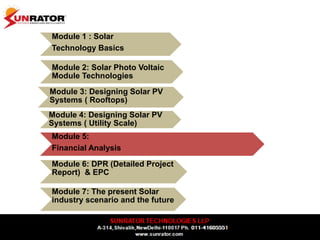
Module 1 : Solar
Technology Basics
Module 2: Solar Photo Voltaic
Module Technologies
Module 3: Designing Solar PV
Systems ( Rooftops)
Module 4: Designing Solar PV
Systems ( Utility Scale)
Module 5:
Financial Analysis
Module 6: DPR (Detailed Project
Report) & EPC
Module 7: The present Solar
industry scenario and the future
Project Financing and Loans
 Project Finance is long term financing of infrastructure and industrial
projects based on projected cash flows of the project rather than
balance sheet of the project sponsor.
 The loans are most commonly non-recourse loans, which are
secured by the project assets and paid entirely from project cash
flow, rather than from the general assets or creditworthiness of the
project sponsors, a decision in part supported by financial modeling,
the process by which a firm constructs a financial representation of
some, or all, aspects of the firm or given security.
 The model is usually characterized by performing calculations, and
makes recommendations based on that information. The model may
also summarize particular events for the end user and provide
direction regarding possible actions or alternatives.
Financial Indicators Used
in a Model
1. Debt Service Coverage ratio
2. Internal Rate of Return
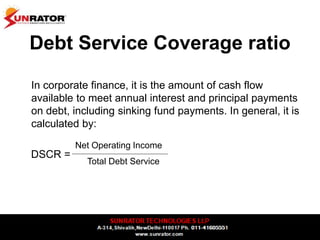
Debt Service Coverage ratio
In corporate finance, it is the amount of cash flow
available to meet annual interest and principal payments
on debt, including sinking fund payments. In general, it is
calculated by:
DSCR =
Net Operating Income
Total Debt Service
Internal Rate of Return (IRR)
The discount rate often used in capital budgeting that
makes the net present value of all cash flows from a
particular project equal to zero. Generally speaking, the
higher a project's internal rate of return, the more
desirable it is to undertake the project.
Financial Model
Financial models essentially serve five purposes:
– to demonstrate the size of the market opportunity
– to explain the business model
– to show the path to profitability
– to quantify the investment requirement
– to facilitate valuation of the business
Financial Analysis Outcome
 Project investment is believed to be acceptable only if the
internal rate of return (IRR) is more than the established
minimum rate of return on capital cost.
 This is normally in contrast with the net present value (NPV) of the
project, which is a value indicator for the investment.
 Average Debt Service Coverage Ratio (Average DSCR) represents
the debt serviceability of the project over the life of debt period.
 Higher values of this represent higher capacity to repay service
debt; whereas Minimum DSCR represents the minimum debt
serviceability of the project over the life of debt period.
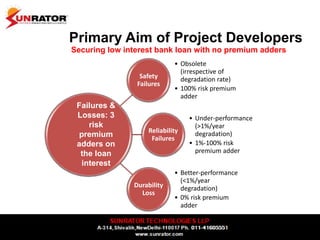
Primary Aim of Project Developers
Securing low interest bank loan with no premium adders
Safety
Failures
• Obsolete
(irrespective of
degradation rate)
• 100% risk premium
adder
Reliability
Failures
• Under-performance
(>1%/year
degradation)
• 1%-100% risk
premium adder
Durability
Loss
• Better-performance
(<1%/year
degradation)
• 0% risk premium
adder
Failures &
Losses: 3
risk
premium
adders on
the loan
interest
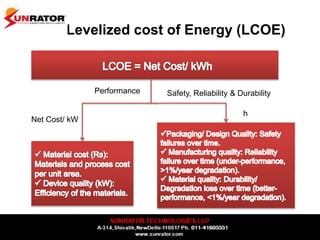
Levelized cost of Energy (LCOE)
Safety, Reliability & DurabilityPerformance
Net Cost/ kW
h
Passionate About Solar ?
Feel Free To Get In Touch
contact@sunrator.com
011-41605551
Thank You!!

Financial Analysis

  • 1.
  • 2.
    Module 1 :Solar Technology Basics Module 2: Solar Photo Voltaic Module Technologies Module 3: Designing Solar PV Systems ( Rooftops) Module 4: Designing Solar PV Systems ( Utility Scale) Module 5: Financial Analysis Module 6: DPR (Detailed Project Report) & EPC Module 7: The present Solar industry scenario and the future
  • 3.
    Project Financing andLoans  Project Finance is long term financing of infrastructure and industrial projects based on projected cash flows of the project rather than balance sheet of the project sponsor.  The loans are most commonly non-recourse loans, which are secured by the project assets and paid entirely from project cash flow, rather than from the general assets or creditworthiness of the project sponsors, a decision in part supported by financial modeling, the process by which a firm constructs a financial representation of some, or all, aspects of the firm or given security.  The model is usually characterized by performing calculations, and makes recommendations based on that information. The model may also summarize particular events for the end user and provide direction regarding possible actions or alternatives.
  • 4.
    Financial Indicators Used ina Model 1. Debt Service Coverage ratio 2. Internal Rate of Return
  • 5.
    Debt Service Coverageratio In corporate finance, it is the amount of cash flow available to meet annual interest and principal payments on debt, including sinking fund payments. In general, it is calculated by: DSCR = Net Operating Income Total Debt Service
  • 6.
    Internal Rate ofReturn (IRR) The discount rate often used in capital budgeting that makes the net present value of all cash flows from a particular project equal to zero. Generally speaking, the higher a project's internal rate of return, the more desirable it is to undertake the project.
  • 7.
    Financial Model Financial modelsessentially serve five purposes: – to demonstrate the size of the market opportunity – to explain the business model – to show the path to profitability – to quantify the investment requirement – to facilitate valuation of the business
  • 8.
    Financial Analysis Outcome Project investment is believed to be acceptable only if the internal rate of return (IRR) is more than the established minimum rate of return on capital cost.  This is normally in contrast with the net present value (NPV) of the project, which is a value indicator for the investment.  Average Debt Service Coverage Ratio (Average DSCR) represents the debt serviceability of the project over the life of debt period.  Higher values of this represent higher capacity to repay service debt; whereas Minimum DSCR represents the minimum debt serviceability of the project over the life of debt period.
  • 9.
    Primary Aim ofProject Developers Securing low interest bank loan with no premium adders Safety Failures • Obsolete (irrespective of degradation rate) • 100% risk premium adder Reliability Failures • Under-performance (>1%/year degradation) • 1%-100% risk premium adder Durability Loss • Better-performance (<1%/year degradation) • 0% risk premium adder Failures & Losses: 3 risk premium adders on the loan interest
  • 10.
    Levelized cost ofEnergy (LCOE) Safety, Reliability & DurabilityPerformance Net Cost/ kW h
  • 11.
    Passionate About Solar? Feel Free To Get In Touch contact@sunrator.com 011-41605551 Thank You!!