Module 10 
Section 7,8 & 9 
Section 7: ICTs for mitigating climate 
change 
Section 8: Dematerialization 
Section 9: Efficiency in electricity 
generation and management, and the 
use of Smart grids 
Richard Labelle 
rlab@sympatico.ca
2 
Objectives of Module 10 
To show that ICTs can be used to 
address climate change 
To demonstrate why ICTs are a 
crucial part of the solution – i.e. in 
promoting efficiency, Green Growth 
& sustainable development
Section 7 - ICTs for mitigating climate 
3 
change 
Provide an overview of the ways 
in which ICTs are used to 
mitigate climate change, 
particularly by enabling energy 
efficiencies in other sectors (also 
known as second order effects).
4 
Objectives of Session 5 
To introduce the idea that ICTs can 
enable positive environmental 
change and abate GHG emissions 
with a focus on two application 
areas: 
Dematerialization 
Smart energy (smart grid) solutions 
To discuss implications for Asia 
Pacific
Enabling effects of ICTs in reducing 
5 
environmental impacts (1) 
What are enabling effects? These are 
positive steps we take to: 
Reduce: 
GHG emissions 
Energy consumption and 
Material use … 
Preserve and enhance ecosystem 
function 
Make human environments 
environmentally secure and 
sustainable…
Enabling effects of ICTs in reducing 
6 
environmental impacts (2) 
… as a result of enhanced 
efficiencies and more sustainable 
human behaviour facilitated 
through the use of ICTs.
Discuss enabling effects of ICTs (1) 
7 
Compare impact of using ICTs – 
before and after using computers? 
Consider e-government & e-commerce
Discuss enabling effects of ICTs (2) 
8 
What are the enabling effects of e-government 
or e-commerce on energy 
consumption or of other ICT uses / 
applications? 
Do they help reduce energy consumption and 
GHG emissions? 
If so, list how 
Use examples from your daily lives, where you 
live, work, etc. 
Just consider the impacts in energy terms 
if we did not have PCs and networks, etc.
What are some of the usual enabling 
9 
effects of ICTs? (1) 
Increased process efficiency: doings 
things faster and more easily 
Easier & more communication 
Faster & easier computation 
Access to knowledge that is fast and 
complete 
I can tell what info I have and have an 
idea of what I do not have and whether 
the info exists at all!
What are some of the usual enabling 
10 
effects? (2) 
I can see the info, I can even map it 
much more easily! 
I can build, test and model things 
faster 
I can see things that are invisible to 
the naked eye 
Result:  Better decision making !
11 
Group exercise 
Come up with other examples similar 
to the “elevator example”. 
Discuss
Enabling effects of ICTs: reducing GHG 
12 
emissions (1) 
No direct effect on land use 
emissions: agriculture & forestry 
But help understand dynamics 
(ecosystem function & steady state 
dynamics – resilience, etc.) 
Energy transmission& distribution: 
Smart grids 
Industrial processes: 
Smart motor systems
Enabling effects of ICTs: reducing GHG 
13 
emissions (2) 
Smart buildings 
Smart logistics and transportation 
systems 
Virtual meetings and other forms of 
dematerialization: 
Travel replacement, server 
virtualization, etc.
14 
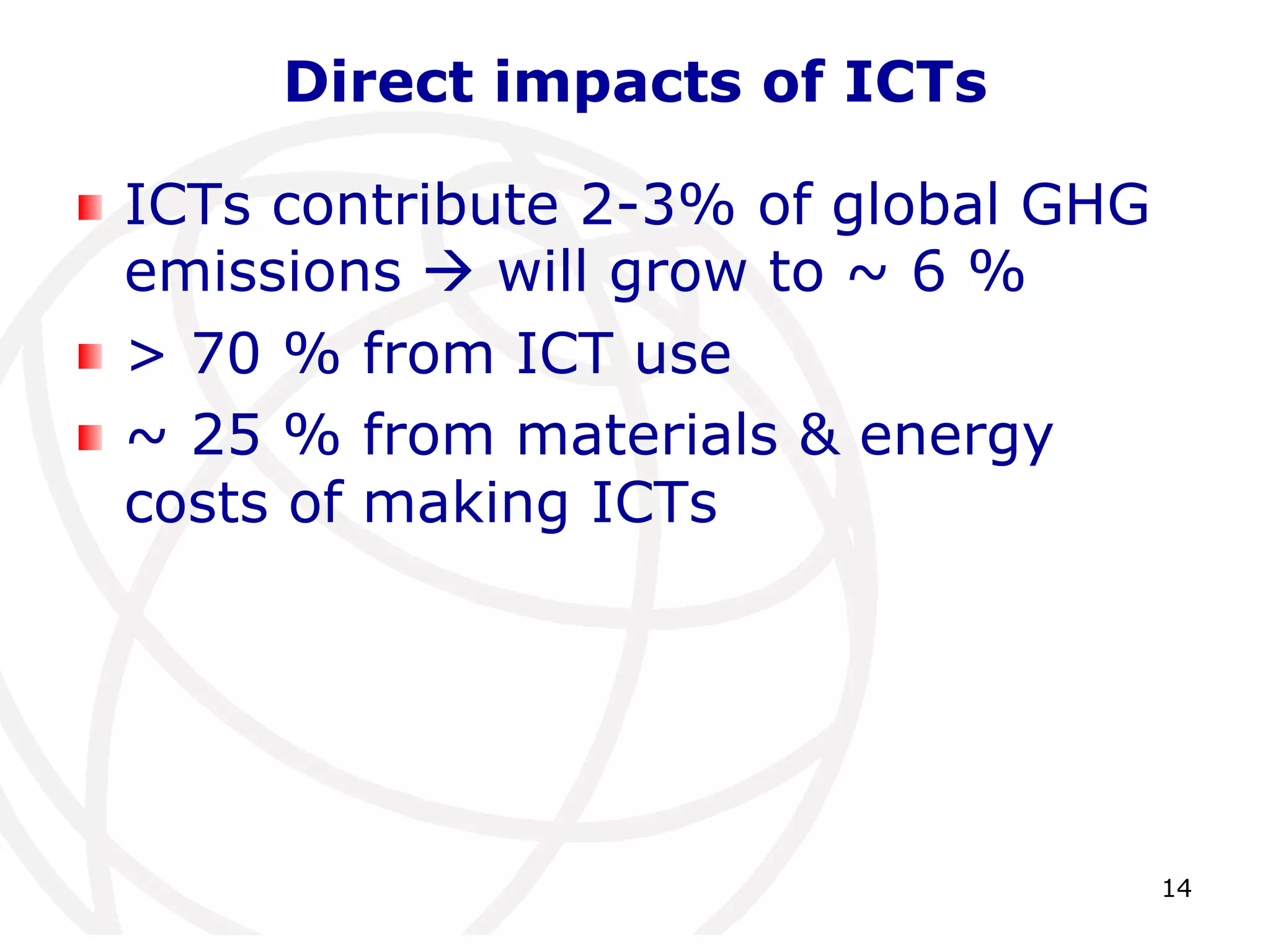
Direct impacts of ICTs 
ICTs contribute 2-3% of global GHG 
emissions  will grow to ~ 6 % 
> 70 % from ICT use 
~ 25 % from materials & energy 
costs of making ICTs
15 
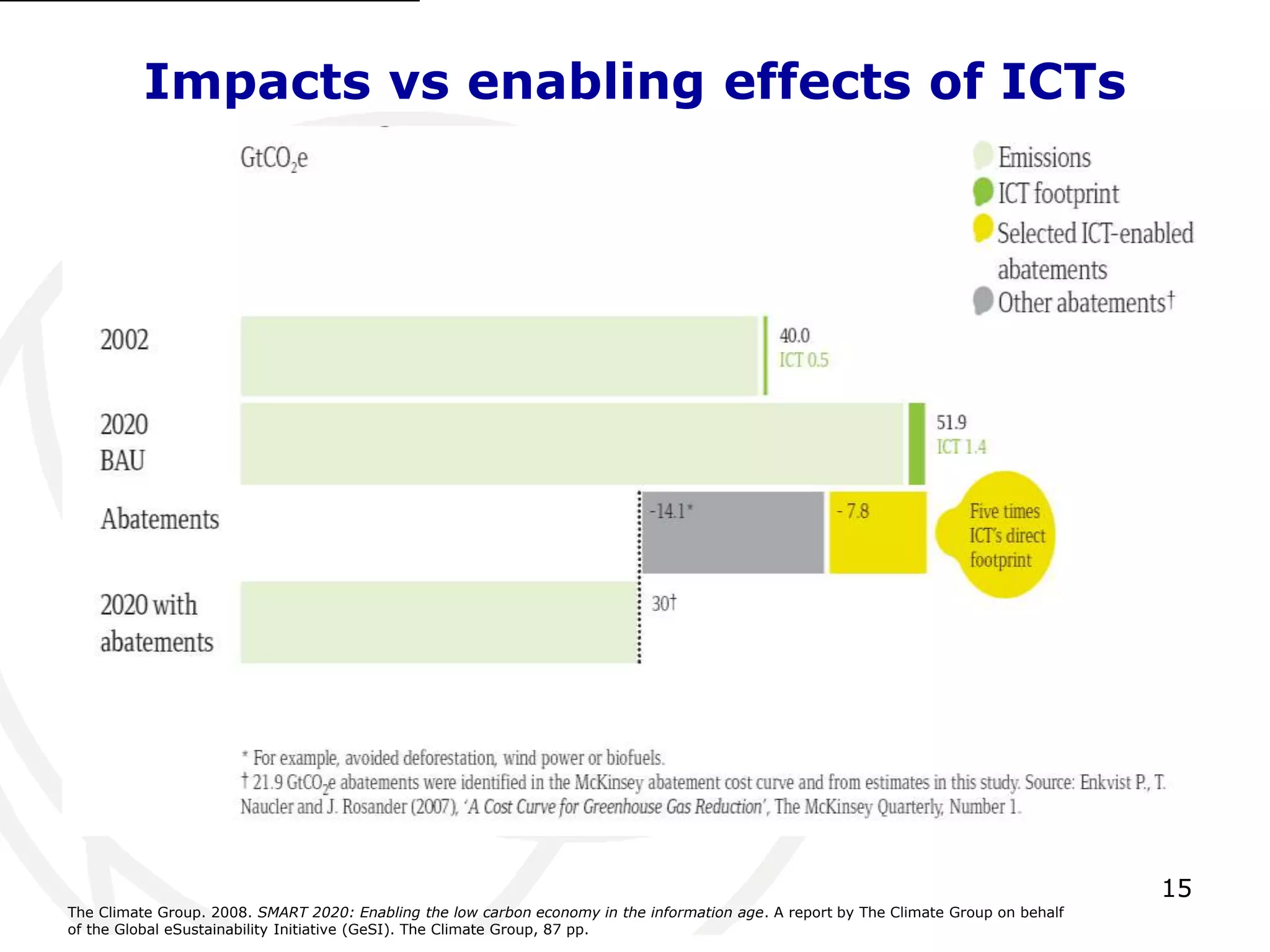
Impacts vs enabling effects of ICTs 
The Climate Group. 2008. SMART 2020: Enabling the low carbon economy in the information age. A report by The Climate Group on behalf 
of the Global eSustainability Initiative (GeSI). The Climate Group, 87 pp.
16 
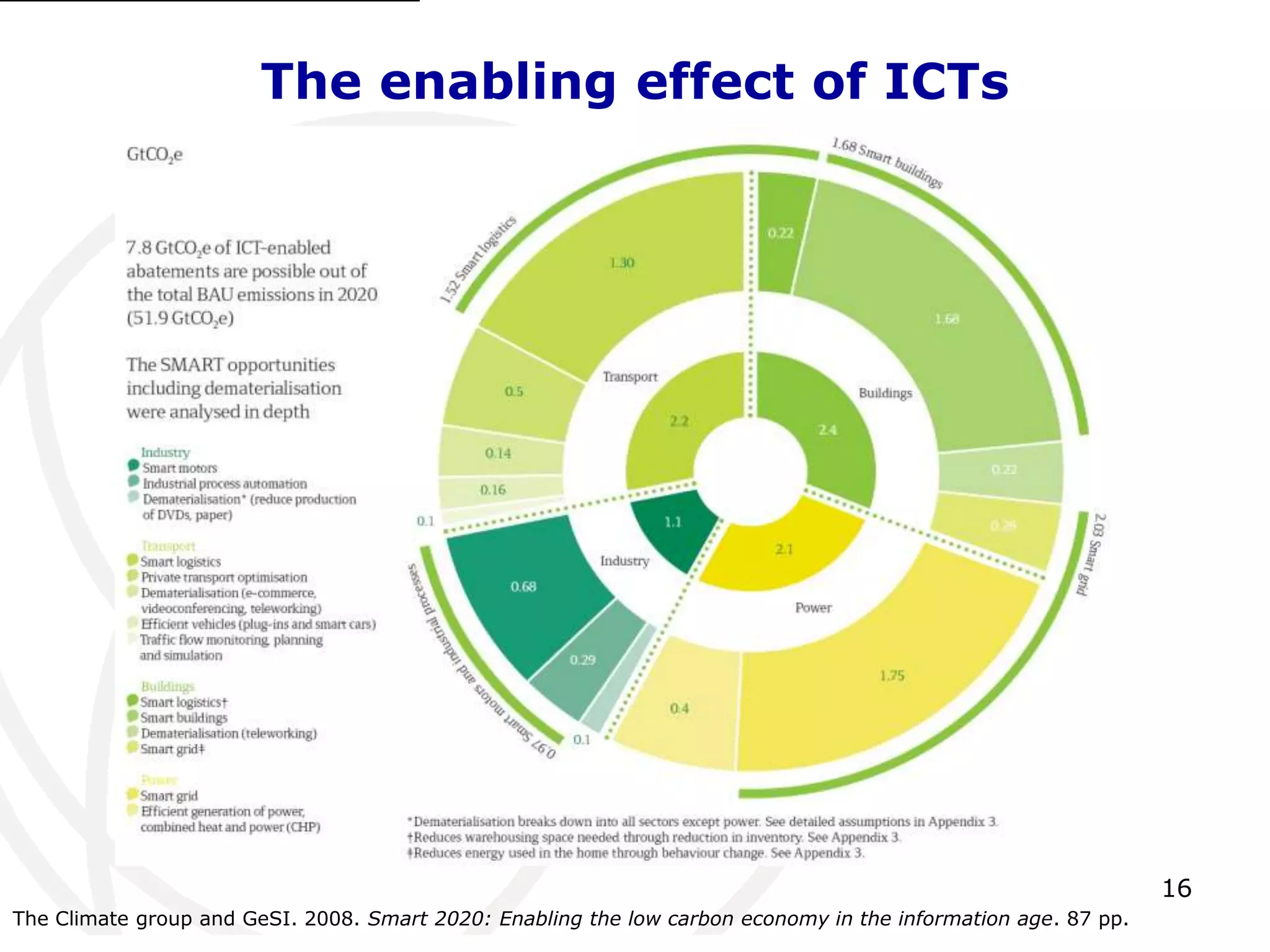
The enabling effect of ICTs 
The Climate group and GeSI. 2008. Smart 2020: Enabling the low carbon economy in the information age. 87 pp.
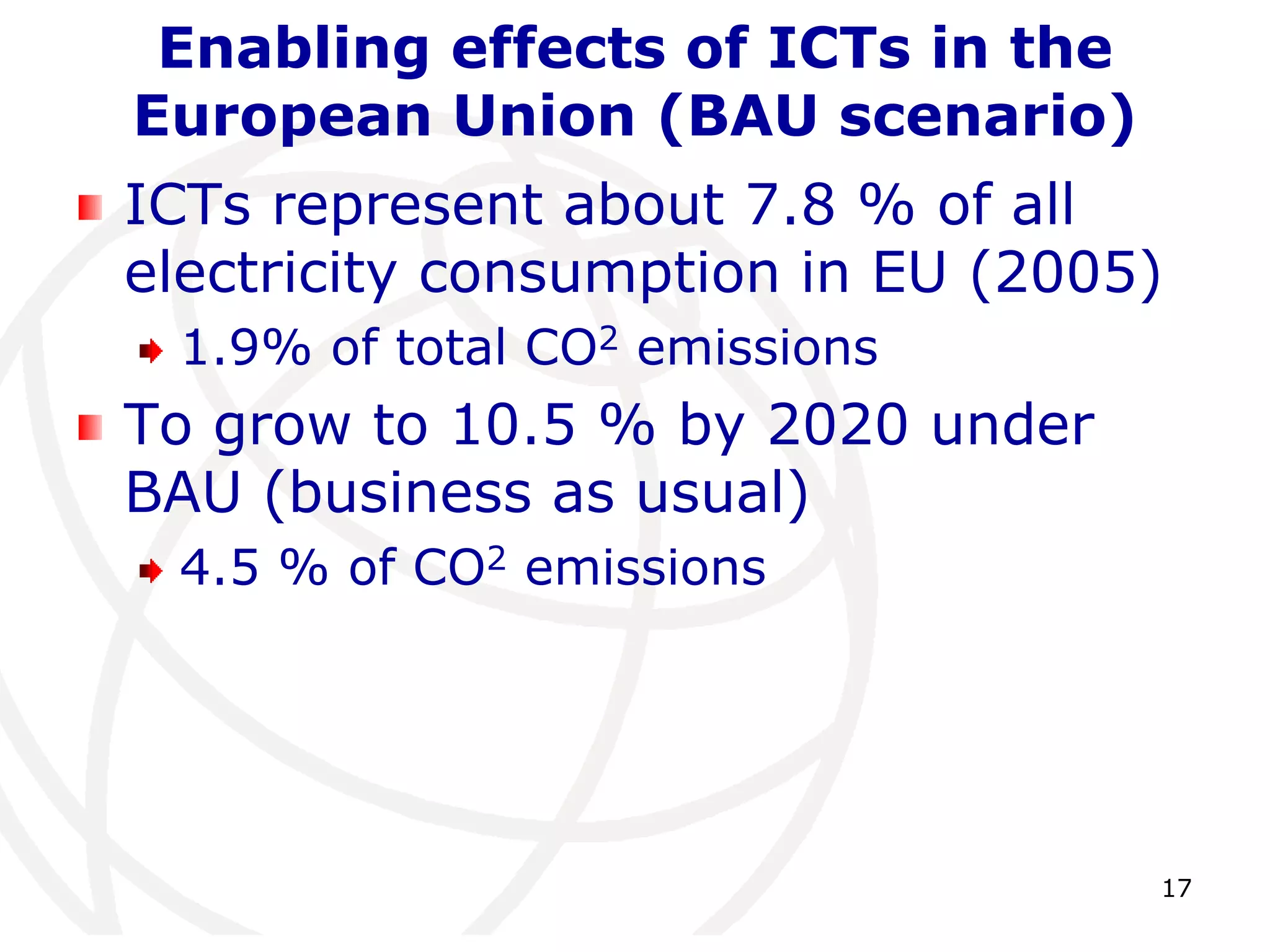
Enabling effects of ICTs in the 
European Union (BAU scenario) 
ICTs represent about 7.8 % of all 
electricity consumption in EU (2005) 
17 
1.9% of total CO2 emissions 
To grow to 10.5 % by 2020 under 
BAU (business as usual) 
4.5 % of CO2 emissions
18 
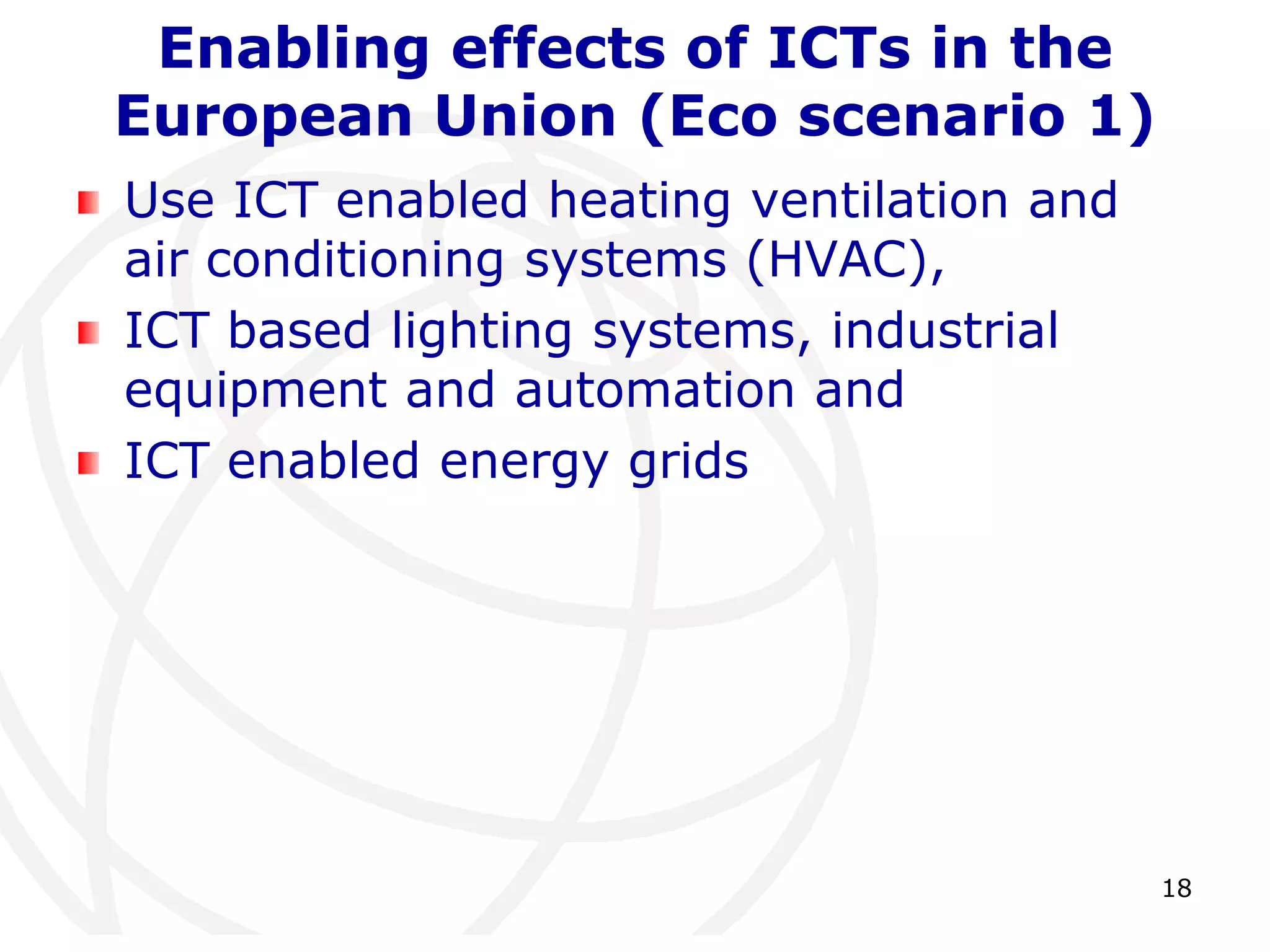
Enabling effects of ICTs in the 
European Union (Eco scenario 1) 
Use ICT enabled heating ventilation and 
air conditioning systems (HVAC), 
ICT based lighting systems, industrial 
equipment and automation and 
ICT enabled energy grids
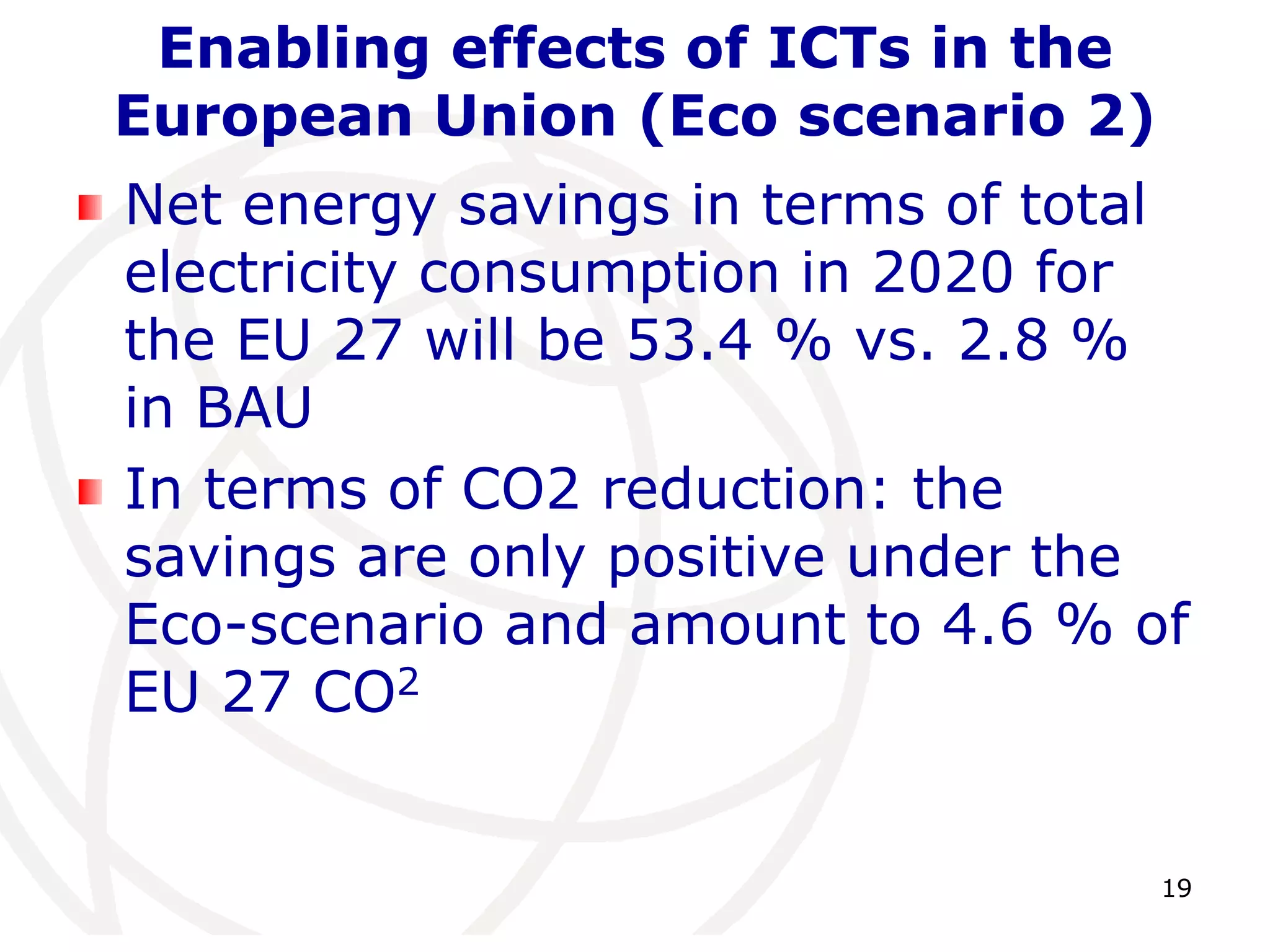
Enabling effects of ICTs in the 
European Union (Eco scenario 2) 
Net energy savings in terms of total 
electricity consumption in 2020 for 
the EU 27 will be 53.4 % vs. 2.8 % 
in BAU 
In terms of CO2 reduction: the 
savings are only positive under the 
Eco-scenario and amount to 4.6 % of 
EU 27 CO2 
19
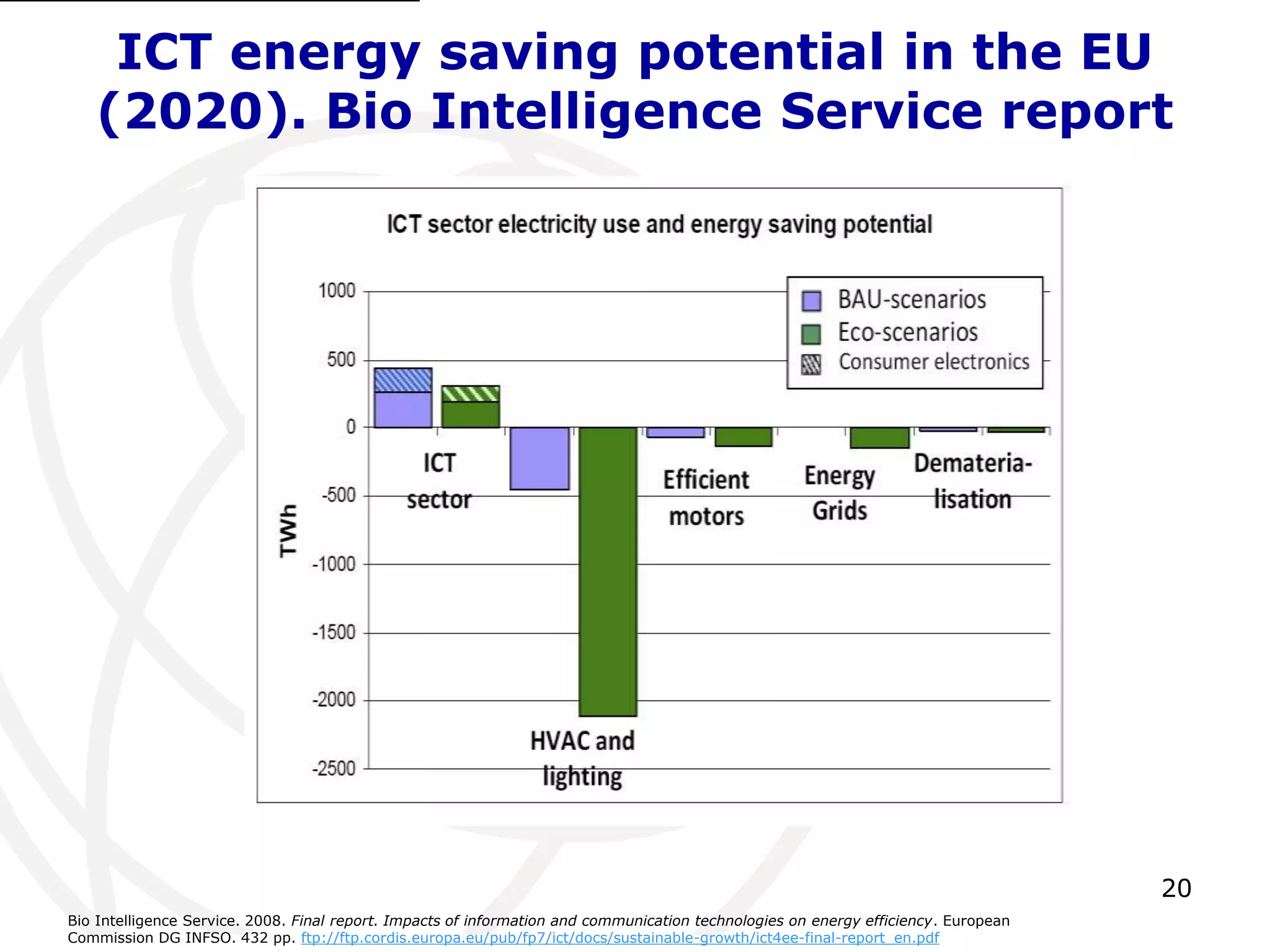
ICT energy saving potential in the EU 
(2020). Bio Intelligence Service report 
20 
Bio Intelligence Service. 2008. Final report. Impacts of information and communication technologies on energy efficiency. European 
Commission DG INFSO. 432 pp. ftp://ftp.cordis.europa.eu/pub/fp7/ict/docs/sustainable-growth/ict4ee-final-report_en.pdf
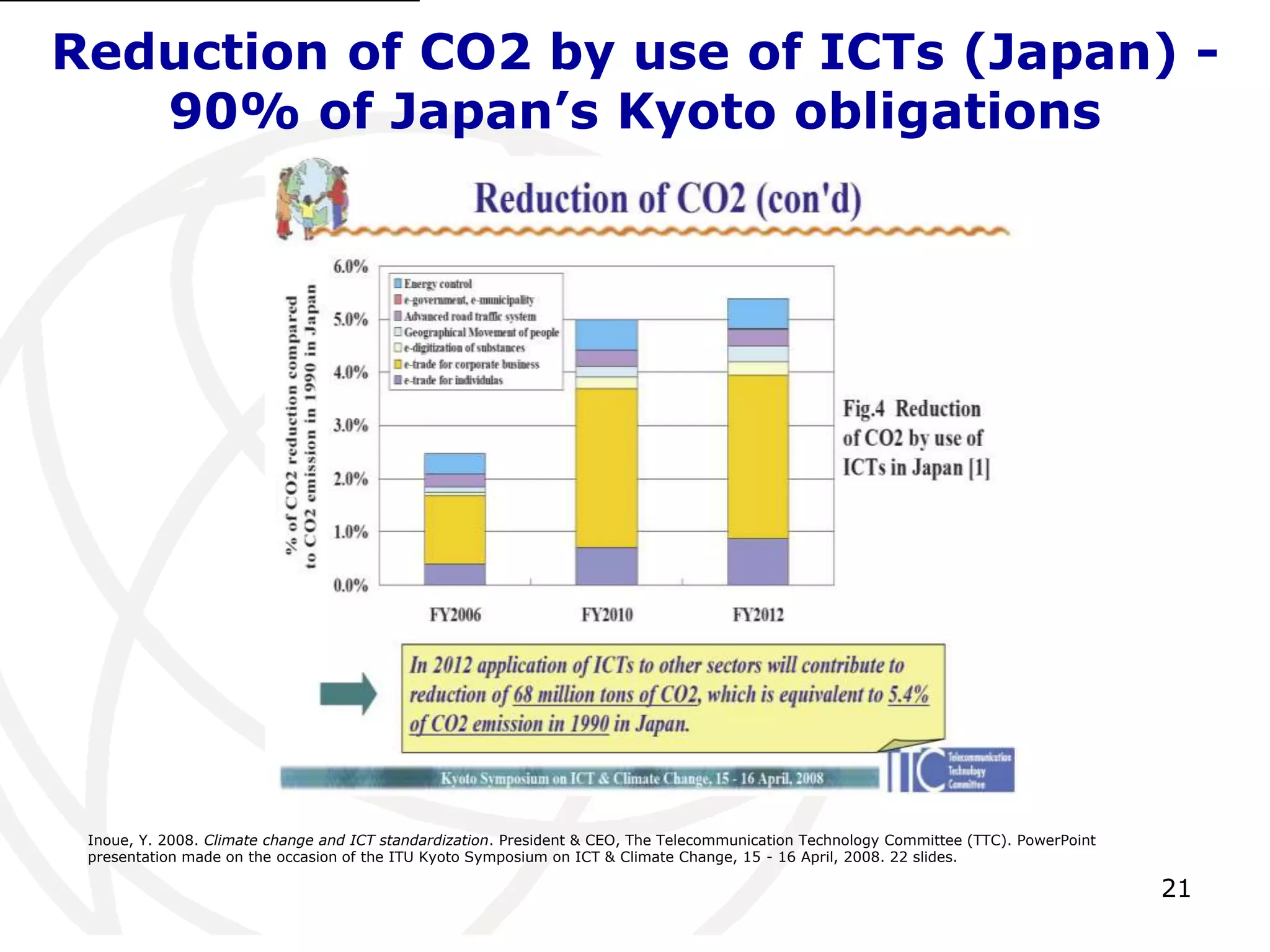
Reduction of CO2 by use of ICTs (Japan) - 
21 
90% of Japan’s Kyoto obligations 
Inoue, Y. 2008. Climate change and ICT standardization. President & CEO, The Telecommunication Technology Committee (TTC). PowerPoint 
presentation made on the occasion of the ITU Kyoto Symposium on ICT & Climate Change, 15 - 16 April, 2008. 22 slides.
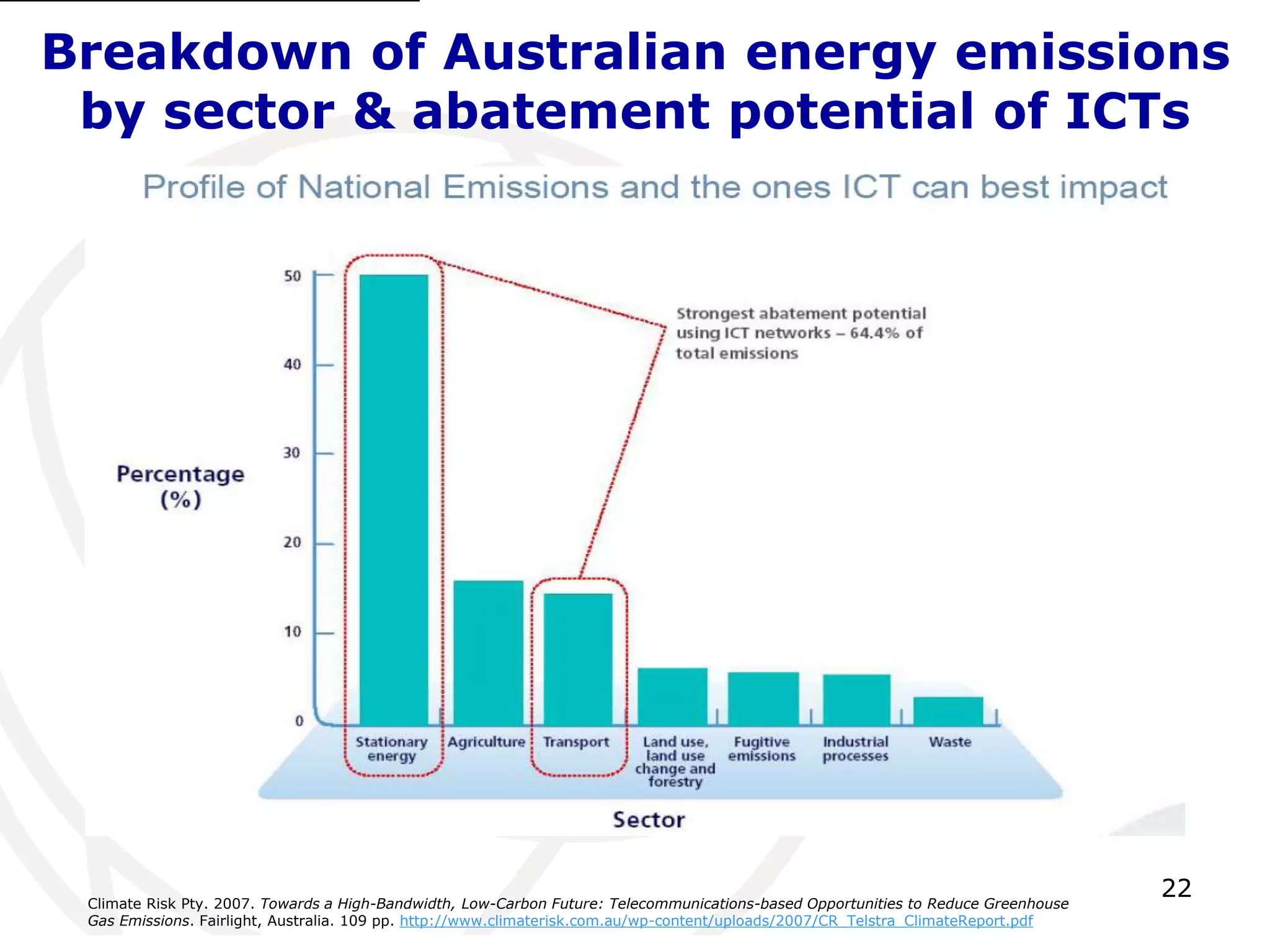
Breakdown of Australian energy emissions 
by sector & abatement potential of ICTs 
22 
Climate Risk Pty. 2007. Towards a High-Bandwidth, Low-Carbon Future: Telecommunications-based Opportunities to Reduce Greenhouse 
Gas Emissions. Fairlight, Australia. 109 pp. http://www.climaterisk.com.au/wp-content/uploads/2007/CR_Telstra_ClimateReport.pdf
23 
Group discussion 
Could ICT use have a similar impact 
in your countries? 
Why or why not?
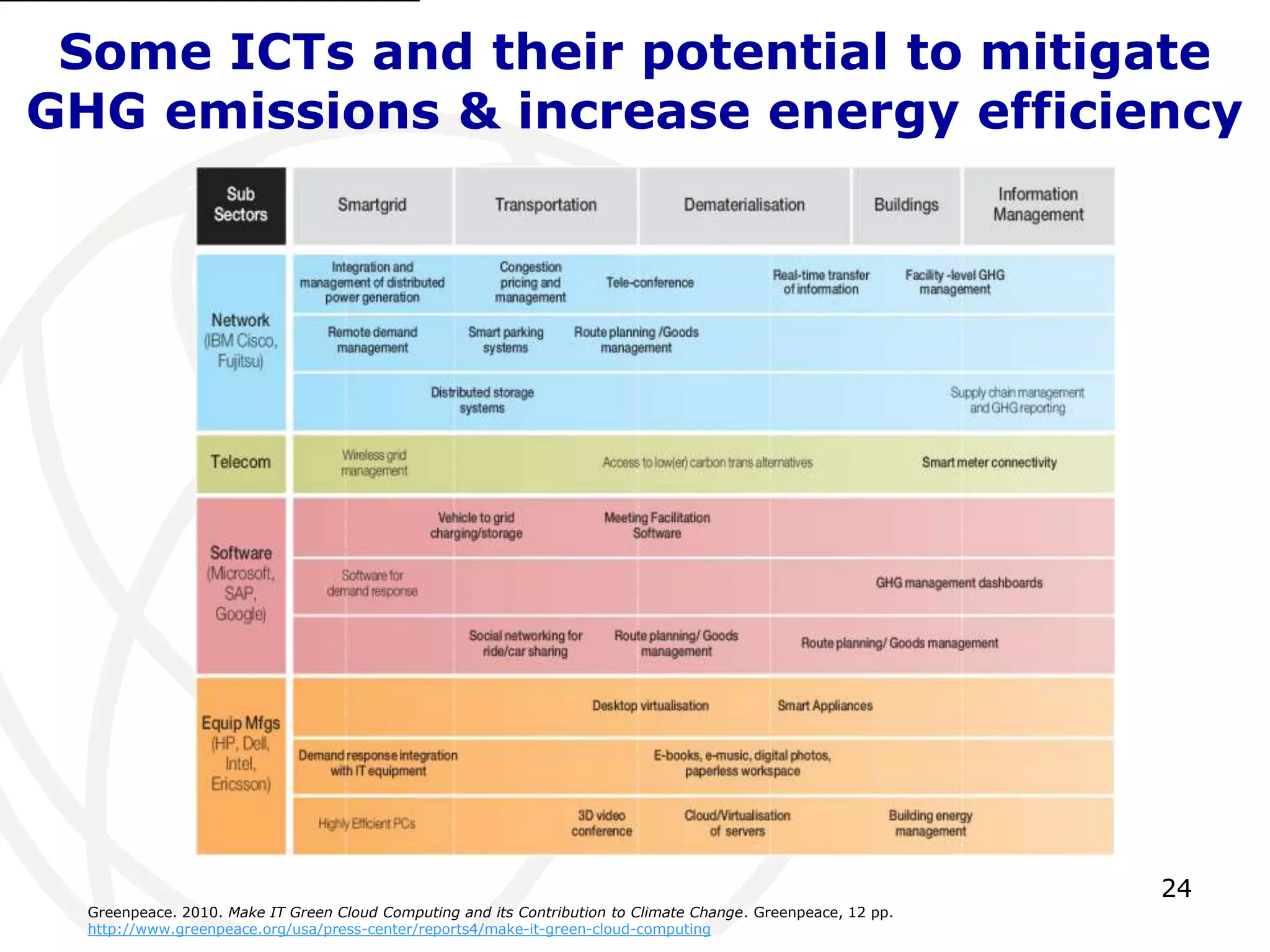
Some ICTs and their potential to mitigate 
GHG emissions & increase energy efficiency 
24 
Greenpeace. 2010. Make IT Green Cloud Computing and its Contribution to Climate Change. Greenpeace, 12 pp. 
http://www.greenpeace.org/usa/press-center/reports4/make-it-green-cloud-computing
25 
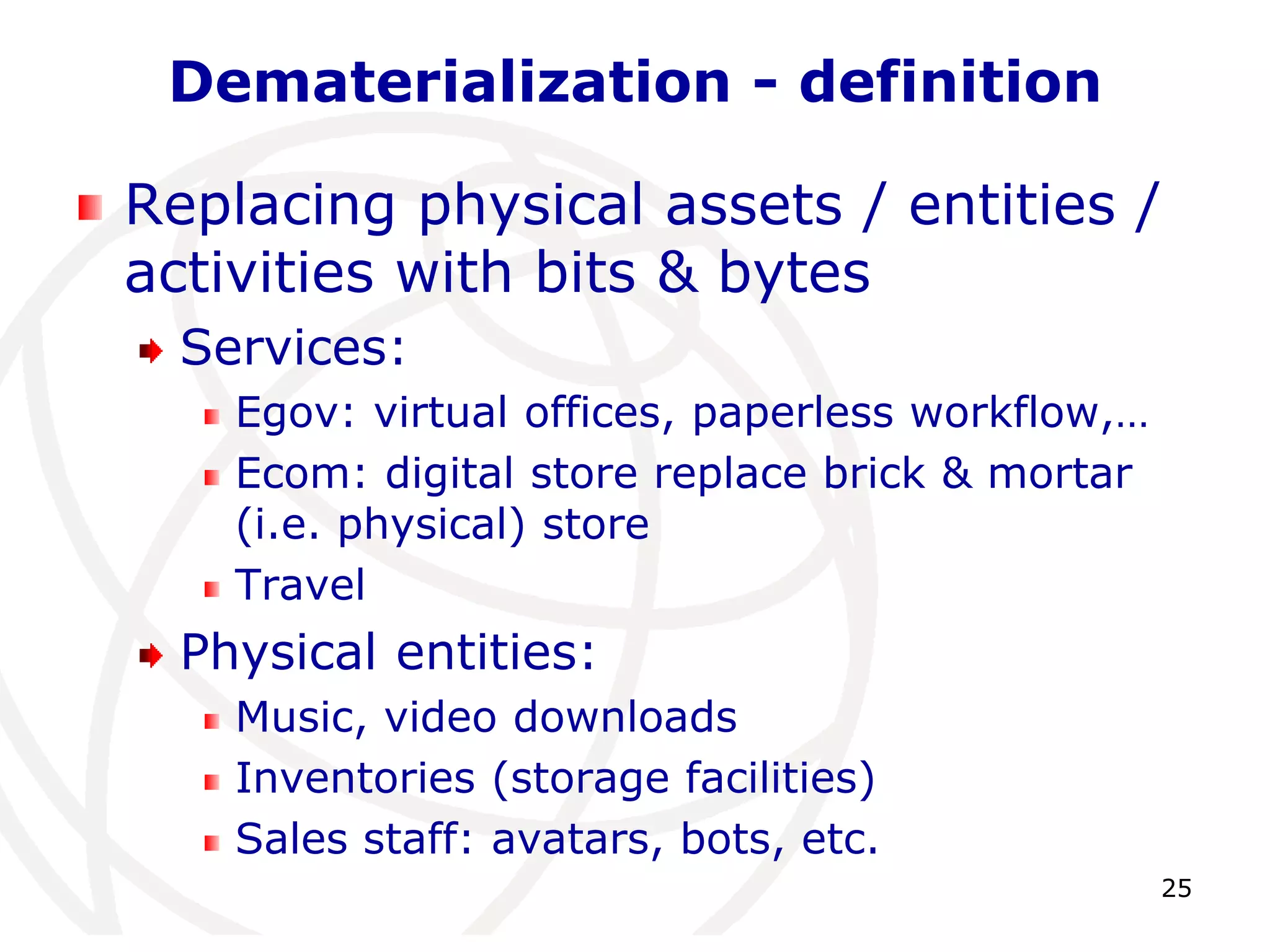
Dematerialization - definition 
Replacing physical assets / entities / 
activities with bits & bytes 
Services: 
Egov: virtual offices, paperless workflow,… 
Ecom: digital store replace brick & mortar 
(i.e. physical) store 
Travel 
Physical entities: 
Music, video downloads 
Inventories (storage facilities) 
Sales staff: avatars, bots, etc.
26 
Section 8 - Dematerialization
27 
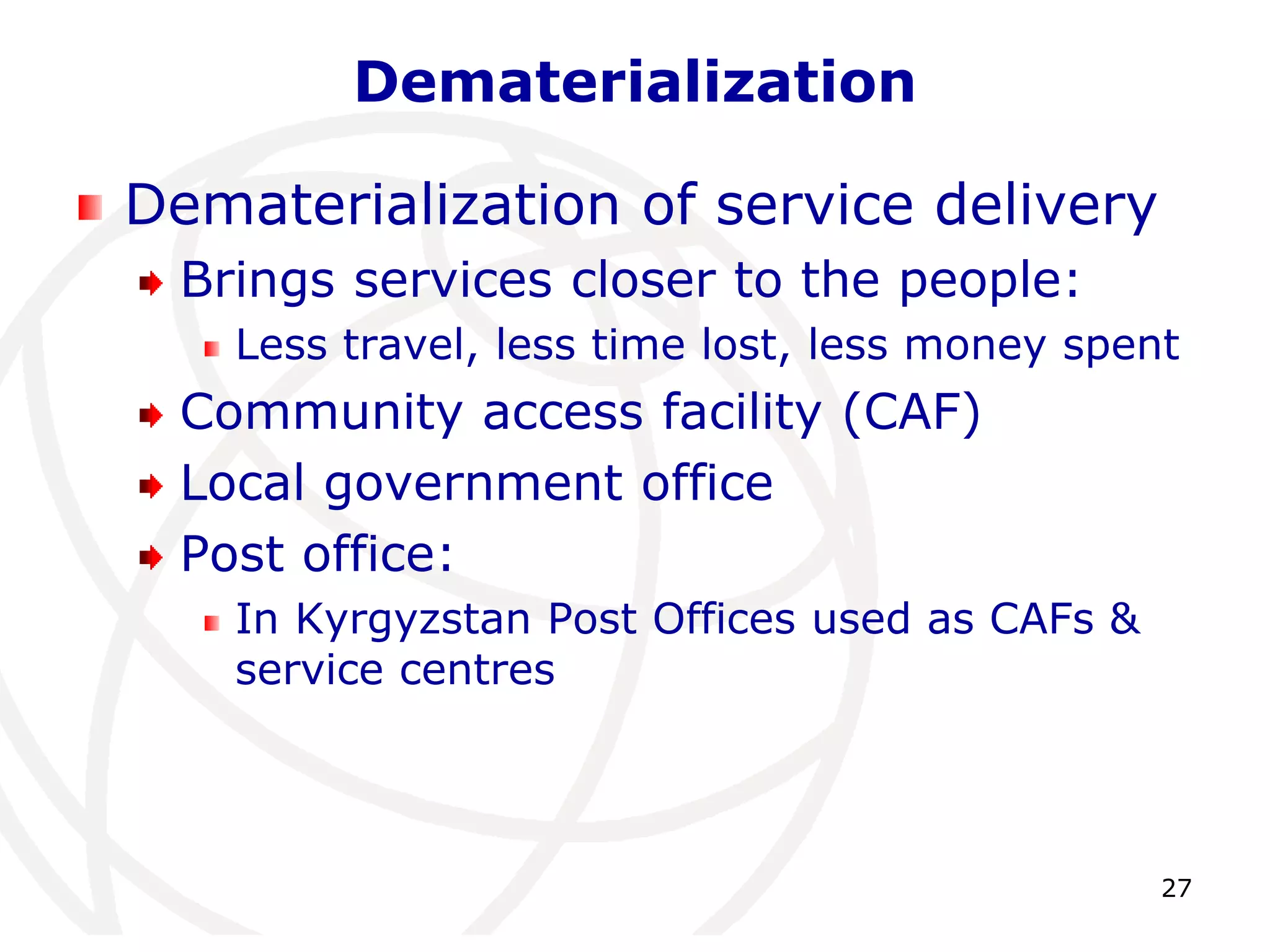
Dematerialization 
Dematerialization of service delivery 
Brings services closer to the people: 
Less travel, less time lost, less money spent 
Community access facility (CAF) 
Local government office 
Post office: 
In Kyrgyzstan Post Offices used as CAFs & 
service centres
28 
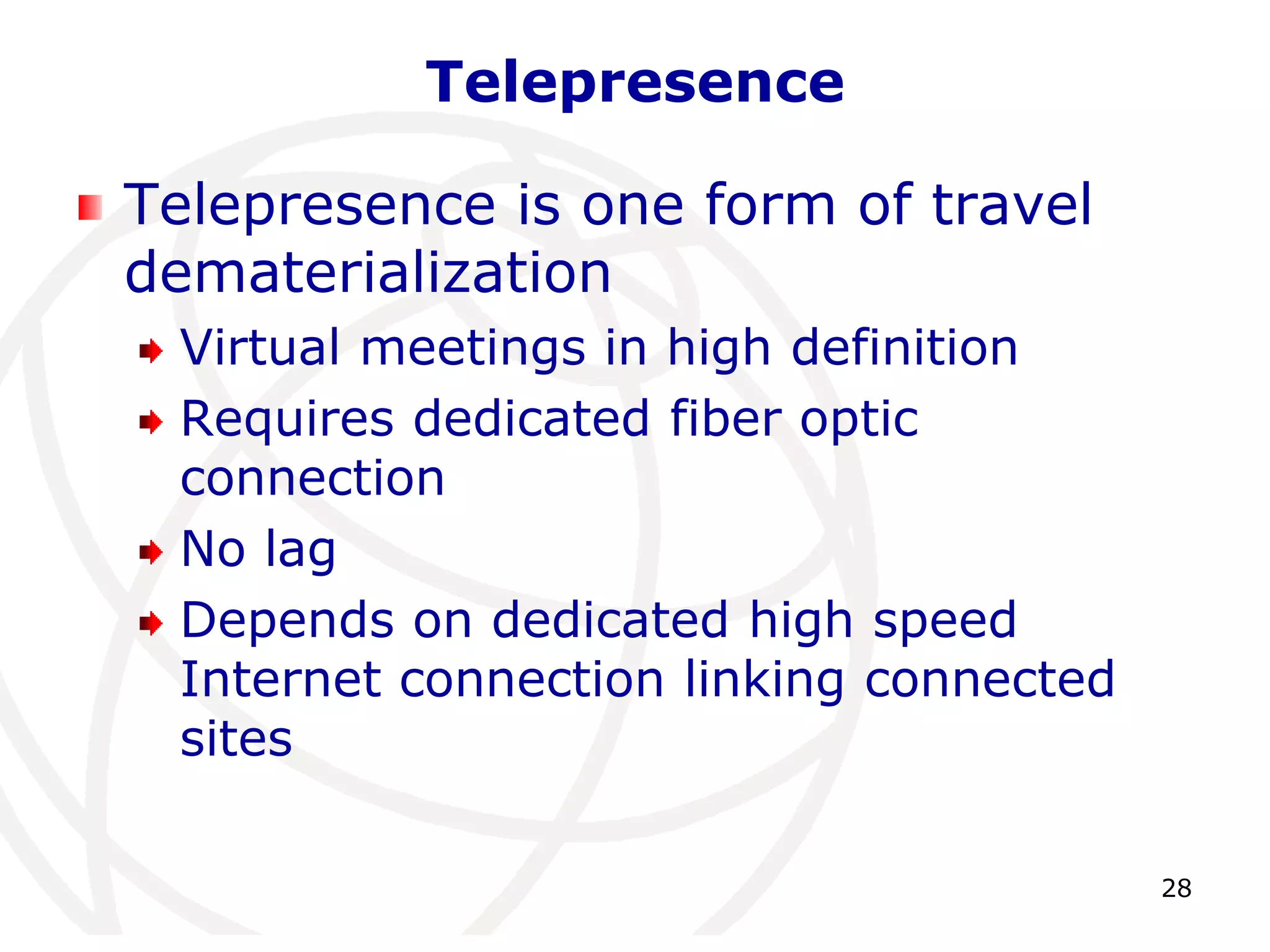
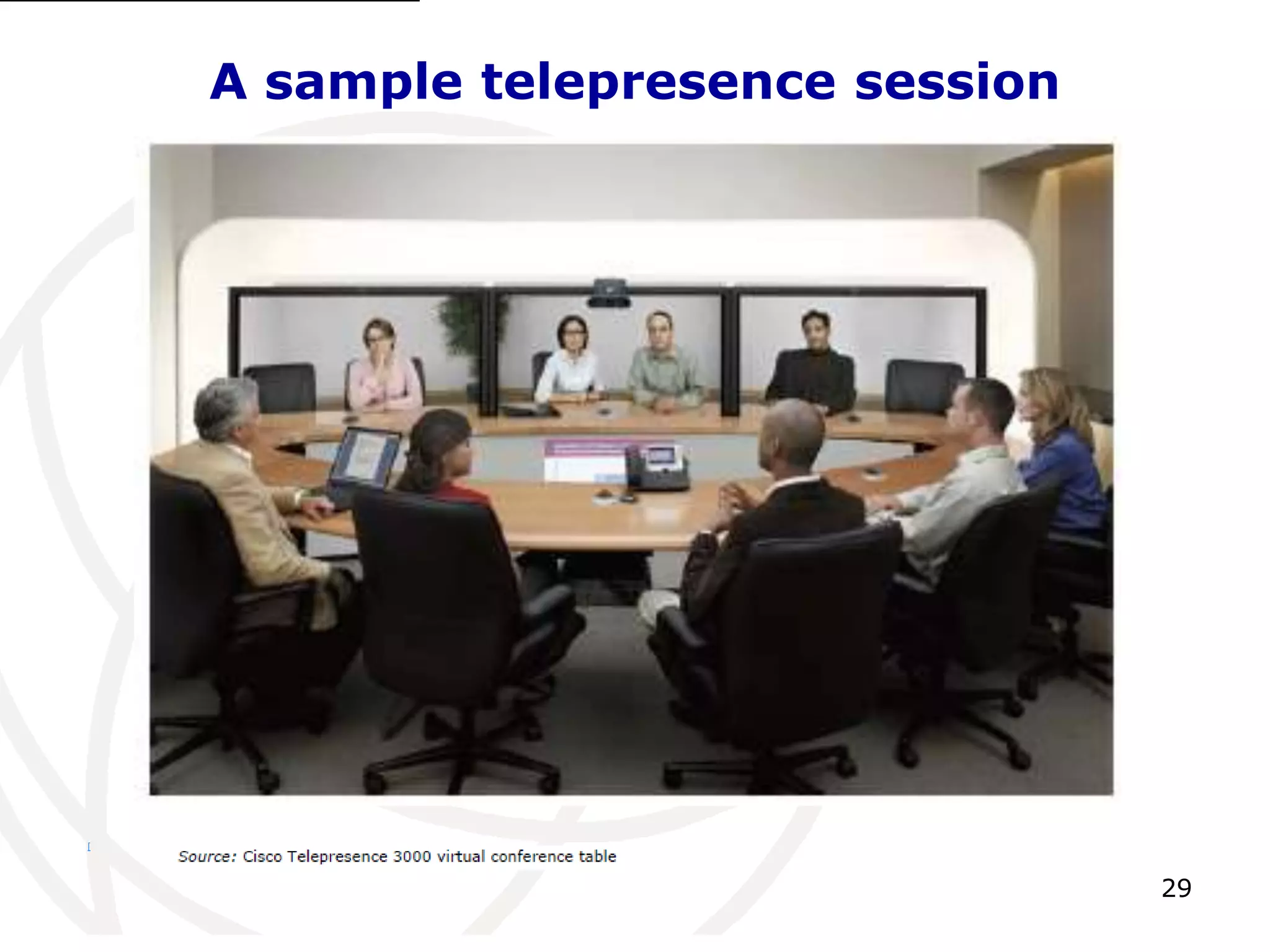
Telepresence 
Telepresence is one form of travel 
dematerialization 
Virtual meetings in high definition 
Requires dedicated fiber optic 
connection 
No lag 
Depends on dedicated high speed 
Internet connection linking connected 
sites
29 
A sample telepresence session 
[
30 
Cost / benefit of telepresence 
Cisco has > 1,000 telepresence units 
Saved $ 390 M in travel over 3 yr 
period 
Saved > 210 M tonnes CO2 
Cheaper consumer units appearing
31 
Other technologies 
Telework 
Telehealth 
Server virtualization 
14 real machines can be replaced by 1 
virtual server
Section 9 - Efficiency in electricity 
generation and management, and the 
32 
use of Smart grids
Smart energy systems – the Internet 
33 
of energy! 
Smart Grid: a next-generation 
electrical power system that is 
typified by the increased use of 
ICT in the generation, delivery 
and consumption of electrical 
energy”.
34 
Existing electrical generation, 
transmission & distribution system (1) 
Important source of emissions 
Inefficient: 
Only 1/3 of energy consumed converted 
into electricity
35 
Existing electrical generation, 
transmission & distribution system(2) 
3 components: 
1. Energy generation 
2. Energy transmission 
3. Energy distribution 
We are especially interested in 
transmission & distribution
36 
Existing electrical generation, 
transmission & distribution system(3) 
Transmission: 
Long distance transport of energy from 
generation centres to more local 
distribution hubs, i.e. electrical sub-stations 
Distribution: 
Local power lines bringing energy to 
homes from electrical sub-stations
37 
Existing electrical generation, 
transmission & distribution system(4) 
Outdated 
One way communication 
Slow mechanical switches 
No automated analysis  unable to 
detect power outages 
Cannot integrate renewables & 
distributed E resources
38 
Smart grid – a modernized 
transmission & distribution network-1 
Smart-grid technology brings power 
grids into the telecommunications 
age 
Use smart meters (advanced meter 
infrastructure – AMI) 
Connect "smart meters" in households 
and businesses to central monitoring 
systems capable of detecting and 
redressing outages or overloads in an 
instant 
Demand side management (DSM).
39 
Smart grid – a modernized 
transmission & distribution network-2 
Smart-grid technology brings power 
grids into the telecommunications 
age 
Uses sensors to link all components 
for monitoring, measurement & 
control 
Embed smart sensors in all components 
of the electrical grid for monitoring, 
measuring, controlling
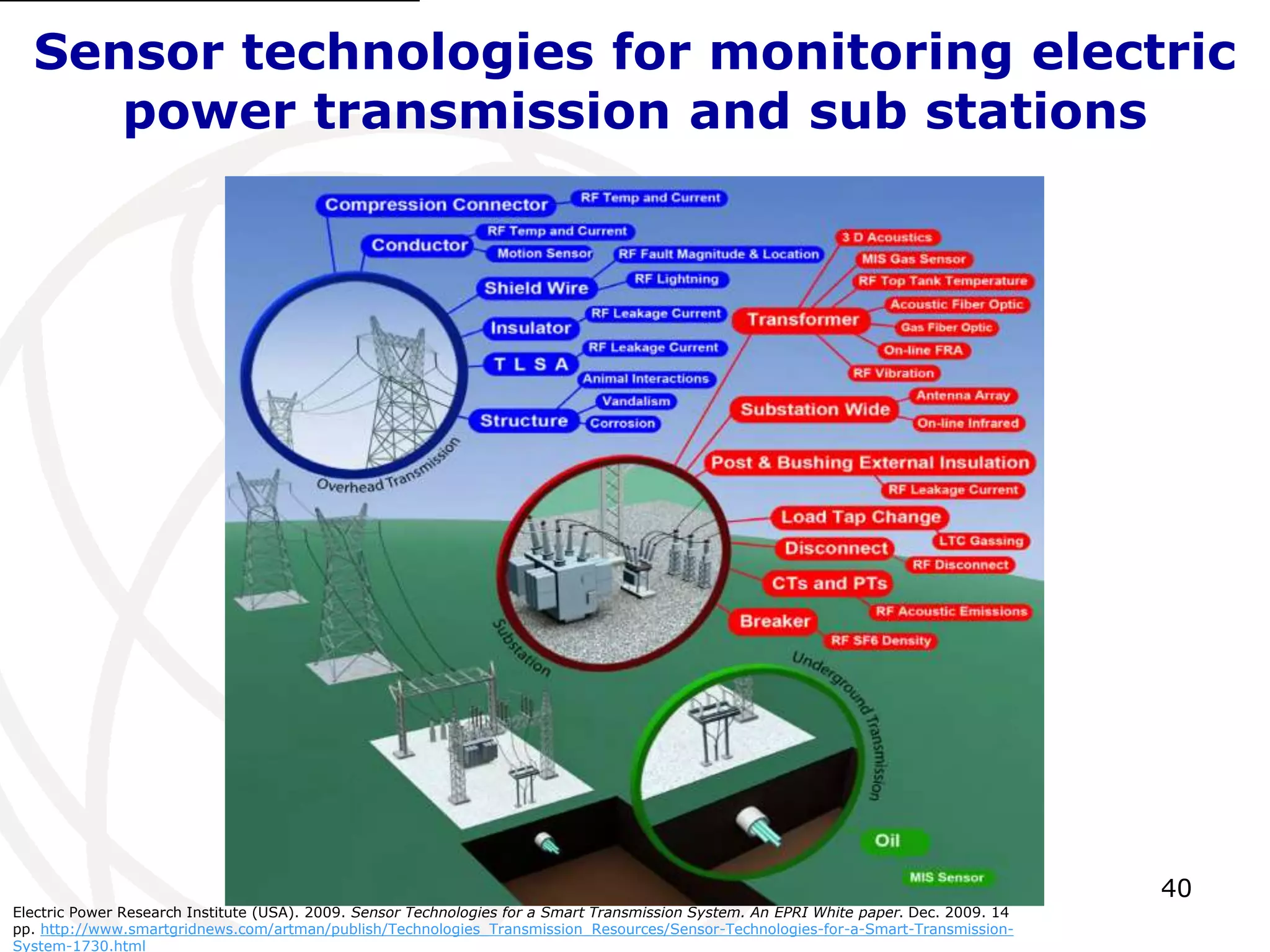
Sensor technologies for monitoring electric 
40 
power transmission and sub stations 
Electric Power Research Institute (USA). 2009. Sensor Technologies for a Smart Transmission System. An EPRI White paper. Dec. 2009. 14 
pp. http://www.smartgridnews.com/artman/publish/Technologies_Transmission_Resources/Sensor-Technologies-for-a-Smart-Transmission- 
System-1730.html
41 
Smart grid – a modernized 
transmission & distribution network-3 
Connect "smart meters" in 
households and businesses to central 
monitoring systems to … 
… detect & redress power outages 
or overloads in an instant 
Demand side management (DSM)
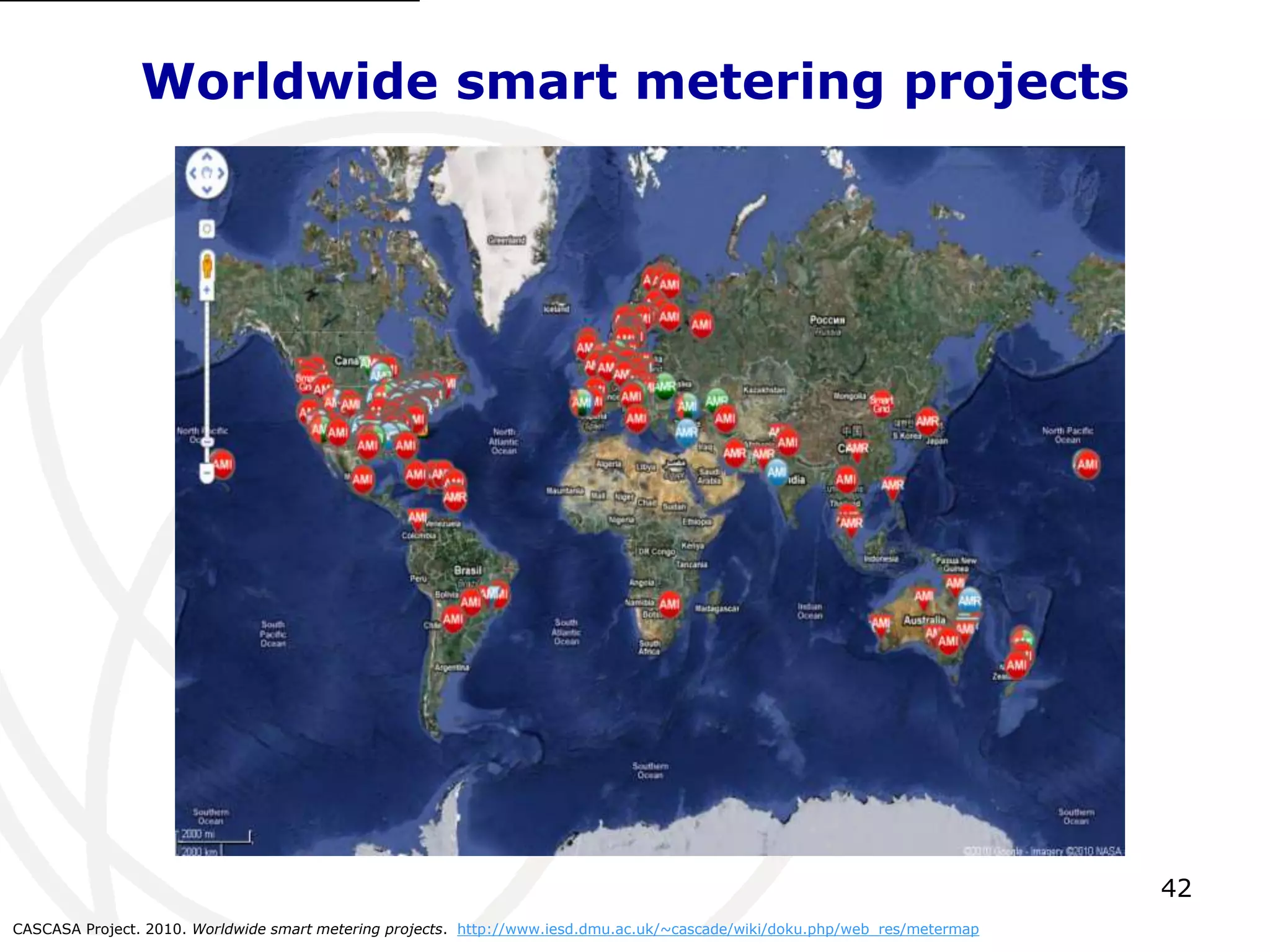
42 
Worldwide smart metering projects 
CASCASA Project. 2010. Worldwide smart metering projects. http://www.iesd.dmu.ac.uk/~cascade/wiki/doku.php/web_res/metermap
43 
Smart grid – a modernized 
transmission & distribution network- 4 
Manage variable energy sources: 
Renewable energy is not always 
available 
 have to manage this by shifting electricity 
from where it is produced to where it is 
required 
Smart grid allows this to happen at speed of 
light over the electrical grid!
44 
Smart grid – a modernized 
transmission & distribution network- 4 
Distributed energy resources 
Local power generating 
Smaller and distributed in space 
Home / office renewable power sources 
Energy generated by smart buildings (Green 
buildings) – the zero energy building and 
the positive energy building 
Contribute energy into the grid 
Based on Feed In Tariffs (FIT) policies to 
encourage investment in renewable energy
45 
Smart grid – a modernized 
transmission & distribution network- 5 
Electric vehicles (EVs) 
< 200 km on single charge 
Battery powered 
Require about the same amount of 
energy as used to power house for 1 
day 
Can be used for energy storage as part 
of component of smart grid
46 
Smart grid – a modernized 
transmission & distribution network- 6 
Energy storage (to manage stored E) 
Required for powering electric vehicles 
(small scale) 
Required for storing and releasing 
energy back to the grid to meet demand 
Underground storage (longer term storage) 
Heat stored in solar thermal (liquid Na 
storage gives off heat over 24 hours – short 
term storage) 
Reverse pumping fill reservoirs when low 
peak (at night) and turn generators during 
peak demand
47 
Smart grid – a modernized 
transmission & distribution network- 7 
Supervisory control and data 
acquisition (SCADA) systems over 
see everything 
Use sensors every where to monitor, 
measure and control (AMI) 
WSNs especially important but wired 
SNs as well because of electrical 
interference 
For security as well 
Everything on the grid can be given an 
IP address
48 
Smart grid – a modernized 
transmission & distribution network- 8 
Makes the energy market more open 
and transparent 
More players can buy and sell 
Small players can participate 
More competition 
More services: demand side 
management
49 
Smart grid – a modernized 
transmission & distribution network- 9 
Demand side management (DSM) 
Utilities connect home and office to 
control motor systems: 
Appliances with smart motors / controls 
(embedded sensors with control features) 
Lighting 
AMI is important 
Users know (smart meters) energy use & 
can also control their energy use 
DSM: let utility control when appliances are 
used to decrease load: incentives  less 
outages because better control of demand
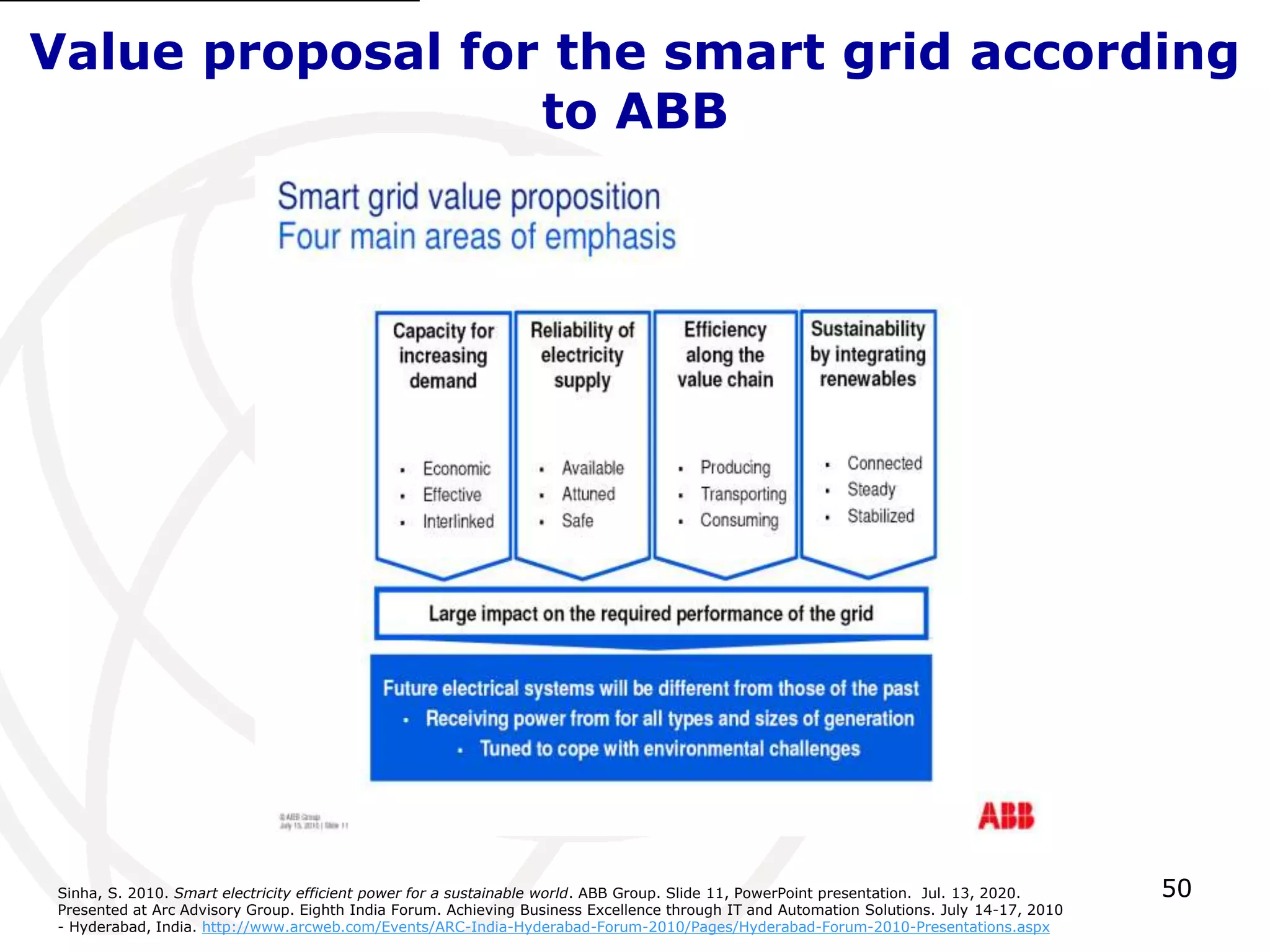
Value proposal for the smart grid according 
50 
to ABB 
Sinha, S. 2010. Smart electricity efficient power for a sustainable world. ABB Group. Slide 11, PowerPoint presentation. Jul. 13, 2020. 
Presented at Arc Advisory Group. Eighth India Forum. Achieving Business Excellence through IT and Automation Solutions. July 14-17, 2010 
- Hyderabad, India. http://www.arcweb.com/Events/ARC-India-Hyderabad-Forum-2010/Pages/Hyderabad-Forum-2010-Presentations.aspx
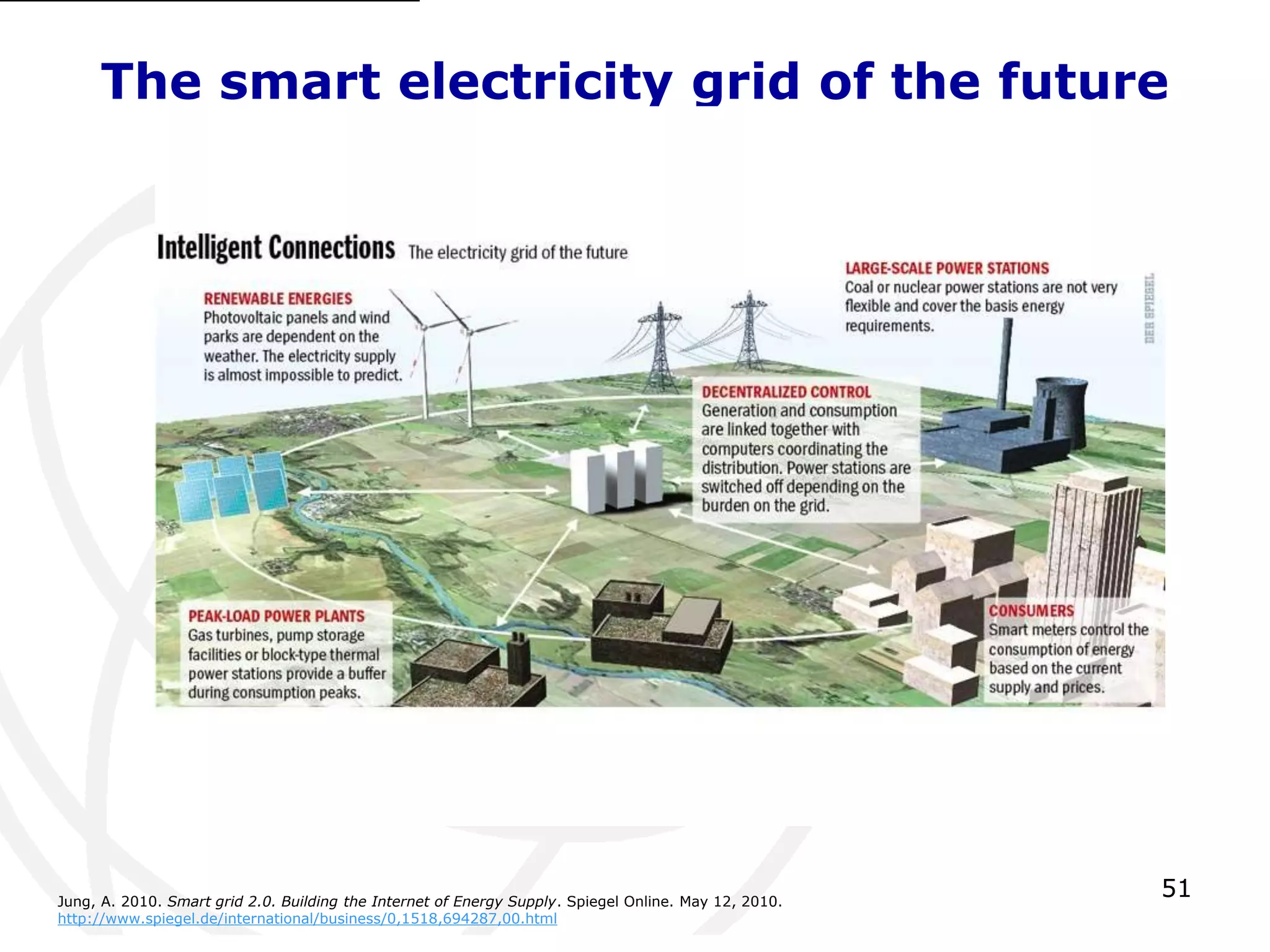
The smart electricity grid of the future 
51 
Jung, A. 2010. Smart grid 2.0. Building the Internet of Energy Supply. Spiegel Online. May 12, 2010. 
http://www.spiegel.de/international/business/0,1518,694287,00.html
The smart grid of the future where sensors 
52 
have a major role to play 
Greenpeace and European Renewable Energy Council. 2010. Energy [R]evolution: A Sustainable World Energy Outlook. 3rd edition 2010 
world energy scenario. June 2010. 260 pp. http://www.greenpeace.org/international/en/publications/reports/Energy-Revolution-A-Sustainable- 
World-Energy-Outlook/
53 
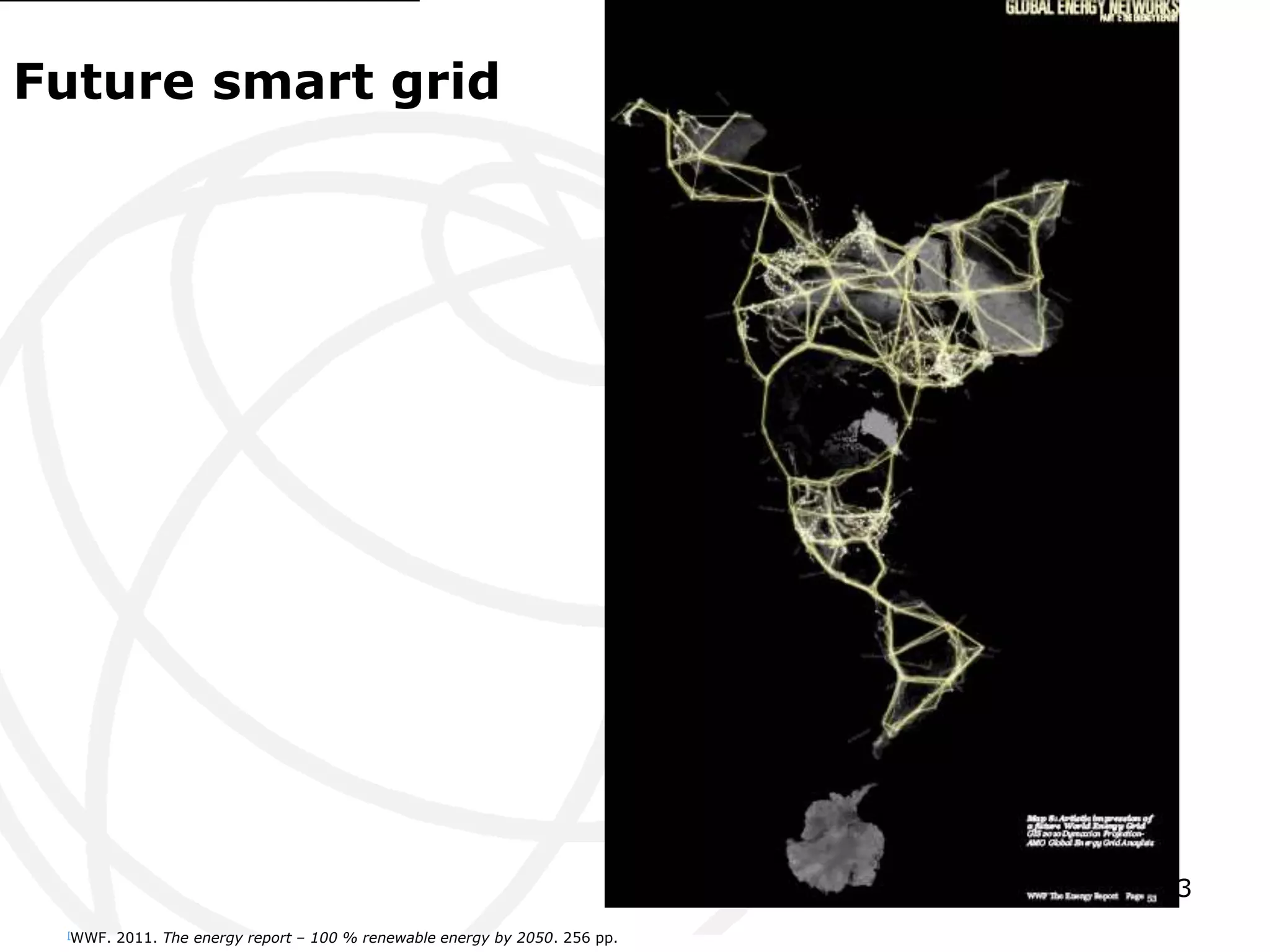
Future smart grid 
[WWF. 2011. The energy report – 100 % renewable energy by 2050. 256 pp.
54 
Smart grid in Asia Pacific 
Still under development everywhere! 
Some very ambitious plans in place 
State Grid Corporation, China will 
build all new grid infrastructure 
$ 100 B over 5 years 
Korea, Japan, India & Thailand all 
developing projects, probably many 
others as well
55 
Conclusions (1) 
Important technologies 
Capital intensive, but very clear 
payback 
Customer response is critical 
Incentives essential to encourage 
use of & investment in renewables: 
FIT: Feed in Tariffs
56 
Conclusions (2) 
Needs more research on standards to 
link all devices, etc. 
Can be scaled to meet needs and 
circumstances of the developing 
world & smaller countries 
Another technology that developing 
countries need to put on the table 
during negotiations for tech. transfer 
to abate climate change
57 
Discussion

Module 10 - Section 7,8 & 9: Enabling effects of ICTs for climate action 20110825

  • 1.
    Module 10 Section7,8 & 9 Section 7: ICTs for mitigating climate change Section 8: Dematerialization Section 9: Efficiency in electricity generation and management, and the use of Smart grids Richard Labelle rlab@sympatico.ca
  • 2.
    2 Objectives ofModule 10 To show that ICTs can be used to address climate change To demonstrate why ICTs are a crucial part of the solution – i.e. in promoting efficiency, Green Growth & sustainable development
  • 3.
    Section 7 -ICTs for mitigating climate 3 change Provide an overview of the ways in which ICTs are used to mitigate climate change, particularly by enabling energy efficiencies in other sectors (also known as second order effects).
  • 4.
    4 Objectives ofSession 5 To introduce the idea that ICTs can enable positive environmental change and abate GHG emissions with a focus on two application areas: Dematerialization Smart energy (smart grid) solutions To discuss implications for Asia Pacific
  • 5.
    Enabling effects ofICTs in reducing 5 environmental impacts (1) What are enabling effects? These are positive steps we take to: Reduce: GHG emissions Energy consumption and Material use … Preserve and enhance ecosystem function Make human environments environmentally secure and sustainable…
  • 6.
    Enabling effects ofICTs in reducing 6 environmental impacts (2) … as a result of enhanced efficiencies and more sustainable human behaviour facilitated through the use of ICTs.
  • 7.
    Discuss enabling effectsof ICTs (1) 7 Compare impact of using ICTs – before and after using computers? Consider e-government & e-commerce
  • 8.
    Discuss enabling effectsof ICTs (2) 8 What are the enabling effects of e-government or e-commerce on energy consumption or of other ICT uses / applications? Do they help reduce energy consumption and GHG emissions? If so, list how Use examples from your daily lives, where you live, work, etc. Just consider the impacts in energy terms if we did not have PCs and networks, etc.
  • 9.
    What are someof the usual enabling 9 effects of ICTs? (1) Increased process efficiency: doings things faster and more easily Easier & more communication Faster & easier computation Access to knowledge that is fast and complete I can tell what info I have and have an idea of what I do not have and whether the info exists at all!
  • 10.
    What are someof the usual enabling 10 effects? (2) I can see the info, I can even map it much more easily! I can build, test and model things faster I can see things that are invisible to the naked eye Result:  Better decision making !
  • 11.
    11 Group exercise Come up with other examples similar to the “elevator example”. Discuss
  • 12.
    Enabling effects ofICTs: reducing GHG 12 emissions (1) No direct effect on land use emissions: agriculture & forestry But help understand dynamics (ecosystem function & steady state dynamics – resilience, etc.) Energy transmission& distribution: Smart grids Industrial processes: Smart motor systems
  • 13.
    Enabling effects ofICTs: reducing GHG 13 emissions (2) Smart buildings Smart logistics and transportation systems Virtual meetings and other forms of dematerialization: Travel replacement, server virtualization, etc.
  • 14.
    14 Direct impactsof ICTs ICTs contribute 2-3% of global GHG emissions  will grow to ~ 6 % > 70 % from ICT use ~ 25 % from materials & energy costs of making ICTs
  • 15.
    15 Impacts vsenabling effects of ICTs The Climate Group. 2008. SMART 2020: Enabling the low carbon economy in the information age. A report by The Climate Group on behalf of the Global eSustainability Initiative (GeSI). The Climate Group, 87 pp.
  • 16.
    16 The enablingeffect of ICTs The Climate group and GeSI. 2008. Smart 2020: Enabling the low carbon economy in the information age. 87 pp.
  • 17.
    Enabling effects ofICTs in the European Union (BAU scenario) ICTs represent about 7.8 % of all electricity consumption in EU (2005) 17 1.9% of total CO2 emissions To grow to 10.5 % by 2020 under BAU (business as usual) 4.5 % of CO2 emissions
  • 18.
    18 Enabling effectsof ICTs in the European Union (Eco scenario 1) Use ICT enabled heating ventilation and air conditioning systems (HVAC), ICT based lighting systems, industrial equipment and automation and ICT enabled energy grids
  • 19.
    Enabling effects ofICTs in the European Union (Eco scenario 2) Net energy savings in terms of total electricity consumption in 2020 for the EU 27 will be 53.4 % vs. 2.8 % in BAU In terms of CO2 reduction: the savings are only positive under the Eco-scenario and amount to 4.6 % of EU 27 CO2 19
  • 20.
    ICT energy savingpotential in the EU (2020). Bio Intelligence Service report 20 Bio Intelligence Service. 2008. Final report. Impacts of information and communication technologies on energy efficiency. European Commission DG INFSO. 432 pp. ftp://ftp.cordis.europa.eu/pub/fp7/ict/docs/sustainable-growth/ict4ee-final-report_en.pdf
  • 21.
    Reduction of CO2by use of ICTs (Japan) - 21 90% of Japan’s Kyoto obligations Inoue, Y. 2008. Climate change and ICT standardization. President & CEO, The Telecommunication Technology Committee (TTC). PowerPoint presentation made on the occasion of the ITU Kyoto Symposium on ICT & Climate Change, 15 - 16 April, 2008. 22 slides.
  • 22.
    Breakdown of Australianenergy emissions by sector & abatement potential of ICTs 22 Climate Risk Pty. 2007. Towards a High-Bandwidth, Low-Carbon Future: Telecommunications-based Opportunities to Reduce Greenhouse Gas Emissions. Fairlight, Australia. 109 pp. http://www.climaterisk.com.au/wp-content/uploads/2007/CR_Telstra_ClimateReport.pdf
  • 23.
    23 Group discussion Could ICT use have a similar impact in your countries? Why or why not?
  • 24.
    Some ICTs andtheir potential to mitigate GHG emissions & increase energy efficiency 24 Greenpeace. 2010. Make IT Green Cloud Computing and its Contribution to Climate Change. Greenpeace, 12 pp. http://www.greenpeace.org/usa/press-center/reports4/make-it-green-cloud-computing
  • 25.
    25 Dematerialization -definition Replacing physical assets / entities / activities with bits & bytes Services: Egov: virtual offices, paperless workflow,… Ecom: digital store replace brick & mortar (i.e. physical) store Travel Physical entities: Music, video downloads Inventories (storage facilities) Sales staff: avatars, bots, etc.
  • 26.
    26 Section 8- Dematerialization
  • 27.
    27 Dematerialization Dematerializationof service delivery Brings services closer to the people: Less travel, less time lost, less money spent Community access facility (CAF) Local government office Post office: In Kyrgyzstan Post Offices used as CAFs & service centres
  • 28.
    28 Telepresence Telepresenceis one form of travel dematerialization Virtual meetings in high definition Requires dedicated fiber optic connection No lag Depends on dedicated high speed Internet connection linking connected sites
  • 29.
    29 A sampletelepresence session [
  • 30.
    30 Cost /benefit of telepresence Cisco has > 1,000 telepresence units Saved $ 390 M in travel over 3 yr period Saved > 210 M tonnes CO2 Cheaper consumer units appearing
  • 31.
    31 Other technologies Telework Telehealth Server virtualization 14 real machines can be replaced by 1 virtual server
  • 32.
    Section 9 -Efficiency in electricity generation and management, and the 32 use of Smart grids
  • 33.
    Smart energy systems– the Internet 33 of energy! Smart Grid: a next-generation electrical power system that is typified by the increased use of ICT in the generation, delivery and consumption of electrical energy”.
  • 34.
    34 Existing electricalgeneration, transmission & distribution system (1) Important source of emissions Inefficient: Only 1/3 of energy consumed converted into electricity
  • 35.
    35 Existing electricalgeneration, transmission & distribution system(2) 3 components: 1. Energy generation 2. Energy transmission 3. Energy distribution We are especially interested in transmission & distribution
  • 36.
    36 Existing electricalgeneration, transmission & distribution system(3) Transmission: Long distance transport of energy from generation centres to more local distribution hubs, i.e. electrical sub-stations Distribution: Local power lines bringing energy to homes from electrical sub-stations
  • 37.
    37 Existing electricalgeneration, transmission & distribution system(4) Outdated One way communication Slow mechanical switches No automated analysis  unable to detect power outages Cannot integrate renewables & distributed E resources
  • 38.
    38 Smart grid– a modernized transmission & distribution network-1 Smart-grid technology brings power grids into the telecommunications age Use smart meters (advanced meter infrastructure – AMI) Connect "smart meters" in households and businesses to central monitoring systems capable of detecting and redressing outages or overloads in an instant Demand side management (DSM).
  • 39.
    39 Smart grid– a modernized transmission & distribution network-2 Smart-grid technology brings power grids into the telecommunications age Uses sensors to link all components for monitoring, measurement & control Embed smart sensors in all components of the electrical grid for monitoring, measuring, controlling
  • 40.
    Sensor technologies formonitoring electric 40 power transmission and sub stations Electric Power Research Institute (USA). 2009. Sensor Technologies for a Smart Transmission System. An EPRI White paper. Dec. 2009. 14 pp. http://www.smartgridnews.com/artman/publish/Technologies_Transmission_Resources/Sensor-Technologies-for-a-Smart-Transmission- System-1730.html
  • 41.
    41 Smart grid– a modernized transmission & distribution network-3 Connect "smart meters" in households and businesses to central monitoring systems to … … detect & redress power outages or overloads in an instant Demand side management (DSM)
  • 42.
    42 Worldwide smartmetering projects CASCASA Project. 2010. Worldwide smart metering projects. http://www.iesd.dmu.ac.uk/~cascade/wiki/doku.php/web_res/metermap
  • 43.
    43 Smart grid– a modernized transmission & distribution network- 4 Manage variable energy sources: Renewable energy is not always available  have to manage this by shifting electricity from where it is produced to where it is required Smart grid allows this to happen at speed of light over the electrical grid!
  • 44.
    44 Smart grid– a modernized transmission & distribution network- 4 Distributed energy resources Local power generating Smaller and distributed in space Home / office renewable power sources Energy generated by smart buildings (Green buildings) – the zero energy building and the positive energy building Contribute energy into the grid Based on Feed In Tariffs (FIT) policies to encourage investment in renewable energy
  • 45.
    45 Smart grid– a modernized transmission & distribution network- 5 Electric vehicles (EVs) < 200 km on single charge Battery powered Require about the same amount of energy as used to power house for 1 day Can be used for energy storage as part of component of smart grid
  • 46.
    46 Smart grid– a modernized transmission & distribution network- 6 Energy storage (to manage stored E) Required for powering electric vehicles (small scale) Required for storing and releasing energy back to the grid to meet demand Underground storage (longer term storage) Heat stored in solar thermal (liquid Na storage gives off heat over 24 hours – short term storage) Reverse pumping fill reservoirs when low peak (at night) and turn generators during peak demand
  • 47.
    47 Smart grid– a modernized transmission & distribution network- 7 Supervisory control and data acquisition (SCADA) systems over see everything Use sensors every where to monitor, measure and control (AMI) WSNs especially important but wired SNs as well because of electrical interference For security as well Everything on the grid can be given an IP address
  • 48.
    48 Smart grid– a modernized transmission & distribution network- 8 Makes the energy market more open and transparent More players can buy and sell Small players can participate More competition More services: demand side management
  • 49.
    49 Smart grid– a modernized transmission & distribution network- 9 Demand side management (DSM) Utilities connect home and office to control motor systems: Appliances with smart motors / controls (embedded sensors with control features) Lighting AMI is important Users know (smart meters) energy use & can also control their energy use DSM: let utility control when appliances are used to decrease load: incentives  less outages because better control of demand
  • 50.
    Value proposal forthe smart grid according 50 to ABB Sinha, S. 2010. Smart electricity efficient power for a sustainable world. ABB Group. Slide 11, PowerPoint presentation. Jul. 13, 2020. Presented at Arc Advisory Group. Eighth India Forum. Achieving Business Excellence through IT and Automation Solutions. July 14-17, 2010 - Hyderabad, India. http://www.arcweb.com/Events/ARC-India-Hyderabad-Forum-2010/Pages/Hyderabad-Forum-2010-Presentations.aspx
  • 51.
    The smart electricitygrid of the future 51 Jung, A. 2010. Smart grid 2.0. Building the Internet of Energy Supply. Spiegel Online. May 12, 2010. http://www.spiegel.de/international/business/0,1518,694287,00.html
  • 52.
    The smart gridof the future where sensors 52 have a major role to play Greenpeace and European Renewable Energy Council. 2010. Energy [R]evolution: A Sustainable World Energy Outlook. 3rd edition 2010 world energy scenario. June 2010. 260 pp. http://www.greenpeace.org/international/en/publications/reports/Energy-Revolution-A-Sustainable- World-Energy-Outlook/
  • 53.
    53 Future smartgrid [WWF. 2011. The energy report – 100 % renewable energy by 2050. 256 pp.
  • 54.
    54 Smart gridin Asia Pacific Still under development everywhere! Some very ambitious plans in place State Grid Corporation, China will build all new grid infrastructure $ 100 B over 5 years Korea, Japan, India & Thailand all developing projects, probably many others as well
  • 55.
    55 Conclusions (1) Important technologies Capital intensive, but very clear payback Customer response is critical Incentives essential to encourage use of & investment in renewables: FIT: Feed in Tariffs
  • 56.
    56 Conclusions (2) Needs more research on standards to link all devices, etc. Can be scaled to meet needs and circumstances of the developing world & smaller countries Another technology that developing countries need to put on the table during negotiations for tech. transfer to abate climate change
  • 57.