
Module 10 
Session 2 
(Seoul, Korea, 24 February 2011) 
ICTs & environmental observation 
Richard Labelle 
rlab@sympatico.ca
2 
Objectives of Module 10 
To show that ICTs be used to address 
climate change 
To demonstrate why ICTs are a crucial 
part of the solution – i.e. in promoting 
efficiency, Green Growth & sustainable 
development
3 
Objectives 
To present current trends in ICT 
developments and innovations that 
shed light on the use of ICTs for 
environmental observation and for 
abating climate change
4 
Trends that underpin ICT use for 
environmental observation & abating 
climate change 
Connecting everything 
Measuring everything 
Controlling everything 
Smart controls 
Connect & control all motors & energy 
consumption (embedded controls)
Environmental observation has many 
specific needs & is very broad 
Havana, Cuba, 8-9 February 2011 5
6 
Trends in ICT development 
Digitization & dematerialization 
Microprocessors 
Internet diffusion 
IPv6 
Broadband 
Cloud computing 
Nanotechnology 
Wireless & mobile device uptake
7 
Trends in ICT development (2) 
Innovations in display technologies 
GIS and related visualization 
technologies 
Improved & greener batteries 
The IOT 
Sensor technology 
Social networking
8 
Trends: digitization & 
dematerialization 
Digitization & dematerialization 
Smaller environmental sensing devices 
More powerful sensing devices 
More digitization (e-government, e-commerce, 
etc.)  less need for travel 
for rural dwellers, more energy 
efficiency 
More downloads: video, music, P2P, etc. 
Telepresence 
Virtualization (servers, networks, etc.)
9 
Trends: microprocessors (1) 
11 nm dies now, with 1 nm in future 
Smarter and more energy efficient 
More powerful microprocessors and 
microcontrollers 
Parallel processing CPUs and GPUs in 
portable / handheld devices 
Moore’s law still works
10 
Trends: microprocessors (2) 
45 nm Intel Core i7 processor: 
Peak data throughput of 50 GB /sec. vs. 
64 MB / sec. for Intel 386 
8 cores per microprocessor die 
Do more (much) faster & with less 
energy
11 
Trends: microprocessors (3) 
Dual / quad core for mobile devices: 
Smartphones more powerful than 
netbooks & as powerful as desktops  
…Powering transition to mobile over 
desktop computing as main computing 
platform 
Enable wireless sensor networks 
(WSNs) & the Internet of Things 
(IoT)
12 
Trends: Internet diffusion 
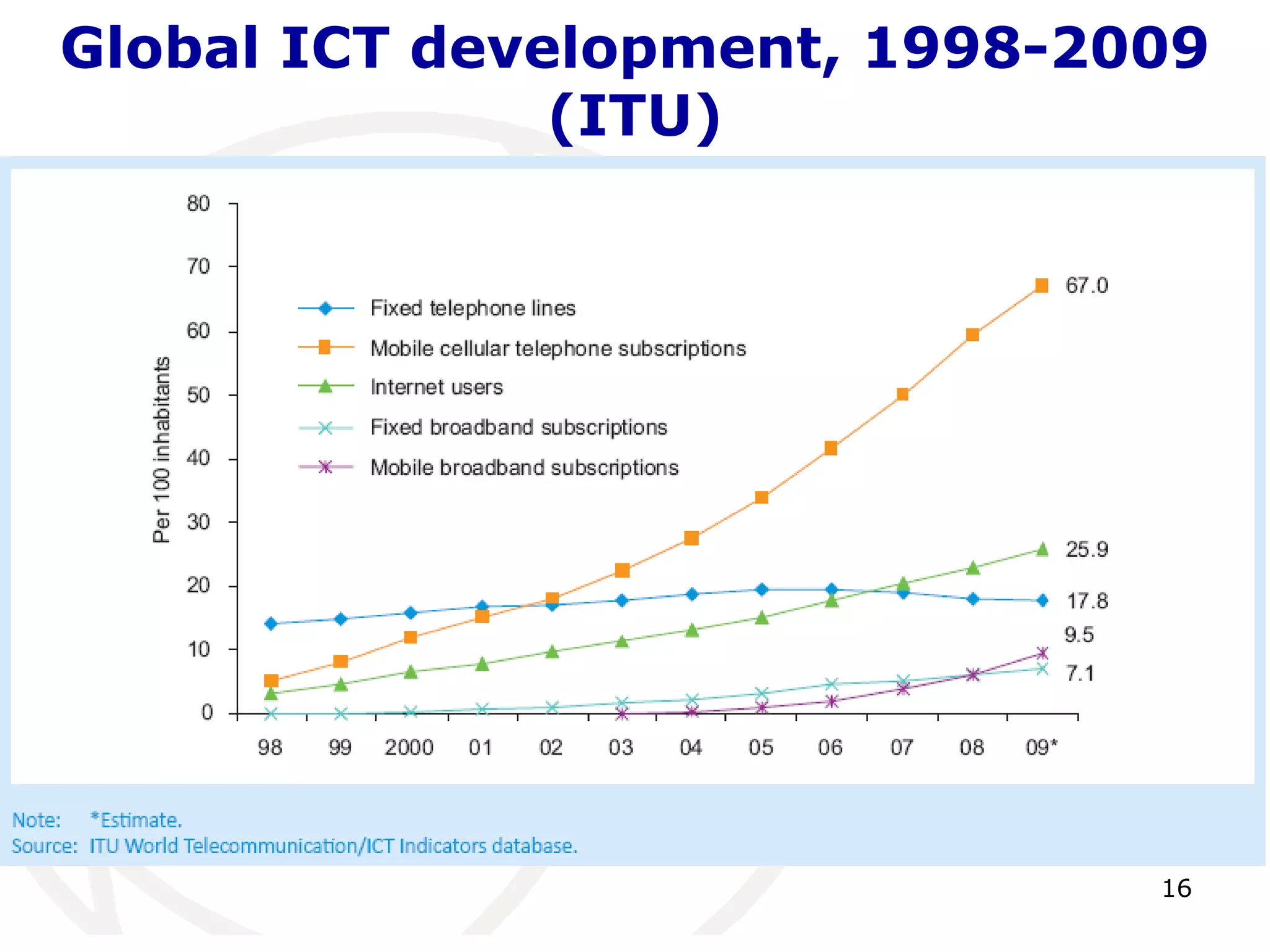
Global connectivity is growing
13 
Trends: Internet diffusion (1) 
Mobile use by consumer & enterprise 
markets in developed & emerging 
economies increasing 
Bandwidth demand from data & 
video increasing 
M2M connections increase 
Backhaul capacity still has to 
increase to meet demand 
More portability and interoperability
14 
Trends: Internet diffusion (2) 
New businesses & models emerging: 
New forms of advertising, media and 
content partnerships, mobile services 
Including M2M, live gaming and looking 
into the future, augmented reality 
Off electrical grid connectivity in 
some countries 
A cottage industry 
Driving use of renewables (solar) for 
charging & powering beyond the 
electrical grid
15 
Trends: Internet diffusion (3) 
Tendency is total integration of 
“desktop” with the Cloud 
High bandwidth, low latency 
connectivity 
FTTx 
4G, 5G… 
This means speed of IP / Cloud access 
~= to speed of computer buses 
Massive data flows 
With social nets: everyone is a user and 
provider of massive amounts of info.
Global ICT development, 1998-2009 
(ITU) 
16
17 
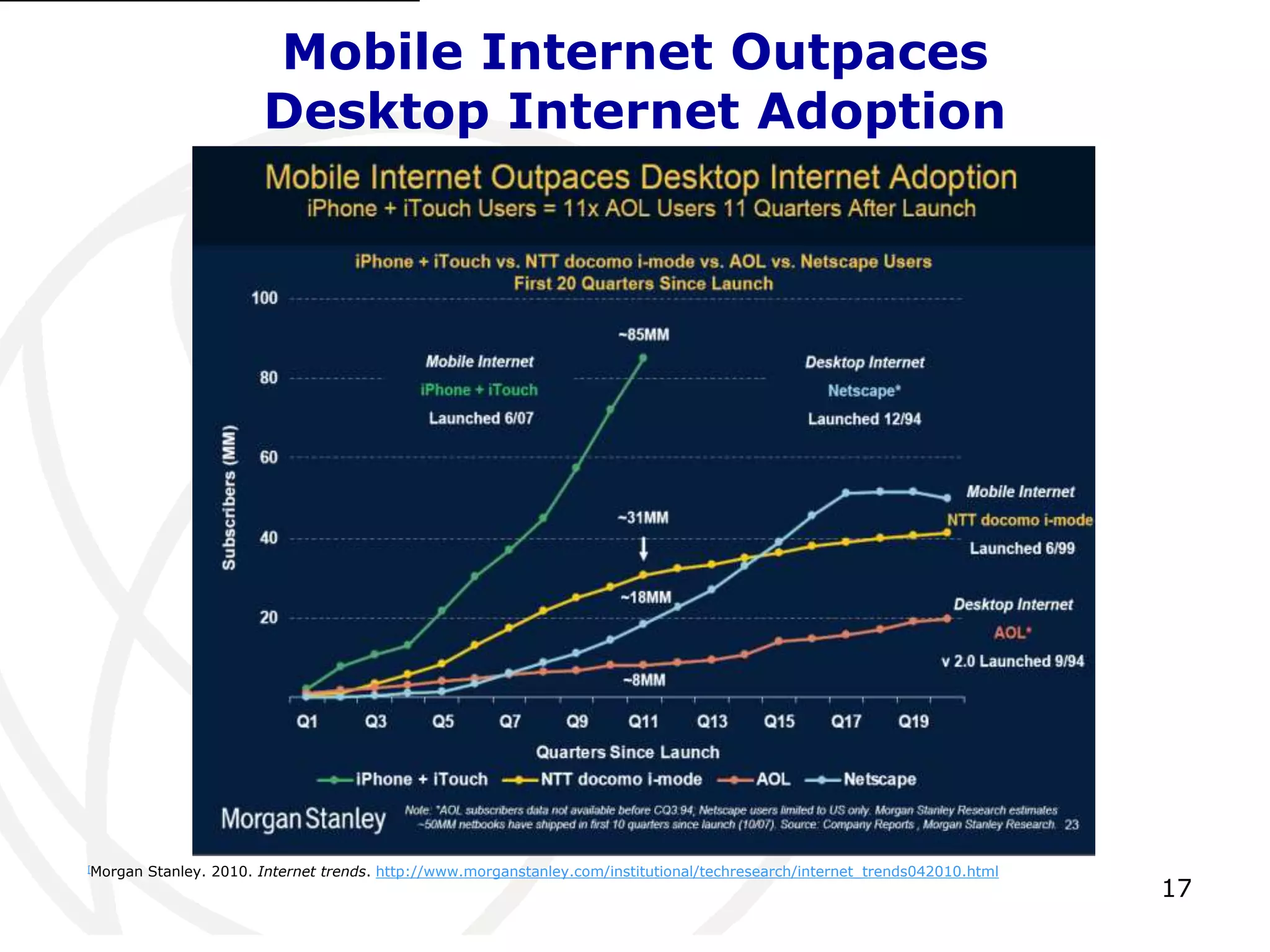
Mobile Internet Outpaces 
Desktop Internet Adoption 
[Morgan Stanley. 2010. Internet trends. http://www.morganstanley.com/institutional/techresearch/internet_trends042010.html
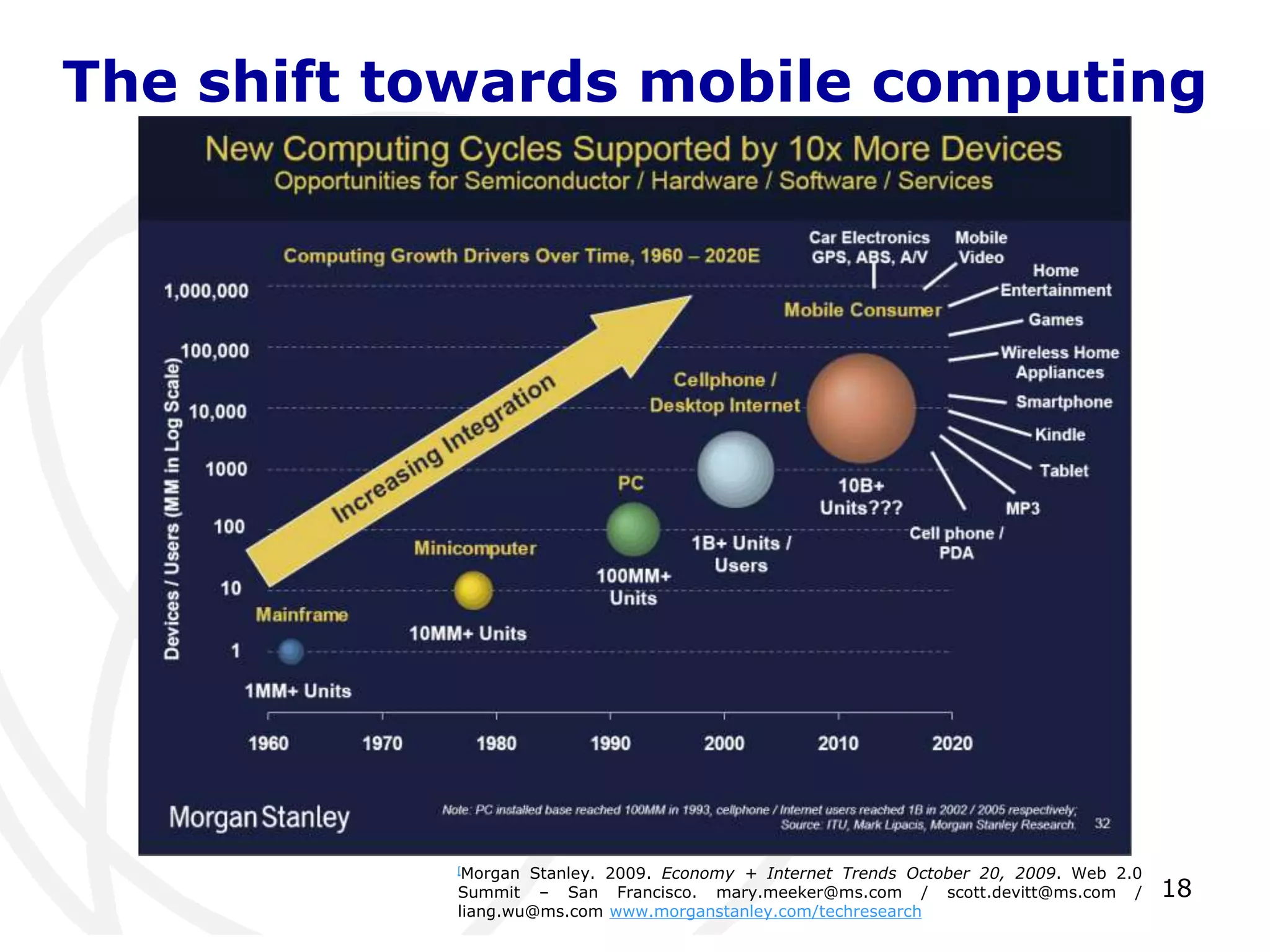
The shift towards mobile computing 
18 
[Morgan Stanley. 2009. Economy + Internet Trends October 20, 2009. Web 2.0 
Summit – San Francisco. mary.meeker@ms.com / scott.devitt@ms.com / 
liang.wu@ms.com www.morganstanley.com/techresearch
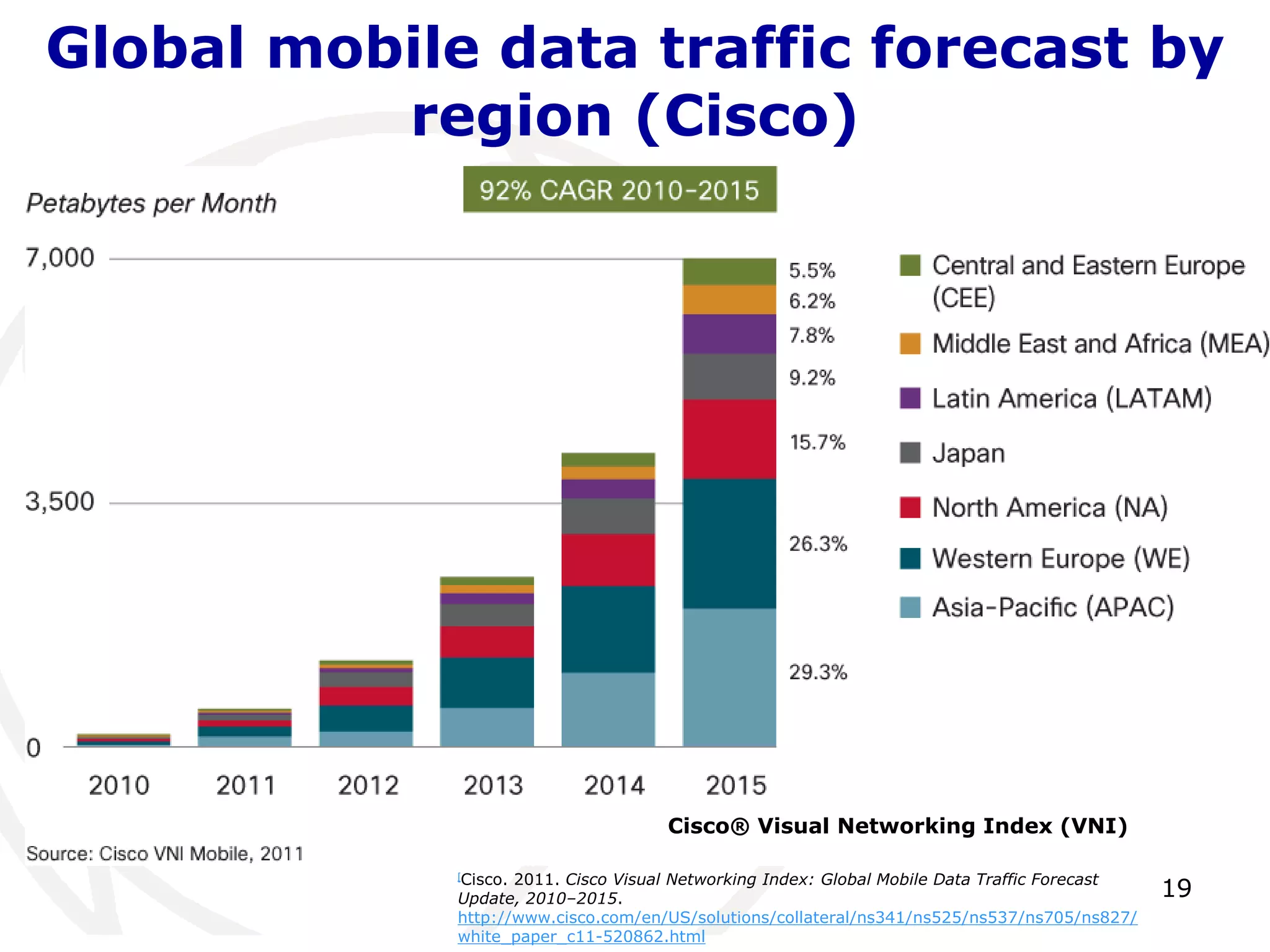
Global mobile data traffic forecast by 
region (Cisco) 
19 
Cisco® Visual Networking Index (VNI) 
[Cisco. 2011. Cisco Visual Networking Index: Global Mobile Data Traffic Forecast 
Update, 2010–2015. 
http://www.cisco.com/en/US/solutions/collateral/ns341/ns525/ns537/ns705/ns827/ 
white_paper_c11-520862.html
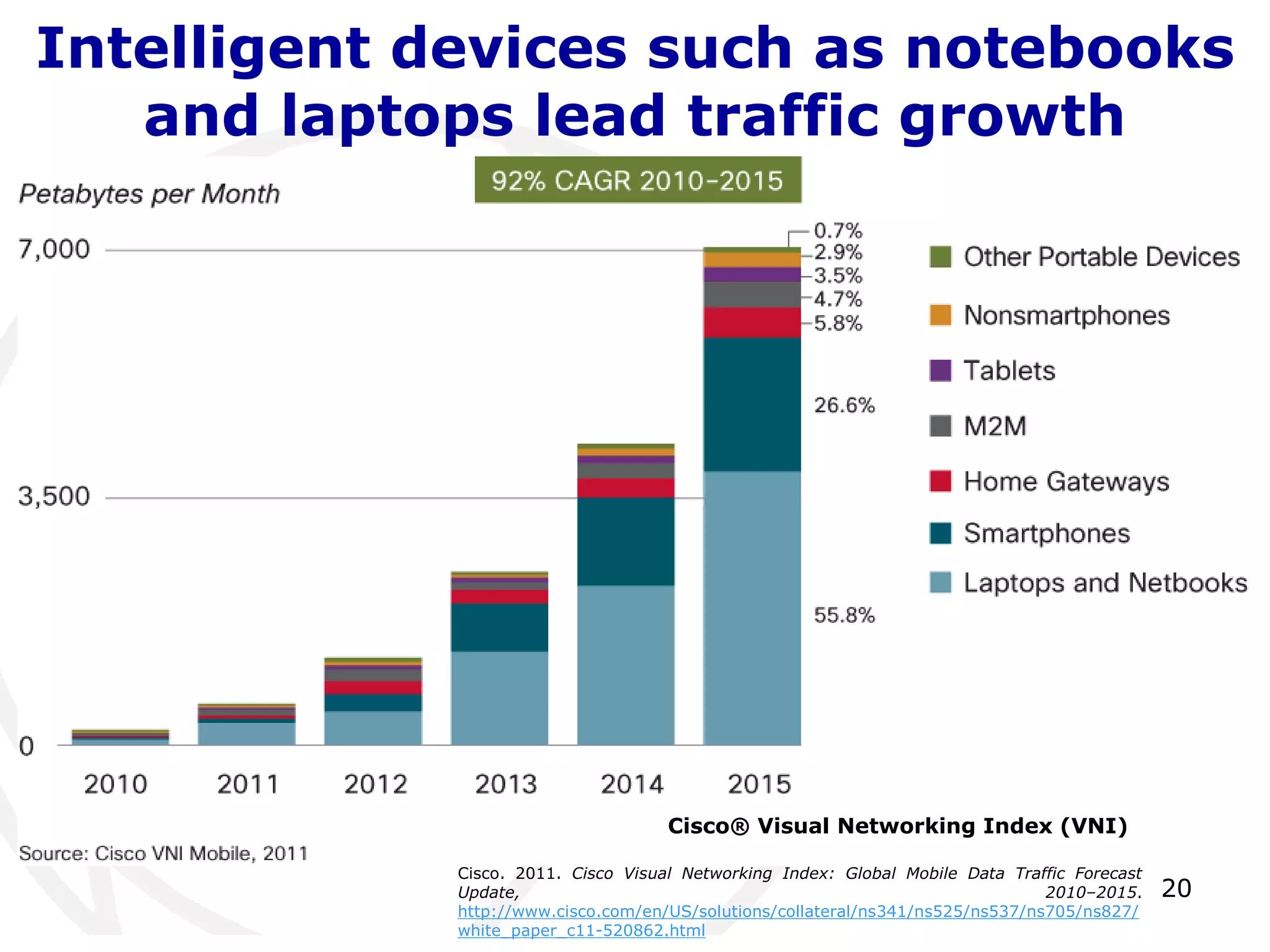
Intelligent devices such as notebooks 
and laptops lead traffic growth 
20 
Cisco® Visual Networking Index (VNI) 
Cisco. 2011. Cisco Visual Networking Index: Global Mobile Data Traffic Forecast 
Update, 2010–2015. 
http://www.cisco.com/en/US/solutions/collateral/ns341/ns525/ns537/ns705/ns827/ 
white_paper_c11-520862.html
21 
Trends: IPv6 
IPv6: 
Will allow the Internet of Things 
Will push IP to the edge of the network 
More efficient that IPv4 
More support for: 
Data / user authentication 
Data integrity 
Data confidentiality 
Etc.
22 
Trends: Broadband (1) 
Passive networking: 
Background streaming and downloading 
from ambient / environmental video 
sources: nannycams, petcams, home 
security cams, etc. 
Real time HD video: 
Internet TV 
Video communications: telepresence,… 
Ambient video
23 
Trends: Broadband (2) 
High definition video 
Transference: from TV to live HD 
video on demand over the Internet 
Silicon photonics and hybrid silicon 
lasers: 
Low cost, high bandwidth optical 
communications will affect all connected 
devices and networks
24 
Trends: Broadband (3) 
Wireless broadband: 
Exponential growth in traffic 
Will outstrip the increased revenue 
required to make it profitable 
Technical solutions: 
Offloading content to the Internet
25 
Trends: Cloud computing (1) 
Allows for Grid computing applied to 
environmental needs: 
Access to super computing resources 
Facilitates access to massive digital 
data sets online (INPE – BR, Landsat, 
etc.) 
The Global Earth Observation System 
of Systems (GEOSS) 
Google Earth, Microsoft Virtual Earth, 
etc.
26 
Trends: Cloud computing (2) 
Computing on demand increasing in 
popularity as broadband speeds rise 
Can reduce energy use of a company 
by moving cost to provider of Cloud 
services 
Can favour green energy sources as 
fiber connected Cloud service centres 
Linked to the Internet of Things 
Collection of live environmental data 
from embedded sensors in mesh nets.
27 
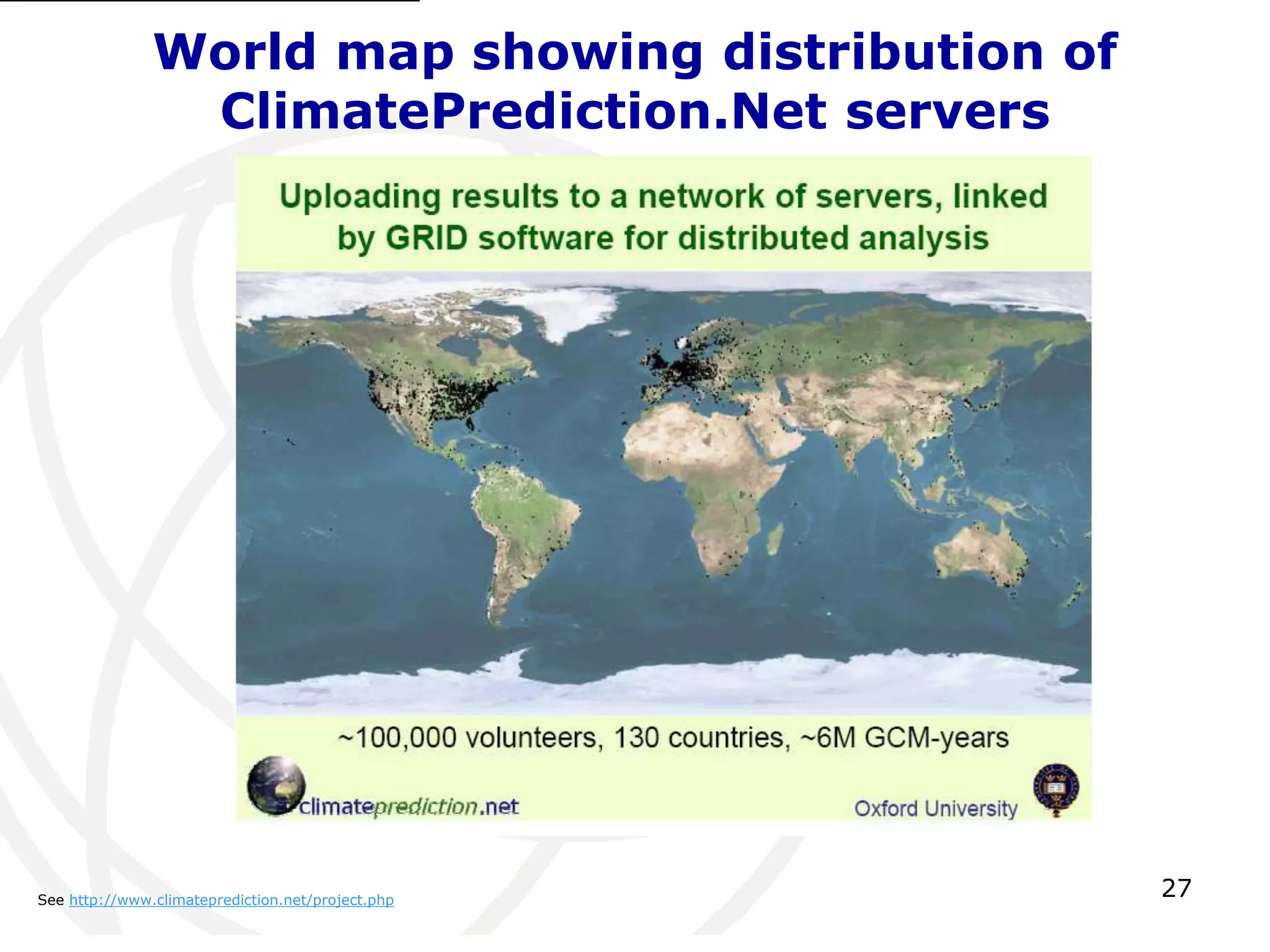
World map showing distribution of 
ClimatePrediction.Net servers 
See http://www.climateprediction.net/project.php
28 
Trends: Nanotechnology 
Greater transistor density 
More energy efficient chip designs 
Enabling Moore’s Law for many years 
to come 
Will “increase transistor speed, 
enhance energy efficiency, and 
provide more functionalities” 
Has allowed the miniaturization of 
computer memory. 
This has made the Apple iPOD a reality.
29 
Trends: wireless (1) 
Digitization of broadcasting signals 
will open more spectrum: 
Many new wireless channels, devices 
and services 
Near field communication & medium 
and longer range technologies to 
operationalize the Internet of Things 
ZigBee, 6LowPAN, WirelessHART, etc. 
c. Location aware (sometime GPS 
enabled) mobile devices or objects
30 
Trends: wireless (2) 
Augmented reality that is facilitated 
through the use of wireless devices 
The proliferation of wireless devices 
enables social networking & vice 
versa
31 
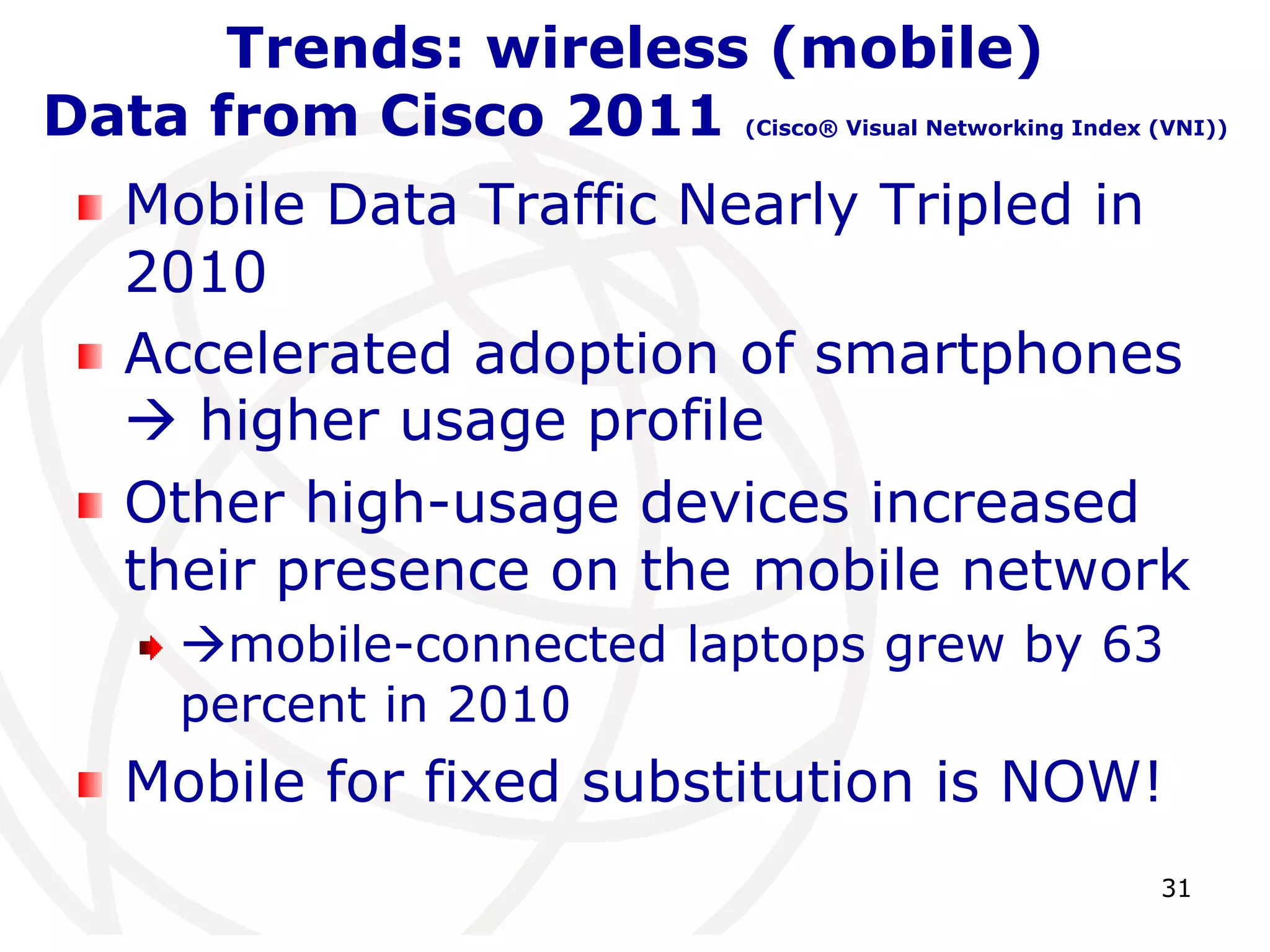
Trends: wireless (mobile) 
Data from Cisco 2011 (Cisco® Visual Networking Index (VNI)) 
Mobile Data Traffic Nearly Tripled in 
2010 
Accelerated adoption of smartphones 
 higher usage profile 
Other high-usage devices increased 
their presence on the mobile network 
mobile-connected laptops grew by 63 
percent in 2010 
Mobile for fixed substitution is NOW!
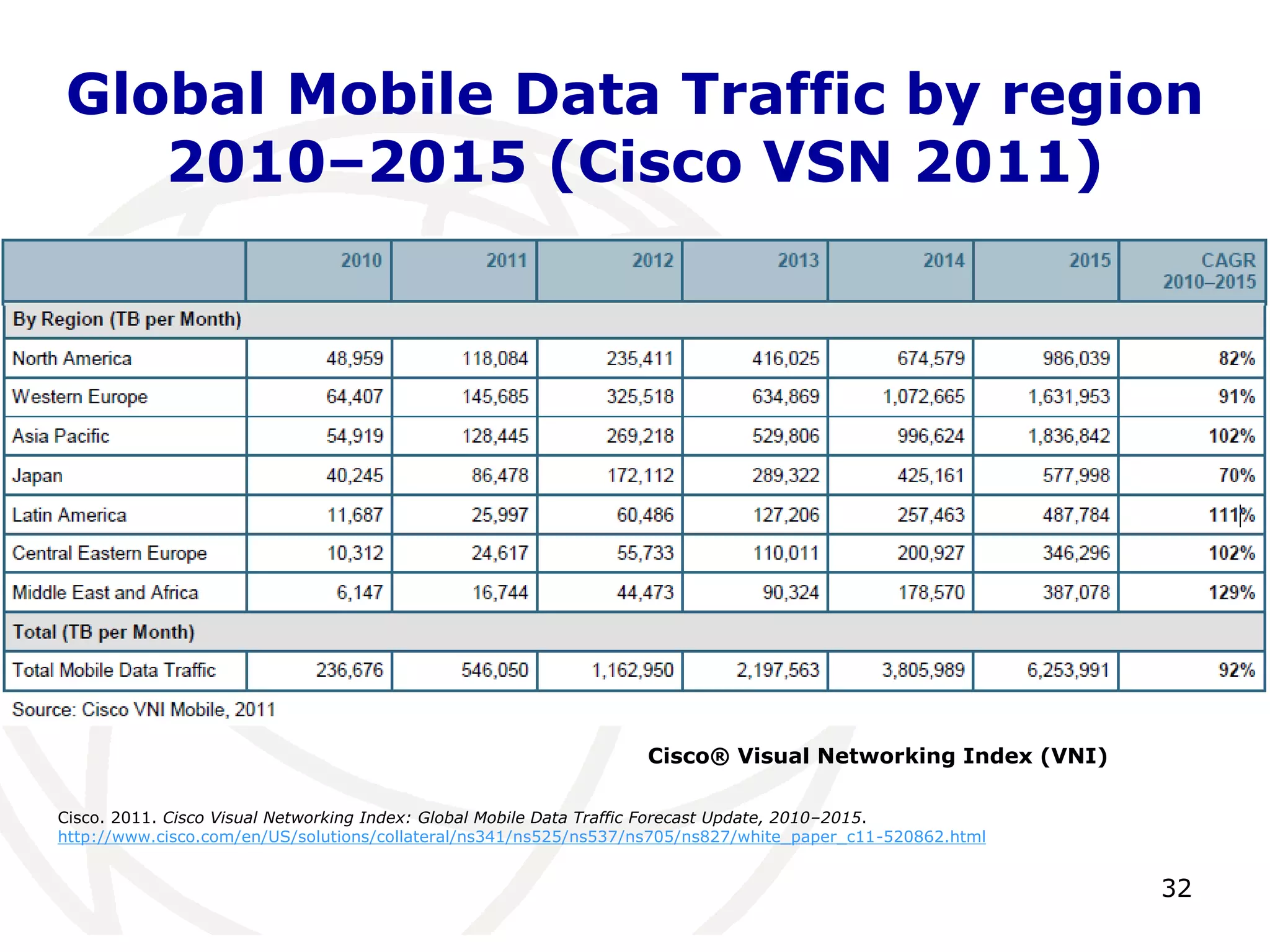
Global Mobile Data Traffic by region 
2010–2015 (Cisco VSN 2011) 
Cisco® Visual Networking Index 
(VNI) 
32 
Cisco® Visual Networking Index (VNI) 
Cisco. 2011. Cisco Visual Networking Index: Global Mobile Data Traffic Forecast Update, 2010–2015. 
http://www.cisco.com/en/US/solutions/collateral/ns341/ns525/ns537/ns705/ns827/white_paper_c11-520862.html
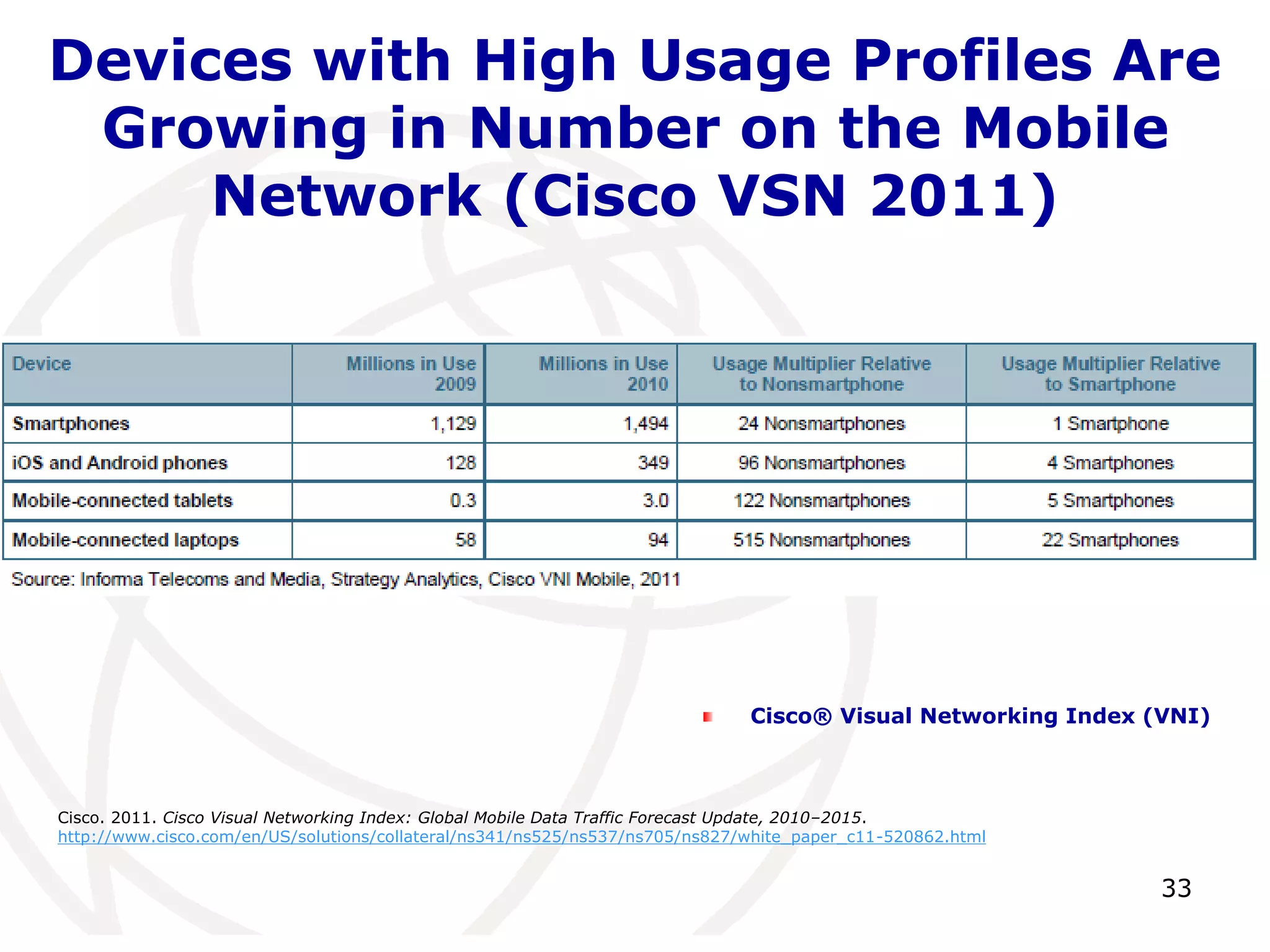
Devices with High Usage Profiles Are 
Growing in Number on the Mobile 
Network (Cisco VSN 2011) 
Cisco® Visual Networking Index (VNI) 
33 
Cisco. 2011. Cisco Visual Networking Index: Global Mobile Data Traffic Forecast Update, 2010–2015. 
http://www.cisco.com/en/US/solutions/collateral/ns341/ns525/ns537/ns705/ns827/white_paper_c11-520862.html
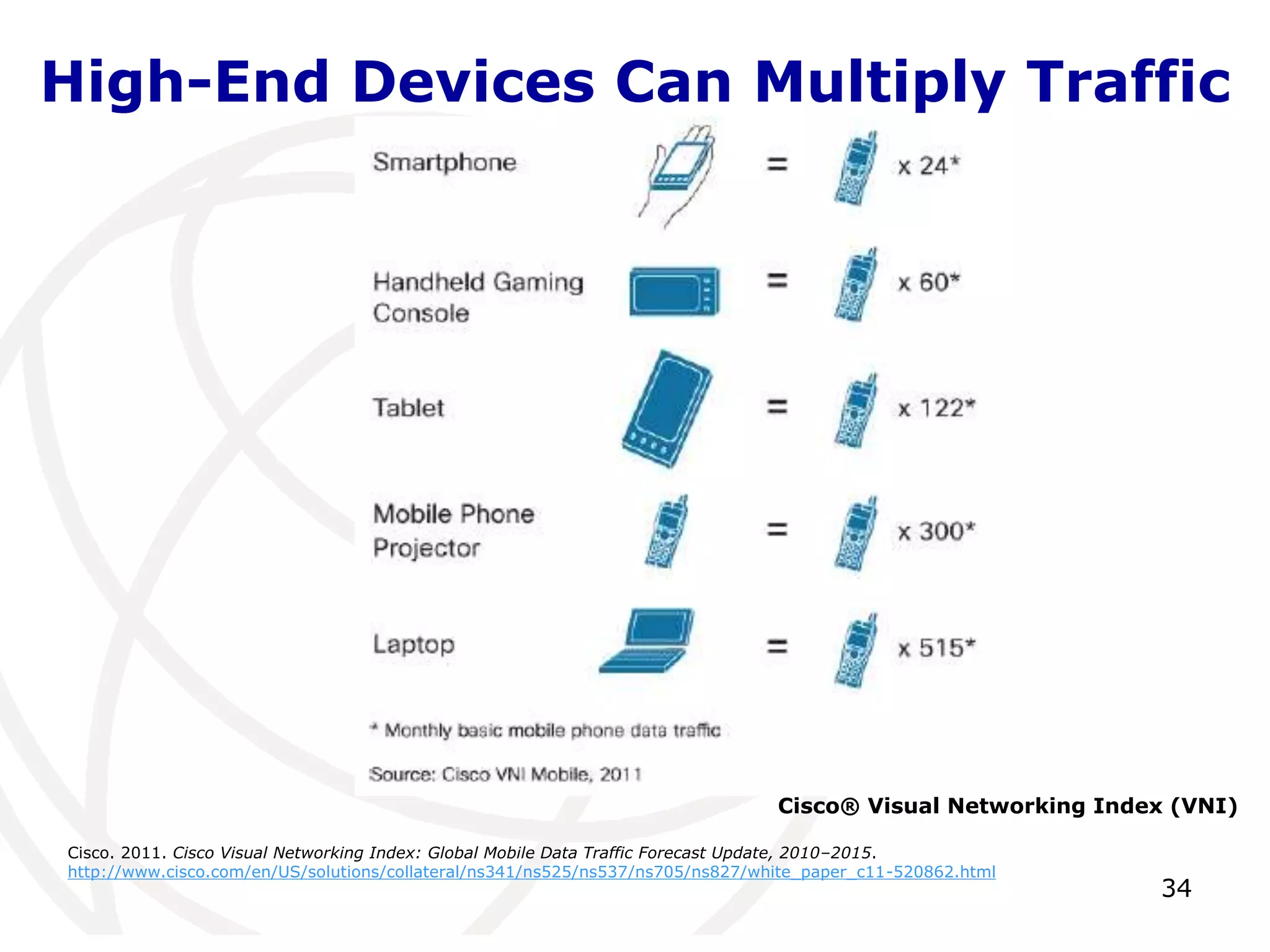
High-End Devices Can Multiply Traffic 
Cisco® Visual Networking Index (VNI) 
34 
Cisco. 2011. Cisco Visual Networking Index: Global Mobile Data Traffic Forecast Update, 2010–2015. 
http://www.cisco.com/en/US/solutions/collateral/ns341/ns525/ns537/ns705/ns827/white_paper_c11-520862.html
35 
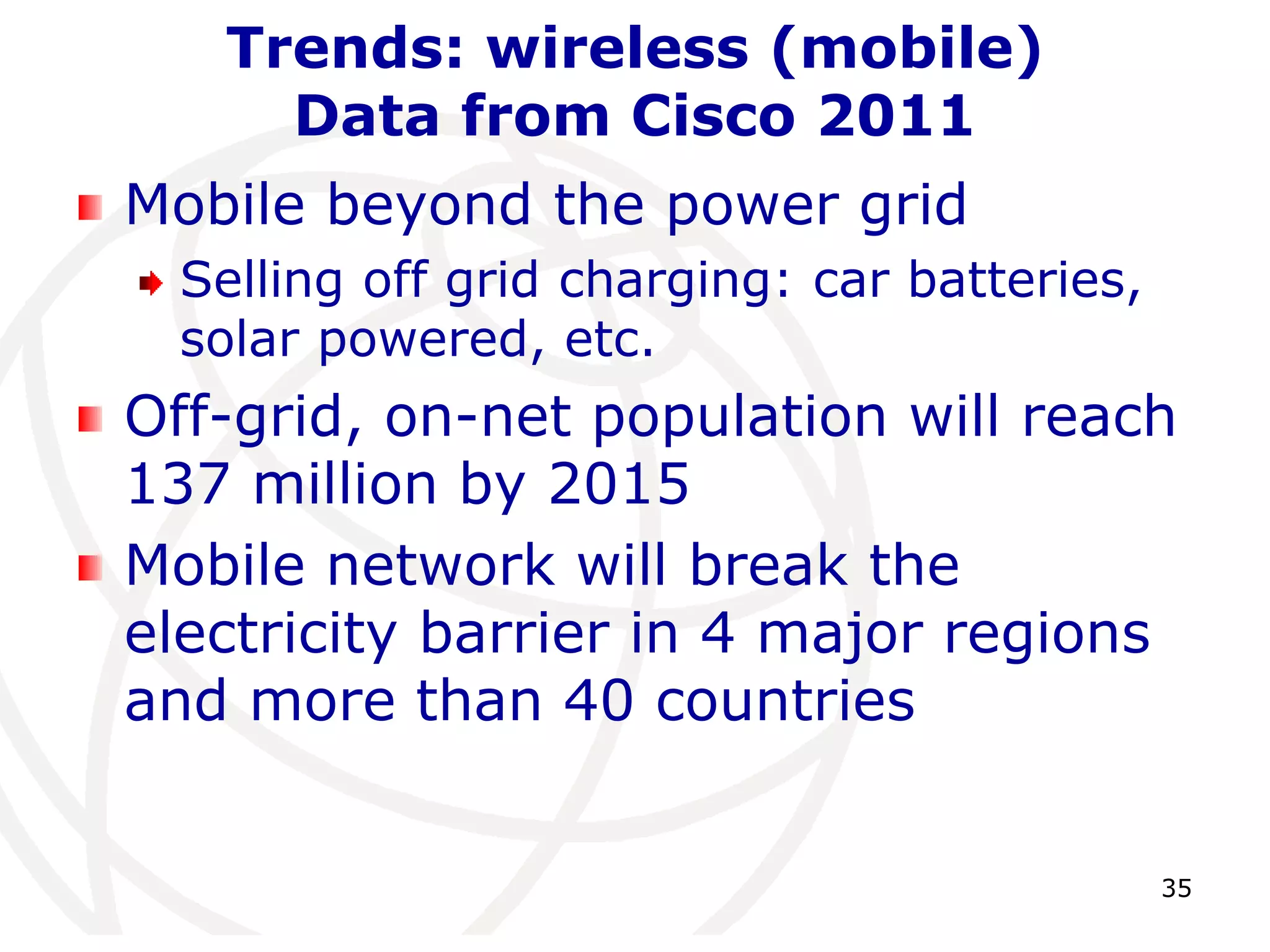
Trends: wireless (mobile) 
Data from Cisco 2011 
Mobile beyond the power grid 
Selling off grid charging: car batteries, 
solar powered, etc. 
Off-grid, on-net population will reach 
137 million by 2015 
Mobile network will break the 
electricity barrier in 4 major regions 
and more than 40 countries
36 
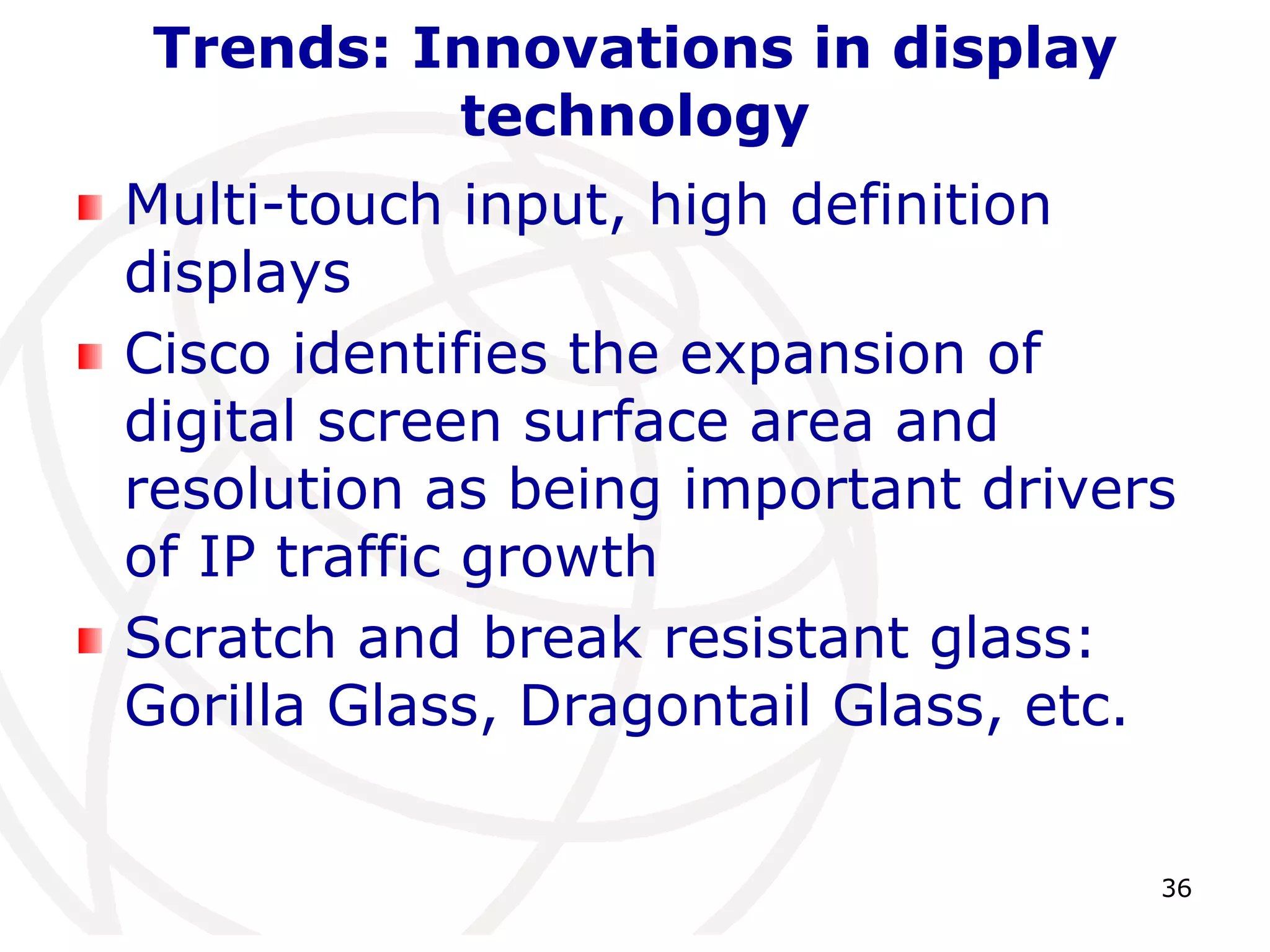
Trends: Innovations in display 
technology 
Multi-touch input, high definition 
displays 
Cisco identifies the expansion of 
digital screen surface area and 
resolution as being important drivers 
of IP traffic growth 
Scratch and break resistant glass: 
Gorilla Glass, Dragontail Glass, etc.
Trends: GIS & related visualization 
37 
technologies 
Increased use of GIS 
If its visual, its easier to measure & 
understand 
Smartphones as visualization tools 
Building information modeling (BIM) 
software for building & city wide 
energy analysis
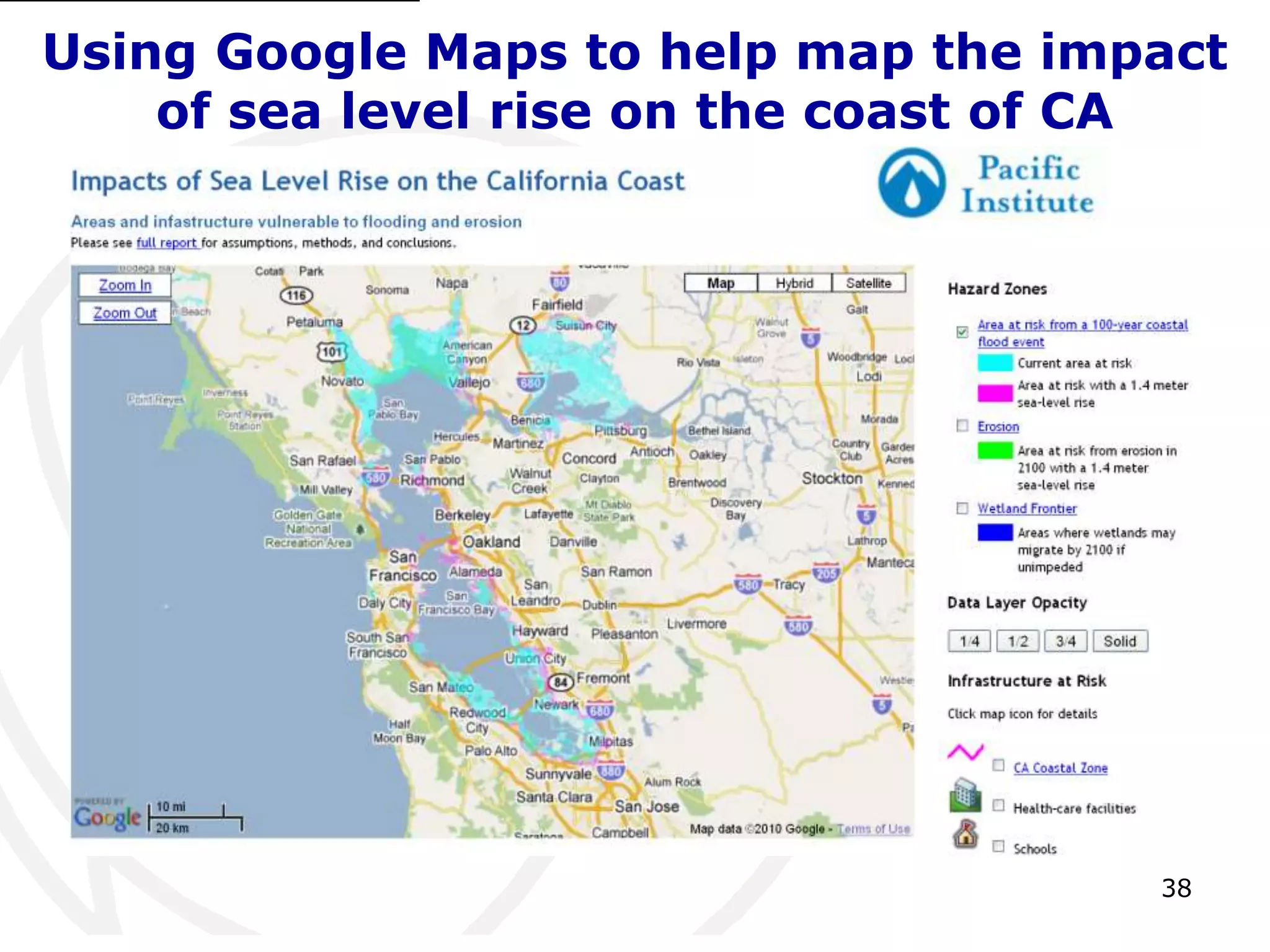
Using Google Maps to help map the impact 
38 
of sea level rise on the coast of CA
Trends: Improved & greener batteries 
39 
(1) 
Quest for low or portable power 
sources and batteries 
Self/ambient powered and/or power 
harvesting devices for sensors, RFID & 
other embedded devices.
Trends: Improved & greener batteries 
40 
(2) 
Standard battery for all portable 
devices (ITU) 
Higher capacity energy storage 
technologies for use in: 
Smart grid 
Electric vehicles
Trends: the Internet of Things (1) 
Growth in machine to machine 
(M2M) communications - a significant 
opportunity for MNOs 
41 
M2M is driving exponential growth in 
connections 
Revenue from services to embedded 
modems in M2M applications to grow 
exponentially until at 2014
Trends: the Internet of Things (2) 
42 
GSM Association (GSMA) has 
launched an “embedded SIM” 
initiative to support the IOT 
To speed up development of M2M 
services 
Make it easier to bring mobile 
broadband to non-traditional devices: 
cameras, MP3 players, navigation 
devices and e-Readers & smart meters
Trends: the Internet of Things (3) 
43 
87 million embedded mobile M2M 
connections last year 
… will reach 428 million by 2014 
Embedded SIM cards in mobile 
phones / smartphones: 
Allow users direct control over their 
connections: ability to select carrier 
networks of choice, bypassing MNOs, 
Allow to connect to the Internet of 
Things without MNO.
Trends: the Internet of Things (4) 
44 
Global revenues from IOT: 
30 x higher than the Internet in the 
smart transportation sector alone 
(Forrester Research) 
Governments have made significant 
investments in IOT: EU, Japan, 
South Korea, China, USA 
In China: revenues from IOT will 
reach 750 billion RMB (USD 112 
billion) by 2015
Trends: the Internet of Things (5) 
The number of devices connected to 
the Internet: > 5 billion @ Aug. 2010 
In an online presentation, an IBM 
researcher reports that there will be 
a trillion Internet connected devices 
by 2011 
A VP at Ericsson predicted that “50 
billion connected devices are coming 
to cellular networks in the next 
decade” 
45
46 
Trends: sensor technology (1) 
Radio-frequency identification (RFID) 
tags 
Low power operating sensors 
(energy harvesting motes) 
Able to withstand harsh 
environments 
Self organizing, self configuring, self-healing
47 
Trends: sensor technology (2) 
Low or zero maintenance 
Bandwidth efficient 
High data capacity 
Many open standards are used, but 
not all standardized. Many corporate, 
i.e. proprietary technologies in the 
market place 
Efforts to standardize on IPv6 
compliant IP (Contiki operating 
system) micro stack
48 
Trends: sensor technology (3) 
Sensors embedded in devices and 
sensor nets (motes) 
Smartphone / mobile device 
Types of sensors: 
Physical: T, P (altitude), density, motion 
(accelerometers), light (cameras and 
wavelength sensors – infra red – 
thermal sensors, etc.), gravity, etc.
49 
Trends: sensor technology (4) 
Types of sensors: 
Chemical sensors evolving as well: wet 
chemistry sensors more difficult (unless 
in aqueous environment), gaseous 
sensors easier to implement 
Motion imagery surveillance 
Wide Area Motion Imagery (WAMI) 
Security application with environmental 
uses
Wireless sensor networks (WSNs -1) 
50 
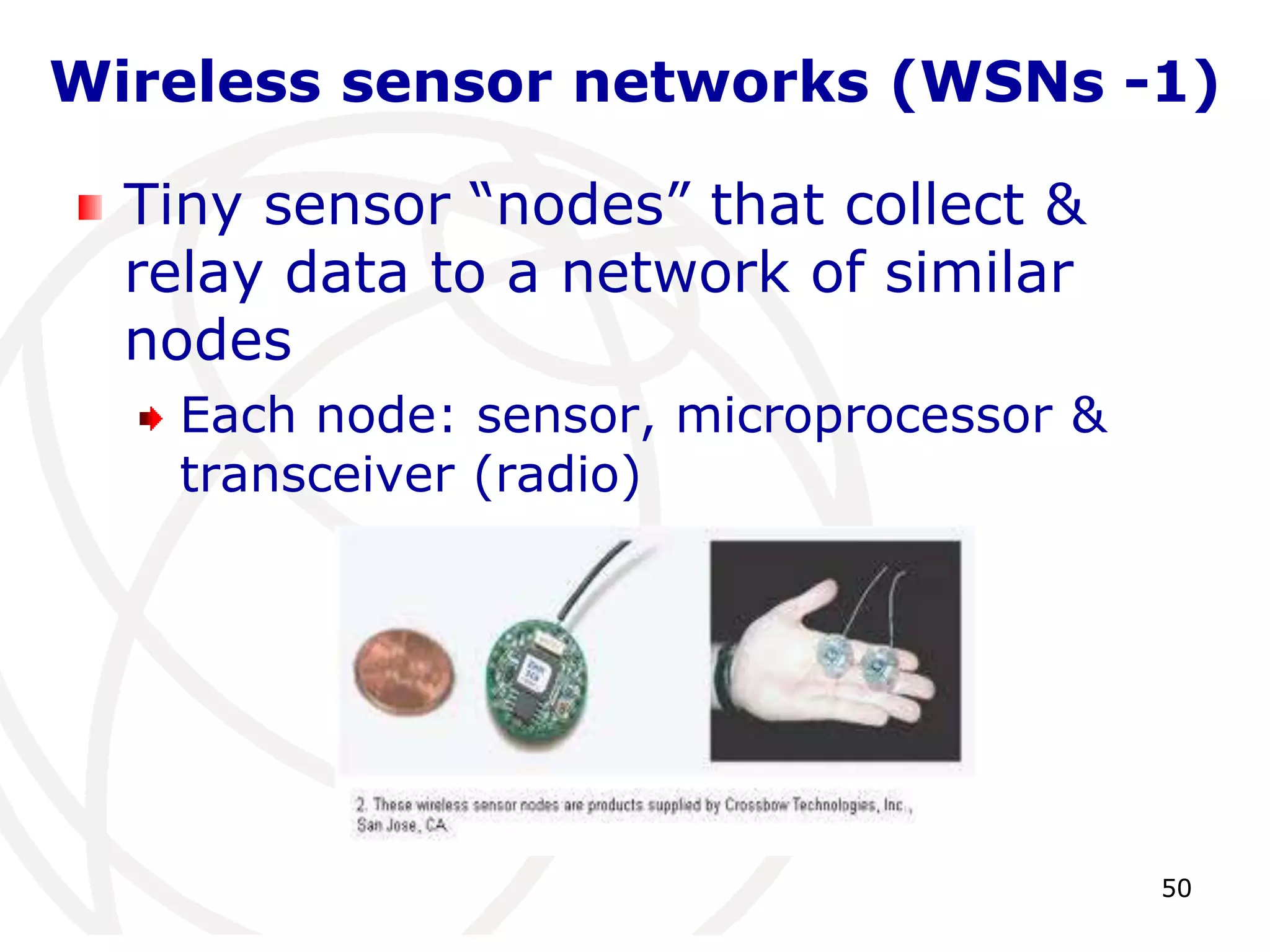
Tiny sensor “nodes” that collect & 
relay data to a network of similar 
nodes 
Each node: sensor, microprocessor & 
transceiver (radio)
Wireless sensor networks (WSNs -2) 
51 
Spatially distributed autonomous 
sensors 
That cooperatively monitor physical 
&/or chemical parameters: 
T, P, sounds, vibration, motion 
Pollutants, gases, 
Limited power 
Energy saving communication 
protocols 
Short range
Wireless sensor networks (WSNs -3) 
52 
Applications 
Homeland security 
Monitoring of space assets for 
potential and human-made threats in 
space, 
Ground based monitoring of both 
land and water 
Intelligence gathering for defense 
Environmental monitoring 
Urban warfare
Wireless sensor networks (WSNs -4) 
53 
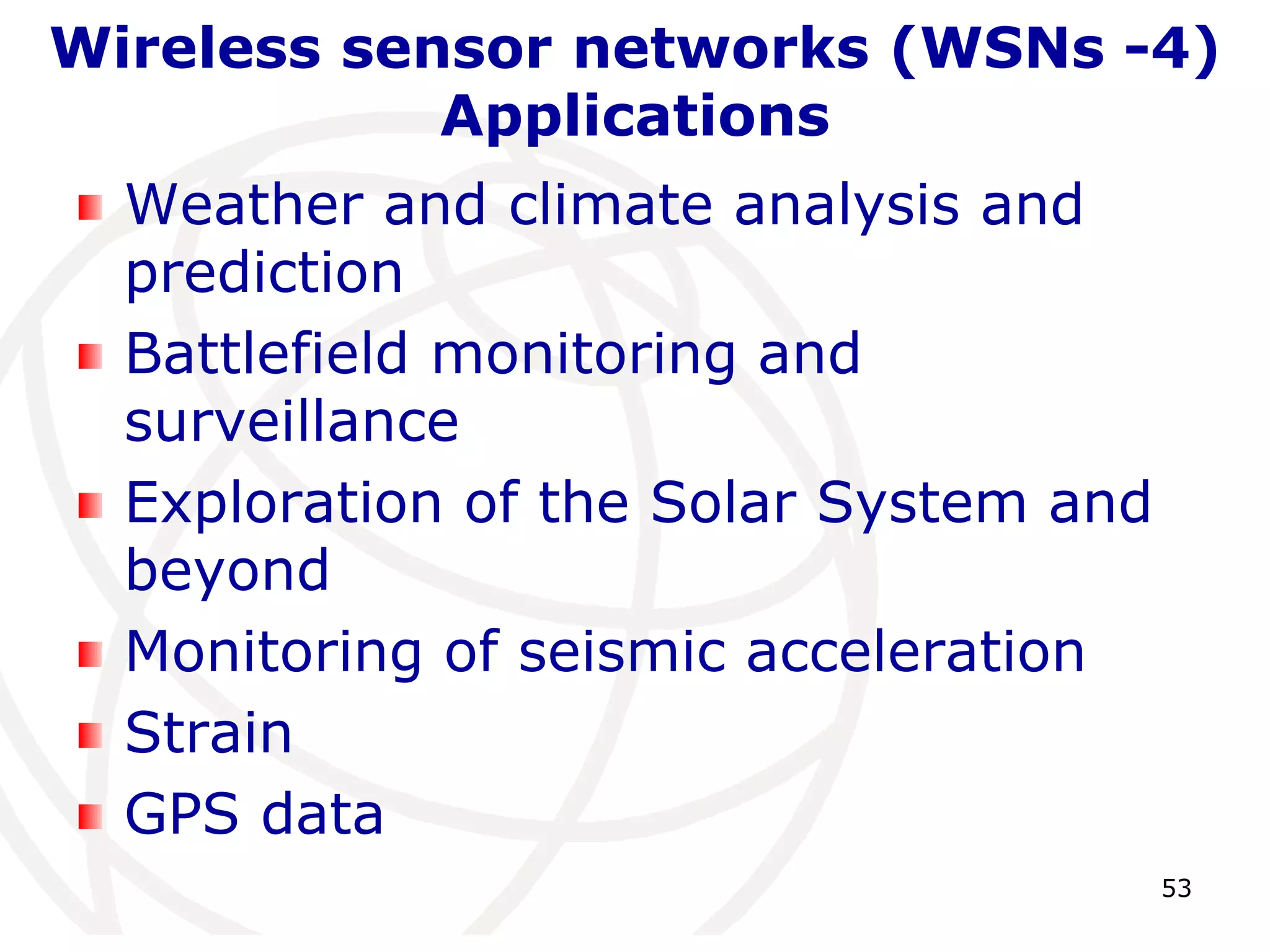
Applications 
Weather and climate analysis and 
prediction 
Battlefield monitoring and 
surveillance 
Exploration of the Solar System and 
beyond 
Monitoring of seismic acceleration 
Strain 
GPS data
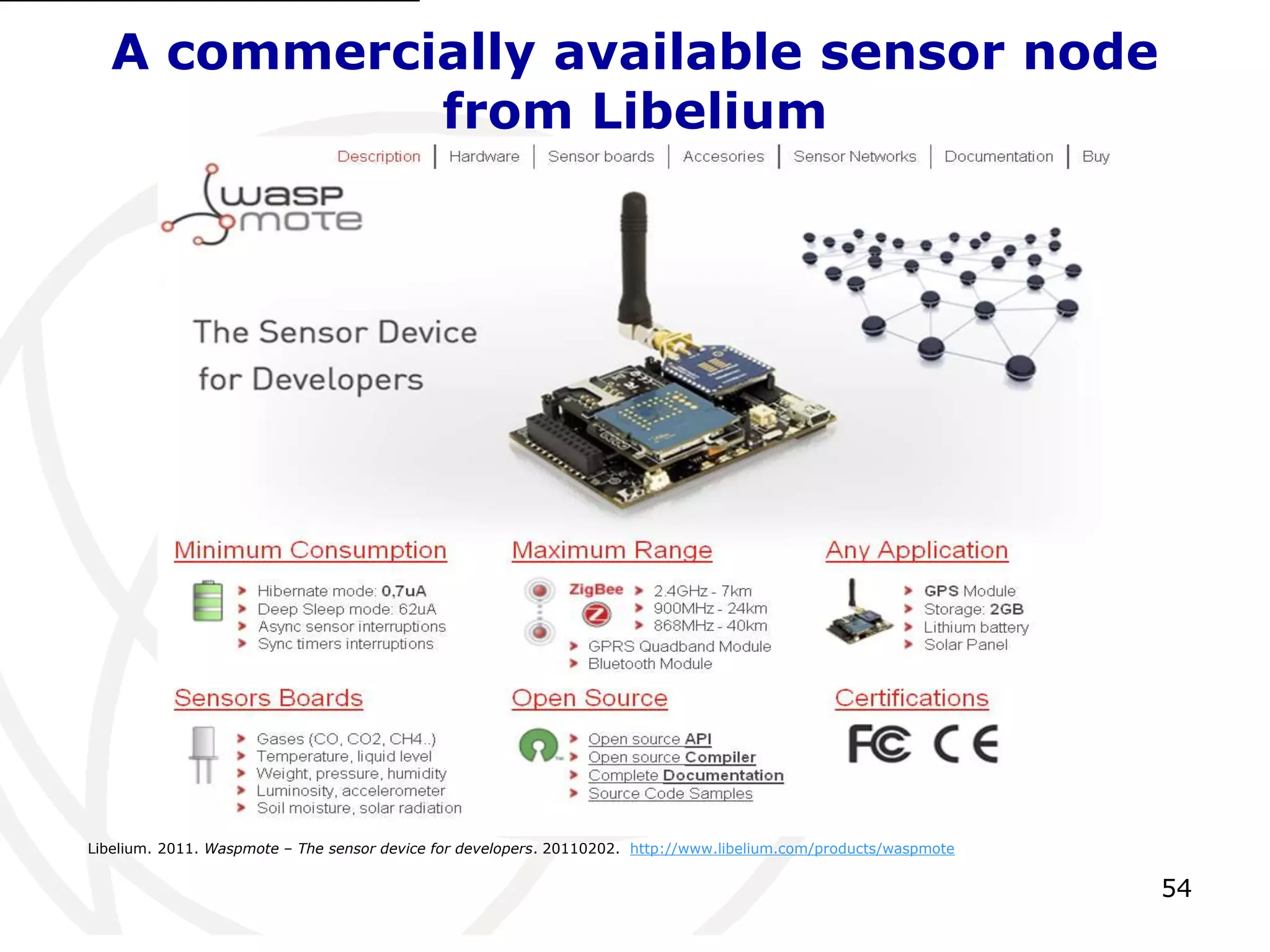
54 
A commercially available sensor node 
from Libelium 
Libelium. 2011. Waspmote – The sensor device for developers. 20110202. http://www.libelium.com/products/waspmote
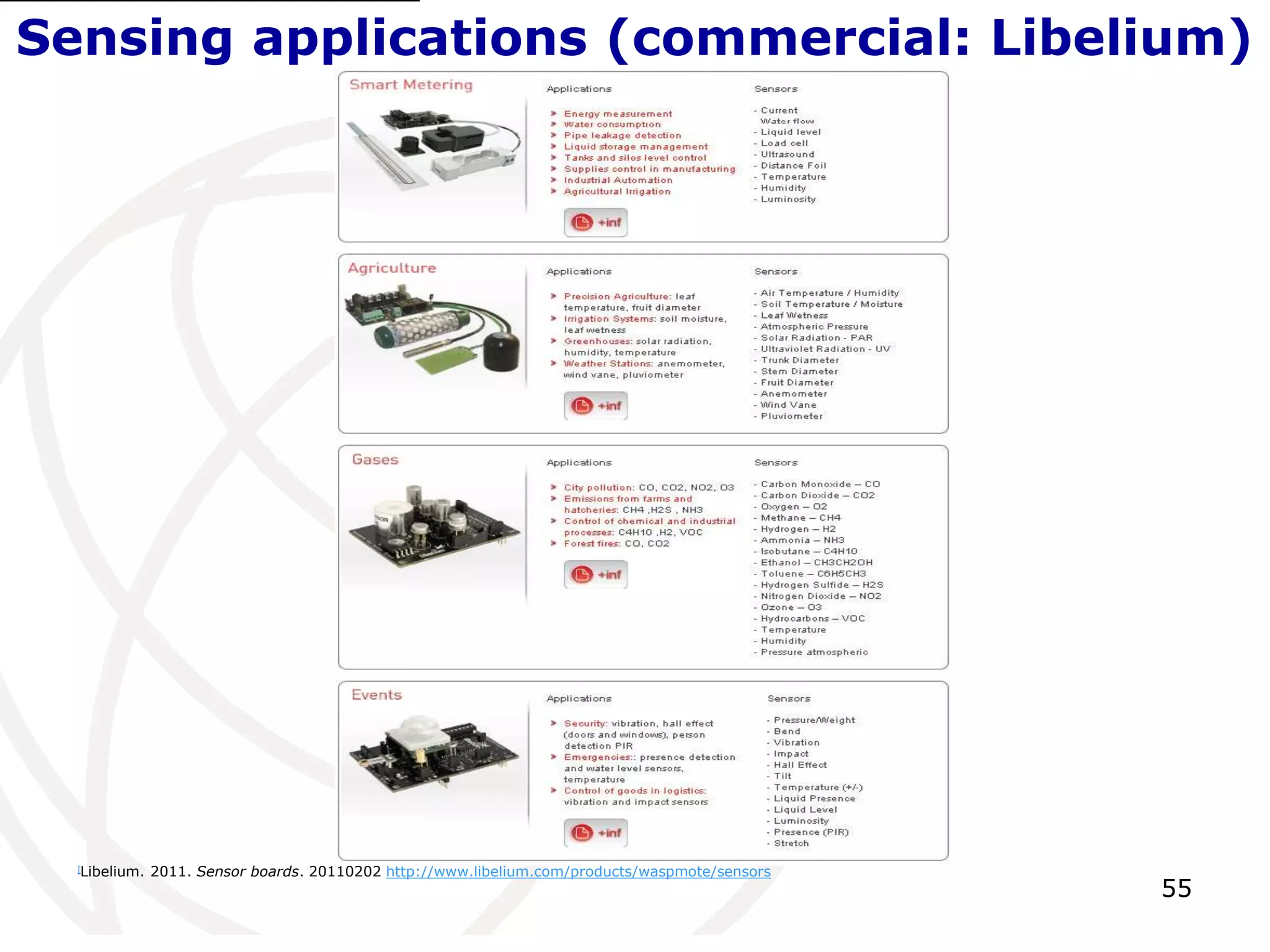
Sensing applications (commercial: Libelium) 
55 
[Libelium. 2011. Sensor boards. 20110202 http://www.libelium.com/products/waspmote/sensors
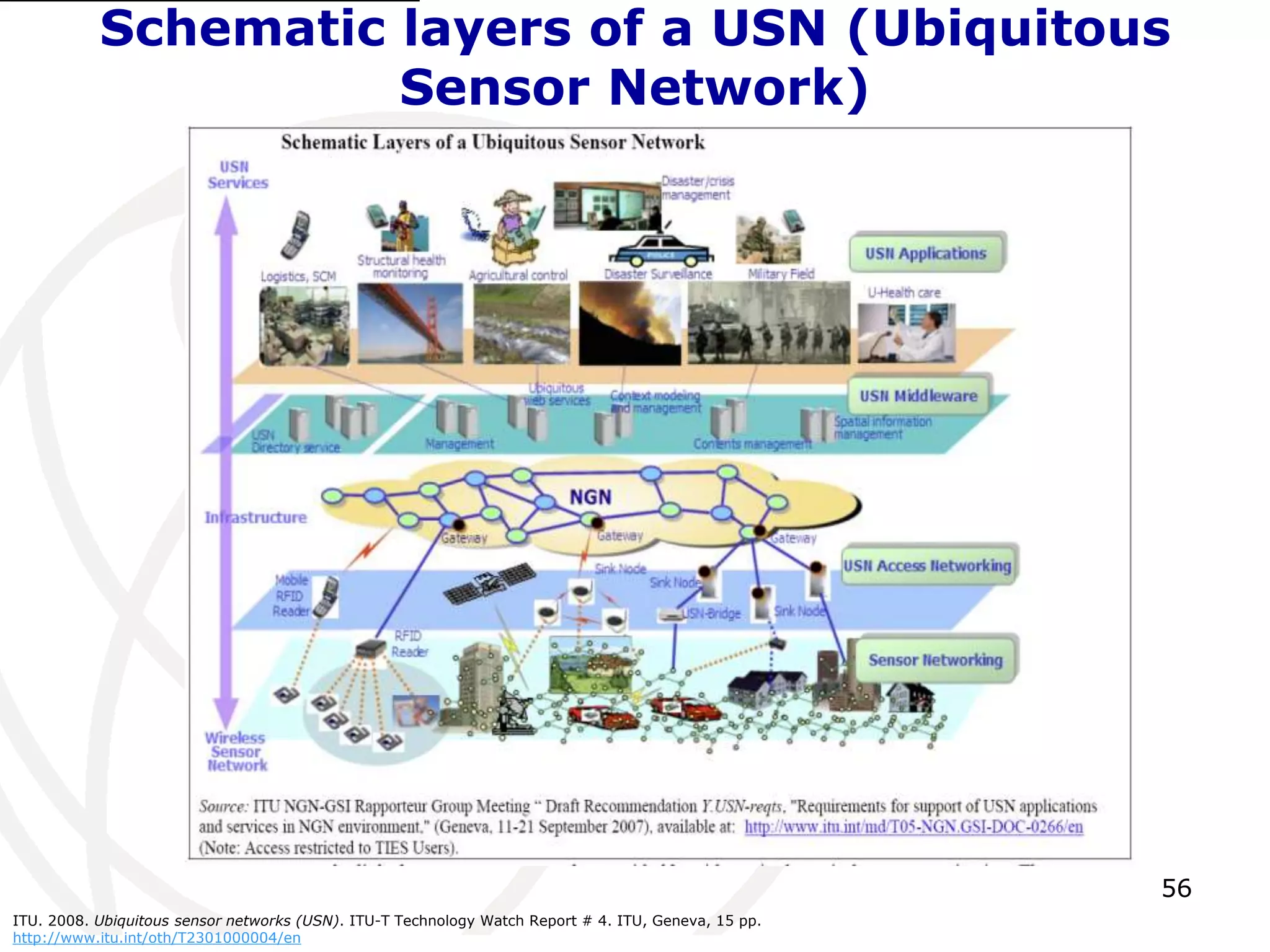
Schematic layers of a USN (Ubiquitous 
56 
Sensor Network) 
ITU. 2008. Ubiquitous sensor networks (USN). ITU-T Technology Watch Report # 4. ITU, Geneva, 15 pp. 
http://www.itu.int/oth/T2301000004/en
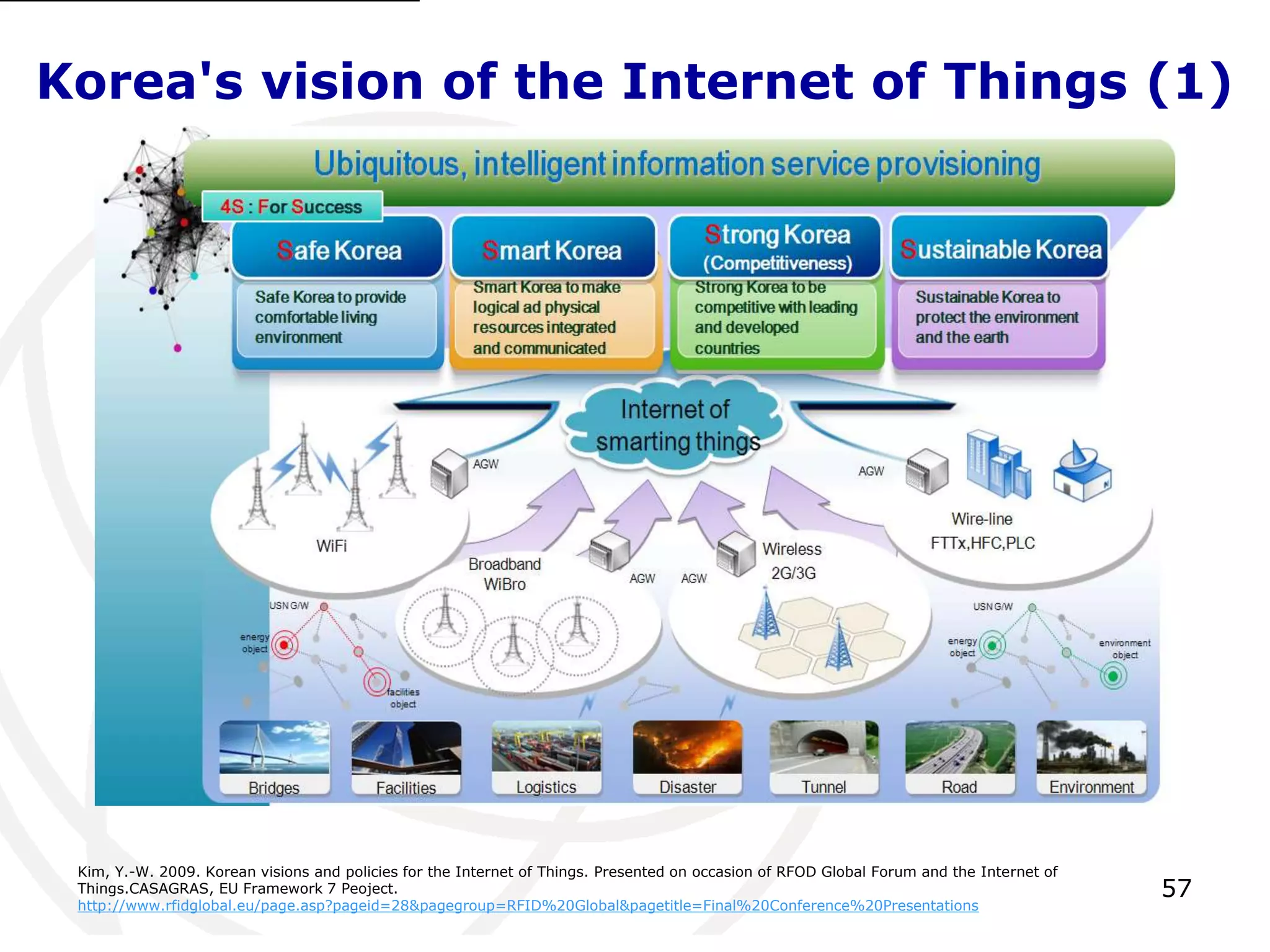
Korea's vision of the Internet of Things (1) 
57 
Kim, Y.-W. 2009. Korean visions and policies for the Internet of Things. Presented on occasion of RFOD Global Forum and the Internet of 
Things.CASAGRAS, EU Framework 7 Peoject. 
http://www.rfidglobal.eu/page.asp?pageid=28&pagegroup=RFID%20Global&pagetitle=Final%20Conference%20Presentations
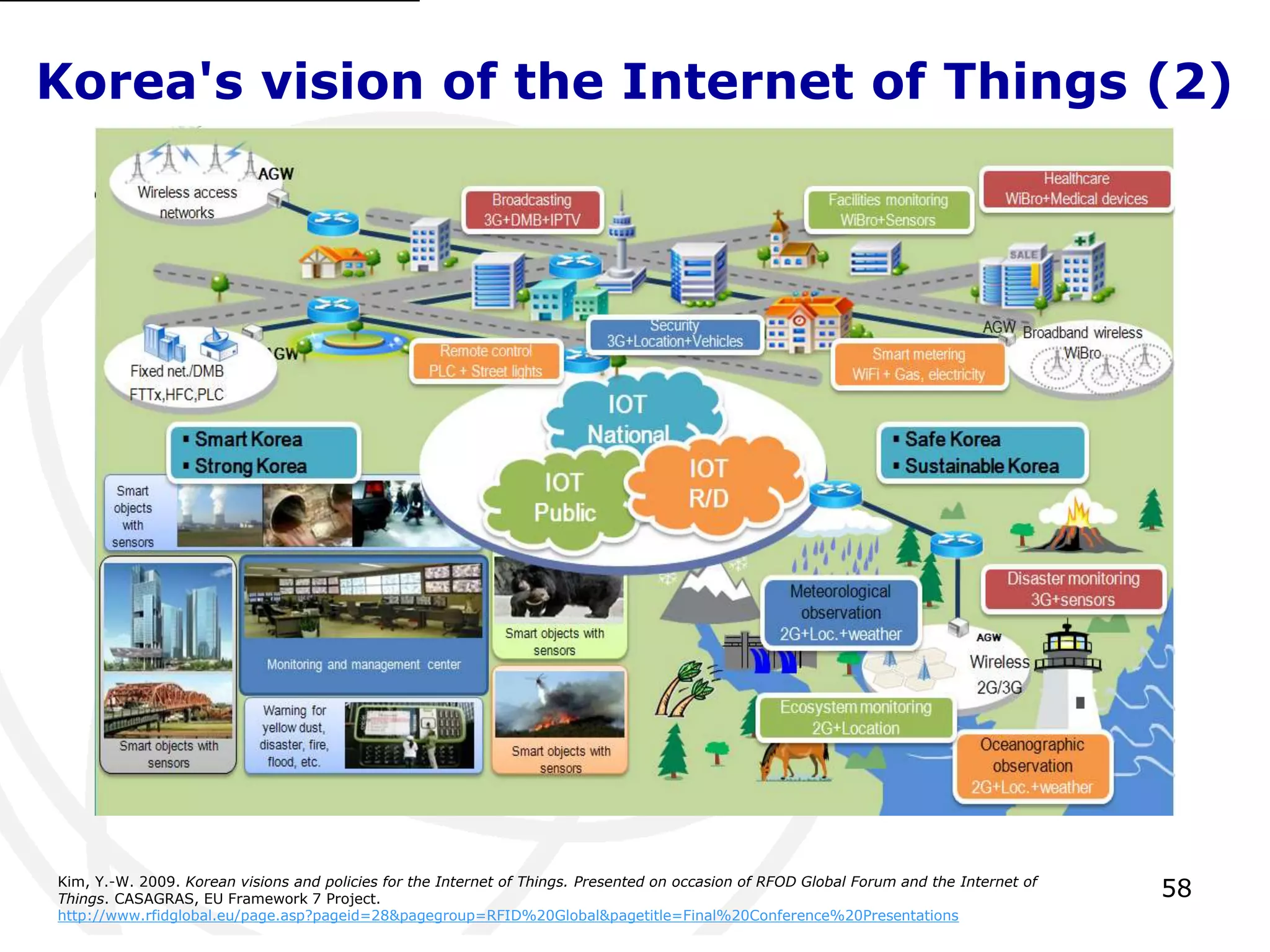
Korea's vision of the Internet of Things (2) 
58 
Kim, Y.-W. 2009. Korean visions and policies for the Internet of Things. Presented on occasion of RFOD Global Forum and the Internet of 
Things. CASAGRAS, EU Framework 7 Project. 
http://www.rfidglobal.eu/page.asp?pageid=28&pagegroup=RFID%20Global&pagetitle=Final%20Conference%20Presentations
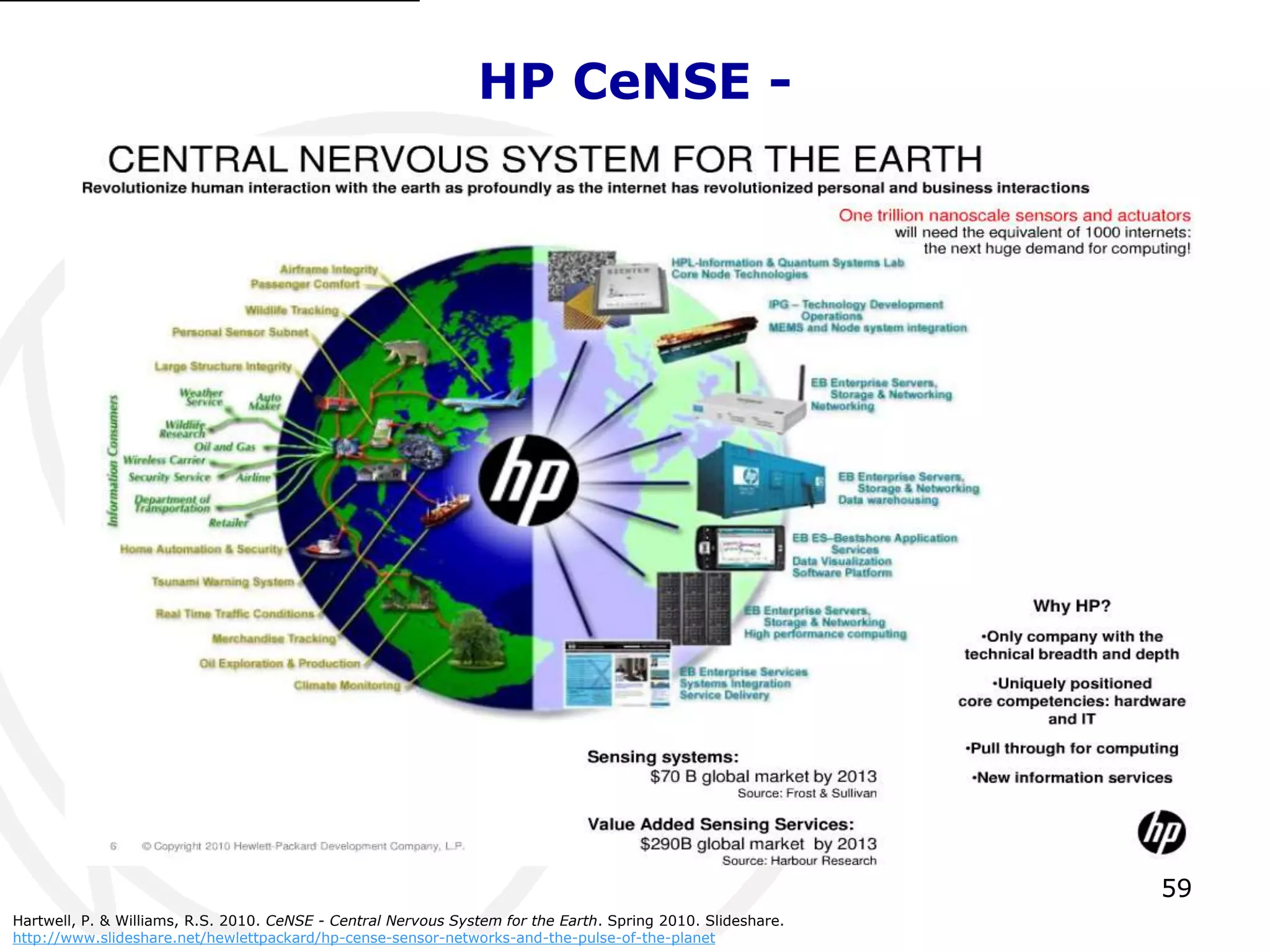
59 
HP CeNSE - 
Hartwell, P. & Williams, R.S. 2010. CeNSE - Central Nervous System for the Earth. Spring 2010. Slideshare. 
http://www.slideshare.net/hewlettpackard/hp-cense-sensor-networks-and-the-pulse-of-the-planet
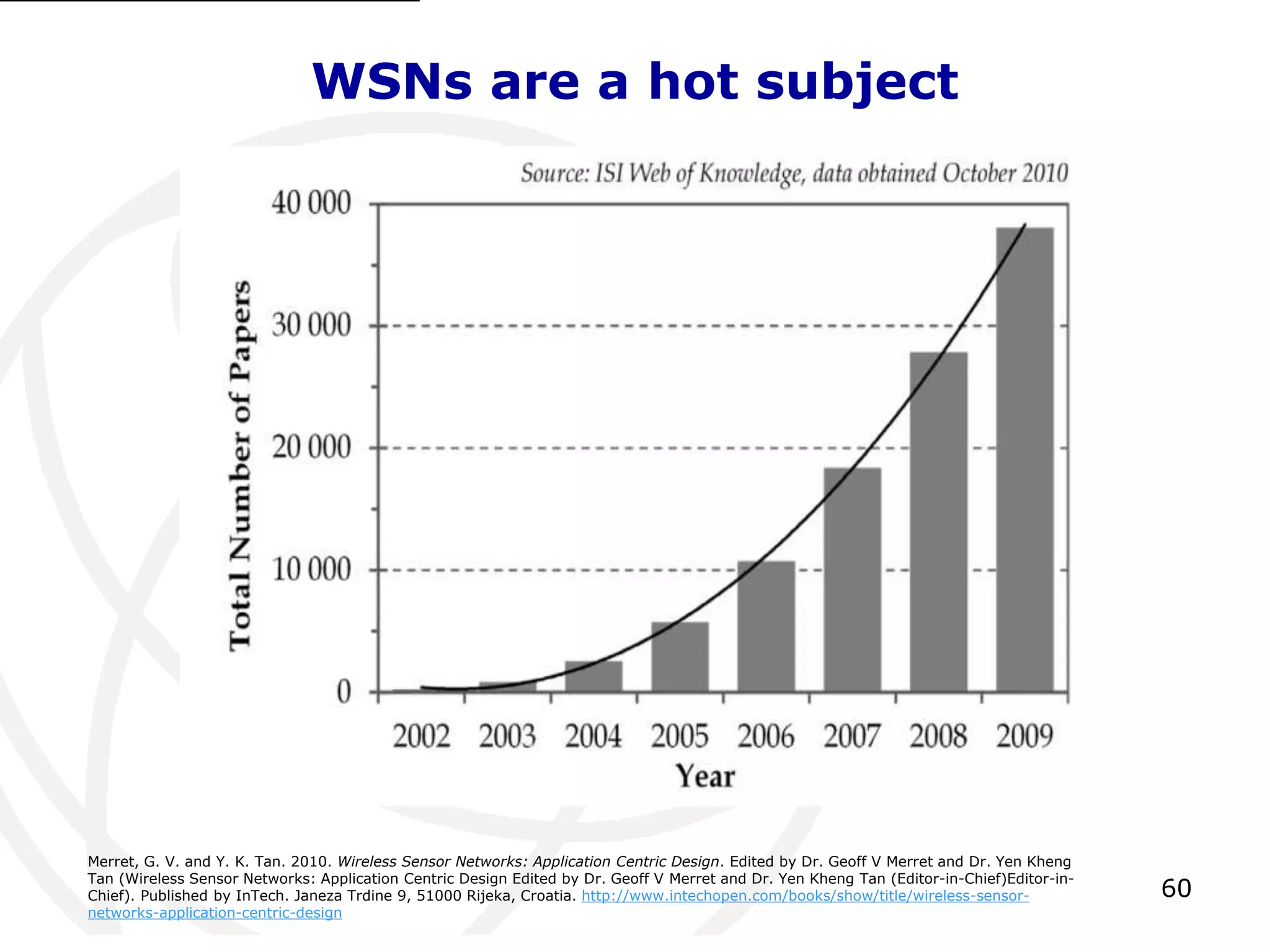
60 
WSNs are a hot subject 
Merret, G. V. and Y. K. Tan. 2010. Wireless Sensor Networks: Application Centric Design. Edited by Dr. Geoff V Merret and Dr. Yen Kheng 
Tan (Wireless Sensor Networks: Application Centric Design Edited by Dr. Geoff V Merret and Dr. Yen Kheng Tan (Editor-in-Chief)Editor-in- 
Chief). Published by InTech. Janeza Trdine 9, 51000 Rijeka, Croatia. http://www.intechopen.com/books/show/title/wireless-sensor-networks- 
application-centric-design
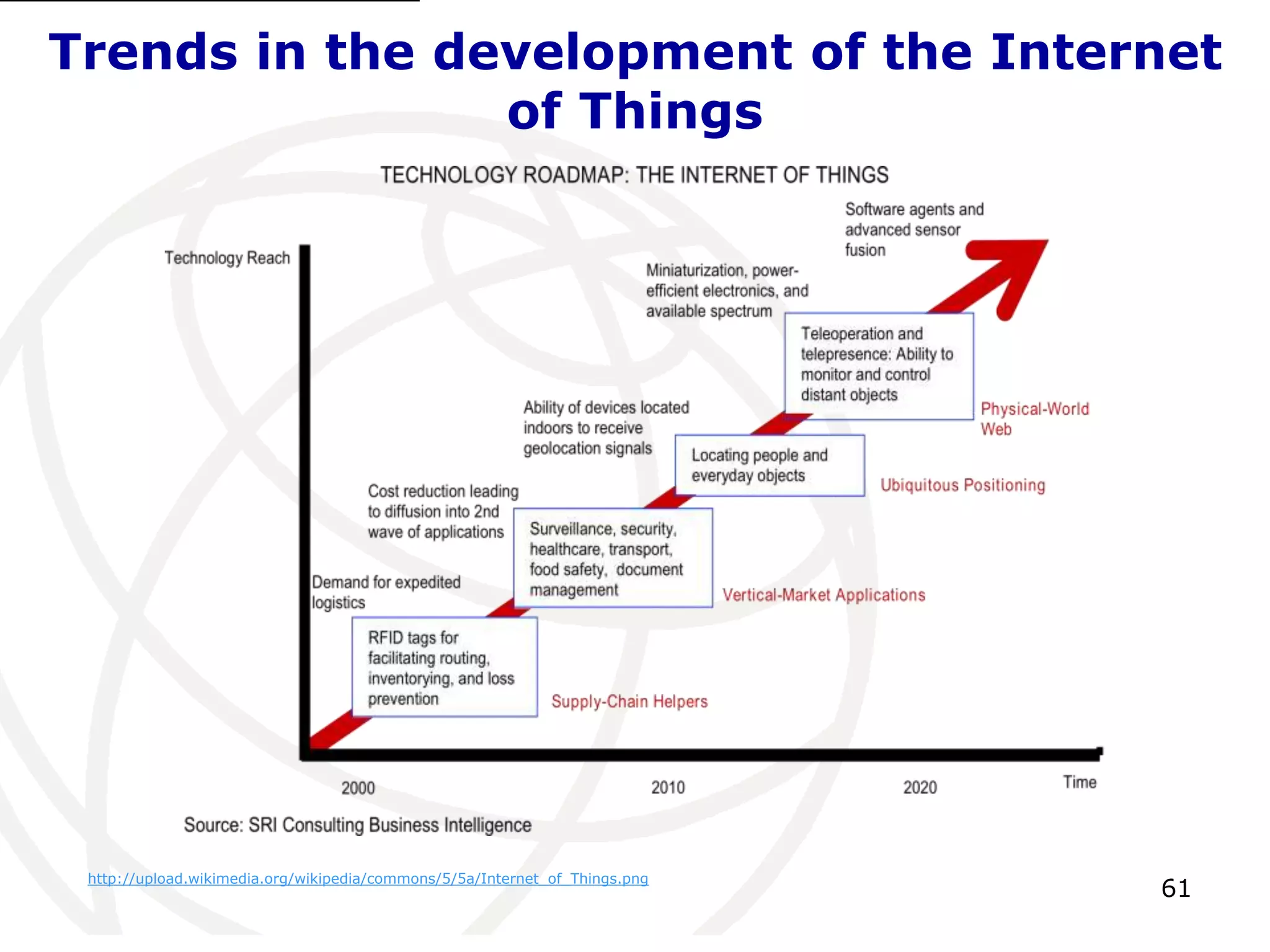
Trends in the development of the Internet 
61 
of Things 
http://upload.wikimedia.org/wikipedia/commons/5/5a/Internet_of_Things.png
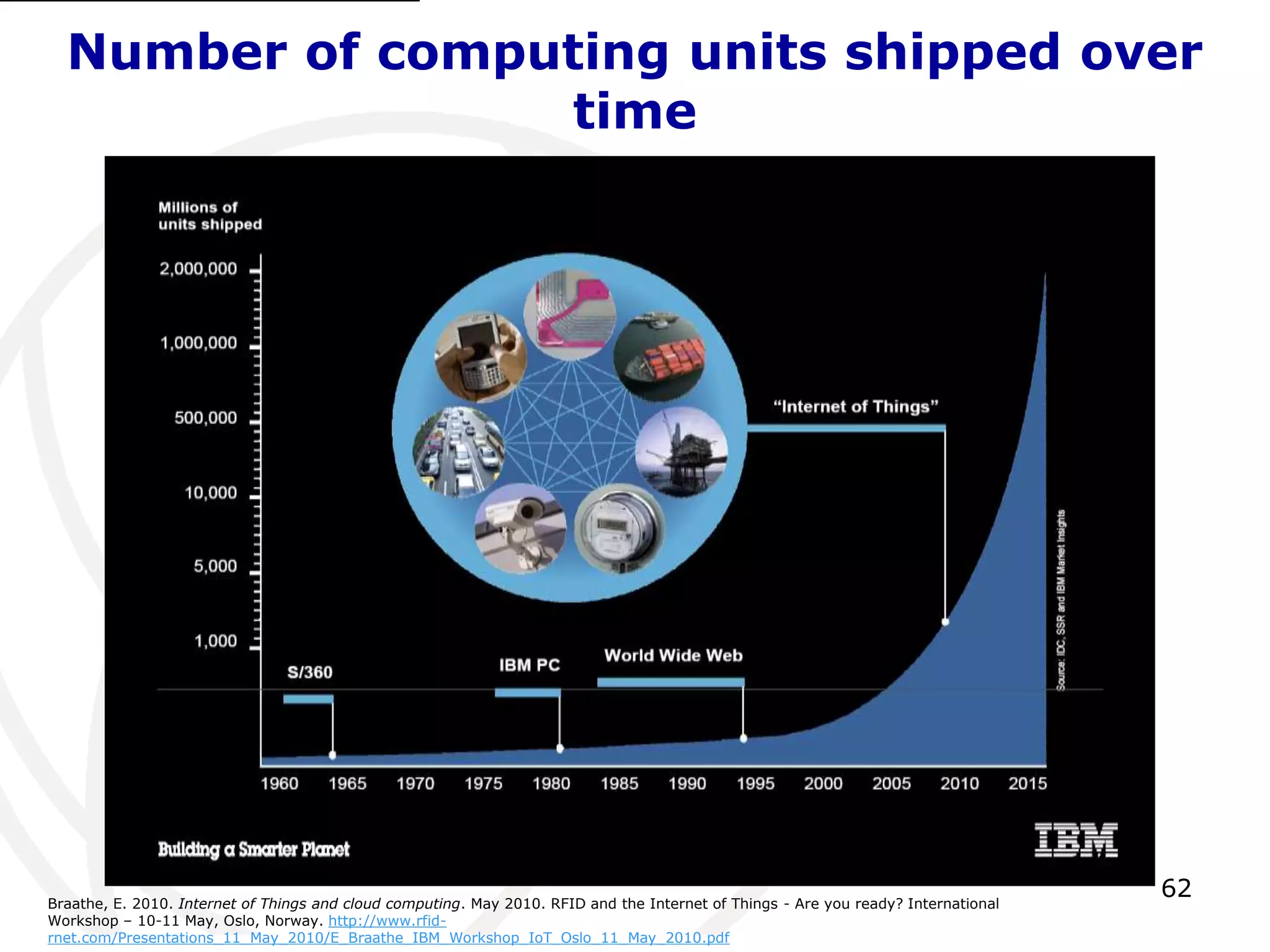
Number of computing units shipped over 
62 
time 
Braathe, E. 2010. Internet of Things and cloud computing. May 2010. RFID and the Internet of Things - Are you ready? International 
Workshop – 10-11 May, Oslo, Norway. http://www.rfid-rnet. 
com/Presentations_11_May_2010/E_Braathe_IBM_Workshop_IoT_Oslo_11_May_2010.pdf
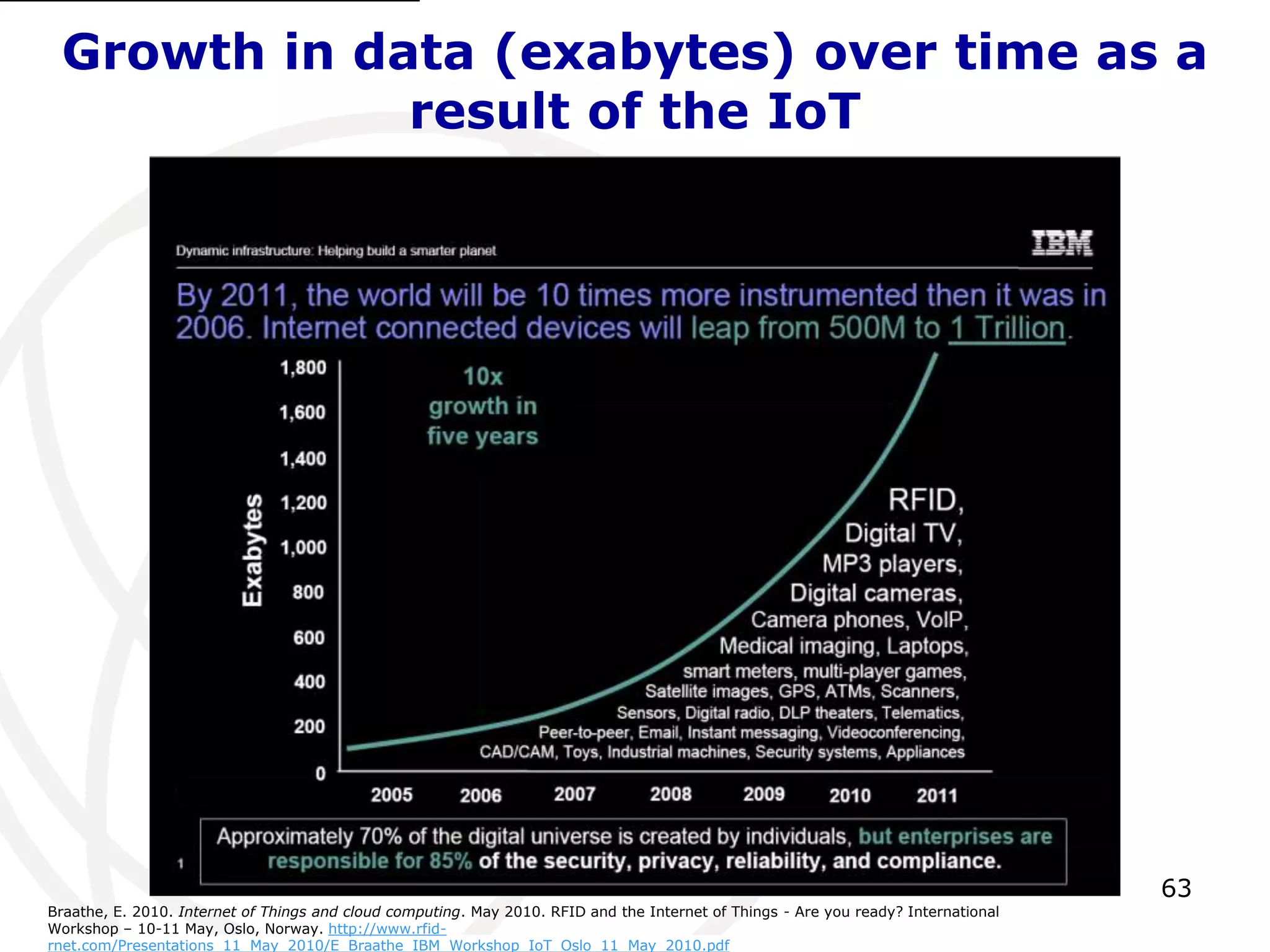
Growth in data (exabytes) over time as a 
63 
result of the IoT 
Braathe, E. 2010. Internet of Things and cloud computing. May 2010. RFID and the Internet of Things - Are you ready? International 
Workshop – 10-11 May, Oslo, Norway. http://www.rfid-rnet. 
com/Presentations_11_May_2010/E_Braathe_IBM_Workshop_IoT_Oslo_11_May_2010.pdf
64 
Trends: social networking (1) 
3 types: 
Imagery social nets 
Gaming driven social nets 
Interaction driven social nets. 
Facebook, Twitter, chat, blogs and 
other social networking applications 
User generated content 
Online content sharing including 
video blogging (vlogging)
65 
Trends: social networking (2) 
Human based computation : 
Human flesh search (HFS) engine: 
people powered search 
Crowdsourcing for soliciting public 
feedback using ICTs 
Much used by environmental groups 
for mobilizing & reporting 
environmental observations & 
infringements
66 
Impact of ICTs 
Facilitating environmental 
observation 
ICTs consume energy and 
greenhouse gases (GHGs) 
Enabling effect: ICTs can enhance 
the efficient use of energy and 
reduce GHG emissions
ICTs for environmental observation 
67
68 
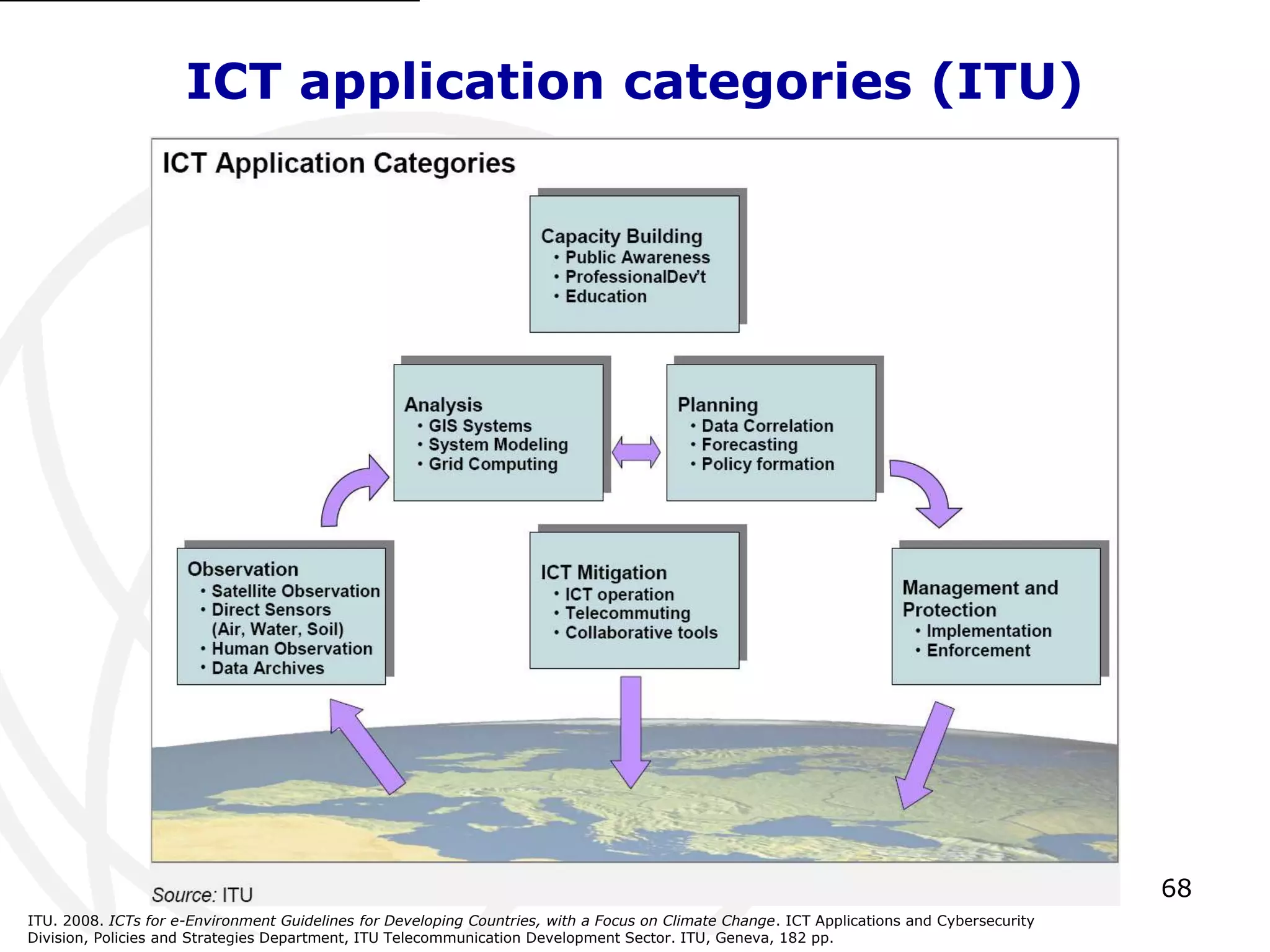
ICT application categories (ITU) 
ITU. 2008. ICTs for e-Environment Guidelines for Developing Countries, with a Focus on Climate Change. ICT Applications and Cybersecurity 
Division, Policies and Strategies Department, ITU Telecommunication Development Sector. ITU, Geneva, 182 pp.
69 
ICTs for earth observation 
Acquiring earth observation data 
Recording & storing data 
Data analysis & visualization
70 
Remote sensing (1) 
Remote sensors (passive and 
active): 
Radio devices that derive environmental 
information by analyzing received radio 
waves. 
Most of these sensors are on 
platforms: satellites or airplanes 
Space-based remote sensors are the 
only tools that provide environmental 
data on a long term, repetitive and 
global scale.
71 
Remote sensing (2) 
By far the most data on 
environmental observation comes 
from satellite based remote sensing 
platforms
72 
Remote sensing (3) 
Provide environmental data on a long 
term, repetitive and global scale. 
Radiocommunication systems based 
on remote sensing play the major 
role in weather and climate change 
prediction.
73 
Remote sensing (4) 
Remote sensing is the essential tool 
for disaster prediction, detection, 
disaster mitigation and planning of 
relief operations. 
Sensors are used for detection and 
tracking of earthquakes, tsunamis 
hurricanes, typhoons, floods, fires, 
oil leaks, dangerous pollution, etc
Some important earth observation 
74 
systems 
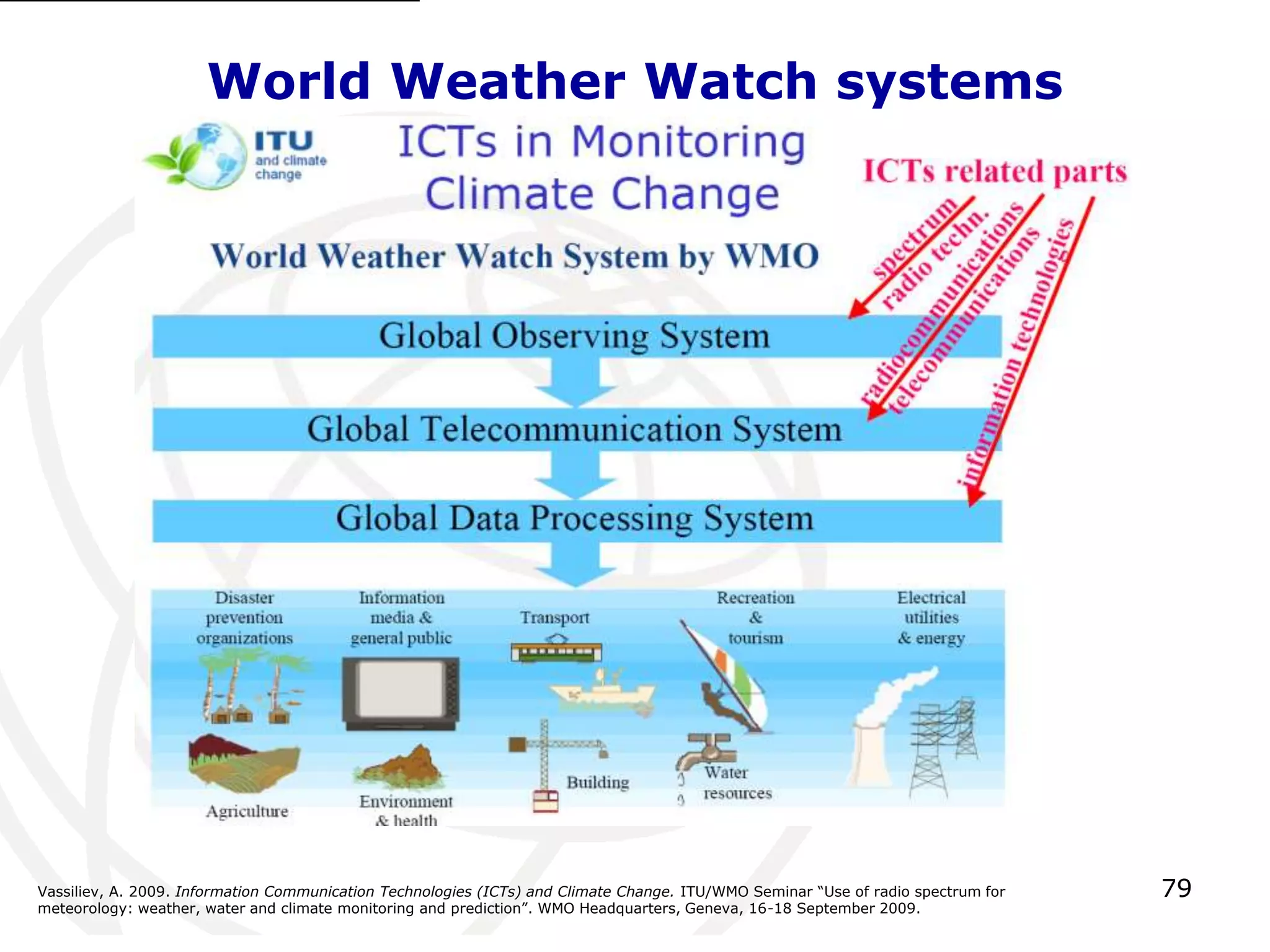
World Weather Watch (WMO) 
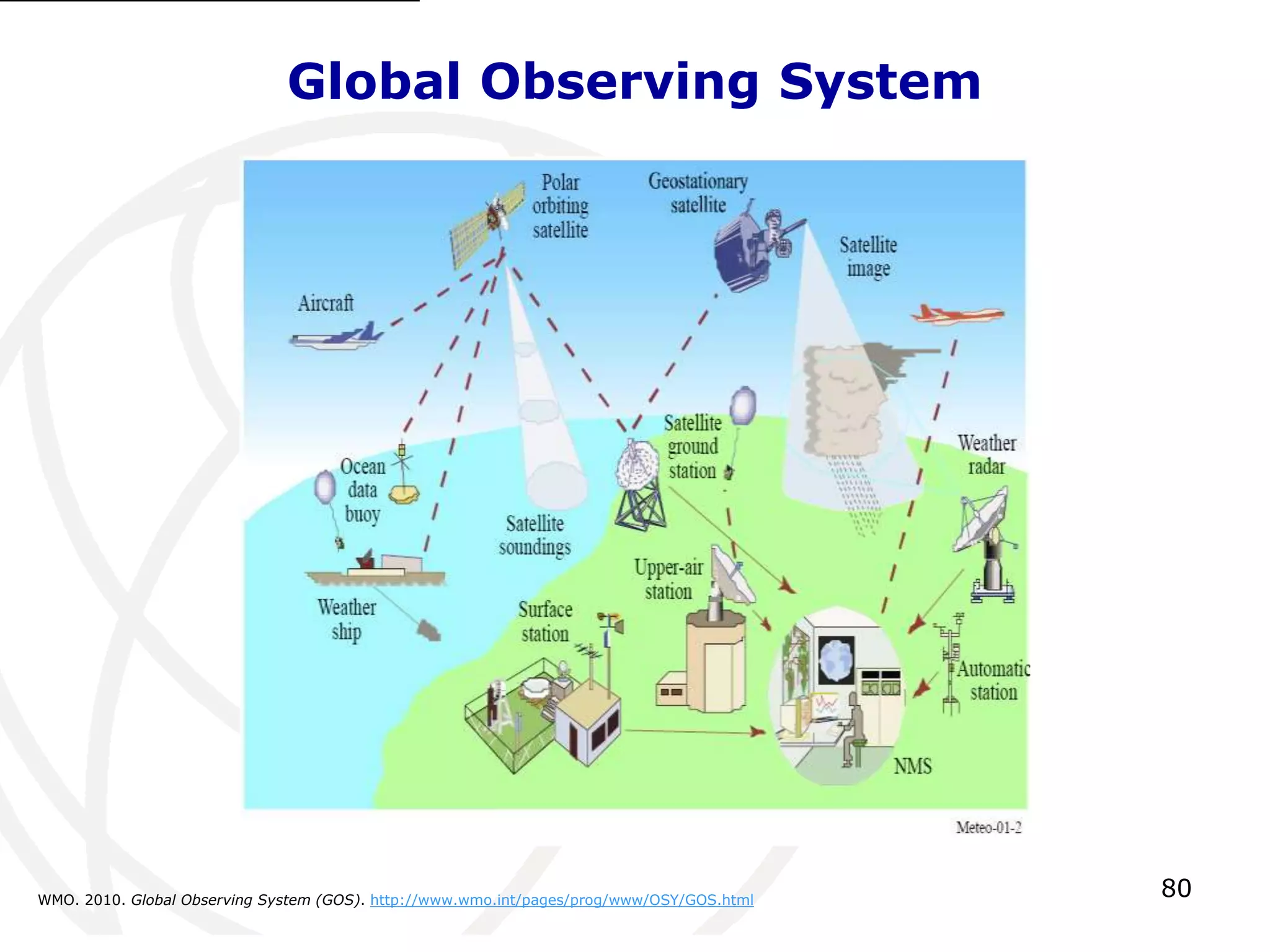
Global Observing System (GOS - 
WMO) 
The Global Earth Observation System 
of Systems (GEOSS)
The Global Earth Observation System 
75 
of Systems (GEOSS) - 1 
Group on Earth Observations (GEO) 
A partnership of govts & int. orgs. 
Earth observations for decision 
making 
To link existing systems & bridge 
gaps
The Global Earth Observation System 
76 
of Systems (GEOSS) - 2 
To link existing systems & bridge 
gaps 
Connect users to data resources 
Portals, Cloud enabled 
GSDI (Global Spatial Data 
Infrastructure) association
The Global Earth Observation System 
77 
of Systems (GEOSS) - 3 
GEO Forest Carbon Tracking portal 
now live 
UN unveils new Global Risk Data 
Platform 
INPE reaches mark of 1 million 
images distributed free
The Global Earth Observation System 
78 
of Systems (GEOSS) - 4 
Earth System Atlas promotes access 
to research data 
Comprehensive Land Surface 
Imagery now available via GEOSS 
Accessing the Landsat archive 
The UNEP Global Environment 
Outlook Data Portal
79 
World Weather Watch systems 
Vassiliev, A. 2009. Information Communication Technologies (ICTs) and Climate Change. ITU/WMO Seminar “Use of radio spectrum for 
meteorology: weather, water and climate monitoring and prediction”. WMO Headquarters, Geneva, 16-18 September 2009.
80 
Global Observing System 
WMO. 2010. Global Observing System (GOS). http://www.wmo.int/pages/prog/www/OSY/GOS.html
81 
Conclusions 
Real time and ongoing earth 
observation possible 
ICTs offer opportunities for: 
Developing a much more precise & 
accurate understanding of the natural 
and human environments 
For controlling our environment, 
especially the built environment
Implications for the developing world 
82 
& Asia Pacific 
Internet access & broadband 
diffusion are key determinants 
Much more understanding of 
environmental issues in general & of 
climate change especially 
Many applications for climate change 
adaptation are made possible by 
these trends and technologies
83 
Discussion

Module 10 - Session 2 ICTs and environmental observation 20110223

  • 1.
    Module 10 Session2 (Seoul, Korea, 24 February 2011) ICTs & environmental observation Richard Labelle rlab@sympatico.ca
  • 2.
    2 Objectives ofModule 10 To show that ICTs be used to address climate change To demonstrate why ICTs are a crucial part of the solution – i.e. in promoting efficiency, Green Growth & sustainable development
  • 3.
    3 Objectives Topresent current trends in ICT developments and innovations that shed light on the use of ICTs for environmental observation and for abating climate change
  • 4.
    4 Trends thatunderpin ICT use for environmental observation & abating climate change Connecting everything Measuring everything Controlling everything Smart controls Connect & control all motors & energy consumption (embedded controls)
  • 5.
    Environmental observation hasmany specific needs & is very broad Havana, Cuba, 8-9 February 2011 5
  • 6.
    6 Trends inICT development Digitization & dematerialization Microprocessors Internet diffusion IPv6 Broadband Cloud computing Nanotechnology Wireless & mobile device uptake
  • 7.
    7 Trends inICT development (2) Innovations in display technologies GIS and related visualization technologies Improved & greener batteries The IOT Sensor technology Social networking
  • 8.
    8 Trends: digitization& dematerialization Digitization & dematerialization Smaller environmental sensing devices More powerful sensing devices More digitization (e-government, e-commerce, etc.)  less need for travel for rural dwellers, more energy efficiency More downloads: video, music, P2P, etc. Telepresence Virtualization (servers, networks, etc.)
  • 9.
    9 Trends: microprocessors(1) 11 nm dies now, with 1 nm in future Smarter and more energy efficient More powerful microprocessors and microcontrollers Parallel processing CPUs and GPUs in portable / handheld devices Moore’s law still works
  • 10.
    10 Trends: microprocessors(2) 45 nm Intel Core i7 processor: Peak data throughput of 50 GB /sec. vs. 64 MB / sec. for Intel 386 8 cores per microprocessor die Do more (much) faster & with less energy
  • 11.
    11 Trends: microprocessors(3) Dual / quad core for mobile devices: Smartphones more powerful than netbooks & as powerful as desktops  …Powering transition to mobile over desktop computing as main computing platform Enable wireless sensor networks (WSNs) & the Internet of Things (IoT)
  • 12.
    12 Trends: Internetdiffusion Global connectivity is growing
  • 13.
    13 Trends: Internetdiffusion (1) Mobile use by consumer & enterprise markets in developed & emerging economies increasing Bandwidth demand from data & video increasing M2M connections increase Backhaul capacity still has to increase to meet demand More portability and interoperability
  • 14.
    14 Trends: Internetdiffusion (2) New businesses & models emerging: New forms of advertising, media and content partnerships, mobile services Including M2M, live gaming and looking into the future, augmented reality Off electrical grid connectivity in some countries A cottage industry Driving use of renewables (solar) for charging & powering beyond the electrical grid
  • 15.
    15 Trends: Internetdiffusion (3) Tendency is total integration of “desktop” with the Cloud High bandwidth, low latency connectivity FTTx 4G, 5G… This means speed of IP / Cloud access ~= to speed of computer buses Massive data flows With social nets: everyone is a user and provider of massive amounts of info.
  • 16.
    Global ICT development,1998-2009 (ITU) 16
  • 17.
    17 Mobile InternetOutpaces Desktop Internet Adoption [Morgan Stanley. 2010. Internet trends. http://www.morganstanley.com/institutional/techresearch/internet_trends042010.html
  • 18.
    The shift towardsmobile computing 18 [Morgan Stanley. 2009. Economy + Internet Trends October 20, 2009. Web 2.0 Summit – San Francisco. mary.meeker@ms.com / scott.devitt@ms.com / liang.wu@ms.com www.morganstanley.com/techresearch
  • 19.
    Global mobile datatraffic forecast by region (Cisco) 19 Cisco® Visual Networking Index (VNI) [Cisco. 2011. Cisco Visual Networking Index: Global Mobile Data Traffic Forecast Update, 2010–2015. http://www.cisco.com/en/US/solutions/collateral/ns341/ns525/ns537/ns705/ns827/ white_paper_c11-520862.html
  • 20.
    Intelligent devices suchas notebooks and laptops lead traffic growth 20 Cisco® Visual Networking Index (VNI) Cisco. 2011. Cisco Visual Networking Index: Global Mobile Data Traffic Forecast Update, 2010–2015. http://www.cisco.com/en/US/solutions/collateral/ns341/ns525/ns537/ns705/ns827/ white_paper_c11-520862.html
  • 21.
    21 Trends: IPv6 IPv6: Will allow the Internet of Things Will push IP to the edge of the network More efficient that IPv4 More support for: Data / user authentication Data integrity Data confidentiality Etc.
  • 22.
    22 Trends: Broadband(1) Passive networking: Background streaming and downloading from ambient / environmental video sources: nannycams, petcams, home security cams, etc. Real time HD video: Internet TV Video communications: telepresence,… Ambient video
  • 23.
    23 Trends: Broadband(2) High definition video Transference: from TV to live HD video on demand over the Internet Silicon photonics and hybrid silicon lasers: Low cost, high bandwidth optical communications will affect all connected devices and networks
  • 24.
    24 Trends: Broadband(3) Wireless broadband: Exponential growth in traffic Will outstrip the increased revenue required to make it profitable Technical solutions: Offloading content to the Internet
  • 25.
    25 Trends: Cloudcomputing (1) Allows for Grid computing applied to environmental needs: Access to super computing resources Facilitates access to massive digital data sets online (INPE – BR, Landsat, etc.) The Global Earth Observation System of Systems (GEOSS) Google Earth, Microsoft Virtual Earth, etc.
  • 26.
    26 Trends: Cloudcomputing (2) Computing on demand increasing in popularity as broadband speeds rise Can reduce energy use of a company by moving cost to provider of Cloud services Can favour green energy sources as fiber connected Cloud service centres Linked to the Internet of Things Collection of live environmental data from embedded sensors in mesh nets.
  • 27.
    27 World mapshowing distribution of ClimatePrediction.Net servers See http://www.climateprediction.net/project.php
  • 28.
    28 Trends: Nanotechnology Greater transistor density More energy efficient chip designs Enabling Moore’s Law for many years to come Will “increase transistor speed, enhance energy efficiency, and provide more functionalities” Has allowed the miniaturization of computer memory. This has made the Apple iPOD a reality.
  • 29.
    29 Trends: wireless(1) Digitization of broadcasting signals will open more spectrum: Many new wireless channels, devices and services Near field communication & medium and longer range technologies to operationalize the Internet of Things ZigBee, 6LowPAN, WirelessHART, etc. c. Location aware (sometime GPS enabled) mobile devices or objects
  • 30.
    30 Trends: wireless(2) Augmented reality that is facilitated through the use of wireless devices The proliferation of wireless devices enables social networking & vice versa
  • 31.
    31 Trends: wireless(mobile) Data from Cisco 2011 (Cisco® Visual Networking Index (VNI)) Mobile Data Traffic Nearly Tripled in 2010 Accelerated adoption of smartphones  higher usage profile Other high-usage devices increased their presence on the mobile network mobile-connected laptops grew by 63 percent in 2010 Mobile for fixed substitution is NOW!
  • 32.
    Global Mobile DataTraffic by region 2010–2015 (Cisco VSN 2011) Cisco® Visual Networking Index (VNI) 32 Cisco® Visual Networking Index (VNI) Cisco. 2011. Cisco Visual Networking Index: Global Mobile Data Traffic Forecast Update, 2010–2015. http://www.cisco.com/en/US/solutions/collateral/ns341/ns525/ns537/ns705/ns827/white_paper_c11-520862.html
  • 33.
    Devices with HighUsage Profiles Are Growing in Number on the Mobile Network (Cisco VSN 2011) Cisco® Visual Networking Index (VNI) 33 Cisco. 2011. Cisco Visual Networking Index: Global Mobile Data Traffic Forecast Update, 2010–2015. http://www.cisco.com/en/US/solutions/collateral/ns341/ns525/ns537/ns705/ns827/white_paper_c11-520862.html
  • 34.
    High-End Devices CanMultiply Traffic Cisco® Visual Networking Index (VNI) 34 Cisco. 2011. Cisco Visual Networking Index: Global Mobile Data Traffic Forecast Update, 2010–2015. http://www.cisco.com/en/US/solutions/collateral/ns341/ns525/ns537/ns705/ns827/white_paper_c11-520862.html
  • 35.
    35 Trends: wireless(mobile) Data from Cisco 2011 Mobile beyond the power grid Selling off grid charging: car batteries, solar powered, etc. Off-grid, on-net population will reach 137 million by 2015 Mobile network will break the electricity barrier in 4 major regions and more than 40 countries
  • 36.
    36 Trends: Innovationsin display technology Multi-touch input, high definition displays Cisco identifies the expansion of digital screen surface area and resolution as being important drivers of IP traffic growth Scratch and break resistant glass: Gorilla Glass, Dragontail Glass, etc.
  • 37.
    Trends: GIS &related visualization 37 technologies Increased use of GIS If its visual, its easier to measure & understand Smartphones as visualization tools Building information modeling (BIM) software for building & city wide energy analysis
  • 38.
    Using Google Mapsto help map the impact 38 of sea level rise on the coast of CA
  • 39.
    Trends: Improved &greener batteries 39 (1) Quest for low or portable power sources and batteries Self/ambient powered and/or power harvesting devices for sensors, RFID & other embedded devices.
  • 40.
    Trends: Improved &greener batteries 40 (2) Standard battery for all portable devices (ITU) Higher capacity energy storage technologies for use in: Smart grid Electric vehicles
  • 41.
    Trends: the Internetof Things (1) Growth in machine to machine (M2M) communications - a significant opportunity for MNOs 41 M2M is driving exponential growth in connections Revenue from services to embedded modems in M2M applications to grow exponentially until at 2014
  • 42.
    Trends: the Internetof Things (2) 42 GSM Association (GSMA) has launched an “embedded SIM” initiative to support the IOT To speed up development of M2M services Make it easier to bring mobile broadband to non-traditional devices: cameras, MP3 players, navigation devices and e-Readers & smart meters
  • 43.
    Trends: the Internetof Things (3) 43 87 million embedded mobile M2M connections last year … will reach 428 million by 2014 Embedded SIM cards in mobile phones / smartphones: Allow users direct control over their connections: ability to select carrier networks of choice, bypassing MNOs, Allow to connect to the Internet of Things without MNO.
  • 44.
    Trends: the Internetof Things (4) 44 Global revenues from IOT: 30 x higher than the Internet in the smart transportation sector alone (Forrester Research) Governments have made significant investments in IOT: EU, Japan, South Korea, China, USA In China: revenues from IOT will reach 750 billion RMB (USD 112 billion) by 2015
  • 45.
    Trends: the Internetof Things (5) The number of devices connected to the Internet: > 5 billion @ Aug. 2010 In an online presentation, an IBM researcher reports that there will be a trillion Internet connected devices by 2011 A VP at Ericsson predicted that “50 billion connected devices are coming to cellular networks in the next decade” 45
  • 46.
    46 Trends: sensortechnology (1) Radio-frequency identification (RFID) tags Low power operating sensors (energy harvesting motes) Able to withstand harsh environments Self organizing, self configuring, self-healing
  • 47.
    47 Trends: sensortechnology (2) Low or zero maintenance Bandwidth efficient High data capacity Many open standards are used, but not all standardized. Many corporate, i.e. proprietary technologies in the market place Efforts to standardize on IPv6 compliant IP (Contiki operating system) micro stack
  • 48.
    48 Trends: sensortechnology (3) Sensors embedded in devices and sensor nets (motes) Smartphone / mobile device Types of sensors: Physical: T, P (altitude), density, motion (accelerometers), light (cameras and wavelength sensors – infra red – thermal sensors, etc.), gravity, etc.
  • 49.
    49 Trends: sensortechnology (4) Types of sensors: Chemical sensors evolving as well: wet chemistry sensors more difficult (unless in aqueous environment), gaseous sensors easier to implement Motion imagery surveillance Wide Area Motion Imagery (WAMI) Security application with environmental uses
  • 50.
    Wireless sensor networks(WSNs -1) 50 Tiny sensor “nodes” that collect & relay data to a network of similar nodes Each node: sensor, microprocessor & transceiver (radio)
  • 51.
    Wireless sensor networks(WSNs -2) 51 Spatially distributed autonomous sensors That cooperatively monitor physical &/or chemical parameters: T, P, sounds, vibration, motion Pollutants, gases, Limited power Energy saving communication protocols Short range
  • 52.
    Wireless sensor networks(WSNs -3) 52 Applications Homeland security Monitoring of space assets for potential and human-made threats in space, Ground based monitoring of both land and water Intelligence gathering for defense Environmental monitoring Urban warfare
  • 53.
    Wireless sensor networks(WSNs -4) 53 Applications Weather and climate analysis and prediction Battlefield monitoring and surveillance Exploration of the Solar System and beyond Monitoring of seismic acceleration Strain GPS data
  • 54.
    54 A commerciallyavailable sensor node from Libelium Libelium. 2011. Waspmote – The sensor device for developers. 20110202. http://www.libelium.com/products/waspmote
  • 55.
    Sensing applications (commercial:Libelium) 55 [Libelium. 2011. Sensor boards. 20110202 http://www.libelium.com/products/waspmote/sensors
  • 56.
    Schematic layers ofa USN (Ubiquitous 56 Sensor Network) ITU. 2008. Ubiquitous sensor networks (USN). ITU-T Technology Watch Report # 4. ITU, Geneva, 15 pp. http://www.itu.int/oth/T2301000004/en
  • 57.
    Korea's vision ofthe Internet of Things (1) 57 Kim, Y.-W. 2009. Korean visions and policies for the Internet of Things. Presented on occasion of RFOD Global Forum and the Internet of Things.CASAGRAS, EU Framework 7 Peoject. http://www.rfidglobal.eu/page.asp?pageid=28&pagegroup=RFID%20Global&pagetitle=Final%20Conference%20Presentations
  • 58.
    Korea's vision ofthe Internet of Things (2) 58 Kim, Y.-W. 2009. Korean visions and policies for the Internet of Things. Presented on occasion of RFOD Global Forum and the Internet of Things. CASAGRAS, EU Framework 7 Project. http://www.rfidglobal.eu/page.asp?pageid=28&pagegroup=RFID%20Global&pagetitle=Final%20Conference%20Presentations
  • 59.
    59 HP CeNSE- Hartwell, P. & Williams, R.S. 2010. CeNSE - Central Nervous System for the Earth. Spring 2010. Slideshare. http://www.slideshare.net/hewlettpackard/hp-cense-sensor-networks-and-the-pulse-of-the-planet
  • 60.
    60 WSNs area hot subject Merret, G. V. and Y. K. Tan. 2010. Wireless Sensor Networks: Application Centric Design. Edited by Dr. Geoff V Merret and Dr. Yen Kheng Tan (Wireless Sensor Networks: Application Centric Design Edited by Dr. Geoff V Merret and Dr. Yen Kheng Tan (Editor-in-Chief)Editor-in- Chief). Published by InTech. Janeza Trdine 9, 51000 Rijeka, Croatia. http://www.intechopen.com/books/show/title/wireless-sensor-networks- application-centric-design
  • 61.
    Trends in thedevelopment of the Internet 61 of Things http://upload.wikimedia.org/wikipedia/commons/5/5a/Internet_of_Things.png
  • 62.
    Number of computingunits shipped over 62 time Braathe, E. 2010. Internet of Things and cloud computing. May 2010. RFID and the Internet of Things - Are you ready? International Workshop – 10-11 May, Oslo, Norway. http://www.rfid-rnet. com/Presentations_11_May_2010/E_Braathe_IBM_Workshop_IoT_Oslo_11_May_2010.pdf
  • 63.
    Growth in data(exabytes) over time as a 63 result of the IoT Braathe, E. 2010. Internet of Things and cloud computing. May 2010. RFID and the Internet of Things - Are you ready? International Workshop – 10-11 May, Oslo, Norway. http://www.rfid-rnet. com/Presentations_11_May_2010/E_Braathe_IBM_Workshop_IoT_Oslo_11_May_2010.pdf
  • 64.
    64 Trends: socialnetworking (1) 3 types: Imagery social nets Gaming driven social nets Interaction driven social nets. Facebook, Twitter, chat, blogs and other social networking applications User generated content Online content sharing including video blogging (vlogging)
  • 65.
    65 Trends: socialnetworking (2) Human based computation : Human flesh search (HFS) engine: people powered search Crowdsourcing for soliciting public feedback using ICTs Much used by environmental groups for mobilizing & reporting environmental observations & infringements
  • 66.
    66 Impact ofICTs Facilitating environmental observation ICTs consume energy and greenhouse gases (GHGs) Enabling effect: ICTs can enhance the efficient use of energy and reduce GHG emissions
  • 67.
    ICTs for environmentalobservation 67
  • 68.
    68 ICT applicationcategories (ITU) ITU. 2008. ICTs for e-Environment Guidelines for Developing Countries, with a Focus on Climate Change. ICT Applications and Cybersecurity Division, Policies and Strategies Department, ITU Telecommunication Development Sector. ITU, Geneva, 182 pp.
  • 69.
    69 ICTs forearth observation Acquiring earth observation data Recording & storing data Data analysis & visualization
  • 70.
    70 Remote sensing(1) Remote sensors (passive and active): Radio devices that derive environmental information by analyzing received radio waves. Most of these sensors are on platforms: satellites or airplanes Space-based remote sensors are the only tools that provide environmental data on a long term, repetitive and global scale.
  • 71.
    71 Remote sensing(2) By far the most data on environmental observation comes from satellite based remote sensing platforms
  • 72.
    72 Remote sensing(3) Provide environmental data on a long term, repetitive and global scale. Radiocommunication systems based on remote sensing play the major role in weather and climate change prediction.
  • 73.
    73 Remote sensing(4) Remote sensing is the essential tool for disaster prediction, detection, disaster mitigation and planning of relief operations. Sensors are used for detection and tracking of earthquakes, tsunamis hurricanes, typhoons, floods, fires, oil leaks, dangerous pollution, etc
  • 74.
    Some important earthobservation 74 systems World Weather Watch (WMO) Global Observing System (GOS - WMO) The Global Earth Observation System of Systems (GEOSS)
  • 75.
    The Global EarthObservation System 75 of Systems (GEOSS) - 1 Group on Earth Observations (GEO) A partnership of govts & int. orgs. Earth observations for decision making To link existing systems & bridge gaps
  • 76.
    The Global EarthObservation System 76 of Systems (GEOSS) - 2 To link existing systems & bridge gaps Connect users to data resources Portals, Cloud enabled GSDI (Global Spatial Data Infrastructure) association
  • 77.
    The Global EarthObservation System 77 of Systems (GEOSS) - 3 GEO Forest Carbon Tracking portal now live UN unveils new Global Risk Data Platform INPE reaches mark of 1 million images distributed free
  • 78.
    The Global EarthObservation System 78 of Systems (GEOSS) - 4 Earth System Atlas promotes access to research data Comprehensive Land Surface Imagery now available via GEOSS Accessing the Landsat archive The UNEP Global Environment Outlook Data Portal
  • 79.
    79 World WeatherWatch systems Vassiliev, A. 2009. Information Communication Technologies (ICTs) and Climate Change. ITU/WMO Seminar “Use of radio spectrum for meteorology: weather, water and climate monitoring and prediction”. WMO Headquarters, Geneva, 16-18 September 2009.
  • 80.
    80 Global ObservingSystem WMO. 2010. Global Observing System (GOS). http://www.wmo.int/pages/prog/www/OSY/GOS.html
  • 81.
    81 Conclusions Realtime and ongoing earth observation possible ICTs offer opportunities for: Developing a much more precise & accurate understanding of the natural and human environments For controlling our environment, especially the built environment
  • 82.
    Implications for thedeveloping world 82 & Asia Pacific Internet access & broadband diffusion are key determinants Much more understanding of environmental issues in general & of climate change especially Many applications for climate change adaptation are made possible by these trends and technologies
  • 83.