Prepared by:
Yogiraj bhandari
What, exactly, is a modular home?
• A modular home is one that is built indoors in a factory-
like setting. The finished products are covered and
transported to their new locations, where they
are assembled by a builder.
• A modular home is not a mobile home; it is simply a
home that is built off-site, as opposed to on-site. These
homes are often called factory-built, system-built or
prefab (short for prefabricated) homes.
How do modular house differ from house built on site?
• Modular homes are built indoors, they can be
completed in a matter of a few weeks, as opposed to
months.
• They don’t see the typical on-site delays caused
predominantly by the weather.
• Modular homes must conform to specific rules,
guidelines and building codes that often surpass
those of traditional on-site homes.
Construction process
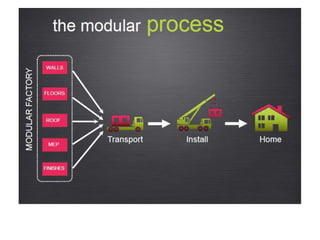
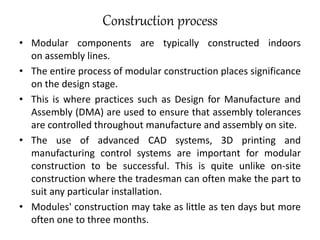
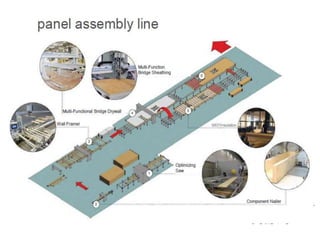
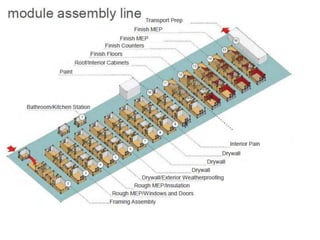
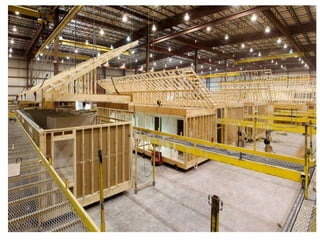
• Modular components are typically constructed indoors
on assembly lines.
• The entire process of modular construction places significance
on the design stage.
• This is where practices such as Design for Manufacture and
Assembly (DMA) are used to ensure that assembly tolerances
are controlled throughout manufacture and assembly on site.
• The use of advanced CAD systems, 3D printing and
manufacturing control systems are important for modular
construction to be successful. This is quite unlike on-site
construction where the tradesman can often make the part to
suit any particular installation.
• Modules' construction may take as little as ten days but more
often one to three months.
Materials
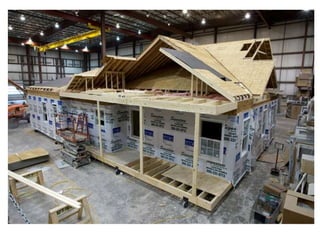
• The materials used in modular homes are the
same as site constructed homes.
• Wood-frame floors, walls and roof are the
most typical. Some modular homes include
brick or stone exteriors, granite counters and
steeply pitched roofs.
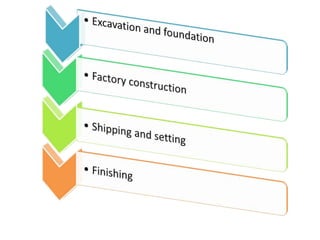
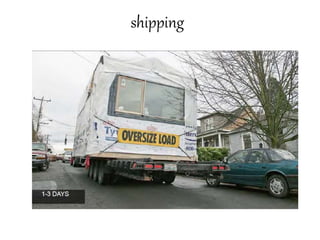
shipping
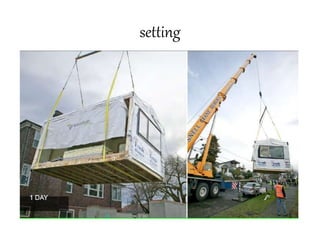
setting
•A factory-built home starts out as sections that
have been built in a climate-controlled area.
•The finished sections are transported to the
building site and then assembled with cranes.
•This process resembles a child building with Lego
blocks.
•Modular homes cannot be moved after they have
been placed and set on their foundations.
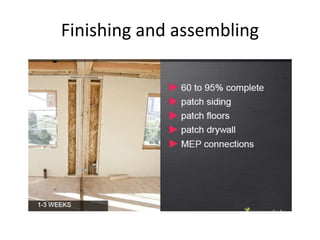
Finishing and assembling
• Modular homes offer hundreds of
personalized features that include (but are not
limited to) ceramic floors, solid-surface
countertops, various cabinet styles and wood
species, exterior finishes, plumbing fixtures
etc.
Are modular houses are more expensive than those built on site?
• Prefab homes can typically save you quite a bit of
money. Because they are constructed in a factory, they
can be built fairly quickly in a matter of weeks, as
opposed to months because there are no weather
delays.
• Furthermore, all inspections are performed at the
factory during each phase of construction by a third-
party inspector, and are completed before the homes
are transported to their permanent locations.
Advantages
• Environment friendly process:
Modular construction reduces waste and site disturbance
compared to site-built structures.
• Indoor construction:
Assembly is independent of weather, which can increase
work efficiency and avoids damaged building material.
• Speed of construction:
Modular construction allows for the building and the site
work to be completed simultaneously. This saves lots of time
and due to that we get faster return of our investment.
• Flexibility:
One can continually add to a modular building, including creating
high rises.
• Ability to service remote locations:
Particularly in countries in which potential markets may be located
far from industrial centers, such as Australia, there can be much
higher costs to build a site-built house in a remote area or an area
experiencing a construction boom such as mining towns.
• Low waste:
With the same plans being constantly built, the manufacturer has
records of exactly what quantity of materials are needed for a given
job. While waste from a site-built dwelling may typically fill several
large dumpsters, construction of a modular dwelling generates
much less waste. Waste can be recycled.
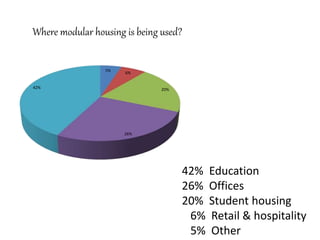
Where modular housing is being used?
5%
6%
20%
26%
42%
42% Education
26% Offices
20% Student housing
6% Retail & hospitality
5% Other
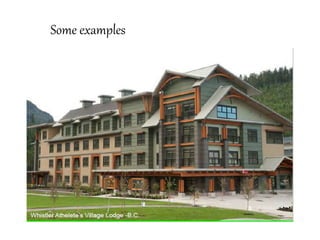
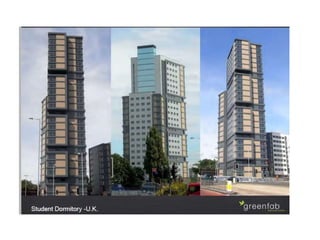
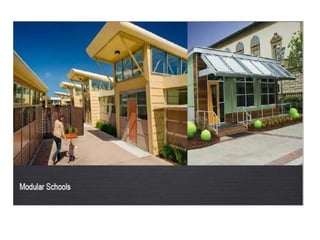
Some examples
Modular housing/building

Modular housing/building

  • 1.
  • 2.
    What, exactly, isa modular home? • A modular home is one that is built indoors in a factory- like setting. The finished products are covered and transported to their new locations, where they are assembled by a builder. • A modular home is not a mobile home; it is simply a home that is built off-site, as opposed to on-site. These homes are often called factory-built, system-built or prefab (short for prefabricated) homes.
  • 3.
    How do modularhouse differ from house built on site? • Modular homes are built indoors, they can be completed in a matter of a few weeks, as opposed to months. • They don’t see the typical on-site delays caused predominantly by the weather. • Modular homes must conform to specific rules, guidelines and building codes that often surpass those of traditional on-site homes.
  • 6.
    Construction process • Modularcomponents are typically constructed indoors on assembly lines. • The entire process of modular construction places significance on the design stage. • This is where practices such as Design for Manufacture and Assembly (DMA) are used to ensure that assembly tolerances are controlled throughout manufacture and assembly on site. • The use of advanced CAD systems, 3D printing and manufacturing control systems are important for modular construction to be successful. This is quite unlike on-site construction where the tradesman can often make the part to suit any particular installation. • Modules' construction may take as little as ten days but more often one to three months.
  • 11.
    Materials • The materialsused in modular homes are the same as site constructed homes. • Wood-frame floors, walls and roof are the most typical. Some modular homes include brick or stone exteriors, granite counters and steeply pitched roofs.
  • 12.
  • 13.
  • 14.
    •A factory-built homestarts out as sections that have been built in a climate-controlled area. •The finished sections are transported to the building site and then assembled with cranes. •This process resembles a child building with Lego blocks. •Modular homes cannot be moved after they have been placed and set on their foundations.
  • 15.
  • 16.
    • Modular homesoffer hundreds of personalized features that include (but are not limited to) ceramic floors, solid-surface countertops, various cabinet styles and wood species, exterior finishes, plumbing fixtures etc.
  • 17.
    Are modular housesare more expensive than those built on site? • Prefab homes can typically save you quite a bit of money. Because they are constructed in a factory, they can be built fairly quickly in a matter of weeks, as opposed to months because there are no weather delays. • Furthermore, all inspections are performed at the factory during each phase of construction by a third- party inspector, and are completed before the homes are transported to their permanent locations.
  • 18.
    Advantages • Environment friendlyprocess: Modular construction reduces waste and site disturbance compared to site-built structures. • Indoor construction: Assembly is independent of weather, which can increase work efficiency and avoids damaged building material. • Speed of construction: Modular construction allows for the building and the site work to be completed simultaneously. This saves lots of time and due to that we get faster return of our investment.
  • 19.
    • Flexibility: One cancontinually add to a modular building, including creating high rises. • Ability to service remote locations: Particularly in countries in which potential markets may be located far from industrial centers, such as Australia, there can be much higher costs to build a site-built house in a remote area or an area experiencing a construction boom such as mining towns. • Low waste: With the same plans being constantly built, the manufacturer has records of exactly what quantity of materials are needed for a given job. While waste from a site-built dwelling may typically fill several large dumpsters, construction of a modular dwelling generates much less waste. Waste can be recycled.
  • 20.
    Where modular housingis being used? 5% 6% 20% 26% 42% 42% Education 26% Offices 20% Student housing 6% Retail & hospitality 5% Other
  • 21.