MODULAR HIGH RISE CONSTRUCTION
1
OVERVIEW
• Introduction
• Difference between modular and prefab
• Modular construction process
• Types of modular construction
• Modular units for construction
• Inter-module joining techniques
• Application of modular techniques in high-rise construction
• Construction approaches for stalking modules
• Case studies
• Advantages and limitations of modular high-rise construction
• Conclusions
• References 2
INTRODUCTION
• In prefabricated construction, building units are fabricated in factory and are
transported to site for assembly
• The three classes of prefabricated construction are: 1D single element, 2D
panelized system and 3D volumetric construction
• The panelized and volumetric construction is also known as modular construction
• It is the most efficient class- 70 to 85% prefabrication in factory
• Enables faster, safer, sustainable, economical construction with better quality
control
3
INTRODUCTION (Cond…)
• It can reduce:
1. Onsite waste generation up to 90%
2. Construction time by 50%
3. Cost of construction by 20%
• Modular construction is preferred in structures with repeated units(modules)
such as offices, schools, apartments
• High rise buildings consists of large number of repeated modules in them
• Therefore, the use of modular construction is highly beneficial for high risers
4
Fig 1: Croydon Tower, London (Source: www.dezeen.com)
5
DIFFERENCE BETWEEN MODULAR AND PREFAB
• The terms modular and prefab are used interchangeably but they are different
• Prefab construction includes any construction work done in factories away from
the site
• Parts of building including panels and modules are made in factory
• They are transported to the site and assembled
• Modular construction is only a type of prefab construction
• Construction of modular buildings are mostly completed in the factory
• It involves the installation of modules on site
6
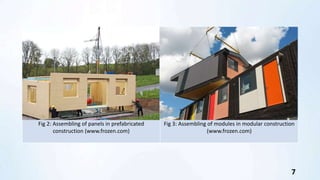
Fig 2: Assembling of panels in prefabricated
construction (www.frozen.com)
Fig 3: Assembling of modules in modular construction
(www.frozen.com)
7
MODULAR BUILDING PROCESS
• The processes involved in modular building construction include:
1. Design approval by the regulating authorities and end users
2. Construction of modular components in controlled atmosphere
3. Transportation of materials to desired location
4. Erection of modules to form a finished building
8
Design approval by the regulating authorities and end users
• Beginning phase-interior and exterior plans are created using BIM and other
softwares
• After getting approval from the client, plan is submitted for getting administrative
and technical sanction
• After the sanction from the competent authorities, components are manufactured
• Modular buildings must follow the local building codes and zoning regulations
9
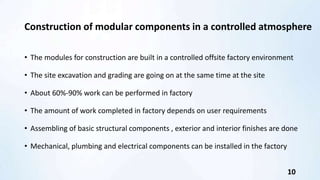
Construction of modular components in a controlled atmosphere
• The modules for construction are built in a controlled offsite factory environment
• The site excavation and grading are going on at the same time at the site
• About 60%-90% work can be performed in factory
• The amount of work completed in factory depends on user requirements
• Assembling of basic structural components , exterior and interior finishes are done
• Mechanical, plumbing and electrical components can be installed in the factory
10
Construction of modular components in a controlled atmosphere
(Continued…)
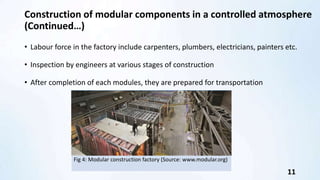
• Labour force in the factory include carpenters, plumbers, electricians, painters etc.
• Inspection by engineers at various stages of construction
• After completion of each modules, they are prepared for transportation
Fig 4: Modular construction factory (Source: www.modular.org)
11
Transportation of modules to desired location
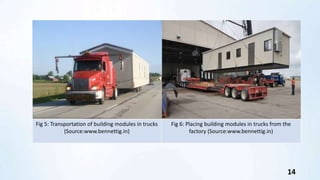
• The building modules are transported on carriers pulled by trucks
• They are loaded and unloaded by cranes
• Each module must be built to independently withstand travel and installation
requirements
• They should withstand high winds and manipulation by cranes
• The resiliency of modules contributes to greater structural strength of the
building
12
Transportation of modules to desired location(Contd…)
• Transportation of the modules depends upon:
1. Method of transport
2. Cost of transport
3. Travel distance
4. Restrictions along the roadways
5. Weight of the modules
• The size of the modules that can be transported also depends on these factors
13
Fig 5: Transportation of building modules in trucks
(Source:www.bennettig.in)
Fig 6: Placing building modules in trucks from the
factory (Source:www.bennettig.in)
14
Erection of modules to form a finished structure
• The modules are placed using a crane in a variety of styles and configurations
• The modules can be placed side by side, end to end or stalked
• After placement, modules are connected using inter-module connections
• In the final construction stage:
1. Internal and external finishes are done
2. Stairs and elevators are added
3. Cabinets, countertops, appliances etc. are added
15
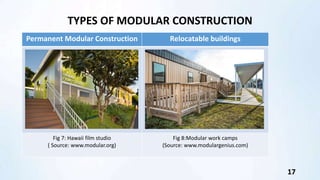
TYPES OF MODULAR CONSTRUCTION
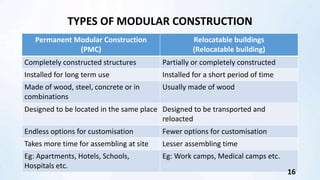
Permanent Modular Construction
(PMC)
Relocatable buildings
(Relocatable building)
Completely constructed structures Partially or completely constructed
Installed for long term use Installed for a short period of time
Made of wood, steel, concrete or in
combinations
Usually made of wood
Designed to be located in the same place Designed to be transported and
reloacted
Endless options for customisation Fewer options for customisation
Takes more time for assembling at site Lesser assembling time
Eg: Apartments, Hotels, Schools,
Hospitals etc.
Eg: Work camps, Medical camps etc.
16
TYPES OF MODULAR CONSTRUCTION
Permanent Modular Construction Relocatable buildings
Fig 7: Hawaii film studio
( Source: www.modular.org)
Fig 8:Modular work camps
(Source: www.modulargenius.com)
17
MODULAR UNITS FOR CONSTRUCTION
• Modular units-sections joined together to make a modular building
• Number of modules used depends on size and style of project
• Based on load transfer mechanism, 3D module is classified:
1. Load Bearing Wall- The gravity load transferred to the base through the
four side walls
2. Corner Supported Frame-Load transfer through edge beams and four
corner posts
18
MODULAR UNITS FOR CONSTRUCTION
Load Bearing wall Corner Supported Frame
Fig 9: Load bearing wall
(Source: www.researchgate.net)
Fig 10: Corner supported Frame
(Source: www.researchgate.net)
19
INTER-MODULE JOINING TECHNIQUES
• Connection between modules ensures structural integrity, overall stability and
robustness
• Welded connections are not preferred onsite
• They required skilled labour, large working space and time consuming inspections
• Joining techniques for steel buildings are:
1. Connection using tie rod
2. Using connector
3. Using bolt
20
INTER-MODULE JOINING TECHNIQUES
• Inter-module connections in concrete high rise buildings increase cost, reduces
speed of construction
• Significant labour for rebars and site grouting
Fig 11: Module stacking in modular construction
( Source: www.modulargrnious.com ) 21
APPLICATION OF MODULAR TECHNOLOGY FOR HIGH RISE
CONSTRUCTION
Table 1: Ten of the world’s tallest buildings
Source: www.researchgate.in
22
CONSTRUCTION APPROACHES FOR STACKING MODULES
Fig 12: Core, Podium and Infilled frame method of
construction
(Source: www.researchgate.in)
Three main approaches for stacking of
modules:
1. Core based approach
2. Podium based approach
3. Infilled frame method
23
1.Core-based approach
• Modules are stacked around one or more stability cores
• Modular units-resist vertical gravity loads
• Cores- lateral forces due to wind and earthquake
• Lateral diaphragms and connections between core and modules should be strong
• This is for safe transfer of lateral loads to the core
• Material of core-precast concrete, cast-in-site steel-concrete composite walls
• Additional bracing system within floor and ceiling-maximise building height
24
2.Podium-based approach
• Modules are placed above a podium or platform
• Podium is designed as a traditional steel, concrete or hybrid steel-concrete structure
• Podium acts as a foundation for modules stacked or clustered around cores for tall
buildings
• Beneficial for mixed use buildings
• Podium provide open space for commercial purpose and underground parking
25
3.Infilled frame method
• Modular units are placed between the beams and columns of a primary framing
structure
• The overall stability of the modular buildings is ensured
• The primary framing structure is constructed onsite by conventional methods.
26
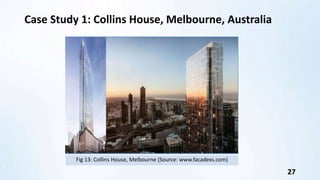
Case Study 1: Collins House, Melbourne, Australia
Fig 13: Collins House, Melbourne (Source: www.facadexs.com)
27
• Slimmest residential skyscraper in Australia- used podium approach
• Combined both panelised and volumetric methods
• Started construction in 2017 and was completed in 2019 (29 months)
• Number of storeys : 60 (including 1 below the ground)
• Ground floor area : 31,809 m2
• Height of building : 190m (177m height occupied)
• No. of apartments-259, elevators-3, parking spaces-73
• Structure was built in conventional method upto level 14 and the rest using HBS system
28
HBS (Hickory Building System)
• Developed by the Hickory group
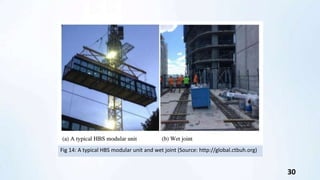
• HBS integrates the core, shear walls and facades of a building into the structure.
• The innovative HBS system is composed of various panelised modules such as
load bearing wall, elevator and stair cores, light-weight concrete floors etc.
• These modules are connected using wet joints
• Minimises material and energy waste, maximises quality and safety
• Saves construction time from 30%-50%
29
Fig 14: A typical HBS modular unit and wet joint (Source: http://global.ctbuh.org)
30
Case Study 2: The Clement Canopy, Singapore
Fig 15: The Clement Canopy Tower (Source: www.modular.org)
31
• The tallest modular building in Singapore
• World’s tallest concrete building constructed using PPVC
• PPVC - Prefabricated Prefinished Volumetric Construction
• Construction method in which free standing 3-dimensional modules are used
• The modules are completed with internal finishes, fixtures and fittings from factory
• Advantages of PPVC- increased productivity, better quality control and construction
environment
• 1899 PPVC modules with 48 different module shapes were used
32
Fig 16: Installation of the PPVC modules (Source: www1.bca.gov.sg)
33
• The Clement Canopy consists 40 storey twin towers
• Used core based approach
• Construction started in 2016 and finished in 2019 (30 months)
• Floor area-50,200 m2 , Height- 140 m
• Consists of 505 dwelling units, multi-storey car park with one basement floor
• Multi-storey car park, basement floor and first floor- conventional method
• Floor 2 to 40 adopted PPVC
34
• The PPVC modules were designed as six sided modules
• Weight - 26 tons to 31 tons
• These were installed using 48-ton capacity tower cranes.
• 10 to 12 modules per day with a floor cycle time of 7 days.
• PPVC saved construction time up to 30%
• Higher quality workmanship, safer construction site
• Reduced 70% onsite waste and 30% offsite waste
• Lesser disruptions to the surrounding schools.
35
ADVANTAGES OF MODULAR HIGH RISE CONSTRUCTION
• Speed of construction • Attractive design
• Off-site construction • Bespoke options available
• Minimal Impact on business • Flexibility of use
• Eco-friendly materials • High quality construction
• Cost effective • Durable materials
36
LIMITATIONS OF MODULAR HIGH RISE CONSTRUCTION
• Limited Variety due to the need of mass production
• Necessity of front loaded design
• Approval process can be complicated
• Transportation cost and risks
37
CONCLUSIONS
• Increasing population and urbanization demands more buildings for residence
and commercial activities
• There is a need of large number of high rise buildings in short period of time
• Modular building construction is faster, economical and sustainable method to
satisfy these needs.
• There is no change in quality and durability
• Highly beneficial for high rise buildings due to large number of repeating modules
38
REFERENCES
• Akok, J.Y and Prakask O.(2017)” Modular Construction Technique”, International
Journal of Engineering Sciences and Research Technology, ISSN: 2277-9655,
pp.207-209
• Edmond, F. (et al) (2016) “Construction of Modular Prefabricated Architecture:
Case Study-Based Review and Future Pathways”, ISSN 8, pp558
• Egege, C.O.(ed.) (2018) “Off-site Modular Construction as a method of increasing
quality and safety“, International Journal of Structural and Civil Engineering
Research, Vol 7, No 3, pp.259-268
• Generalova, E. (et al.) (2016) “Modular Buildings in Modern Construction”,
Russian Slovak Seminar, Theoretical Foundation of Civil Engineering, Vol 25,
pp.167-172
• Gharebhaghi, K. (et al.) (2020) “Case studies in modular prefabrication:
comparative analysis and discoveries”, Journal of Physics: Conference Series
39
• Hough, M and Lawson, R. (2019) “Design and Construction of Modular High
Rise Buildings based on recent projects”, ICE Publishing, Vol 6, pp.37-44
• Pansur, P and Patil, K. (2018) “Review paper on Modular Construction in
High Rise Buildings”, Journal of Advances and Scholarly Researches in Allied
Education, Vol 15, Issue 2, pp.623-625
• Singhal, S and Siddiqui B. (2019) “Comparative Study between RCC
Structures and Prefabricated Structures”. Babu Banarasi Das University,
Uttar Pradesh, India
• Thai T. (et al.) (2020) “A review on Modular Construction for High Rise
Buildings”. The University of Melbourne, Pakville
• Yang, Y. (et al.) (2017) “Manufacturing of Modular Buildings: A Literature
Review”, Modular and Offsite Construction Summit, pp.55-62,Shangai,
China
• Modular Building Institute: Modular Construction, Frequently updated
website, Viewed on November 25, 2021
https://www.modular.org/HtmlPage.aspx? name=why modular
• TWI Global: A Guide to Modular Construction, Frequently updated website,
Viewed on November 26, 2021 https://www.twi-global.com/technical-
knowledge/faqs/what-is-a-modular-building
40

Modular High Rise Construction.pptx

  • 1.
    MODULAR HIGH RISECONSTRUCTION 1
  • 2.
    OVERVIEW • Introduction • Differencebetween modular and prefab • Modular construction process • Types of modular construction • Modular units for construction • Inter-module joining techniques • Application of modular techniques in high-rise construction • Construction approaches for stalking modules • Case studies • Advantages and limitations of modular high-rise construction • Conclusions • References 2
  • 3.
    INTRODUCTION • In prefabricatedconstruction, building units are fabricated in factory and are transported to site for assembly • The three classes of prefabricated construction are: 1D single element, 2D panelized system and 3D volumetric construction • The panelized and volumetric construction is also known as modular construction • It is the most efficient class- 70 to 85% prefabrication in factory • Enables faster, safer, sustainable, economical construction with better quality control 3
  • 4.
    INTRODUCTION (Cond…) • Itcan reduce: 1. Onsite waste generation up to 90% 2. Construction time by 50% 3. Cost of construction by 20% • Modular construction is preferred in structures with repeated units(modules) such as offices, schools, apartments • High rise buildings consists of large number of repeated modules in them • Therefore, the use of modular construction is highly beneficial for high risers 4
  • 5.
    Fig 1: CroydonTower, London (Source: www.dezeen.com) 5
  • 6.
    DIFFERENCE BETWEEN MODULARAND PREFAB • The terms modular and prefab are used interchangeably but they are different • Prefab construction includes any construction work done in factories away from the site • Parts of building including panels and modules are made in factory • They are transported to the site and assembled • Modular construction is only a type of prefab construction • Construction of modular buildings are mostly completed in the factory • It involves the installation of modules on site 6
  • 7.
    Fig 2: Assemblingof panels in prefabricated construction (www.frozen.com) Fig 3: Assembling of modules in modular construction (www.frozen.com) 7
  • 8.
    MODULAR BUILDING PROCESS •The processes involved in modular building construction include: 1. Design approval by the regulating authorities and end users 2. Construction of modular components in controlled atmosphere 3. Transportation of materials to desired location 4. Erection of modules to form a finished building 8
  • 9.
    Design approval bythe regulating authorities and end users • Beginning phase-interior and exterior plans are created using BIM and other softwares • After getting approval from the client, plan is submitted for getting administrative and technical sanction • After the sanction from the competent authorities, components are manufactured • Modular buildings must follow the local building codes and zoning regulations 9
  • 10.
    Construction of modularcomponents in a controlled atmosphere • The modules for construction are built in a controlled offsite factory environment • The site excavation and grading are going on at the same time at the site • About 60%-90% work can be performed in factory • The amount of work completed in factory depends on user requirements • Assembling of basic structural components , exterior and interior finishes are done • Mechanical, plumbing and electrical components can be installed in the factory 10
  • 11.
    Construction of modularcomponents in a controlled atmosphere (Continued…) • Labour force in the factory include carpenters, plumbers, electricians, painters etc. • Inspection by engineers at various stages of construction • After completion of each modules, they are prepared for transportation Fig 4: Modular construction factory (Source: www.modular.org) 11
  • 12.
    Transportation of modulesto desired location • The building modules are transported on carriers pulled by trucks • They are loaded and unloaded by cranes • Each module must be built to independently withstand travel and installation requirements • They should withstand high winds and manipulation by cranes • The resiliency of modules contributes to greater structural strength of the building 12
  • 13.
    Transportation of modulesto desired location(Contd…) • Transportation of the modules depends upon: 1. Method of transport 2. Cost of transport 3. Travel distance 4. Restrictions along the roadways 5. Weight of the modules • The size of the modules that can be transported also depends on these factors 13
  • 14.
    Fig 5: Transportationof building modules in trucks (Source:www.bennettig.in) Fig 6: Placing building modules in trucks from the factory (Source:www.bennettig.in) 14
  • 15.
    Erection of modulesto form a finished structure • The modules are placed using a crane in a variety of styles and configurations • The modules can be placed side by side, end to end or stalked • After placement, modules are connected using inter-module connections • In the final construction stage: 1. Internal and external finishes are done 2. Stairs and elevators are added 3. Cabinets, countertops, appliances etc. are added 15
  • 16.
    TYPES OF MODULARCONSTRUCTION Permanent Modular Construction (PMC) Relocatable buildings (Relocatable building) Completely constructed structures Partially or completely constructed Installed for long term use Installed for a short period of time Made of wood, steel, concrete or in combinations Usually made of wood Designed to be located in the same place Designed to be transported and reloacted Endless options for customisation Fewer options for customisation Takes more time for assembling at site Lesser assembling time Eg: Apartments, Hotels, Schools, Hospitals etc. Eg: Work camps, Medical camps etc. 16
  • 17.
    TYPES OF MODULARCONSTRUCTION Permanent Modular Construction Relocatable buildings Fig 7: Hawaii film studio ( Source: www.modular.org) Fig 8:Modular work camps (Source: www.modulargenius.com) 17
  • 18.
    MODULAR UNITS FORCONSTRUCTION • Modular units-sections joined together to make a modular building • Number of modules used depends on size and style of project • Based on load transfer mechanism, 3D module is classified: 1. Load Bearing Wall- The gravity load transferred to the base through the four side walls 2. Corner Supported Frame-Load transfer through edge beams and four corner posts 18
  • 19.
    MODULAR UNITS FORCONSTRUCTION Load Bearing wall Corner Supported Frame Fig 9: Load bearing wall (Source: www.researchgate.net) Fig 10: Corner supported Frame (Source: www.researchgate.net) 19
  • 20.
    INTER-MODULE JOINING TECHNIQUES •Connection between modules ensures structural integrity, overall stability and robustness • Welded connections are not preferred onsite • They required skilled labour, large working space and time consuming inspections • Joining techniques for steel buildings are: 1. Connection using tie rod 2. Using connector 3. Using bolt 20
  • 21.
    INTER-MODULE JOINING TECHNIQUES •Inter-module connections in concrete high rise buildings increase cost, reduces speed of construction • Significant labour for rebars and site grouting Fig 11: Module stacking in modular construction ( Source: www.modulargrnious.com ) 21
  • 22.
    APPLICATION OF MODULARTECHNOLOGY FOR HIGH RISE CONSTRUCTION Table 1: Ten of the world’s tallest buildings Source: www.researchgate.in 22
  • 23.
    CONSTRUCTION APPROACHES FORSTACKING MODULES Fig 12: Core, Podium and Infilled frame method of construction (Source: www.researchgate.in) Three main approaches for stacking of modules: 1. Core based approach 2. Podium based approach 3. Infilled frame method 23
  • 24.
    1.Core-based approach • Modulesare stacked around one or more stability cores • Modular units-resist vertical gravity loads • Cores- lateral forces due to wind and earthquake • Lateral diaphragms and connections between core and modules should be strong • This is for safe transfer of lateral loads to the core • Material of core-precast concrete, cast-in-site steel-concrete composite walls • Additional bracing system within floor and ceiling-maximise building height 24
  • 25.
    2.Podium-based approach • Modulesare placed above a podium or platform • Podium is designed as a traditional steel, concrete or hybrid steel-concrete structure • Podium acts as a foundation for modules stacked or clustered around cores for tall buildings • Beneficial for mixed use buildings • Podium provide open space for commercial purpose and underground parking 25
  • 26.
    3.Infilled frame method •Modular units are placed between the beams and columns of a primary framing structure • The overall stability of the modular buildings is ensured • The primary framing structure is constructed onsite by conventional methods. 26
  • 27.
    Case Study 1:Collins House, Melbourne, Australia Fig 13: Collins House, Melbourne (Source: www.facadexs.com) 27
  • 28.
    • Slimmest residentialskyscraper in Australia- used podium approach • Combined both panelised and volumetric methods • Started construction in 2017 and was completed in 2019 (29 months) • Number of storeys : 60 (including 1 below the ground) • Ground floor area : 31,809 m2 • Height of building : 190m (177m height occupied) • No. of apartments-259, elevators-3, parking spaces-73 • Structure was built in conventional method upto level 14 and the rest using HBS system 28
  • 29.
    HBS (Hickory BuildingSystem) • Developed by the Hickory group • HBS integrates the core, shear walls and facades of a building into the structure. • The innovative HBS system is composed of various panelised modules such as load bearing wall, elevator and stair cores, light-weight concrete floors etc. • These modules are connected using wet joints • Minimises material and energy waste, maximises quality and safety • Saves construction time from 30%-50% 29
  • 30.
    Fig 14: Atypical HBS modular unit and wet joint (Source: http://global.ctbuh.org) 30
  • 31.
    Case Study 2:The Clement Canopy, Singapore Fig 15: The Clement Canopy Tower (Source: www.modular.org) 31
  • 32.
    • The tallestmodular building in Singapore • World’s tallest concrete building constructed using PPVC • PPVC - Prefabricated Prefinished Volumetric Construction • Construction method in which free standing 3-dimensional modules are used • The modules are completed with internal finishes, fixtures and fittings from factory • Advantages of PPVC- increased productivity, better quality control and construction environment • 1899 PPVC modules with 48 different module shapes were used 32
  • 33.
    Fig 16: Installationof the PPVC modules (Source: www1.bca.gov.sg) 33
  • 34.
    • The ClementCanopy consists 40 storey twin towers • Used core based approach • Construction started in 2016 and finished in 2019 (30 months) • Floor area-50,200 m2 , Height- 140 m • Consists of 505 dwelling units, multi-storey car park with one basement floor • Multi-storey car park, basement floor and first floor- conventional method • Floor 2 to 40 adopted PPVC 34
  • 35.
    • The PPVCmodules were designed as six sided modules • Weight - 26 tons to 31 tons • These were installed using 48-ton capacity tower cranes. • 10 to 12 modules per day with a floor cycle time of 7 days. • PPVC saved construction time up to 30% • Higher quality workmanship, safer construction site • Reduced 70% onsite waste and 30% offsite waste • Lesser disruptions to the surrounding schools. 35
  • 36.
    ADVANTAGES OF MODULARHIGH RISE CONSTRUCTION • Speed of construction • Attractive design • Off-site construction • Bespoke options available • Minimal Impact on business • Flexibility of use • Eco-friendly materials • High quality construction • Cost effective • Durable materials 36
  • 37.
    LIMITATIONS OF MODULARHIGH RISE CONSTRUCTION • Limited Variety due to the need of mass production • Necessity of front loaded design • Approval process can be complicated • Transportation cost and risks 37
  • 38.
    CONCLUSIONS • Increasing populationand urbanization demands more buildings for residence and commercial activities • There is a need of large number of high rise buildings in short period of time • Modular building construction is faster, economical and sustainable method to satisfy these needs. • There is no change in quality and durability • Highly beneficial for high rise buildings due to large number of repeating modules 38
  • 39.
    REFERENCES • Akok, J.Yand Prakask O.(2017)” Modular Construction Technique”, International Journal of Engineering Sciences and Research Technology, ISSN: 2277-9655, pp.207-209 • Edmond, F. (et al) (2016) “Construction of Modular Prefabricated Architecture: Case Study-Based Review and Future Pathways”, ISSN 8, pp558 • Egege, C.O.(ed.) (2018) “Off-site Modular Construction as a method of increasing quality and safety“, International Journal of Structural and Civil Engineering Research, Vol 7, No 3, pp.259-268 • Generalova, E. (et al.) (2016) “Modular Buildings in Modern Construction”, Russian Slovak Seminar, Theoretical Foundation of Civil Engineering, Vol 25, pp.167-172 • Gharebhaghi, K. (et al.) (2020) “Case studies in modular prefabrication: comparative analysis and discoveries”, Journal of Physics: Conference Series 39
  • 40.
    • Hough, Mand Lawson, R. (2019) “Design and Construction of Modular High Rise Buildings based on recent projects”, ICE Publishing, Vol 6, pp.37-44 • Pansur, P and Patil, K. (2018) “Review paper on Modular Construction in High Rise Buildings”, Journal of Advances and Scholarly Researches in Allied Education, Vol 15, Issue 2, pp.623-625 • Singhal, S and Siddiqui B. (2019) “Comparative Study between RCC Structures and Prefabricated Structures”. Babu Banarasi Das University, Uttar Pradesh, India • Thai T. (et al.) (2020) “A review on Modular Construction for High Rise Buildings”. The University of Melbourne, Pakville • Yang, Y. (et al.) (2017) “Manufacturing of Modular Buildings: A Literature Review”, Modular and Offsite Construction Summit, pp.55-62,Shangai, China • Modular Building Institute: Modular Construction, Frequently updated website, Viewed on November 25, 2021 https://www.modular.org/HtmlPage.aspx? name=why modular • TWI Global: A Guide to Modular Construction, Frequently updated website, Viewed on November 26, 2021 https://www.twi-global.com/technical- knowledge/faqs/what-is-a-modular-building 40