Modular buildings and
modular homes are sectional
prefabricated buildings, or
houses, that consist of
multiple sections called
modules. International
space station is located in the
orbit around the Earth at an
altitude of approximately
360 km and orbits around
the Earth about every 90
minutes. Modules were send
up into space and then
assembled for the
construction of the space
station.
Down here on earth
Modular buildings are
also called prefabricated
buildings. They are
typically transported to
their site by truck or
container and conform
to all local building
codes for their proposed
use. Construction of
modular homes are
exactly the same
building codes that
govern the construction
of site-constructed
homes.
Modular buildings are
used for long-term or
permanent
facilities, such as,
schools, civilian
housing, hospitals,
military housing,
commercial building
and industrial facilities.
Modular buildings are
used in remote and
rural areas
where conventional
construction may not
be reasonable or
possible.
Modular buildings are often
priced lower than their site-built
counterparts, for a variety of
reasons.
Indoor construction: Assembly
is independent of weather,
which increases work efficiency
and avoids damaged building
material.
Favourable pricing from
suppliers: Large-scale
manufacturers can effectively
bargain with suppliers for
discounts on materials.
Ability to service remote
locations: Particularly in
countries in which potential
markets may be located far from
industrial centres.
Low waste: With the same plans
being constantly built, the
manufacturer has records of
exactly what quantity of
materials are needed for a given
job.
Environmentally friendly
construction process: Modular
construction reduces waste and
site disturbance compared to
site-built structures.
Flexibility: Conventional
buildings can be difficult to
extend, however with a modular
building you can simply add
sections, or even entire floors.
The materials used in
modular homes are the
same as site constructed
homes. Steel frame walls,
floors and roof are the
most typical. Some
modular homes can
include stone exteriors,
granite counters and
steeply pitched roofs. All
modular are designed to
sit on a perimeter
foundation or basement
and modular homes are
designed to be stronger
than traditional homes.
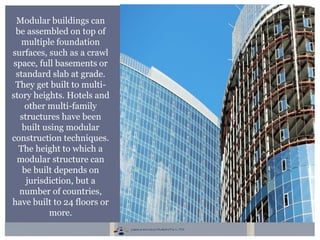
Modular buildings can
be assembled on top of
multiple foundation
surfaces, such as a crawl
space, full basements or
standard slab at grade.
They get built to multi-
story heights. Hotels and
other multi-family
structures have been
built using modular
construction techniques.
The height to which a
modular structure can
be built depends on
jurisdiction, but a
number of countries,
have built to 24 floors or
more.
Modular ground to space station

Modular ground to space station

  • 2.
    Modular buildings and modularhomes are sectional prefabricated buildings, or houses, that consist of multiple sections called modules. International space station is located in the orbit around the Earth at an altitude of approximately 360 km and orbits around the Earth about every 90 minutes. Modules were send up into space and then assembled for the construction of the space station.
  • 3.
    Down here onearth Modular buildings are also called prefabricated buildings. They are typically transported to their site by truck or container and conform to all local building codes for their proposed use. Construction of modular homes are exactly the same building codes that govern the construction of site-constructed homes.
  • 4.
    Modular buildings are usedfor long-term or permanent facilities, such as, schools, civilian housing, hospitals, military housing, commercial building and industrial facilities. Modular buildings are used in remote and rural areas where conventional construction may not be reasonable or possible.
  • 5.
    Modular buildings areoften priced lower than their site-built counterparts, for a variety of reasons. Indoor construction: Assembly is independent of weather, which increases work efficiency and avoids damaged building material. Favourable pricing from suppliers: Large-scale manufacturers can effectively bargain with suppliers for discounts on materials. Ability to service remote locations: Particularly in countries in which potential markets may be located far from industrial centres.
  • 6.
    Low waste: Withthe same plans being constantly built, the manufacturer has records of exactly what quantity of materials are needed for a given job. Environmentally friendly construction process: Modular construction reduces waste and site disturbance compared to site-built structures. Flexibility: Conventional buildings can be difficult to extend, however with a modular building you can simply add sections, or even entire floors.
  • 7.
    The materials usedin modular homes are the same as site constructed homes. Steel frame walls, floors and roof are the most typical. Some modular homes can include stone exteriors, granite counters and steeply pitched roofs. All modular are designed to sit on a perimeter foundation or basement and modular homes are designed to be stronger than traditional homes.
  • 8.
    Modular buildings can beassembled on top of multiple foundation surfaces, such as a crawl space, full basements or standard slab at grade. They get built to multi- story heights. Hotels and other multi-family structures have been built using modular construction techniques. The height to which a modular structure can be built depends on jurisdiction, but a number of countries, have built to 24 floors or more.