MODULAR CONSTRUCTION
SUBMITTED BY:
JEELKUMAR PATEL(18BCL039)
•An increasing number of building projects across several markets are using modular construction,
the process by which components of building are prefabricated off-site in a controlled setting and
then shipped to the project site and assembled.
•According to research conducted by McGraw-Hill construction, when implemented effectively this
approach has been shown to result in a higher quality building, delivered in a shorter time frame,
with more predicated costs and fewer environmental impacts for example, through reduced
material use and waste.
INTRODUCTION:-
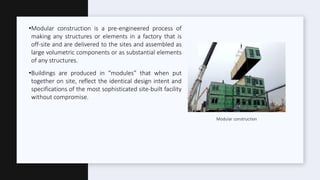
•Modular construction is a pre-engineered process of
making any structures or elements in a factory that is
off-site and are delivered to the sites and assembled as
large volumetric components or as substantial elements
of any structures.
•Buildings are produced in “modules” that when put
together on site, reflect the identical design intent and
specifications of the most sophisticated site-built facility
without compromise.
Modular construction
•To prefabricated single or multi-story buildings.
•Based on around standard 20 foot containers.
•Using the same dimensions, structures building and placing techniques.
•Permanent modular construction(PMC) buildings are manufactured in a controlled setting and
can be constructed of wood, steel, or concrete.
•Modular components are typically constructed indoors on assembly lines.
•Modules construction may take as little as ten days but more often one to three months.
•PMC modules can be integrated into site built projects or stand alone and can be delivered with
MEP(Mechanical, electrical and plumbing) fixtures and interior finishes.
CONSTRUCTION PROCESS:-
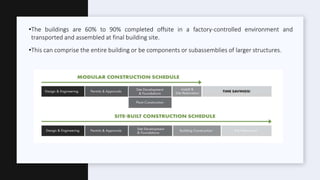
•The buildings are 60% to 90% completed offsite in a factory-controlled environment and
transported and assembled at final building site.
•This can comprise the entire building or be components or subassemblies of larger structures.
The following are key measurement metrics that were considered for measurement:
1. Percentage of onsite vs. offsite construction via modular technology
2. Project Timing
3. Cost saving
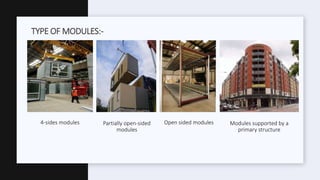
TYPE OF MODULES:-
4-sides modules Partially open-sided
modules
Open sided modules Modules supported by a
primary structure
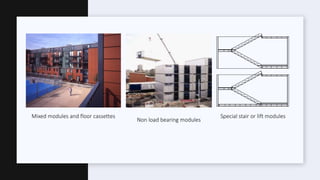
Mixed modules and floor cassettes
Non load bearing modules
Special stair or lift modules
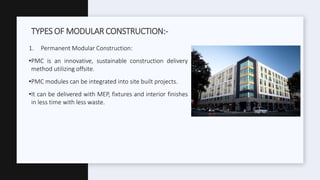
1. Permanent Modular Construction:
•PMC is an innovative, sustainable construction delivery
method utilizing offsite.
•PMC modules can be integrated into site built projects.
•It can be delivered with MEP, fixtures and interior finishes
in less time with less waste.
TYPES OF MODULAR CONSTRUCTION:-
2. Relocated Buildings:
•RB is partially or completely assembled building that
complies with applicable codes.
•Relocated buildings are designed to be reused or
repurposed multiple times and transported to different
building sites.
•They are utilized for schools, construction site offices,
medical clinics.
•These buildings offer fast delivery, ease of relocation, low
cost reconfiguration, accelerated depreciation schedules
and enormous flexibility.
Advantages:
•Speed of construction/Faster return on
investment
•Indoor construction
•Ability to service remote locations
•Low waste
•Environmentally friendly construction process
•Quality
•Improved air quality
 Disadvantages:
• Volumetric
• Flexibility
• Some financial institutions may be hesitant
to offer a loan for a modular home.
•Project: Caramel Place
•Off site fabrication and transport: Capsys
•On site assembly: Monadnock construction
•Size: 35000 sq. Ft
•Location: New York city
•Year completed: 2017
•Time to complete: 22months
•Total cost: $300- $400 per sq. Ft
•Use type: Residential
CASE STUDY:
Modular Construction

Modular Construction

  • 1.
  • 2.
    •An increasing numberof building projects across several markets are using modular construction, the process by which components of building are prefabricated off-site in a controlled setting and then shipped to the project site and assembled. •According to research conducted by McGraw-Hill construction, when implemented effectively this approach has been shown to result in a higher quality building, delivered in a shorter time frame, with more predicated costs and fewer environmental impacts for example, through reduced material use and waste. INTRODUCTION:-
  • 3.
    •Modular construction isa pre-engineered process of making any structures or elements in a factory that is off-site and are delivered to the sites and assembled as large volumetric components or as substantial elements of any structures. •Buildings are produced in “modules” that when put together on site, reflect the identical design intent and specifications of the most sophisticated site-built facility without compromise. Modular construction
  • 4.
    •To prefabricated singleor multi-story buildings. •Based on around standard 20 foot containers. •Using the same dimensions, structures building and placing techniques. •Permanent modular construction(PMC) buildings are manufactured in a controlled setting and can be constructed of wood, steel, or concrete. •Modular components are typically constructed indoors on assembly lines. •Modules construction may take as little as ten days but more often one to three months. •PMC modules can be integrated into site built projects or stand alone and can be delivered with MEP(Mechanical, electrical and plumbing) fixtures and interior finishes. CONSTRUCTION PROCESS:-
  • 5.
    •The buildings are60% to 90% completed offsite in a factory-controlled environment and transported and assembled at final building site. •This can comprise the entire building or be components or subassemblies of larger structures.
  • 6.
    The following arekey measurement metrics that were considered for measurement: 1. Percentage of onsite vs. offsite construction via modular technology 2. Project Timing 3. Cost saving
  • 7.
    TYPE OF MODULES:- 4-sidesmodules Partially open-sided modules Open sided modules Modules supported by a primary structure
  • 8.
    Mixed modules andfloor cassettes Non load bearing modules Special stair or lift modules
  • 9.
    1. Permanent ModularConstruction: •PMC is an innovative, sustainable construction delivery method utilizing offsite. •PMC modules can be integrated into site built projects. •It can be delivered with MEP, fixtures and interior finishes in less time with less waste. TYPES OF MODULAR CONSTRUCTION:-
  • 10.
    2. Relocated Buildings: •RBis partially or completely assembled building that complies with applicable codes. •Relocated buildings are designed to be reused or repurposed multiple times and transported to different building sites. •They are utilized for schools, construction site offices, medical clinics. •These buildings offer fast delivery, ease of relocation, low cost reconfiguration, accelerated depreciation schedules and enormous flexibility.
  • 11.
    Advantages: •Speed of construction/Fasterreturn on investment •Indoor construction •Ability to service remote locations •Low waste •Environmentally friendly construction process •Quality •Improved air quality  Disadvantages: • Volumetric • Flexibility • Some financial institutions may be hesitant to offer a loan for a modular home.
  • 12.
    •Project: Caramel Place •Offsite fabrication and transport: Capsys •On site assembly: Monadnock construction •Size: 35000 sq. Ft •Location: New York city •Year completed: 2017 •Time to complete: 22months •Total cost: $300- $400 per sq. Ft •Use type: Residential CASE STUDY: