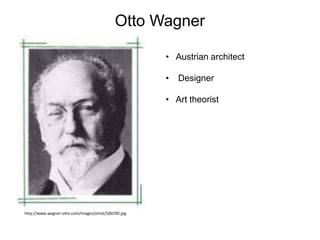
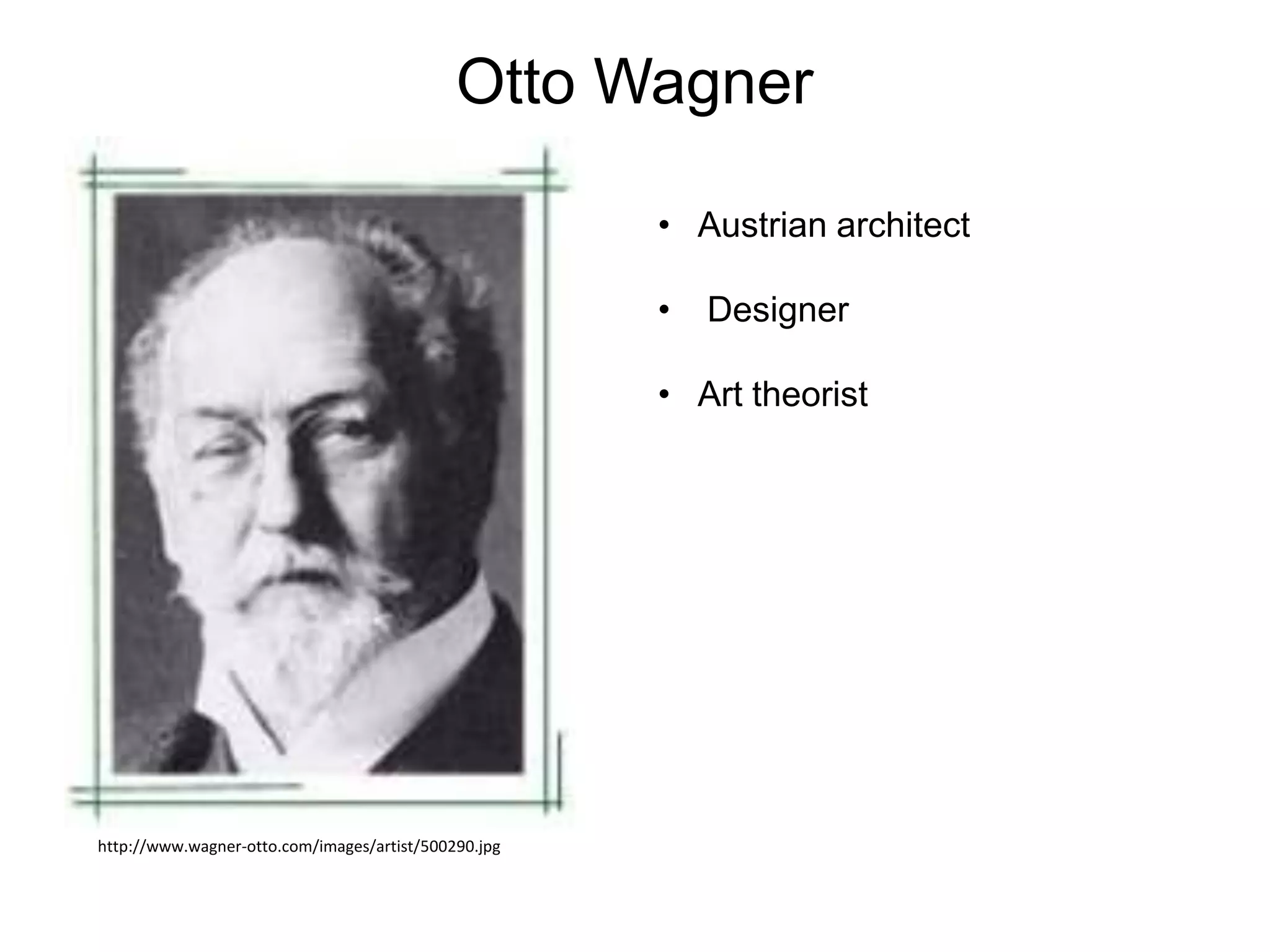
Otto Wagner
• Austrian architect

•

Designer

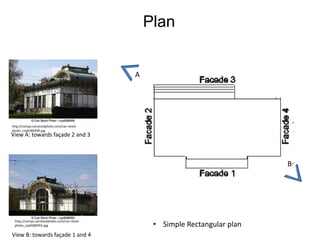
• Art theorist

http://www.wagner-otto.com/images/artist/500290.jpg
Timeline
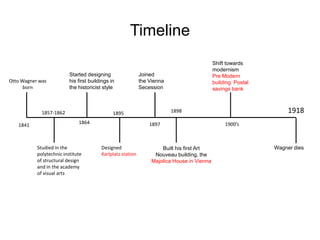
Otto Wagner was
born

Started designing
his first buildings in
the historicist style

1857-1862
1841

Joined
the Vienna
Secession

Studied in the
polytechnic institute
of structural design
and in the academy
of visual arts

1897

Designed
Karlplatz station

1918

1898

1895
1864

Shift towards
modernism
Pre Modern
building: Postal
savings bank

Built his first Art
Nouveau building, the
Majolica House in Vienna

1900’s

Wagner dies
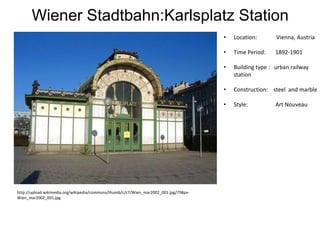
Wiener Stadtbahn:Karlsplatz Station
•

Vienna, Austria

•

Time Period:

1892-1901

•

Building type : urban railway
station

•

Construction: steel and marble

•

http://upload.wikimedia.org/wikipedia/commons/thumb/c/c7/Wien_mar2002_001.jpg/798pxWien_mar2002_001.jpg

Location:

Style:

Art Nouveau
Plan

A

http://comps.canstockphoto.com/can-stockphoto_csp9286949.jpg

View A: towards façade 2 and 3

B

http://comps.canstockphoto.com/can-stockphoto_csp9286955.jpg

View B: towards façade 1 and 4

• Simple Rectangular plan
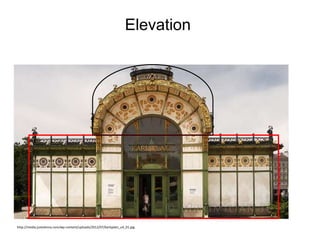
Elevation

http://media.justvienna.com/wp-content/uploads/2012/07/karlsplatz_u4_01.jpg
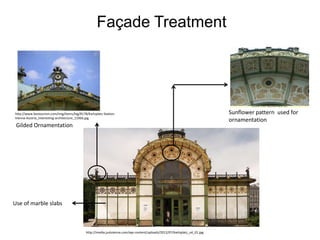
Façade Treatment

http://www.bestourism.com/img/items/big/8178/Karlsplatz-StationVienna-Austria_Interesting-architecture_15966.jpg

Gilded Ornamentation

Use of marble slabs

http://media.justvienna.com/wp-content/uploads/2012/07/karlsplatz_u4_01.jpg

Sunflower pattern used for
ornamentation
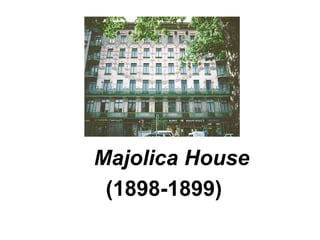
Majolica House
(1898-1899)
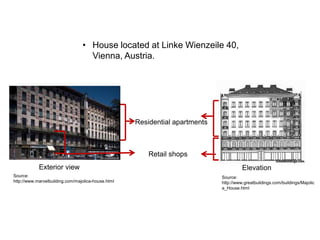
• House located at Linke Wienzeile 40,
Vienna, Austria.

Residential apartments

Retail shops
Exterior view
Source:
http://www.marvelbuilding.com/majolica-house.html

Elevation
Source:
http://www.greatbuildings.com/buildings/Majolic
a_House.html
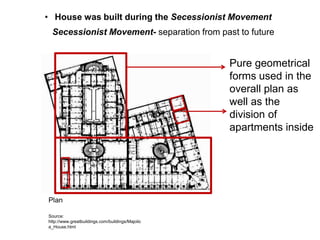
• House was built during the Secessionist Movement
Secessionist Movement- separation from past to future

Pure geometrical
forms used in the
overall plan as
well as the
division of
apartments inside

Plan
Source:
http://www.greatbuildings.com/buildings/Majolic
a_House.html
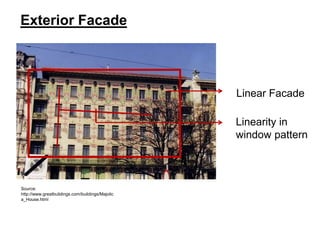
Exterior Facade

Linear Facade
Linearity in
window pattern

Source:
http://www.greatbuildings.com/buildings/Majolic
a_House.html
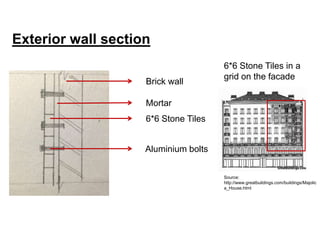
Exterior wall section
Brick wall

6*6 Stone Tiles in a
grid on the facade

Mortar
6*6 Stone Tiles
Aluminium bolts
Source:
http://www.greatbuildings.com/buildings/Majolic
a_House.html
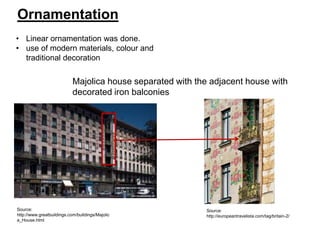
Ornamentation
• Linear ornamentation was done.
• use of modern materials, colour and
traditional decoration

Majolica house separated with the adjacent house with
decorated iron balconies

Source:
http://www.greatbuildings.com/buildings/Majolic
a_House.html

Source:
http://europeantravelista.com/tag/britain-2/
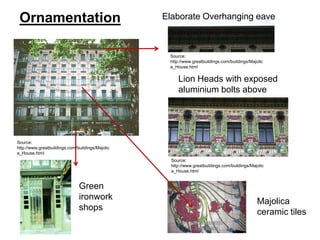
Ornamentation

Elaborate Overhanging eave

Source:
http://www.greatbuildings.com/buildings/Majolic
a_House.html

Lion Heads with exposed
aluminium bolts above

Source:
http://www.greatbuildings.com/buildings/Majolic
a_House.html
Source:
http://www.greatbuildings.com/buildings/Majolic
a_House.html

Green
ironwork
shops

Majolica
ceramic tiles
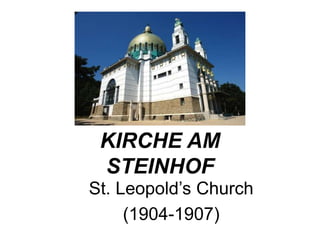
KIRCHE AM
STEINHOF
St. Leopold’s Church
(1904-1907)
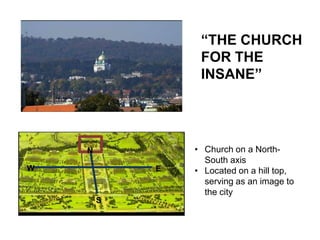
“THE CHURCH
FOR THE
INSANE”

N
W

E

S

• Church on a NorthSouth axis
• Located on a hill top,
serving as an image to
the city
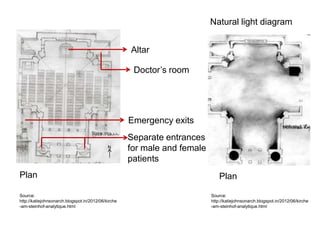
Natural light diagram
Altar
Doctor’s room

Emergency exits
N

Plan
Source:
http://katiejohnsonarch.blogspot.in/2012/06/kirche
-am-steinhof-analytique.html

Separate entrances
for male and female
patients
Plan
Source:
http://katiejohnsonarch.blogspot.in/2012/06/kirche
-am-steinhof-analytique.html
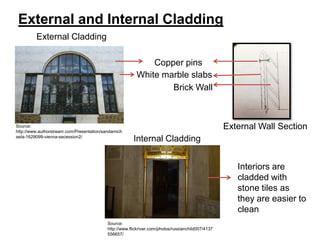
External and Internal Cladding
External Cladding
Copper pins
White marble slabs
Brick Wall

Source:
http://www.authorstream.com/Presentation/sandamich
aela-1629099-vienna-secession2/

External Wall Section
Internal Cladding
Interiors are
cladded with
stone tiles as
they are easier to
clean

Source:
http://www.flickriver.com/photos/russianchild007/4137
556657/
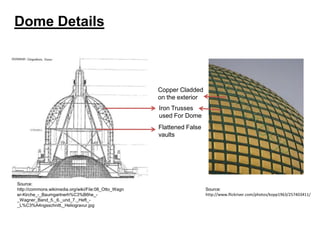
Dome Details

Copper Cladded
on the exterior
Iron Trusses
used For Dome
Flattened False
vaults

Source:
http://commons.wikimedia.org/wiki/File:08_Otto_Wagn
er-Kirche_-_Baumgartnerh%C3%B6he__Wagner_Band_5._6._und_7._Heft__L%C3%A4ngsschnitt,_Heliogravur.jpg

Source:
http://www.flickriver.com/photos/kopp1963/257403411/
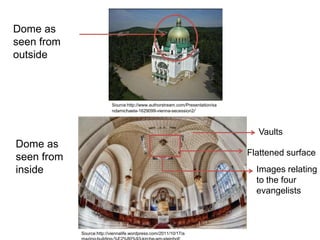
Dome as
seen from
outside

Source:http://www.authorstream.com/Presentation/sa
ndamichaela-1629099-vienna-secession2/

Vaults

Dome as
seen from
inside

Flattened surface
Images relating
to the four
evangelists

Source:http://viennalife.wordpress.com/2011/10/17/a
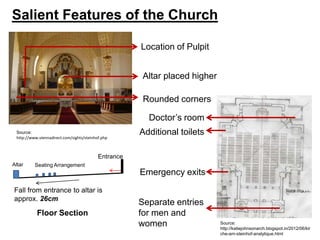
Salient Features of the Church
Location of Pulpit
Altar placed higher
Rounded corners
Doctor’s room
Source:
http://www.viennadirect.com/sights/steinhof.php

Additional toilets

Entrance
Altar

Seating Arrangement

Emergency exits
Fall from entrance to altar is
approx. 26cm

Floor Section

Separate entries
for men and
women

Source:
http://katiejohnsonarch.blogspot.in/2012/06/kir
che-am-steinhof-analytique.html
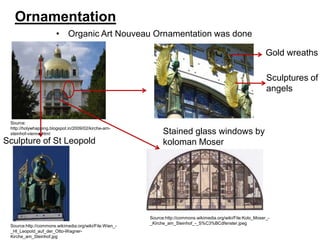
Ornamentation
• Organic Art Nouveau Ornamentation was done
Gold wreaths
Sculptures of
angels

Source:
http://holywhapping.blogspot.in/2009/02/kirche-amsteinhof-vienna.html

Sculpture of St Leopold

Source:http://commons.wikimedia.org/wiki/File:Wien__Hl_Leopold_auf_der_Otto-WagnerKirche_am_Steinhof.jpg

Stained glass windows by
koloman Moser

Source:http://commons.wikimedia.org/wiki/File:Kolo_Moser__Kirche_am_Steinhof_-_S%C3%BCdfenster.jpeg
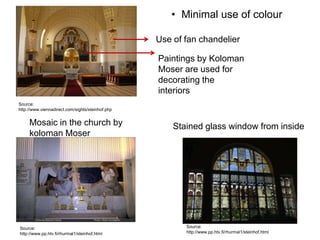
• Minimal use of colour
Use of fan chandelier
Paintings by Koloman
Moser are used for
decorating the
interiors
Source:
http://www.viennadirect.com/sights/steinhof.php

Mosaic in the church by
koloman Moser

Source:
http://www.pp.htv.fi/rhurmal1/steinhof.html

Stained glass window from inside

Source:
http://www.pp.htv.fi/rhurmal1/steinhof.html
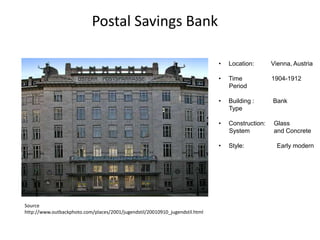
Postal Savings Bank
•

Vienna, Austria

•

Time
Period

1904-1912

•

Building :
Type

Bank

•

Construction:
System

Glass
and Concrete

•

Source
http://www.outbackphoto.com/places/2001/jugendstil/20010910_jugendstil.html

Location:

Style:

Early modern
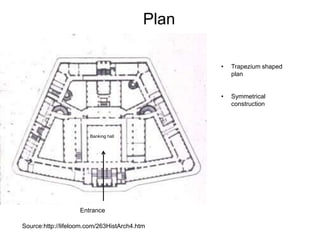
Plan
•

•

Banking hall

Entrance
Source:http://lifeloom.com/263HistArch4.htm

Trapezium shaped
plan

Symmetrical
construction
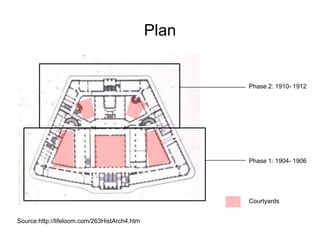
Plan

Phase 2: 1910- 1912

Phase 1: 1904- 1906

Courtyards
Source:http://lifeloom.com/263HistArch4.htm
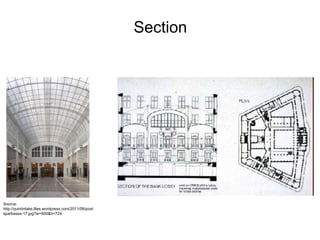
Section

Source:
http://quintinlake.files.wordpress.com/2011/08/post
sparkasse-17.jpg?w=500&h=724
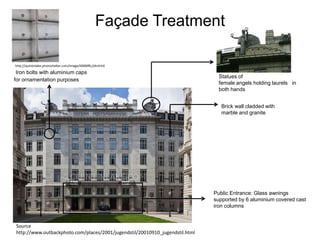
Façade Treatment
http://quintinlake.photoshelter.com/image/I0000fB.j34n5rh0

Iron bolts with aluminium caps
for ornamentation purposes

Statues of
female angels holding laurels in
both hands
Brick wall cladded with
marble and granite

Public Entrance: Glass awnings
supported by 6 aluminium covered cast
iron columns

Source
http://www.outbackphoto.com/places/2001/jugendstil/20010910_jugendstil.html
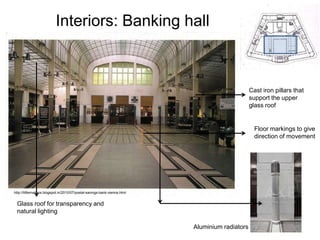
Interiors: Banking hall

Cast iron pillars that
support the upper
glass roof

Floor markings to give
direction of movement

http://littlemailbox.blogspot.in/2010/07/postal-savings-bank-vienna.html

Glass roof for transparency and
natural lighting
Aluminium radiators
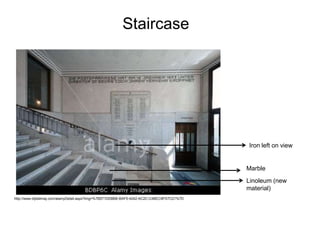
Staircase

Iron left on view

Marble
Linoleum (new
material)
http://www.dijitalimaj.com/alamyDetail.aspx?img=%7B571DD8BB-BAF5-4242-AC2C-C4BEC9FD7C21%7D
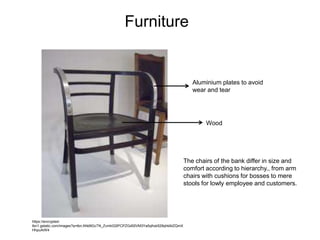
Furniture

Aluminium plates to avoid
wear and tear

Wood

The chairs of the bank differ in size and
comfort according to hierarchy., from arm
chairs with cushions for bosses to mere
stools for lowly employee and customers.

https://encryptedtbn1.gstatic.com/images?q=tbn:ANd9GcTN_Zvmkt32lPCPZGd00VM3Ya5qKsb529qhklblZQmX
HhpuAiW4
INFLUENCES OF
OTTO WAGNER
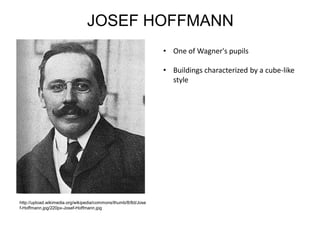
JOSEF HOFFMANN
• One of Wagner's pupils
• Buildings characterized by a cube-like
style

http://upload.wikimedia.org/wikipedia/commons/thumb/8/8d/Jose
f-Hoffmann.jpg/220px-Josef-Hoffmann.jpg
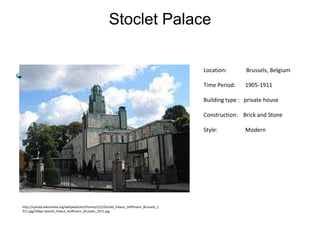
Stoclet Palace
Location:

Brussels, Belgium

Time Period:

1905-1911

Building type : private house
Construction: Brick and Stone
Style:

http://upload.wikimedia.org/wikipedia/en/thumb/c/c5/Stoclet_Palace_Hoffmann_Brussels_1
911.jpg/240px-Stoclet_Palace_Hoffmann_Brussels_1911.jpg

Modern
Entrance

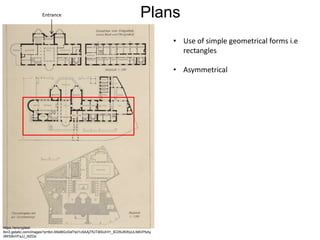
Plans
• Use of simple geometrical forms i.e
rectangles
• Asymmetrical

https://encryptedtbn3.gstatic.com/images?q=tbn:ANd9GcSsf7s01c5AAjTfUTi8SUH7r_IED5UKWyULN6VPbAy
dWS9vVFsJJ_0tZDo
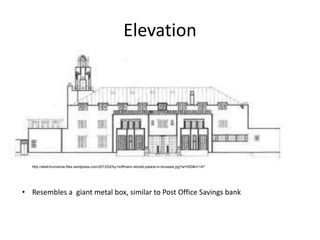
Elevation

http://sketchuniverse.files.wordpress.com/2013/02/by-hoffmann-stoclet-palace-in-brussels.jpg?w=300&h=147

• Resembles a giant metal box, similar to Post Office Savings bank
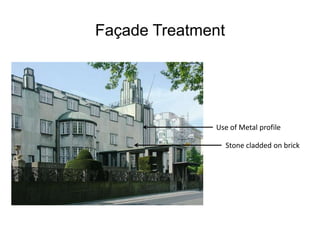
Façade Treatment

Use of Metal profile
Stone cladded on brick
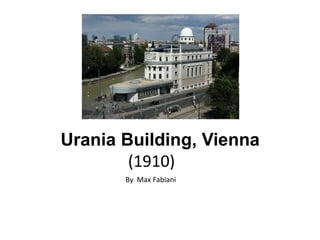
Urania Building, Vienna
(1910)
By Max Fabiani
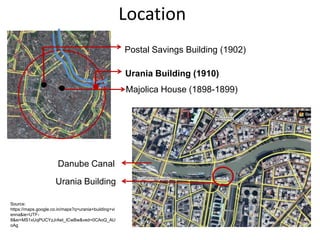
Location
Postal Savings Building (1902)
Urania Building (1910)
Majolica House (1898-1899)

Danube Canal

Urania Building
Source:
https://maps.google.co.in/maps?q=urania+building+vi
enna&ie=UTF8&ei=MS1xUqPUCYzJrAet_ICwBw&ved=0CAoQ_AU
oAg
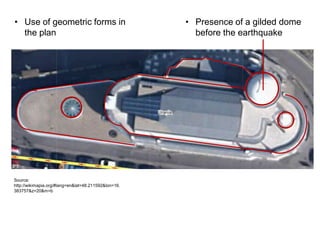
• Use of geometric forms in
the plan

Source:
http://wikimapia.org/#lang=en&lat=48.211592&lon=16.
383757&z=20&m=b

• Presence of a gilded dome
before the earthquake
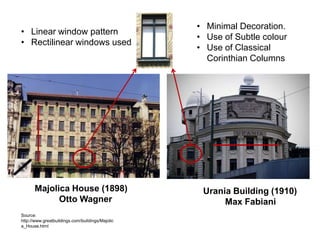
• Linear window pattern
• Rectilinear windows used

Majolica House (1898)
Otto Wagner
Source:
http://www.greatbuildings.com/buildings/Majolic
a_House.html

• Minimal Decoration.
• Use of Subtle colour
• Use of Classical
Corinthian Columns

Urania Building (1910)
Max Fabiani
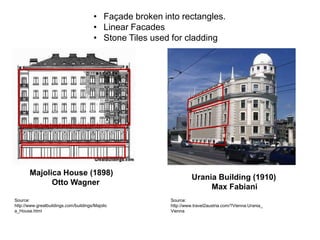
• Façade broken into rectangles.
• Linear Facades
• Stone Tiles used for cladding

Majolica House (1898)
Otto Wagner
Source:
http://www.greatbuildings.com/buildings/Majolic
a_House.html

Urania Building (1910)
Max Fabiani
Source:
http://www.travel2austria.com/?Vienna:Urania_
Vienna
References:
•

Kenneth Frampton, 1992. Modern Architecture: A Critical History (World of Art). 3 Sub Edition.
Thames & Hudson.
•

Amazing building – Kirche am Steinhof | viennalife. 2013. Amazing building – Kirche am Steinhof |
viennalife. [ONLINE] Available at: http://viennalife.wordpress.com/2011/10/17/amazing-building%E2%80%93-kirche-am-steinhof/

•

. [Accessed 24 October 2013].

•

St. Leopold am Steinhof - Otto Wagner - Great Buildings Architecture. 2013.St. Leopold am
Steinhof - Otto Wagner - Great Buildings Architecture. [ONLINE] Available
at:http://www.greatbuildings.com/buildings/st_leopold_am_steinhof.html . [Accessed 24 October
2013].

•

Majolica House Design | Home, Building, Furniture and Interior Design Ideas. 2013. Majolica
House Design | Home, Building, Furniture and Interior Design Ideas. [ONLINE] Available
at: http://www.marvelbuilding.com/majolica-house.html . [Accessed 30 October 2013].

•

WFS History. 2013. WFS History. [ONLINE] Available at:http://www.planetariumberlin.de/pages/hist/WFS-History.html. [Accessed 30 October 2013].

History

  • 1.
    Otto Wagner • Austrianarchitect • Designer • Art theorist http://www.wagner-otto.com/images/artist/500290.jpg
  • 2.
    Timeline Otto Wagner was born Starteddesigning his first buildings in the historicist style 1857-1862 1841 Joined the Vienna Secession Studied in the polytechnic institute of structural design and in the academy of visual arts 1897 Designed Karlplatz station 1918 1898 1895 1864 Shift towards modernism Pre Modern building: Postal savings bank Built his first Art Nouveau building, the Majolica House in Vienna 1900’s Wagner dies
  • 3.
    Wiener Stadtbahn:Karlsplatz Station • Vienna,Austria • Time Period: 1892-1901 • Building type : urban railway station • Construction: steel and marble • http://upload.wikimedia.org/wikipedia/commons/thumb/c/c7/Wien_mar2002_001.jpg/798pxWien_mar2002_001.jpg Location: Style: Art Nouveau
  • 4.
    Plan A http://comps.canstockphoto.com/can-stockphoto_csp9286949.jpg View A: towardsfaçade 2 and 3 B http://comps.canstockphoto.com/can-stockphoto_csp9286955.jpg View B: towards façade 1 and 4 • Simple Rectangular plan
  • 5.
  • 6.
    Façade Treatment http://www.bestourism.com/img/items/big/8178/Karlsplatz-StationVienna-Austria_Interesting-architecture_15966.jpg Gilded Ornamentation Useof marble slabs http://media.justvienna.com/wp-content/uploads/2012/07/karlsplatz_u4_01.jpg Sunflower pattern used for ornamentation
  • 7.
  • 8.
    • House locatedat Linke Wienzeile 40, Vienna, Austria. Residential apartments Retail shops Exterior view Source: http://www.marvelbuilding.com/majolica-house.html Elevation Source: http://www.greatbuildings.com/buildings/Majolic a_House.html
  • 9.
    • House wasbuilt during the Secessionist Movement Secessionist Movement- separation from past to future Pure geometrical forms used in the overall plan as well as the division of apartments inside Plan Source: http://www.greatbuildings.com/buildings/Majolic a_House.html
  • 10.
    Exterior Facade Linear Facade Linearityin window pattern Source: http://www.greatbuildings.com/buildings/Majolic a_House.html
  • 11.
    Exterior wall section Brickwall 6*6 Stone Tiles in a grid on the facade Mortar 6*6 Stone Tiles Aluminium bolts Source: http://www.greatbuildings.com/buildings/Majolic a_House.html
  • 12.
    Ornamentation • Linear ornamentationwas done. • use of modern materials, colour and traditional decoration Majolica house separated with the adjacent house with decorated iron balconies Source: http://www.greatbuildings.com/buildings/Majolic a_House.html Source: http://europeantravelista.com/tag/britain-2/
  • 13.
    Ornamentation Elaborate Overhanging eave Source: http://www.greatbuildings.com/buildings/Majolic a_House.html LionHeads with exposed aluminium bolts above Source: http://www.greatbuildings.com/buildings/Majolic a_House.html Source: http://www.greatbuildings.com/buildings/Majolic a_House.html Green ironwork shops Majolica ceramic tiles
  • 14.
  • 15.
    “THE CHURCH FOR THE INSANE” N W E S •Church on a NorthSouth axis • Located on a hill top, serving as an image to the city
  • 16.
    Natural light diagram Altar Doctor’sroom Emergency exits N Plan Source: http://katiejohnsonarch.blogspot.in/2012/06/kirche -am-steinhof-analytique.html Separate entrances for male and female patients Plan Source: http://katiejohnsonarch.blogspot.in/2012/06/kirche -am-steinhof-analytique.html
  • 17.
    External and InternalCladding External Cladding Copper pins White marble slabs Brick Wall Source: http://www.authorstream.com/Presentation/sandamich aela-1629099-vienna-secession2/ External Wall Section Internal Cladding Interiors are cladded with stone tiles as they are easier to clean Source: http://www.flickriver.com/photos/russianchild007/4137 556657/
  • 18.
    Dome Details Copper Cladded onthe exterior Iron Trusses used For Dome Flattened False vaults Source: http://commons.wikimedia.org/wiki/File:08_Otto_Wagn er-Kirche_-_Baumgartnerh%C3%B6he__Wagner_Band_5._6._und_7._Heft__L%C3%A4ngsschnitt,_Heliogravur.jpg Source: http://www.flickriver.com/photos/kopp1963/257403411/
  • 19.
    Dome as seen from outside Source:http://www.authorstream.com/Presentation/sa ndamichaela-1629099-vienna-secession2/ Vaults Domeas seen from inside Flattened surface Images relating to the four evangelists Source:http://viennalife.wordpress.com/2011/10/17/a
  • 20.
    Salient Features ofthe Church Location of Pulpit Altar placed higher Rounded corners Doctor’s room Source: http://www.viennadirect.com/sights/steinhof.php Additional toilets Entrance Altar Seating Arrangement Emergency exits Fall from entrance to altar is approx. 26cm Floor Section Separate entries for men and women Source: http://katiejohnsonarch.blogspot.in/2012/06/kir che-am-steinhof-analytique.html
  • 21.
    Ornamentation • Organic ArtNouveau Ornamentation was done Gold wreaths Sculptures of angels Source: http://holywhapping.blogspot.in/2009/02/kirche-amsteinhof-vienna.html Sculpture of St Leopold Source:http://commons.wikimedia.org/wiki/File:Wien__Hl_Leopold_auf_der_Otto-WagnerKirche_am_Steinhof.jpg Stained glass windows by koloman Moser Source:http://commons.wikimedia.org/wiki/File:Kolo_Moser__Kirche_am_Steinhof_-_S%C3%BCdfenster.jpeg
  • 22.
    • Minimal useof colour Use of fan chandelier Paintings by Koloman Moser are used for decorating the interiors Source: http://www.viennadirect.com/sights/steinhof.php Mosaic in the church by koloman Moser Source: http://www.pp.htv.fi/rhurmal1/steinhof.html Stained glass window from inside Source: http://www.pp.htv.fi/rhurmal1/steinhof.html
  • 23.
    Postal Savings Bank • Vienna,Austria • Time Period 1904-1912 • Building : Type Bank • Construction: System Glass and Concrete • Source http://www.outbackphoto.com/places/2001/jugendstil/20010910_jugendstil.html Location: Style: Early modern
  • 24.
  • 25.
    Plan Phase 2: 1910-1912 Phase 1: 1904- 1906 Courtyards Source:http://lifeloom.com/263HistArch4.htm
  • 26.
  • 27.
    Façade Treatment http://quintinlake.photoshelter.com/image/I0000fB.j34n5rh0 Iron boltswith aluminium caps for ornamentation purposes Statues of female angels holding laurels in both hands Brick wall cladded with marble and granite Public Entrance: Glass awnings supported by 6 aluminium covered cast iron columns Source http://www.outbackphoto.com/places/2001/jugendstil/20010910_jugendstil.html
  • 28.
    Interiors: Banking hall Castiron pillars that support the upper glass roof Floor markings to give direction of movement http://littlemailbox.blogspot.in/2010/07/postal-savings-bank-vienna.html Glass roof for transparency and natural lighting Aluminium radiators
  • 29.
    Staircase Iron left onview Marble Linoleum (new material) http://www.dijitalimaj.com/alamyDetail.aspx?img=%7B571DD8BB-BAF5-4242-AC2C-C4BEC9FD7C21%7D
  • 30.
    Furniture Aluminium plates toavoid wear and tear Wood The chairs of the bank differ in size and comfort according to hierarchy., from arm chairs with cushions for bosses to mere stools for lowly employee and customers. https://encryptedtbn1.gstatic.com/images?q=tbn:ANd9GcTN_Zvmkt32lPCPZGd00VM3Ya5qKsb529qhklblZQmX HhpuAiW4
  • 31.
  • 32.
    JOSEF HOFFMANN • Oneof Wagner's pupils • Buildings characterized by a cube-like style http://upload.wikimedia.org/wikipedia/commons/thumb/8/8d/Jose f-Hoffmann.jpg/220px-Josef-Hoffmann.jpg
  • 33.
    Stoclet Palace Location: Brussels, Belgium TimePeriod: 1905-1911 Building type : private house Construction: Brick and Stone Style: http://upload.wikimedia.org/wikipedia/en/thumb/c/c5/Stoclet_Palace_Hoffmann_Brussels_1 911.jpg/240px-Stoclet_Palace_Hoffmann_Brussels_1911.jpg Modern
  • 34.
    Entrance Plans • Use ofsimple geometrical forms i.e rectangles • Asymmetrical https://encryptedtbn3.gstatic.com/images?q=tbn:ANd9GcSsf7s01c5AAjTfUTi8SUH7r_IED5UKWyULN6VPbAy dWS9vVFsJJ_0tZDo
  • 35.
  • 36.
    Façade Treatment Use ofMetal profile Stone cladded on brick
  • 37.
  • 38.
    Location Postal Savings Building(1902) Urania Building (1910) Majolica House (1898-1899) Danube Canal Urania Building Source: https://maps.google.co.in/maps?q=urania+building+vi enna&ie=UTF8&ei=MS1xUqPUCYzJrAet_ICwBw&ved=0CAoQ_AU oAg
  • 39.
    • Use ofgeometric forms in the plan Source: http://wikimapia.org/#lang=en&lat=48.211592&lon=16. 383757&z=20&m=b • Presence of a gilded dome before the earthquake
  • 40.
    • Linear windowpattern • Rectilinear windows used Majolica House (1898) Otto Wagner Source: http://www.greatbuildings.com/buildings/Majolic a_House.html • Minimal Decoration. • Use of Subtle colour • Use of Classical Corinthian Columns Urania Building (1910) Max Fabiani
  • 41.
    • Façade brokeninto rectangles. • Linear Facades • Stone Tiles used for cladding Majolica House (1898) Otto Wagner Source: http://www.greatbuildings.com/buildings/Majolic a_House.html Urania Building (1910) Max Fabiani Source: http://www.travel2austria.com/?Vienna:Urania_ Vienna
  • 42.
    References: • Kenneth Frampton, 1992.Modern Architecture: A Critical History (World of Art). 3 Sub Edition. Thames & Hudson. • Amazing building – Kirche am Steinhof | viennalife. 2013. Amazing building – Kirche am Steinhof | viennalife. [ONLINE] Available at: http://viennalife.wordpress.com/2011/10/17/amazing-building%E2%80%93-kirche-am-steinhof/ • . [Accessed 24 October 2013]. • St. Leopold am Steinhof - Otto Wagner - Great Buildings Architecture. 2013.St. Leopold am Steinhof - Otto Wagner - Great Buildings Architecture. [ONLINE] Available at:http://www.greatbuildings.com/buildings/st_leopold_am_steinhof.html . [Accessed 24 October 2013]. • Majolica House Design | Home, Building, Furniture and Interior Design Ideas. 2013. Majolica House Design | Home, Building, Furniture and Interior Design Ideas. [ONLINE] Available at: http://www.marvelbuilding.com/majolica-house.html . [Accessed 30 October 2013]. • WFS History. 2013. WFS History. [ONLINE] Available at:http://www.planetariumberlin.de/pages/hist/WFS-History.html. [Accessed 30 October 2013].

Editor's Notes

  • #3 Otto Wagner was an Austrian architect practicing around 1860′s-1910 most known for his progressive design style – transitioning between historicism, art nouveau and modernism
  • #6 Rectangular + semicircular
  • #7  gilded ornamentation,  fluid and organic ornamentation, Flowers are very largely stylized,  Metal and wood were painted apple-green, the signal colour of the Stadtbahn. Gold, and finest white marble were added on the exterior. 
  • #10 Geometric forms pureLinear decorations
  • #24 First large scale building by ottowagner where he tested out his new theories.
  • #25 8 storey bank with no supporting walls ,Set back from the street: surprise element and no disturbance to existing
  • #27 Glass construction. Similar to a industrial building.
  • #28 . The entire facade is covered with square marble plates. These are attached to the main brick structure with mortar and ornamented with 17000iron bolts with aluminum caps, which themselves form a patternThe use of marble also makes the maintenance and cleaning of the facade very easy and inexpensive, another important functional element in Wagner's designEntrance elegant and discrete
  • #29 Shape similar to early Christian basilica: high central naïve flanked by lower two naves. Activities take place in lower naves.central nave free . Top of the pillars pass through glass and appear on the other side. This gives a felling of mystery and tranperancy.\Wagner’s favmetal:aluminiumEven the floor of the main hall is constructed of glass tiles, allowing natural light to reach further down to the floor below, where the Post Office boxes and mail sorting rooms are located. 
  • #31 The furniture followed all of his trademarks: min decoration, one material over the other, function justifies practice
  • #34 asymmetrical compilation of rectangular blocks, This no-nonsense starkness is softened by the artistic windowsthe rooftop conservatory and the bronze sculptures of four nude males, which are mounted on the tower that rises above the stairwell. Regimented upright balustrades line the balconies, touched with Art Nouveauornamentation.[5]
  • #35 The customary of the view of the house from the Avenue de Tervuren is not of the front of the building, but of the rear. The principle façade is on the other side, with the main entrance set in a portico beneath a concave wall between two trapezoid bays. it looks out over the fountains and formal gardens to lawns and a tennis court
  • #36 The outside of the building is entirely covered with white marble framed by gilded mouldings and is the only one of its kind in Brussels (cannot be visited). si,mil to karlsplatz
  • #37 Windows :rectangular surface on or in front of the wall, not just a hole in the walll