Claude Nicholas Ledoux

By
mipul Kumar
Pankaj Kumar
Claude Nicholas Ledoux
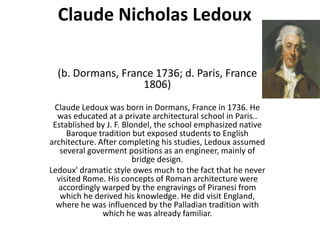
(b. Dormans, France 1736; d. Paris, France
1806)
Claude Ledoux was born in Dormans, France in 1736. He
was educated at a private architectural school in Paris..
Established by J. F. Blondel, the school emphasized native
Baroque tradition but exposed students to English
architecture. After completing his studies, Ledoux assumed
several goverment positions as an engineer, mainly of
bridge design.
Ledoux' dramatic style owes much to the fact that he never
visited Rome. His concepts of Roman architecture were
accordingly warped by the engravings of Piranesi from
which he derived his knowledge. He did visit England,
where he was influenced by the Palladian tradition with
which he was already familiar.
style
Although much of Ledoux's architecture is
quite practical and functional, the "visionary"
aspects of his work are better known. His
designs became symbols of the ancient
regime and their exaggerated use of classical
elements seems to anticipate post-modern
classicism.
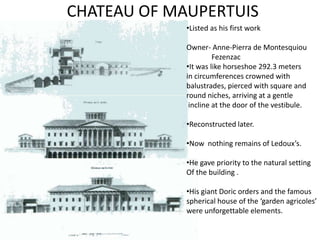
CHATEAU OF MAUPERTUIS
•Listed as his first work
Owner- Anne-Pierra de Montesquiou
Fezenzac
•It was like horseshoe 292.3 meters
in circumferences crowned with
balustrades, pierced with square and
round niches, arriving at a gentle
incline at the door of the vestibule.
•Reconstructed later.
•Now nothing remains of Ledoux’s.
•He gave priority to the natural setting
Of the building .
•His giant Doric orders and the famous
spherical house of the ‘garden agricoles’
were unforgettable elements.
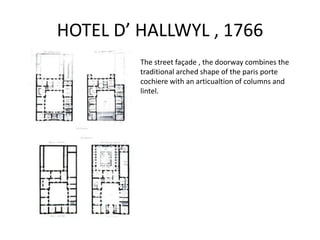
HOTEL D’ HALLWYL , 1766
The street façade , the doorway combines the
traditional arched shape of the paris porte
cochiere with an articualtion of columns and
lintel.
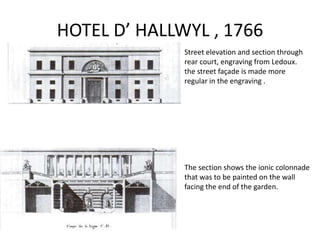
HOTEL D’ HALLWYL , 1766
Street elevation and section through
rear court, engraving from Ledoux.
the street façade is made more
regular in the engraving .

The section shows the ionic colonnade
that was to be painted on the wall
facing the end of the garden.
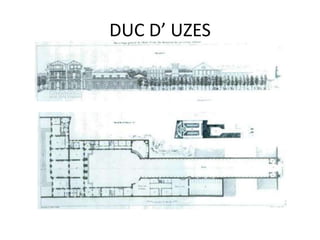
DUC D’ UZES
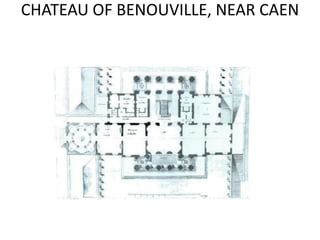
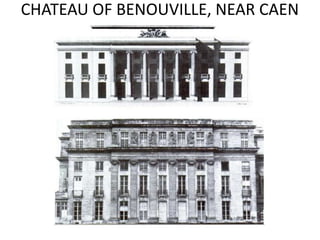
CHATEAU OF BENOUVILLE, NEAR CAEN
The 1770s
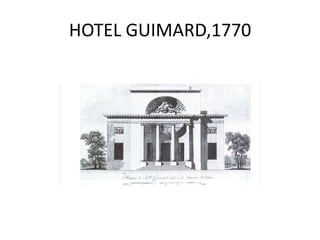
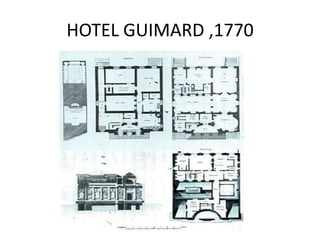
HOTEL GUIMARD,1770
HOTEL GUIMARD ,1770
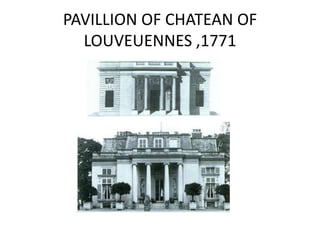
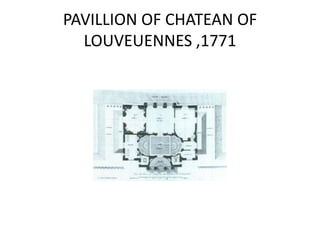
PAVILLION OF CHATEAN OF
LOUVEUENNES ,1771
PAVILLION OF CHATEAN OF
LOUVEUENNES ,1771
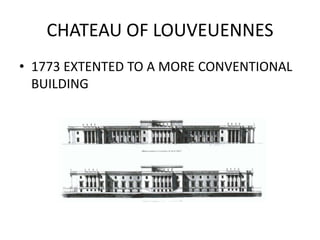
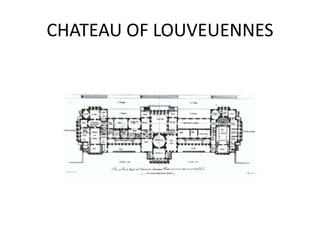
CHATEAU OF LOUVEUENNES
• 1773 EXTENTED TO A MORE CONVENTIONAL
BUILDING
CHATEAU OF LOUVEUENNES
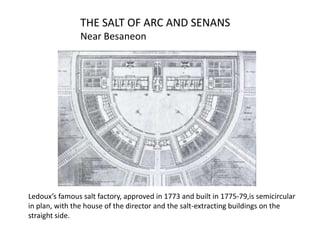
THE SALT OF ARC AND SENANS
Near Besaneon

Ledoux’s famous salt factory, approved in 1773 and built in 1775-79,is semicircular
in plan, with the house of the director and the salt-extracting buildings on the
straight side.
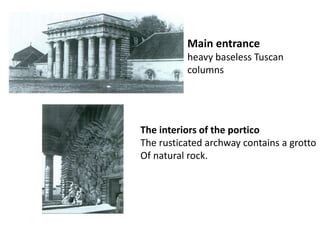
Main entrance
heavy baseless Tuscan
columns

The interiors of the portico
The rusticated archway contains a grotto
Of natural rock.
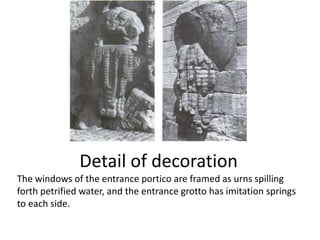
Detail of decoration
The windows of the entrance portico are framed as urns spilling
forth petrified water, and the entrance grotto has imitation springs
to each side.
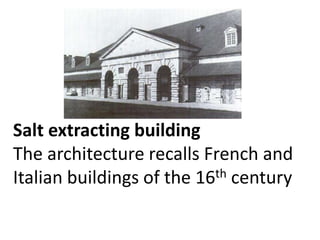
Salt extracting building
The architecture recalls French and
th century
Italian buildings of the 16

Claude nicholas ledoux

  • 1.
  • 2.
    Claude Nicholas Ledoux (b.Dormans, France 1736; d. Paris, France 1806) Claude Ledoux was born in Dormans, France in 1736. He was educated at a private architectural school in Paris.. Established by J. F. Blondel, the school emphasized native Baroque tradition but exposed students to English architecture. After completing his studies, Ledoux assumed several goverment positions as an engineer, mainly of bridge design. Ledoux' dramatic style owes much to the fact that he never visited Rome. His concepts of Roman architecture were accordingly warped by the engravings of Piranesi from which he derived his knowledge. He did visit England, where he was influenced by the Palladian tradition with which he was already familiar.
  • 3.
    style Although much ofLedoux's architecture is quite practical and functional, the "visionary" aspects of his work are better known. His designs became symbols of the ancient regime and their exaggerated use of classical elements seems to anticipate post-modern classicism.
  • 4.
    CHATEAU OF MAUPERTUIS •Listedas his first work Owner- Anne-Pierra de Montesquiou Fezenzac •It was like horseshoe 292.3 meters in circumferences crowned with balustrades, pierced with square and round niches, arriving at a gentle incline at the door of the vestibule. •Reconstructed later. •Now nothing remains of Ledoux’s. •He gave priority to the natural setting Of the building . •His giant Doric orders and the famous spherical house of the ‘garden agricoles’ were unforgettable elements.
  • 5.
    HOTEL D’ HALLWYL, 1766 The street façade , the doorway combines the traditional arched shape of the paris porte cochiere with an articualtion of columns and lintel.
  • 6.
    HOTEL D’ HALLWYL, 1766 Street elevation and section through rear court, engraving from Ledoux. the street façade is made more regular in the engraving . The section shows the ionic colonnade that was to be painted on the wall facing the end of the garden.
  • 7.
  • 8.
  • 9.
  • 10.
  • 11.
  • 12.
  • 13.
    PAVILLION OF CHATEANOF LOUVEUENNES ,1771
  • 14.
    PAVILLION OF CHATEANOF LOUVEUENNES ,1771
  • 15.
    CHATEAU OF LOUVEUENNES •1773 EXTENTED TO A MORE CONVENTIONAL BUILDING
  • 16.
  • 17.
    THE SALT OFARC AND SENANS Near Besaneon Ledoux’s famous salt factory, approved in 1773 and built in 1775-79,is semicircular in plan, with the house of the director and the salt-extracting buildings on the straight side.
  • 18.
    Main entrance heavy baselessTuscan columns The interiors of the portico The rusticated archway contains a grotto Of natural rock.
  • 19.
    Detail of decoration Thewindows of the entrance portico are framed as urns spilling forth petrified water, and the entrance grotto has imitation springs to each side.
  • 20.
    Salt extracting building Thearchitecture recalls French and th century Italian buildings of the 16