Slavery and
Abolition
An Overview
Origins
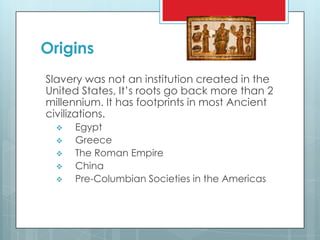
Slavery was not an institution created in the
United States, It’s roots go back more than 2
millennium. It has footprints in most Ancient
civilizations.
     Egypt
     Greece
     The Roman Empire
     China
     Pre-Columbian Societies in the Americas
The Colonies
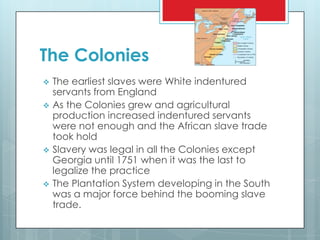
   The earliest slaves were White indentured
    servants from England
   As the Colonies grew and agricultural
    production increased indentured servants
    were not enough and the African slave trade
    took hold
   Slavery was legal in all the Colonies except
    Georgia until 1751 when it was the last to
    legalize the practice
   The Plantation System developing in the South
    was a major force behind the booming slave
    trade.
Slaves
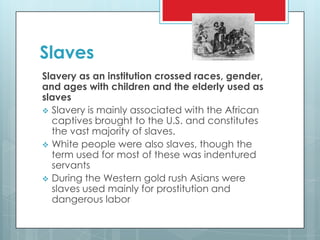
Slavery as an institution crossed races, gender,
and ages with children and the elderly used as
slaves
 Slavery is mainly associated with the African
  captives brought to the U.S. and constitutes
  the vast majority of slaves.
 White people were also slaves, though the
  term used for most of these was indentured
  servants
 During the Western gold rush Asians were
  slaves used mainly for prostitution and
  dangerous labor
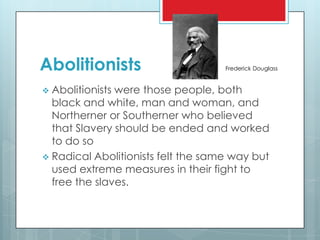
Abolitionists                       Frederick Douglass


 Abolitionistswere those people, both
  black and white, man and woman, and
  Northerner or Southerner who believed
  that Slavery should be ended and worked
  to do so
 Radical Abolitionists felt the same way but
  used extreme measures in their fight to
  free the slaves.
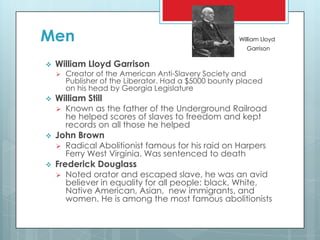
Men                                                   William Lloyd
                                                        Garrison

   William Lloyd Garrison
       Creator of the American Anti-Slavery Society and
        Publisher of the Liberator. Had a $5000 bounty placed
        on his head by Georgia Legislature
   William Still
       Known as the father of the Underground Railroad
        he helped scores of slaves to freedom and kept
        records on all those he helped
   John Brown
       Radical Abolitionist famous for his raid on Harpers
        Ferry West Virginia. Was sentenced to death
   Frederick Douglass
       Noted orator and escaped slave, he was an avid
        believer in equality for all people: black, White,
        Native American, Asian, new immigrants, and
        women. He is among the most famous abolitionists
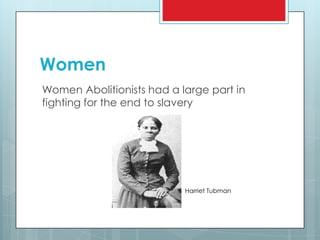
Women
Women Abolitionists had a large part in
fighting for the end to slavery


                           Harriet Tubman
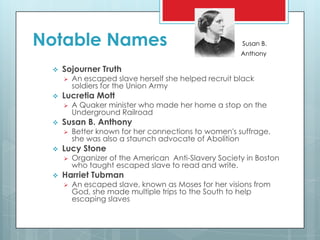
Notable Names                                          Susan B.
                                                      Anthony

    Sojourner Truth
        An escaped slave herself she helped recruit black
         soldiers for the Union Army
    Lucretia Mott
        A Quaker minister who made her home a stop on the
         Underground Railroad
    Susan B. Anthony
        Better known for her connections to women's suffrage,
         she was also a staunch advocate of Abolition
    Lucy Stone
        Organizer of the American Anti-Slavery Society in Boston
         who taught escaped slave to read and write.
    Harriet Tubman
        An escaped slave, known as Moses for her visions from
         God, she made multiple trips to the South to help
         escaping slaves
Documents
   The Fugitive Slave Act of 1850
       Was part of a compromise between Southern
        Slave Owners and Northern Free- Soilers requiring
        escaped slaves to be returned to their owners.
   The Emancipation Proclamation
       An Executive Order issued by Abraham Lincoln
        on January 1st, 1863 proclaiming all slaves in
        Confederate territory free
   The 13th Amendment
       Passed on April 8th, 1864 this Amendment to the
        Constitution officially outlawed slavery in the
        United States
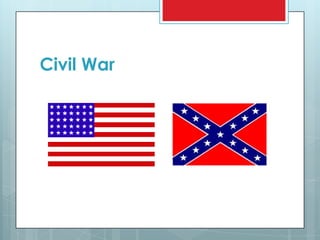
Civil War
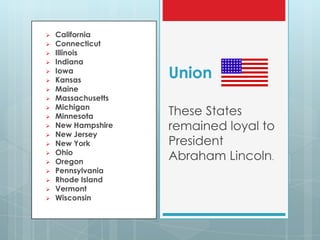
   California
   Connecticut
   Illinois
   Indiana


    Iowa
    Kansas
                    Union
   Maine
   Massachusetts
    Michigan

   Minnesota       These States
   New Hampshire   remained loyal to
   New Jersey
   New York        President


    Ohio
    Oregon
                    Abraham Lincoln.
   Pennsylvania
   Rhode Island
   Vermont
   Wisconsin
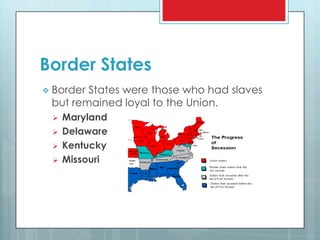
Border States
 BorderStates were those who had slaves
 but remained loyal to the Union.
    Maryland
    Delaware
    Kentucky
    Missouri
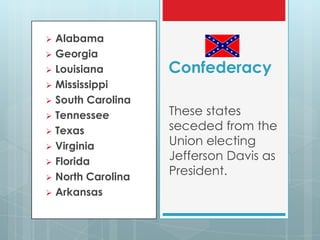
 Alabama
 Georgia
 Louisiana        Confederacy
 Mississippi
 South Carolina
 Tennessee        These states
 Texas
                   seceded from the
 Virginia
                   Union electing
 Florida
                   Jefferson Davis as
 North Carolina
                   President.
 Arkansas
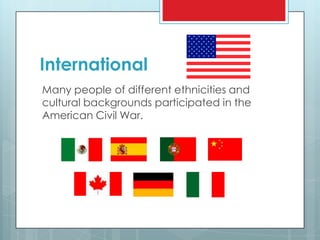
International
Many people of different ethnicities and
cultural backgrounds participated in the
American Civil War.
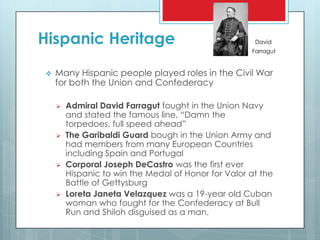
Hispanic Heritage                                     David
                                                     Farragut


   Many Hispanic people played roles in the Civil War
    for both the Union and Confederacy

       Admiral David Farragut fought in the Union Navy
        and stated the famous line, “Damn the
        torpedoes, full speed ahead”
       The Garibaldi Guard bough in the Union Army and
        had members from many European Countries
        including Spain and Portugal
       Corporal Joseph DeCastro was the first ever
        Hispanic to win the Medal of Honor for Valor at the
        Battle of Gettysburg
       Loreta Janeta Velazquez was a 19-year old Cuban
        woman who fought for the Confederacy at Bull
        Run and Shiloh disguised as a man.
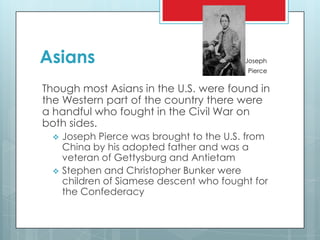
Asians                                     Joseph
                                           Pierce


Though most Asians in the U.S. were found in
the Western part of the country there were
a handful who fought in the Civil War on
both sides.
     Joseph Pierce was brought to the U.S. from
      China by his adopted father and was a
      veteran of Gettysburg and Antietam
     Stephen and Christopher Bunker were
      children of Siamese descent who fought for
      the Confederacy