ORAL
COMMUNICATION
IN CONTEXT
WEEK 2
Learning
Competency
Differentiates the various
models of communication
Communication
Models
Communication models are the
metaphorical, simplified, and
systematic representation of the
communication processes which
forms general perspectives on
communication.
3 Types of
Communication
Models
Linear Model
• One-way communication
• Sender sends the message
• The receiver receives only
• No feedback
PROS/ADVANT
AGES
• Good at audience
persuasion
• There is an intentional result
CONS/DISADVANTAG
ES
• Communication is not continuous
• No feedback
• Not interactive
• Difficult to identify if
communication was effective
Transactional
Model
Transactional model of communication. Here
the sender and the receiver are both
communicators. They both play equally
important role in communication, the
communication is simultaneous, there is
feedback it is verbal or, nonverbal such as
gestures, body language are also considered
feedback. And feedback is also considered as
a new message.
PROS/ADVANT
AGES
• Simultaneous and instant
feedback
• Receiver and sender are the
same
CONS/DISADVAN
TAGES
• Encourage nonverbal
communication
• More noise
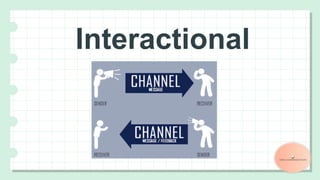
Interactional
Model
• Two-way communication
process
• Used for new media such as
internet
• There is feedback
• Interactive but not
simultaneous
PROS/ADVANTAGE
S
• Feedback even in mass
communication
(include television, radio, social
media, and print media.)
• New communication channels
CONS/DISADVAN
TAGES
• Delayed feedback
• The sender and the receiver
might not know who the
other person is
Aristotle’s Model of
Communication
This model is more focused on public
speaking than interpersonal
communication.
SPEAKER AUDIENCE
MESSAGE
Aristotle’s Model of
Communication
Shannon – Weaver’s
Model of
Communication
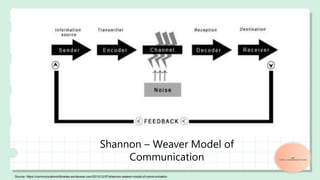
This model of communication is also known
as the Telephone Model for this is based on
the experience of using the telephone back in
the 1940’s wherein the message was hindered
by noise.
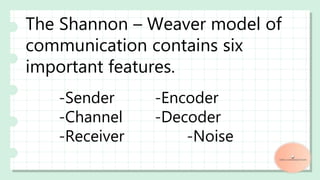
The Shannon – Weaver model of
communication contains six
important features.
-Sender -Encoder
-Channel -Decoder
-Receiver -Noise
Shannon – Weaver Model of
Communication
Source: https://communicationinlibraries.wordpress.com/2013/12/07/shannon-weaver-model-of-communication
An example of Shannon - Weaver model of communication
Mr. Diaz made a call to his secretary “Please call the internet
provider.” During his call, noise comes in (transmission error)
and his secretary heard “Please call” only. The secretary
replied (feedback) “Whom will I call, Sir?”
Sender : Mr. Diaz
Encoder : Telephone (Mr. Diaz)
Channel : Cable
Noise : Distraction in voice
Reception : Telephone (Secretary)
Receiver : Assistant
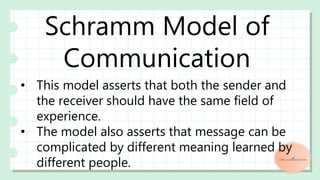
Schramm Model of
Communication
• This model asserts that both the sender and
the receiver should have the same field of
experience.
• The model also asserts that message can be
complicated by different meaning learned by
different people.
In this concept, field of experience refers to
everything that makes an individual unique –
everything that he/she has ever learned, watched,
seen, heard, read, and studied. In this model,
communication has six elements
Source, Encoder, Message, Channel, Decoder and
Receiver
Schramm’s Model of
Communication
Source: https://methods.sagepub.com/images/virtual/how-to-build-social-science-theories/127_1.jpg
Eugene White Model of
Communication
Eugene White’s Model of communication
says that communication is circular and
continuous, without a beginning or end. His
1960 cyclical model, the communication
process is composed of eight stages-
thinking, symbolizing, expressing,
transmitting, receiving, decoding, feed-
backing, monitoring, and thinking.
White’s Model of
Communication
Source: https://depedtambayan.net/wp-content/uploads/2021/10/CO_Q1-Oral-comm-in-Context-SHS-Module-2-FINAL.pdf
Berlo’s Model of
Communication
The Berlo’s model of communication considers
the emotional aspect of the message.
Berlo’s model follows the SMCR model
S – Source
M – Message
C – Channel
R – Receiver
Berlo’s Model of
Communication
Source: https://www.managementstudyguide.com/berlo-model-of-communication.htm
Helical Model of
Communication
• This model presents the concept of time
where continuousness of communication
process is very important.
• In helical model, communication is a
dynamic process.
• Communication progresses as an individual
gets older and his experience and
vocabulary increases
Helical Model of
Communication
Source: https://www.businesstopia.net/communication/helical-model-communication
THANK
YOU!!!

OCC-Q1-W2-PPT.pptx