Models of Communication
 Linear Communication Model
 Lasswell’s Model
 Aristotle’s Model
 Berlo’s SMCR Model
 Transactional Model
 Interactive Model
 Schramm’s Model
 White’s Model
 Barlund’s Model
 Shannon & Weaver Model
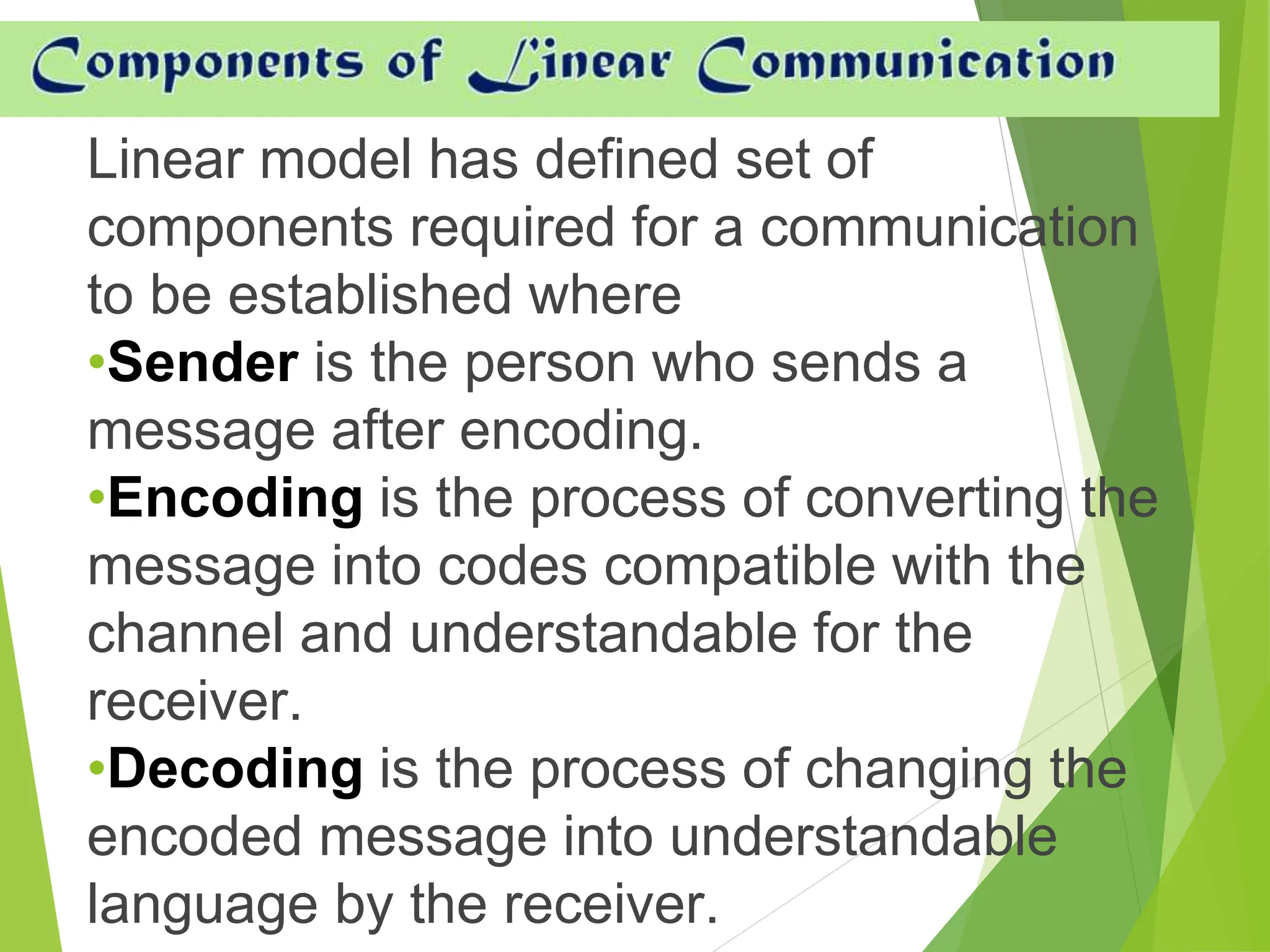
Linear model has defined set of
components required for a communication
to be established where
•Sender is the person who sends a
message after encoding.
•Encoding is the process of converting the
message into codes compatible with the
channel and understandable for the
receiver.
•Decoding is the process of changing the
encoded message into understandable
language by the receiver.
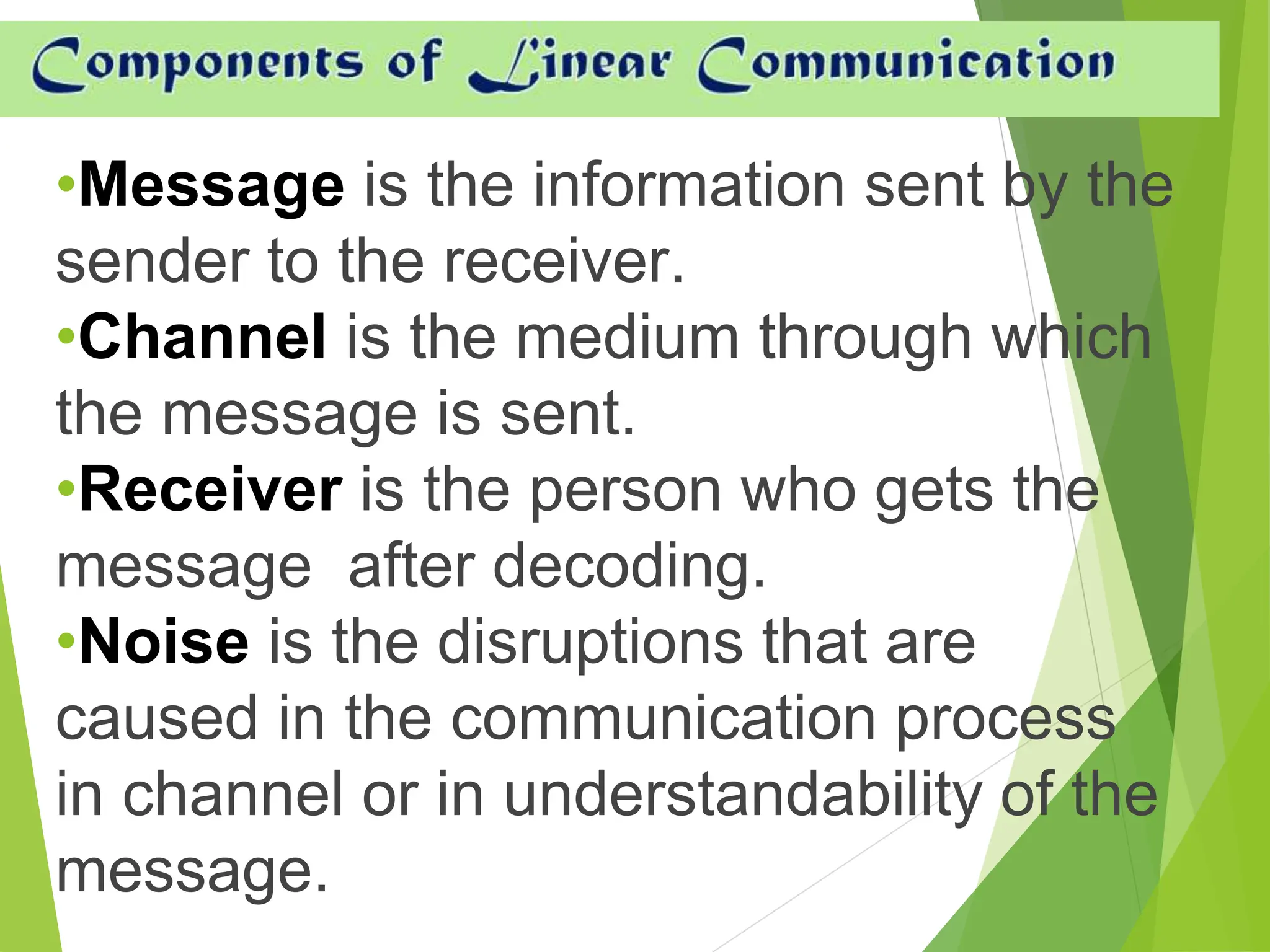
•Message is the information sent by the
sender to the receiver.
•Channel is the medium through which
the message is sent.
•Receiver is the person who gets the
message after decoding.
•Noise is the disruptions that are
caused in the communication process
in channel or in understandability of the
message.
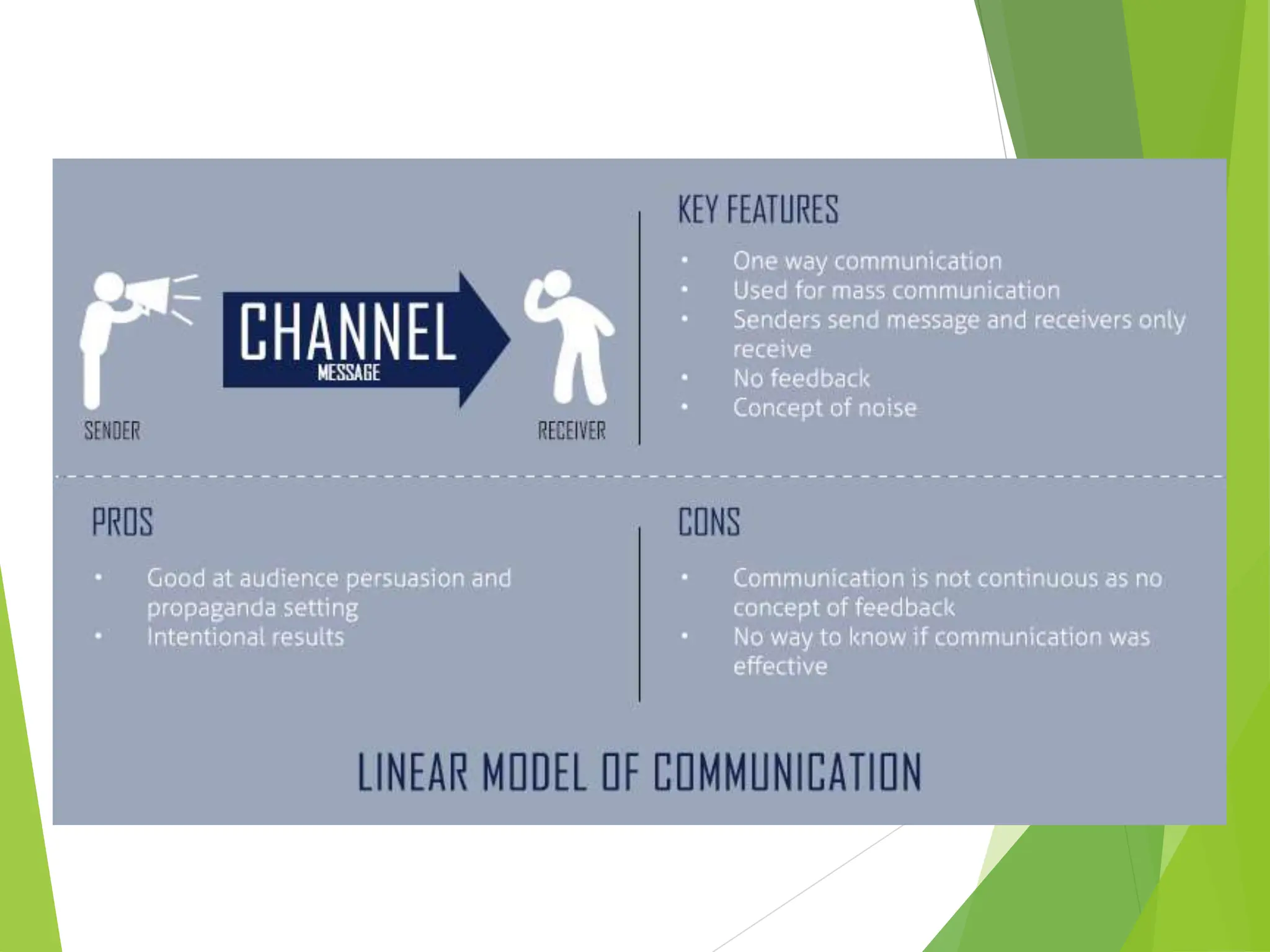
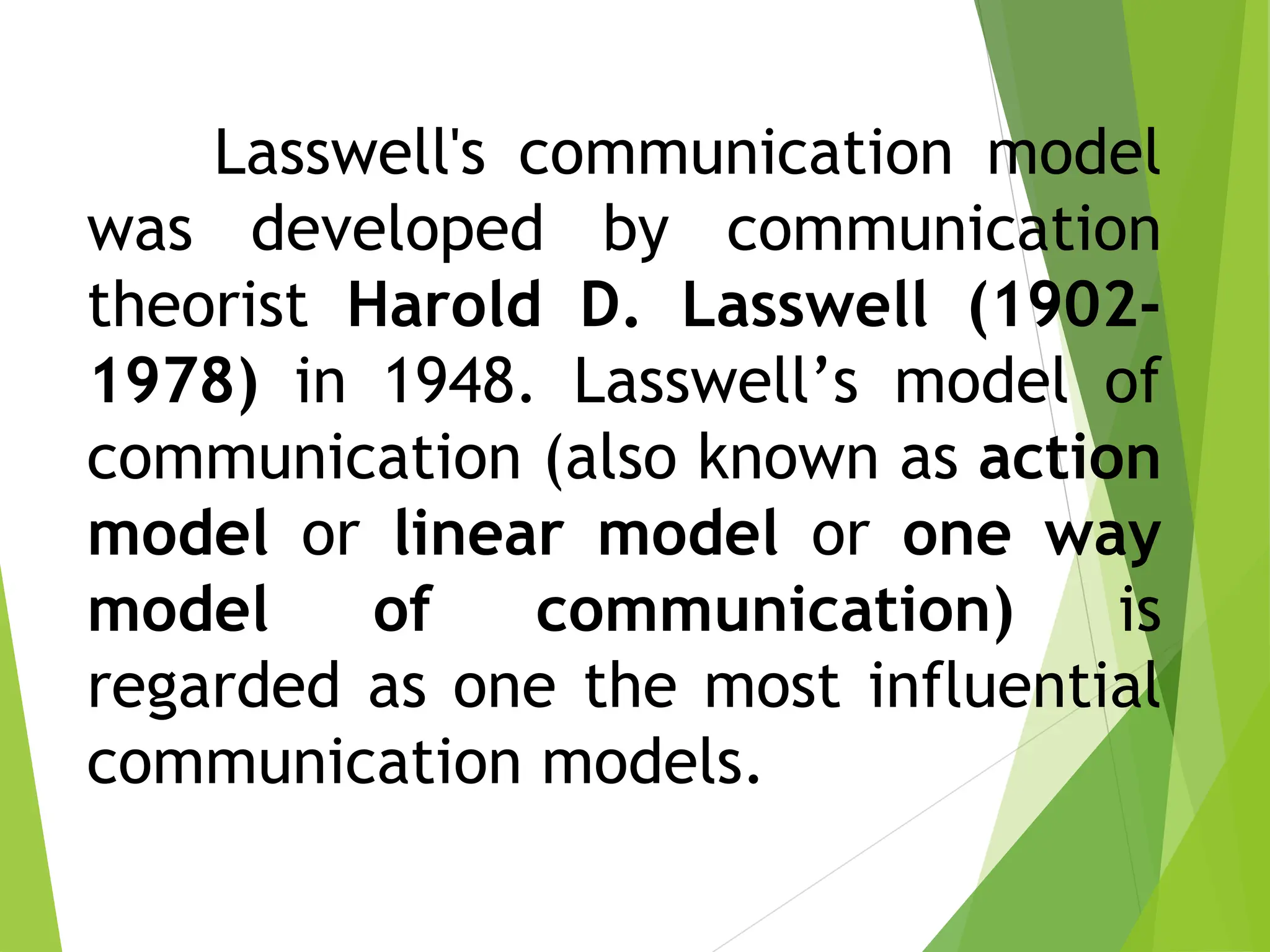
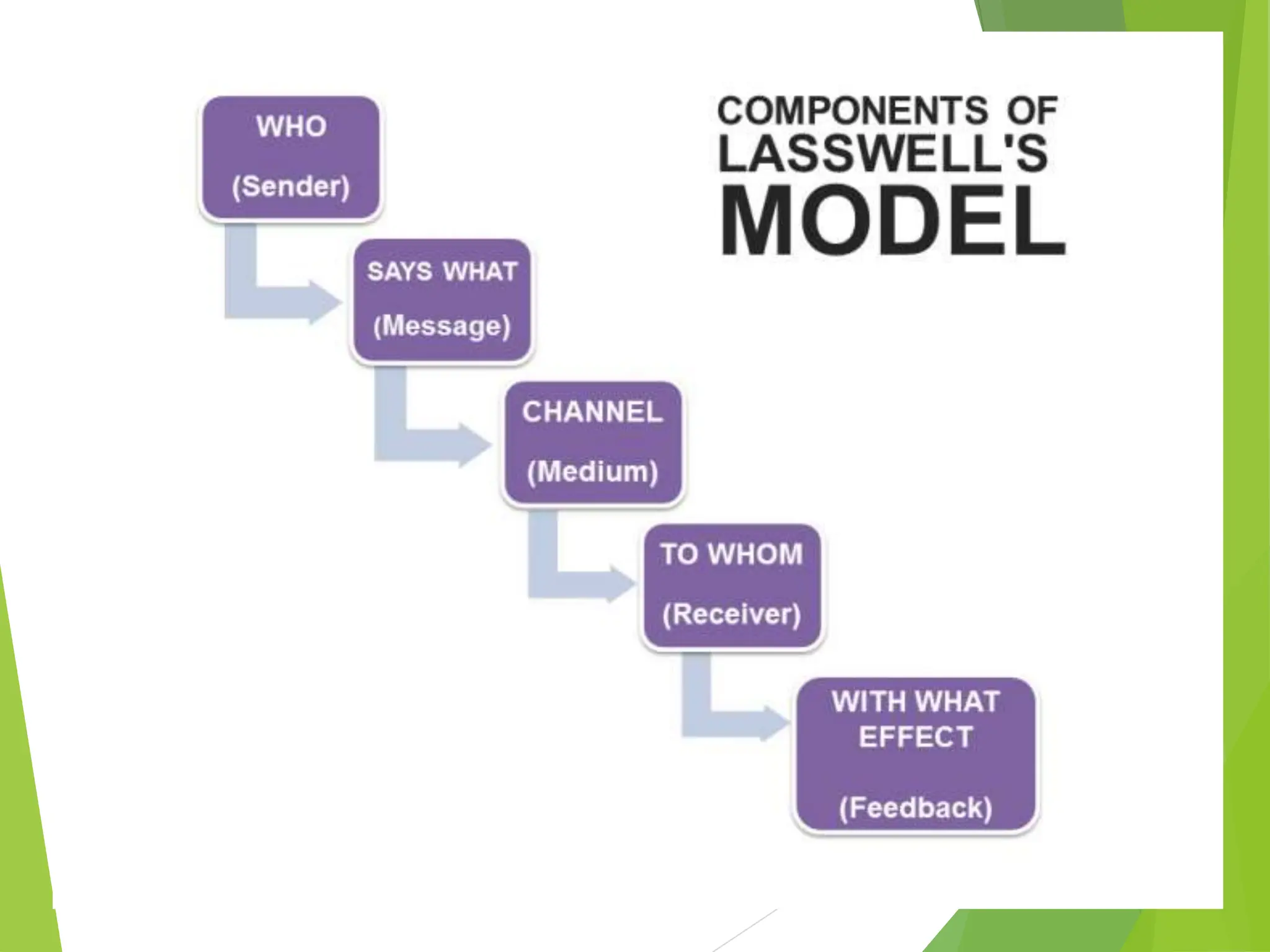
Lasswell's communication model
was developed by communication
theorist Harold D. Lasswell (1902-
1978) in 1948. Lasswell’s model of
communication (also known as action
model or linear model or one way
model of communication) is
regarded as one the most influential
communication models.
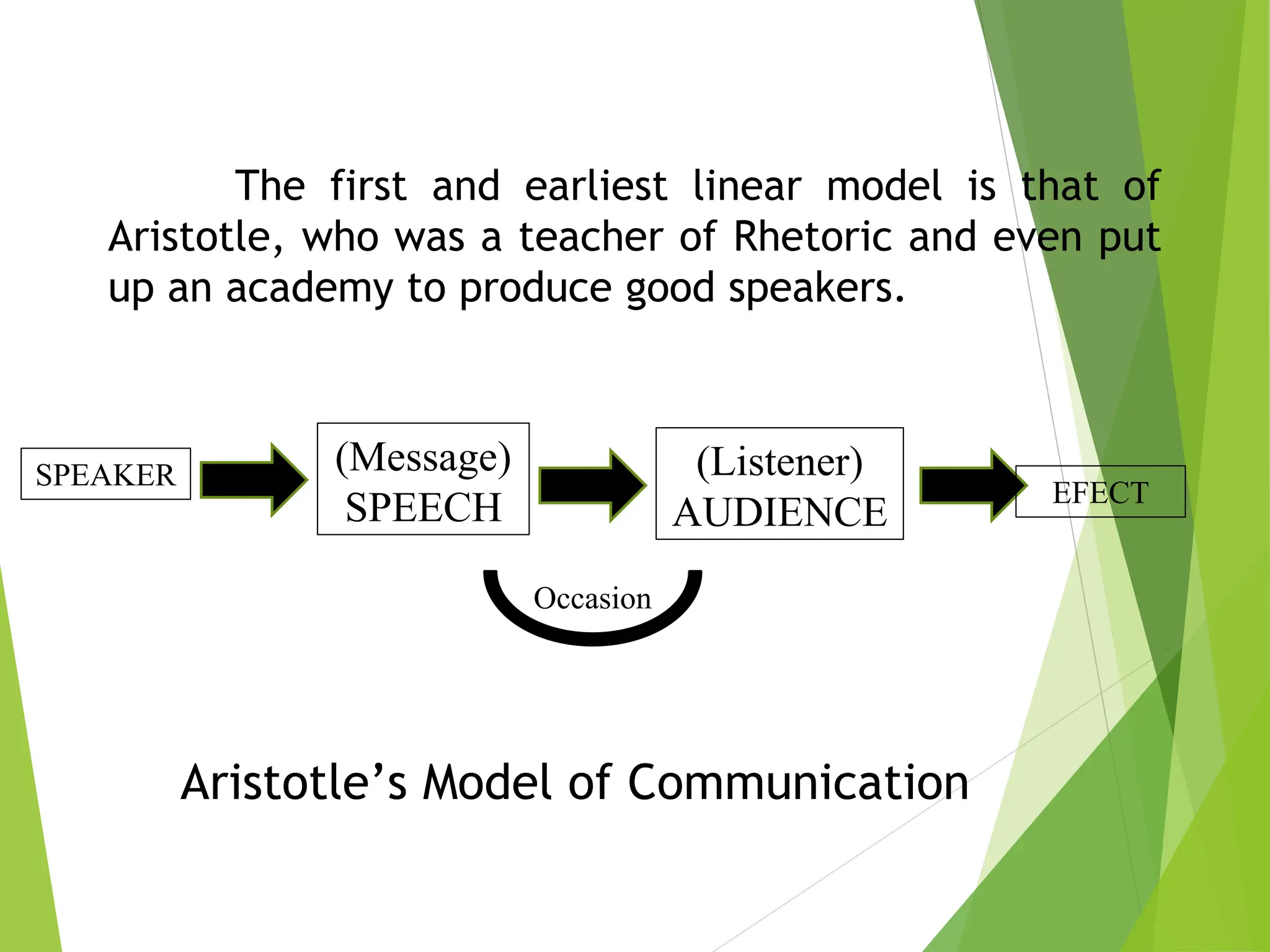
The first and earliest linear model is that of
Aristotle, who was a teacher of Rhetoric and even put
up an academy to produce good speakers.
SPEAKER (Message)
SPEECH
(Listener)
AUDIENCE
Aristotle’s Model of Communication
EFECT
Occasion
There are few criticisms around
this model. Some of them are:
•There is no concept of feedback,
it is one way from speaker to
audience.
•There is no concept
of communication failure like
noise and barriers.
•This model can only be used in
public speaking.
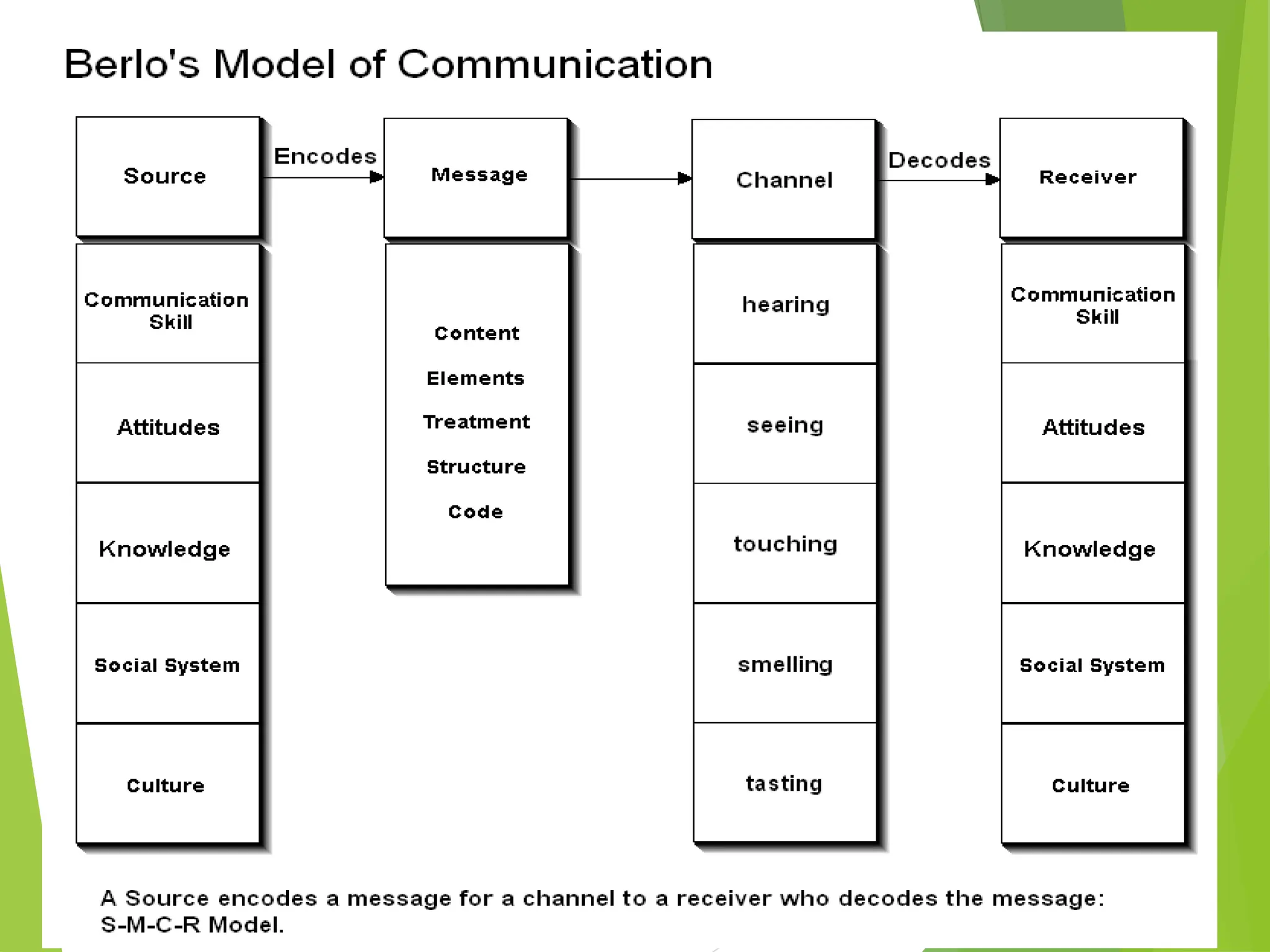
In 1960, David Berlo
postulated Berlo's Sender-Message-Channel-
Receiver (SMCR) Model of Communication
from Shannon Weaver's Model of
Communication (1949). He described
factors affecting the individual components
in the communication making the
communication more efficient. This model
also focuses on encoding and decoding
which happens before sender sends the
message and before receiver receives the
message respectively.
 There is no concept of feedback, so
the effect is not considered.
 There is no concept of noise or any
kind of barriers in communication.
 It is a linear model of
communication, there is no two way
communication.
 Both of the people must be similar
according to all the factors
mentioned above.
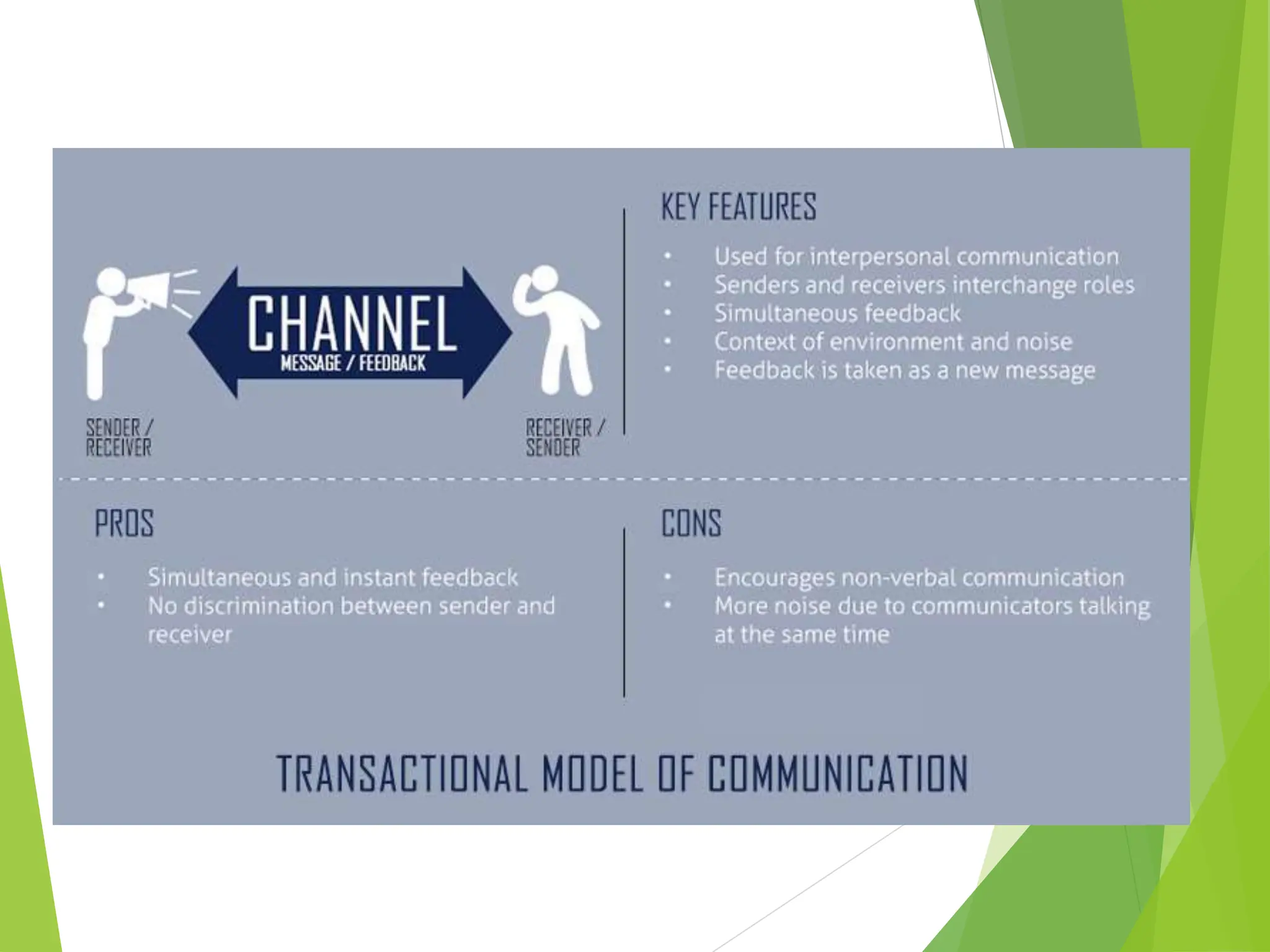
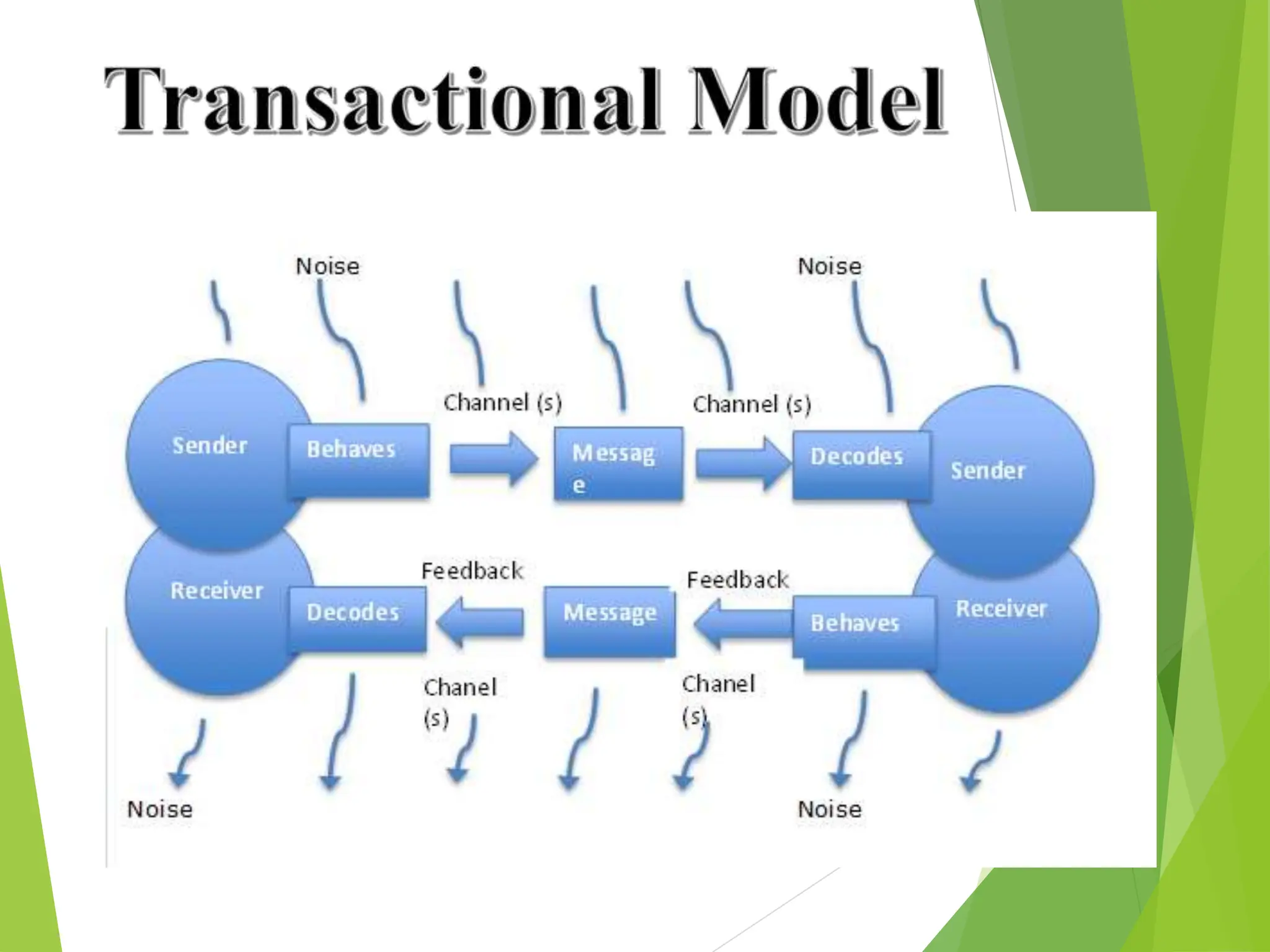
Transactional model of
communication is the exchange of
messages between sender and
receiver where each take turns to send
or receive messages. Here, both
"sender" and "receiver" are known as
"communicators" and their role
reverses each time in the
communication process as both
processes of sending and receiving
occurs at the same time.
 Without verbal response, the sender can not be
sure that the receiver got the message as
intended. Feedback is an important component in
the communication process, especially in
interpersonal communication as it gives a space to
clarify misunderstandings.
 The transactional model gives the opportunity for a
lot of noise because the communication is
simultaneous. For example, when many people
are talking at the same time in a meeting, the
objective of the meeting will not be fulfilled.
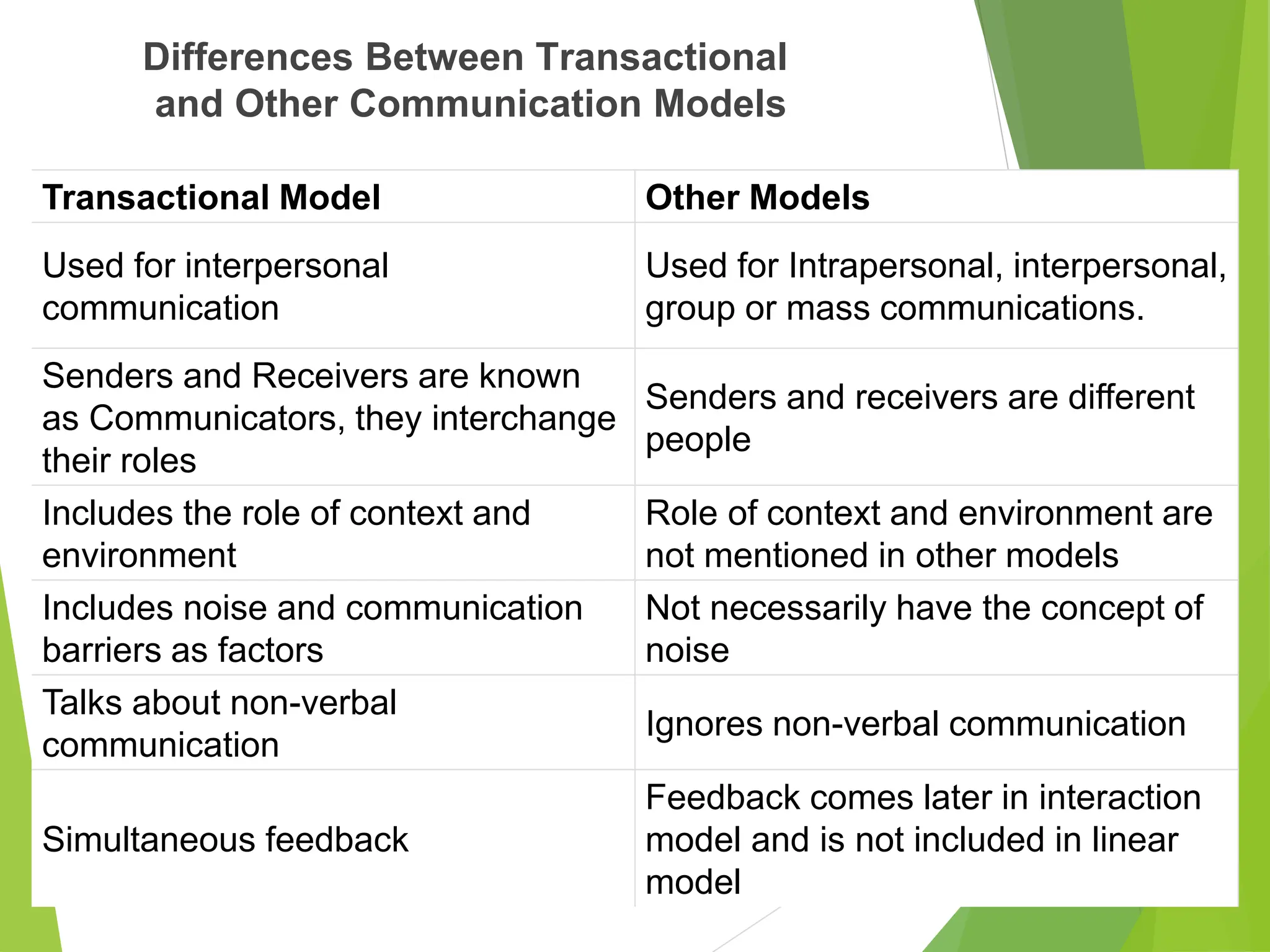
Transactional Model Other Models
Used for interpersonal
communication
Used for Intrapersonal, interpersonal,
group or mass communications.
Senders and Receivers are known
as Communicators, they interchange
their roles
Senders and receivers are different
people
Includes the role of context and
environment
Role of context and environment are
not mentioned in other models
Includes noise and communication
barriers as factors
Not necessarily have the concept of
noise
Talks about non-verbal
communication
Ignores non-verbal communication
Simultaneous feedback
Feedback comes later in interaction
model and is not included in linear
model
Differences Between Transactional
and Other Communication Models
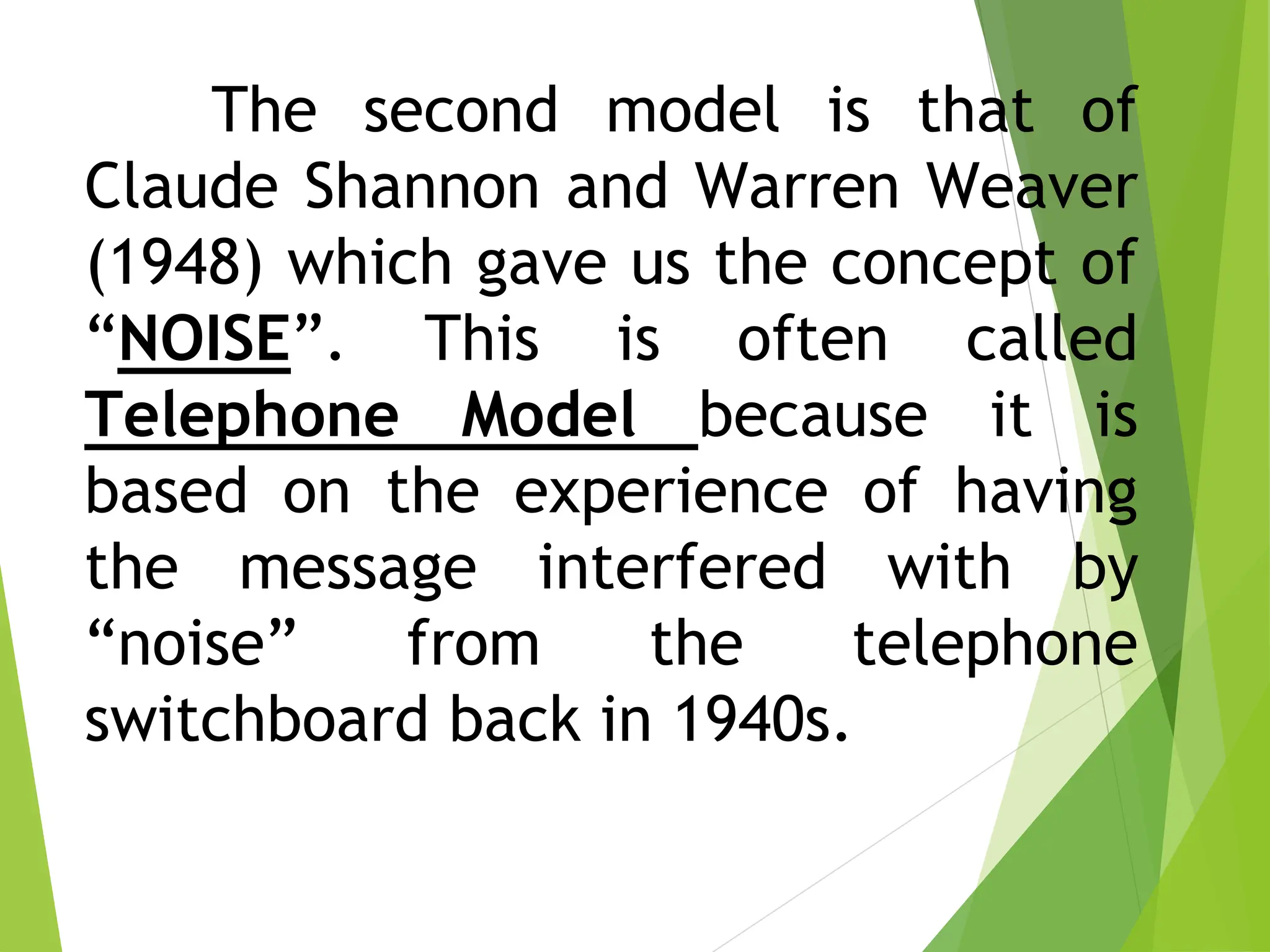
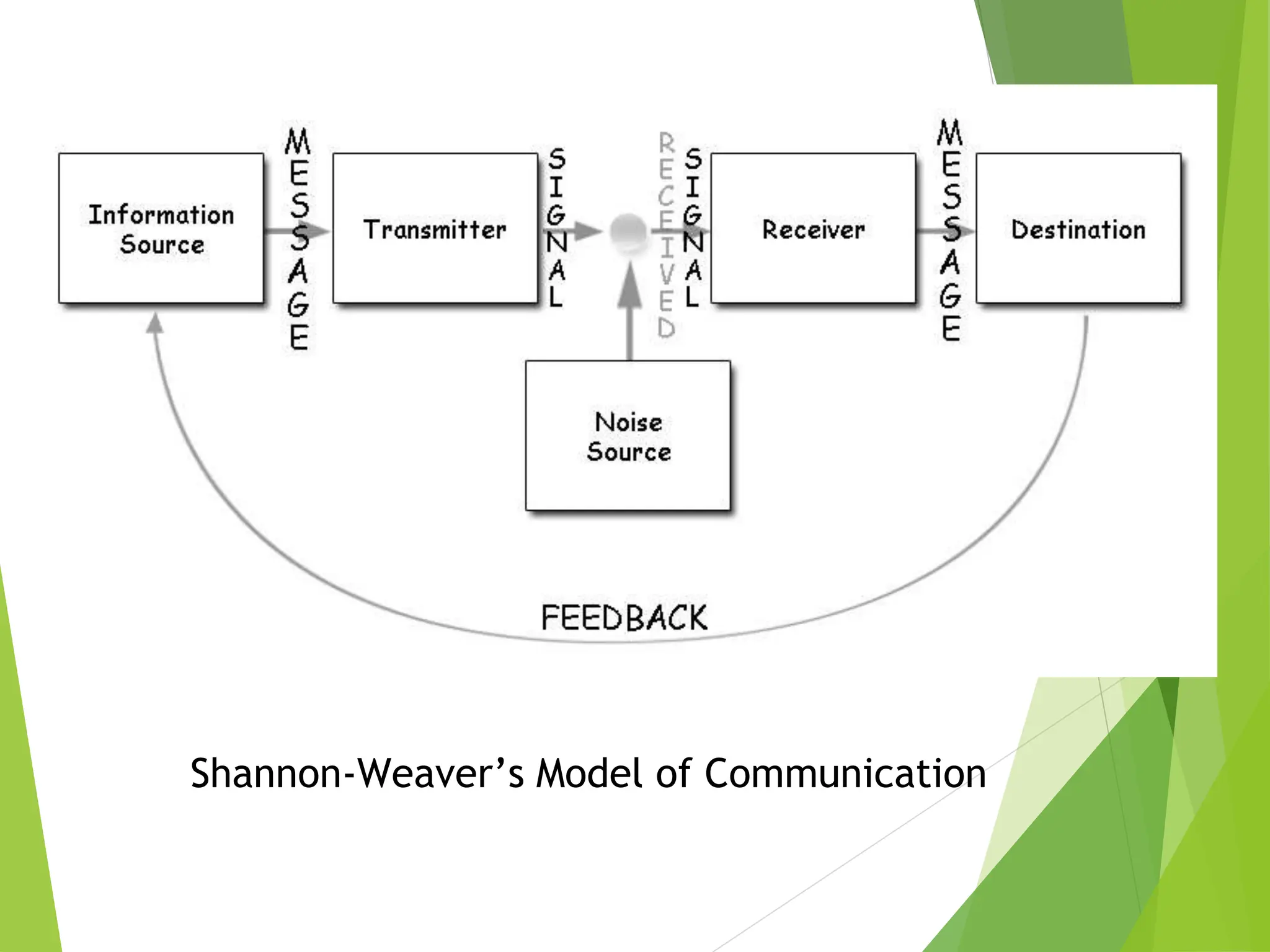
The second model is that of
Claude Shannon and Warren Weaver
(1948) which gave us the concept of
“NOISE”. This is often called
Telephone Model because it is
based on the experience of having
the message interfered with by
“noise” from the telephone
switchboard back in 1940s.
Shannon-Weaver’s Model of Communication
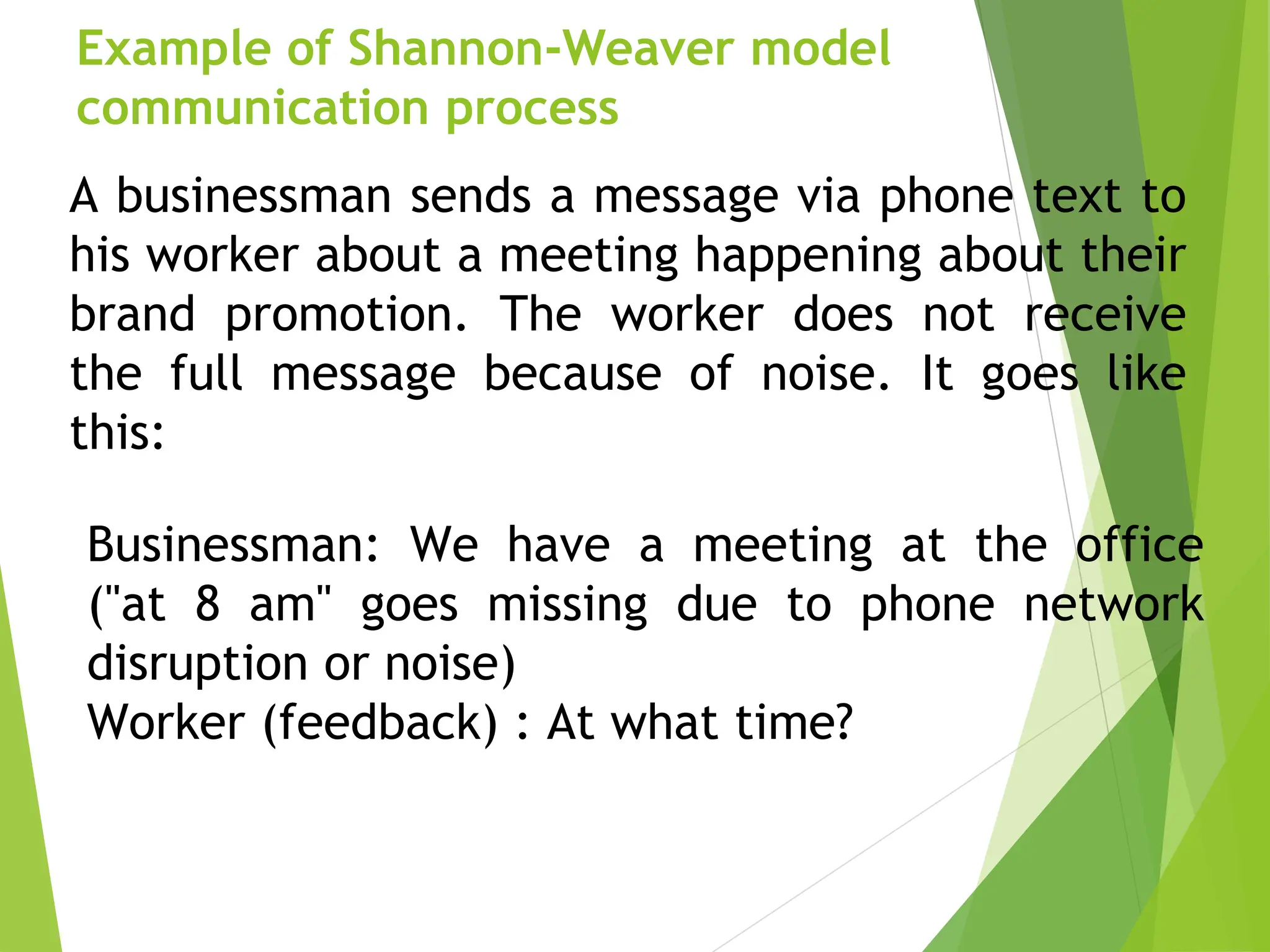
Example of Shannon-Weaver model
communication process
A businessman sends a message via phone text to
his worker about a meeting happening about their
brand promotion. The worker does not receive
the full message because of noise. It goes like
this:
Businessman: We have a meeting at the office
("at 8 am" goes missing due to phone network
disruption or noise)
Worker (feedback) : At what time?
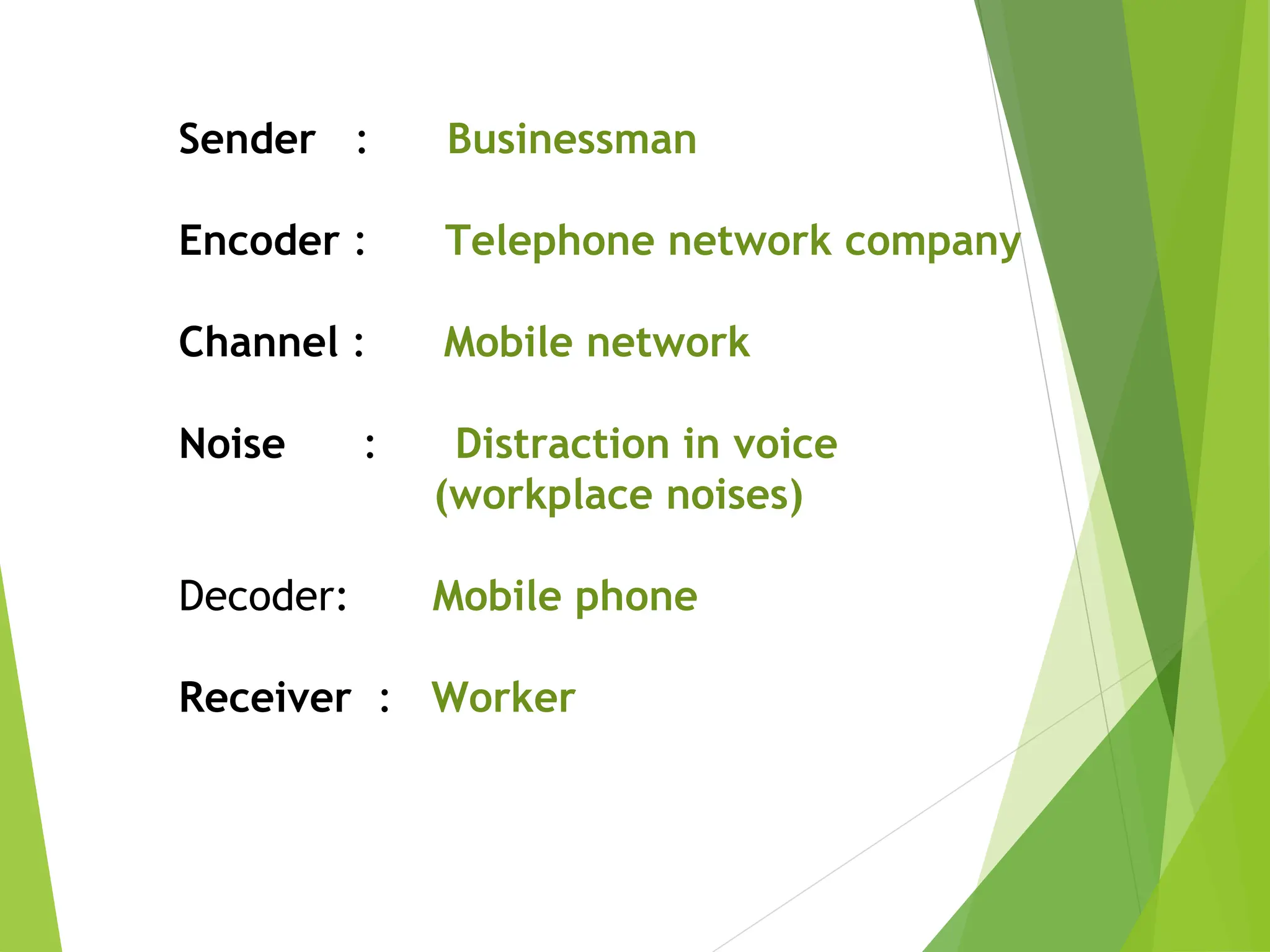
Sender : Businessman
Encoder : Telephone network company
Channel : Mobile network
Noise : Distraction in voice
(workplace noises)
Decoder: Mobile phone
Receiver : Worker
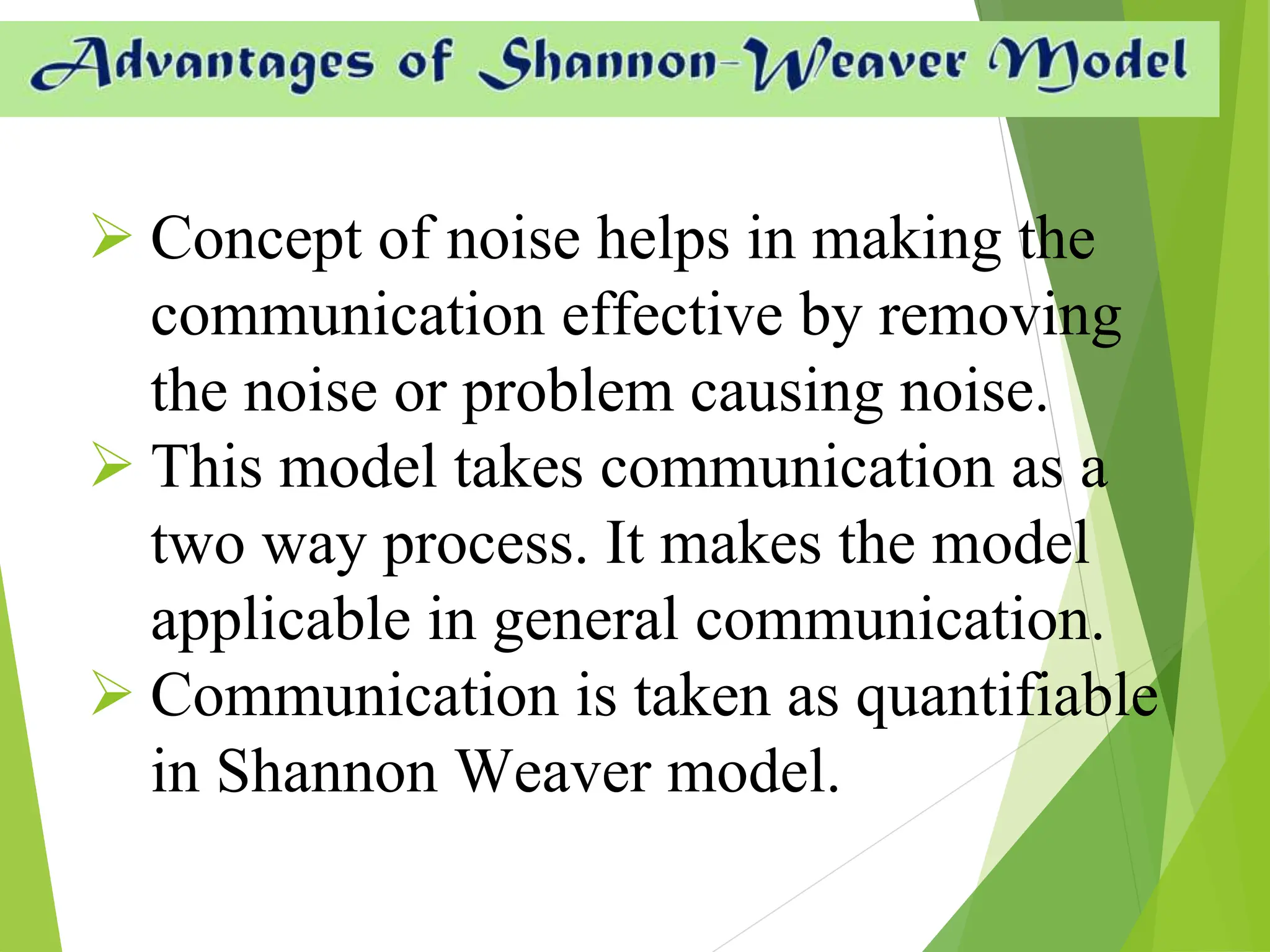
 Concept of noise helps in making the
communication effective by removing
the noise or problem causing noise.
 This model takes communication as a
two way process. It makes the model
applicable in general communication.
 Communication is taken as quantifiable
in Shannon Weaver model.
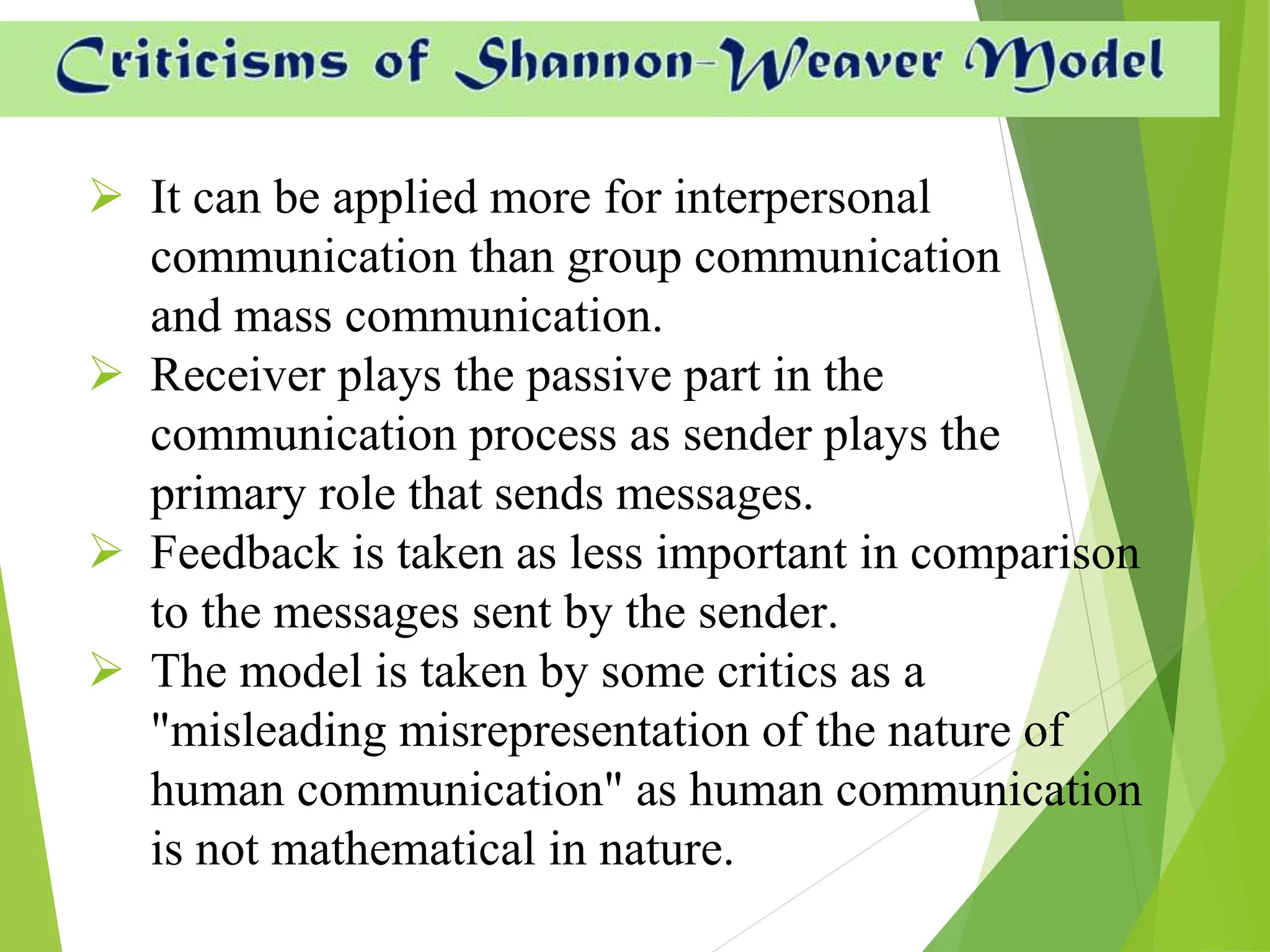
 It can be applied more for interpersonal
communication than group communication
and mass communication.
 Receiver plays the passive part in the
communication process as sender plays the
primary role that sends messages.
 Feedback is taken as less important in comparison
to the messages sent by the sender.
 The model is taken by some critics as a
"misleading misrepresentation of the nature of
human communication" as human communication
is not mathematical in nature.
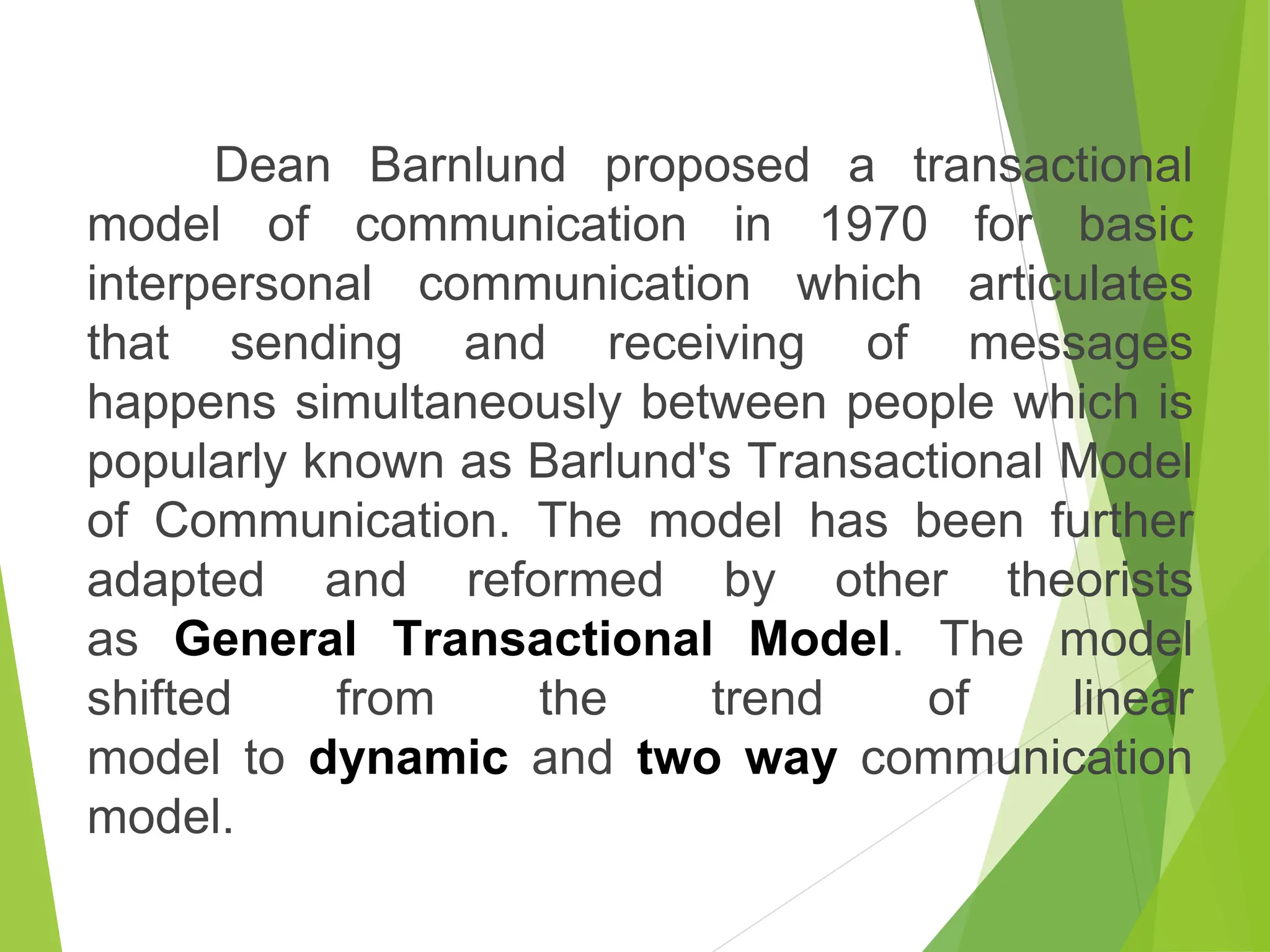
Dean Barnlund proposed a transactional
model of communication in 1970 for basic
interpersonal communication which articulates
that sending and receiving of messages
happens simultaneously between people which is
popularly known as Barlund's Transactional Model
of Communication. The model has been further
adapted and reformed by other theorists
as General Transactional Model. The model
shifted from the trend of linear
model to dynamic and two way communication
model.
Components of Barlund's model
 The model shows shared field
experience of the sender and
receiver.
 Transactional model talks about
simultaneous message sending,
noise and feedback.
 Barnlund’s model is taken by
critics as the most systematic
model of communication.
 Barnlund’s model is very complex.
 Both the sender and receiver must
understand the codes sent by the
other. So they must each possess
a similar "code book". (The concept
of code book is not mentioned in
the model but understood.)
Interactive model (also known as
convergence model) deals with exchange of
ideas and messages taking place both ways
from sender to receiver and vice-versa.
The communication process take place
between humans or machines in both verbal
or non-verbal way. This is a relatively new
model of communication for new
technologies like web.
In Interactive model, whenever a
source sends a message to a receiver
(source), he/she encodes the message
first. The encoded message is then
received by the receiver where it is
decoded to get the original information.
Again, the receiver acts as a source,
encodes another message (also knows
as a feedback) and sends it back to the
sender.
Interactive Model of
Communication
Other Models of Communication
Indirect and slow feedback Direct and fast feedback
Feedback is a whole new process
of communication
Feedback is the part of a single
communication process
For new media
For all other kinds of media like
print, news, etc.
No engagement of sender and
receiver in communication
Engagement of sender and receiver
in communication
Sender and receiver is equally
important
Sender is important and
overpowering than receiver
It can become linear if the receiver
does not respond
The receiver is bound to give some
kind of response verbal or non-
verbal
Interactive Model and Other Models Differences
An example of Interactive model is
that of Wilbur Schramm, who is
considered the Father of Mass
Communication. He came up with five
models, but the Schramm Model in
(1995) we are concerned with is the
concept that explains why
communication breakdown occurs.
Schramm asserts that communication
can take place if and only if there is an
overlap between the Field of Experience
of the Speaker and the Field of
Experience of the Listener.
Schramm’s Model of Communication
Field of Experience are the things that
influences the understanding and interpretation of
message like culture, social background, beliefs,
experiences, values and rules.
Examples:
•a person who always eats with spoon is informed
that that he has to eat with hands in that place,
the person will get offended because he will think
it is impolite to eat that way.
•the teacher must deliver his/her lecture in either
English or Filipino because that is the language
that students know and use.
 Circular communication gives opportunity
to both parties to give their opinion.
 As it is dynamic and ever changing model,
it is helpful in general practice.
 Sender and receiver interchanges and both
are equally active.
 Semantic noise included as a concept
helps in understanding problems that can
occur during interpretation of message.
 Feedback makes it easier to know if
the message is interpreted by the receiver as
intended or not.
 Concept of interpretation makes the
communication effective.
 Field of experience (psychological effect)
helps to understand the communication
process in many other ways than the
traditional ones..
 Concept of context makes the environmental
factor be included in interpretation of message
and brings change in the message value.
This model can not deal with multiple
levels of communication and complex
communication processes.
There can only be two sources
communicating, many sources
complicates the process and the
model can not be implemented.
Message sent and received might be
interpreted differently than intended.
https://prezi.com/rfcgo_zdlscc/eugene-
whites/
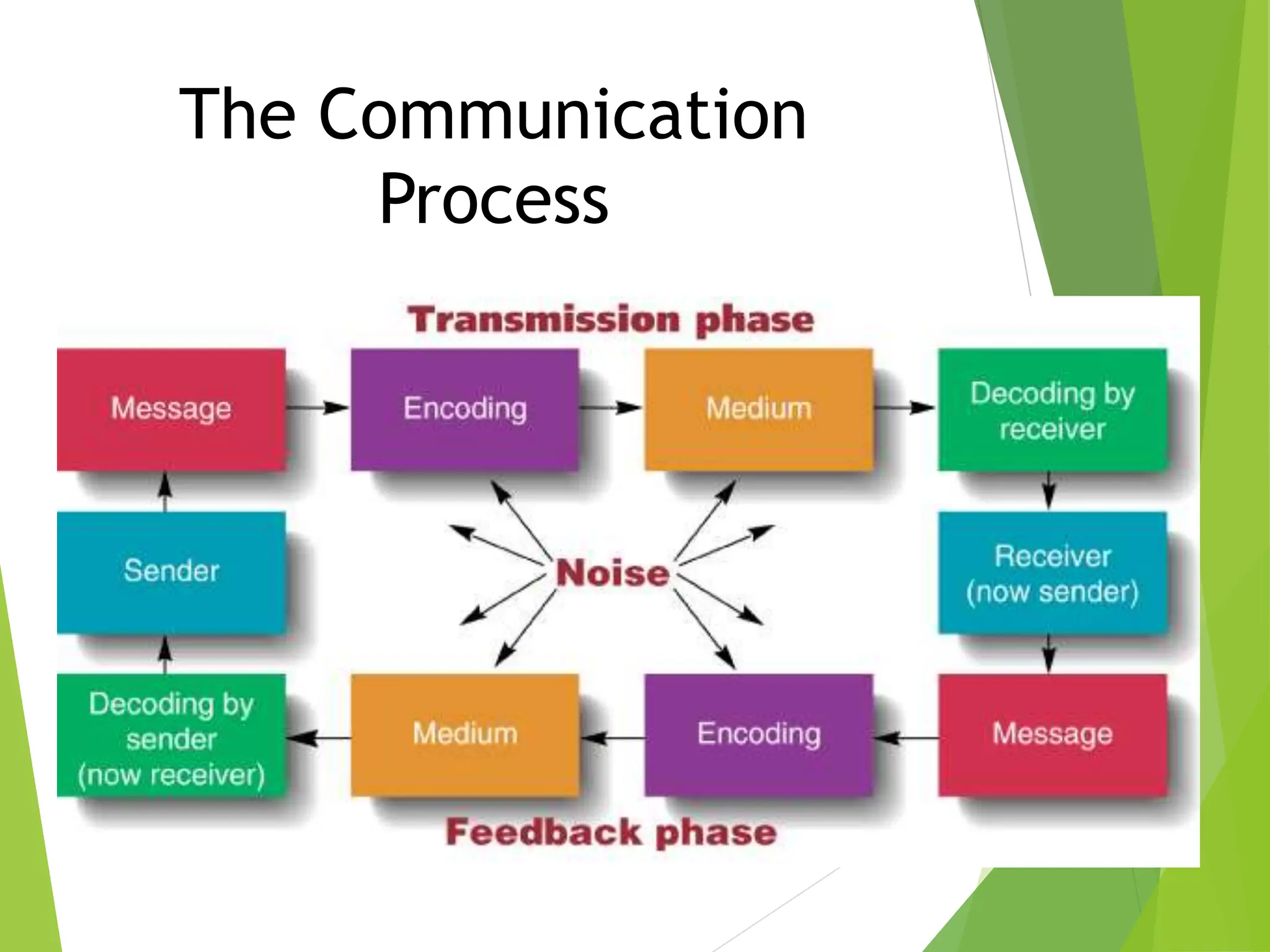
The Communication
Process

modelsofcommunicationhandout-160711061345 (1).ppt

  • 1.
  • 2.
    Models of Communication Linear Communication Model  Lasswell’s Model  Aristotle’s Model  Berlo’s SMCR Model  Transactional Model  Interactive Model  Schramm’s Model  White’s Model  Barlund’s Model  Shannon & Weaver Model
  • 4.
    Linear model hasdefined set of components required for a communication to be established where •Sender is the person who sends a message after encoding. •Encoding is the process of converting the message into codes compatible with the channel and understandable for the receiver. •Decoding is the process of changing the encoded message into understandable language by the receiver.
  • 5.
    •Message is theinformation sent by the sender to the receiver. •Channel is the medium through which the message is sent. •Receiver is the person who gets the message after decoding. •Noise is the disruptions that are caused in the communication process in channel or in understandability of the message.
  • 6.
    Lasswell's communication model wasdeveloped by communication theorist Harold D. Lasswell (1902- 1978) in 1948. Lasswell’s model of communication (also known as action model or linear model or one way model of communication) is regarded as one the most influential communication models.
  • 8.
    The first andearliest linear model is that of Aristotle, who was a teacher of Rhetoric and even put up an academy to produce good speakers. SPEAKER (Message) SPEECH (Listener) AUDIENCE Aristotle’s Model of Communication EFECT Occasion
  • 9.
    There are fewcriticisms around this model. Some of them are: •There is no concept of feedback, it is one way from speaker to audience. •There is no concept of communication failure like noise and barriers. •This model can only be used in public speaking.
  • 10.
    In 1960, DavidBerlo postulated Berlo's Sender-Message-Channel- Receiver (SMCR) Model of Communication from Shannon Weaver's Model of Communication (1949). He described factors affecting the individual components in the communication making the communication more efficient. This model also focuses on encoding and decoding which happens before sender sends the message and before receiver receives the message respectively.
  • 12.
     There isno concept of feedback, so the effect is not considered.  There is no concept of noise or any kind of barriers in communication.  It is a linear model of communication, there is no two way communication.  Both of the people must be similar according to all the factors mentioned above.
  • 14.
    Transactional model of communicationis the exchange of messages between sender and receiver where each take turns to send or receive messages. Here, both "sender" and "receiver" are known as "communicators" and their role reverses each time in the communication process as both processes of sending and receiving occurs at the same time.
  • 16.
     Without verbalresponse, the sender can not be sure that the receiver got the message as intended. Feedback is an important component in the communication process, especially in interpersonal communication as it gives a space to clarify misunderstandings.  The transactional model gives the opportunity for a lot of noise because the communication is simultaneous. For example, when many people are talking at the same time in a meeting, the objective of the meeting will not be fulfilled.
  • 17.
    Transactional Model OtherModels Used for interpersonal communication Used for Intrapersonal, interpersonal, group or mass communications. Senders and Receivers are known as Communicators, they interchange their roles Senders and receivers are different people Includes the role of context and environment Role of context and environment are not mentioned in other models Includes noise and communication barriers as factors Not necessarily have the concept of noise Talks about non-verbal communication Ignores non-verbal communication Simultaneous feedback Feedback comes later in interaction model and is not included in linear model Differences Between Transactional and Other Communication Models
  • 18.
    The second modelis that of Claude Shannon and Warren Weaver (1948) which gave us the concept of “NOISE”. This is often called Telephone Model because it is based on the experience of having the message interfered with by “noise” from the telephone switchboard back in 1940s.
  • 19.
  • 20.
    Example of Shannon-Weavermodel communication process A businessman sends a message via phone text to his worker about a meeting happening about their brand promotion. The worker does not receive the full message because of noise. It goes like this: Businessman: We have a meeting at the office ("at 8 am" goes missing due to phone network disruption or noise) Worker (feedback) : At what time?
  • 21.
    Sender : Businessman Encoder: Telephone network company Channel : Mobile network Noise : Distraction in voice (workplace noises) Decoder: Mobile phone Receiver : Worker
  • 22.
     Concept ofnoise helps in making the communication effective by removing the noise or problem causing noise.  This model takes communication as a two way process. It makes the model applicable in general communication.  Communication is taken as quantifiable in Shannon Weaver model.
  • 23.
     It canbe applied more for interpersonal communication than group communication and mass communication.  Receiver plays the passive part in the communication process as sender plays the primary role that sends messages.  Feedback is taken as less important in comparison to the messages sent by the sender.  The model is taken by some critics as a "misleading misrepresentation of the nature of human communication" as human communication is not mathematical in nature.
  • 24.
    Dean Barnlund proposeda transactional model of communication in 1970 for basic interpersonal communication which articulates that sending and receiving of messages happens simultaneously between people which is popularly known as Barlund's Transactional Model of Communication. The model has been further adapted and reformed by other theorists as General Transactional Model. The model shifted from the trend of linear model to dynamic and two way communication model.
  • 25.
  • 26.
     The modelshows shared field experience of the sender and receiver.  Transactional model talks about simultaneous message sending, noise and feedback.  Barnlund’s model is taken by critics as the most systematic model of communication.
  • 27.
     Barnlund’s modelis very complex.  Both the sender and receiver must understand the codes sent by the other. So they must each possess a similar "code book". (The concept of code book is not mentioned in the model but understood.)
  • 28.
    Interactive model (alsoknown as convergence model) deals with exchange of ideas and messages taking place both ways from sender to receiver and vice-versa. The communication process take place between humans or machines in both verbal or non-verbal way. This is a relatively new model of communication for new technologies like web.
  • 30.
    In Interactive model,whenever a source sends a message to a receiver (source), he/she encodes the message first. The encoded message is then received by the receiver where it is decoded to get the original information. Again, the receiver acts as a source, encodes another message (also knows as a feedback) and sends it back to the sender.
  • 31.
    Interactive Model of Communication OtherModels of Communication Indirect and slow feedback Direct and fast feedback Feedback is a whole new process of communication Feedback is the part of a single communication process For new media For all other kinds of media like print, news, etc. No engagement of sender and receiver in communication Engagement of sender and receiver in communication Sender and receiver is equally important Sender is important and overpowering than receiver It can become linear if the receiver does not respond The receiver is bound to give some kind of response verbal or non- verbal Interactive Model and Other Models Differences
  • 32.
    An example ofInteractive model is that of Wilbur Schramm, who is considered the Father of Mass Communication. He came up with five models, but the Schramm Model in (1995) we are concerned with is the concept that explains why communication breakdown occurs. Schramm asserts that communication can take place if and only if there is an overlap between the Field of Experience of the Speaker and the Field of Experience of the Listener.
  • 33.
    Schramm’s Model ofCommunication
  • 34.
    Field of Experienceare the things that influences the understanding and interpretation of message like culture, social background, beliefs, experiences, values and rules. Examples: •a person who always eats with spoon is informed that that he has to eat with hands in that place, the person will get offended because he will think it is impolite to eat that way. •the teacher must deliver his/her lecture in either English or Filipino because that is the language that students know and use.
  • 35.
     Circular communicationgives opportunity to both parties to give their opinion.  As it is dynamic and ever changing model, it is helpful in general practice.  Sender and receiver interchanges and both are equally active.  Semantic noise included as a concept helps in understanding problems that can occur during interpretation of message.
  • 36.
     Feedback makesit easier to know if the message is interpreted by the receiver as intended or not.  Concept of interpretation makes the communication effective.  Field of experience (psychological effect) helps to understand the communication process in many other ways than the traditional ones..  Concept of context makes the environmental factor be included in interpretation of message and brings change in the message value.
  • 37.
    This model cannot deal with multiple levels of communication and complex communication processes. There can only be two sources communicating, many sources complicates the process and the model can not be implemented. Message sent and received might be interpreted differently than intended.
  • 38.
  • 39.