RLC CIRCUIT
PROBLEM
Presented By:
Md. Nazmus Saqib Khan
Roll no. 12075768
Email: ratulkhan.jhenidah@gmail.com
Class of Masters,
Department of Mathematics,
University of Rajshahi,
Rajshahi 6205.
TOPICS
Definitions
 Resistor (R)
 Inductor (L)
 Capacitor (C)
RLC Circuit
RLC Circuit Problem
MATLAB Code
Figure
References
1
RESISTOR (R)
 A resistor is an electrical
component that implements
electrical resistance as a
circuit element. In electronic
circuits, resistors are used to
reduce current flow, adjust
signal levels, to divide
voltages, bias active
elements, and terminate
transmission lines, among
other uses.[1]
Fig.2 Electronic Symbol
(Source: wikipedia)
Fig.1 A typical axial-lead
resistor (Source:
wikipedia)
2
INDUCTOR (L)
 An inductor, also called a coil
or reactor, is an electrical
component that stores
electrical energy in a
magnetic field when electric
current is flowing through it.
An inductor typically consists
of an electric conductor, such
as a wire, that is wound into a
coil.[2]
Fig.3 A selection of low-
value inductors
(Source: wikipedia)
Fig.4 Electronic Symbol
(Source: wikipedia)
3
CAPACITOR (C)
 A capacitor is an electrical
component that stores
electrical energy in an
electric field. The effect of a
capacitor is known as
capacitance. Capacitors are
widely used in electronic
circuits for blocking direct
current while allowing
alternating current to pass. In
analog filter networks, they
smooth the output of power
supplies.[3]
Fig.5 Different types of
capacitors
(Source: wikipedia)
Fig.6 Electronic
Symbol(Source:
wikipedia) 4
RLC CIRCUIT
 An RLC circuit is an electrical circuit consisting of a
resistor (R), an inductor (L), and a capacitor (C),
connected in series or in parallel. The name of the
circuit is derived from the letters that are used to
denote the constituent components of this circuit,
where the sequence of the components may vary from
RLC. [4]
Fig.5 A series RLC circuit: a resistor, inductor, and a
capacitor (Source: wikipedia)
5
RLC CIRCUIT PROBLEM
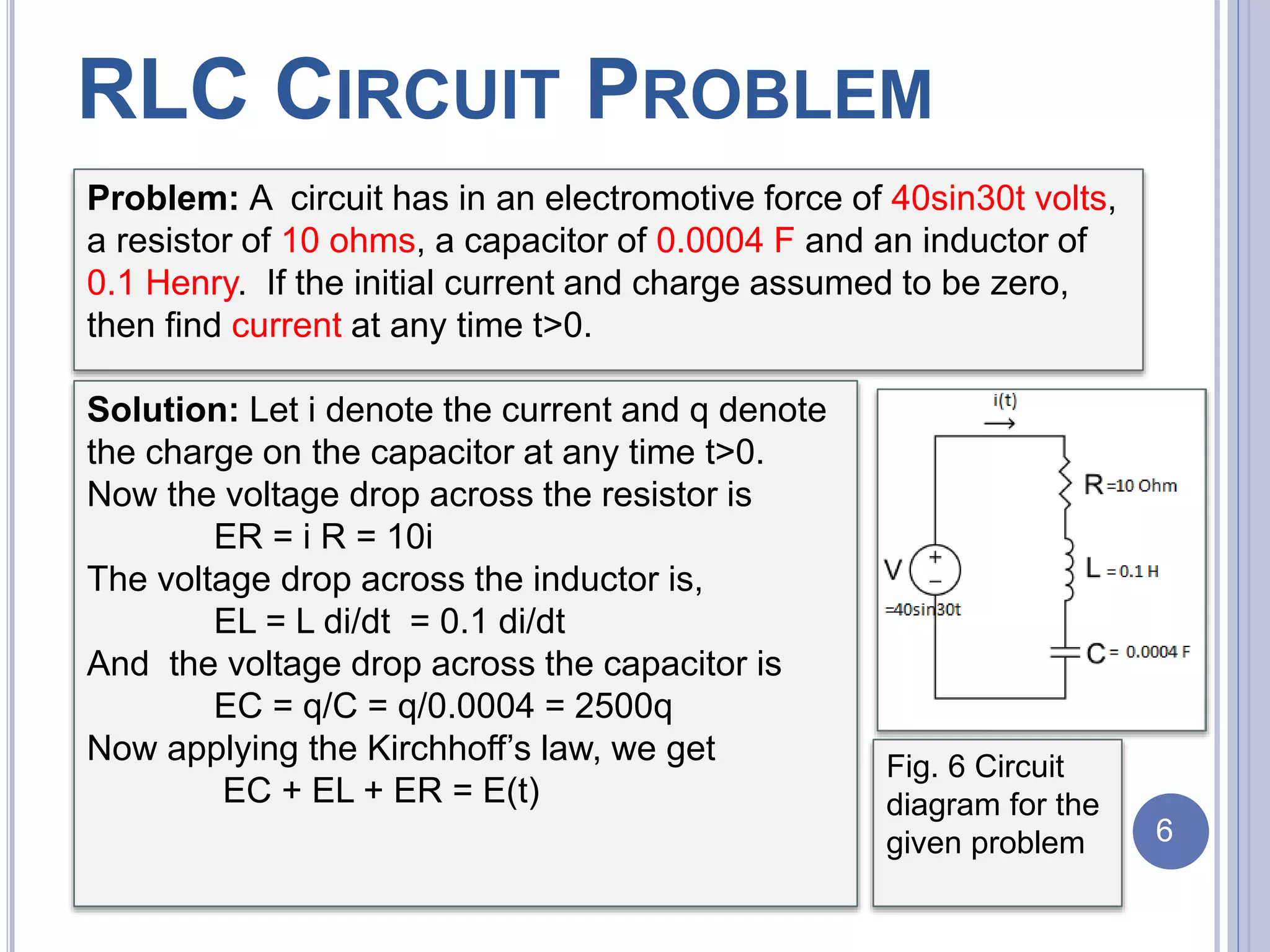
Problem: A circuit has in an electromotive force of 40sin30t volts,
a resistor of 10 ohms, a capacitor of 0.0004 F and an inductor of
0.1 Henry. If the initial current and charge assumed to be zero,
then find current at any time t>0.
Solution: Let i denote the current and q denote
the charge on the capacitor at any time t>0.
Now the voltage drop across the resistor is
ER = i R = 10i
The voltage drop across the inductor is,
EL = L di/dt = 0.1 di/dt
And the voltage drop across the capacitor is
EC = q/C = q/0.0004 = 2500q
Now applying the Kirchhoff’s law, we get
EC + EL + ER = E(t)
Fig. 6 Circuit
diagram for the
given problem 6
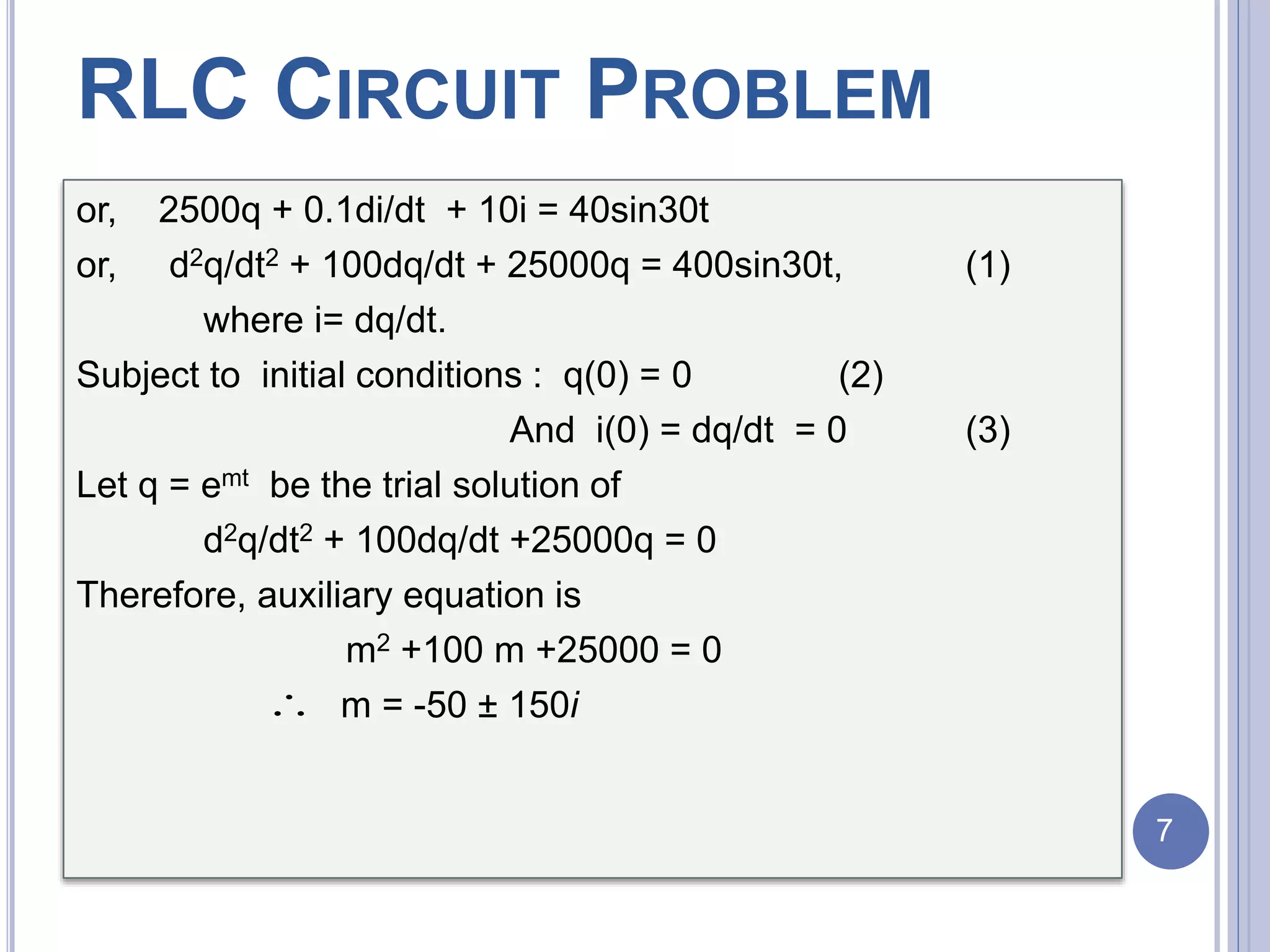
or, 2500q + 0.1di/dt + 10i = 40sin30t
or, d2q/dt2 + 100dq/dt + 25000q = 400sin30t, (1)
where i= dq/dt.
Subject to initial conditions : q(0) = 0 (2)
And i(0) = dq/dt = 0 (3)
Let q = emt be the trial solution of
d2q/dt2 + 100dq/dt +25000q = 0
Therefore, auxiliary equation is
m2 +100 m +25000 = 0
m = -50 ± 150i
RLC CIRCUIT PROBLEM

7
Now, the complementary solution is
qc = e-50t (Asin150t + Bcos150t)
Now, the particular solution is
qp =
1
D2
+100D +25000
(400sin30t)
=
400
−900+100D +25000
(sin30t)
=
4
D +241
(sin30t)
=
4(𝐷−241)
D2
−58081
(sin30t)
=
120𝑐𝑜𝑠30𝑡−964𝑠𝑖𝑛30𝑡
−900−58081
=
964
58981
sin30t -
120
58981
𝑐𝑜𝑠30t
RLC CIRCUIT PROBLEM
8
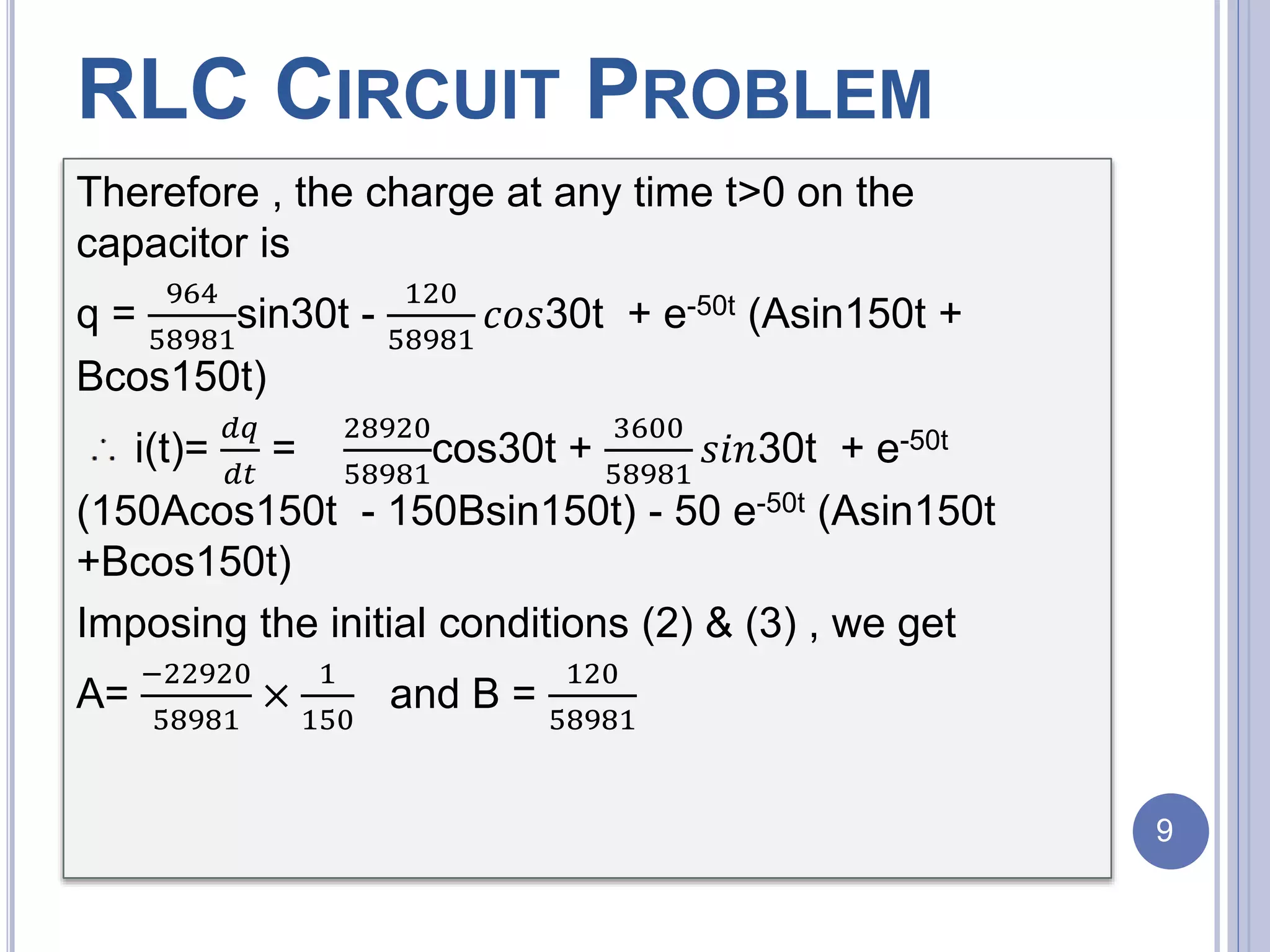
Therefore , the charge at any time t>0 on the
capacitor is
q =
964
58981
sin30t -
120
58981
𝑐𝑜𝑠30t + e-50t (Asin150t +
Bcos150t)
i(t)=
𝑑𝑞
𝑑𝑡
=
28920
58981
cos30t +
3600
58981
𝑠𝑖𝑛30t + e-50t
(150Acos150t - 150Bsin150t) - 50 e-50t (Asin150t
+Bcos150t)
Imposing the initial conditions (2) & (3) , we get
A=
−22920
58981
×
1
150
and B =
120
58981
RLC CIRCUIT PROBLEM
9
Therefore ,
q =
964
58981
sin30t -
120
58981
𝑐𝑜𝑠30t + e-50t (
−22920
58981
×
1
150
sin150t +
120
58981
cos150t)
i(t)=
𝑑𝑞
𝑑𝑡
=
28920
58981
cos30t +
3600
58981
𝑠𝑖𝑛30t - e-50t
(
22920
58981
cos150t +
18000
58981
sin150t) +50 e-50t (
22920
58981
×
1
150
sin150t -
120
58981
cos150t)
Which is the required current at any time t>0.
RLC CIRCUIT PROBLEM
10
MATLAB CODE
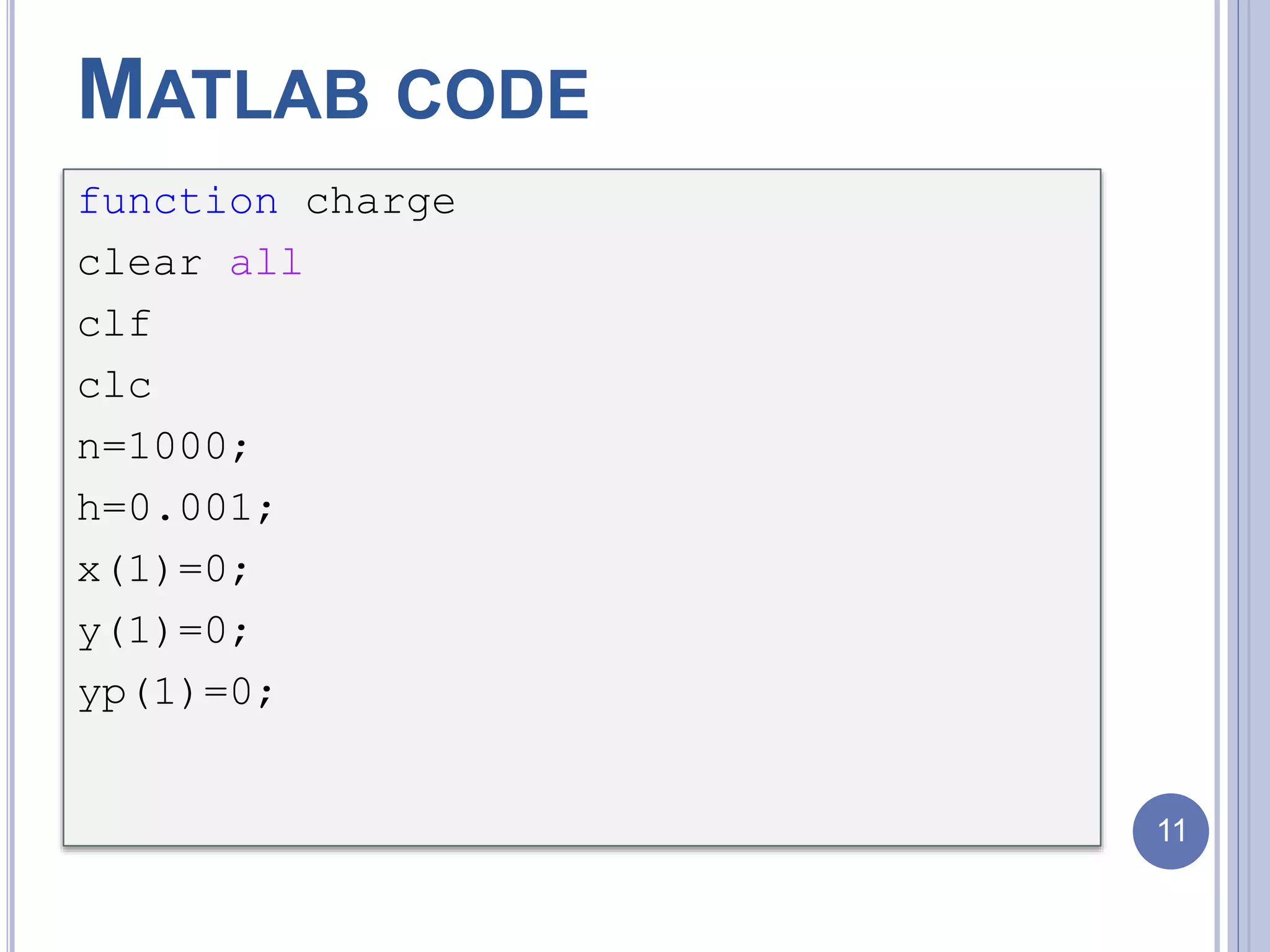
function charge
clear all
clf
clc
n=1000;
h=0.001;
x(1)=0;
y(1)=0;
yp(1)=0;
11
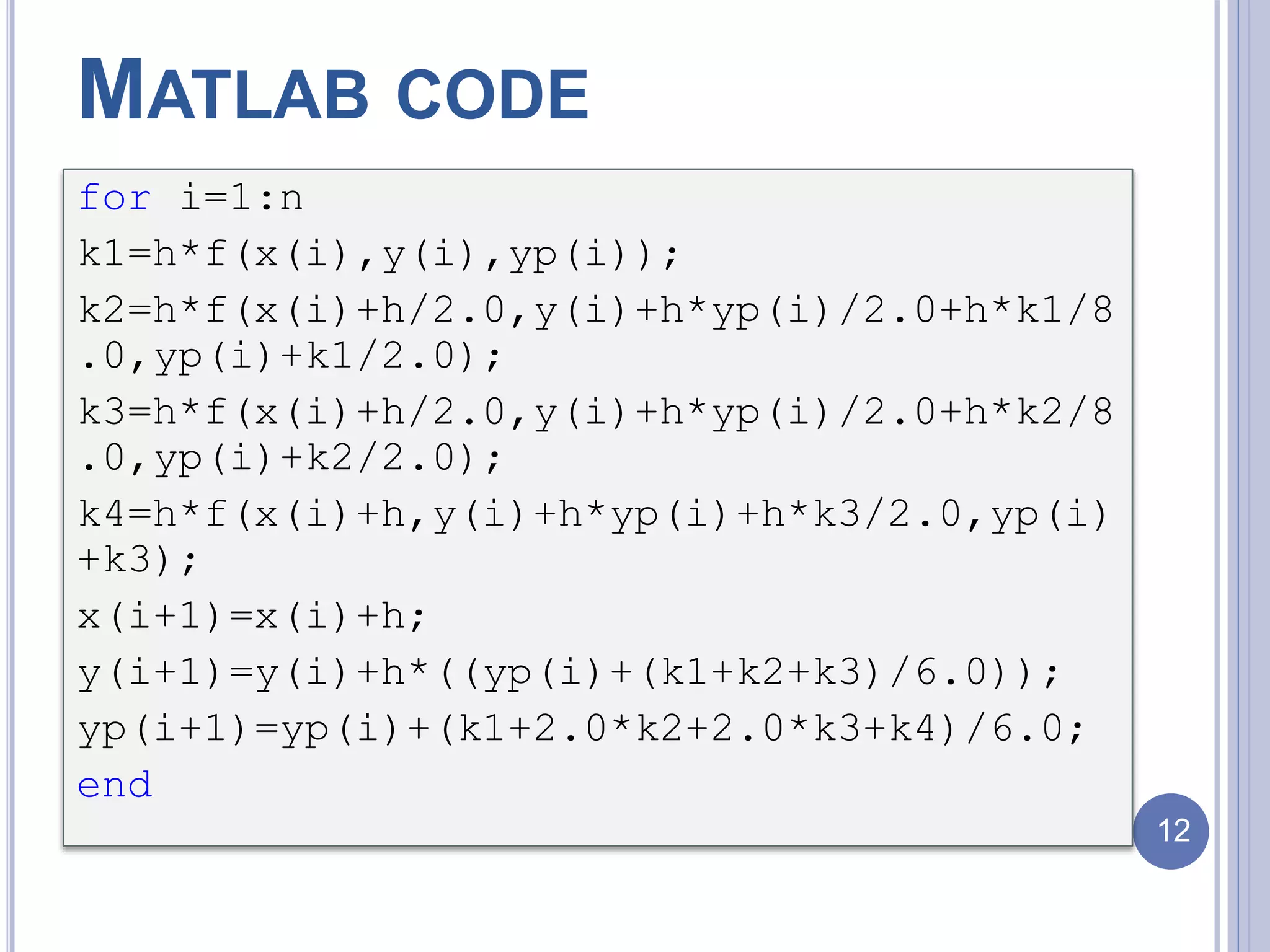
for i=1:n
k1=h*f(x(i),y(i),yp(i));
k2=h*f(x(i)+h/2.0,y(i)+h*yp(i)/2.0+h*k1/8
.0,yp(i)+k1/2.0);
k3=h*f(x(i)+h/2.0,y(i)+h*yp(i)/2.0+h*k2/8
.0,yp(i)+k2/2.0);
k4=h*f(x(i)+h,y(i)+h*yp(i)+h*k3/2.0,yp(i)
+k3);
x(i+1)=x(i)+h;
y(i+1)=y(i)+h*((yp(i)+(k1+k2+k3)/6.0));
yp(i+1)=yp(i)+(k1+2.0*k2+2.0*k3+k4)/6.0;
end
12
MATLAB CODE
for i=1:n+1
q=(964/58981)*sin(30*x(i)) -
(120/58981)*cos(30*x(i)) + exp(-
50*x(i))*((-2292/(58981*15))*
sin(150*x(i)) + (120/58981)*
cos(150*x(i)));
end
q'
a=[x' y' yp'];
13
MATLAB CODE
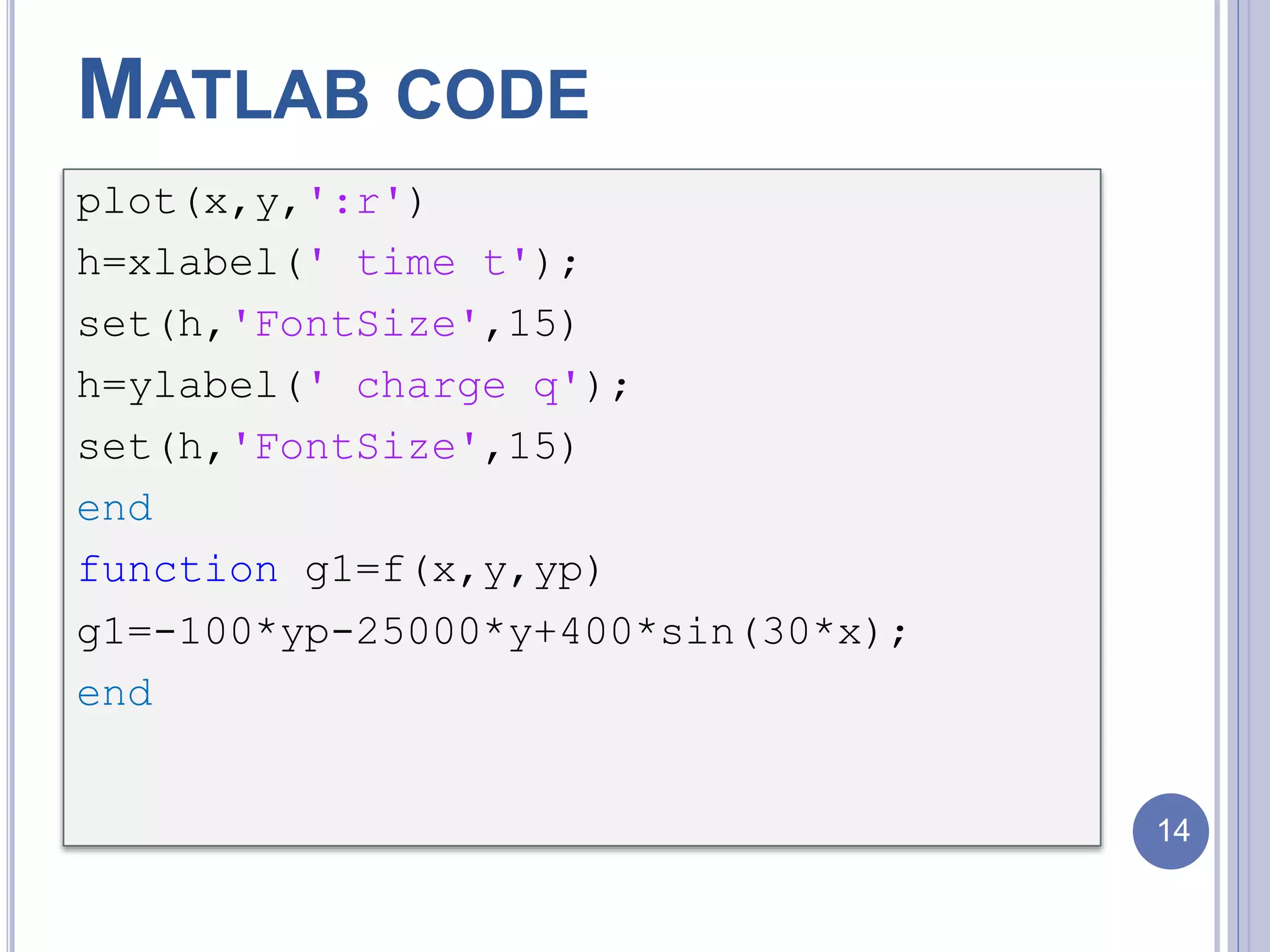
plot(x,y,':r')
h=xlabel(' time t');
set(h,'FontSize',15)
h=ylabel(' charge q');
set(h,'FontSize',15)
end
function g1=f(x,y,yp)
g1=-100*yp-25000*y+400*sin(30*x);
end
14
MATLAB CODE
FIGURE
15
Fig.7 Graph of the solution curve.
REFERENCES
[1] https://en.wikipedia.org/wiki/Resistor
[2] https://en.wikipedia.org/wiki/Inductor
[3] https://en.wikipedia.org/wiki/Capacitor
[4] https://en.wikipedia.org/wiki/RLC_circuit
16
END OF THE PRESENTATION
THANK YOU!
17

Modeling of an RLC circuit

  • 1.
    RLC CIRCUIT PROBLEM Presented By: Md.Nazmus Saqib Khan Roll no. 12075768 Email: ratulkhan.jhenidah@gmail.com Class of Masters, Department of Mathematics, University of Rajshahi, Rajshahi 6205.
  • 2.
    TOPICS Definitions  Resistor (R) Inductor (L)  Capacitor (C) RLC Circuit RLC Circuit Problem MATLAB Code Figure References 1
  • 3.
    RESISTOR (R)  Aresistor is an electrical component that implements electrical resistance as a circuit element. In electronic circuits, resistors are used to reduce current flow, adjust signal levels, to divide voltages, bias active elements, and terminate transmission lines, among other uses.[1] Fig.2 Electronic Symbol (Source: wikipedia) Fig.1 A typical axial-lead resistor (Source: wikipedia) 2
  • 4.
    INDUCTOR (L)  Aninductor, also called a coil or reactor, is an electrical component that stores electrical energy in a magnetic field when electric current is flowing through it. An inductor typically consists of an electric conductor, such as a wire, that is wound into a coil.[2] Fig.3 A selection of low- value inductors (Source: wikipedia) Fig.4 Electronic Symbol (Source: wikipedia) 3
  • 5.
    CAPACITOR (C)  Acapacitor is an electrical component that stores electrical energy in an electric field. The effect of a capacitor is known as capacitance. Capacitors are widely used in electronic circuits for blocking direct current while allowing alternating current to pass. In analog filter networks, they smooth the output of power supplies.[3] Fig.5 Different types of capacitors (Source: wikipedia) Fig.6 Electronic Symbol(Source: wikipedia) 4
  • 6.
    RLC CIRCUIT  AnRLC circuit is an electrical circuit consisting of a resistor (R), an inductor (L), and a capacitor (C), connected in series or in parallel. The name of the circuit is derived from the letters that are used to denote the constituent components of this circuit, where the sequence of the components may vary from RLC. [4] Fig.5 A series RLC circuit: a resistor, inductor, and a capacitor (Source: wikipedia) 5
  • 7.
    RLC CIRCUIT PROBLEM Problem:A circuit has in an electromotive force of 40sin30t volts, a resistor of 10 ohms, a capacitor of 0.0004 F and an inductor of 0.1 Henry. If the initial current and charge assumed to be zero, then find current at any time t>0. Solution: Let i denote the current and q denote the charge on the capacitor at any time t>0. Now the voltage drop across the resistor is ER = i R = 10i The voltage drop across the inductor is, EL = L di/dt = 0.1 di/dt And the voltage drop across the capacitor is EC = q/C = q/0.0004 = 2500q Now applying the Kirchhoff’s law, we get EC + EL + ER = E(t) Fig. 6 Circuit diagram for the given problem 6
  • 8.
    or, 2500q +0.1di/dt + 10i = 40sin30t or, d2q/dt2 + 100dq/dt + 25000q = 400sin30t, (1) where i= dq/dt. Subject to initial conditions : q(0) = 0 (2) And i(0) = dq/dt = 0 (3) Let q = emt be the trial solution of d2q/dt2 + 100dq/dt +25000q = 0 Therefore, auxiliary equation is m2 +100 m +25000 = 0 m = -50 ± 150i RLC CIRCUIT PROBLEM  7
  • 9.
    Now, the complementarysolution is qc = e-50t (Asin150t + Bcos150t) Now, the particular solution is qp = 1 D2 +100D +25000 (400sin30t) = 400 −900+100D +25000 (sin30t) = 4 D +241 (sin30t) = 4(𝐷−241) D2 −58081 (sin30t) = 120𝑐𝑜𝑠30𝑡−964𝑠𝑖𝑛30𝑡 −900−58081 = 964 58981 sin30t - 120 58981 𝑐𝑜𝑠30t RLC CIRCUIT PROBLEM 8
  • 10.
    Therefore , thecharge at any time t>0 on the capacitor is q = 964 58981 sin30t - 120 58981 𝑐𝑜𝑠30t + e-50t (Asin150t + Bcos150t) i(t)= 𝑑𝑞 𝑑𝑡 = 28920 58981 cos30t + 3600 58981 𝑠𝑖𝑛30t + e-50t (150Acos150t - 150Bsin150t) - 50 e-50t (Asin150t +Bcos150t) Imposing the initial conditions (2) & (3) , we get A= −22920 58981 × 1 150 and B = 120 58981 RLC CIRCUIT PROBLEM 9
  • 11.
    Therefore , q = 964 58981 sin30t- 120 58981 𝑐𝑜𝑠30t + e-50t ( −22920 58981 × 1 150 sin150t + 120 58981 cos150t) i(t)= 𝑑𝑞 𝑑𝑡 = 28920 58981 cos30t + 3600 58981 𝑠𝑖𝑛30t - e-50t ( 22920 58981 cos150t + 18000 58981 sin150t) +50 e-50t ( 22920 58981 × 1 150 sin150t - 120 58981 cos150t) Which is the required current at any time t>0. RLC CIRCUIT PROBLEM 10
  • 12.
    MATLAB CODE function charge clearall clf clc n=1000; h=0.001; x(1)=0; y(1)=0; yp(1)=0; 11
  • 13.
  • 14.
    for i=1:n+1 q=(964/58981)*sin(30*x(i)) - (120/58981)*cos(30*x(i))+ exp(- 50*x(i))*((-2292/(58981*15))* sin(150*x(i)) + (120/58981)* cos(150*x(i))); end q' a=[x' y' yp']; 13 MATLAB CODE
  • 15.
    plot(x,y,':r') h=xlabel(' time t'); set(h,'FontSize',15) h=ylabel('charge q'); set(h,'FontSize',15) end function g1=f(x,y,yp) g1=-100*yp-25000*y+400*sin(30*x); end 14 MATLAB CODE
  • 16.
    FIGURE 15 Fig.7 Graph ofthe solution curve.
  • 17.
    REFERENCES [1] https://en.wikipedia.org/wiki/Resistor [2] https://en.wikipedia.org/wiki/Inductor [3]https://en.wikipedia.org/wiki/Capacitor [4] https://en.wikipedia.org/wiki/RLC_circuit 16
  • 18.
    END OF THEPRESENTATION THANK YOU! 17