PHASE UNDERSTAND EVALUATE DESIGN VALIDATE RECOMMEND
PURPOSE Identify requirement & agree
criteria for evaluation
Analyse research & appraise methods to
prototype options
Design prototype/s based on
evaluation
Test prototype to validate &
review analysis
Produce business case to specify
requirements
TOUCHPOIN
T
 Customer to define their
business requirement &
agree resource/milestones
 Customer to determine
process for involvement
 Customer to review requirement
 Stakeholders with relevant expertise
to inform research
 Work with ICT Teams to understand
capability to deploy technology
 TA to identify future
modifications needed to
move prototype to live
 Suppliers to install
prototypes/products
 Testing Team to support
testing
 Target users to test
prototypes
 Meet with Customer to
discuss emerging options
 BD to identify opportunities
for joint R&D
SKILLS
REQUIRED
 Strategic perspective
 Conceptual Thinking
 Planning & Organisation
 Analytical Thinking
 Cross-Functional/Disciplinary Awareness
 Written Expression
 Operations Management
 Initiative
 Creativity
 Attention to Detail
 Persistence
 Goal orientation
 Commercial Orientation
 Influence, Persuasion &
Impact
 Oral Expression
KNOWLEDG
E
REQUIRED
 Research Field
 Literature Search
 Research Proposal Assessment
 Research Techniques
 Experimental Work
 Proof of Concept and
Prototyping
 Structured Reviews
 Product Evaluation and
Selection
 Presentation Techniques
 National/International
Standards
INPUTS  Business Requirement
 Model
 Research Brief
 R&D Process
 Prototype Plan
 R&D Methods
 Test Plan
 R&D Methods
 Evaluation
 R&D Roadmap
OUTPUTS  Research Brief / Plan  Concept Paper
 Evaluation Scorecard
 Prototype
 Test Plan
 Evaluation
 Test Scorecard
 Business Case
 Blueprint
QUESTIONS  What are the issues that the
research will address?
 How is the research going to be
planned?
 Who are the stakeholders that
need to be involved?
 What research do we need to support
the evaluation?
 What does the research show? Where
are the gaps?
 How well do the options put forward
address the requirement?
 How will we translate the
requirements into prototypes?
 What resources are required
to design/install the
prototypes?
 What methods are we going to
use to test the prototypes
 How can we ensure the testing
will be repeatable?
 How are we going to
disseminate the lessons
 How suitable is each
recommendation in meeting
the requirement?
 How feasible is each objective
given the resources?
 How can the business case be
learned? taken forward?
PLAN  Agree research goals
 Develop the brief
 Plan the activity
 Structure the thinking
 Set milestones
 Define accountability
 Identify resources required
 Evaluate technologies and/or
products
 Evaluate data based on criteria set
out in Research Brief
 Negotiate with suppliers to gain
technical advice & products to
evaluate
 Research best method of
prototype
 Evaluate potential systems
 Document results
 Design or install prototypes
 Develop a testing plan to meet
scoping requirements
 Self test the product based on
Scoreboard criteria
 Evaluate against original testing
plan with stakeholder group
 Iterate prototype
 Design a blueprint to turn
concept into functioning model
 Provide proposed approach
which can map onto Solution
Design Technical Architecture
Template
METHODS
STRUCTUR
E
Justify the project
Structure the issues
Appraise options
Prioritise requirements to be prototyped
Plan the prototyping
Plan the testing
Plan the evaluation of the research
& testing
Plan development of business
case/blueprint
ANALYSE Identify research required Build an evidence base
Develop scenarios for adoption of
technology
Describe what elements of
prototype meet requirement
Analyse test results
Validate research
Establish resources required
INVOLVE Identify stakeholders Engage stakeholders to stimulate ideas on
research
Design visual prototypes
Create scenarios for testing
Test prototypes with customers
Use feedback to iterate prototype
Present blueprint to stakeholders
using scenarios
PRE-
COMPLETIO
N
 Assess what opportunities
would solve the issues
identified
 Propose which should be
taken forward to be
developed into concepts
 Define requirements for
Evaluation
 Analyse, define and refine findings as
requirements to be prototyped
 Synthesise ideas into a brief with
tasks for prototyping
 Review, select & discard ideas
 Decide which requirements
need further prototyping
 Prioritise what we want to
prototype
 Develop and agree targets
for testing with Customer
 Ensure evaluation provides
sufficient insights to be able
to develop business case &
blueprint
 Set up meeting with
stakeholders to plan
potential business models
PRE-GATE  Discuss activities proposed
& resource requirements in
Research Brief with
Customer
 Discuss findings from Research
Analysis to Customer and the
activities/resource requirements
proposed in Prototype Plan
 Showcase of Prototypes &
discuss Test Plan with
Customer
 Discuss lessons learned
from Evaluation to Customer
 Discuss how Business
Case meets requirements
to go forward to Customer
GATE Customer either
 Approves Research Brief
and commissions R&D to
either
 Produce a Research
Analysis
 Carry out the full R&D
Process
 Negotiates modification to
activities or resources
Customer approves Research Analysis and
either agrees that
 R&D is complete or
 Commissions R&D to carry out
further research on a particular
aspect of the Business Requirement
or
 Prioritise what requirements should
be prototyped
Customer either
 Approves Test Plan and
asks R&D to move to
testing prototypes or
 Requests that Test Plan is
modified to ensure it can
effectively validate
requirements
Customer approves Evaluation and
either
 Asks R&D to produce
business case. Requests
R&D carry out
• Further testing on prototype.
• Further prototyping.
Customer either
 Approves Business Case
and takes it forward
 Requests modifications to
activities/resource
requirements before
approving
STORE Plan the flow of information for the
project to Sharepoint R&D
Workflow
Gather data/insights from research and add
to Sharepoint R&D Analysis
Gather designs from prototypes
and add to R&D Lab
Disseminate evaluation and add to
Sharepoint R&D Analysis
Host Business Case in a way that
customer can visualise blueprint
PRINCIPLES  Maintain up-to-date
knowledge of emerging
technology, public sector and
business trends and
developments
 Help customer understand the
opportunities that technology can
provide
 Understand current
developments in the
application of ICT
 Demonstrate the feasibility of
applying a particular
technology to meet a business
need
 Promote alignment of
technology capabilities with
associated business
opportunities

Model Process

  • 1.
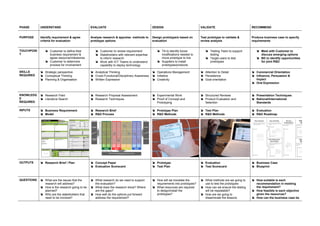
    PHASE UNDERSTAND EVALUATEDESIGN VALIDATE RECOMMEND PURPOSE Identify requirement & agree criteria for evaluation Analyse research & appraise methods to prototype options Design prototype/s based on evaluation Test prototype to validate & review analysis Produce business case to specify requirements TOUCHPOIN T  Customer to define their business requirement & agree resource/milestones  Customer to determine process for involvement  Customer to review requirement  Stakeholders with relevant expertise to inform research  Work with ICT Teams to understand capability to deploy technology  TA to identify future modifications needed to move prototype to live  Suppliers to install prototypes/products  Testing Team to support testing  Target users to test prototypes  Meet with Customer to discuss emerging options  BD to identify opportunities for joint R&D SKILLS REQUIRED  Strategic perspective  Conceptual Thinking  Planning & Organisation  Analytical Thinking  Cross-Functional/Disciplinary Awareness  Written Expression  Operations Management  Initiative  Creativity  Attention to Detail  Persistence  Goal orientation  Commercial Orientation  Influence, Persuasion & Impact  Oral Expression KNOWLEDG E REQUIRED  Research Field  Literature Search  Research Proposal Assessment  Research Techniques  Experimental Work  Proof of Concept and Prototyping  Structured Reviews  Product Evaluation and Selection  Presentation Techniques  National/International Standards INPUTS  Business Requirement  Model  Research Brief  R&D Process  Prototype Plan  R&D Methods  Test Plan  R&D Methods  Evaluation  R&D Roadmap OUTPUTS  Research Brief / Plan  Concept Paper  Evaluation Scorecard  Prototype  Test Plan  Evaluation  Test Scorecard  Business Case  Blueprint QUESTIONS  What are the issues that the research will address?  How is the research going to be planned?  Who are the stakeholders that need to be involved?  What research do we need to support the evaluation?  What does the research show? Where are the gaps?  How well do the options put forward address the requirement?  How will we translate the requirements into prototypes?  What resources are required to design/install the prototypes?  What methods are we going to use to test the prototypes  How can we ensure the testing will be repeatable?  How are we going to disseminate the lessons  How suitable is each recommendation in meeting the requirement?  How feasible is each objective given the resources?  How can the business case be
  • 2.
    learned? taken forward? PLAN Agree research goals  Develop the brief  Plan the activity  Structure the thinking  Set milestones  Define accountability  Identify resources required  Evaluate technologies and/or products  Evaluate data based on criteria set out in Research Brief  Negotiate with suppliers to gain technical advice & products to evaluate  Research best method of prototype  Evaluate potential systems  Document results  Design or install prototypes  Develop a testing plan to meet scoping requirements  Self test the product based on Scoreboard criteria  Evaluate against original testing plan with stakeholder group  Iterate prototype  Design a blueprint to turn concept into functioning model  Provide proposed approach which can map onto Solution Design Technical Architecture Template METHODS STRUCTUR E Justify the project Structure the issues Appraise options Prioritise requirements to be prototyped Plan the prototyping Plan the testing Plan the evaluation of the research & testing Plan development of business case/blueprint ANALYSE Identify research required Build an evidence base Develop scenarios for adoption of technology Describe what elements of prototype meet requirement Analyse test results Validate research Establish resources required INVOLVE Identify stakeholders Engage stakeholders to stimulate ideas on research Design visual prototypes Create scenarios for testing Test prototypes with customers Use feedback to iterate prototype Present blueprint to stakeholders using scenarios PRE- COMPLETIO N  Assess what opportunities would solve the issues identified  Propose which should be taken forward to be developed into concepts  Define requirements for Evaluation  Analyse, define and refine findings as requirements to be prototyped  Synthesise ideas into a brief with tasks for prototyping  Review, select & discard ideas  Decide which requirements need further prototyping  Prioritise what we want to prototype  Develop and agree targets for testing with Customer  Ensure evaluation provides sufficient insights to be able to develop business case & blueprint  Set up meeting with stakeholders to plan potential business models
  • 3.
    PRE-GATE  Discussactivities proposed & resource requirements in Research Brief with Customer  Discuss findings from Research Analysis to Customer and the activities/resource requirements proposed in Prototype Plan  Showcase of Prototypes & discuss Test Plan with Customer  Discuss lessons learned from Evaluation to Customer  Discuss how Business Case meets requirements to go forward to Customer GATE Customer either  Approves Research Brief and commissions R&D to either  Produce a Research Analysis  Carry out the full R&D Process  Negotiates modification to activities or resources Customer approves Research Analysis and either agrees that  R&D is complete or  Commissions R&D to carry out further research on a particular aspect of the Business Requirement or  Prioritise what requirements should be prototyped Customer either  Approves Test Plan and asks R&D to move to testing prototypes or  Requests that Test Plan is modified to ensure it can effectively validate requirements Customer approves Evaluation and either  Asks R&D to produce business case. Requests R&D carry out • Further testing on prototype. • Further prototyping. Customer either  Approves Business Case and takes it forward  Requests modifications to activities/resource requirements before approving STORE Plan the flow of information for the project to Sharepoint R&D Workflow Gather data/insights from research and add to Sharepoint R&D Analysis Gather designs from prototypes and add to R&D Lab Disseminate evaluation and add to Sharepoint R&D Analysis Host Business Case in a way that customer can visualise blueprint PRINCIPLES  Maintain up-to-date knowledge of emerging technology, public sector and business trends and developments  Help customer understand the opportunities that technology can provide  Understand current developments in the application of ICT  Demonstrate the feasibility of applying a particular technology to meet a business need  Promote alignment of technology capabilities with associated business opportunities