Developing a Mobile Proposition


Section 6: From defined proposition to
delivery
MICHAEL NUCIFORO
Mobile Consultant, Innovator and Futurist
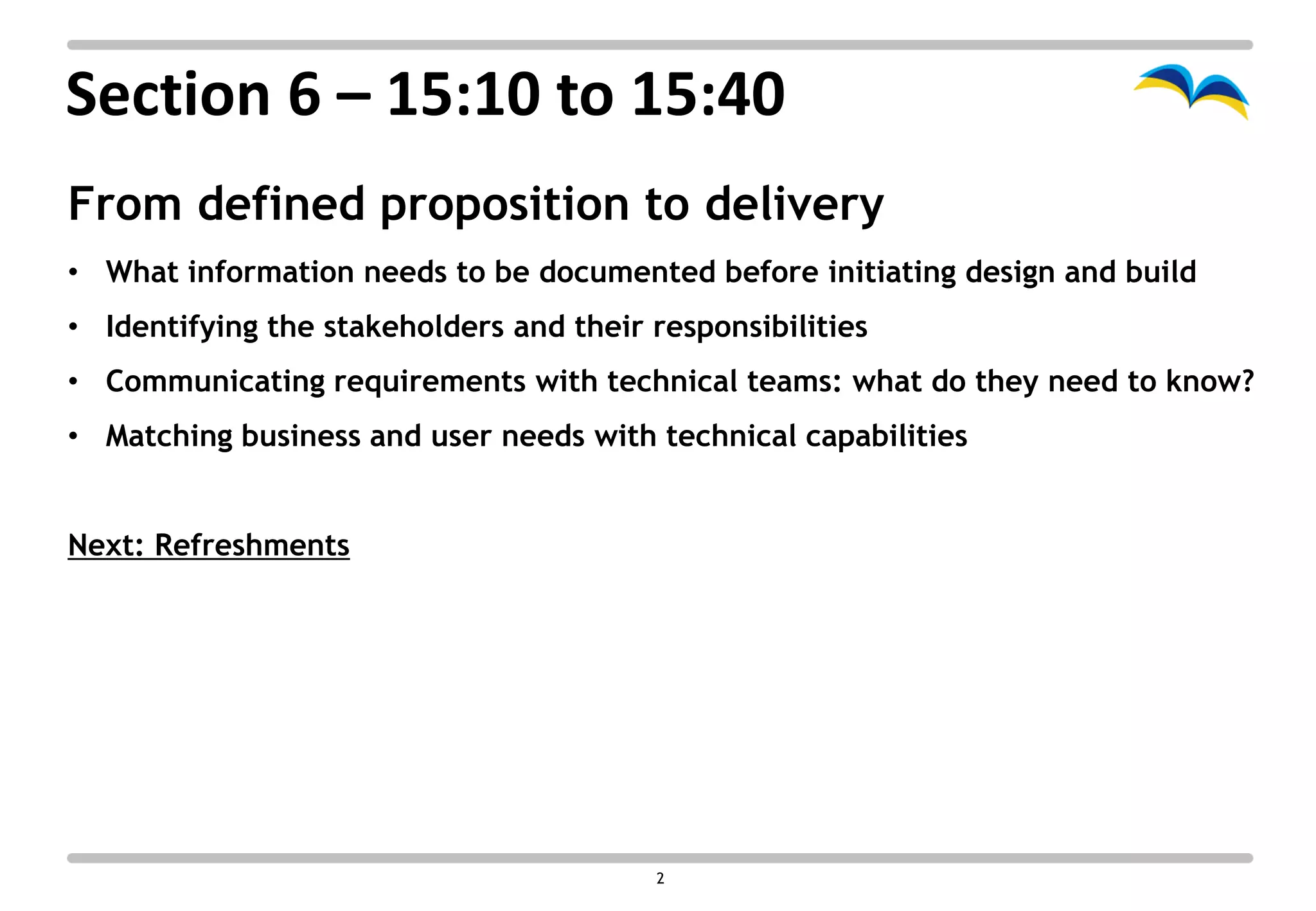
Section 6 – 15:10 to 15:40
From defined proposition to delivery
• What information needs to be documented before initiating design and build
• Identifying the stakeholders and their responsibilities
• Communicating requirements with technical teams: what do they need to know?
• Matching business and user needs with technical capabilities


Next: Refreshments


                                         2
3


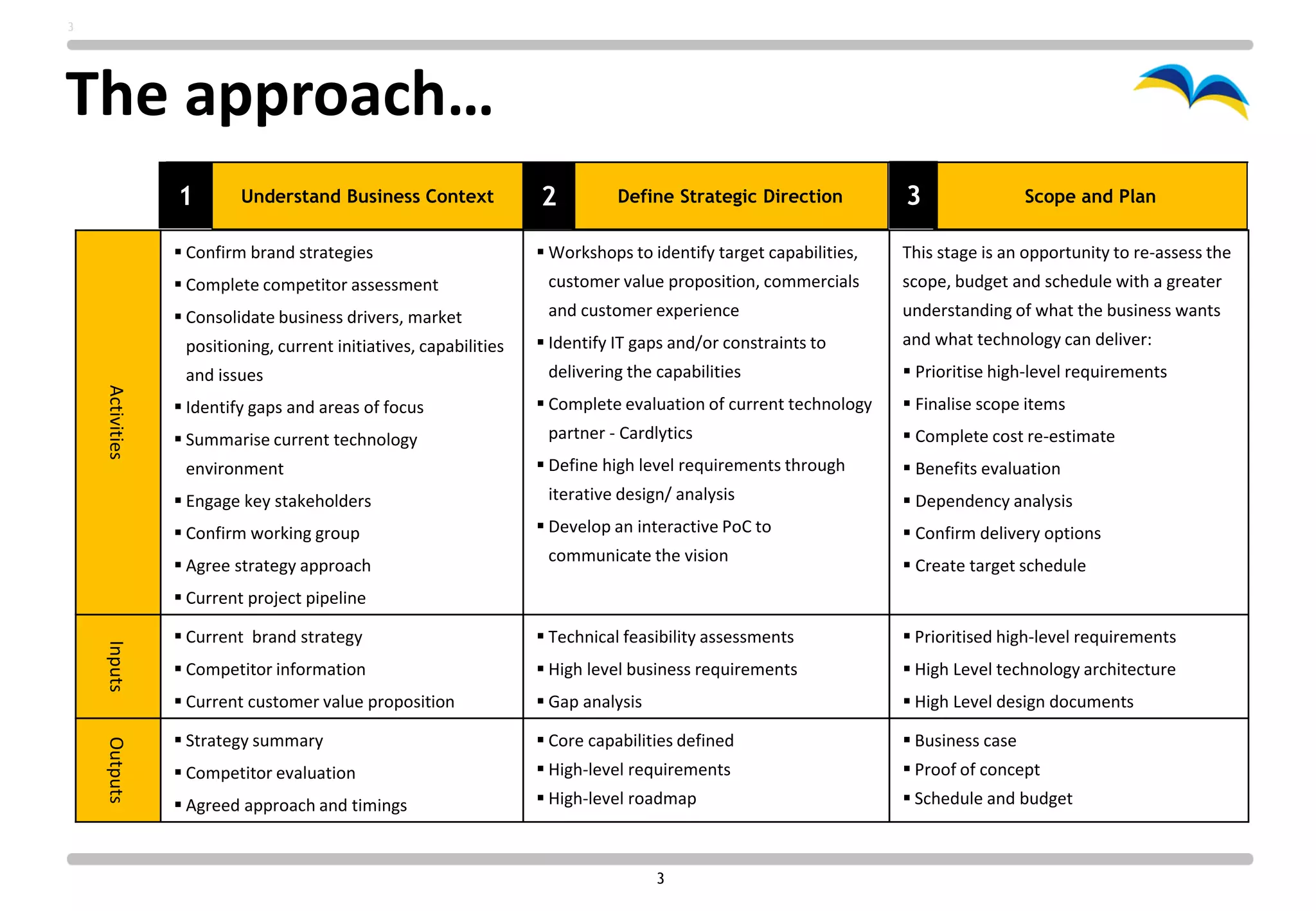
The approach…
                 1        Understand Business Context              2          Define Strategic Direction          3                 Scope and Plan

                  Confirm brand strategies                         Workshops to identify target capabilities,   This stage is an opportunity to re-assess the
                  Complete competitor assessment                   customer value proposition, commercials       scope, budget and schedule with a greater
                  Consolidate business drivers, market             and customer experience                       understanding of what the business wants
                  positioning, current initiatives, capabilities    Identify IT gaps and/or constraints to       and what technology can deliver:
                  and issues                                        delivering the capabilities                    Prioritise high-level requirements
    Activities


                  Identify gaps and areas of focus                 Complete evaluation of current technology     Finalise scope items
                  Summarise current technology                     partner - Cardlytics                           Complete cost re-estimate
                  environment                                       Define high level requirements through        Benefits evaluation
                  Engage key stakeholders                          iterative design/ analysis                     Dependency analysis
                  Confirm working group                            Develop an interactive PoC to                 Confirm delivery options
                                                                    communicate the vision
                  Agree strategy approach                                                                         Create target schedule
                  Current project pipeline

                  Current brand strategy                           Technical feasibility assessments             Prioritised high-level requirements
    Inputs


                  Competitor information                           High level business requirements              High Level technology architecture
                  Current customer value proposition               Gap analysis                                  High Level design documents

                  Strategy summary                                 Core capabilities defined                     Business case
    Outputs


                  Competitor evaluation                            High-level requirements                       Proof of concept
                  Agreed approach and timings                      High-level roadmap                            Schedule and budget


                                                                                    3
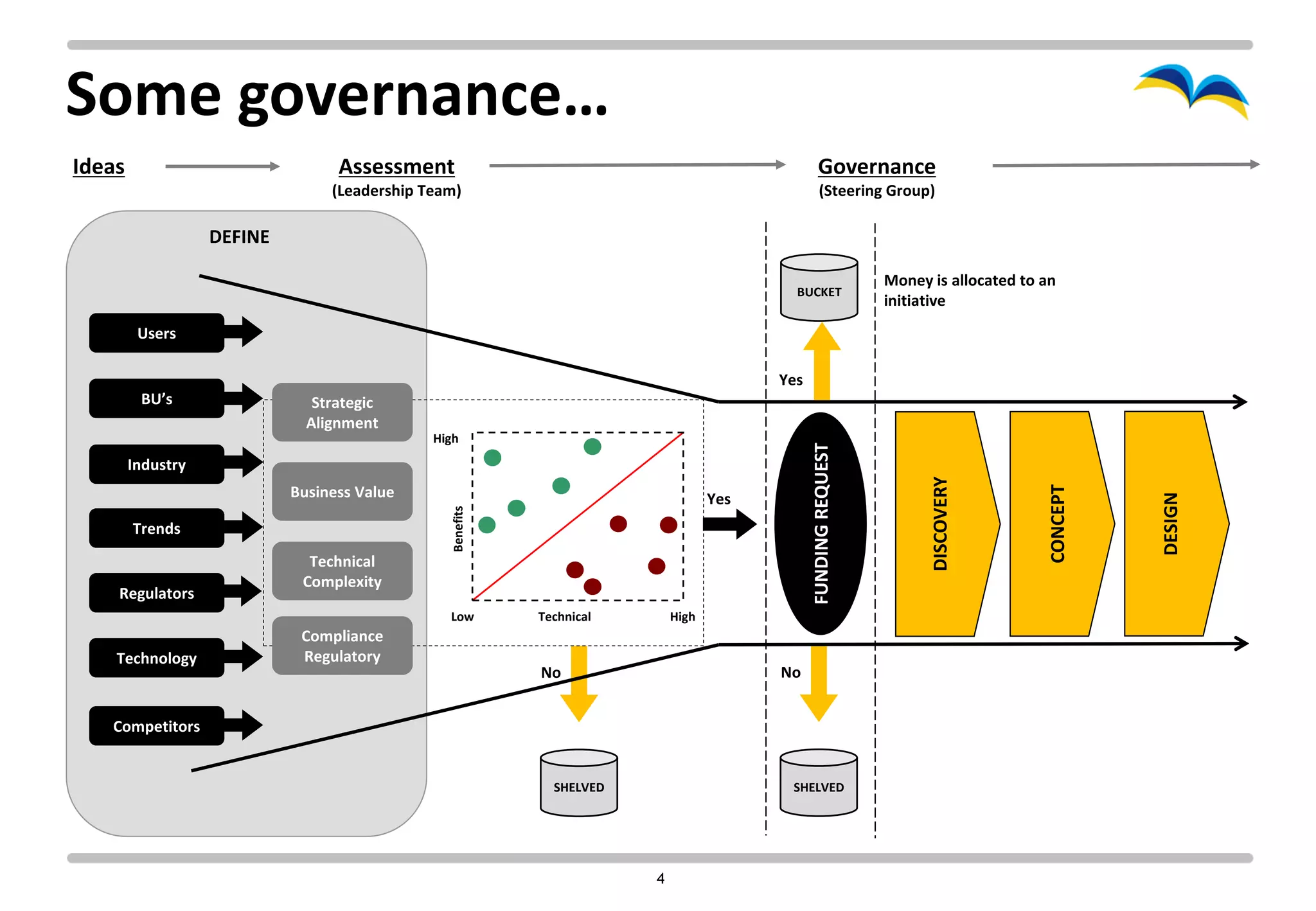
Some governance…
Ideas                             Assessment                                                      Governance
                                 (Leadership Team)                                                (Steering Group)

                   DEFINE

                                                                                                                Money is allocated to an
                                                                                          BUCKET
                                                                                                                initiative
         Users

                                                                                        Yes
         BU’s                  Strategic
                              Alignment
                                              High


                                                                                              FUNDING REQUEST
        Industry


                                                                                                                      DISCOVERY


                                                                                                                                       CONCEPT
                            Business Value                                        Yes


                                                                                                                                                 DESIGN
                                                Benefits


        Trends
                              Technical
                             Complexity
    Regulators
                                                Low        Technical       High
                             Compliance
    Technology               Regulatory
                                                           No                           No


   Competitors


                                                             SHELVED                     SHELVED


                                                                       4
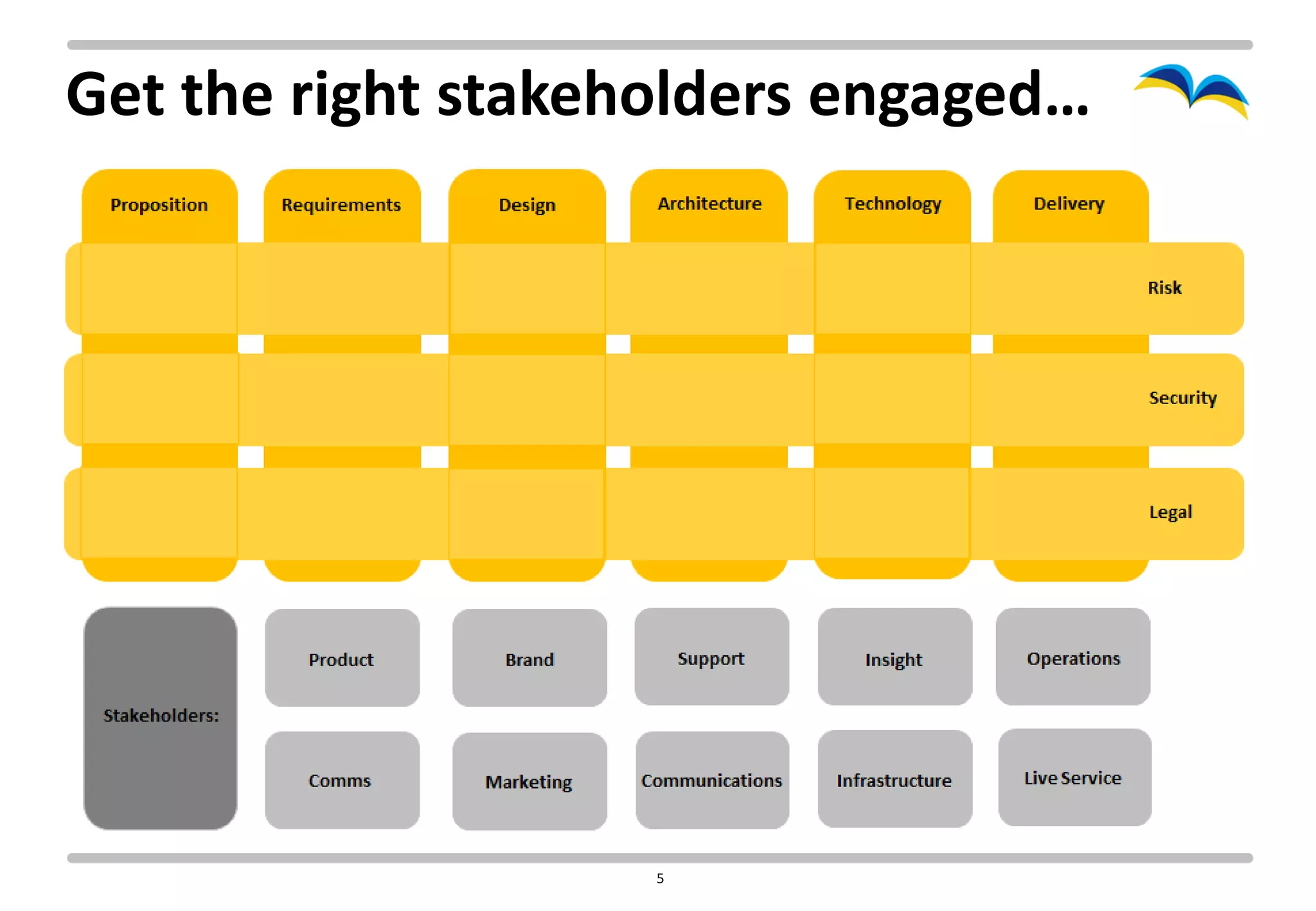
Get the right stakeholders engaged…


                    5
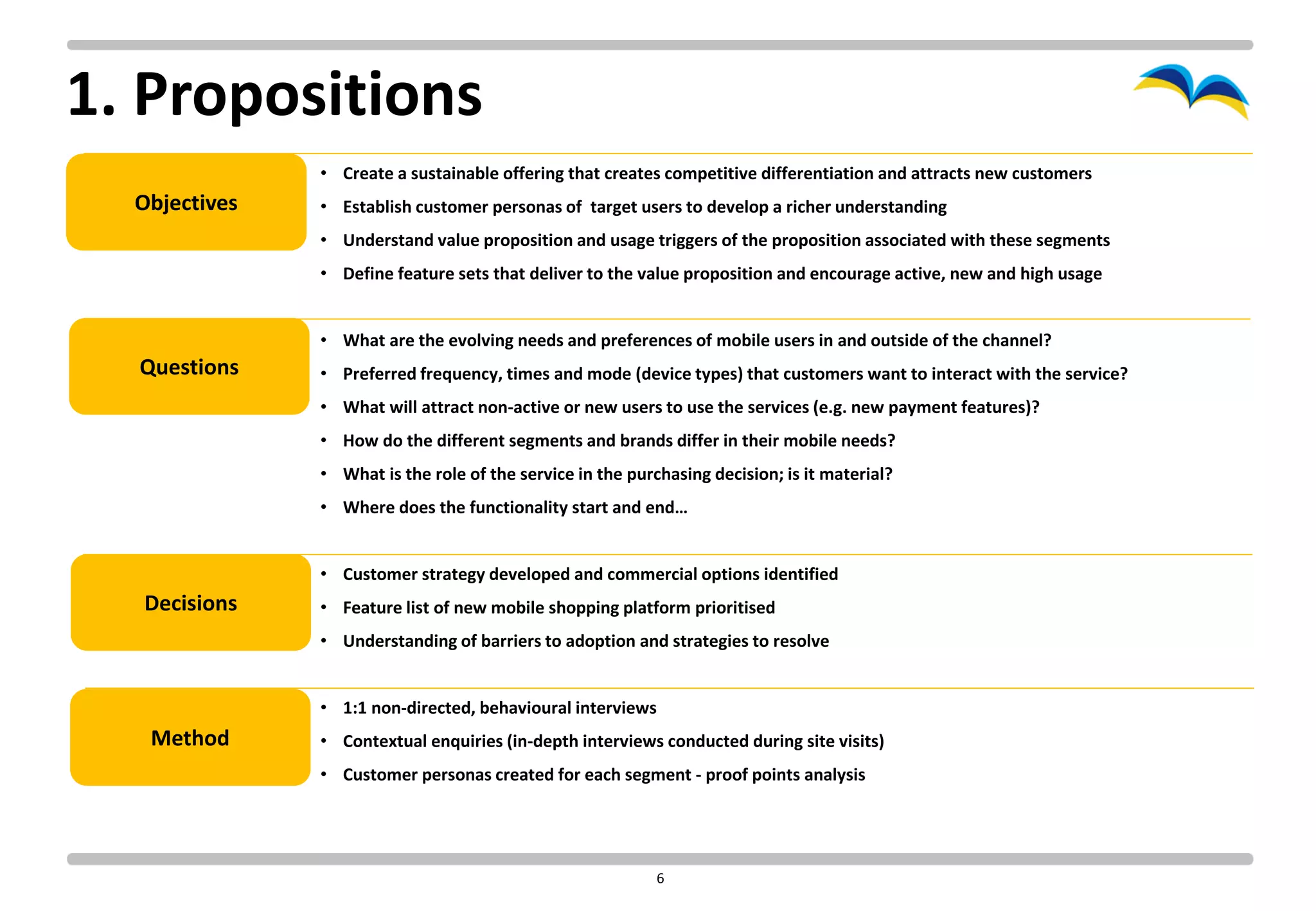
1. Propositions
               • Create a sustainable offering that creates competitive differentiation and attracts new customers
  Objectives   • Establish customer personas of target users to develop a richer understanding
               • Understand value proposition and usage triggers of the proposition associated with these segments
               • Define feature sets that deliver to the value proposition and encourage active, new and high usage


               • What are the evolving needs and preferences of mobile users in and outside of the channel?
  Questions    • Preferred frequency, times and mode (device types) that customers want to interact with the service?
               • What will attract non-active or new users to use the services (e.g. new payment features)?
               • How do the different segments and brands differ in their mobile needs?
               • What is the role of the service in the purchasing decision; is it material?
               • Where does the functionality start and end…


               • Customer strategy developed and commercial options identified
  Decisions    • Feature list of new mobile shopping platform prioritised
               • Understanding of barriers to adoption and strategies to resolve


               • 1:1 non-directed, behavioural interviews
   Method      • Contextual enquiries (in-depth interviews conducted during site visits)
               • Customer personas created for each segment - proof points analysis


                                                            6
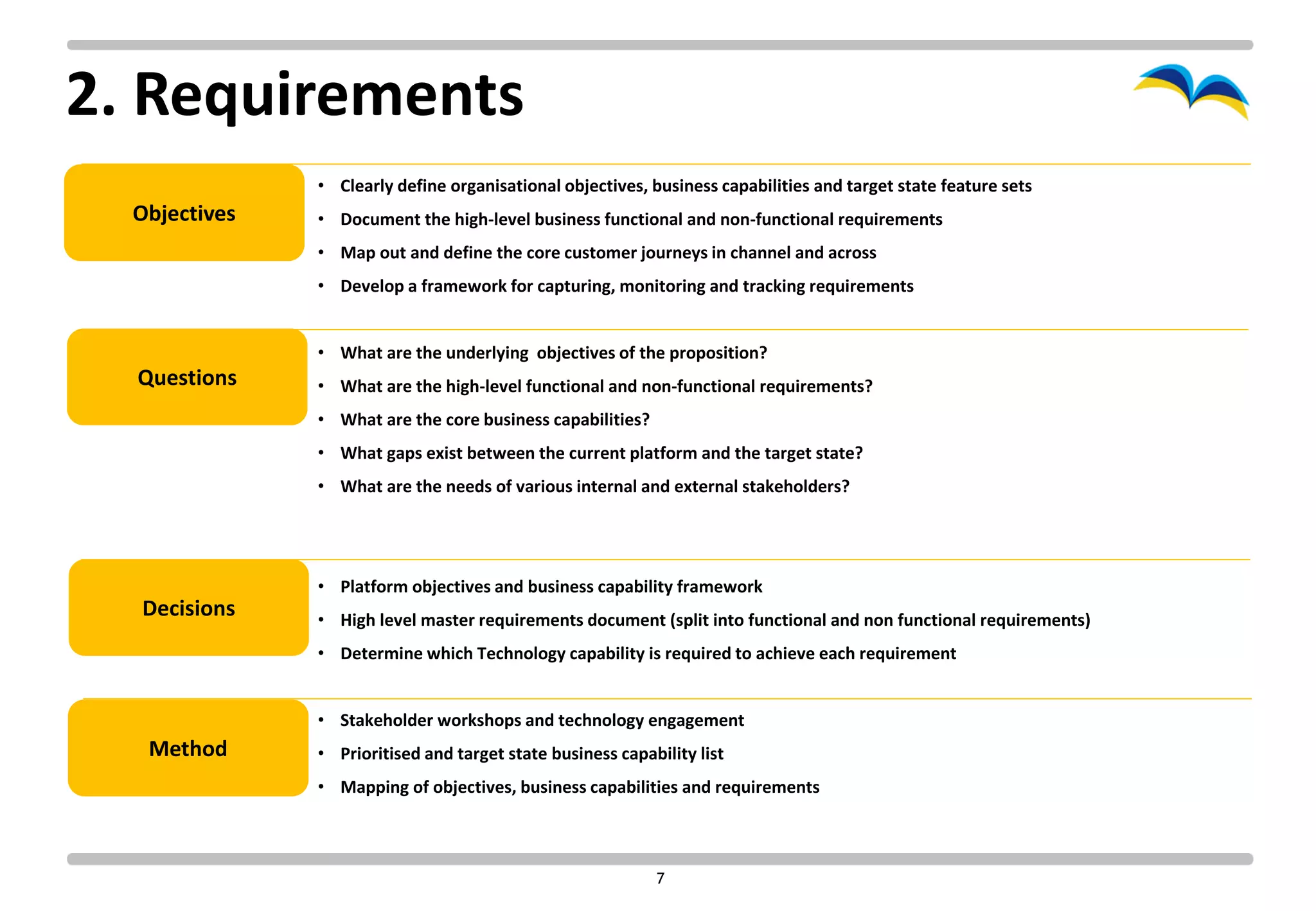
2. Requirements
               • Clearly define organisational objectives, business capabilities and target state feature sets
  Objectives   • Document the high-level business functional and non-functional requirements
               • Map out and define the core customer journeys in channel and across
               • Develop a framework for capturing, monitoring and tracking requirements


               • What are the underlying objectives of the proposition?
  Questions    • What are the high-level functional and non-functional requirements?
               • What are the core business capabilities?
               • What gaps exist between the current platform and the target state?
               • What are the needs of various internal and external stakeholders?


               • Platform objectives and business capability framework
  Decisions    • High level master requirements document (split into functional and non functional requirements)
               • Determine which Technology capability is required to achieve each requirement


               • Stakeholder workshops and technology engagement
   Method      • Prioritised and target state business capability list
               • Mapping of objectives, business capabilities and requirements


                                                            7
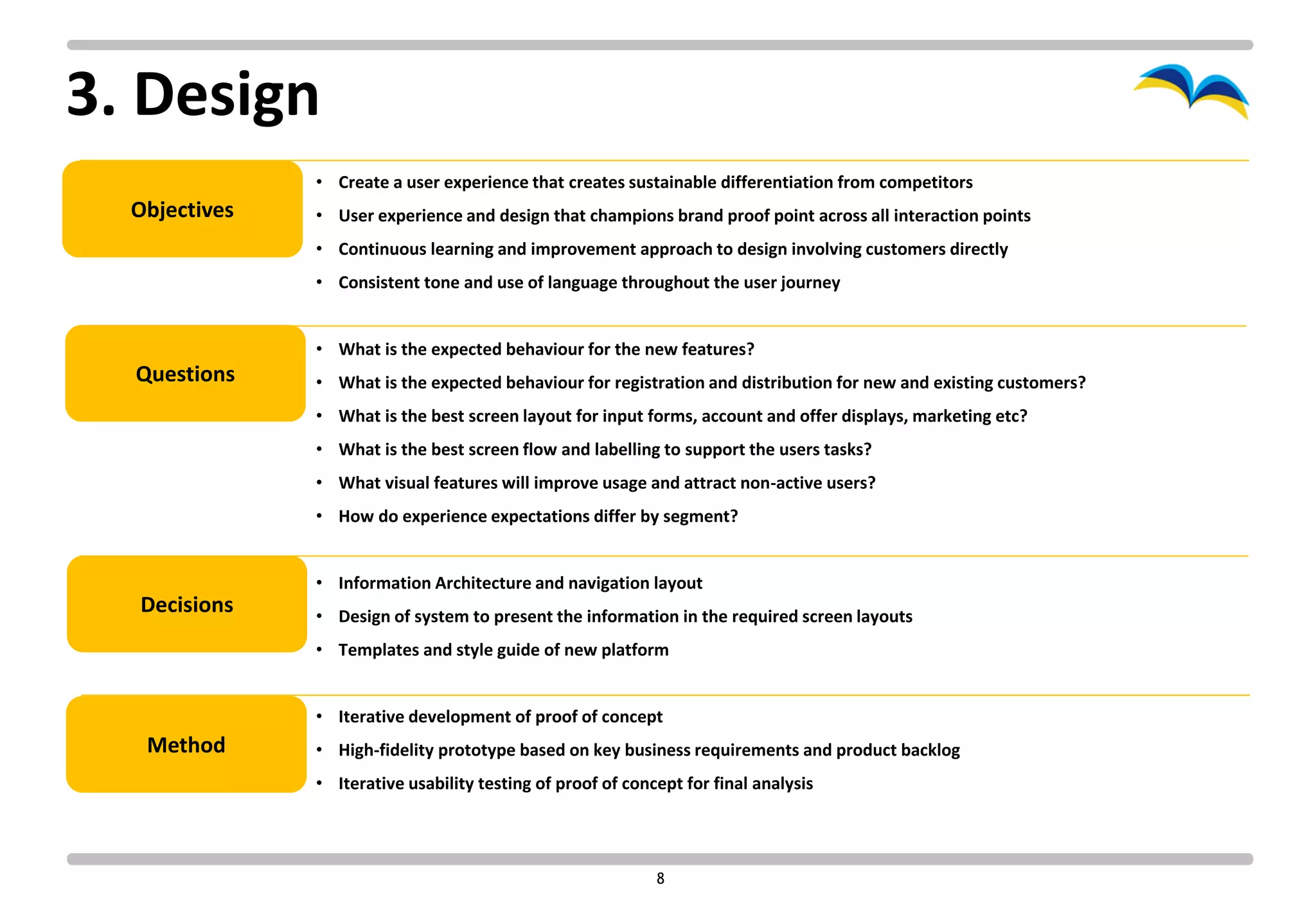
3. Design
               • Create a user experience that creates sustainable differentiation from competitors
  Objectives   • User experience and design that champions brand proof point across all interaction points
               • Continuous learning and improvement approach to design involving customers directly
               • Consistent tone and use of language throughout the user journey


               • What is the expected behaviour for the new features?
  Questions    • What is the expected behaviour for registration and distribution for new and existing customers?
               • What is the best screen layout for input forms, account and offer displays, marketing etc?
               • What is the best screen flow and labelling to support the users tasks?
               • What visual features will improve usage and attract non-active users?
               • How do experience expectations differ by segment?


               • Information Architecture and navigation layout
  Decisions    • Design of system to present the information in the required screen layouts
               • Templates and style guide of new platform


               • Iterative development of proof of concept
   Method      • High-fidelity prototype based on key business requirements and product backlog
               • Iterative usability testing of proof of concept for final analysis


                                                             8
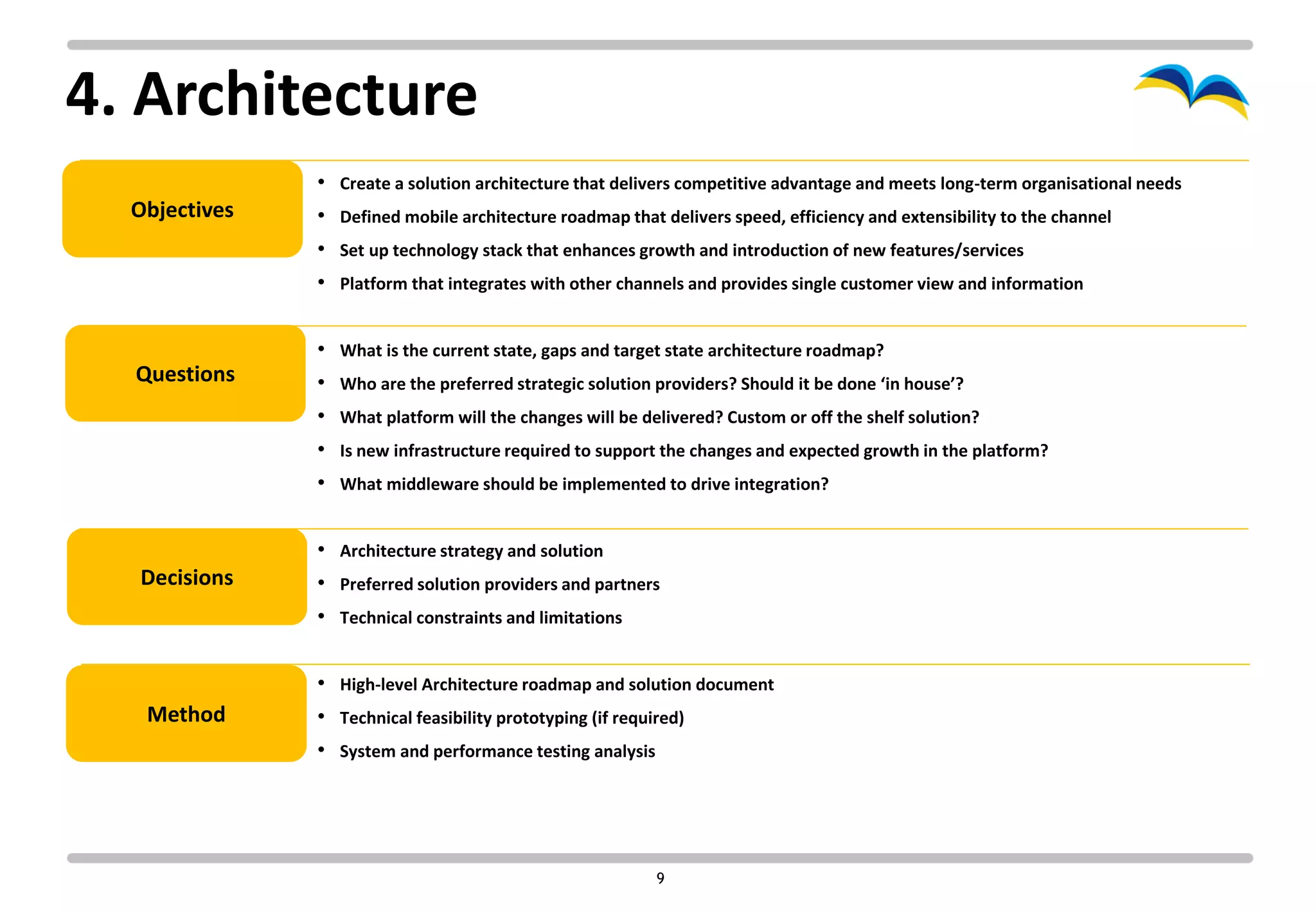
4. Architecture
               • Create a solution architecture that delivers competitive advantage and meets long-term organisational needs
  Objectives   • Defined mobile architecture roadmap that delivers speed, efficiency and extensibility to the channel
               • Set up technology stack that enhances growth and introduction of new features/services
               • Platform that integrates with other channels and provides single customer view and information

               • What is the current state, gaps and target state architecture roadmap?
  Questions    • Who are the preferred strategic solution providers? Should it be done ‘in house’?
               • What platform will the changes will be delivered? Custom or off the shelf solution?
               • Is new infrastructure required to support the changes and expected growth in the platform?
               • What middleware should be implemented to drive integration?


               • Architecture strategy and solution
  Decisions    • Preferred solution providers and partners
               • Technical constraints and limitations

               • High-level Architecture roadmap and solution document
   Method      • Technical feasibility prototyping (if required)
               • System and performance testing analysis


                                                          9
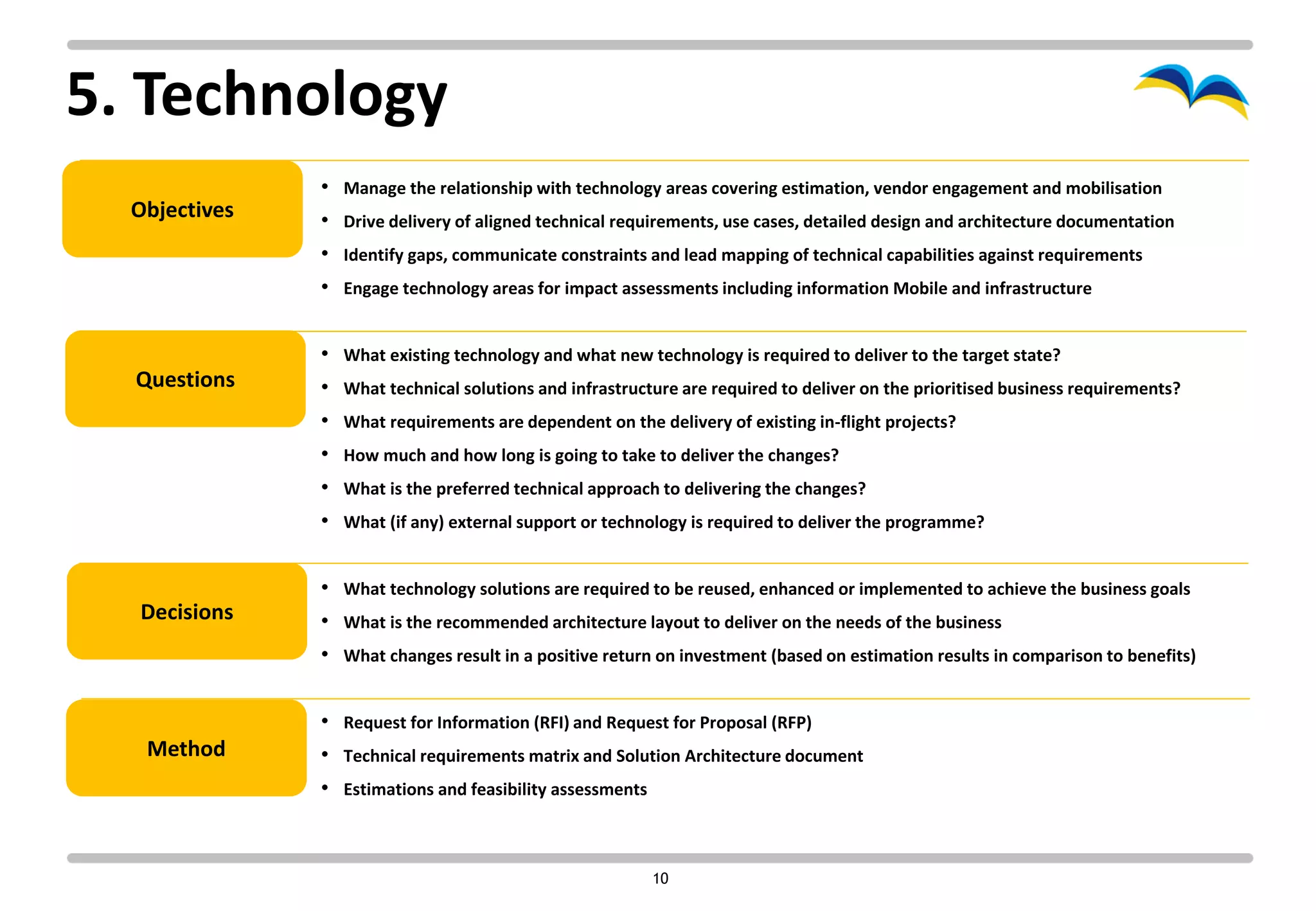
5. Technology
               •   Manage the relationship with technology areas covering estimation, vendor engagement and mobilisation
  Objectives   •   Drive delivery of aligned technical requirements, use cases, detailed design and architecture documentation
               •   Identify gaps, communicate constraints and lead mapping of technical capabilities against requirements
               •   Engage technology areas for impact assessments including information Mobile and infrastructure


               •   What existing technology and what new technology is required to deliver to the target state?
  Questions    •   What technical solutions and infrastructure are required to deliver on the prioritised business requirements?
               •   What requirements are dependent on the delivery of existing in-flight projects?
               •   How much and how long is going to take to deliver the changes?
               •   What is the preferred technical approach to delivering the changes?
               •   What (if any) external support or technology is required to deliver the programme?


               • What technology solutions are required to be reused, enhanced or implemented to achieve the business goals
  Decisions    • What is the recommended architecture layout to deliver on the needs of the business
               • What changes result in a positive return on investment (based on estimation results in comparison to benefits)


               • Request for Information (RFI) and Request for Proposal (RFP)
   Method      • Technical requirements matrix and Solution Architecture document
               • Estimations and feasibility assessments


                                                           10
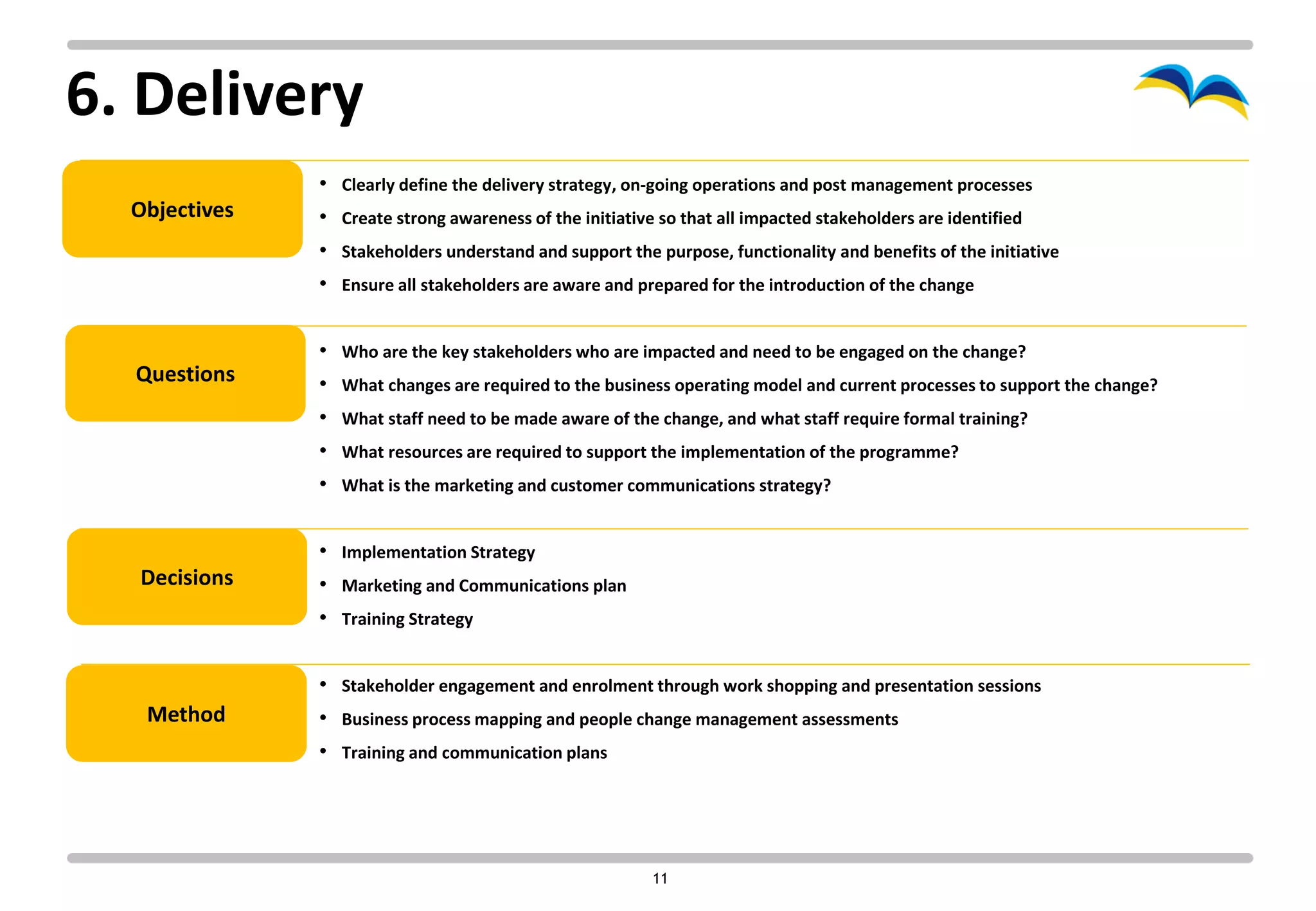
6. Delivery
               • Clearly define the delivery strategy, on-going operations and post management processes
  Objectives   • Create strong awareness of the initiative so that all impacted stakeholders are identified
               • Stakeholders understand and support the purpose, functionality and benefits of the initiative
               • Ensure all stakeholders are aware and prepared for the introduction of the change


               • Who are the key stakeholders who are impacted and need to be engaged on the change?
  Questions    •   What changes are required to the business operating model and current processes to support the change?
               •   What staff need to be made aware of the change, and what staff require formal training?
               •   What resources are required to support the implementation of the programme?
               •   What is the marketing and customer communications strategy?


               • Implementation Strategy
  Decisions    • Marketing and Communications plan
               • Training Strategy


               • Stakeholder engagement and enrolment through work shopping and presentation sessions
   Method      • Business process mapping and people change management assessments
               • Training and communication plans


                                                          11
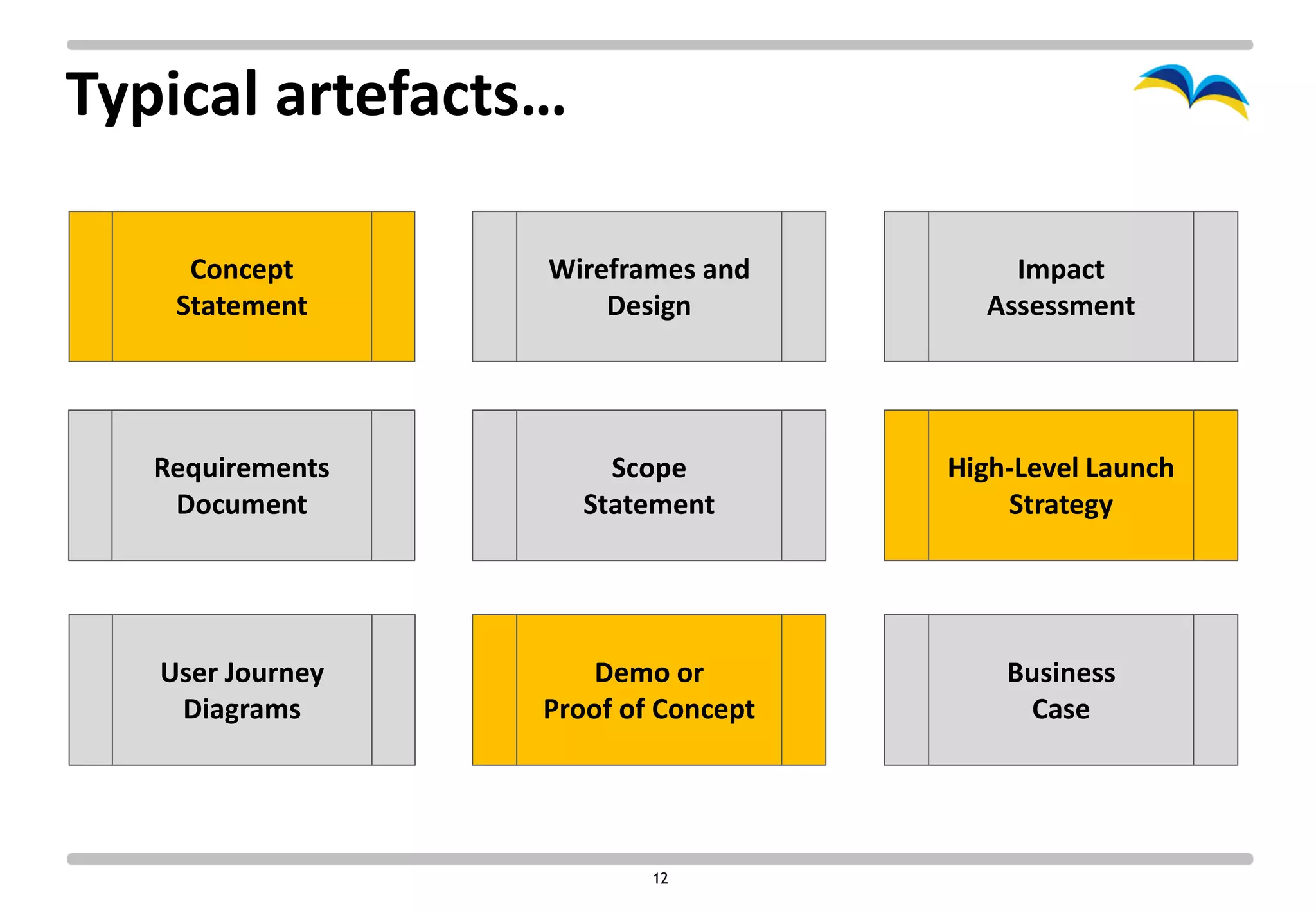
Typical artefacts…

     Concept      Wireframes and         Impact
    Statement         Design           Assessment


   Requirements        Scope         High-Level Launch
    Document         Statement           Strategy


   User Journey       Demo or            Business
    Diagrams      Proof of Concept        Case


                          12
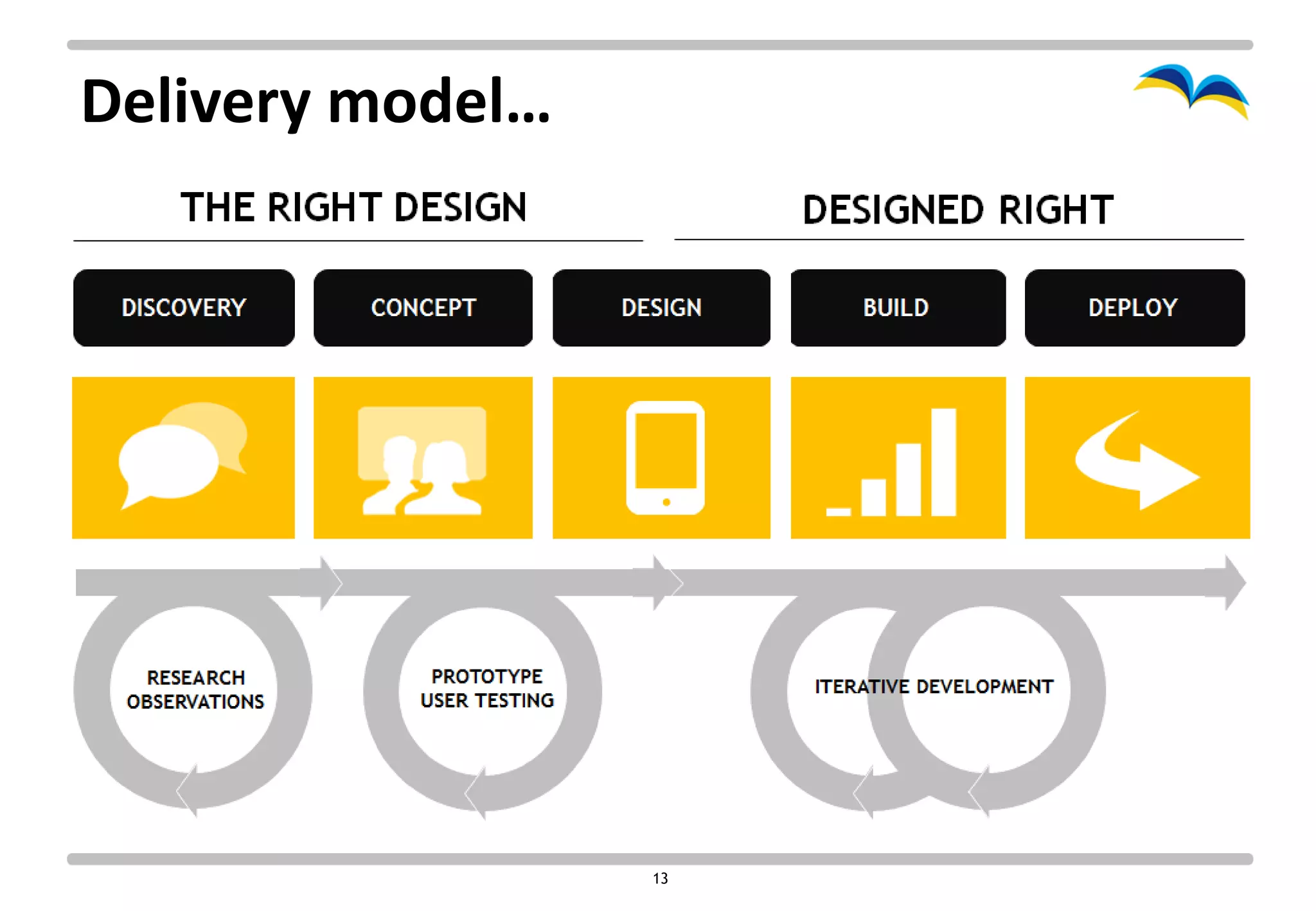
Delivery model…


                  13
Go Agile…


            As a [user]
            I want [what]
            So I can [benefit]


                                 14
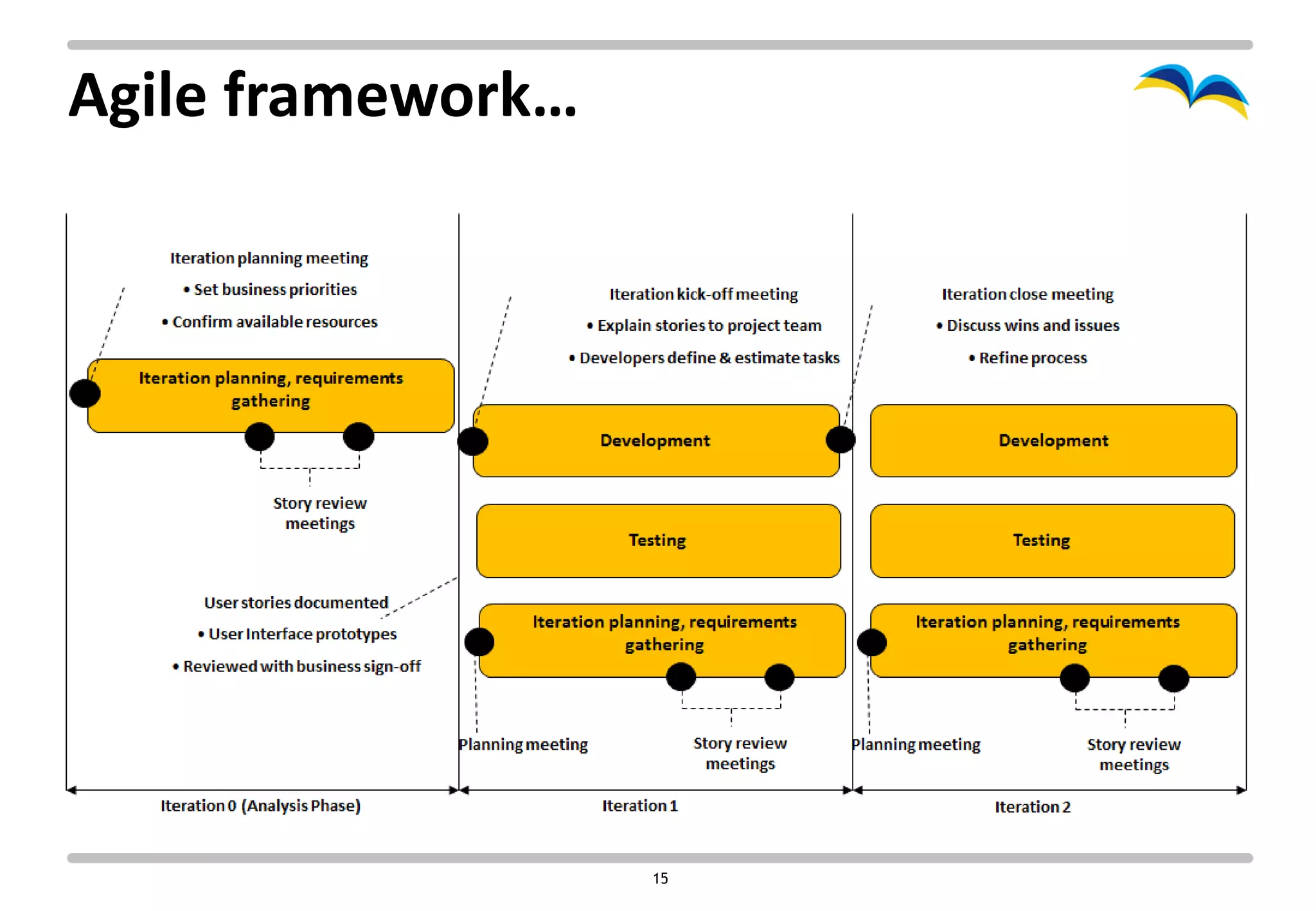
Agile framework…


                   15
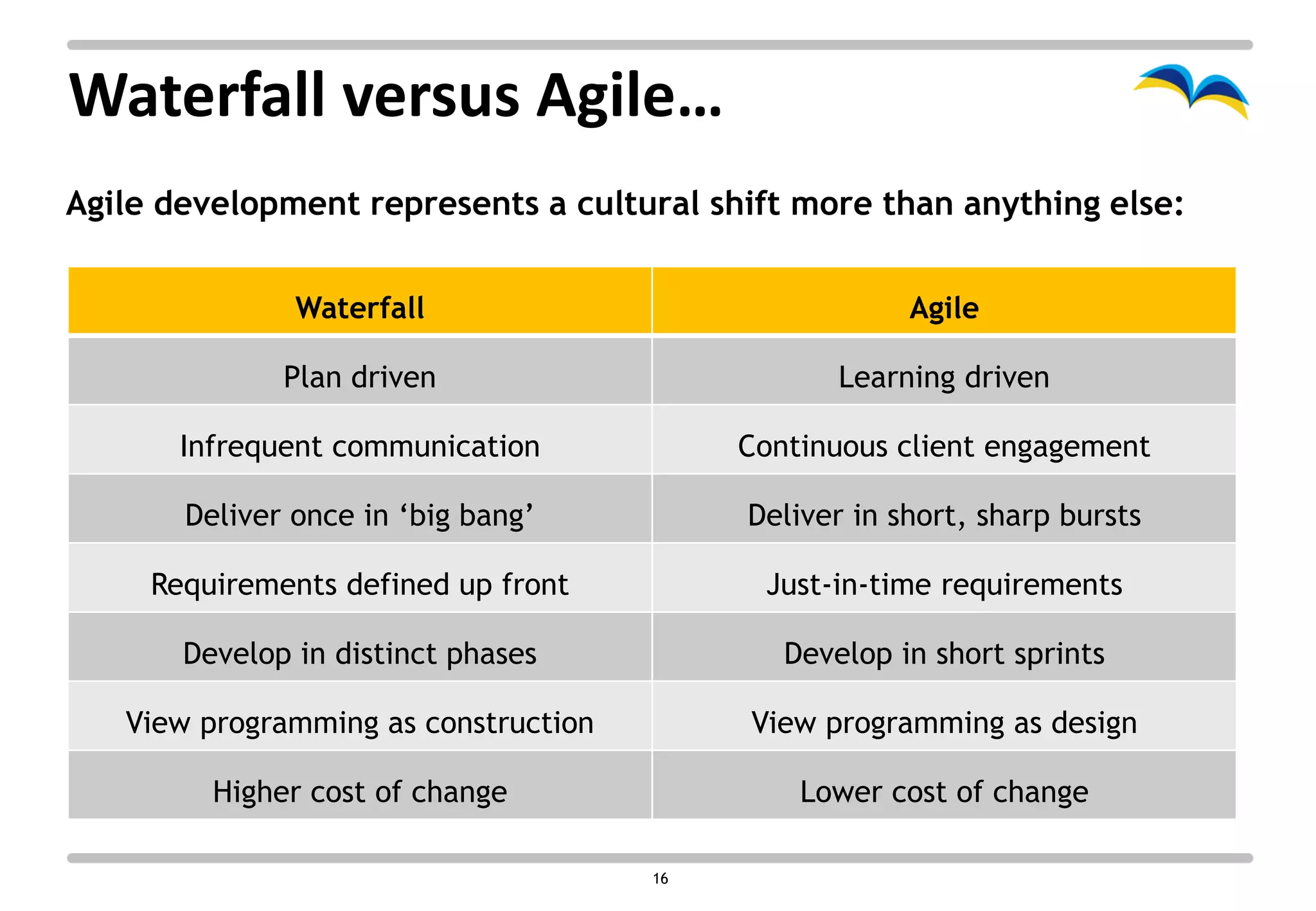
Waterfall versus Agile…
Agile development represents a cultural shift more than anything else:


               Waterfall                               Agile

              Plan driven                         Learning driven

       Infrequent communication            Continuous client engagement

       Deliver once in ‘big bang’          Deliver in short, sharp bursts

     Requirements defined up front          Just-in-time requirements

       Develop in distinct phases             Develop in short sprints

   View programming as construction        View programming as design

         Higher cost of change                 Lower cost of change

                                      16
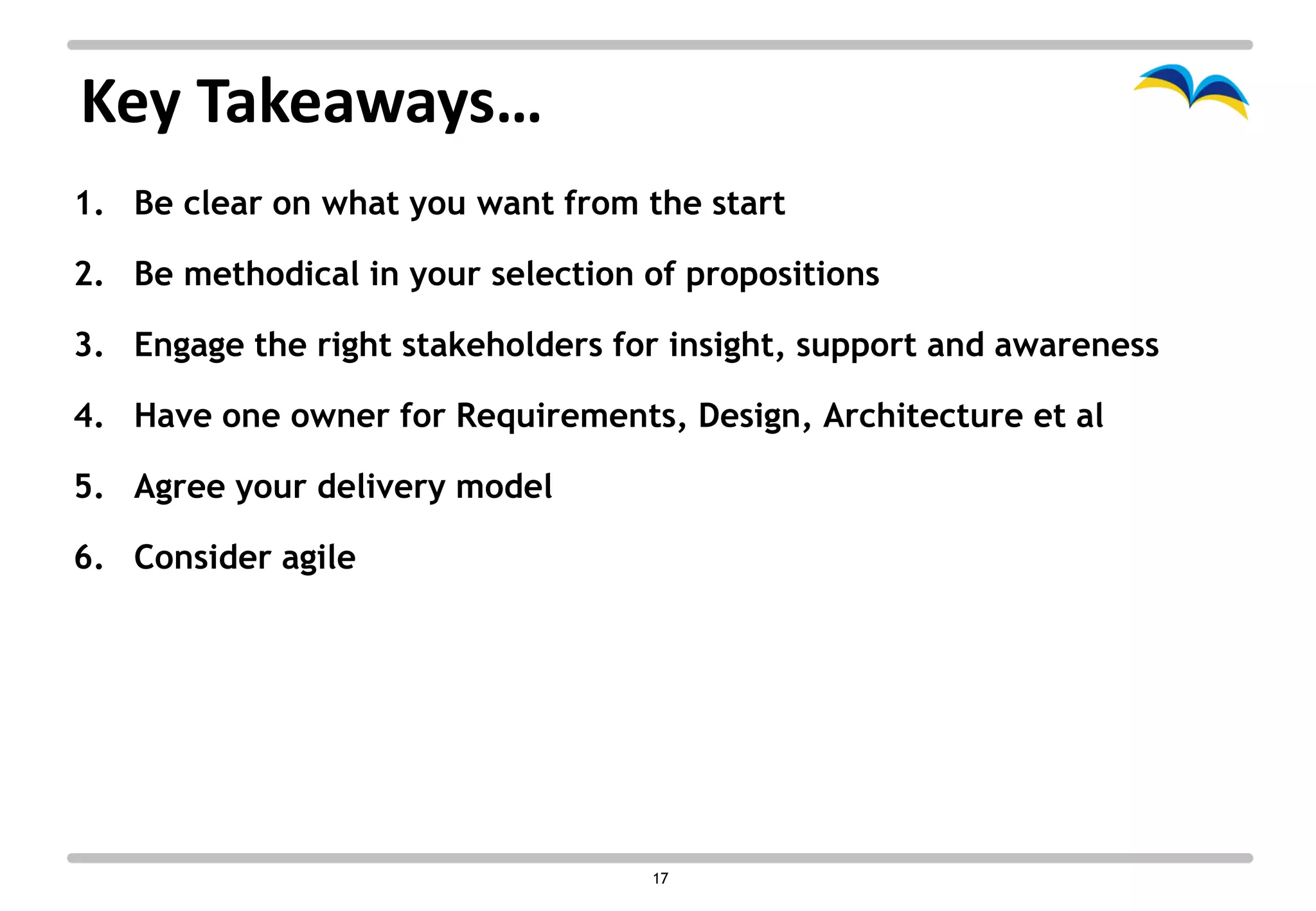
Key Takeaways…
1. Be clear on what you want from the start

2. Be methodical in your selection of propositions

3. Engage the right stakeholders for insight, support and awareness

4. Have one owner for Requirements, Design, Architecture et al

5. Agree your delivery model

6. Consider agile


                                   17

6. From defined proposition to delivery

  • 1.
    Developing a MobileProposition Section 6: From defined proposition to delivery MICHAEL NUCIFORO Mobile Consultant, Innovator and Futurist
  • 2.
    Section 6 –15:10 to 15:40 From defined proposition to delivery • What information needs to be documented before initiating design and build • Identifying the stakeholders and their responsibilities • Communicating requirements with technical teams: what do they need to know? • Matching business and user needs with technical capabilities Next: Refreshments 2
  • 3.
    3 The approach… 1 Understand Business Context 2 Define Strategic Direction 3 Scope and Plan  Confirm brand strategies  Workshops to identify target capabilities, This stage is an opportunity to re-assess the  Complete competitor assessment customer value proposition, commercials scope, budget and schedule with a greater  Consolidate business drivers, market and customer experience understanding of what the business wants positioning, current initiatives, capabilities  Identify IT gaps and/or constraints to and what technology can deliver: and issues delivering the capabilities  Prioritise high-level requirements Activities  Identify gaps and areas of focus  Complete evaluation of current technology  Finalise scope items  Summarise current technology partner - Cardlytics  Complete cost re-estimate environment  Define high level requirements through  Benefits evaluation  Engage key stakeholders iterative design/ analysis  Dependency analysis  Confirm working group  Develop an interactive PoC to  Confirm delivery options communicate the vision  Agree strategy approach  Create target schedule  Current project pipeline  Current brand strategy  Technical feasibility assessments  Prioritised high-level requirements Inputs  Competitor information  High level business requirements  High Level technology architecture  Current customer value proposition  Gap analysis  High Level design documents  Strategy summary  Core capabilities defined  Business case Outputs  Competitor evaluation  High-level requirements  Proof of concept  Agreed approach and timings  High-level roadmap  Schedule and budget 3
  • 4.
    Some governance… Ideas Assessment Governance (Leadership Team) (Steering Group) DEFINE Money is allocated to an BUCKET initiative Users Yes BU’s Strategic Alignment High FUNDING REQUEST Industry DISCOVERY CONCEPT Business Value Yes DESIGN Benefits Trends Technical Complexity Regulators Low Technical High Compliance Technology Regulatory No No Competitors SHELVED SHELVED 4
  • 5.
    Get the rightstakeholders engaged… 5
  • 6.
    1. Propositions • Create a sustainable offering that creates competitive differentiation and attracts new customers Objectives • Establish customer personas of target users to develop a richer understanding • Understand value proposition and usage triggers of the proposition associated with these segments • Define feature sets that deliver to the value proposition and encourage active, new and high usage • What are the evolving needs and preferences of mobile users in and outside of the channel? Questions • Preferred frequency, times and mode (device types) that customers want to interact with the service? • What will attract non-active or new users to use the services (e.g. new payment features)? • How do the different segments and brands differ in their mobile needs? • What is the role of the service in the purchasing decision; is it material? • Where does the functionality start and end… • Customer strategy developed and commercial options identified Decisions • Feature list of new mobile shopping platform prioritised • Understanding of barriers to adoption and strategies to resolve • 1:1 non-directed, behavioural interviews Method • Contextual enquiries (in-depth interviews conducted during site visits) • Customer personas created for each segment - proof points analysis 6
  • 7.
    2. Requirements • Clearly define organisational objectives, business capabilities and target state feature sets Objectives • Document the high-level business functional and non-functional requirements • Map out and define the core customer journeys in channel and across • Develop a framework for capturing, monitoring and tracking requirements • What are the underlying objectives of the proposition? Questions • What are the high-level functional and non-functional requirements? • What are the core business capabilities? • What gaps exist between the current platform and the target state? • What are the needs of various internal and external stakeholders? • Platform objectives and business capability framework Decisions • High level master requirements document (split into functional and non functional requirements) • Determine which Technology capability is required to achieve each requirement • Stakeholder workshops and technology engagement Method • Prioritised and target state business capability list • Mapping of objectives, business capabilities and requirements 7
  • 8.
    3. Design • Create a user experience that creates sustainable differentiation from competitors Objectives • User experience and design that champions brand proof point across all interaction points • Continuous learning and improvement approach to design involving customers directly • Consistent tone and use of language throughout the user journey • What is the expected behaviour for the new features? Questions • What is the expected behaviour for registration and distribution for new and existing customers? • What is the best screen layout for input forms, account and offer displays, marketing etc? • What is the best screen flow and labelling to support the users tasks? • What visual features will improve usage and attract non-active users? • How do experience expectations differ by segment? • Information Architecture and navigation layout Decisions • Design of system to present the information in the required screen layouts • Templates and style guide of new platform • Iterative development of proof of concept Method • High-fidelity prototype based on key business requirements and product backlog • Iterative usability testing of proof of concept for final analysis 8
  • 9.
    4. Architecture • Create a solution architecture that delivers competitive advantage and meets long-term organisational needs Objectives • Defined mobile architecture roadmap that delivers speed, efficiency and extensibility to the channel • Set up technology stack that enhances growth and introduction of new features/services • Platform that integrates with other channels and provides single customer view and information • What is the current state, gaps and target state architecture roadmap? Questions • Who are the preferred strategic solution providers? Should it be done ‘in house’? • What platform will the changes will be delivered? Custom or off the shelf solution? • Is new infrastructure required to support the changes and expected growth in the platform? • What middleware should be implemented to drive integration? • Architecture strategy and solution Decisions • Preferred solution providers and partners • Technical constraints and limitations • High-level Architecture roadmap and solution document Method • Technical feasibility prototyping (if required) • System and performance testing analysis 9
  • 10.
    5. Technology • Manage the relationship with technology areas covering estimation, vendor engagement and mobilisation Objectives • Drive delivery of aligned technical requirements, use cases, detailed design and architecture documentation • Identify gaps, communicate constraints and lead mapping of technical capabilities against requirements • Engage technology areas for impact assessments including information Mobile and infrastructure • What existing technology and what new technology is required to deliver to the target state? Questions • What technical solutions and infrastructure are required to deliver on the prioritised business requirements? • What requirements are dependent on the delivery of existing in-flight projects? • How much and how long is going to take to deliver the changes? • What is the preferred technical approach to delivering the changes? • What (if any) external support or technology is required to deliver the programme? • What technology solutions are required to be reused, enhanced or implemented to achieve the business goals Decisions • What is the recommended architecture layout to deliver on the needs of the business • What changes result in a positive return on investment (based on estimation results in comparison to benefits) • Request for Information (RFI) and Request for Proposal (RFP) Method • Technical requirements matrix and Solution Architecture document • Estimations and feasibility assessments 10
  • 11.
    6. Delivery • Clearly define the delivery strategy, on-going operations and post management processes Objectives • Create strong awareness of the initiative so that all impacted stakeholders are identified • Stakeholders understand and support the purpose, functionality and benefits of the initiative • Ensure all stakeholders are aware and prepared for the introduction of the change • Who are the key stakeholders who are impacted and need to be engaged on the change? Questions • What changes are required to the business operating model and current processes to support the change? • What staff need to be made aware of the change, and what staff require formal training? • What resources are required to support the implementation of the programme? • What is the marketing and customer communications strategy? • Implementation Strategy Decisions • Marketing and Communications plan • Training Strategy • Stakeholder engagement and enrolment through work shopping and presentation sessions Method • Business process mapping and people change management assessments • Training and communication plans 11
  • 12.
    Typical artefacts… Concept Wireframes and Impact Statement Design Assessment Requirements Scope High-Level Launch Document Statement Strategy User Journey Demo or Business Diagrams Proof of Concept Case 12
  • 13.
  • 14.
    Go Agile… As a [user] I want [what] So I can [benefit] 14
  • 15.
  • 16.
    Waterfall versus Agile… Agiledevelopment represents a cultural shift more than anything else: Waterfall Agile Plan driven Learning driven Infrequent communication Continuous client engagement Deliver once in ‘big bang’ Deliver in short, sharp bursts Requirements defined up front Just-in-time requirements Develop in distinct phases Develop in short sprints View programming as construction View programming as design Higher cost of change Lower cost of change 16
  • 17.
    Key Takeaways… 1. Beclear on what you want from the start 2. Be methodical in your selection of propositions 3. Engage the right stakeholders for insight, support and awareness 4. Have one owner for Requirements, Design, Architecture et al 5. Agree your delivery model 6. Consider agile 17