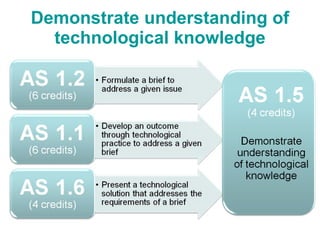
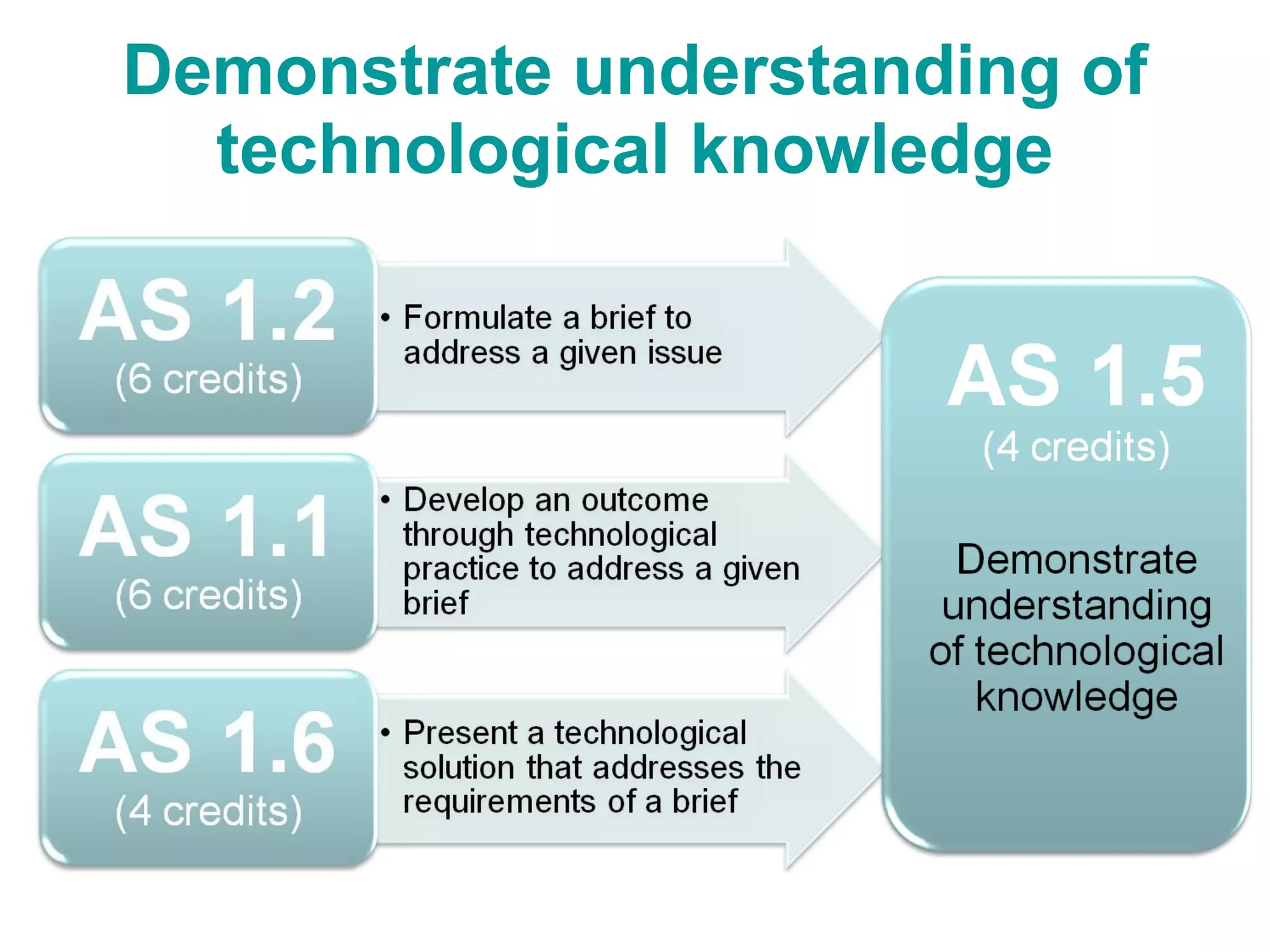
Demonstrate understanding of technological knowledge
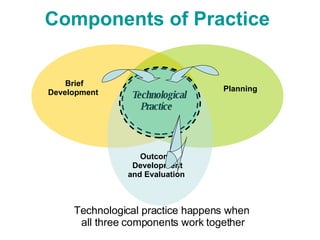
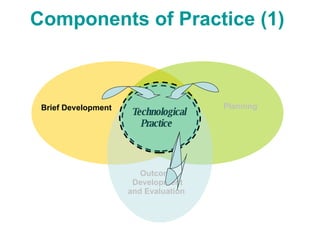
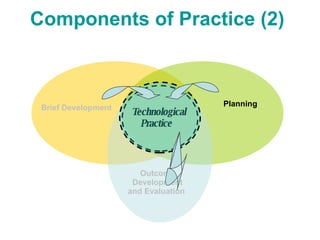
Brief Development   Outcome Development and Evaluation   Technological practice happens when  all three components work together Technological Practice   Components of Practice   Planning
Journal (ongoing evaluation) You will be continually evaluating your ideas as you work through the process, and may need to make changes to: Plan of action / Timeline Design You must keep a record of any changes made – we’ll keep a daily log of our progess.
Getting Started: understanding the problem getting organised  creating an  Initial Brief
Getting Started (1) Read through the Web Challenge Resource Kit information and create an  Inspiration   document to record all the points that will be relevant to your assignment.  This will help you to list the website specifications when you create your brief, so be thorough. Look at last year’s winners and record what you liked about them.
Getting Started (2) Create a  Technology Diary  to record your “technological journey” and assist your future planning. You must add to this on a regular basis. Make sure you record: What you did today Problems encountered & how you fixed them What else is affected (eg you may need to make changes to your initial timeline) What should happen next, and what is needed to do it. (This is important, as it helps keep you on track and may be used by examiners to clarify the process you have undertaken)
Getting Started (3): The Issue Show your understanding of the problem so far. Compose a broad statement outlining what the issue is:  NetGuide Web Challenge Subject – “What we’ve learned …”  referring to the NetGuide handout where necessary. Unit Standard 18735  Create a simple website to meet the specifications of a given brief (This will be used later in your  brief )
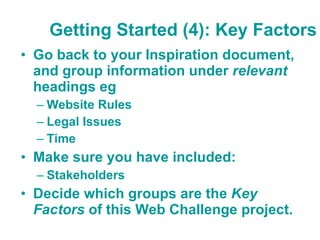
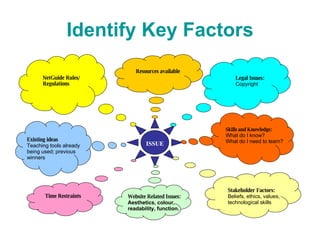
Getting Started (4): Key Factors Go back to your Inspiration document, and group information under  relevant  headings eg  Website Rules Legal Issues  Time Make sure you have included: Stakeholders Decide which groups are the  Key Factors  of this Web Challenge project.
Identify Key Factors ISSUE NetGuide Rules/ Regulations Legal Issues: Copyright Resources available Skills and Knowledge: What do I know? What do I need to learn? Website Related Issues:  Aesthetics, colour, readability, function. Existing ideas Teaching tools already being used; previous winners Time Restraints Stakeholder Factors: Beliefs, ethics, values, technological skills
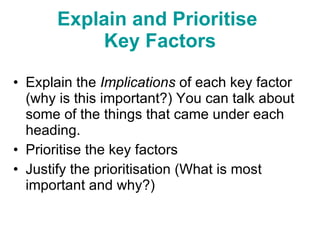
Explain the  Implications  of each key factor (why is this important?) You can talk about some of the things that came under each heading. Prioritise the key factors Justify the prioritisation (What is most important and why?) Explain and Prioritise  Key Factors
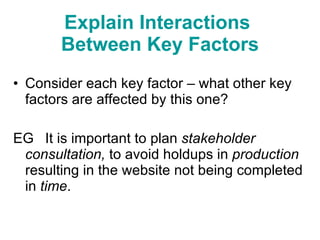
Consider each key factor – what other key factors are affected by this one?  EG  It is important to plan  stakeholder consultation,  to avoid holdups in  production  resulting in the website not being completed in  time .  Explain Interactions  Between Key Factors
Getting Started (5) Subjects Brainstorm the subjects you are studying, and possible topics within each subject.  Decide on at least four opportunities for further development Evaluate each option against the  Key Factors.  Decide on your subject/topic based on your evaluation AND justify your decision ie WHY did you choose that topic?
Brief Development  Outcome Development and Evaluation   Planning  Technological Practice   Components of Practice (1)
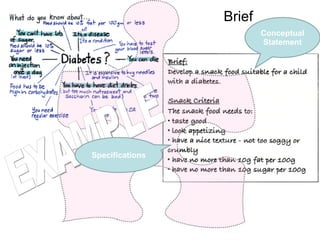
Brief Development Comprises of 2 components: Conceptual statement : a written description of what the product is used for who will be using the product where it will be used. Specifications : A list of  key requirements  (including  constraints )   that  can be used as a checklist of your progress will be used as a measure during the final evaluation.
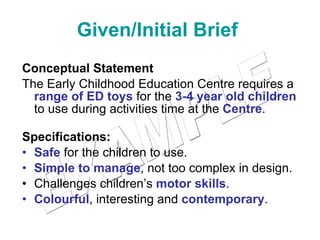
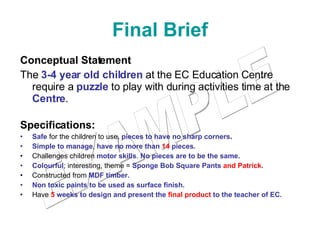
The Brief   Given brief  /  Issue  /  Situation   A broad outline of the problem to be solved.  Initial brief   Developed from the given brief or situation. The technologist (you) will  undertake in-depth research into the problem identify and consult stakeholder/s Identify key factors formulate information and research into a list of specifications Final brief   As the technological process is undertaken; modifications may be required to the initial brief. These could be due to a change in the stakeholders needs, material availability, skill levels etc.
Given/Initial Brief   Conceptual Statement The Early Childhood Education Centre requires a  range of ED toys  for the  3-4 year old children  to use during activities time at the  Centre .  Specifications: Safe  for the children to use. Simple to manage , not too complex in design. Challenges children’s  motor skills . Colourful , interesting and  contemporary . EXAMPLE
Final Brief Conceptual Statement The  3-4 year old children  at the EC Education Centre require a  puzzle  to play with during activities time at the  Centre .  Specifications: Safe  for the children to use,  pieces to have no sharp corners . Simple to manage ,  have no more than  14  pieces. Challenges children  motor skills .  No pieces are to be the same.   Colourful ; interesting, theme =  Sponge Bob Square Pants  and Patrick . Constructed from  MDF timber. Non toxic paints to be used as surface finish.  Have   5  weeks to design and present the  final product  to the teacher of EC. EXAMPLE
Brief Conceptual Statement EXAMPLE Specifications
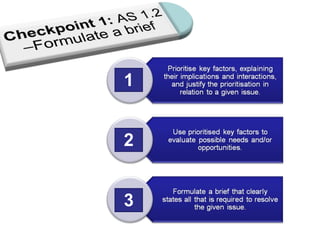
Create your  Initial Brief
1 2 3
Brief Development  Outcome Development and Evaluation   Planning  Technological Practice   Components of Practice (2)
Plan your Solution establish  key   milestones establish how  consultation with stakeholders  will be carried out
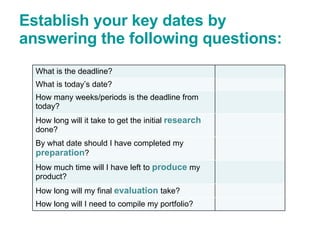
Establish your key dates by answering the following questions: What is the deadline? What is today’s date? How many weeks/periods is the deadline from today? How long will it take to get the initial  research   done? By what date should I have completed my  preparation ? How much time will I have left to  produce  my product? How long will my final  evaluation  take? How long will I need to compile my portfolio?
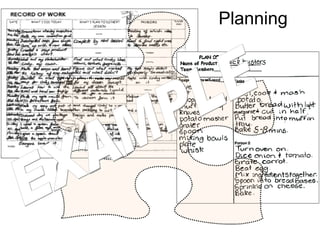
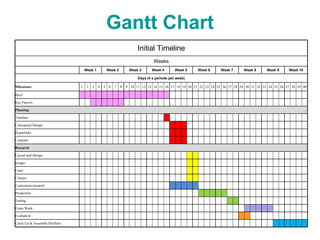
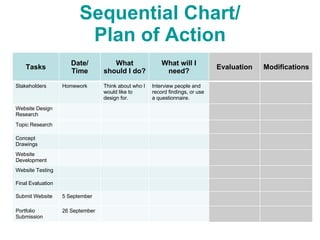
Planning the Process Planning tools may include: Plan of action Gantt charts Sequential Chart Flow Chart
Planning EXAMPLE
Gantt Chart Initial Timeline Weeks Week 1 Week 2 Week 3 Week 4 Week 5 Week 6 Week 7 Week 8 Week 9 Week 10 Days (4 x periods per week) Milestones 1 2 3 4 5 6 7 8 9 10 11 12 13 14 15 16 17 18 19 20 21 22 23 24 25 26 27 28 29 30 31 32 33 34 35 36 37 38 39 40 Brief Key Factors Planning  Timeline Conceptual Design                                                                                 Hyperlinks                                                                                 Contents                                                                                 Research  Layout and Design                                                                                 Images                                                                                 Fonts                                                                                 Colours                                                                                 Curriculum research  Production                                                                                 Testing                                                                                 Exam Week                                                                                  Evaluation Catch Up & Assemble Portfolio
Sequential Chart/ Plan of Action Tasks Date/ Time What should I do? What will I need? Evaluation Modifications Stakeholders Homework Think about who I would like to design for.  Interview people and record findings, or use a questionnaire.  Website Design Research Topic Research  Concept Drawings Website Development Website Testing Final Evaluation Submit Website 5 September Portfolio Submission 26 September
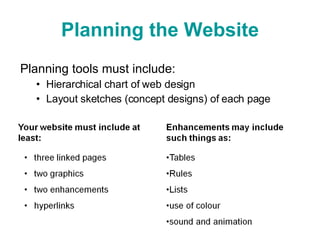
Planning the Website Planning tools must include: Hierarchical chart of web design Layout sketches (concept designs) of each page
Research Website Design Investigate the current trends in good web design. A good place to start is:  http://webdesignfromscratch.com/current-style.cfm
Create your Website!! Don’t Forget: Keep a record of stakeholder consultation Keep your journal up to date  What you have done What you need to do Change your Gantt Chart if necessary and reprint Change your Brief if necessary and reprint: Copy/paste original Emphasise the changes
1 2 3
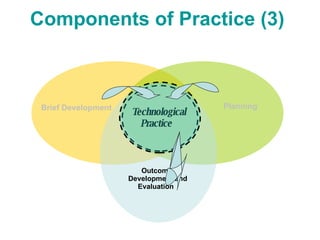
Brief Development  Outcome  Development and Evaluation   Planning  Technological Practice   Components of Practice (3)
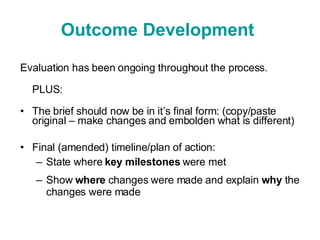
Outcome Development  Evaluation has been ongoing throughout the process. PLUS: The brief should now be in it’s final form: (copy/paste original – make changes and embolden what is different) Final (amended) timeline/plan of action: State where  key   milestones  were met Show  where  changes were made and explain  why  the changes were made
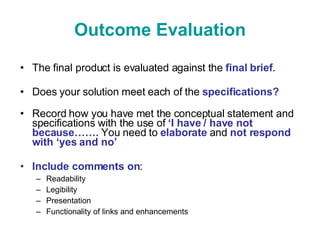
Outcome Evaluation The final product is evaluated against the  final brief . Does your solution meet each of the  specifications? Record how you have met the conceptual statement and specifications with the use of  ‘I have / have not because…….  You need to  elaborate  and  not respond with ‘yes and no’  Include comments on : Readability Legibility Presentation Functionality of links and enhancements
Portfolio Compile your portfolio. Make sure you: Structure it in a logical sequence Include a contents page
1 2

The Technology Process (Updated)

  • 1.
    Demonstrate understanding oftechnological knowledge
  • 2.
    Brief Development Outcome Development and Evaluation Technological practice happens when all three components work together Technological Practice Components of Practice Planning
  • 3.
    Journal (ongoing evaluation)You will be continually evaluating your ideas as you work through the process, and may need to make changes to: Plan of action / Timeline Design You must keep a record of any changes made – we’ll keep a daily log of our progess.
  • 4.
    Getting Started: understandingthe problem getting organised creating an Initial Brief
  • 5.
    Getting Started (1)Read through the Web Challenge Resource Kit information and create an Inspiration document to record all the points that will be relevant to your assignment. This will help you to list the website specifications when you create your brief, so be thorough. Look at last year’s winners and record what you liked about them.
  • 6.
    Getting Started (2)Create a Technology Diary to record your “technological journey” and assist your future planning. You must add to this on a regular basis. Make sure you record: What you did today Problems encountered & how you fixed them What else is affected (eg you may need to make changes to your initial timeline) What should happen next, and what is needed to do it. (This is important, as it helps keep you on track and may be used by examiners to clarify the process you have undertaken)
  • 7.
    Getting Started (3):The Issue Show your understanding of the problem so far. Compose a broad statement outlining what the issue is: NetGuide Web Challenge Subject – “What we’ve learned …” referring to the NetGuide handout where necessary. Unit Standard 18735 Create a simple website to meet the specifications of a given brief (This will be used later in your brief )
  • 8.
    Getting Started (4):Key Factors Go back to your Inspiration document, and group information under relevant headings eg Website Rules Legal Issues Time Make sure you have included: Stakeholders Decide which groups are the Key Factors of this Web Challenge project.
  • 9.
    Identify Key FactorsISSUE NetGuide Rules/ Regulations Legal Issues: Copyright Resources available Skills and Knowledge: What do I know? What do I need to learn? Website Related Issues: Aesthetics, colour, readability, function. Existing ideas Teaching tools already being used; previous winners Time Restraints Stakeholder Factors: Beliefs, ethics, values, technological skills
  • 10.
    Explain the Implications of each key factor (why is this important?) You can talk about some of the things that came under each heading. Prioritise the key factors Justify the prioritisation (What is most important and why?) Explain and Prioritise Key Factors
  • 11.
    Consider each keyfactor – what other key factors are affected by this one? EG It is important to plan stakeholder consultation, to avoid holdups in production resulting in the website not being completed in time . Explain Interactions Between Key Factors
  • 12.
    Getting Started (5)Subjects Brainstorm the subjects you are studying, and possible topics within each subject. Decide on at least four opportunities for further development Evaluate each option against the Key Factors. Decide on your subject/topic based on your evaluation AND justify your decision ie WHY did you choose that topic?
  • 13.
    Brief Development Outcome Development and Evaluation Planning Technological Practice Components of Practice (1)
  • 14.
    Brief Development Comprisesof 2 components: Conceptual statement : a written description of what the product is used for who will be using the product where it will be used. Specifications : A list of key requirements (including constraints ) that can be used as a checklist of your progress will be used as a measure during the final evaluation.
  • 15.
    The Brief Given brief / Issue / Situation A broad outline of the problem to be solved. Initial brief Developed from the given brief or situation. The technologist (you) will undertake in-depth research into the problem identify and consult stakeholder/s Identify key factors formulate information and research into a list of specifications Final brief As the technological process is undertaken; modifications may be required to the initial brief. These could be due to a change in the stakeholders needs, material availability, skill levels etc.
  • 16.
    Given/Initial Brief Conceptual Statement The Early Childhood Education Centre requires a range of ED toys for the 3-4 year old children to use during activities time at the Centre . Specifications: Safe for the children to use. Simple to manage , not too complex in design. Challenges children’s motor skills . Colourful , interesting and contemporary . EXAMPLE
  • 17.
    Final Brief ConceptualStatement The 3-4 year old children at the EC Education Centre require a puzzle to play with during activities time at the Centre . Specifications: Safe for the children to use, pieces to have no sharp corners . Simple to manage , have no more than 14 pieces. Challenges children motor skills . No pieces are to be the same. Colourful ; interesting, theme = Sponge Bob Square Pants and Patrick . Constructed from MDF timber. Non toxic paints to be used as surface finish. Have 5 weeks to design and present the final product to the teacher of EC. EXAMPLE
  • 18.
    Brief Conceptual StatementEXAMPLE Specifications
  • 19.
    Create your Initial Brief
  • 20.
  • 21.
    Brief Development Outcome Development and Evaluation Planning Technological Practice Components of Practice (2)
  • 22.
    Plan your Solutionestablish key milestones establish how consultation with stakeholders will be carried out
  • 23.
    Establish your keydates by answering the following questions: What is the deadline? What is today’s date? How many weeks/periods is the deadline from today? How long will it take to get the initial research done? By what date should I have completed my preparation ? How much time will I have left to produce my product? How long will my final evaluation take? How long will I need to compile my portfolio?
  • 24.
    Planning the ProcessPlanning tools may include: Plan of action Gantt charts Sequential Chart Flow Chart
  • 25.
  • 26.
    Gantt Chart InitialTimeline Weeks Week 1 Week 2 Week 3 Week 4 Week 5 Week 6 Week 7 Week 8 Week 9 Week 10 Days (4 x periods per week) Milestones 1 2 3 4 5 6 7 8 9 10 11 12 13 14 15 16 17 18 19 20 21 22 23 24 25 26 27 28 29 30 31 32 33 34 35 36 37 38 39 40 Brief Key Factors Planning Timeline Conceptual Design                                                                                 Hyperlinks                                                                                 Contents                                                                                 Research Layout and Design                                                                                 Images                                                                                 Fonts                                                                                 Colours                                                                                 Curriculum research Production                                                                                 Testing                                                                                 Exam Week                                                                                 Evaluation Catch Up & Assemble Portfolio
  • 27.
    Sequential Chart/ Planof Action Tasks Date/ Time What should I do? What will I need? Evaluation Modifications Stakeholders Homework Think about who I would like to design for. Interview people and record findings, or use a questionnaire. Website Design Research Topic Research Concept Drawings Website Development Website Testing Final Evaluation Submit Website 5 September Portfolio Submission 26 September
  • 28.
    Planning the WebsitePlanning tools must include: Hierarchical chart of web design Layout sketches (concept designs) of each page
  • 29.
    Research Website DesignInvestigate the current trends in good web design. A good place to start is: http://webdesignfromscratch.com/current-style.cfm
  • 30.
    Create your Website!!Don’t Forget: Keep a record of stakeholder consultation Keep your journal up to date What you have done What you need to do Change your Gantt Chart if necessary and reprint Change your Brief if necessary and reprint: Copy/paste original Emphasise the changes
  • 31.
  • 32.
    Brief Development Outcome Development and Evaluation Planning Technological Practice Components of Practice (3)
  • 33.
    Outcome Development Evaluation has been ongoing throughout the process. PLUS: The brief should now be in it’s final form: (copy/paste original – make changes and embolden what is different) Final (amended) timeline/plan of action: State where key milestones were met Show where changes were made and explain why the changes were made
  • 34.
    Outcome Evaluation Thefinal product is evaluated against the final brief . Does your solution meet each of the specifications? Record how you have met the conceptual statement and specifications with the use of ‘I have / have not because……. You need to elaborate and not respond with ‘yes and no’ Include comments on : Readability Legibility Presentation Functionality of links and enhancements
  • 35.
    Portfolio Compile yourportfolio. Make sure you: Structure it in a logical sequence Include a contents page
  • 36.