Edexcel GCSE
Business
Controlled Assessment
Teacher Support Book 2012
Edexcel GCSE
Business
Controlled Assessment
Teacher Support Book
Unit 5BS02: Investigating Small Business
Welcome to the GCSE
Business 2012 Controlled
Assessment Teacher
Support Book
This CA Teacher Support Book has been designed to provide you with
the answers to key questions that you may have during the teaching
and assessment of Controlled Assessment Unit 5BS02: Investigating
Small Business.
It includes:
● advice to support your delivery of controlled assessment
● suggestions for getting the most from controlled assessment.
Expert advice from the people who know
We hope you find this document useful and look forward to working
with you on our new GCSE specifications. We are on hand to answer
your questions so please feel free to get in touch.
To contact our GCSE Business senior examining team please email:
TeachingBusiness@pearson.com
To speak to our Business Subject Advisor, Colin Leith,
please call 0844 372 2187 or email
TeachingBusiness@pearson.com
Colin Leith, Subject Advisor
We look forward to working with you.
Contents
Introduction to controlled assessment 1
A brief overview of controlled assessment and the controlled
assessment units.
Assessment information 2
In this section we provide you with answers to your key questions.
We also provide information for candidates which you may choose to
copy for them.
Supporting you with controlled assessment 15
In this section we provide you with information and resources to help you
plan and deliver controlled assessment with confidence.
Candidate handouts 16
Appendix A: Example research log
Section 1: Introduction to controlled assessment
GCSE Business Version 2012 Controlled Assessment Teacher Support Book1
Unit 5BS02: Investigating Small
Business
Controlled assessment
In the controlled assessment unit:
● The assessment takes place under specific time limits.
● Work is undertaken under different levels of control, with the final write-up being
done under a ‘high level of control’.
● Greater emphasis is placed on independent research by candidates.
What will candidates actually do?
Candidates will choose from one of five investigation titles. These will be released
annually and can be completed at any time for submission by 15 May at the end of
the course. Candidates must complete the correct task for moderation at the end of
the course.
The investigation should be undertaken of a small business.
Centres provide a maximum of 6 hours of research time for candidates to gather
information on their chosen investigation. This research can be carried out under
‘limited level of control’ and could include research outside of the classroom. Any
research which candidates collect must be added to a research folder. This folder can
be used during the write-up phase, but is to be kept securely by the school when not
in use by the candidate.
After the 6 hours of research candidates are required to write up their investigation.
Here, candidates use the contents of their research folder to address the
investigation title. At this stage any information and data can be interpreted and
analysed in order to answer the question. This can be done in a maximum of 3 hours,
which can be spread over a number of sessions. Candidates must not have access to
their research folder when they are not in the controlled write-up session(s).
Candidates will be assessed on four assessment objectives: Research (AO1),
Presentation (AO2), Analysis (AO3) and Evaluation (AO4).
Section 2: Assessment information
GCSE Business Version 2012 Controlled Assessment Teacher Support Book 2
Overview of assessment
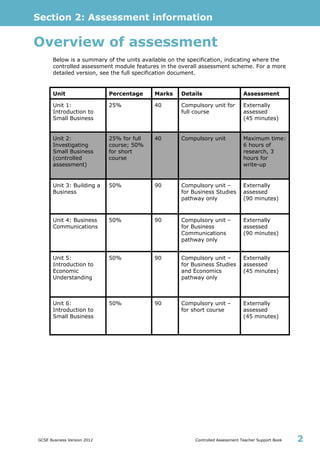
Below is a summary of the units available on the specification, indicating where the
controlled assessment module features in the overall assessment scheme. For a more
detailed version, see the full specification document.
Unit Percentage Marks Details Assessment
Unit 1:
Introduction to
Small Business
25% 40 Compulsory unit for
full course
Externally
assessed
(45 minutes)
Unit 2:
Investigating
Small Business
(controlled
assessment)
25% for full
course; 50%
for short
course
40 Compulsory unit Maximum time:
6 hours of
research, 3
hours for
write-up
Unit 3: Building a
Business
50% 90 Compulsory unit –
for Business Studies
pathway only
Externally
assessed
(90 minutes)
Unit 4: Business
Communications
50% 90 Compulsory unit –
for Business
Communications
pathway only
Externally
assessed
(90 minutes)
Unit 5:
Introduction to
Economic
Understanding
50% 90 Compulsory unit –
for Business Studies
and Economics
pathway only
Externally
assessed
(45 minutes)
Unit 6:
Introduction to
Small Business
50% 90 Compulsory unit –
for short course
Externally
assessed
(45 minutes)
Section 2: Assessment information
GCSE Business Version 2012 Controlled Assessment Teacher Support Book3
Levels of control
Task setting
What is the level of control?
High
What does this mean?
It is a requirement that different tasks are set each year by awarding bodies. In
January Edexcel will publish five tasks. Candidates will choose one of these as the
basis for their own controlled assessment assignment. It is advisable for a variety of
tasks to be chosen across a cohort of candidates rather than all candidates choosing
the same task.
These tasks remain live until May of the following academic year, when marks and
samples of work are submitted for external moderation.
The published tasks draw from the unit specification, so it is important that the
necessary teaching and learning has taken place and candidates have carried out
sufficient research to attempt the tasks within controlled conditions.
Task taking
The controls for taking the task have been designed to ensure that the task is done
by the candidate and is all their own work. Research and preparation may be done
outside the centre and materials brought in to refer to during the controlled sessions
(both electronic and hard copy). However, teachers must inspect them and be
satisfied that the work is the candidates’ own. All research materials must be placed
in the candidates’ research folders.
The task is split into two parts:
● research
● analysis and evaluation.
The levels of control are different for each part.
The research time allowed is 6 hours and time allowed within controlled conditions for
writing up the task is 3 hours.
It is recommended that centres log the timings of each controlled session and keep a
written record that can be available for moderation, to ensure that completion of the
tasks set does not exceed the permitted time.
What is the level of control?
Research: Limited
Write-up: High
What does this mean?
Research:
Candidates select the task they wish to answer. The centre should help to guide them
in finding an appropriate business to research and base their investigation. The
business could be local and should ideally be a small business. This would allow
candidates to contextualise the tasks set. Research may be completed without direct
supervision and will not contribute directly to assessable outcomes.
Section 2: Assessment information
GCSE Business Version 2012 Controlled Assessment Teacher Support Book 4
Teachers can:
● Tell candidates they have 6 hours for research, some of which can be done in the
classroom and some of it outside. Research done outside the classroom should be put in
the research folder.
● Ask candidates to use a research log to help keep track of the time spent on research
both inside and outside the classroom.
● Advise candidates about the suitability of their chosen business. If a candidate says that
they are intending to use B&Q or Tesco Extra as their business, the centre ought to
advise against this. If a candidate intends to produce a large questionnaire targeted at
30 people, it is acceptable to suggest this may be too large, too time-consuming and
lack focus and selectivity.
● Discuss the assessment criteria with candidates when doing a trial run.
● Give general guidance about appropriate research. For example, if a candidate asked
whether a particular website was appropriate you could say ‘yes’ or ‘no’.
● Allow a small group of candidates to interview a business together. Note: the research
each individual has done must be clearly identifiable and independent.
● Allow candidates to do research inside and outside the classroom subject to the 6-hour
time limit.
● Allow candidates to bring material they have collected during their research into school
to put in their research folders. The research folder might be saved on a memory stick
but you should keep the folder securely and be able to check that it only contains the
research candidates have collected during allocated research time.
● Set up a secure write-up file alongside the research file, both of which can only be
accessed during the write-up period.
Teachers cannot:
● Give candidates a research pack for the live controlled assessment.
● Carry out research for candidates.
● Allow candidates unsecure access to the research file. If you do not have a secure login
for the teacher file, it is possible that candidates could access this at any time – from
home, or outside the designated research time – so you would have no control over
what the candidate is doing with that research.
For further guidance on research, please refer to the FAQs on the Edexcel website:
www.edexcel.com/subjects/Business/Pages/ViewEditorial.aspx?editorial=433
Section 2: Assessment information
GCSE Business Version 2012 Controlled Assessment Teacher Support Book5
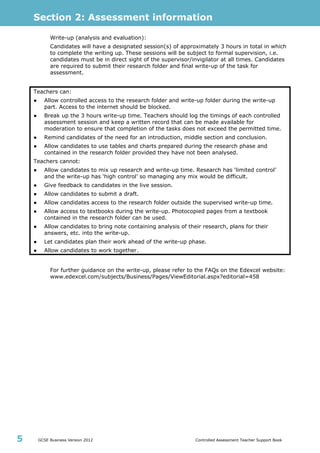
Write-up (analysis and evaluation):
Candidates will have a designated session(s) of approximately 3 hours in total in which
to complete the writing up. These sessions will be subject to formal supervision, i.e.
candidates must be in direct sight of the supervisor/invigilator at all times. Candidates
are required to submit their research folder and final write-up of the task for
assessment.
Teachers can:
● Allow controlled access to the research folder and write-up folder during the write-up
part. Access to the internet should be blocked.
● Break up the 3 hours write-up time. Teachers should log the timings of each controlled
assessment session and keep a written record that can be made available for
moderation to ensure that completion of the tasks does not exceed the permitted time.
● Remind candidates of the need for an introduction, middle section and conclusion.
● Allow candidates to use tables and charts prepared during the research phase and
contained in the research folder provided they have not been analysed.
Teachers cannot:
● Allow candidates to mix up research and write-up time. Research has ‘limited control’
and the write-up has ‘high control’ so managing any mix would be difficult.
● Give feedback to candidates in the live session.
● Allow candidates to submit a draft.
● Allow candidates access to the research folder outside the supervised write-up time.
● Allow access to textbooks during the write-up. Photocopied pages from a textbook
contained in the research folder can be used.
● Allow candidates to bring note containing analysis of their research, plans for their
answers, etc. into the write-up.
● Let candidates plan their work ahead of the write-up phase.
● Allow candidates to work together.
For further guidance on the write-up, please refer to the FAQs on the Edexcel website:
www.edexcel.com/subjects/Business/Pages/ViewEditorial.aspx?editorial=458
Section 2: Assessment information
GCSE Business Version 2012 Controlled Assessment Teacher Support Book 6
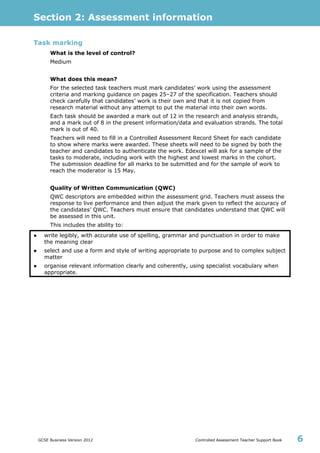
Task marking
What is the level of control?
Medium
What does this mean?
For the selected task teachers must mark candidates’ work using the assessment
criteria and marking guidance on pages 25–27 of the specification. Teachers should
check carefully that candidates’ work is their own and that it is not copied from
research material without any attempt to put the material into their own words.
Each task should be awarded a mark out of 12 in the research and analysis strands,
and a mark out of 8 in the present information/data and evaluation strands. The total
mark is out of 40.
Teachers will need to fill in a Controlled Assessment Record Sheet for each candidate
to show where marks were awarded. These sheets will need to be signed by both the
teacher and candidates to authenticate the work. Edexcel will ask for a sample of the
tasks to moderate, including work with the highest and lowest marks in the cohort.
The submission deadline for all marks to be submitted and for the sample of work to
reach the moderator is 15 May.
Quality of Written Communication (QWC)
QWC descriptors are embedded within the assessment grid. Teachers must assess the
response to live performance and then adjust the mark given to reflect the accuracy of
the candidates’ QWC. Teachers must ensure that candidates understand that QWC will
be assessed in this unit.
This includes the ability to:
● write legibly, with accurate use of spelling, grammar and punctuation in order to make
the meaning clear
● select and use a form and style of writing appropriate to purpose and to complex subject
matter
● organise relevant information clearly and coherently, using specialist vocabulary when
appropriate.
Section 2: Assessment information
GCSE Business Version 2012 Controlled Assessment Teacher Support Book7
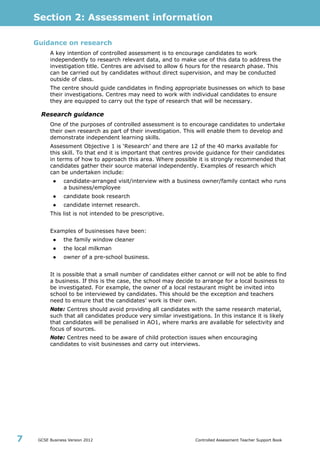
Guidance on research
A key intention of controlled assessment is to encourage candidates to work
independently to research relevant data, and to make use of this data to address the
investigation title. Centres are advised to allow 6 hours for the research phase. This
can be carried out by candidates without direct supervision, and may be conducted
outside of class.
The centre should guide candidates in finding appropriate businesses on which to base
their investigations. Centres may need to work with individual candidates to ensure
they are equipped to carry out the type of research that will be necessary.
Research guidance
One of the purposes of controlled assessment is to encourage candidates to undertake
their own research as part of their investigation. This will enable them to develop and
demonstrate independent learning skills.
Assessment Objective 1 is ‘Research’ and there are 12 of the 40 marks available for
this skill. To that end it is important that centres provide guidance for their candidates
in terms of how to approach this area. Where possible it is strongly recommended that
candidates gather their source material independently. Examples of research which
can be undertaken include:
● candidate-arranged visit/interview with a business owner/family contact who runs
a business/employee
● candidate book research
● candidate internet research.
This list is not intended to be prescriptive.
Examples of businesses have been:
● the family window cleaner
● the local milkman
● owner of a pre-school business.
It is possible that a small number of candidates either cannot or will not be able to find
a business. If this is the case, the school may decide to arrange for a local business to
be investigated. For example, the owner of a local restaurant might be invited into
school to be interviewed by candidates. This should be the exception and teachers
need to ensure that the candidates’ work is their own.
Note: Centres should avoid providing all candidates with the same research material,
such that all candidates produce very similar investigations. In this instance it is likely
that candidates will be penalised in AO1, where marks are available for selectivity and
focus of sources.
Note: Centres need to be aware of child protection issues when encouraging
candidates to visit businesses and carry out interviews.
Section 2: Assessment information
GCSE Business Version 2012 Controlled Assessment Teacher Support Book 8
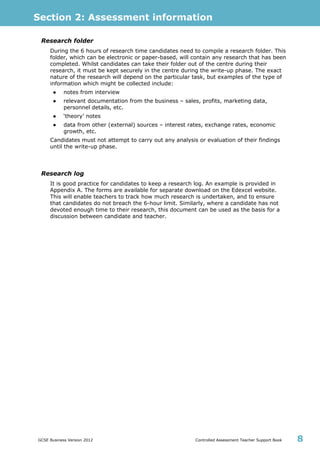
Research folder
During the 6 hours of research time candidates need to compile a research folder. This
folder, which can be electronic or paper-based, will contain any research that has been
completed. Whilst candidates can take their folder out of the centre during their
research, it must be kept securely in the centre during the write-up phase. The exact
nature of the research will depend on the particular task, but examples of the type of
information which might be collected include:
● notes from interview
● relevant documentation from the business – sales, profits, marketing data,
personnel details, etc.
● ‘theory’ notes
● data from other (external) sources – interest rates, exchange rates, economic
growth, etc.
Candidates must not attempt to carry out any analysis or evaluation of their findings
until the write-up phase.
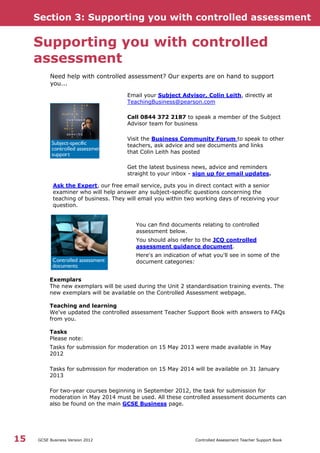
Research log
It is good practice for candidates to keep a research log. An example is provided in
Appendix A. The forms are available for separate download on the Edexcel website.
This will enable teachers to track how much research is undertaken, and to ensure
that candidates do not breach the 6-hour limit. Similarly, where a candidate has not
devoted enough time to their research, this document can be used as the basis for a
discussion between candidate and teacher.
Section 2: Assessment information
GCSE Business Version 2012 Controlled Assessment Teacher Support Book9
Guidance on the write-up
The writing-up period is a maximum of 3 hours, which for most centres equates to
approximately 1 week of class time. This task should take place under a high level of
control, i.e. under direct supervision from a teacher. Candidates should use the
contents of their research folder to analyse and evaluate their research information.
Teachers must keep the live controlled assessment tasks and candidate research
folders secure when in their possession during the write-up phase.
Tackling the write-up
The write-up is the answer to the set question using the research findings that the
candidate has gathered. Candidates should be advised to spend the first 30 minutes
planning how they are going to tackle the question. An introduction to the business
may be useful, although it does not need to be extensive. Candidates should not
explain how they conducted the research, nor describe what methods they used. They
should not evaluate the process they have been through.
In the write-up candidates can use any evidence from their research folder. They may
choose to use charts or diagrams in their actual write-up. Alternatively, they may
choose to refer to evidence which is in an appendix.
Building candidate capabilities within the controlled assessment
It is clear that the controlled assessment is a departure from traditional coursework
elements of GCSE Business courses, so centres will need to spend some time and
effort in developing their candidates’ skills in this type of assessment. One approach is
to provide candidates with a practice experience, to model the approach they will need
to take. This can be a valuable and informative experience for candidates and
teachers.
The document beginning on page 9 details how one school has approached a practice
controlled assessment. In this case candidates were provided with an electronic
version of a research folder and were given time to interrogate this evidence in
preparation for the 3-hour write-up phase. In this particular example, the practice was
carried out in October/November, with 3 hours of class time plus 3 hours of homework
(over the half-term break) making up the research phase. The write-up was conducted
in the week after the half term. This particular centre completed the ‘real’ controlled
assessment in February of Year 10.
Section 2: Assessment information
GCSE Business Version 2012 Controlled Assessment Teacher Support Book 10
GCSE Business (Edexcel)
A practice controlled assessment model
Background
The approach detailed below was developed at Wickersley School and Sports
College as a means of acclimatising our Year 10 students to the demands of the new
controlled assessment (CA) component. Our intention was to create an activity that
would allow students to experience the full CA process. This could then be revisited
later in Year 10 as a reference point when students were completing the actual CA.
This was our main hope: to develop a process that could be revisited and could be
used to help students model what was required in this type of activity. For example,
when advising students on how to carry out any actual interview they might
undertake, we could refer back along the lines of, ‘In the practice controlled
assessment, what types of questions were asked in the interview? How might you
prepare for this interview?’ And so on. Similar prompts can be used for many
aspects of the research.
At Wickersley School and Sports College we took the decision that the real CA would
be completed in February, allowing students half term for part of their 6 hours
research time. It was decided that the practice CA would be completed in
October/November. This appears early into a new GCSE course, but we felt that the
sooner students are experiencing the actual process the better. However, this can
be done at any time prior to the real thing.
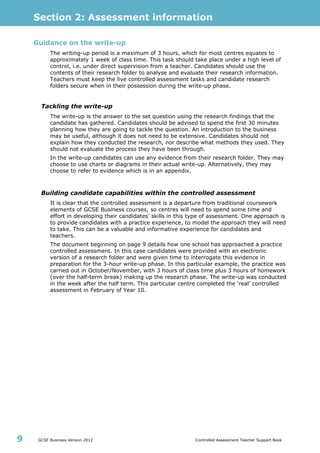
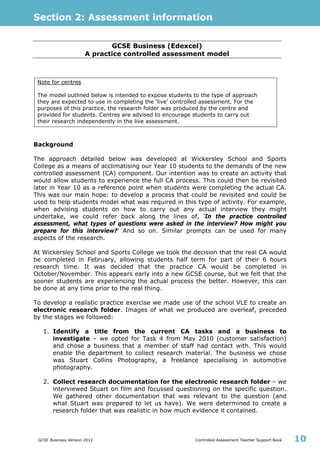
To develop a realistic practice exercise we made use of the school VLE to create an
electronic research folder. Images of what we produced are overleaf, preceded
by the stages we followed:
1. Identify a title from the current CA tasks and a business to
investigate – we opted for Task 4 from May 2010 (customer satisfaction)
and chose a business that a member of staff had contact with. This would
enable the department to collect research material. The business we chose
was Stuart Collins Photography, a freelance specialising in automotive
photography.
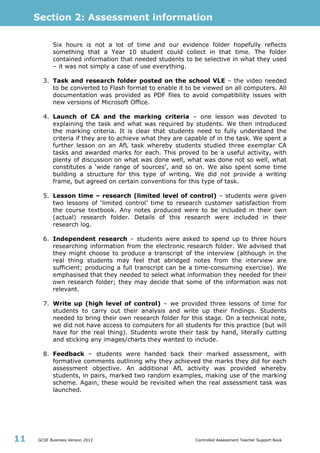
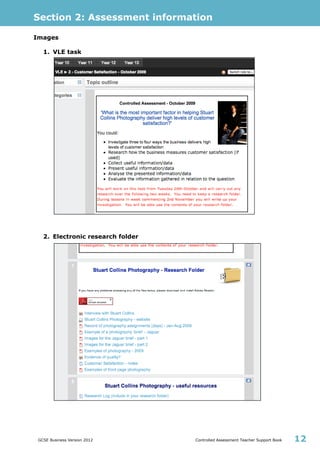
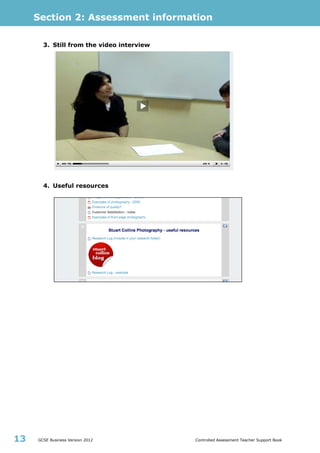
2. Collect research documentation for the electronic research folder – we
interviewed Stuart on film and focussed questioning on the specific question.
We gathered other documentation that was relevant to the question (and
what Stuart was prepared to let us have). We were determined to create a
research folder that was realistic in how much evidence it contained.
Note for centres
The model outlined below is intended to expose students to the type of approach
they are expected to use in completing the ‘live’ controlled assessment. For the
purposes of this practice, the research folder was produced by the centre and
provided for students. Centres are advised to encourage students to carry out
their research independently in the live assessment.
Section 2: Assessment information
GCSE Business Version 2012 Controlled Assessment Teacher Support Book11
Six hours is not a lot of time and our evidence folder hopefully reflects
something that a Year 10 student could collect in that time. The folder
contained information that needed students to be selective in what they used
– it was not simply a case of use everything.
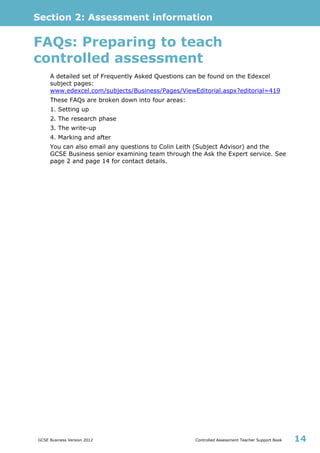
3. Task and research folder posted on the school VLE – the video needed
to be converted to Flash format to enable it to be viewed on all computers. All
documentation was provided as PDF files to avoid compatibility issues with
new versions of Microsoft Office.
4. Launch of CA and the marking criteria – one lesson was devoted to
explaining the task and what was required by students. We then introduced
the marking criteria. It is clear that students need to fully understand the
criteria if they are to achieve what they are capable of in the task. We spent a
further lesson on an AfL task whereby students studied three exemplar CA
tasks and awarded marks for each. This proved to be a useful activity, with
plenty of discussion on what was done well, what was done not so well, what
constitutes a ‘wide range of sources’, and so on. We also spent some time
building a structure for this type of writing. We did not provide a writing
frame, but agreed on certain conventions for this type of task.
5. Lesson time – research (limited level of control) – students were given
two lessons of ‘limited control’ time to research customer satisfaction from
the course textbook. Any notes produced were to be included in their own
(actual) research folder. Details of this research were included in their
research log.
6. Independent research – students were asked to spend up to three hours
researching information from the electronic research folder. We advised that
they might choose to produce a transcript of the interview (although in the
real thing students may feel that abridged notes from the interview are
sufficient; producing a full transcript can be a time-consuming exercise). We
emphasised that they needed to select what information they needed for their
own research folder; they may decide that some of the information was not
relevant.
7. Write up (high level of control) – we provided three lessons of time for
students to carry out their analysis and write up their findings. Students
needed to bring their own research folder for this stage. On a technical note,
we did not have access to computers for all students for this practice (but will
have for the real thing). Students wrote their task by hand, literally cutting
and sticking any images/charts they wanted to include.
8. Feedback – students were handed back their marked assessment, with
formative comments outlining why they achieved the marks they did for each
assessment objective. An additional AfL activity was provided whereby
students, in pairs, marked two random examples, making use of the marking
scheme. Again, these would be revisited when the real assessment task was
launched.
Section 2: Assessment information
GCSE Business Version 2012 Controlled Assessment Teacher Support Book 12
Images
1. VLE task
2. Electronic research folder
Section 2: Assessment information
GCSE Business Version 2012 Controlled Assessment Teacher Support Book13
3. Still from the video interview
4. Useful resources
Section 2: Assessment information
GCSE Business Version 2012 Controlled Assessment Teacher Support Book 14
FAQs: Preparing to teach
controlled assessment
A detailed set of Frequently Asked Questions can be found on the Edexcel
subject pages:
www.edexcel.com/subjects/Business/Pages/ViewEditorial.aspx?editorial=419
These FAQs are broken down into four areas:
1. Setting up
2. The research phase
3. The write-up
4. Marking and after
You can also email any questions to Colin Leith (Subject Advisor) and the
GCSE Business senior examining team through the Ask the Expert service. See
page 2 and page 14 for contact details.
Section 3: Supporting you with controlled assessment
GCSE Business Version 2012 Controlled Assessment Teacher Support Book15
Supporting you with controlled
assessment
Need help with controlled assessment? Our experts are on hand to support
you...
Email your Subject Advisor, Colin Leith, directly at
TeachingBusiness@pearson.com
Call 0844 372 2187 to speak a member of the Subject
Advisor team for business
Visit the Business Community Forum to speak to other
teachers, ask advice and see documents and links
that Colin Leith has posted
Get the latest business news, advice and reminders
straight to your inbox - sign up for email updates.
Ask the Expert, our free email service, puts you in direct contact with a senior
examiner who will help answer any subject-specific questions concerning the
teaching of business. They will email you within two working days of receiving your
question.
You can find documents relating to controlled
assessment below.
You should also refer to the JCQ controlled
assessment guidance document.
Here's an indication of what you'll see in some of the
document categories:
Exemplars
The new exemplars will be used during the Unit 2 standardisation training events. The
new exemplars will be available on the Controlled Assessment webpage.
Teaching and learning
We've updated the controlled assessment Teacher Support Book with answers to FAQs
from you.
Tasks
Please note:
Tasks for submission for moderation on 15 May 2013 were made available in May
2012
Tasks for submission for moderation on 15 May 2014 will be available on 31 January
2013
For two-year courses beginning in September 2012, the task for submission for
moderation in May 2014 must be used. All these controlled assessment documents can
also be found on the main GCSE Business page.
Section 4: Candidate handouts
GCSE Business Version 2012 Controlled Assessment Teacher Support Book 16
Appendix A - candidate forms
The following proforma has been designed for candidates to write their plans and notes. The form will be available for
separate download on the Edexcel website. The plans and notes used for the write-up session must be handwritten on this
form.
Research log - example
Gcse controlled-assessment-tsb-business finalised (1)

Gcse controlled-assessment-tsb-business finalised (1)

  • 1.
  • 2.
    Edexcel GCSE Business Controlled Assessment TeacherSupport Book Unit 5BS02: Investigating Small Business
  • 3.
    Welcome to theGCSE Business 2012 Controlled Assessment Teacher Support Book This CA Teacher Support Book has been designed to provide you with the answers to key questions that you may have during the teaching and assessment of Controlled Assessment Unit 5BS02: Investigating Small Business. It includes: ● advice to support your delivery of controlled assessment ● suggestions for getting the most from controlled assessment. Expert advice from the people who know We hope you find this document useful and look forward to working with you on our new GCSE specifications. We are on hand to answer your questions so please feel free to get in touch. To contact our GCSE Business senior examining team please email: TeachingBusiness@pearson.com To speak to our Business Subject Advisor, Colin Leith, please call 0844 372 2187 or email TeachingBusiness@pearson.com Colin Leith, Subject Advisor We look forward to working with you.
  • 4.
    Contents Introduction to controlledassessment 1 A brief overview of controlled assessment and the controlled assessment units. Assessment information 2 In this section we provide you with answers to your key questions. We also provide information for candidates which you may choose to copy for them. Supporting you with controlled assessment 15 In this section we provide you with information and resources to help you plan and deliver controlled assessment with confidence. Candidate handouts 16 Appendix A: Example research log
  • 5.
    Section 1: Introductionto controlled assessment GCSE Business Version 2012 Controlled Assessment Teacher Support Book1 Unit 5BS02: Investigating Small Business Controlled assessment In the controlled assessment unit: ● The assessment takes place under specific time limits. ● Work is undertaken under different levels of control, with the final write-up being done under a ‘high level of control’. ● Greater emphasis is placed on independent research by candidates. What will candidates actually do? Candidates will choose from one of five investigation titles. These will be released annually and can be completed at any time for submission by 15 May at the end of the course. Candidates must complete the correct task for moderation at the end of the course. The investigation should be undertaken of a small business. Centres provide a maximum of 6 hours of research time for candidates to gather information on their chosen investigation. This research can be carried out under ‘limited level of control’ and could include research outside of the classroom. Any research which candidates collect must be added to a research folder. This folder can be used during the write-up phase, but is to be kept securely by the school when not in use by the candidate. After the 6 hours of research candidates are required to write up their investigation. Here, candidates use the contents of their research folder to address the investigation title. At this stage any information and data can be interpreted and analysed in order to answer the question. This can be done in a maximum of 3 hours, which can be spread over a number of sessions. Candidates must not have access to their research folder when they are not in the controlled write-up session(s). Candidates will be assessed on four assessment objectives: Research (AO1), Presentation (AO2), Analysis (AO3) and Evaluation (AO4).
  • 6.
    Section 2: Assessmentinformation GCSE Business Version 2012 Controlled Assessment Teacher Support Book 2 Overview of assessment Below is a summary of the units available on the specification, indicating where the controlled assessment module features in the overall assessment scheme. For a more detailed version, see the full specification document. Unit Percentage Marks Details Assessment Unit 1: Introduction to Small Business 25% 40 Compulsory unit for full course Externally assessed (45 minutes) Unit 2: Investigating Small Business (controlled assessment) 25% for full course; 50% for short course 40 Compulsory unit Maximum time: 6 hours of research, 3 hours for write-up Unit 3: Building a Business 50% 90 Compulsory unit – for Business Studies pathway only Externally assessed (90 minutes) Unit 4: Business Communications 50% 90 Compulsory unit – for Business Communications pathway only Externally assessed (90 minutes) Unit 5: Introduction to Economic Understanding 50% 90 Compulsory unit – for Business Studies and Economics pathway only Externally assessed (45 minutes) Unit 6: Introduction to Small Business 50% 90 Compulsory unit – for short course Externally assessed (45 minutes)
  • 7.
    Section 2: Assessmentinformation GCSE Business Version 2012 Controlled Assessment Teacher Support Book3 Levels of control Task setting What is the level of control? High What does this mean? It is a requirement that different tasks are set each year by awarding bodies. In January Edexcel will publish five tasks. Candidates will choose one of these as the basis for their own controlled assessment assignment. It is advisable for a variety of tasks to be chosen across a cohort of candidates rather than all candidates choosing the same task. These tasks remain live until May of the following academic year, when marks and samples of work are submitted for external moderation. The published tasks draw from the unit specification, so it is important that the necessary teaching and learning has taken place and candidates have carried out sufficient research to attempt the tasks within controlled conditions. Task taking The controls for taking the task have been designed to ensure that the task is done by the candidate and is all their own work. Research and preparation may be done outside the centre and materials brought in to refer to during the controlled sessions (both electronic and hard copy). However, teachers must inspect them and be satisfied that the work is the candidates’ own. All research materials must be placed in the candidates’ research folders. The task is split into two parts: ● research ● analysis and evaluation. The levels of control are different for each part. The research time allowed is 6 hours and time allowed within controlled conditions for writing up the task is 3 hours. It is recommended that centres log the timings of each controlled session and keep a written record that can be available for moderation, to ensure that completion of the tasks set does not exceed the permitted time. What is the level of control? Research: Limited Write-up: High What does this mean? Research: Candidates select the task they wish to answer. The centre should help to guide them in finding an appropriate business to research and base their investigation. The business could be local and should ideally be a small business. This would allow candidates to contextualise the tasks set. Research may be completed without direct supervision and will not contribute directly to assessable outcomes.
  • 8.
    Section 2: Assessmentinformation GCSE Business Version 2012 Controlled Assessment Teacher Support Book 4 Teachers can: ● Tell candidates they have 6 hours for research, some of which can be done in the classroom and some of it outside. Research done outside the classroom should be put in the research folder. ● Ask candidates to use a research log to help keep track of the time spent on research both inside and outside the classroom. ● Advise candidates about the suitability of their chosen business. If a candidate says that they are intending to use B&Q or Tesco Extra as their business, the centre ought to advise against this. If a candidate intends to produce a large questionnaire targeted at 30 people, it is acceptable to suggest this may be too large, too time-consuming and lack focus and selectivity. ● Discuss the assessment criteria with candidates when doing a trial run. ● Give general guidance about appropriate research. For example, if a candidate asked whether a particular website was appropriate you could say ‘yes’ or ‘no’. ● Allow a small group of candidates to interview a business together. Note: the research each individual has done must be clearly identifiable and independent. ● Allow candidates to do research inside and outside the classroom subject to the 6-hour time limit. ● Allow candidates to bring material they have collected during their research into school to put in their research folders. The research folder might be saved on a memory stick but you should keep the folder securely and be able to check that it only contains the research candidates have collected during allocated research time. ● Set up a secure write-up file alongside the research file, both of which can only be accessed during the write-up period. Teachers cannot: ● Give candidates a research pack for the live controlled assessment. ● Carry out research for candidates. ● Allow candidates unsecure access to the research file. If you do not have a secure login for the teacher file, it is possible that candidates could access this at any time – from home, or outside the designated research time – so you would have no control over what the candidate is doing with that research. For further guidance on research, please refer to the FAQs on the Edexcel website: www.edexcel.com/subjects/Business/Pages/ViewEditorial.aspx?editorial=433
  • 9.
    Section 2: Assessmentinformation GCSE Business Version 2012 Controlled Assessment Teacher Support Book5 Write-up (analysis and evaluation): Candidates will have a designated session(s) of approximately 3 hours in total in which to complete the writing up. These sessions will be subject to formal supervision, i.e. candidates must be in direct sight of the supervisor/invigilator at all times. Candidates are required to submit their research folder and final write-up of the task for assessment. Teachers can: ● Allow controlled access to the research folder and write-up folder during the write-up part. Access to the internet should be blocked. ● Break up the 3 hours write-up time. Teachers should log the timings of each controlled assessment session and keep a written record that can be made available for moderation to ensure that completion of the tasks does not exceed the permitted time. ● Remind candidates of the need for an introduction, middle section and conclusion. ● Allow candidates to use tables and charts prepared during the research phase and contained in the research folder provided they have not been analysed. Teachers cannot: ● Allow candidates to mix up research and write-up time. Research has ‘limited control’ and the write-up has ‘high control’ so managing any mix would be difficult. ● Give feedback to candidates in the live session. ● Allow candidates to submit a draft. ● Allow candidates access to the research folder outside the supervised write-up time. ● Allow access to textbooks during the write-up. Photocopied pages from a textbook contained in the research folder can be used. ● Allow candidates to bring note containing analysis of their research, plans for their answers, etc. into the write-up. ● Let candidates plan their work ahead of the write-up phase. ● Allow candidates to work together. For further guidance on the write-up, please refer to the FAQs on the Edexcel website: www.edexcel.com/subjects/Business/Pages/ViewEditorial.aspx?editorial=458
  • 10.
    Section 2: Assessmentinformation GCSE Business Version 2012 Controlled Assessment Teacher Support Book 6 Task marking What is the level of control? Medium What does this mean? For the selected task teachers must mark candidates’ work using the assessment criteria and marking guidance on pages 25–27 of the specification. Teachers should check carefully that candidates’ work is their own and that it is not copied from research material without any attempt to put the material into their own words. Each task should be awarded a mark out of 12 in the research and analysis strands, and a mark out of 8 in the present information/data and evaluation strands. The total mark is out of 40. Teachers will need to fill in a Controlled Assessment Record Sheet for each candidate to show where marks were awarded. These sheets will need to be signed by both the teacher and candidates to authenticate the work. Edexcel will ask for a sample of the tasks to moderate, including work with the highest and lowest marks in the cohort. The submission deadline for all marks to be submitted and for the sample of work to reach the moderator is 15 May. Quality of Written Communication (QWC) QWC descriptors are embedded within the assessment grid. Teachers must assess the response to live performance and then adjust the mark given to reflect the accuracy of the candidates’ QWC. Teachers must ensure that candidates understand that QWC will be assessed in this unit. This includes the ability to: ● write legibly, with accurate use of spelling, grammar and punctuation in order to make the meaning clear ● select and use a form and style of writing appropriate to purpose and to complex subject matter ● organise relevant information clearly and coherently, using specialist vocabulary when appropriate.
  • 11.
    Section 2: Assessmentinformation GCSE Business Version 2012 Controlled Assessment Teacher Support Book7 Guidance on research A key intention of controlled assessment is to encourage candidates to work independently to research relevant data, and to make use of this data to address the investigation title. Centres are advised to allow 6 hours for the research phase. This can be carried out by candidates without direct supervision, and may be conducted outside of class. The centre should guide candidates in finding appropriate businesses on which to base their investigations. Centres may need to work with individual candidates to ensure they are equipped to carry out the type of research that will be necessary. Research guidance One of the purposes of controlled assessment is to encourage candidates to undertake their own research as part of their investigation. This will enable them to develop and demonstrate independent learning skills. Assessment Objective 1 is ‘Research’ and there are 12 of the 40 marks available for this skill. To that end it is important that centres provide guidance for their candidates in terms of how to approach this area. Where possible it is strongly recommended that candidates gather their source material independently. Examples of research which can be undertaken include: ● candidate-arranged visit/interview with a business owner/family contact who runs a business/employee ● candidate book research ● candidate internet research. This list is not intended to be prescriptive. Examples of businesses have been: ● the family window cleaner ● the local milkman ● owner of a pre-school business. It is possible that a small number of candidates either cannot or will not be able to find a business. If this is the case, the school may decide to arrange for a local business to be investigated. For example, the owner of a local restaurant might be invited into school to be interviewed by candidates. This should be the exception and teachers need to ensure that the candidates’ work is their own. Note: Centres should avoid providing all candidates with the same research material, such that all candidates produce very similar investigations. In this instance it is likely that candidates will be penalised in AO1, where marks are available for selectivity and focus of sources. Note: Centres need to be aware of child protection issues when encouraging candidates to visit businesses and carry out interviews.
  • 12.
    Section 2: Assessmentinformation GCSE Business Version 2012 Controlled Assessment Teacher Support Book 8 Research folder During the 6 hours of research time candidates need to compile a research folder. This folder, which can be electronic or paper-based, will contain any research that has been completed. Whilst candidates can take their folder out of the centre during their research, it must be kept securely in the centre during the write-up phase. The exact nature of the research will depend on the particular task, but examples of the type of information which might be collected include: ● notes from interview ● relevant documentation from the business – sales, profits, marketing data, personnel details, etc. ● ‘theory’ notes ● data from other (external) sources – interest rates, exchange rates, economic growth, etc. Candidates must not attempt to carry out any analysis or evaluation of their findings until the write-up phase. Research log It is good practice for candidates to keep a research log. An example is provided in Appendix A. The forms are available for separate download on the Edexcel website. This will enable teachers to track how much research is undertaken, and to ensure that candidates do not breach the 6-hour limit. Similarly, where a candidate has not devoted enough time to their research, this document can be used as the basis for a discussion between candidate and teacher.
  • 13.
    Section 2: Assessmentinformation GCSE Business Version 2012 Controlled Assessment Teacher Support Book9 Guidance on the write-up The writing-up period is a maximum of 3 hours, which for most centres equates to approximately 1 week of class time. This task should take place under a high level of control, i.e. under direct supervision from a teacher. Candidates should use the contents of their research folder to analyse and evaluate their research information. Teachers must keep the live controlled assessment tasks and candidate research folders secure when in their possession during the write-up phase. Tackling the write-up The write-up is the answer to the set question using the research findings that the candidate has gathered. Candidates should be advised to spend the first 30 minutes planning how they are going to tackle the question. An introduction to the business may be useful, although it does not need to be extensive. Candidates should not explain how they conducted the research, nor describe what methods they used. They should not evaluate the process they have been through. In the write-up candidates can use any evidence from their research folder. They may choose to use charts or diagrams in their actual write-up. Alternatively, they may choose to refer to evidence which is in an appendix. Building candidate capabilities within the controlled assessment It is clear that the controlled assessment is a departure from traditional coursework elements of GCSE Business courses, so centres will need to spend some time and effort in developing their candidates’ skills in this type of assessment. One approach is to provide candidates with a practice experience, to model the approach they will need to take. This can be a valuable and informative experience for candidates and teachers. The document beginning on page 9 details how one school has approached a practice controlled assessment. In this case candidates were provided with an electronic version of a research folder and were given time to interrogate this evidence in preparation for the 3-hour write-up phase. In this particular example, the practice was carried out in October/November, with 3 hours of class time plus 3 hours of homework (over the half-term break) making up the research phase. The write-up was conducted in the week after the half term. This particular centre completed the ‘real’ controlled assessment in February of Year 10.
  • 14.
    Section 2: Assessmentinformation GCSE Business Version 2012 Controlled Assessment Teacher Support Book 10 GCSE Business (Edexcel) A practice controlled assessment model Background The approach detailed below was developed at Wickersley School and Sports College as a means of acclimatising our Year 10 students to the demands of the new controlled assessment (CA) component. Our intention was to create an activity that would allow students to experience the full CA process. This could then be revisited later in Year 10 as a reference point when students were completing the actual CA. This was our main hope: to develop a process that could be revisited and could be used to help students model what was required in this type of activity. For example, when advising students on how to carry out any actual interview they might undertake, we could refer back along the lines of, ‘In the practice controlled assessment, what types of questions were asked in the interview? How might you prepare for this interview?’ And so on. Similar prompts can be used for many aspects of the research. At Wickersley School and Sports College we took the decision that the real CA would be completed in February, allowing students half term for part of their 6 hours research time. It was decided that the practice CA would be completed in October/November. This appears early into a new GCSE course, but we felt that the sooner students are experiencing the actual process the better. However, this can be done at any time prior to the real thing. To develop a realistic practice exercise we made use of the school VLE to create an electronic research folder. Images of what we produced are overleaf, preceded by the stages we followed: 1. Identify a title from the current CA tasks and a business to investigate – we opted for Task 4 from May 2010 (customer satisfaction) and chose a business that a member of staff had contact with. This would enable the department to collect research material. The business we chose was Stuart Collins Photography, a freelance specialising in automotive photography. 2. Collect research documentation for the electronic research folder – we interviewed Stuart on film and focussed questioning on the specific question. We gathered other documentation that was relevant to the question (and what Stuart was prepared to let us have). We were determined to create a research folder that was realistic in how much evidence it contained. Note for centres The model outlined below is intended to expose students to the type of approach they are expected to use in completing the ‘live’ controlled assessment. For the purposes of this practice, the research folder was produced by the centre and provided for students. Centres are advised to encourage students to carry out their research independently in the live assessment.
  • 15.
    Section 2: Assessmentinformation GCSE Business Version 2012 Controlled Assessment Teacher Support Book11 Six hours is not a lot of time and our evidence folder hopefully reflects something that a Year 10 student could collect in that time. The folder contained information that needed students to be selective in what they used – it was not simply a case of use everything. 3. Task and research folder posted on the school VLE – the video needed to be converted to Flash format to enable it to be viewed on all computers. All documentation was provided as PDF files to avoid compatibility issues with new versions of Microsoft Office. 4. Launch of CA and the marking criteria – one lesson was devoted to explaining the task and what was required by students. We then introduced the marking criteria. It is clear that students need to fully understand the criteria if they are to achieve what they are capable of in the task. We spent a further lesson on an AfL task whereby students studied three exemplar CA tasks and awarded marks for each. This proved to be a useful activity, with plenty of discussion on what was done well, what was done not so well, what constitutes a ‘wide range of sources’, and so on. We also spent some time building a structure for this type of writing. We did not provide a writing frame, but agreed on certain conventions for this type of task. 5. Lesson time – research (limited level of control) – students were given two lessons of ‘limited control’ time to research customer satisfaction from the course textbook. Any notes produced were to be included in their own (actual) research folder. Details of this research were included in their research log. 6. Independent research – students were asked to spend up to three hours researching information from the electronic research folder. We advised that they might choose to produce a transcript of the interview (although in the real thing students may feel that abridged notes from the interview are sufficient; producing a full transcript can be a time-consuming exercise). We emphasised that they needed to select what information they needed for their own research folder; they may decide that some of the information was not relevant. 7. Write up (high level of control) – we provided three lessons of time for students to carry out their analysis and write up their findings. Students needed to bring their own research folder for this stage. On a technical note, we did not have access to computers for all students for this practice (but will have for the real thing). Students wrote their task by hand, literally cutting and sticking any images/charts they wanted to include. 8. Feedback – students were handed back their marked assessment, with formative comments outlining why they achieved the marks they did for each assessment objective. An additional AfL activity was provided whereby students, in pairs, marked two random examples, making use of the marking scheme. Again, these would be revisited when the real assessment task was launched.
  • 16.
    Section 2: Assessmentinformation GCSE Business Version 2012 Controlled Assessment Teacher Support Book 12 Images 1. VLE task 2. Electronic research folder
  • 17.
    Section 2: Assessmentinformation GCSE Business Version 2012 Controlled Assessment Teacher Support Book13 3. Still from the video interview 4. Useful resources
  • 18.
    Section 2: Assessmentinformation GCSE Business Version 2012 Controlled Assessment Teacher Support Book 14 FAQs: Preparing to teach controlled assessment A detailed set of Frequently Asked Questions can be found on the Edexcel subject pages: www.edexcel.com/subjects/Business/Pages/ViewEditorial.aspx?editorial=419 These FAQs are broken down into four areas: 1. Setting up 2. The research phase 3. The write-up 4. Marking and after You can also email any questions to Colin Leith (Subject Advisor) and the GCSE Business senior examining team through the Ask the Expert service. See page 2 and page 14 for contact details.
  • 19.
    Section 3: Supportingyou with controlled assessment GCSE Business Version 2012 Controlled Assessment Teacher Support Book15 Supporting you with controlled assessment Need help with controlled assessment? Our experts are on hand to support you... Email your Subject Advisor, Colin Leith, directly at TeachingBusiness@pearson.com Call 0844 372 2187 to speak a member of the Subject Advisor team for business Visit the Business Community Forum to speak to other teachers, ask advice and see documents and links that Colin Leith has posted Get the latest business news, advice and reminders straight to your inbox - sign up for email updates. Ask the Expert, our free email service, puts you in direct contact with a senior examiner who will help answer any subject-specific questions concerning the teaching of business. They will email you within two working days of receiving your question. You can find documents relating to controlled assessment below. You should also refer to the JCQ controlled assessment guidance document. Here's an indication of what you'll see in some of the document categories: Exemplars The new exemplars will be used during the Unit 2 standardisation training events. The new exemplars will be available on the Controlled Assessment webpage. Teaching and learning We've updated the controlled assessment Teacher Support Book with answers to FAQs from you. Tasks Please note: Tasks for submission for moderation on 15 May 2013 were made available in May 2012 Tasks for submission for moderation on 15 May 2014 will be available on 31 January 2013 For two-year courses beginning in September 2012, the task for submission for moderation in May 2014 must be used. All these controlled assessment documents can also be found on the main GCSE Business page.
  • 20.
    Section 4: Candidatehandouts GCSE Business Version 2012 Controlled Assessment Teacher Support Book 16 Appendix A - candidate forms The following proforma has been designed for candidates to write their plans and notes. The form will be available for separate download on the Edexcel website. The plans and notes used for the write-up session must be handwritten on this form. Research log - example