BSc Project
Management
by
Assist. Prof. Dr. Ayad Albadri
lecturer: Shahad Dakhel Khalaf
1
Topics covered
 Abstract
 Table of contents
 CHAPTER ONE Introduction
 Overview
 Purpose of the study
 Project Aim and Objectives
 CHAPTER TWO RELATED WORKS & TECHNICAL BACKGROUND
 CHAPTER THREE
 METHODOLOGY USED
 DEVELOPMENT STEPS
 VALIDATION
 CONCLUSION
 References
2
Abstract
This is the first part of any final year BSc project. It should be written at
the final step of the final project as a full story of the BSc project, It
should be brief, clear, and easy to understand. The abstract explains
what you have done, how you did it, and why you did it.
3
Table of Content
An automatic Table of Contents uses Styles to keep track of page
numbers and section titles for you automatically.
Microsoft Office (Word) application provides us with an excellent way
to create a table of contents automatically.
4
CHAPTER ONE Introduction
OVERVIEW
The introduction contains the background of the BSc project. It explains the
project problem as well as the way would be solving. It also describes the
practical approaches you’d be using to solve these problems. Your
introduction should also be able to explain how the problems relate to your
field of study. Your introduction should be easy to understand and should be
backed up with facts. Try to make it engaging research. Don’t be boring.
5
CHAPTER ONE Introduction
Purpose of the study
The goals of your project topic should be clearly defined in this section. You
should be able to provide practical reasons why you think this project is
important. This section will state hypotheses that need to be tested and
questions that are to be answered by your research. You should begin this
section with the statement ‘the purpose of this study is…’
6
CHAPTER ONE Introduction
Project aim and objectives
The Project aim focus on what the research project is intended to achieve;
Project objectives focus on how the aim will be achieved. ... Project aims
focus on a project's long-term outcomes; Project objectives focus on its
immediate, short-term outcomes.
7
CHAPTER TWO
RELATED WORKS
The related work section may also be called a literature review. The point of
the section is to highlight work done by others that somehow ties in with
your own work. It may be work that you're basing your work off of, or work
that shows others attempts to solve the same problem.
8
CHAPTER THREE
THE METHODOLOGY USED
In the BSc Project, you will have to discuss the methods you used to do your Project.
The methodology section explains what you did and how you did it, allowing readers
to evaluate the reliability and validity of the BSc project. It should include:
The type of research you did
How you collected your data
How you analyzed your data
Any tools or materials you used in the research
Your rationale for choosing these methods
The methodology section should generally be written in the past tense.
9
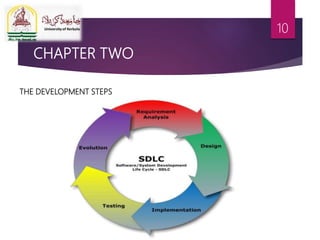
CHAPTER TWO
THE DEVELOPMENT STEPS
10
CHAPTER THREE
THE VALIDATION STEPS
The Secret Code of Software Validation…in 5 Easy Steps
Step 1: Create the Validation Plan. ...
Step 2: Define System Requirements. ...
Step 3: Create the Validation Protocol & Test Specifications. ..
Step 4: Testing. ...
Step 5: Develop/Revise Procedures & Final Report.
11
CHAPTER THREE
THE CONCLUSION
For any research project and any scientific discipline, drawing
conclusions is the final, and most important, part of the process.
The final conclusion is critical, determining success or failure. If an
otherwise excellent experiment is summarized by a weak conclusion,
the results will not be taken seriously.
Generally, a researcher will summarize what they believe has been
learned from the research project.
12
REFERENCES
This is the last part of your research proposal. All academic writings
require references and citations. This shows the readers that you
value the work done by others that have helped you formulate the
research proposal. It also shows the readers that you understand
your project topic. Citations should include the names of authors, the
title of publication, date of publication and depending on your
referencing style and any other necessary information.
13

BSc Project Management

  • 1.
    BSc Project Management by Assist. Prof.Dr. Ayad Albadri lecturer: Shahad Dakhel Khalaf 1
  • 2.
    Topics covered  Abstract Table of contents  CHAPTER ONE Introduction  Overview  Purpose of the study  Project Aim and Objectives  CHAPTER TWO RELATED WORKS & TECHNICAL BACKGROUND  CHAPTER THREE  METHODOLOGY USED  DEVELOPMENT STEPS  VALIDATION  CONCLUSION  References 2
  • 3.
    Abstract This is thefirst part of any final year BSc project. It should be written at the final step of the final project as a full story of the BSc project, It should be brief, clear, and easy to understand. The abstract explains what you have done, how you did it, and why you did it. 3
  • 4.
    Table of Content Anautomatic Table of Contents uses Styles to keep track of page numbers and section titles for you automatically. Microsoft Office (Word) application provides us with an excellent way to create a table of contents automatically. 4
  • 5.
    CHAPTER ONE Introduction OVERVIEW Theintroduction contains the background of the BSc project. It explains the project problem as well as the way would be solving. It also describes the practical approaches you’d be using to solve these problems. Your introduction should also be able to explain how the problems relate to your field of study. Your introduction should be easy to understand and should be backed up with facts. Try to make it engaging research. Don’t be boring. 5
  • 6.
    CHAPTER ONE Introduction Purposeof the study The goals of your project topic should be clearly defined in this section. You should be able to provide practical reasons why you think this project is important. This section will state hypotheses that need to be tested and questions that are to be answered by your research. You should begin this section with the statement ‘the purpose of this study is…’ 6
  • 7.
    CHAPTER ONE Introduction Projectaim and objectives The Project aim focus on what the research project is intended to achieve; Project objectives focus on how the aim will be achieved. ... Project aims focus on a project's long-term outcomes; Project objectives focus on its immediate, short-term outcomes. 7
  • 8.
    CHAPTER TWO RELATED WORKS Therelated work section may also be called a literature review. The point of the section is to highlight work done by others that somehow ties in with your own work. It may be work that you're basing your work off of, or work that shows others attempts to solve the same problem. 8
  • 9.
    CHAPTER THREE THE METHODOLOGYUSED In the BSc Project, you will have to discuss the methods you used to do your Project. The methodology section explains what you did and how you did it, allowing readers to evaluate the reliability and validity of the BSc project. It should include: The type of research you did How you collected your data How you analyzed your data Any tools or materials you used in the research Your rationale for choosing these methods The methodology section should generally be written in the past tense. 9
  • 10.
  • 11.
    CHAPTER THREE THE VALIDATIONSTEPS The Secret Code of Software Validation…in 5 Easy Steps Step 1: Create the Validation Plan. ... Step 2: Define System Requirements. ... Step 3: Create the Validation Protocol & Test Specifications. .. Step 4: Testing. ... Step 5: Develop/Revise Procedures & Final Report. 11
  • 12.
    CHAPTER THREE THE CONCLUSION Forany research project and any scientific discipline, drawing conclusions is the final, and most important, part of the process. The final conclusion is critical, determining success or failure. If an otherwise excellent experiment is summarized by a weak conclusion, the results will not be taken seriously. Generally, a researcher will summarize what they believe has been learned from the research project. 12
  • 13.
    REFERENCES This is thelast part of your research proposal. All academic writings require references and citations. This shows the readers that you value the work done by others that have helped you formulate the research proposal. It also shows the readers that you understand your project topic. Citations should include the names of authors, the title of publication, date of publication and depending on your referencing style and any other necessary information. 13