Module - 5
Robotics
Contents
• Robot anatomy,
• Joints and links,
• Common robot configurations.
• Applications of robots in material handling,
• Processing , assembly and inspection.
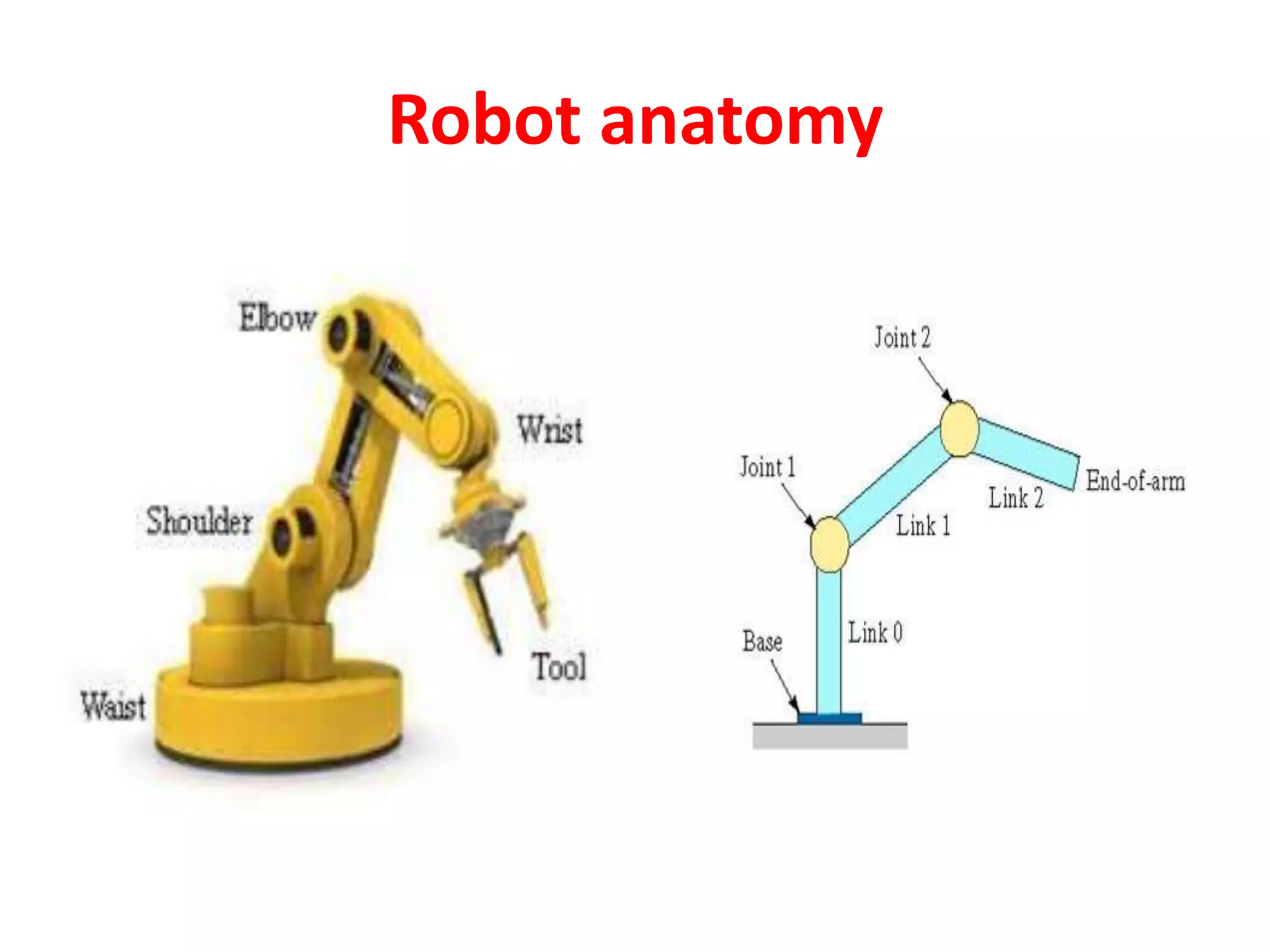
Robot anatomy
Links and Joints
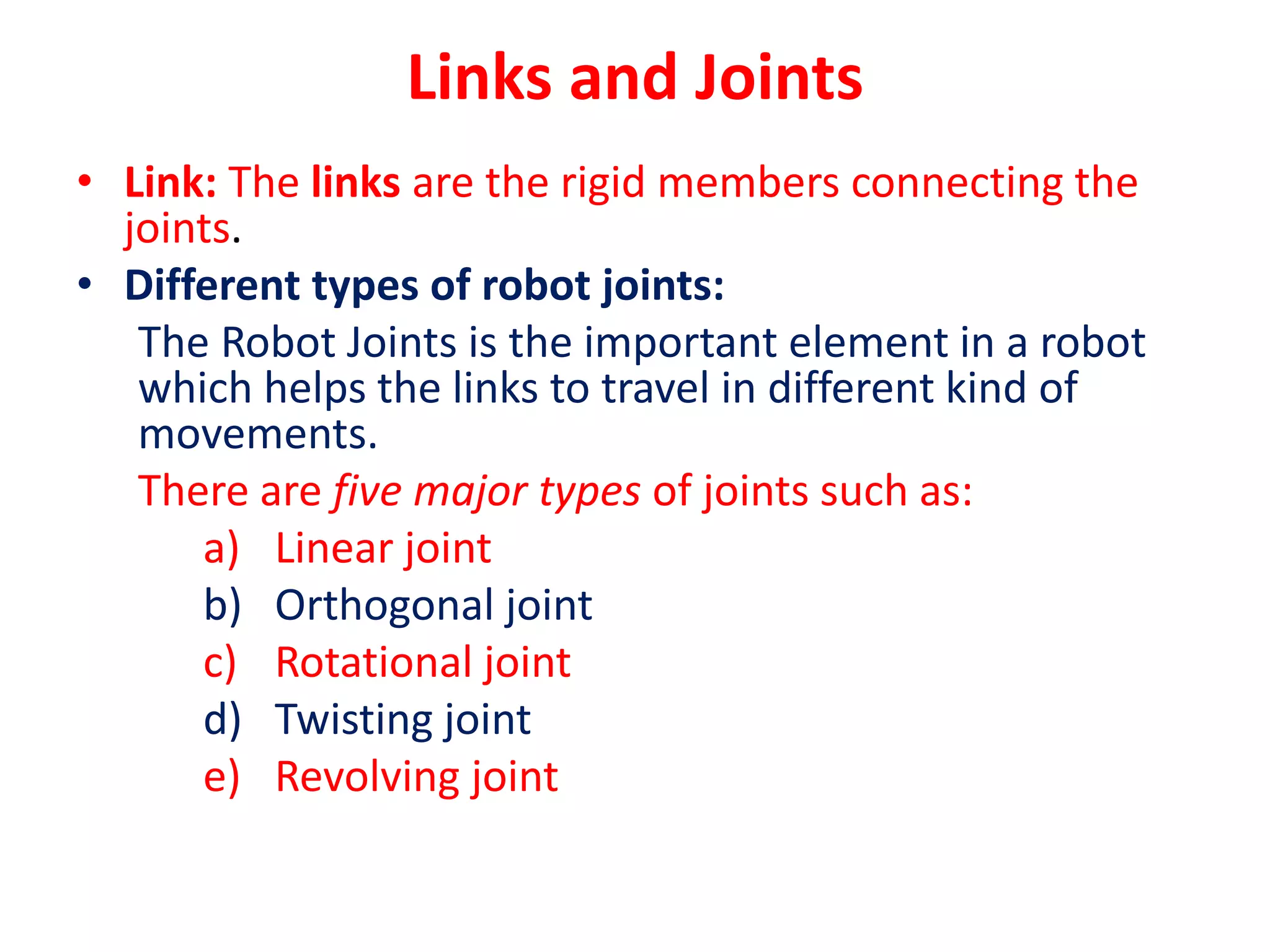
• Link: The links are the rigid members connecting the
joints.
• Different types of robot joints:
The Robot Joints is the important element in a robot
which helps the links to travel in different kind of
movements.
There are five major types of joints such as:
a) Linear joint
b) Orthogonal joint
c) Rotational joint
d) Twisting joint
e) Revolving joint
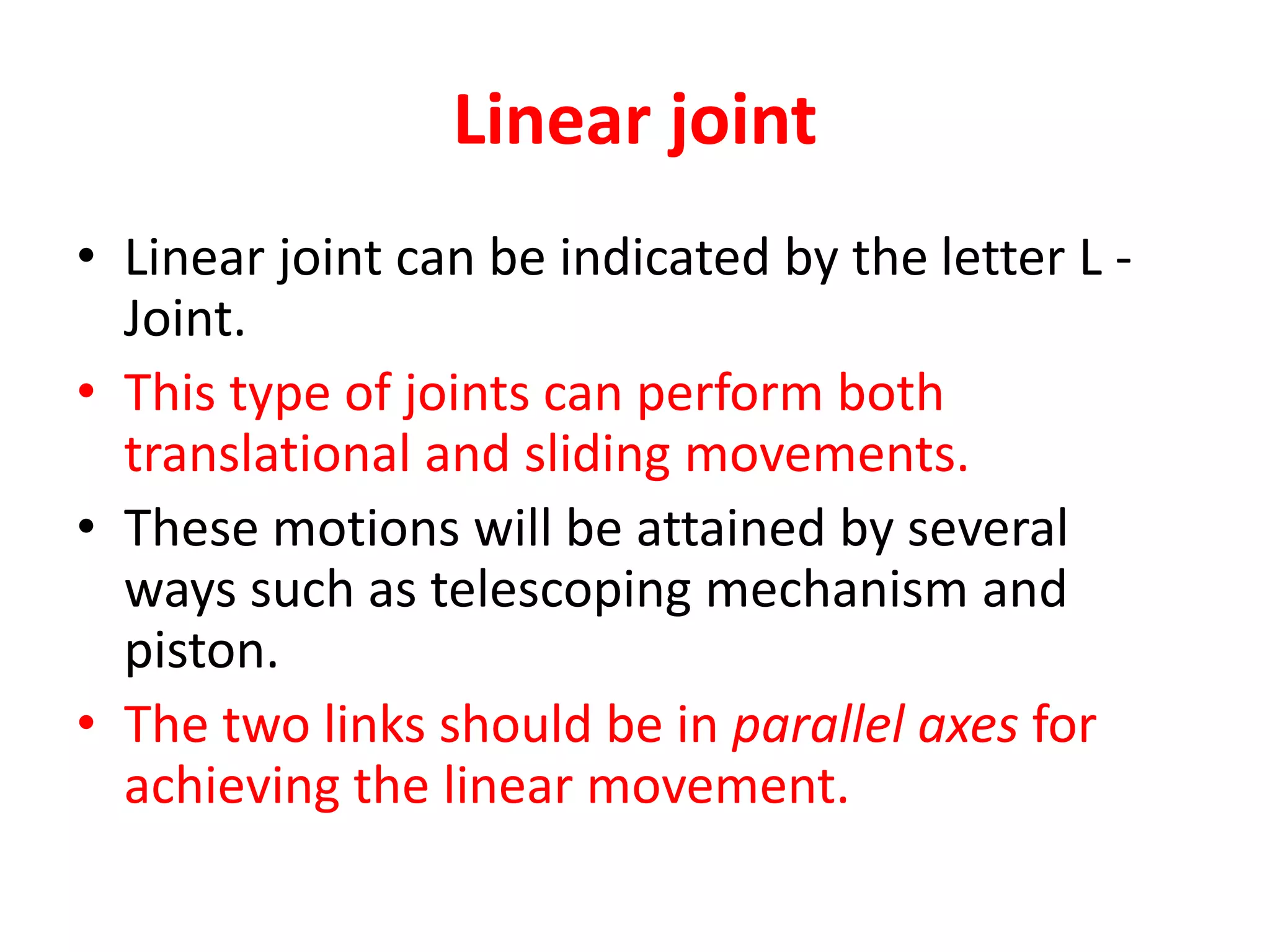
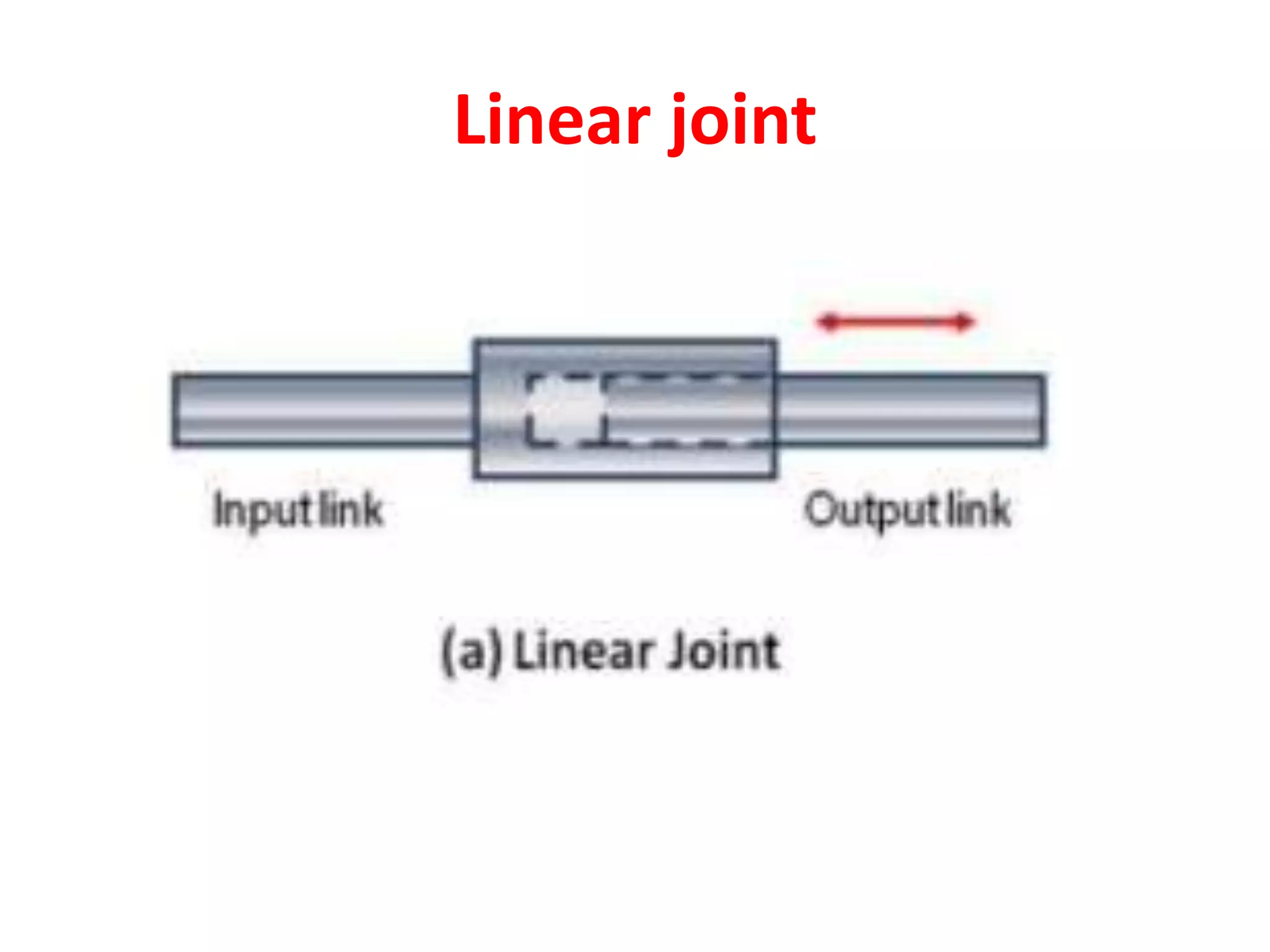
Linear joint
• Linear joint can be indicated by the letter L -
Joint.
• This type of joints can perform both
translational and sliding movements.
• These motions will be attained by several
ways such as telescoping mechanism and
piston.
• The two links should be in parallel axes for
achieving the linear movement.
Linear joint
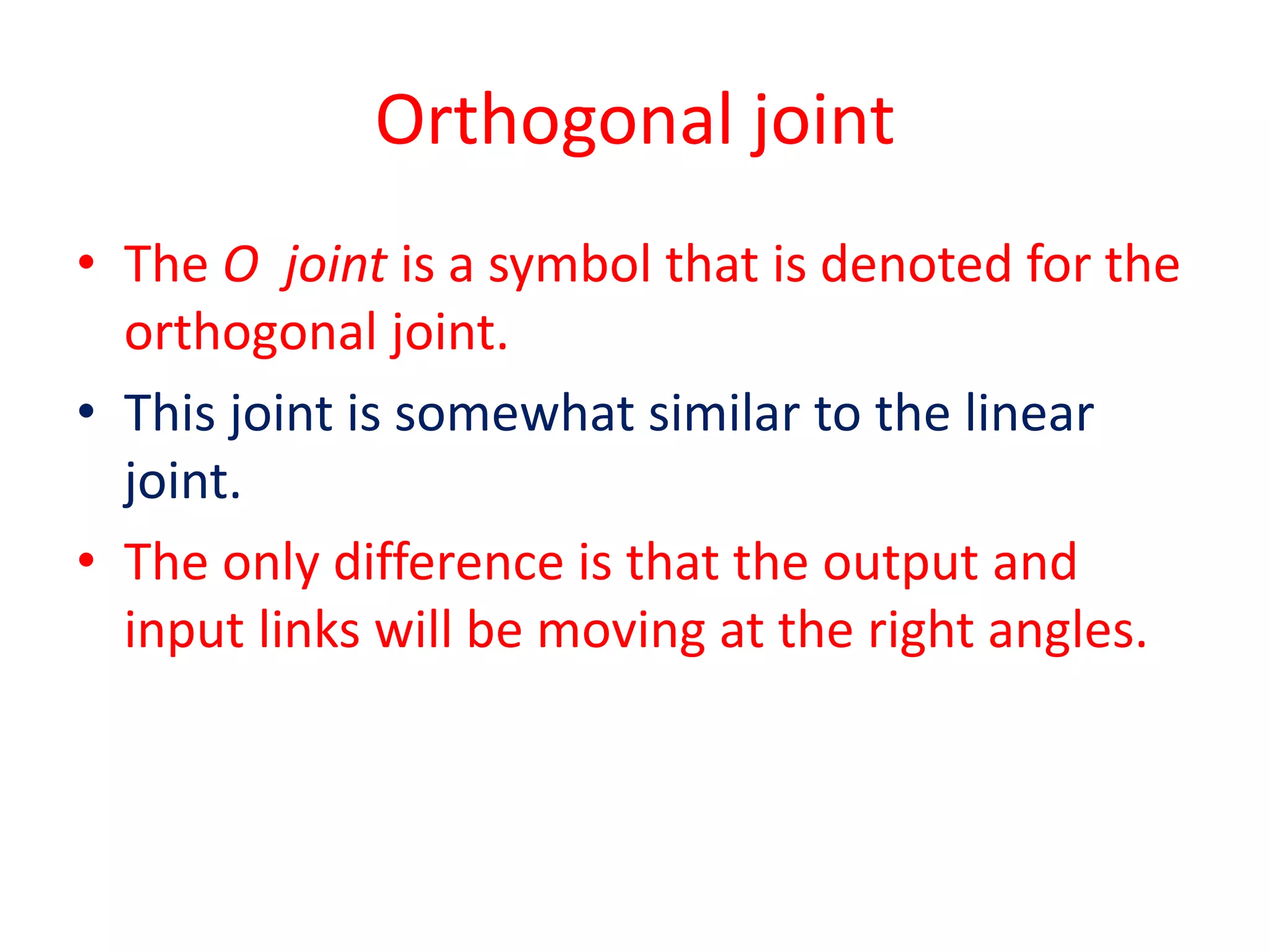
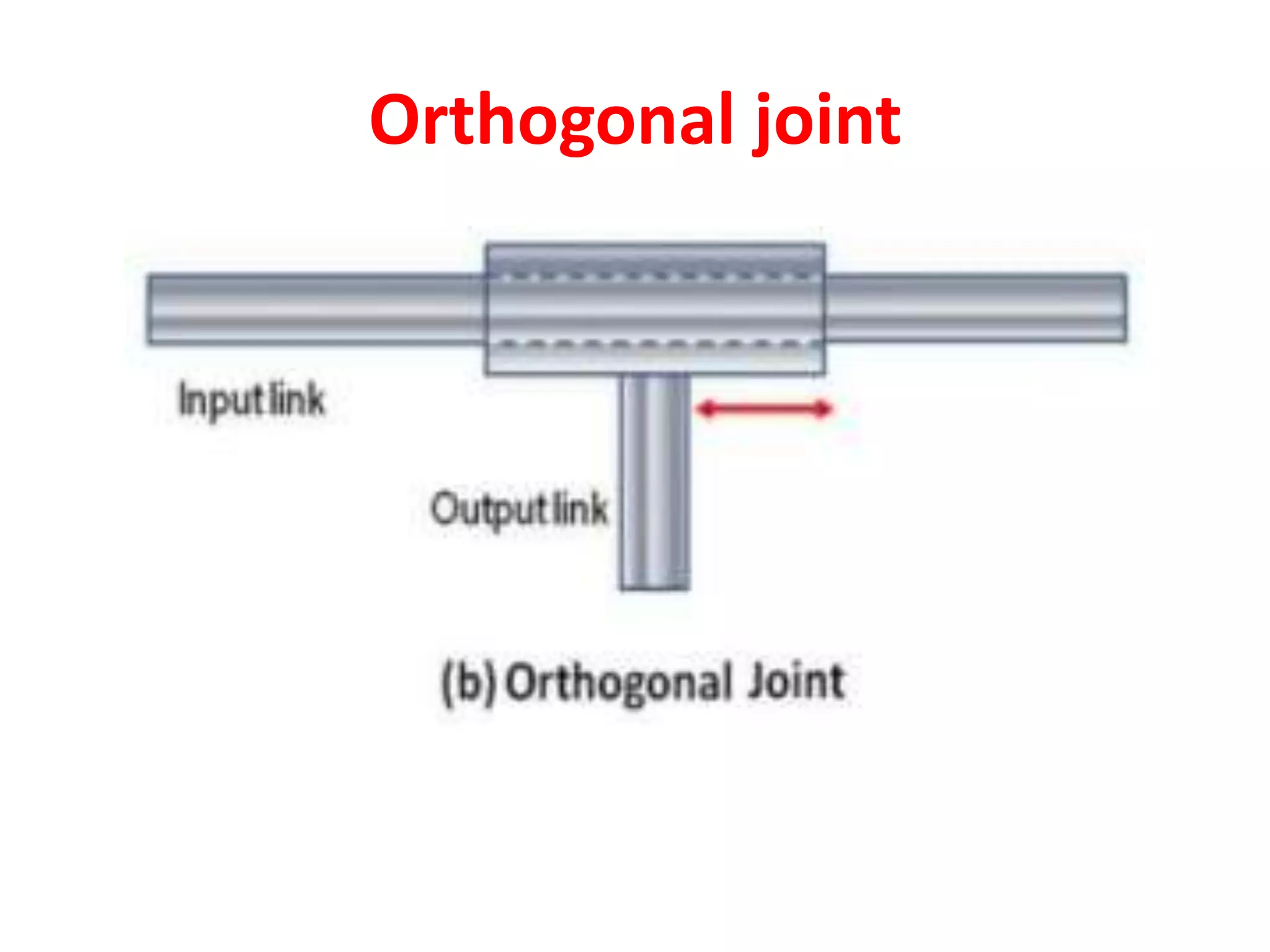
Orthogonal joint
• The O joint is a symbol that is denoted for the
orthogonal joint.
• This joint is somewhat similar to the linear
joint.
• The only difference is that the output and
input links will be moving at the right angles.
Orthogonal joint
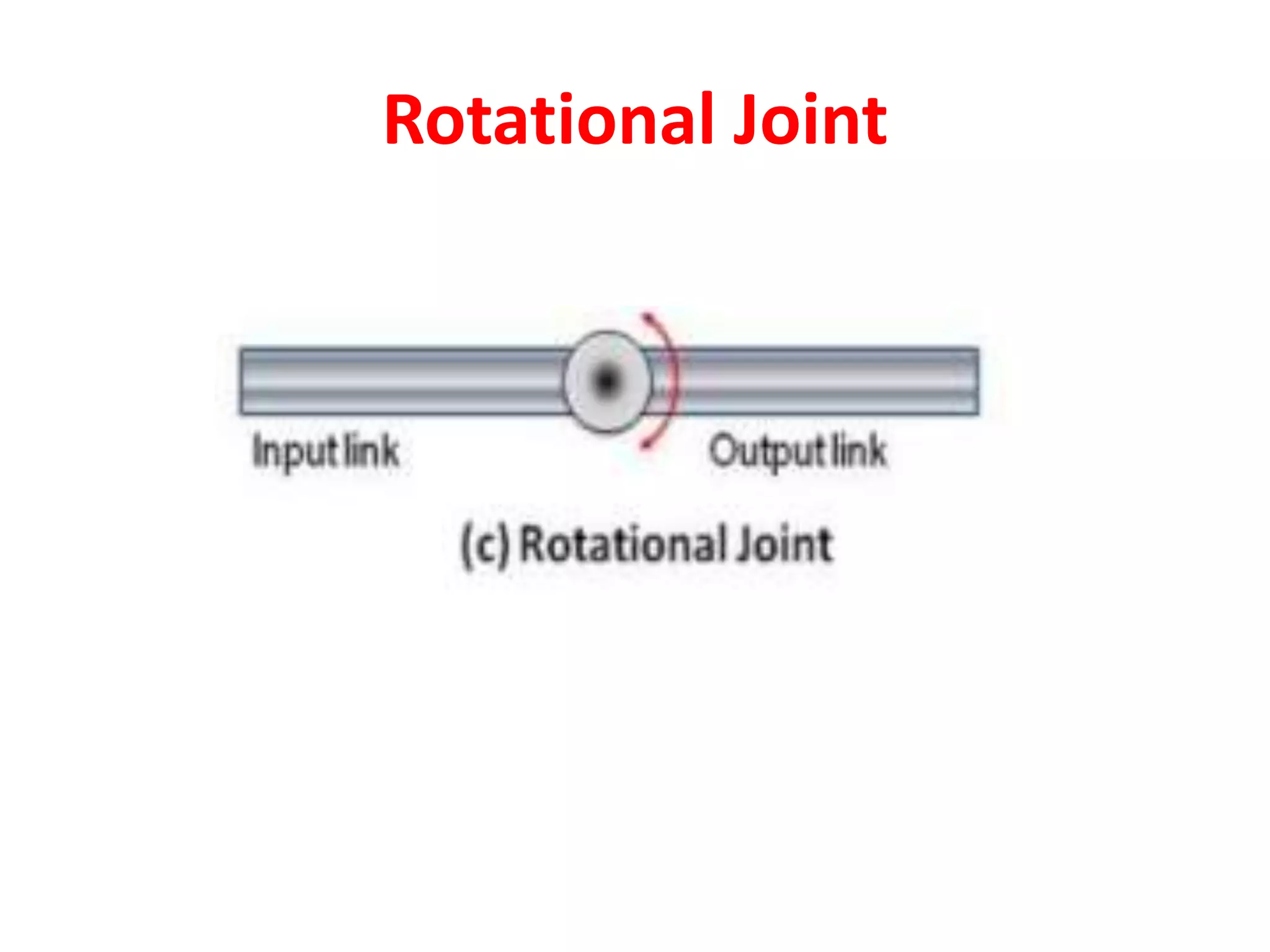
Rotational Joint
• Rotational joint can also be represented as R -
Joint.
• This type will allow the joints to move in
a rotary motion along the axis, which is
vertical to the arm axes.
Rotational Joint
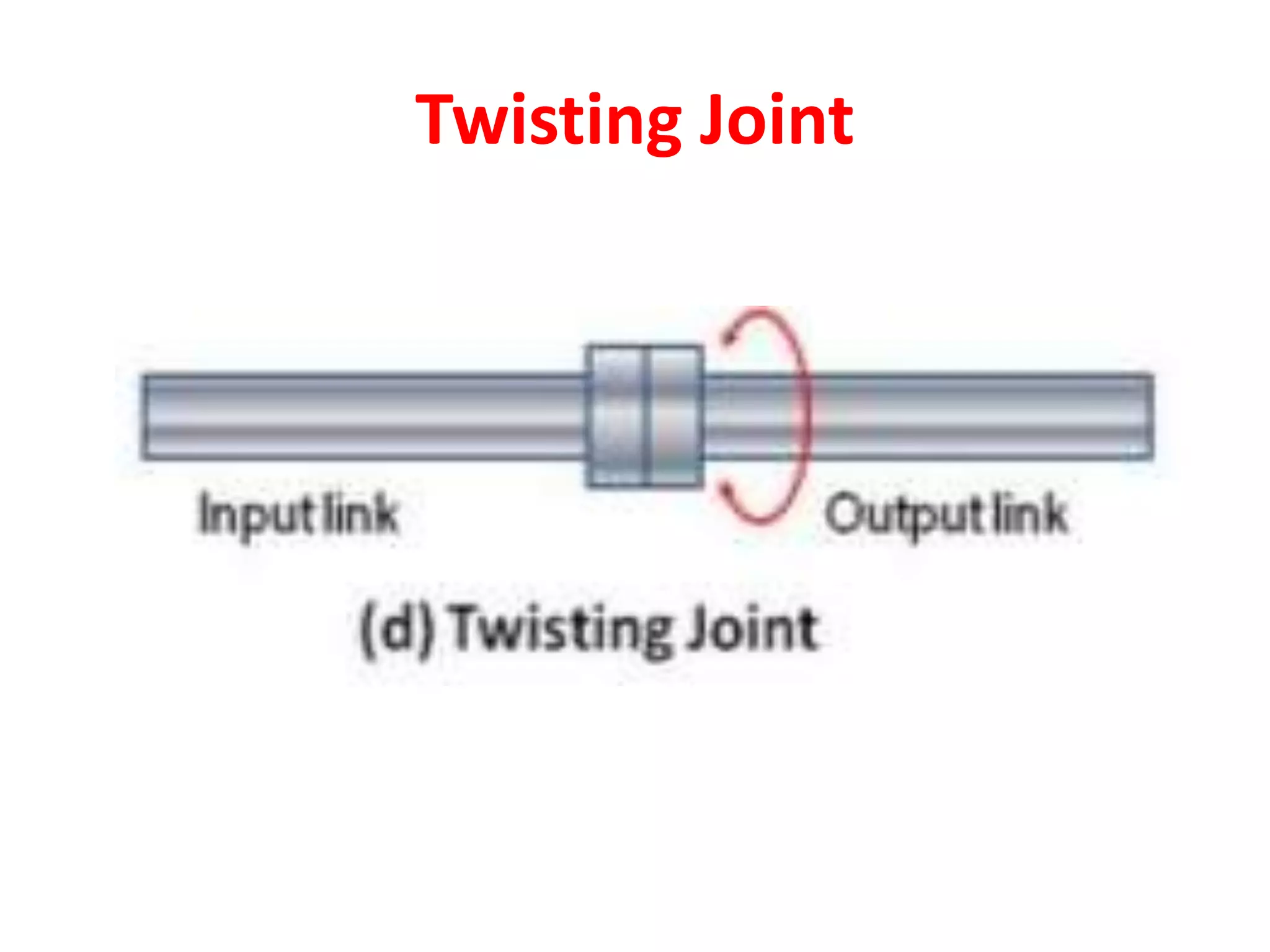
Twisting joint
• Twisting joint will be referred as V- Joint.
• This joint makes twisting motion among the
output and input link.
• During this process, the output link axis will be
vertical to the rotational axis.
• The output link rotates in relation to the input
link.
Twisting Joint
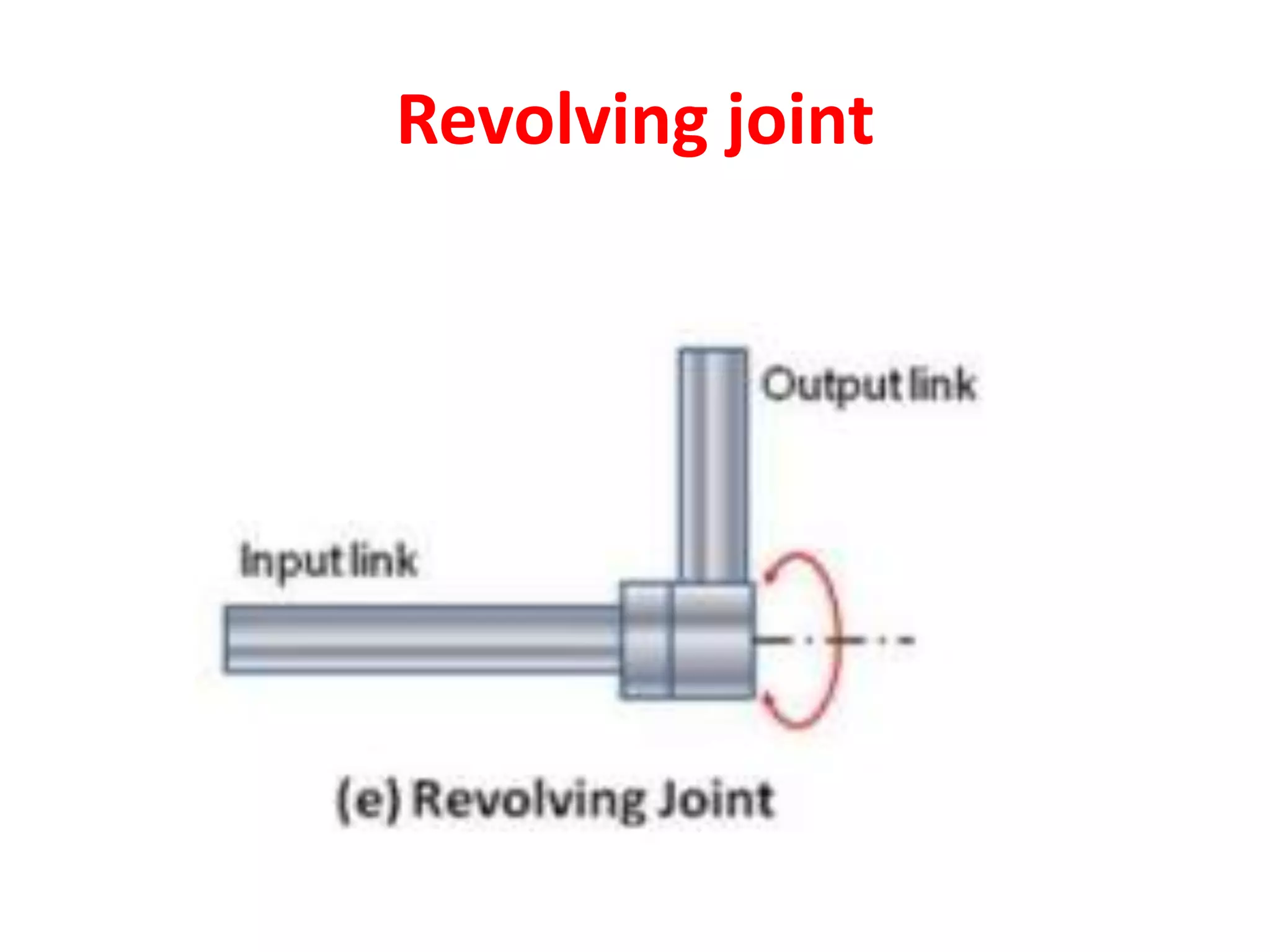
Revolving joint
• Revolving joint is generally known as V -Joint.
• Here, the output link axis is perpendicular to
the rotational axis and the input link
is parallel to the rotational axes.
• As like twisting joint, the output link spins
about the input link.
Revolving joint
Common robot configurations
• The common robot configurations used in the
robotics are as listed below
a) Rectangular configuration or Cartesian
configuration
b) Cylindrical configuration
c) Spherical configuration
d) Jointed arm configuration
e) SCARA configuration
Common robot configurations
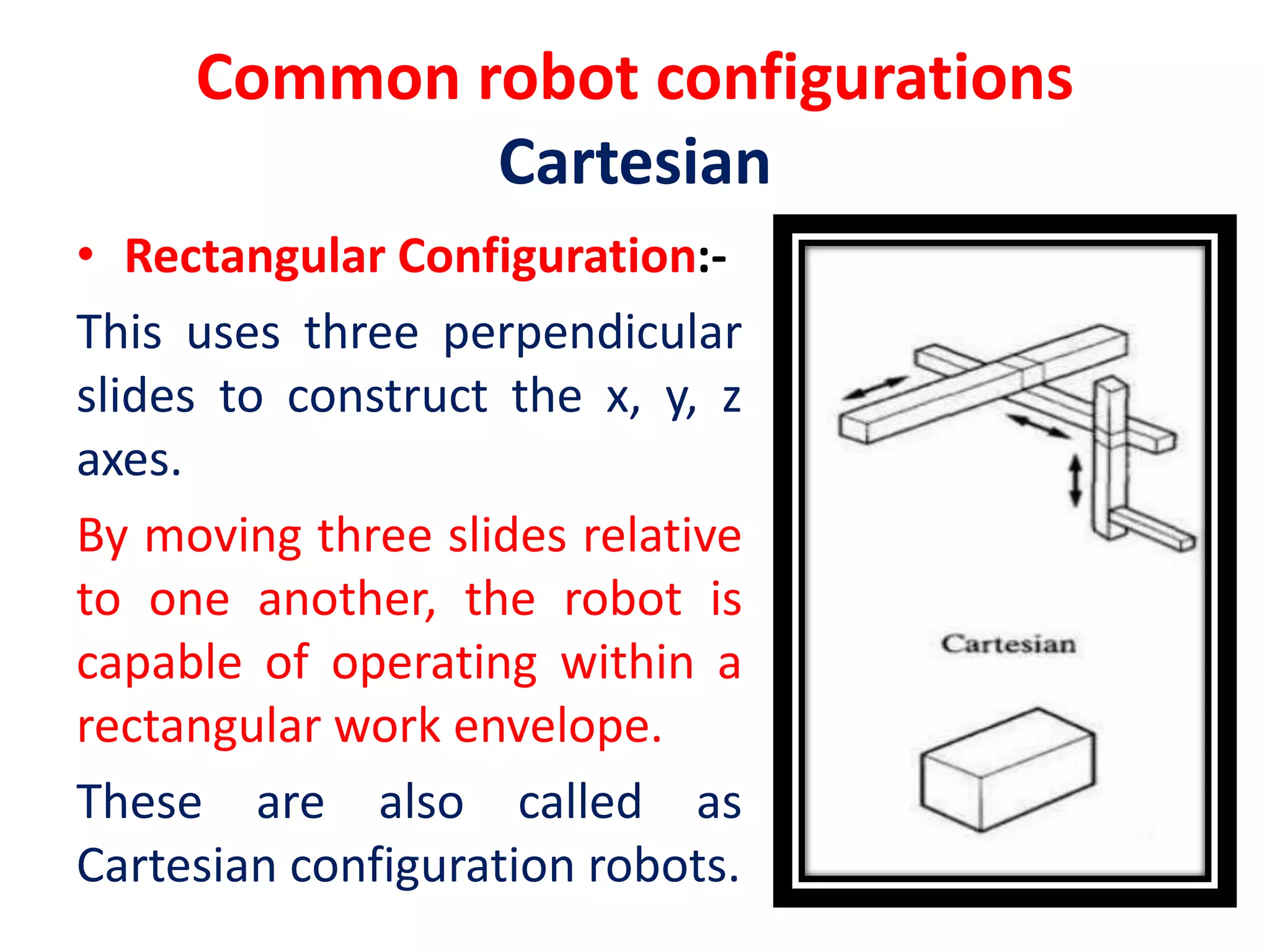
Cartesian
• Rectangular Configuration:-
This uses three perpendicular
slides to construct the x, y, z
axes.
By moving three slides relative
to one another, the robot is
capable of operating within a
rectangular work envelope.
These are also called as
Cartesian configuration robots.
Common robot configurations
Cylindrical Configuration
• Cylindrical Configuration:-
These uses a vertical
column and a slide that can
be moved up and down
along the column.
• The robot arm is attached
to the slide so that it can be
moved radially with respect
to the column.
• By rotting the column the
robot is capable of
retrieving a cylindrical work
envelope.
Common robot configurations
Spherical Configuration
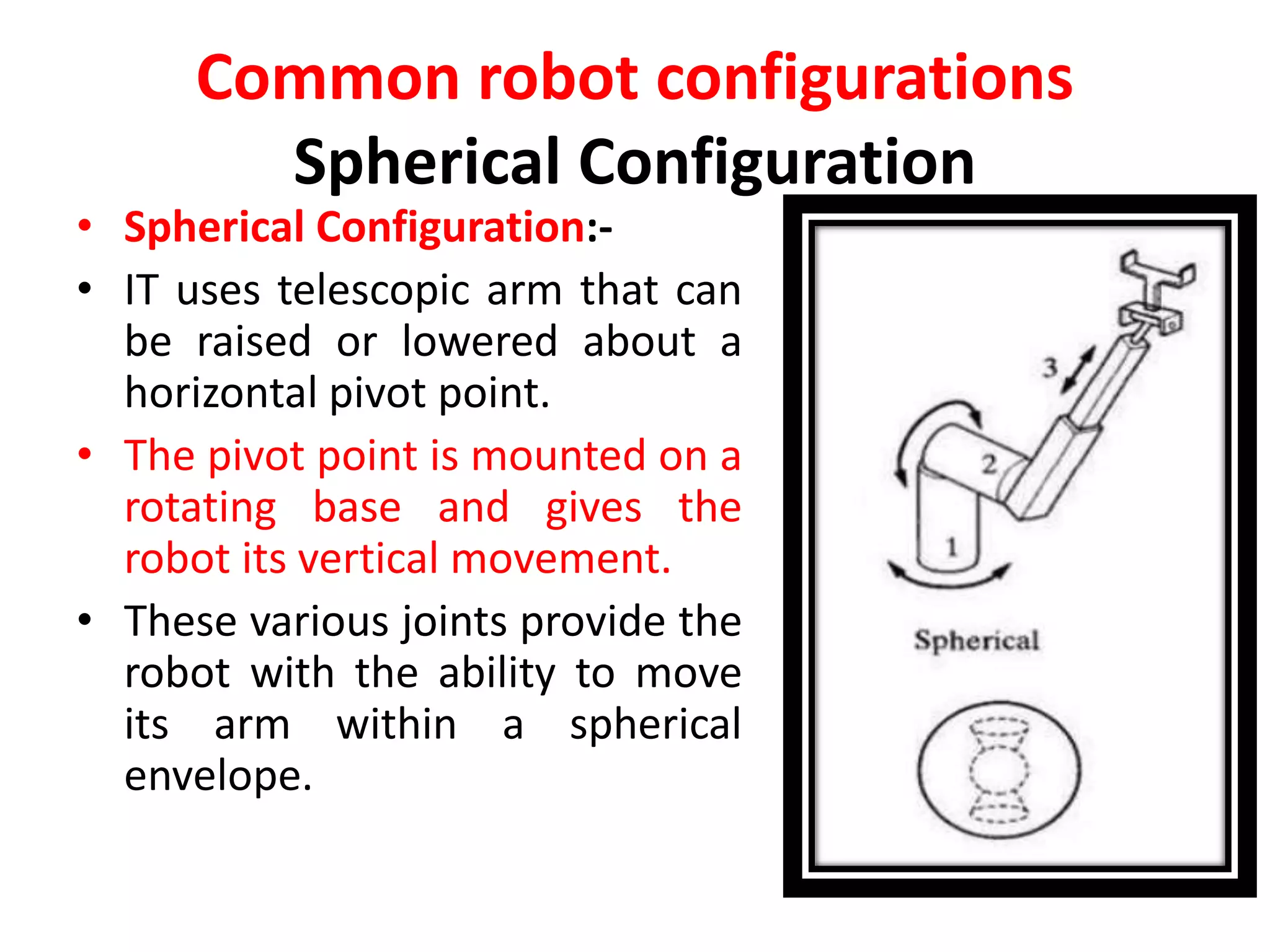
• Spherical Configuration:-
• IT uses telescopic arm that can
be raised or lowered about a
horizontal pivot point.
• The pivot point is mounted on a
rotating base and gives the
robot its vertical movement.
• These various joints provide the
robot with the ability to move
its arm within a spherical
envelope.
Common robot configurations
Jointed arm Configuration
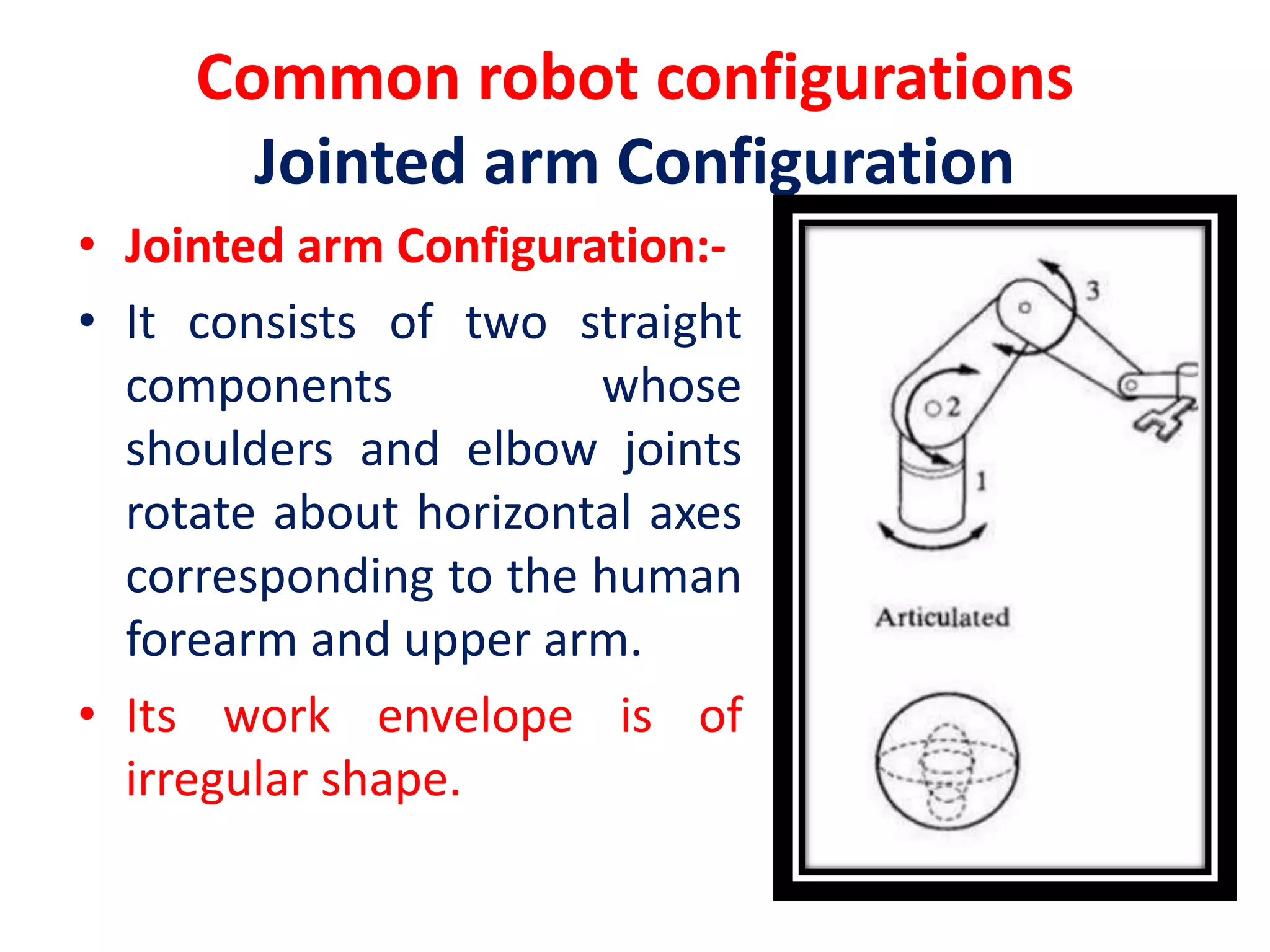
• Jointed arm Configuration:-
• It consists of two straight
components whose
shoulders and elbow joints
rotate about horizontal axes
corresponding to the human
forearm and upper arm.
• Its work envelope is of
irregular shape.
Common robot configurations
Selective Compliant Assembly Robot Arm
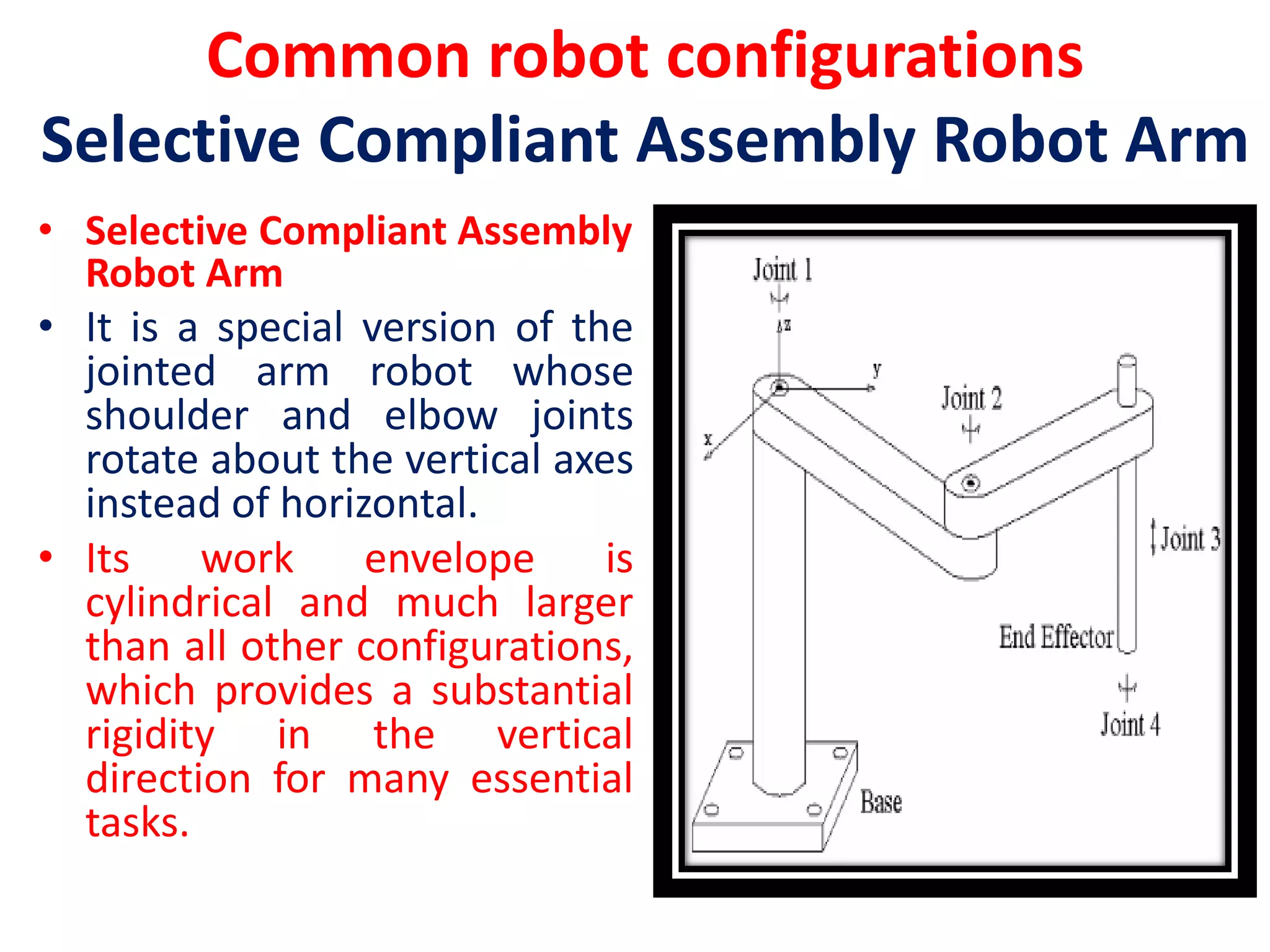
• Selective Compliant Assembly
Robot Arm
• It is a special version of the
jointed arm robot whose
shoulder and elbow joints
rotate about the vertical axes
instead of horizontal.
• Its work envelope is
cylindrical and much larger
than all other configurations,
which provides a substantial
rigidity in the vertical
direction for many essential
tasks.
Applications of robots in material
handling
• Material handling robots can automate some of
the most tedious, dull, and unsafe tasks in a
production line.
• Material handling robots enhance the efficiency
of your production line and increase customer
satisfaction by providing quality products in a
timely manner.
• The term material handling encompasses a wide
variety of product movements on the shop floor.
Applications of robots in material
handling
• Material handling (MH) makes use of the
robot's simple capability to transport objects.
• By fitting the robot with an appropriate end of
arm tool (e.g. gripper), the robot can
efficiently and accurately move product from
one location to another.
ROBOTS APPLICATIONS to MH
• Robot applications can be studied under
present and future applications. under
present applications they can be classified into
three major headings. They are
1. Material Transfer,
2. Machine Loading and Unloading.
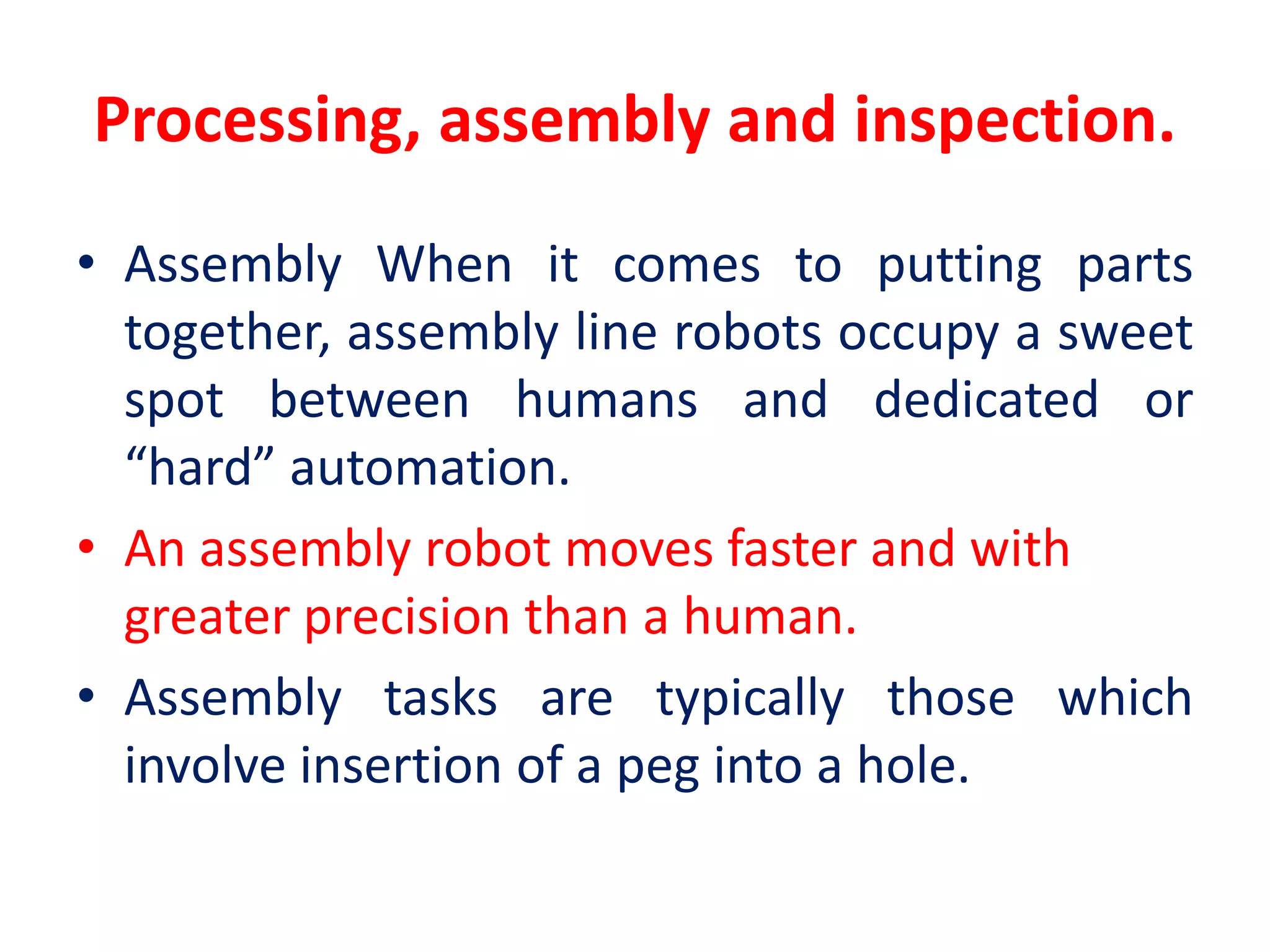
3. Processing operations
4. Assembly and
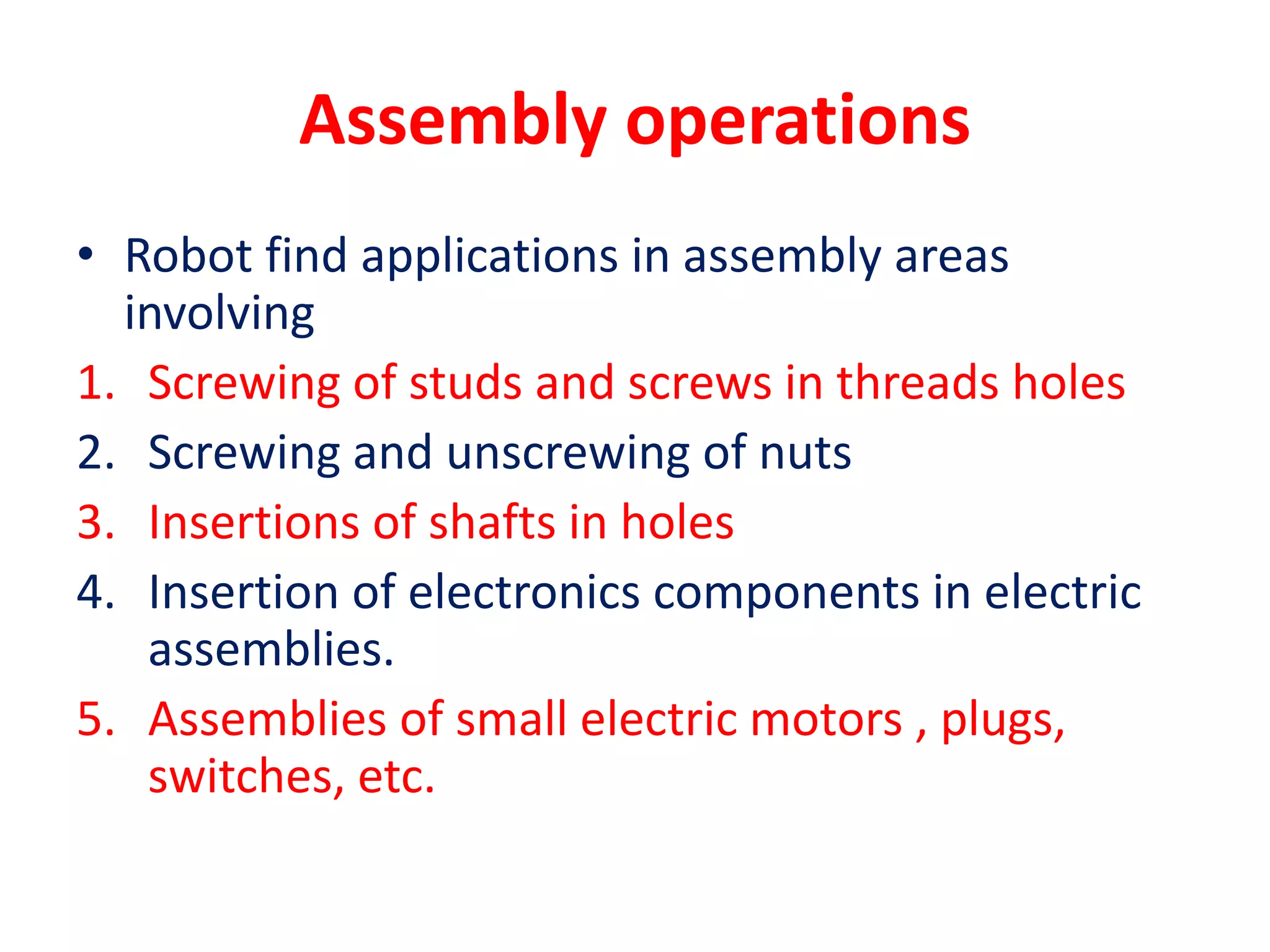
5. Inspection
Material Handling
• Material handling is further classified into two types :
1.Machine loading and unloading
2.Material transfer Material Handling
We use material handling robots to transfer parts from
one machine to another.
Material handling is the combination of art and science
of:
• Moving
• Storing
• Protecting
• Controlling the material
Processing, assembly and inspection.
• Assembly When it comes to putting parts
together, assembly line robots occupy a sweet
spot between humans and dedicated or
“hard” automation.
• An assembly robot moves faster and with
greater precision than a human.
• Assembly tasks are typically those which
involve insertion of a peg into a hole.
Assembly operations
• Robot find applications in assembly areas
involving
1. Screwing of studs and screws in threads holes
2. Screwing and unscrewing of nuts
3. Insertions of shafts in holes
4. Insertion of electronics components in electric
assemblies.
5. Assemblies of small electric motors , plugs,
switches, etc.
Robots in Assembly operations
Robots in Inspection
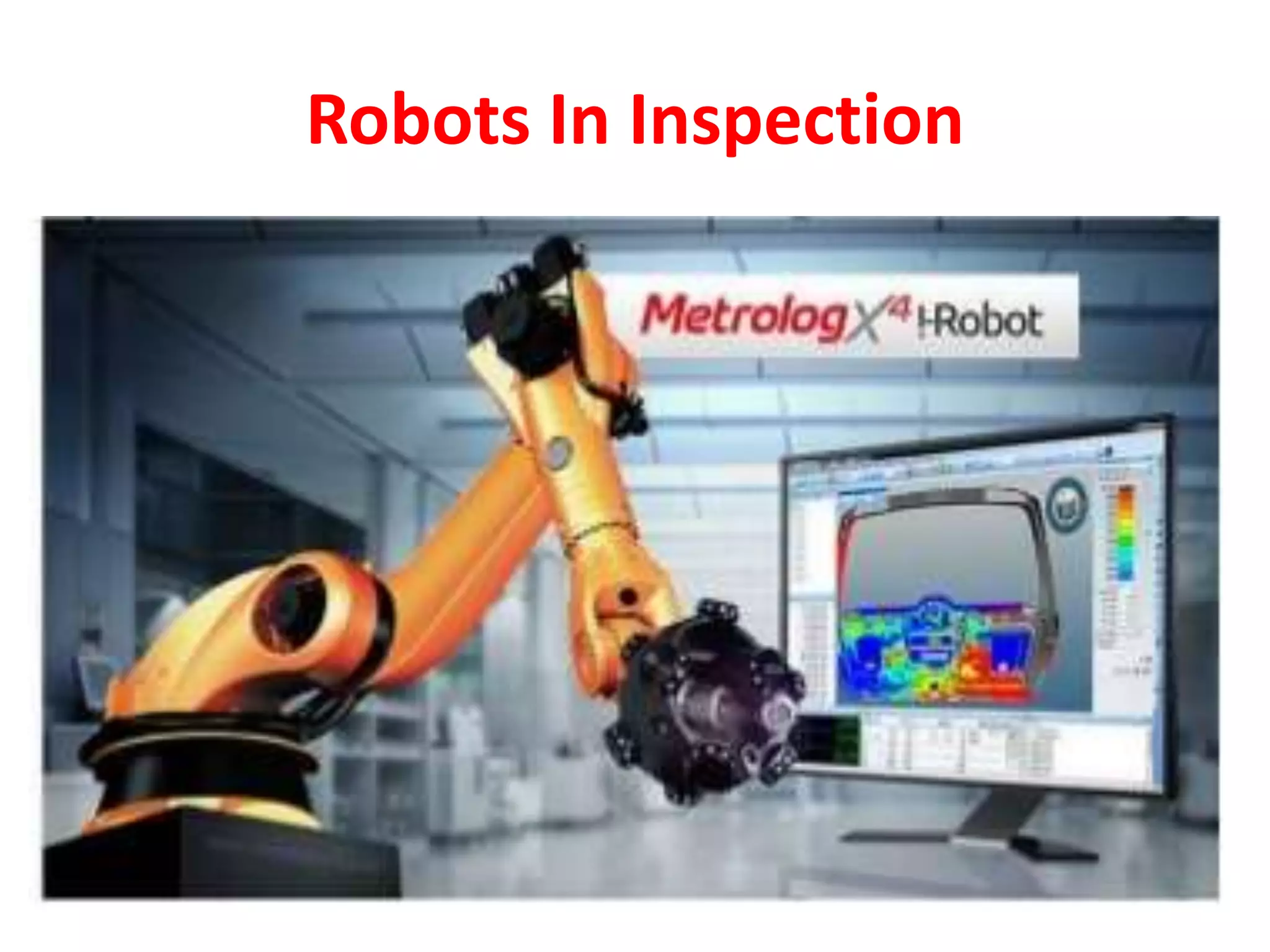
• The inspection of robots will involve some of the
sensors to calculate the worth of a manufactured
part.
• It uses mechanical probe experiments to inspect
the finished parts
• A robot arm with a vision camera can also be
used for non-destructive testing and 3D
measurements.
• It can objectively identify and pinpoint defects or
faulty parts before they are packed or shipped.
Robots In Inspection

Mod 5 robotics

  • 1.
  • 2.
    Contents • Robot anatomy, •Joints and links, • Common robot configurations. • Applications of robots in material handling, • Processing , assembly and inspection.
  • 3.
  • 4.
    Links and Joints •Link: The links are the rigid members connecting the joints. • Different types of robot joints: The Robot Joints is the important element in a robot which helps the links to travel in different kind of movements. There are five major types of joints such as: a) Linear joint b) Orthogonal joint c) Rotational joint d) Twisting joint e) Revolving joint
  • 5.
    Linear joint • Linearjoint can be indicated by the letter L - Joint. • This type of joints can perform both translational and sliding movements. • These motions will be attained by several ways such as telescoping mechanism and piston. • The two links should be in parallel axes for achieving the linear movement.
  • 6.
  • 7.
    Orthogonal joint • TheO joint is a symbol that is denoted for the orthogonal joint. • This joint is somewhat similar to the linear joint. • The only difference is that the output and input links will be moving at the right angles.
  • 8.
  • 9.
    Rotational Joint • Rotationaljoint can also be represented as R - Joint. • This type will allow the joints to move in a rotary motion along the axis, which is vertical to the arm axes.
  • 10.
  • 11.
    Twisting joint • Twistingjoint will be referred as V- Joint. • This joint makes twisting motion among the output and input link. • During this process, the output link axis will be vertical to the rotational axis. • The output link rotates in relation to the input link.
  • 12.
  • 13.
    Revolving joint • Revolvingjoint is generally known as V -Joint. • Here, the output link axis is perpendicular to the rotational axis and the input link is parallel to the rotational axes. • As like twisting joint, the output link spins about the input link.
  • 14.
  • 15.
    Common robot configurations •The common robot configurations used in the robotics are as listed below a) Rectangular configuration or Cartesian configuration b) Cylindrical configuration c) Spherical configuration d) Jointed arm configuration e) SCARA configuration
  • 16.
    Common robot configurations Cartesian •Rectangular Configuration:- This uses three perpendicular slides to construct the x, y, z axes. By moving three slides relative to one another, the robot is capable of operating within a rectangular work envelope. These are also called as Cartesian configuration robots.
  • 17.
    Common robot configurations CylindricalConfiguration • Cylindrical Configuration:- These uses a vertical column and a slide that can be moved up and down along the column. • The robot arm is attached to the slide so that it can be moved radially with respect to the column. • By rotting the column the robot is capable of retrieving a cylindrical work envelope.
  • 18.
    Common robot configurations SphericalConfiguration • Spherical Configuration:- • IT uses telescopic arm that can be raised or lowered about a horizontal pivot point. • The pivot point is mounted on a rotating base and gives the robot its vertical movement. • These various joints provide the robot with the ability to move its arm within a spherical envelope.
  • 19.
    Common robot configurations Jointedarm Configuration • Jointed arm Configuration:- • It consists of two straight components whose shoulders and elbow joints rotate about horizontal axes corresponding to the human forearm and upper arm. • Its work envelope is of irregular shape.
  • 20.
    Common robot configurations SelectiveCompliant Assembly Robot Arm • Selective Compliant Assembly Robot Arm • It is a special version of the jointed arm robot whose shoulder and elbow joints rotate about the vertical axes instead of horizontal. • Its work envelope is cylindrical and much larger than all other configurations, which provides a substantial rigidity in the vertical direction for many essential tasks.
  • 21.
    Applications of robotsin material handling • Material handling robots can automate some of the most tedious, dull, and unsafe tasks in a production line. • Material handling robots enhance the efficiency of your production line and increase customer satisfaction by providing quality products in a timely manner. • The term material handling encompasses a wide variety of product movements on the shop floor.
  • 22.
    Applications of robotsin material handling • Material handling (MH) makes use of the robot's simple capability to transport objects. • By fitting the robot with an appropriate end of arm tool (e.g. gripper), the robot can efficiently and accurately move product from one location to another.
  • 23.
    ROBOTS APPLICATIONS toMH • Robot applications can be studied under present and future applications. under present applications they can be classified into three major headings. They are 1. Material Transfer, 2. Machine Loading and Unloading. 3. Processing operations 4. Assembly and 5. Inspection
  • 24.
    Material Handling • Materialhandling is further classified into two types : 1.Machine loading and unloading 2.Material transfer Material Handling We use material handling robots to transfer parts from one machine to another. Material handling is the combination of art and science of: • Moving • Storing • Protecting • Controlling the material
  • 25.
    Processing, assembly andinspection. • Assembly When it comes to putting parts together, assembly line robots occupy a sweet spot between humans and dedicated or “hard” automation. • An assembly robot moves faster and with greater precision than a human. • Assembly tasks are typically those which involve insertion of a peg into a hole.
  • 26.
    Assembly operations • Robotfind applications in assembly areas involving 1. Screwing of studs and screws in threads holes 2. Screwing and unscrewing of nuts 3. Insertions of shafts in holes 4. Insertion of electronics components in electric assemblies. 5. Assemblies of small electric motors , plugs, switches, etc.
  • 27.
  • 28.
    Robots in Inspection •The inspection of robots will involve some of the sensors to calculate the worth of a manufactured part. • It uses mechanical probe experiments to inspect the finished parts • A robot arm with a vision camera can also be used for non-destructive testing and 3D measurements. • It can objectively identify and pinpoint defects or faulty parts before they are packed or shipped.
  • 29.