WIFI BASED MOBILITY DETECTION
SYSTEM FOR MOBILE AD HOC
SYSTEM
 Haseeb Ahsan
 Arslan Akhter
 Ahmed Butt
 Hafiz Mohammad Bilal
Co-ordinator
Engr Ali Bajwa
By
P a g e 1 | 87
CHAPTER 1
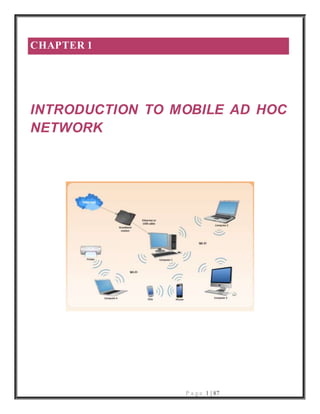
INTRODUCTION TO MOBILE AD HOC
NETWORK
P a g e 2 | 87
TABLE OF CONTENTS
Introduction to Manet
Protocols of Manet
 Table-driven (Proactive)
 On-demand (Reactive)
 Hybrid
Applications
Conclusion
P a g e 3 | 87
ABSTRACT
In the last few decades, we have seen a rapid progress in the field of mobile computing due
to the proliferation of inexpensive, widely available wireless devices. However, current
devices, their workings, applications and protocols are solely focused on cellular or wireless
local area networks (WLANs), not taking into account the great potential offered by mobile
ad hoc networking.
A mobile ad hoc network is an autonomous collection of mobile devices (laptops, smart
phones, sensors, etc.) that communicate with each other over wireless links and cooperate
in a distributed manner in order to provide the necessary network functionality in the
absence of a fixed infrastructure. This type of network, operating as a stand-alone network
or with one or multiple points of attachment to cellular networks or the Internet, paves the
way for numerous new and exciting applications. [1]
Application scenarios include, but are not limited to: emergency and rescue operations,
business associates sharing information during a meeting, soldiers relaying information
for situational awareness on the battlefield and emergency disaster relief personnel
coordinating efforts after a hurricane or earthquake , also provide facility for some
temporary requirement like conference & seminar at new place where there is no earlier
network infrastructure exist and need alternative solution.
INTRODUCTION
Mobile Ad Hoc Network (MANET) is a collection of communication devices or nodes that
wish to communicate without any fixed infrastructure and pre-determined organization
of available links. The node in MANET themselves are responsible for dynamically
discovering other nodes to communicate. It is a self-configuring network of mobile nodes
connected by wireless links the union of which forms an arbitrary topology. The nodes are
free to move randomly and organize themselves arbitrarily; thus, the network’s wireless
topology may change rapidly and unpredictably. [2]
P a g e 4 | 87
Nodes that lie within each other’s send range can communicate directly and are responsible
for dynamically discovering each other. In order to enable communication between nodes
that are not directly within each other’s send range, intermediate nodes act as routers that
relay packets generated by other nodes to their destination. These nodes are often energy
constrained—that is, battery-powered—devices with a great diversity in their capabilities.
Furthermore, devices are free to join or leave the network and they may move randomly,
possibly resulting in rapid and unpredictable topology changes. In this energy-constrained,
dynamic, distributed multi-hop environment, nodes need to organize themselves
dynamically in order to provide the necessary network functionality in the absence of fixed
infrastructure or central administration. [1]
The concept of mobile ad hoc networking is not a new one and its origins can be traced back
to the DARPA Packet Radio Network project in 1972. Then, the advantages such as flexibility,
mobility, resilience and independence of fixed infrastructure, elicited immediate interest
among military, police and rescue agencies in the use of such networks under dis organized
or hostile environments. For a long time, ad hoc network research stayed in the realm of the
military, and only in the middle of 1990, with the advent of commercial radio technologies,
did the wireless research community become aware of the great potential and advantages of
mobile ad hoc networks outside the military domain, witnessed by the creation of the Mobile
Ad Hoc Networking working groupwithin the IETF.
Networks (MANETs) are characterized by a dynamic, multi-hop, rapid changing topology.
Such networks are aimed to provide communication capabilities to areas where limited or no
communication infrastructures exist.
P a g e 5 | 87
CHARACTERISTICS AND COMPLEXITIES OF
MOBILE AD HOC NETWORKS
 Autonomous and infrastructure less
 Multi-hoprouting
 Device heterogeneity
 Energy constrained operation
 Network scalability
 Self-creation, self-organization and self-administration
 Follows a dynamic topology i.e nodes may join or leave the
network at any time.
 Limited bandwidth and limited power
 Needs limited physical security
REASON TO BE PREFER OVER FIXED
INFRASTRUCTRE
Fixed infrastructure is the one that have a centralized base for communication like that of
Cellular system.
In addition, these networks are faced with the traditional problems such as lower reliability
than wired media, limited physical security, timevarying channels, interference, etc.
P a g e 6 | 87
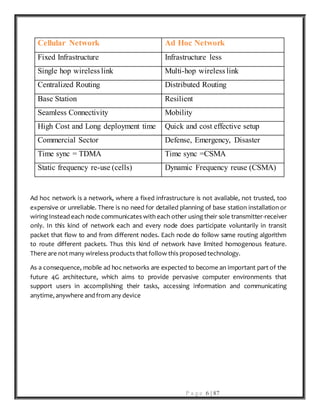
Cellular Network Ad Hoc Network
Fixed Infrastructure Infrastructure less
Single hop wireless link Multi-hop wireless link
Centralized Routing Distributed Routing
Base Station Resilient
Seamless Connectivity Mobility
High Cost and Long deployment time Quick and cost effective setup
Commercial Sector Defense, Emergency, Disaster
Time sync = TDMA Time sync =CSMA
Static frequency re-use (cells) Dynamic Frequency reuse (CSMA)
Ad hoc network is a network, where a fixed infrastructure is not available, not trusted, too
expensive or unreliable. There is no need for detailed planning of base station installation or
wiring Instead each node communicates with each other using their sole transmitter-receiver
only. In this kind of network each and every node does participate voluntarily in transit
packet that flow to and from different nodes. Each node do follow same routing algorithm
to route different packets. Thus this kind of network have limited homogenous feature.
There are not many wireless products that follow this proposed technology.
As a consequence, mobile ad hoc networks are expected to become an important part of the
future 4G architecture, which aims to provide pervasive computer environments that
support users in accomplishing their tasks, accessing information and communicating
anytime, anywhere and from any device
P a g e 7 | 87
ROUTING IN MOBILE
AD HOC NETWORKS
The absence of fixed infrastructure in a MANET poses several types of challenges. The
biggest challenge among them is routing. Routing is the process of selecting paths in a
network along which to send data packets. An ad hoc routing protocol is a convention, or
P a g e 8 | 87
standard, that controls how nodes decide which way to route packets between computing
devices in a mobile ad-hoc network.
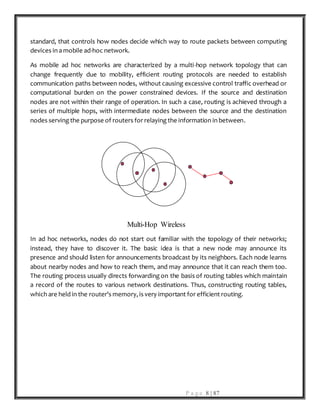
As mobile ad hoc networks are characterized by a multi-hop network topology that can
change frequently due to mobility, efficient routing protocols are needed to establish
communication paths between nodes, without causing excessive control traffic overhead or
computational burden on the power constrained devices. If the source and destination
nodes are not within their range of operation. In such a case, routing is achieved through a
series of multiple hops, with intermediate nodes between the source and the destination
nodes serving the purpose of routers for relaying the information in between.
Multi-Hop Wireless
In ad hoc networks, nodes do not start out familiar with the topology of their networks;
instead, they have to discover it. The basic idea is that a new node may announce its
presence and should listen for announcements broadcast by its neighbors. Each node learns
about nearby nodes and how to reach them, and may announce that it can reach them too.
The routing process usually directs forwarding on the basis of routing tables which maintain
a record of the routes to various network destinations. Thus, constructing routing tables,
which are held in the router's memory, is very important for efficient routing.
P a g e 9 | 87
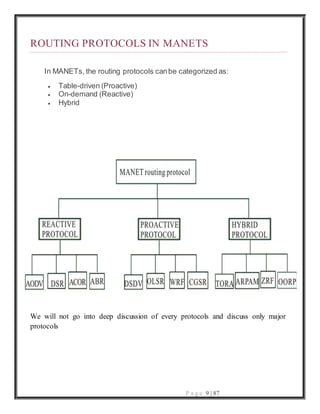
ROUTING PROTOCOLS IN MANETS
In MANETs, the routing protocols canbe categorized as:
 Table-driven (Proactive)
 On-demand (Reactive)
 Hybrid
We will not go into deep discussion of every protocols and discuss only major
protocols
P a g e 10 | 87
PROACTIVE ROUTING PROTOCOLS
A proactive approach to MANET routing seeks to maintain a constantly updated topology
understanding. Each node in the network has routing table for the broadcast of the
data packets and want to establish connection to other nodes in the network. These
nodes record for all the presented destinations, number of hops required to arrive at
each destination in the routing table. To retain the stability, each station broadcasts and
modifies its routing table from time to time. How many hops are required to arrive that
particular node and which stations are accessible is result of broadcasting of packets
between nodes.
We introduce three popular proactive routing protocols
 DSDV
 WRP
 OLSR
Besides the three popular protocols, there are many other proactive routing protocols for
MNAET, such as CGSR, HSR, MMRPand so on.
 DESTINATION-SEQUENCED DISTANCE VECTOR (DSDV)
Destination-Sequenced Distance-Vector Routing (DSDV) is a table-driven routing scheme for
ad hoc mobile networks based on the Bellman-Ford algorithm. It was developed by C.
Perkins and P. Bhagwat in 1994.The main contribution of the algorithm was to solve the
routing loop problem. Each entry in the routing table contains a sequence number. If a link
presents the sequence numbers are even generally, otherwise an odd number is used. The
number is generated by the destination, and the emitter needs to send out the next update
with this number. Routing information is distributed between nodes by sending full dumps
infrequently and smaller incremental updates more frequently. [2]
P a g e 11 | 87
Advantages
DSDV was one of the early algorithms available. It is quite suitable for creating ad hoc
Networks with small number of nodes.
Disadvantages
DSDV requires a regular update of its routing tables, which uses up battery power and a
small amount of bandwidth even when the network is idle. Also, whenever the topology of
the network changes, a new sequence number is necessary before the network re-
converges; thus, DSDV is not suitable for highly dynamic networks
 WIRELESS ROUTING PROTOCOL (WRP)
The Wireless Routing Protocol (WRP) is a proactive unicast routing protocol for MANETs.
WRP uses an enhanced version of the distance-vector routing protocol, which uses the
Bellman-Ford algorithm to calculate paths. Because of the mobile nature of the nodes within
the MANET, the protocol introduces mechanisms which reduce route loops and ensure
reliable message exchanges.
The wireless routing protocol (WRP), similar to DSDV, inherits the properties of
the distributed Bellman-Ford algorithm. To solve the count-to-infinity problem and to enable
faster convergence, it employs a unique method of maintaining information regarding the
shortest path to every destination node and the penultimate hop node on the path to every
destination node in the network. Since WRP, like DSDV, maintains an up-to-date view of the
network, every node has a readily available route to every destination node in the network.
It differs from DSDV in table maintenance and in the update procedures. While DSDV
maintains only one topology table, WRP uses a set of tables to maintain more accurate
information. The tables that are maintained by a node are the following: distance table (DT),
routing table (RT), link cost table (LCT), and a message retransmission list (MRL). [4]
Distance Table
P a g e 12 | 87
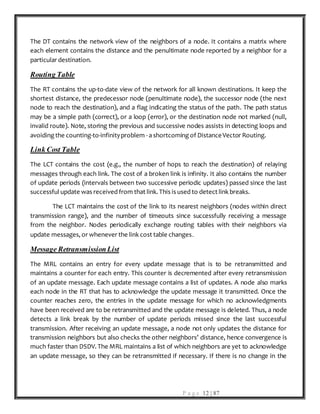
The DT contains the network view of the neighbors of a node. It contains a matrix where
each element contains the distance and the penultimate node reported by a neighbor for a
particular destination.
Routing Table
The RT contains the up-to-date view of the network for all known destinations. It keep the
shortest distance, the predecessor node (penultimate node), the successor node (the next
node to reach the destination), and a flag indicating the status of the path. The path status
may be a simple path (correct), or a loop (error), or the destination node not marked (null,
invalid route). Note, storing the previous and successive nodes assists in detecting loops and
avoiding the counting-to-infinityproblem - a shortcoming of DistanceVector Routing.
Link Cost Table
The LCT contains the cost (e.g., the number of hops to reach the destination) of relaying
messages through each link. The cost of a broken link is infinity. It also contains the number
of update periods (intervals between two successive periodic updates) passed since the last
successful update was received from that link. This is used to detect link breaks.
The LCT maintains the cost of the link to its nearest neighbors (nodes within direct
transmission range), and the number of timeouts since successfully receiving a message
from the neighbor. Nodes periodically exchange routing tables with their neighbors via
update messages, or whenever the link cost table changes.
Message RetransmissionList
The MRL contains an entry for every update message that is to be retransmitted and
maintains a counter for each entry. This counter is decremented after every retransmission
of an update message. Each update message contains a list of updates. A node also marks
each node in the RT that has to acknowledge the update message it transmitted. Once the
counter reaches zero, the entries in the update message for which no acknowledgments
have been received are to be retransmitted and the update message is deleted. Thus, a node
detects a link break by the number of update periods missed since the last successful
transmission. After receiving an update message, a node not only updates the distance for
transmission neighbors but also checks the other neighbors’ distance, hence convergence is
much faster than DSDV. The MRL maintains a list of which neighbors are yet to acknowledge
an update message, so they can be retransmitted if necessary. If there is no change in the
P a g e 13 | 87
routing table, a node is required to transmit a “hello” message to affirm its connectivity.
When an update message is received, a node updates its distance table and reassesses the
best route paths. It also carries out a consistency check with its neighbors, to help eliminate
loops and speed up convergence.
Advantages
WRP has the same advantage as that of DSDV. In addition, it has faster convergence and
involves fewer table updates.
Disadvantages
The complexity of maintenance of multiple tables demands a larger memory and greater
processing power from nodes in the wireless ad hoc network. At high mobility, the control
overhead involved in updating table entries is almost the same as that of DSDV and hence is
not suitable for a highly dynamic and for a very large ad hoc wireless network as it suffers
from limited scalability.
 OPTIMIZED LINK STATE ROUTING (OLSR)
As the name suggests, it uses the link-state scheme in an optimized manner to diffuse
topology information. In a classic link-state algorithm, link-state information is flooded
throughout the network. OLSR uses this approach as well, but since the protocol runs in
wireless multi-hop scenarios the message flooding in OLSR is optimized to preserve
bandwidth. The optimization is based on a technique called Multi Point Relaying. [2]
Being a table-driven protocol, OLSR operation mainly consists of updating and maintaining
information in a variety of tables. The data in these tables is based on received control traffic,
and control traffic is generated based on information retrieved from these tables. The route
calculation itself is also driven by the tables
OLSR defines three basic types of control messages those are,
HELLO
HELLO messages are transmitted to all neighbors. These messages are used for neighbor
sensing and MPR calculation.
P a g e 14 | 87
TC
Topology Control messages are the link state signaling done by OLSR. This messaging is
optimized in several ways using MPRs.
MID
Multiple Interface Declaration messages are transmitted by nodes running OLSR on more
than one interface. These messages lists all IP addresses used by a node.
Advantages
Being a proactive protocol, routes to all destinations within the network are known and
maintained before use. Having the routes available within the standard routing table can be
useful for some systems and network applications as there is no route discovery delay
associated with finding a new route.
Disadvantages
The original definition of OLSR does not include any provisions for sensing of link quality; it
simply assumes that a link is up if a number of hello packets have been received recently.
This assumes that links are bi-modal (either working or failed), which is not necessarily the
case on wireless networks, where links often exhibit intermediate rates of packet loss.
REACTIVE (ON-DEMAND) PROTOCOLS
Reactive routing is also known as on-demand routing protocol since they don’t maintain
routing information or routing activity at the network nodes if there is no
communication. They do not maintain or constantly update their route tables with the latest
route topology. If a node wants to send a packet to another node then this protocol
searches for the route in an on-demand manner and establishes the connection in order to
transmit and receive the packet. It employs flooding (global search) concept. Route
P a g e 15 | 87
discovery process is used in on demand routing by flooding the route request (RREQ)
packets throughout the network.
Reactive routing protocols are the
 Dynamic source Routing (DSR)
 Ad hoc on-demand distance vector routing (AODV)
 AssociativityBasedRouting (ABR)
 Admission Control enabled On demand Routing (ACOR)
We will discuss them one by one.
 DYNAMIC SOURCE ROUTING (DSR)
Dynamic Source Routing (DSR) is a routing protocol for wireless mesh networks and is based
on a method known as source routing. It is similar to AODV in that it forms a route on-
demand when a transmitting computer requests one. Except that each intermediate node
that broadcasts a route request packet adds its own address identifier to a list carried in the
packet. The destination node generates a route reply message that includes the list of
addresses received in the route request and transmits it back along this path to the source.
DSR uses Route Discovery process to send the data packets from sender to receiver
node for which it does not already know the route, it uses a route discovery process to
dynamically determine such a route. In Route discovery DSR works by flooding the data
packets in network with route request (RREQ) packets. RREQ packets are received by
every neighbor nodes and continue this flooding process by retransmissions of RREQ
packets, unless it gets destination or its route cache consists a route for
destination .Such a node replies to the RREQ with a route reply (RREP) packet that
is routed back to real source node .source routing uses RREQ and RREP packets. The
RREQ builds up the path traversed across the network. The RREP routes itself back to
the source by traversing this path toward the back. The source caches backward
route by RREP packets for upcoming use. [5]
P a g e 16 | 87
Route Maintains will also work If any connection on a source route is wrecked, a route
error (RERR) packet is notified to the source node.
The protocol consists of twomajor phases
 Route Discovery
 Route Maintenance
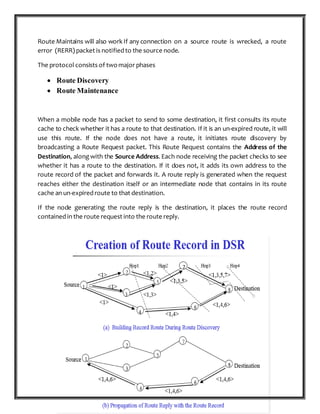
When a mobile node has a packet to send to some destination, it first consults its route
cache to check whether it has a route to that destination. If it is an un-expired route, it will
use this route. If the node does not have a route, it initiates route discovery by
broadcasting a Route Request packet. This Route Request contains the Address of the
Destination, along with the Source Address. Each node receiving the packet checks to see
whether it has a route to the destination. If it does not, it adds its own address to the
route record of the packet and forwards it. A route reply is generated when the request
reaches either the destination itself or an intermediate node that contains in its route
cache an un-expired route to that destination.
If the node generating the route reply is the destination, it places the route record
contained in the route request into the route reply.
P a g e 17 | 87
 AD HOC ON-DEMAND DISTANCE VECTOR ROUTING
(AODV)
The ad-hoc on demand distance vector (AODV) is routing protocol enables multi-hop
routing between participating mobile nodes wishing to establish and maintain an ad-hoc
network. AODV is distance vector type routing where it does not involve nodes to
maintain routes to destination that are not on active path. As long as end points are valid
AODV does not play its part. Different route messages like Route Request, Route Replies
and Route Errors are used to discover and maintain links. UDP/IP is used to receive and
get messages. AODV uses a destination sequence number for each route created by
destination node for any request to the nodes. A route with maximum sequence number
is selected. To find a new route the source node sends Route Request message to the
network till destination is reached or anode with fresh route is found. Then Route Reply is
sent back to the source node. The nodes on active route communicate with each other by
passing hello messages periodically to its immediate neighbor. If anode does not receive
then it deletes the node from its list and sends Route Error to all the members in the
active members in the route. [2]
AODV uses sequence numbers maintained at each destination to determine freshness of
routing information and to prevent routing loops. All routing packets carry these
sequence numbers. [6]
ROUTING LOOPS
P a g e 18 | 87
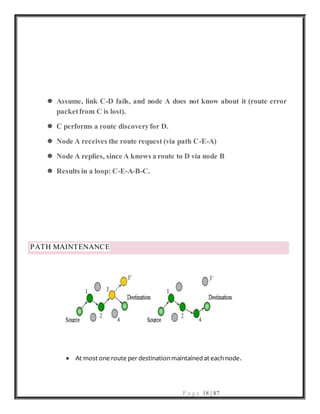
 Assume, link C-D fails, and node A does not know about it (route error
packetfrom C is lost).
 C performs a route discoveryfor D.
 Node A receives the route request (via path C-E-A)
 Node A replies, since A knows a route to D via node B
 Results in a loop: C-E-A-B-C.
PATH MAINTENANCE
 At most one route per destination maintained at each node.
P a g e 19 | 87
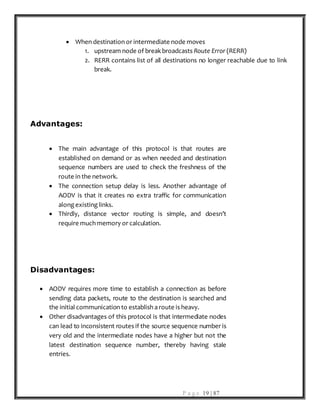
 When destination or intermediate node moves
1. upstream node of break broadcasts Route Error (RERR)
2. RERR contains list of all destinations no longer reachable due to link
break.
Advantages:
 The main advantage of this protocol is that routes are
established on demand or as when needed and destination
sequence numbers are used to check the freshness of the
route in the network.
 The connection setup delay is less. Another advantage of
AODV is that it creates no extra traffic for communication
along existing links.
 Thirdly, distance vector routing is simple, and doesn’t
require much memory or calculation.
Disadvantages:
 AODV requires more time to establish a connection as before
sending data packets, route to the destination is searched and
the initial communication to establish a route is heavy.
 Other disadvantages of this protocol is that intermediate nodes
can lead to inconsistent routes if the source sequence number is
very old and the intermediate nodes have a higher but not the
latest destination sequence number, thereby having stale
entries.
P a g e 20 | 87
 Thirdly, multiple RREP packets in response to a single RREQ
packet can lead to heavy control overhead.
 ASSOCIATIVITY BASED ROUTING (ABR)
Toh proposes the ABR algorithm which considers route stability as the most important factor
in selecting a route. Routes are discovered by broadcasting a broadcast query request packet.
Using these packets, the destination becomes aware of all possible routes between itself
and the source. The ABR algorithm maintains a ‘‘degree of associativity’’ by using a
mechanism called associativity ticks. Each node maintains a tick value for each neighbors,
which is increase by one every time a periodic link layer HELLO message is received from the
neighbor. Once the tick value reaches a specified threshold value, it means that the route is
stable. If the neighbor goes out of the range, then the tick value is reset to zero. Hence a tick
level above the threshold value is an indicator of a rather stable association between these
two nodes. Once a destination has received the broadcast query packets, it has to decide
which path to select by checking the tick-associativity of the nodes. The route with the
highest degree of associativity is selected since it is considered the most stable of the
available routes. [7]
HYBRID ROUTING PROTOCOLS
Hybrid Routing Protocols combines the merits of proactive and reactive routing
protocols by overcoming their demerits. Combinations of proactive and reactive protocols,
where nearby routes (for example, maximum two hops) are kept up-to-date proactively,
P a g e 21 | 87
while far-away routes are set up reactively, are also possible and fall in the category of hybrid
routing protocols.
In this section we put some light on existing hybrid routing protocol someare as follows
 Zone Routing Protocol (ZRP)
 Temporarily Ordered Routing Algorithm (TORA)
 Ad-hoc Routing Protocol for Aeronautical Mobile Ad hoc Networks (ARPAM)
 Order One MANET Routing Protocol (OORP)
Here we will discuss only major protocols.
 ZONE ROUTING PROTOCOL (ZRP)
Zone routing protocol is a hybrid routing protocol which effectively combines the best
features of proactive and reactive routing protocol .The key concept is to use a
proactive routing scheme within a limited zone in the r -hop neighborhood of every node,
and use reactive routing scheme for nodes beyond this zone. An Intra-zone routing protocol
(IARP) is used in the zone where particular node employs proactive routing whereas
inter-zone routing protocol (IERP) is used outside the zone. The routing zone of a given
nodes is a subsetof the network, within which all nodes are reachable within less than or
equal to the zone radius hops. The IERP is responsible for finding paths to the nodes
which are not within the routing zone. When a node S wants to send data to node D, it
checks whether node D is within its zone. If yes packet is delivered directly using IARP. If
not then it broadcasts (uses unicast to deliver the packet directly to border nodes) the REQ
packet to its peripherals nodes. If any peripheral nodes find D in its zone, it sends RREP
packet; otherwise the node re broadcasts the RREQ packet to the peripherals nodes.
This procedure is repeated until node D is located. [4]
 TEMPORARILY ORDERED ROUTING ALGORITHM (TORA)
P a g e 22 | 87
The Temporally Ordered Routing Algorithm (TORA) is a highly adaptive, efficient and scalable
distributed routing algorithm based on the concept of link reversal [3]. TORA is proposed for
highly dynamic mobile, multi-hop wireless networks. It is a source-initiated on-demand
routing protocol. It finds multiple routes from a source node to a destination node. The main
feature of TORA is that the control messages are localized to a very small set of nodes near
the occurrence of a topological change. To achieve this, the nodes maintain routing
information about adjacent nodes. [5]
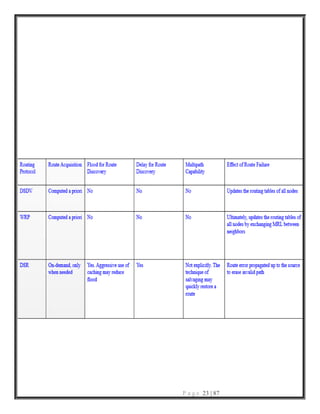
COMPARISON
At the end I want to make a comparisonof all the protocols we have discussed above.
P a g e 23 | 87
P a g e 24 | 87
APPLICATION OF MANET
Applications for MANETs are wide ranging and have use in many critical situations. With
the increase of portable devices as well as progress in wireless communication, ad hoc
Networking is gaining importance with the increasing number of widespread applications
in Commercial, Military and private sectors. Mobile Ad-Hoc Networks allow users to access
and exchange information regardless of their geographic position or proximity to
infrastructure. In contrast to the infrastructure networks, all nodes in MANETs are mobile
and their connections are dynamic. Unlike other mobile networks, MANETs do not require
a fixed infrastructure. This offers an advantageous decentralized character to the network.
Decentralization makes the networks moreflexible and more robust.
Military battlefield:
Ad-Hoc networking would allow the military to take advantage of commonplace network
technology to maintain an information network between the soldiers, vehicles, and
military information head quarter. Military equipment now routinely contains some sort of
computer equipment. The basic techniques ofad hoc network came from this field.
Commercial Sector:
Ad hoc can be used in emergency/rescue operations for disaster relief efforts, e.g. in fire,
flood, or earthquake. Emergency rescue operations must take place where non-existing or
damaged communications infrastructure and rapid deployment of a communication
P a g e 25 | 87
network is needed. This may be because all of the equipment was destroyed, or perhaps
because the region is too remote. Rescuers must be able to communicate in order to
make the best use of their energy, but also to maintain safety. By automatically
establishing a data network with the communications equipment that the rescuers are
already carrying, their jobmade easier.
Low Level:
Appropriate low level application might be in home networks where devices can
communicate directly to exchange information. Similarly in other civilian environments
like taxicab, sports stadium, boat and small aircraft, mobile ad hoc communications will
have many applications. Ad-Hoc networks can autonomously link an instant and
temporary multimedia network using notebook computers to spread and share
information among participants at a e.g. conference or classroom.
Sensor Networks:
This technology is a network composed of a very large number of small sensors. These
can be used to detect any number of properties of an area. Examples include temperature,
pressure, toxins, pollutions, etc. The capabilities of each sensor are very limited, and each
must rely on others in order to forward data to a central computer. Individual sensors are
limited in their computing capability and are prone to failure and loss. Mobile ad-hoc
sensor networks could be the key to future homeland security.
Collaborative work:
For some business environments, the need for collaborative computing might be more
important outside office environments than inside and where people do need to have
outside meetings to cooperate and exchange information on a given project.
Ad Hoc Networks for Cooperative Mobile Positioning:
P a g e 26 | 87
We can use MANET for the detecting the position of a mobile node. Localization in
wireless ad-hoc network has it many advantages our GPS. Currently, we employs GPS
(which is now a day most popular source for positioning) for localization. Mobile Handsets
embedded with GPS receivers causing huge increase in costs, size and battery
consumption. However, it is also known that the GPS is not always the most suitable
solution for localization. In adverse environments, such as outdoor urban canyons and
indoor, it is not an easy task to obtain location information, due to the signal blocking,
multipath conditions and the infeasibility to have a continuous tracking of at least four
satellites. So, we can apply MANET here which compensates these problem for
localization.
Vehicular Ad Hoc Network (VANET):
Recent advances in wireless networks have led to the introduction of a new type of
networks called Vehicular Networks. Vehicular Ad Hoc Network (VANET) is a form of
Mobile Ad Hoc Networks (MANET). VANETs provide us with the infrastructure for
developing new systems to enhance drivers’ and passengers’ safety and comfort. VANETs
are distributed self-organizing networks formed between moving vehicles equipped with
wireless communication devices. This type of networks is developed as part of the
Intelligent Transportation Systems (ITS) to bring significant improvement to the
transportation systems performance. One of the main goals of the (ITS) is to improve
safety on the roads, and reduce traffic congestion, waiting times, and fuel consumptions.
The integration of the embedded computers, sensing devices, navigation systems (GPS),
digital maps, and the wireless communication devices along with intelligent algorithms
will help to develop numerous types of applications for the ITS to improve safety on the
roads. The up to date information provided by the integration of all these systems helps
drivers to acquire real-time information about road conditions allowing them to react on
time. For example, warning messages sent by vehicles involved in an accident enhances
traffic safety by helping the approaching drivers to take proper decisions before entering
the crash dangerous zone. And Information about the current transportation conditions
facilitate driving by taking new routes in case of congestion, thus saving time and
adjusting fuel consumption. In addition to safety concerns, VANET can also support other
non-safety applications that require a Quality of Service (QOS) guarantee. This includes
Multimedia (e.g., audio/video) and data (e.g., toll collection, internet access,
weather/maps/ information) applications.
P a g e 27 | 87
Personal area networkand Bluetooth:
A personal area network is a short range, localized network where nodes are usually
associated with a given person. Short-range MANET such as Bluetooth can simplify the
inter communication between various mobile devices such as a laptop, and a mobile
phone.
Education:
In education field MANET can apply for campus and university settings. Different campus
can link and communicate with each other. It also provide ad-hoc communication during
meetings or lectures.
Entertainment:
MANET is also a source of entertainment. Multi-users games, wireless point-to-point
networking and outdoor internet access can be provided by it.
Coverage Extension:
Being an infrastructure-less and without central administration control, wireless ad-hoc
networking is playing a more and more important role in extending the coverage of
traditional wireless infrastructure(cellular networks, wireless LAN).
CONCLUSION
The rapid evolution in the field of mobile computing is driving a new alternative way for
mobile communication, in which mobile devices form a self-creating, self-organizing and self-
administering wireless network, called a mobile ad hoc network. Its intrinsic flexibility, lack of
infrastructure, ease of deployment, auto-configuration, low cost and potential applications
make it an essential part of future pervasive computing environments.
As a special type of network, Mobile Ad hoc Networks (MANETs) have received increasing
research attention in recent years. There are many active research projects concerned with
MANETs. Mobile ad hoc networks are wireless networks that use multi-hop routing instead
of static networks infrastructure to providenetwork connectivity.
P a g e 28 | 87
So Final remarks of Mobile ad hoc Network are that they have,
 No fixed Infrastructure
 No centralized Access
 Dynamic Topology(Mobility)
 Collection of mobile devices
 Multi hoprouting
 Self – Organizing
 Energy Conservation
 Scalability: Thousands of Nodes
 Security Issues
 Bandwidth Constrained
REFERENCES
[1] Jeroen Hoebeke, Ingrid Moerman, Bart Dhoedt and Piet Demeester, “An Overview
of Mobile Ad Hoc Networks: Applications and Challenges”pp. 1-2
[2] S. A. Ade & P.A.Tijare, “Performance Comparison of AODV, DSDV, OLSR and
DSR Routing Protocols in Mobile Ad Hoc Networks”, Volume 2, No. 2, pp. 1-3, July-
December 2010
[3] Amit Shrivastava, Aravinth Raj Shanmogavel, Avinash Mistry, Nitin Chander,
Prashanth Patlolla, Vivek Yadlapalli, “Overview of Routing Protocols in MANET’s
and Enhancementsin Reactive Protocols”
[4] Prof. Dr. C. A. Dhote, Prof M.A.Pund, Prof. R.S. Mangrulkar, Mr. Makarand R.
Shahade, “Hybrid Routing Protocol with Broadcast Reply for Mobile Ad hoc Network”
Volume 1, No. 10, pp.1-3, 2010
[5] Anuj K. Gupta, Dr. Harsh Sadawarti, Dr. Anil K. Verma, “Performance analysis of
AODV, DSR & TORA Routing Protocols” Vol.2, No.2, April 2010
P a g e 29 | 87
[6] Basu Dev Shivahare, Charu Wahi, Shalini Shivhare, “Comparison Of Proactive
And Reactive Routing Protocols In Mobile Adhoc Network Using Routing Protocol
Property” Volume 2, Issue 3, March 2012
[7] Azzedine Boukerche, Begumhan Turgut, Nevin Aydin, Mohammad Z. Ahmad,
Ladislau Bölöni, Damla Turgut, “Routing protocols in ad hoc networks: A survey”
Computer Networks 55 (2011) 3032–3080
[8] L Raja et al, International Journal of Computer Science and Mobile Computing,
Vol.3 Issue.1, January- 2014, pg. 408-417.
[9] Zaydoun Yahya Rawashdeh and Syed Masud Mahmud, “Communication in
Vehicular Networks,” in Mobile Ad-Hoc Network: Applications, th ed. Xin Wang, Ed.
In Tech: 30 January 2011, pp. 19-20.
[10] Francescantonio Della Rosa, Helena Leppäkoski, Ata-ul Ghalib, Leyla Ghazanfari,
Oscar Garcia, Simone Frattasi and Jari Nurmi, “Ad Hoc Networks for Cooperative
Mobile Positioning” in Mobile Ad-Hoc Network: Applications , th ed. Xin Wang, Ed.
In Tech: 30 January 2011, pp. 289-290.
P a g e 30 | 87
CHAPTER 2
REVIEW OF LITERATURE
P a g e 31 | 87
TABLE OF CONTACTS
P a g e 32 | 87
Communication has always been a field where man has been trying to bring
advancements. Computer networks have evolved to be a separate domain
communication in last decade. Expertise and liking for the subject lead towards
research in MANET.
SIMULATION ENVIRONMENT AND PARAMETERS
In this section we will study about the research work of different authors, how they use
the protocol to solve the problems, what challenges they have to face and what are their
future works. Till now there are many contributions which strive to develop energy
efficient networking planning and routing in Manet.
CLASSIFICATION OF PROTOCOLS
MANET broadly can be classified into three categories such as
 Reactive protocol
 Proactive protocol
 Hybrid protocol
P a g e 33 | 87
REACTIVE PROTOCOL
Reactive protocol also called as on demand routing protocol. Reactive protocol is
based upon some sort of query –reply dialog. Reactive protocol is better than the
proactive protocol. Most of time everyone can use the reactive protocol because it is
an on-demand routing protocol. For example reactive protocols are AODV, PAAMODV
etc...
PROACTIVE PROTOCOL
In the proactive protocol all the nodes maintains the information about the next node.
All the nodes of any protocol have to relay it’s entire to its adjacent nodes. The nodes
send the packet data from one node to the other node after mutual agreement
therefore the entire node constantly update their position.
HYBRID PROTOCOL
Hybrid protocol is based upon distance vector protocol but contain many features and
advantage of link state protocol. Hybrid protocol enhances interior gateway routing
protocol.
RESEARCH DONE BY DIFFERENT AUTHORS
A lot of work has been done in Manet field and still further work is going on. Although
different protocols and Simulation result have been presented by authors but only some
of them is used in modern life, all protocols are not efficient. So let’s see the work made
by different authors.
P a g e 34 | 87
BENJIE CHEN, KYLE JAMISON, HARI BALAKARISHNAN AND
ROBERT MORRIS
Provide a multi-hop ad hoc wireless technique. It is a distributed
coordination technique that reduces energy consumption without significantly
diminishing the capacity or connectivity of the network. The span adaptively elects
coordinators from all nodes in the network, and rotates them in time. The span
coordinators stay awake and perform multi-hop packet routing within the ad hoc
network. When all the other node perform multi hop packet than rest nodes remain in
power-saving mode and periodically check if they should awaken and become a
coordinator. In Span, each node uses a random back off delay to decide the coordinator.
Delay is the number of other nodes in the neighborhood that can be bridged using this
node and the amount of energy it has remaining. There results shows that Span not only
save network connectivity. It also preserves capacity and provides energy savings. For a
practical range of node densities and a practical energy model, system lifetime with Span
is more than a factor of two better than without Span. The amount of energy that Span
saves increases only and density increases. Their current implementation of Span uses
the power saving features of 802.11. When node want to send the packet only then nodes
periodically wake up and listen for traffic advertisements shows that this approach can
be extremely expensive. It gives warrants investigation into a more robust and efficient
power saving MAC layer, one that minimizes the amount of time each node in power
saving mode must stay up.
WASSIM EL-HAJJ, ALA AL-FUQAHA
Proposed OLSR protocol. They provide the information regarding
cluster and node maintenance. They used the FDDS (fast distribution connected
dominating set) techniques to maintain connectivity in the network and also to take care
of the routing part. It uses the FDDS-M to maintain the connectivity of the network and
FDDS-R to take care the routing part. FDDS is used to handle the initial hierarchical
architecture in a distributed way. A node can calculate its mobility (M) by measuring its
displacement with respect to his own position and its neighbors at different time periods.
Scalability of FDDS-R comes from OLSR. OLSR uses MPR, which minimizes the Flooding of
control messages in the network. Also OLSR is known to perform well in wide Scale and
P a g e 35 | 87
dense networks. In their design, they only need to flood information in the backbone
Network. Since, the backbone network size is very small compared to the
total size of the network, FDDS-R Achieves scalability. Even though the controller tries to
balance entry of the energy path and its length, it is more biased to high energy paths.
This is directly Contributes in the energy-efficiency of FDDSR. The best (highest) outputs
produced by the controller are for routing paths that are powerful with short nodes.
ANDY AN-KAI JENG AND RONG-HONG JAN
Propose an adaptive topology control protocol for
mobile nodes. This protocol allows each node to decide whether to support energy-
efficient routing to conserve its own energy. It can drastically shrink the broadcasting
power of beacon messages for mobile nodes. They also proposed an energy efficient
maintenance protocol to reduce the beacon power. They have been proven that any
reconstruction and power change can coverage in four and five beacon intervals. An
adaptive configuration rule is given to configure the parameter for each node based on
the node’s mobility and energy levels. Based on the equivalence they design an energy-
efficient maintenance protocol for the general enclosed graph. The ANGTC Protocol is to
utilize the information partially received from nearby nodes to confine the broadcasting
radiuses of subsequent beacons. Every time interval each node broadcasts a beacon at a
certain radius to nearby nodes. This protocol can significantly decrease the total energy
consumption for successfully transmitted data, and the lifetimes of nodes, especially in
high mobility environments.
YUGUANG FANG YUGUANG, YAO GUOLIANG, ZHANG CHI, LIU
WEI
Proposed new scheme device-energy-load aware
Relaying framework, namely DELAR, it achieve energy conservation in heterogeneous
mobile ad hoc networks. A DELAR utilizes the device heterogeneity inherent in ad hoc
networks and features the cross-layer protocol design methodology. They show that
DELAR can significantly reduce the energy consumption and thus prolong the network
lifetime even with just a few P-nodes (Powerful nodes) placed in the network. There
various energy conservation techniques such as power saving modes. Transmission
power control and power aware routing can be integrated to jointly achieve better
energy conservation. More importantly, in this the framework provides a platform to
P a g e 36 | 87
address other challenging issues such as quality of service provisioning and security
support as well.
RAJARAM AND SUGESH J
Provide a Power aware ad hoc on demand multipath
distance vector scheme for energy efficient routing protocol. In PAAOMDV (power aware
ad hoc on demand multipath distance vector) each node should maintain an Energy
Reservation Table (ERT) instead of the route cache in the common on-demand protocols.
ERT is mapped to a route passing this node, and records the corresponding energy
reserved. ERT contain the following entries of an item request id, source id destination id,
amount of energy reserved, last operation time, and route. The basic operations of
PAAOMDV include discovery of route, forwarding of packets and maintenance of route.
Packet Forwarding-Once the route has been established, the source starts sending the
data packets to the destination. After the node on the route forwards a data packet, it
will update the corresponding item in the routing table by firstly subtracting
the amount of energy just consumed from the amount of energy reserved. When a node
finds a fault in forwarding a data packet; it will initiate a route error packet (RERR) and
send it back to the source. Each node that receives the RERR packet would remove the
corresponding item from routing table and switch to alternate path. For the nodes that
could not receive the RERR packet on the route, expiration time out is used to switch
from that path to other.
XIAONAN LUO ET AL
Provide information regarding energy-efficient
packet routing in a multi-hop wireless network, where mobility is taken into account by
adopting a deterministic model. They considered the objective of minimizing the energy
consumption or packet delivery and subject to the packet delay constraint. They also
presented a heuristic approaches. In this approached packets in a greedy manner.
Heuristic approach involves only the shortest path computation, and can thus better
scale to the network size and the online traffic demand. There simulation results indicate
that, with mobility globally taken into account, the performance can be greatly improved
over a wide range of network settings. The multiple hops relay may be involved and a
sender might better hold the packet first and transmit when the relay link is in a sound
channel condition. They specifically to ensure high throughput and low energy usage,
P a g e 37 | 87
preferably we should choose transmission links with relatively low energy requirement.
The system’s performance would be greatly improved if the packets of delivery can be
arranged in few relays with relatively low energy consumption and small impact to the
system.
BUCHEGGER AND BOUDEC
Proposed CONFIDANT protocol in 2002, as an
extension of reactive source-routing protocols, such as DSR. The proposed protocol uses
a reputation system that rates nodes based on malicious behavior. The neighborhood
watch listens into the transmission of the neighboring nodes and observes the route
protocol behavior. On detection of any intrusive activity, the node sends an alarm
message about the malicious neighbor to other nodes on its friends list. Nodes on
receiving alarm messages, evaluates it. The reputation of an accused node is changed
only if the source of the alarm is a fully trusted node or the node was similarly accused by
several partially trusted nodes.
CONFIDANT protocol has four parts,
o A monitor
o A reputation system
o A trust manager
o A path manager
The Monitor is responsible for recording the behavior information of neighboring
nodes. The reputation system is responsible for calculating the reputation of nodes
on the basis of direct observation and friends’ (indirect) observation. The trust
manager is defined to collect warning messages from friends, and the path manager
is used to manage routing by excluding selfish nodes. In this protocol, each node
monitors its neighborhood behavior and observed misbehavior is reported to the
reputation system. If the misbehavior is intolerable then it is reported to the path
manager, and then the path manager excludes the nodes from the routing path and
calculates new paths.
VISWANATHAM AND CHARI
P a g e 38 | 87
Proposed using My-AODV agent for detecting and
analyzing various attacks on MANET. The My-AODV agent is utilized to introduce various
attacks against the network. The proposed system works in two levels, it initially detects
nodes which drop data packets, divert routes or consume extra resources. After
detection, the recovery process is started where the malicious node is isolated from the
network. Thus the network has more secure communication. Simulation results show
that the performance of the proposed method improves significantly by reducing the
number of packet drops in various attacks.
Michiardi et al.
Proposed reputation measure to know a node’s contribution to a network.
Reputation is classified into three types,
o Subjective
o Indirect
o Functional
Subjective reputation is computed on the basis of node’s direct observation, Indirect
reputation is computed based on the information provided by other nodes and
Functional reputation the subjective and indirect reputation with respect to different
functions. It concentrates only routing function and packet forwarding function.
Miranda et al. suggested that a node periodically broadcast information’s about the
status of its neighboring nodes and nodes are allowed to globally declare their refusal
to forward messages to certain nodes. This mechanism gives higher communication
overhead.
Pauland Westhoff
Proposed security extensions to the existing DSR protocol to detect
attacks in the process of routing. The mechanism depends on neighbor’s observations
and the routing message’s in order to detect the attacker.
Akhtar& Sahoo
The Friendly Group model proposed by Akhtar & Sahoo is an approach for
securing an ad hoc network by involving two Network Interface Cards (NICs) in each
P a g e 39 | 87
node to partition a MANET into several friendly groups/subnets. This model enhances
cooperation by minimizing battery usage but it is not a suitable solution for all
applications.
We can minimize the total control traffic overhead by dividing a MANET into several
friendly groups suitable for some applications. In FG Model a network is divided using
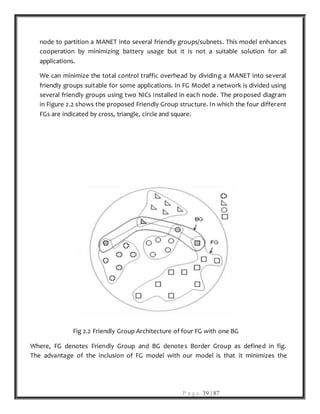
several friendly groups using two NICs installed in each node. The proposed diagram
in Figure 2.2 shows the proposed Friendly Group structure. In which the four different
FGs are indicated by cross, triangle, circle and square.
Fig 2.2 Friendly Group Architecture of four FG with one BG
Where, FG denotes Friendly Group and BG denotes Border Group as defined in fig.
The advantage of the inclusion of FG model with our model is that it minimizes the
P a g e 40 | 87
battery usage and thus enhances the network cooperation. The nodes have fewer
chances for misbehaving because they have enough energy to survive. The FG Model
gives a reduction in control packets as it divides a MANET of size N into k friendly groups
with an approx. N/k number of nodes per group.
Tao Lin
Tao Lin has published his research paper with the name “Mobile Ad-hoc Network
Routing Protocols: Methodologies and Applications” in 2004 in which he utilize different
protocols and extract their simulation results. So experiment had been performed
using TSC Model.
He study the relationship between the performance metrics and the average node
degree. There are 30 nodes in the network. Single different traffic loads is used, that is
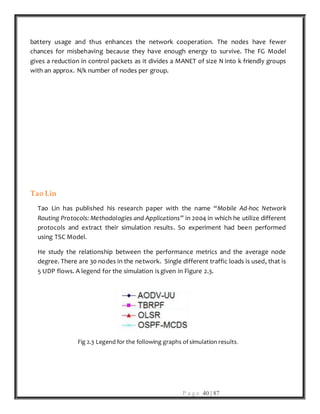
5 UDP flows. A legend for the simulation is given in Figure 2.3.
Fig 2.3 Legend for the following graphs of simulation results.
P a g e 41 | 87
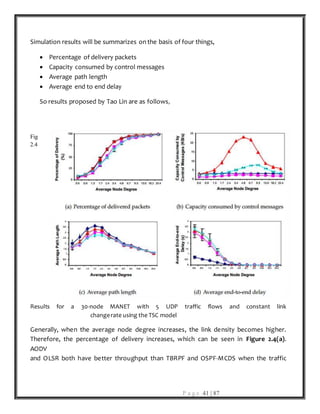
Simulation results will be summarizes on the basis of four things,
 Percentage of delivery packets
 Capacity consumed by control messages
 Average path length
 Average end to end delay
So results proposed by Tao Lin are as follows,
Fig
2.4
Results for a 30-node MANET with 5 UDP traffic flows and constant link
changerate using the TSC model
Generally, when the average node degree increases, the link density becomes higher.
Therefore, the percentage of delivery increases, which can be seen in Figure 2.4(a).
AODV
and OLSR both have better throughput than TBRPF and OSPF-MCDS when the traffic
P a g e 42 | 87
load is low. However, Figure 2.4(b) shows that OLSR consumes the most capacity for
control messages compared to the other three protocols. In other words, OLSR trades
capacity for throughput.
As shown in Figure 2.4(c), OSPF-MCDS has the smallest average hop count because it
reports link state changes immediately after link changes are detected. This
implies that OSPF-MCDS requires fewer transmissions per user data packet and, thus,
consumes less power, on average, to transfer user data. According to Figure 2.4(c) AODV
has the highest hop counts because reactive protocols are not sensitive to link-up events.
When a new and shorter route is available due to a link-up event, reactive protocols
cannot detect it and switch the better route. Interestingly, we can see that the average
hop count in OLSR is always greater than those in TBRPF and OSPF-MCDS, as shown in
Figure 2.4(c). It is even longer than those in AODV in some of the following simulation
results.
The results for average end-to-end delay are presented in Figure 2.4(d). AODV has
the smallest average end-to-end delay compared to other protocols since it sends out
user
packets in a TCP-like way. It first validates an existing path using a hand-shaking process
using route request and route reply messages between the initiator and the destination
(or an intermediate node that has the route to the destination). After that, AODV keeps
using this path unless this path is broken. This guarantees that once a packet is sent, the
end-to-end delay is small. As we can see, the 95% confidence interval for AODV curves
in Figure 2.4(d) is small. This feature suggests that AODV can provide predictable end to-
end delays when the average link change rate is or is close to constant. Thus, AODV
may be suitable for real-time applications over wireless links in MANETs with relative
stable link change rates. The end-to-end delays in proactive routing protocols are usually
larger than in AODV except when the number of traffic flows is large.. When the number
of user traffic flows is large and the link density is high, OSPF-MCDS can provide the
smallest end-to-end delay, on average, compared to other protocols (which is shown
more clearly in the following scenarios). We believe the reason is that OSPF-MCDS uses a
MCDS to broadcast control messages and the nodes in MCDS are not necessary to be the
gateways for user data. This reduces the possibility of collisions between user data
packets and control packets.
P a g e 43 | 87
P a g e 44 | 87
CHAPTER 3
UNDERSTANDING PROBLEMS AND CHALLENGES
P a g e 45 | 87
Regardless of the variety of applications, there are still some issues and design
challenges that we have to overcome and removed. The specific characteristics of
MANETs impose many challenges to network protocol designs on all layers of the
protocol stack. The physical layer must deal with rapid changes in link characteristics. The
media access control (MAC) layer needs to allow fair channel access, minimize packet
collisions and deal with hidden and exposed terminals. At the network layer, nodes need
to cooperate to calculate paths. The transport layer must be capable of handling packet
loss and delay characteristics that are very different from wired networks. Applications
should be able to handle possible disconnections and reconnections. Furthermore, all
network protocol developments need to integrate smoothly with traditional networks
and take into account possible security problems. Existing mechanisms protect at
somehow but still faces other challenges such as battery lifetime and bandwidth.
Proposing and establishing a secured, reliable and applicable design that suits all
applications is still a big.
Some of the challenges in MANET include:
 Unicast Routing
 Multicast Routing
 Dynamic Network Topology
 Speed
 Count to Infinity Problem
P a g e 46 | 87
 Network Overhead
 Scalability
 Quality of Service
 Energy Efficient
 Secure Routing
 Nodes Co-operation
 Packet Loss
 Resource and Service Discovery
 Addressing and Internet Connectivity
 Security Issues
The key challenges faced at different layers of MANET are shown in Fig. 3.1. It
represents layered structure and approach to ad hoc networks.
Fig 3.1 Manet Challenges
So I will Discuss some of the factors that can be improved to some extent and provide
better results.
P a g e 47 | 87
ROUTING
As mobile ad hoc networks are characterized by a multi-hop network topology that
can change frequently due to mobility, efficient routing protocols are needed to
establish communication paths between nodes, without causing excessive control
traffic overhead or computational burden on the power constrained devices6. A large
number of solutions have already been proposed, some of them being subject to
standardization within the IETF. A number of proposed solutions attempts to have an
up-to-date route to all other nodes at all times and to avoid the nodes to turn into
malicious one. Albeit in an event where one or more of the nodes turn malicious,
security attacks can be launched which may disrupt routing operations or create a DOS
(Denial of Service). To this end, these protocols exchange
routing control information periodically and on topological changes. These protocols
which are called proactive routing protocols, are typically modified versions of
traditional link state or distance vector routing protocols encountered in wired
networks, adapted to the specific requirements of the dynamic mobile ad hoc network
environment. Most of the time, it is not necessary to have an up-to-date route to all
other nodes. Therefore, reactive routing protocols only set up routes to nodes they
communicate with and these routes are kept alive as long as they are needed.
Combinations of proactive and reactive protocols, where nearby routes (for example,
maximum two hops) are kept up-to-date proactively, while far-away routes
are set up reactively, are also possible and fall in the category of hybrid routing
protocols. A completely different approach is taken by the location-based routing
protocols, where packet forwarding is based on the location of a node’s
communication
partner. Location information services provide nodes with the location of the
others, so packets can be forwarded in the direction of the destination.
Simulation studies have revealed that the performance of routing protocols in
terms of throughput, packet loss, delay and control overhead strongly depends on the
network conditions such as traffic load, mobility, density and the number of nodes.
Ongoing research at Ghent University therefore investigates the possibility of
developing protocols capable of dynamically adapting to the network.
QUALITY OF SERVICE
P a g e 48 | 87
More and more efficient routing protocols for MANET might come in front in the
coming future, which might take security and QoS (Quality of Service) as the major
concerns.
So far, the routing protocols mainly focused on the methods of routing, but in future a
secured but QoS-aware routing protocol could be worked on. Ensuring both of these
parameters at the same time might be difficult. A very secure routing protocol
surely incurs more overhead for routing, which might degrade the QoS level. So an
optimal trade-off between these two parameters could be searched. In the recent
years some multicast routing protocols have been proposed. The reason for the
growing importance of multicast is that this strategy could be used as a means to
reduce bandwidth utilization for mass distribution of data. As there is a pressing need
to conserve scarce bandwidth over wireless media, it is natural that
multicast routing should receive some attention for ad hoc networks. So it is, in most
of the cases, advantageous to use multicast rather than multiple unicast, especially in
ad hoc environment where bandwidth comes at a premium. Ad hoc wireless networks
find applications in civilian operations (collaborative and distributed computing)
emergency search and-rescue, law enforcement, and warfare situations, where setting
up and maintaining a communication infrastructure is very difficult. In all these
applications, communication and coordination among a given set of nodes are
necessary. Considering all these, in future the routing protocols might especially
emphasize the support for multicasting in the network.
ENERGY EFFICIENT
Some of the protocols utilize more energy thus decreasing efficiency of battery. We
take the example of AODV that is an energy efficiency protocol. We can reduce the
energy by using MPR in AODV. We are using MPR because MPR reduces the number of
nodes to which the message in the network is to be broadcasted. When we
calculate the MPR set then each node must have information about one or two hop
neighbour. When a nodes want to know the information about their neighbour than
they can broadcast the hello packet. By the help of hello message two
neighbours are found. The goal of the MPR selection algorithm is to find shortest path
between the source and destination. Initially source will broadcast hello packet to
other nodes and these nodes reply to the source through route reply. If this contains
our destination node then process ends else a node is selected which is kept as an
P a g e 49 | 87
MPR set and later this will broadcast the message until destination is found or a new
node will be added to MPR set.
We have to implement MPR (multipoint relay) in AODV. Multipoint relay is used in the
ad-hoc network because it is a broadcast mechanism. According to the multipoint
relay, each node first computes a multipoint relay set. To compute the Multipoint relay
set, firstly we need to find 1hop neighbour and then find the 2-hop neighbour. The
intermediated node is called as the MPR set node.
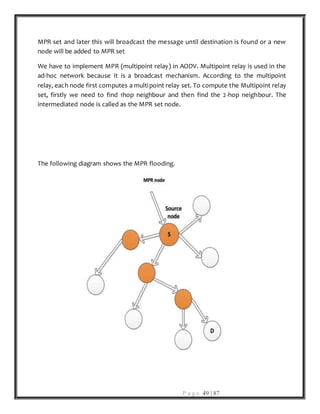
The following diagram shows the MPR flooding.
P a g e 50 | 87
Fig 3.2 MPR flooding mechanism
MPR flooding
 Assume that S is a source and D is a destination node.
 S firstly finds their 1 -hop neighbour and two hop neighbours.
 Then S can broadcast the message to their 1 -hop neighbours.
 Then node can broadcast the message to their two hop neighbours.
 If source node S broadcast message M, each node N that receives the message
forwards M unless it has been previously forwarded.
NODES CO-OPERATION
MANETs may be considered as a society in which nodes agree to co-operate with each
other to fulfill the common goal, but non-cooperation is genuine to save itself in terms
of their battery power and bandwidth. As we know, cooperation is the basic
requirement of MANET that is why we are defining Retaliation Model that strictly
enforces cooperation and eliminates misbehavior that gives a secured and reliable
platform to execute MANET.
In this model node’s behavior is watched by its neighbors in promiscuous listening
mode, to update the NPF/NPRF value for a specified time. After the expiry of the
defined time every node calculates the PFR value and broadcasts in its neighborhood.
Finally all neighbors broadcasted PFR values is received and processed by the nodes to
define the ‘G’ and ‘BP’ values. The Grade is used to isolate selfish nodes from the
routing paths and the Bonus Points defines the number of packets dropped by an
honest node in return of selfish neighbor misbehavior.
The Grade is used to isolate selfish nodes from the routing paths and the Bonus Points
defines the number of packets dropped by an honest node in return of selfish
neighbor misbehavior. We have proposed packet forwarding ratio (PFR) as criterion
where PFR is the ratio of the number of packets forwarded (NPF) to the total number
P a g e 51 | 87
of packets received for forwarding (NPRF) and it shows a node’s contribution to the
network.
In this model each node has to maximize the PFR up to 100% as it is used to define the
grade. Therefore, for every packet loss a node will be punished and the punishment
cost is in terms of its packet drop by the entire neighbors. The selfish nodes are
punished by honest nodes by dropping packets intended for, or originated from, such
a node. The new route is defined on the basis of Grade by bypassing such misbehaving
nodes. A node is punished till the BP is greater than zero and after that the selfish
node is automatically added to the network because the positive BP value
denotes its selfishness. This model does not use any kind of elimination and addition
algorithm because a node is punished on the basis of BP which minimizes battery
usage.
In a MANET nodes become selfish because of its limited resources (such as battery
power and bandwidth), that is why the packet dropping behavior or selfishness would
take place. To prevent from the selfishness we have defined BP that denotes the
amount of packets to be dropped by an honest node against a selfish node in
retaliation over its misconducts. Thus, a node who wants to save its resources must
know that by dropping packets of others, it has to spend more energy to rebroadcast
the same packet again and again. Because, its packets are dropped by all its neighbors
till the BP value in each node is greater than zero. The punishment cost is substantially
more than to act like an honest node because more energy will be needed to
rebroadcast the same packet. So, a selfish node knows that selfishness will be harmful,
and will be forced to be cooperative. Use of Retaliation Model over DSR protocol to
overcome the misbehavior can also be used to enhance the DSR protocol by
overhearing any communications within its neighborhood. A route reply (RREP)
packet can be snooped and a new source route can be added to its route cache.
This would minimize the routing overhead incurred due to initiating a route request in
further routing. We have deliberately not incorporated this concept in this paper.
This model gives the chances of saving energy to honest nodes by dropping packets of
selfish/misbehaved nodes as well as enforces stricter punishment strategy. This model
ensures cooperation and reliability in MANET because rather than eliminating it
behaves in the same way as the node behaved. Therefore, it justifies its name.
P a g e 52 | 87
WATCHDOG
There is another model to check the behavior of nodes and that is a “Watch Dog”
Model. The main function of watchdog is to detect misbehaving nodes. The advantage
of this method is that it detects failures not only at link level but also at the forwarding
level. This algorithm works well with source routing protocols since the hop-by-hop
nature of DSR. Without DSR, the watchdog would not know about a message lost
due to a broken link.
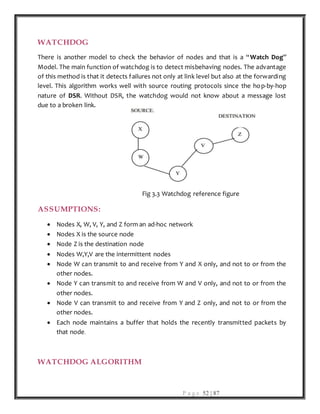
Fig 3.3 Watchdog reference figure
ASSUMPTIONS:
 Nodes X, W, V, Y, and Z form an ad-hoc network
 Nodes X is the source node
 Node Z is the destination node
 Nodes W,Y,V are the intermittent nodes
 Node W can transmit to and receive from Y and X only, and not to or from the
other nodes.
 Node Y can transmit to and receive from W and V only, and not to or from the
other nodes.
 Node V can transmit to and receive from Y and Z only, and not to or from the
other nodes.
 Each node maintains a buffer that holds the recently transmitted packets by
that node.
WATCHDOG ALGORITHM
P a g e 53 | 87
 Once a node sends a packet to some other node it also adds it to its Buffer i.e. if
X sends a packet to W it will add the packet to its own buffer
 The node that sent the packet, node X, listens for its neighbor transmissions,
node W’s transmissions. Node X then compares the overheard packet to the
packet in its own buffer
 If the packet in the buffer of node X matches the packet transmitted by node W
then the packet is removed from buffer of node X.
 If the packet doesn’t match and if the packet in the buffer of any node exceeds
a timeout then a tally is incremented for the node that is to transmit the packet
 If this tally is greater than the misbehavior threshold then it is said to be a
misbehaving node and a message is sent to node X (i.e. the source node) by the
misbehaving node to inform it of the misbehaving node.
SERVICE AND RESOURCE DISCOVERY
MANET nodes may have little or no knowledge at all about the capabilities of, or
services offered by, each other. Therefore, service and resource discovery mechanisms
which allow devices to automatically locate network services and to advertise their
own
capabilities to the rest of the network, are an important aspect of self-configurable
networks. Possible services or resources include storage, access to databases or files
printer, computing power, Internet access, etc.
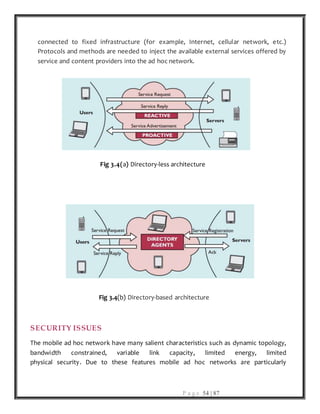
Directory-less service and resource discovery mechanisms, in which nodes
reactively request services when needed and/or nodes proactively announce their
services to others, seem an attractive approach for infrastructure less networks
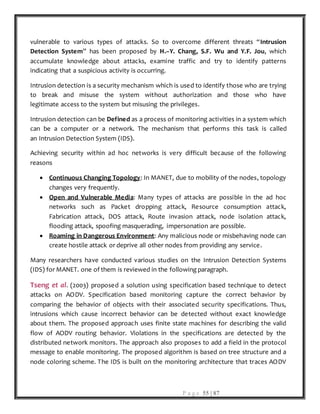
(Figure 3.4(a)). The alternative scheme is directory-based and involves directory agents
where services are registered and service requests are handled (Figure 3.4(b)). This
implies that this functionality should be statically or dynamically assigned to a
subset of the nodes and kept up-to-date. Existing directory-based service and
resource discovery mechanisms such as UPnP or Salutation are unable to deal
with the dynamics in ad hoc networks. Currently, no mature solution exists, but it is
clear that the design of these protocols should be done in close cooperation with
the routing protocols and should include context-awareness (location, neighborhood,
user profile, etc.) to improve performance. Also, when ad hoc networks are
P a g e 54 | 87
connected to fixed infrastructure (for example, Internet, cellular network, etc.)
Protocols and methods are needed to inject the available external services offered by
service and content providers into the ad hoc network.
Fig 3.4(a) Directory-less architecture
Fig 3.4(b) Directory-based architecture
SECURITY ISSUES
The mobile ad hoc network have many salient characteristics such as dynamic topology,
bandwidth constrained, variable link capacity, limited energy, limited
physical security. Due to these features mobile ad hoc networks are particularly
P a g e 55 | 87
vulnerable to various types of attacks. So to overcome different threats “Intrusion
Detection System” has been proposed by H.–Y. Chang, S.F. Wu and Y.F. Jou, which
accumulate knowledge about attacks, examine traffic and try to identify patterns
indicating that a suspicious activity is occurring.
Intrusion detection is a security mechanism which is used to identify those who are trying
to break and misuse the system without authorization and those who have
legitimate access to the system but misusing the privileges.
Intrusion detection can be Defined as a process of monitoring activities in a system which
can be a computer or a network. The mechanism that performs this task is called
an Intrusion Detection System (IDS).
Achieving security within ad hoc networks is very difficult because of the following
reasons
 Continuous Changing Topology: In MANET, due to mobility of the nodes, topology
changes very frequently.
 Open and Vulnerable Media: Many types of attacks are possible in the ad hoc
networks such as Packet dropping attack, Resource consumption attack,
Fabrication attack, DOS attack, Route invasion attack, node isolation attack,
flooding attack, spoofing masquerading, impersonation are possible.
 Roaming in Dangerous Environment: Any malicious node or misbehaving node can
create hostile attack or deprive all other nodes from providing any service.
Many researchers have conducted various studies on the Intrusion Detection Systems
(IDS) for MANET. one of them is reviewed in the following paragraph.
Tseng et al. (2003) proposed a solution using specification based technique to detect
attacks on AODV. Specification based monitoring capture the correct behavior by
comparing the behavior of objects with their associated security specifications. Thus,
intrusions which cause incorrect behavior can be detected without exact knowledge
about them. The proposed approach uses finite state machines for describing the valid
flow of AODV routing behavior. Violations in the specifications are detected by the
distributed network monitors. The approach also proposes to add a field in the protocol
message to enable monitoring. The proposed algorithm is based on tree structure and a
node coloring scheme. The IDS is built on the monitoring architecture that traces AODV
P a g e 56 | 87
request-reply flow. Detail procedures for constructing and processing the trees for
detecting attacks are discussed. The proposed method detects AODV routing
attacks efficiently and with low overhead.
CHAPTER 4
Methodology and planning of work
P a g e 57 | 87
We used simulation and emulation tools to verify the new protocol and to compare it
with
other routing protocols. This section introduces network simulator (ns2) models and a
Linux test bed we developed for emulation of MANET topologies.
Simulation experiments are widely used to evaluate MANET routing protocols. Like
simulations of traditional wired networks, these experiments must model the network
topology, network traffic, and the routing and other network protocols. Different things
need to take under consideration like node mobility, physical layer issues, including the
radio frequency channel, terrain, and antenna properties, and, perhaps, energy and
battery characteristics. Link connectivity is an important factor, if not the most
important factor, affecting the relative performance of MANET routing protocols.
P a g e 58 | 87
FACILITIES REQUIRED FOR PROPOSED WORK
For networking, the real world experiments produce the most realistic results for the
technologies similar to that in which they are carried out, but they could be infeasible in
some cases like MANETs. The experimentation may involve large number of nodes which
would be very hard to implement in real world. In addition to implementation hurdles,
this is difficult also because of the mobility of nodes. [] ‟s survey shows that about 95% of
the research oriented experiments are carried out on simulation tools. It also gives the
popularity graph of well-known simulation tools which is as under:
Fig. 4.1 Distribution of Simulation Tools
Figure 4.1 shows that 62.5% of the simulation studies of network related researches,
specially the MANET, are carried out in Network Simulator 2 (NS-2). Utilization of a
well-known and popular simulator can be beneficial for both comparability and
repeatability, since large parts of the utilized models are identical.
So mainly the Network Simulator 2 (NS-2) will be used for the simulations with other
tools like:
P a g e 59 | 87
 RUBY Scripts for scripting NS-2 codes
 PERL, AWK or MATLAB for trace files extraction
 XGRAPH or GNUPLOT to plot graphs
 GloMoSim for Wi-Fi based simulations
 LATEX and MICROSOFT OFFICE for thesis and research paper writing
 ENDNOTE to build references library
Network Simulator (Version 2), widely known as NS2, is simply an event driven
simulation tool that has proved useful in studying the dynamic nature of communication
networks. Simulation of wired as well as wireless network functions and protocols (e.g.,
routing algorithms, TCP, UDP) can be done using NS2. In general, NS2 provides users with
a way of specifying such network protocols and simulating their corresponding behaviors.
Basic Architecture
Figure 4.1 shows the basic architecture of NS2. NS2 provides users with an executable
command ns which takes on input argument, the name of a Tcl simulation scripting file.
Users are feeding the name of a Tcl simulation script (which sets up a simulation) as an
input argument of an NS2 executable command ns. In most cases, a simulation trace file
is created, and is used to plot graph and/or to create animation.
Fig 4.1 Basic Architecture of Ns2
P a g e 60 | 87
NS2 consists of two key languages
• C++
• Object-oriented Tool Command Language (OTcl)
The Two-Language Conceptin NS2
NS2 uses OTcl to create and configure a network, and uses C++ to run simulation. All
C++ codes need to be compiled and linked to create an executable file.
Use OTcl
 For configuration, setup, or one time simulation, or to run simulation with
existing NS2 modules.
Use C++
 When you are dealing with a packet, or when you need to modify existing
NS2 modules
Calculations need to be taken
So by using simulation we will perform different experiments on proposed protocols.
• We will make changes or modify these protocols according to our need and by
considering the behavior of environment i.e. either there is high mobility or
what the condition of data traffic is.
P a g e 61 | 87
• Signal strength will be measure and by utilizing different protocols we can
achieve different ranges. In other words, various radio ranges can produce
various combinations of the average node degree, the link connectivity rate
change, and the average length of paths.
• Health of the link and link stability will also be measured as link connectivity is
an important factor, if not the most important factor, affecting the relative
performance of MANET routing protocols.
• We will also test different Mobility Models according to our situation.
• Therefore, to compare different protocols fairly, a loop detection scheme that
can check for routing loops for user packets should be implemented for all
routing protocols.
MOBILITY AND TRAFFIC SCENARIOS
1) Reference Point Group Mobility model (RPGM)
Ns-2 requires node movements to either be defined in the OTCL script or to be read
from an external file. So one of the software has been used in Ns2 named as
Bonnmotion-1.3 software [Wall 2003], developed at the University of Bonn, to create
mobile-node movement scenarios. The RPGM [Hong 1999] is a mobility model in which
mobile nodes move in clusters in the simulation area. This model can create
movements similar to military movements as army troops move mainly by forming
clusters. The movement of cluster-heads is randomly chosen, and the movements of
the cluster-members follow the direction of the cluster-head.
Figure 4.2 shows the creation of clusters as it is shown in the NAM console after the
end of the simulation.
P a g e 62 | 87
Fig 4.2 Creationof Clusters withthe RPGMmodel
2) Manhattan Grid MobilityModel
In this model, nodes move in predefined paths. By using Bonnmotion-1.3, we can
define the number of blocks along the x-axis and the y-axis, which will enable us to
define the size of blocks in a city. This is an important attribute of the model because it
enables us to create a scenario applicable to a specific targeted city in which mobile
nodes move.
P a g e 63 | 87
Figure 4.3 shows a screenshot of the NAM console at the end of the simulation with
that mobility model. What is important in that model is that nodes at opposite sides of
a block cannot communicate due to the reception failure posed by the blocks. As we
increase the size of blocks in the simulation area, the probability of data packet loss by
the mobile nodes increases.
Fig 4.3 Manhattan Grid Mobility Model
3) Traffic Scenarios
NS-2 supports two different types of traffic for wireless ad-hoc networks. The user can
choose either the Transmission Control protocol (TCP) or Constant Bit Rate (CBR). The
traffic generator is located under the directory indep-utils/cmu-scen-gen and the two
tcl scripts tcpgen.tcl and cbrgen.tcl, can be used for traffic generation.
P a g e 64 | 87
QUANTITATIVE METRICS
RFC 2501 describes a number of quantitative metrics that can be used for evaluating the
performance of a routing protocol for mobile wireless ad-hoc networks. In this thesis, we
follow the general ideas described in RFC 2501, and we use four quantitative metrics
similar to those that were used in [Das, S.R., Perkins, C.E. Royer, E.M. 2000]. The packet
delivery ratio and average end-to-end delay are most important for best-effort traffic.
The normalized routing load will be used to evaluate the efficiency of the routing
protocol. Finally, the normalized MAC load is a measure of the effective utilization of the
wireless medium for data traffic. In the next sections, we will define those four
quantitative metrics.
Packet DeliveryRatio
The packet delivery ratio is defined as the fraction of all the received data packets at the
destinations over the number of data packets sent by the sources. This is an important
metric in networks. If the application uses TCP as the layer 2 protocol, high packet loss at
the intermediate nodes will result in retransmissions by the sources that will result in
network congestion.
Average End-to-EndDelay
End-to-end delay includes all possible delays in the network caused by route discovery
latency, retransmission by the intermediate nodes, processing delay, queuing delay, and
propagation delay. To average the end-to-end delay we add every delay for each
P a g e 65 | 87
successful data packet delivery and divide that sum by the number of successfully
received data packets. This metric is important in delay sensitive applications such as
video and voice transmission.
Normalized Routing Load
The normalized routing load is defined as the fraction of all routing control packets sent
by all nodes over the number of received data packets at the destination nodes. This
metric discloses how efficient the routing protocol is. Proactive protocols are expected
to have a higher normalized routing load than reactive ones. The bigger this fraction is
the less efficient the protocol.
Normalized MAC Load
The normalized MAC load is defined as the fraction of all control packets (routing control
packets, Clear-To-Send (CTS), Request-To-Send (RTS), Address Resolution Protocol (ARP)
requests and replies, and MAC ACKs) over the total number of successfully received data
packets. This is the metric for evaluating the effective utilization of the wireless medium
for data traffic.
Fair Comparisons among MANET Routing Protocols
P a g e 66 | 87
To compare different MANET routing protocols, one should use the same and reasonable
assumptions for all protocols that are studied. However, current models of different
routing protocols do use different assumptions. For example, a MANET routing protocol
known as AODV holds outgoing user packets in a buffer for up to a certain maximum
holding time before the packet is sent or dropped. AODV needs time to determine
a route if there is no known route to the destination. As long as the route is discovered
within the maximum buffer holding time, this user packet can be delivered even if the
packet is generated at a time when there is no known path between the source and the
destination nodes. However, models of some other routing protocols, such as OLSR, do
not have this kind of buffer. In OLSR, a user layer packet is dropped immediately if the
node’s routing agent has no route for it. Therefore, AODV and other protocols that have
this buffer can have, potentially, higher throughput than OLSR and other protocols that
do not have this feature. Our recommendation is to install the same buffer scheme in
all MANET routing protocols so that they can be compared fairly. Note that in ns2, the
processing procedure for data packets originated from a node, as we described above, is
different from that for forwarding data packets. The buffer can also be applied to the
procedure for forwarding data packets. In this dissertation, we do not investigate
whether
we should use the buffer for forwarding data packets, but ensure that all protocols use
consistent assumptions.
CHAPTER 5
P a g e 67 | 87
SIMULATION RESULTS
P a g e 68 | 87
This section presents a comparison of MANET routing protocols using simulation which
will be conducted on Ns2. Protocols investigated are DSR, AODV and OLSR. DSR is similar
to AODV except a node list is used in DSR instead of hop count used in AODV. Moreover,
there is no further development on the simulation model for DSR since it was first
proposed.
ComparisonModel
As we have already stated two major models are used in Ns2
 REFERENCE POINT GROUP MOBILITY (RPGM) MODEL
 Manhattan Grid Mobility Model
Our major concern is with RPGM so we will use this model and carry out our simulation.
REFERENCE POINT GROUP MOBILITY (RPGM) MODEL
So in this model we will generate different result by focusing on different scenarios.
Some of them are listed below
I. Varying the Number of Connections
II. Varying the Network Load
III. Distributing the Network Load
IV. Varying Network Mobility
V. Varying Node Density
We will discuss each of these one by one and check the behavior of protocols on the
basis of graphs that will be generated by Xgraph in Ns2.
P a g e 69 | 87
I. Varying the Numberof Connections
In the first set of simulations, we increase the number of connections from 10 to 40 and
keep all other parameters unchanged. The data traffic and the routing load in the
network increase as we increase the number of connections. We keep a constant bit rate
of 10 packets/sec (40.960 Kbps) for all cases. Given table shows the parameters of the
simulation.
RPGM, Varying the Number of connections
With this low-to-medium traffic, the routing protocols are expected to have a high
packet delivery ratio and a low normalized routing and MAC load. We expect OLSR to
have a lower and-to-end delay than AODV and DSR due to its proactive behavior.
Packet Delivery Ratio
Figure 5.1 shows the packet delivery ratio of the protocols. As we observe that all
protocols have almost the same performance with AODV to present a higher packet
delivery ratio in all cases. OLSR has the worst performance. The explanation is that,
because nodes within the clusters are very close, data packets are dropped at the MAC
layer. The reason being for that is that the network is congested at some point by the
P a g e 70 | 87
periodic transmission of HELLO messages and OLSR routing packets. Therefore, the
existence of valid routes between a source/destination pair in a node’s routing table,
does not necessarily guarantee a better packet delivery ratio.
Fig 5.1 RPGM, Packet Delivery Ratio (Increasing number of connections)
Normalized Routing Load
Figure 5.2 shows the normalized routing load of the protocols. We observe that OLSR has
a normalized routing load 800 percent higher than AODV and DSR for 10 connections.
With a higher number of connections, OLSR “stabilizes” its routing overhead. This
happens because, with a higher number of connections, the number of the received
packets at the destinations is getting higher while the number of OLSR routing packets
remains the same. As a result, the value of the normalized routing load fraction is getting
higher. AODV presents a higher routing load than DSR for an increased number of
connections, as nodes need to transmit a bigger number of routing control messages to
establish and maintain those additional connections. DSR seems to be the most stable
protocol regardless of the number of connections in the network due to its cashing
mechanism at the source and intermediate nodes.
P a g e 71 | 87
Fig 5.2 RPGM, Normalized Routing Load (Increasing number of connections)
NormalizedMAC Load
Figure 5.3 shows the normalized MAC load of the protocols. We observe that OLSR has a
higher MAC load than AODV and DSR for 10 and 20 connections. However, with 30 and 40
connections, OLSR presents the lowest MAC load. The explanation is that both AODV and
DSR generate a higher number of messages at the MAC layer because more control
messages are needed to satisfy the establishment and maintenance of those new
connections. The MAC layer generates RTS, CTS, and ACK messages for each
transmission of RREQ, RREP, and RERR messages. Thus the higher the number of routing
control messages, the higher the normalized MAC load. On the other hand, OLSR
generates those additional RTS, CTS, and ACK messages at the MAC layer only for data
packets transmission, as the time interval for HELLO and other types of OLSR routing
control packets remains unchanged, regardless of the increased number of connections.
The conclusion is that, although AODV and DSR generate a lower number of routing
control messages, the utilization of the wireless medium by data traffic is better in OLSR
in a network in which the number of connections increases over time.
P a g e 72 | 87
Fig 5.3 RPGM, Normalized MAC Load (Increasing number of connections)
Average end-to-endDelay
OLSR has the lowest and-to-end delay, which increases almost linearly with the number
of connections. DSR has lower end-to-end delay than AODV, although AODV employs a
similar chasing mechanism to that of DSR. This is because the timeout value for erasing
routes that has been used previously in AODV is not optimized to cover all possible
mobility and traffic scenarios. We observe that DSR has higher end-to-end delays for 30
connections for the same reason.
P a g e 73 | 87
Fig 5.4 Average End To End Delay
II. Varying the Network Load
In the second set of simulations, we increase the number of data packets sent by the
sources from 5 packets/sec (20.480 Kbps) to 20 packets/sec, (81.920 Kbps), keeping all
other network parameters unchanged. The demand for efficient routing and wireless
medium utilization for data traffic is higher in that scenario; we will observe how the
three protocols can scale in that demanding network. We observed that, under that
mobility scenario and a packet rate of more than 25 packets/sec (102.400 Kbps), all
protocols present a very low packet delivery ratio (below 50 percent), making any
comparison at those rates meaningless. Table shows the parameters of the simulation
RPGM, Varying the Network load
Packet Delivery Ratio
Figure 5.5 shows the packet delivery ratio of the protocols. All protocols have an identical
performance at low rates (5 packets/sec). DSR outperforms AODV and OLSR in all cases,
whereas OLSR has, again, the worst performance. Although we placed 50 nodes in an
area of 2000 x 1000 meters to avoid interference, nodes are still in close proximity,
P a g e 74 | 87
especially within the clusters. This scenario does not favor OLSR: we noticed by analyzing
the ns-2 trace files that OLSR produces a fairly large size of route update packets that
require higher transmission time than that of AODV and DSR. Neither AODV nor DSR
suffers from that periodic exchange of link state information, as routes are discovered in
an ad-hoc fashion.
Fig 5.5 Packet Delivery Ratio
Normalized Routing Load
Figure 5.5 shows the normalized routing load. DSR has the lowest routing load at all
packet rates, showing that it scales well in networks with low mobility in which data
traffic increases over time. OLSR has a high routing load in low traffic (5packets/sec),
which drops significantly in higher traffic. AODV has a higher routing load than DSR,
although, like DSR, it employs an expanding ring and cashing mechanism. However,
AODV was designed for networks with a larger number of nodes and higher mobility than
that in our
simulation.
P a g e 75 | 87
Fig 5.5 Normalized Load
End-to-End Delay
Figure 5.6 shows the end-to-end delay. We expected OSLR to have better performance
than the other two reactive protocols. However, the end-to-end delay in OLSR increases
when the data traffic increases. The explanation lies in the low mobility of the network.
As nodes do not change their positions very frequently, there exists a high level of
network congestion at certain regions of the network because none of the three
protocols employs any mechanism for load balancing, data traffic is not evenly
distributed in the network, and high end-to-end delays result.
Fig 5.6 End to End Delay
P a g e 76 | 87
III. Distributing the Network Load
In the third set of simulations, we distribute the network load so that 66 percent of the
data packets are destined within the clusters and 33 percent are destined to a cluster at a
central position in the simulation area. We do that to approximate a real situation
scenario in which a node within each cluster, which we arbitrarily choose to be the
cluster head, communicates with its neighboring nodes within the cluster and with other
nodes at a central position in the simulation area, which represents the Headquarters
(HQ) of the unit. As none of the protocols employs a mechanism for balancing the
network load, we expect all the protocols to have a lower performance than in our
previous scenario. This is because nodes around the central cluster behave as
“bottlenecks” of the network, dropping data packets. However, this is a real situation in
tactical communications, and we wish to analyze the behavior of the tested protocols
under that scenario. Below table shows the parameters of the simulation.
P a g e 77 | 87
Packet Delivery Ratio
Figure 5.7 shows the packet delivery ratio. All protocols present almost identical
performance, which is lower than in our previous scenario. That at least indicates that all
three protocols can be used for any traffic scenario in a network with a low number of
nodes, medium data traffic, and medium mobility.
Fig 5.7 Packet Delivery Ratio
P a g e 78 | 87
Normalized Routing Load
Figure 5.8 shows the normalized routing load of the protocols. We observe that DSR has
the lowest routing load that remains stable regardless of the data packet rate. AODV, in
contrast, presents the highest routing load. We explained in the previous section that the
reason for AODV’s high routing load lies in the design of AODV, which performs better in
larger networks with a higher mobility.
Fig 5.8 Normalized Routing
Normalized MAC Load
Figure 5.9 shows the normalized MAC load. OLSR again presents the lowest MAC load,
while the DSR performance is the most stable. AODV has the highest MAC load at lower
data packet rates; that drops when the data packet rates increase.
P a g e 79 | 87
Fig 5.9 Normalized Mac Load
Average End to End Delay
Finally, figure 5.10 shows the average end-to-end delay of the protocols. OLSR has the
lowest end-to-end delay at lower rates while DSR has the lowest end-to-end delay at
higher rates.
Fig 5.10 End to End Delay
IV. Varying Network Mobility
In the fourth set of simulations, we vary nodes’ mobility. We start with a mobility
scenario in which the nodes have a low velocity of 5 m/sec (18 Km/h). We then increase
nodes’ velocity up to 20 m/sec (72 Km/h). Our intention is to investigate the behavior of
the three protocols in networks with varied mobility, although the high mobility, 72 Km/h,
cannot be easily found in tactical movements. We keep a constant data rate of 10
packets/sec (40.960 Kbps) and a constant number of 20 connections. We observed that,
at higher data rates with increasing mobility, the performance of the protocols decreases
due to network congestion in a way that makes any comparison meaningless. Table
shows the simulation parameters.
P a g e 80 | 87
Packet Delivery Ratio
Figure 5.10 shows the packet delivery ratio of the protocols. All protocols, present a
similar performance with AODV, having the best performance at all mobility rates. We
observe again that protocols have a better performance when the speed of the nodes is
10 m/sec and 15 m/sec, because the network load is more evenly distributed among the
nodes at higher mobility rates.
P a g e 81 | 87
Fig 5.10 Packet Delivery Ratio
Normalized Routing Load
Figure 5.11 shows the normalized routing load. DSR has the best performance with an
increase of the routing load at a higher mobility. That stable behavior of DSR is a
desirable property of a protocol as it indicates that it can scale well in networks in which
the mobility changes over time. OLSR has the same behavior, while the AODV
performance increases when nodes move at higher speeds.
Fig 5.11 Normalized Load
Normalized MAC Load
Figure 5.12 shows the normalized
routing load. AODV has lower
normalized MAC load than DSR,
despite having a higher normalized
P a g e 82 | 87
routing load. The explanation is that under this simulation scenario, the route discovery
in AODV is more accurate than in DSR. DSR, as a result, generates a higher number of
routing control messages than AODV to discover alternate routes at the intermediate
nodes. OLSR is the most stable protocol in terms of the normalized MAC load in networks
with varying mobility.
Fig 5.12 Normalized Load
Average End to End Delay
Figure 5.13 shows the end-to-end delay of the protocols. OLSR has the lowest end to-end
delay at low and high mobility, while AODV outperforms DSR.
Fig 5.13 Average End to End Delay
P a g e 83 | 87
V. Varying Node Density
In the last scenario of RPGM model we vary the number of nodes in the network. We
gradually increase the nodes for this purpose. The main purpose is to adjust the nodes in
such a way that there is less distance between them so more connectivity can be
achieved, so we have to limit nodes in a small area. Also a large number of nodes in a
network causes signal interference as nodes are place close to each other. Following
results are expected to come,
a) Packet delivery ratio is almost same for these three protocols but as we increase
the nodes performance of OLSR decreases significantly as compared to AODV and
DSR.
b) DSR has lowest normalized routing load and AODV has highest one. However
AODV performs well when number of nodes in the network increases
c) OLSR has the lowest normalized MAC load except in the case of increased nodes,
in which OLSR generates a higher number of control packets. That high number of
the normalized MAC load reveals that the network is congested, not by data
packets, as we keep the data rate constant, but from the routing packets
generated by OLSR. So the congested network will result increase end to end
delay as for AODV and DSR end to end delay is almost stable.
CONCLUSIONS
OLSR had the lowest performance in terms of the packet delivery ratio in all of the
simulations with the RPGM mobility model. The reason lies in the proactive behavior of
OLSR, because the Multipoint Relay (MPR) nodes flood the network with Topology
Control (TC) packets every 5 seconds (default value). Therefore, when the network load
increases, data packets are dropped by the mobile nodes due to network congestion
caused by the periodic transmission of TC packets. Also OLSR presented the lowest end-
to-end delay in almost all of the simulations, and in most cases, the end-to-end delay was
independent of the varying simulation parameters.
AODV performance depended on the mobility models that were used in the simulations.
Under the RPGM model with low mobility, AODV has a lower packet delivery ratio, higher
normalized routing and MAC loads, and a higher end-to-end delay than DSR. In networks
with a small number of nodes and low mobility, AODV does not suggest a good solution
P a g e 84 | 87
as a routing protocol. However, AODV has better performance in networks with higher
mobility and a greater number of nodes.
With the RPGM reference model and a heavy network load, DSR presented the best
performance in terms of packet delivery ratio and end-to-end delay. In most cases, under
this mobility model, DSR presented the lowest normalized routing and MAC loads,
proving that source routing proves to be an efficient routing mechanism in networks
with a small number of nodes and high connectivity, because it utilizes the wireless
medium for data traffic in a better way than the other tested protocols. However, DSR
performance decreases in networks with higher mobility, disclosing that source routing
cannot efficiently adapt the network topology changes that are caused by the frequent
movement of the mobility nodes.
To summarize the above results and observations, it is concluded that DSR is a good
candidate as the routing protocol in networks with high connectivity, a small number of
nodes (up to 100), and low mobility. The high packet delivery ratio and the low end-to-
end delay in those networks enable the efficient use of time-sensitive applications, such
as voice and video streaming.
P a g e 85 | 87
CHAPTER 6
FUTURE WORK
P a g e 86 | 87
As a special type of network, MANETs have received increasing research attention in
recent years. There are many active research projects concerned with MANETs. This
section focuses on promising future research directions based on our current research.
Further study of node mobility is also a promising research direction. Such a study
might aid in the design of simulation mobility models, improve estimates of link and path
lifetimes, and improve the performance of MANET routing protocols.
More extensive simulation and emulation studies can be used to compare different
protocols. Analysis and conclusions can guide users when they choose routing protocols
for their MANET applications and aid designers in improving protocols.
More and more efficient routing protocols for MANET might come in front in the coming
future, which might take security and QoS (Quality of Service) as the major concerns.
So far, the routing protocols mainly focused on the methods of routing, but in future a
secured but QoS-aware routing protocol could be worked on. Ensuring both of these
parameters at the same time might be difficult. A very secure routing protocol surely
incurs more overhead for routing, which might degrade the QoS level. So an optimal
trade-off between these two parameters could be searched. In the recent years some
multicast routing protocols have been proposed. The reason for the growing importance
of multicast is that this strategy could be used as a means to reduce bandwidth utilization
for mass distribution of data. As there is a pressing need to conserve scarce bandwidth
over wireless media, it is natural that multicast routing should receive some attention for
ad hoc
networks. So it is, in most of the cases, advantageous to use multicast rather than
multiple unicast, especially in ad hoc environment where bandwidth comes at a premium.
Ad hoc
wireless networks find applications in civilian operations (collaborative and distributed
computing) emergency search and-rescue, law enforcement, and warfare situations,
where setting up and maintaining a communication infrastructure is very difficult. In all
these applications, communication and coordination among a given set of nodes are
necessary. Considering all these, in future the routing protocols might especially
emphasize the support for multicasting in the network.
P a g e 87 | 87
It is the author’s understanding, after studying the routing protocols and running several
simulations for this thesis, that there is no protocol that can be applied to all "kinds" of
networks. In other words, there is no routing protocol for MANETs that c an provide
efficient routing to any size of network, commercial or military, with a small or large
number of nodes and varying network load and mobility. What is needed to be done is to
adjust these protocols to the network attributes. No protocol can be seen as the best
solution for all mobility and traffic models. The bottom line: When one knows in advance
the mobility of the nodes, the network topology, the degree of connectivity, the type of
the transport protocol (UDP or TCP), and the application that is to be used (email, ftp,
video, voice, etc.), he can adjust the internal parameters of the protocol (route updates
interval, HELLO interval, etc.) to get the best performance of the protocol. Here is where
the problem for finding and standardizing just a single protocol, which can solve the
routing problem in MANETs, is located. None of the proposed protocols can be THE 106
solution to the routing problem. On the other hand, if one takes any of the proposed
routing protocols and adjust its internal parameters to network attributes, he will have a
very good protocol, but only for a specific network or similar networks.
A second approach would be a self-configurable routing protocol that would be able to
adjust its internal parameters to network attributes. This protocol would collect a
number of statistics, such as observed end-to-end delay, packet delivery ratio, node
velocity, degree of network connectivity etc. and would make decisions to adjust its
behavior and therefore optimize its performance.

CHAPTER-1234

  • 1.
    WIFI BASED MOBILITYDETECTION SYSTEM FOR MOBILE AD HOC SYSTEM  Haseeb Ahsan  Arslan Akhter  Ahmed Butt  Hafiz Mohammad Bilal Co-ordinator Engr Ali Bajwa By
  • 2.
    P a ge 1 | 87 CHAPTER 1 INTRODUCTION TO MOBILE AD HOC NETWORK
  • 3.
    P a ge 2 | 87 TABLE OF CONTENTS Introduction to Manet Protocols of Manet  Table-driven (Proactive)  On-demand (Reactive)  Hybrid Applications Conclusion
  • 4.
    P a ge 3 | 87 ABSTRACT In the last few decades, we have seen a rapid progress in the field of mobile computing due to the proliferation of inexpensive, widely available wireless devices. However, current devices, their workings, applications and protocols are solely focused on cellular or wireless local area networks (WLANs), not taking into account the great potential offered by mobile ad hoc networking. A mobile ad hoc network is an autonomous collection of mobile devices (laptops, smart phones, sensors, etc.) that communicate with each other over wireless links and cooperate in a distributed manner in order to provide the necessary network functionality in the absence of a fixed infrastructure. This type of network, operating as a stand-alone network or with one or multiple points of attachment to cellular networks or the Internet, paves the way for numerous new and exciting applications. [1] Application scenarios include, but are not limited to: emergency and rescue operations, business associates sharing information during a meeting, soldiers relaying information for situational awareness on the battlefield and emergency disaster relief personnel coordinating efforts after a hurricane or earthquake , also provide facility for some temporary requirement like conference & seminar at new place where there is no earlier network infrastructure exist and need alternative solution. INTRODUCTION Mobile Ad Hoc Network (MANET) is a collection of communication devices or nodes that wish to communicate without any fixed infrastructure and pre-determined organization of available links. The node in MANET themselves are responsible for dynamically discovering other nodes to communicate. It is a self-configuring network of mobile nodes connected by wireless links the union of which forms an arbitrary topology. The nodes are free to move randomly and organize themselves arbitrarily; thus, the network’s wireless topology may change rapidly and unpredictably. [2]
  • 5.
    P a ge 4 | 87 Nodes that lie within each other’s send range can communicate directly and are responsible for dynamically discovering each other. In order to enable communication between nodes that are not directly within each other’s send range, intermediate nodes act as routers that relay packets generated by other nodes to their destination. These nodes are often energy constrained—that is, battery-powered—devices with a great diversity in their capabilities. Furthermore, devices are free to join or leave the network and they may move randomly, possibly resulting in rapid and unpredictable topology changes. In this energy-constrained, dynamic, distributed multi-hop environment, nodes need to organize themselves dynamically in order to provide the necessary network functionality in the absence of fixed infrastructure or central administration. [1] The concept of mobile ad hoc networking is not a new one and its origins can be traced back to the DARPA Packet Radio Network project in 1972. Then, the advantages such as flexibility, mobility, resilience and independence of fixed infrastructure, elicited immediate interest among military, police and rescue agencies in the use of such networks under dis organized or hostile environments. For a long time, ad hoc network research stayed in the realm of the military, and only in the middle of 1990, with the advent of commercial radio technologies, did the wireless research community become aware of the great potential and advantages of mobile ad hoc networks outside the military domain, witnessed by the creation of the Mobile Ad Hoc Networking working groupwithin the IETF. Networks (MANETs) are characterized by a dynamic, multi-hop, rapid changing topology. Such networks are aimed to provide communication capabilities to areas where limited or no communication infrastructures exist.
  • 6.
    P a ge 5 | 87 CHARACTERISTICS AND COMPLEXITIES OF MOBILE AD HOC NETWORKS  Autonomous and infrastructure less  Multi-hoprouting  Device heterogeneity  Energy constrained operation  Network scalability  Self-creation, self-organization and self-administration  Follows a dynamic topology i.e nodes may join or leave the network at any time.  Limited bandwidth and limited power  Needs limited physical security REASON TO BE PREFER OVER FIXED INFRASTRUCTRE Fixed infrastructure is the one that have a centralized base for communication like that of Cellular system. In addition, these networks are faced with the traditional problems such as lower reliability than wired media, limited physical security, timevarying channels, interference, etc.
  • 7.
    P a ge 6 | 87 Cellular Network Ad Hoc Network Fixed Infrastructure Infrastructure less Single hop wireless link Multi-hop wireless link Centralized Routing Distributed Routing Base Station Resilient Seamless Connectivity Mobility High Cost and Long deployment time Quick and cost effective setup Commercial Sector Defense, Emergency, Disaster Time sync = TDMA Time sync =CSMA Static frequency re-use (cells) Dynamic Frequency reuse (CSMA) Ad hoc network is a network, where a fixed infrastructure is not available, not trusted, too expensive or unreliable. There is no need for detailed planning of base station installation or wiring Instead each node communicates with each other using their sole transmitter-receiver only. In this kind of network each and every node does participate voluntarily in transit packet that flow to and from different nodes. Each node do follow same routing algorithm to route different packets. Thus this kind of network have limited homogenous feature. There are not many wireless products that follow this proposed technology. As a consequence, mobile ad hoc networks are expected to become an important part of the future 4G architecture, which aims to provide pervasive computer environments that support users in accomplishing their tasks, accessing information and communicating anytime, anywhere and from any device
  • 8.
    P a ge 7 | 87 ROUTING IN MOBILE AD HOC NETWORKS The absence of fixed infrastructure in a MANET poses several types of challenges. The biggest challenge among them is routing. Routing is the process of selecting paths in a network along which to send data packets. An ad hoc routing protocol is a convention, or
  • 9.
    P a ge 8 | 87 standard, that controls how nodes decide which way to route packets between computing devices in a mobile ad-hoc network. As mobile ad hoc networks are characterized by a multi-hop network topology that can change frequently due to mobility, efficient routing protocols are needed to establish communication paths between nodes, without causing excessive control traffic overhead or computational burden on the power constrained devices. If the source and destination nodes are not within their range of operation. In such a case, routing is achieved through a series of multiple hops, with intermediate nodes between the source and the destination nodes serving the purpose of routers for relaying the information in between. Multi-Hop Wireless In ad hoc networks, nodes do not start out familiar with the topology of their networks; instead, they have to discover it. The basic idea is that a new node may announce its presence and should listen for announcements broadcast by its neighbors. Each node learns about nearby nodes and how to reach them, and may announce that it can reach them too. The routing process usually directs forwarding on the basis of routing tables which maintain a record of the routes to various network destinations. Thus, constructing routing tables, which are held in the router's memory, is very important for efficient routing.
  • 10.
    P a ge 9 | 87 ROUTING PROTOCOLS IN MANETS In MANETs, the routing protocols canbe categorized as:  Table-driven (Proactive)  On-demand (Reactive)  Hybrid We will not go into deep discussion of every protocols and discuss only major protocols
  • 11.
    P a ge 10 | 87 PROACTIVE ROUTING PROTOCOLS A proactive approach to MANET routing seeks to maintain a constantly updated topology understanding. Each node in the network has routing table for the broadcast of the data packets and want to establish connection to other nodes in the network. These nodes record for all the presented destinations, number of hops required to arrive at each destination in the routing table. To retain the stability, each station broadcasts and modifies its routing table from time to time. How many hops are required to arrive that particular node and which stations are accessible is result of broadcasting of packets between nodes. We introduce three popular proactive routing protocols  DSDV  WRP  OLSR Besides the three popular protocols, there are many other proactive routing protocols for MNAET, such as CGSR, HSR, MMRPand so on.  DESTINATION-SEQUENCED DISTANCE VECTOR (DSDV) Destination-Sequenced Distance-Vector Routing (DSDV) is a table-driven routing scheme for ad hoc mobile networks based on the Bellman-Ford algorithm. It was developed by C. Perkins and P. Bhagwat in 1994.The main contribution of the algorithm was to solve the routing loop problem. Each entry in the routing table contains a sequence number. If a link presents the sequence numbers are even generally, otherwise an odd number is used. The number is generated by the destination, and the emitter needs to send out the next update with this number. Routing information is distributed between nodes by sending full dumps infrequently and smaller incremental updates more frequently. [2]
  • 12.
    P a ge 11 | 87 Advantages DSDV was one of the early algorithms available. It is quite suitable for creating ad hoc Networks with small number of nodes. Disadvantages DSDV requires a regular update of its routing tables, which uses up battery power and a small amount of bandwidth even when the network is idle. Also, whenever the topology of the network changes, a new sequence number is necessary before the network re- converges; thus, DSDV is not suitable for highly dynamic networks  WIRELESS ROUTING PROTOCOL (WRP) The Wireless Routing Protocol (WRP) is a proactive unicast routing protocol for MANETs. WRP uses an enhanced version of the distance-vector routing protocol, which uses the Bellman-Ford algorithm to calculate paths. Because of the mobile nature of the nodes within the MANET, the protocol introduces mechanisms which reduce route loops and ensure reliable message exchanges. The wireless routing protocol (WRP), similar to DSDV, inherits the properties of the distributed Bellman-Ford algorithm. To solve the count-to-infinity problem and to enable faster convergence, it employs a unique method of maintaining information regarding the shortest path to every destination node and the penultimate hop node on the path to every destination node in the network. Since WRP, like DSDV, maintains an up-to-date view of the network, every node has a readily available route to every destination node in the network. It differs from DSDV in table maintenance and in the update procedures. While DSDV maintains only one topology table, WRP uses a set of tables to maintain more accurate information. The tables that are maintained by a node are the following: distance table (DT), routing table (RT), link cost table (LCT), and a message retransmission list (MRL). [4] Distance Table
  • 13.
    P a ge 12 | 87 The DT contains the network view of the neighbors of a node. It contains a matrix where each element contains the distance and the penultimate node reported by a neighbor for a particular destination. Routing Table The RT contains the up-to-date view of the network for all known destinations. It keep the shortest distance, the predecessor node (penultimate node), the successor node (the next node to reach the destination), and a flag indicating the status of the path. The path status may be a simple path (correct), or a loop (error), or the destination node not marked (null, invalid route). Note, storing the previous and successive nodes assists in detecting loops and avoiding the counting-to-infinityproblem - a shortcoming of DistanceVector Routing. Link Cost Table The LCT contains the cost (e.g., the number of hops to reach the destination) of relaying messages through each link. The cost of a broken link is infinity. It also contains the number of update periods (intervals between two successive periodic updates) passed since the last successful update was received from that link. This is used to detect link breaks. The LCT maintains the cost of the link to its nearest neighbors (nodes within direct transmission range), and the number of timeouts since successfully receiving a message from the neighbor. Nodes periodically exchange routing tables with their neighbors via update messages, or whenever the link cost table changes. Message RetransmissionList The MRL contains an entry for every update message that is to be retransmitted and maintains a counter for each entry. This counter is decremented after every retransmission of an update message. Each update message contains a list of updates. A node also marks each node in the RT that has to acknowledge the update message it transmitted. Once the counter reaches zero, the entries in the update message for which no acknowledgments have been received are to be retransmitted and the update message is deleted. Thus, a node detects a link break by the number of update periods missed since the last successful transmission. After receiving an update message, a node not only updates the distance for transmission neighbors but also checks the other neighbors’ distance, hence convergence is much faster than DSDV. The MRL maintains a list of which neighbors are yet to acknowledge an update message, so they can be retransmitted if necessary. If there is no change in the
  • 14.
    P a ge 13 | 87 routing table, a node is required to transmit a “hello” message to affirm its connectivity. When an update message is received, a node updates its distance table and reassesses the best route paths. It also carries out a consistency check with its neighbors, to help eliminate loops and speed up convergence. Advantages WRP has the same advantage as that of DSDV. In addition, it has faster convergence and involves fewer table updates. Disadvantages The complexity of maintenance of multiple tables demands a larger memory and greater processing power from nodes in the wireless ad hoc network. At high mobility, the control overhead involved in updating table entries is almost the same as that of DSDV and hence is not suitable for a highly dynamic and for a very large ad hoc wireless network as it suffers from limited scalability.  OPTIMIZED LINK STATE ROUTING (OLSR) As the name suggests, it uses the link-state scheme in an optimized manner to diffuse topology information. In a classic link-state algorithm, link-state information is flooded throughout the network. OLSR uses this approach as well, but since the protocol runs in wireless multi-hop scenarios the message flooding in OLSR is optimized to preserve bandwidth. The optimization is based on a technique called Multi Point Relaying. [2] Being a table-driven protocol, OLSR operation mainly consists of updating and maintaining information in a variety of tables. The data in these tables is based on received control traffic, and control traffic is generated based on information retrieved from these tables. The route calculation itself is also driven by the tables OLSR defines three basic types of control messages those are, HELLO HELLO messages are transmitted to all neighbors. These messages are used for neighbor sensing and MPR calculation.
  • 15.
    P a ge 14 | 87 TC Topology Control messages are the link state signaling done by OLSR. This messaging is optimized in several ways using MPRs. MID Multiple Interface Declaration messages are transmitted by nodes running OLSR on more than one interface. These messages lists all IP addresses used by a node. Advantages Being a proactive protocol, routes to all destinations within the network are known and maintained before use. Having the routes available within the standard routing table can be useful for some systems and network applications as there is no route discovery delay associated with finding a new route. Disadvantages The original definition of OLSR does not include any provisions for sensing of link quality; it simply assumes that a link is up if a number of hello packets have been received recently. This assumes that links are bi-modal (either working or failed), which is not necessarily the case on wireless networks, where links often exhibit intermediate rates of packet loss. REACTIVE (ON-DEMAND) PROTOCOLS Reactive routing is also known as on-demand routing protocol since they don’t maintain routing information or routing activity at the network nodes if there is no communication. They do not maintain or constantly update their route tables with the latest route topology. If a node wants to send a packet to another node then this protocol searches for the route in an on-demand manner and establishes the connection in order to transmit and receive the packet. It employs flooding (global search) concept. Route
  • 16.
    P a ge 15 | 87 discovery process is used in on demand routing by flooding the route request (RREQ) packets throughout the network. Reactive routing protocols are the  Dynamic source Routing (DSR)  Ad hoc on-demand distance vector routing (AODV)  AssociativityBasedRouting (ABR)  Admission Control enabled On demand Routing (ACOR) We will discuss them one by one.  DYNAMIC SOURCE ROUTING (DSR) Dynamic Source Routing (DSR) is a routing protocol for wireless mesh networks and is based on a method known as source routing. It is similar to AODV in that it forms a route on- demand when a transmitting computer requests one. Except that each intermediate node that broadcasts a route request packet adds its own address identifier to a list carried in the packet. The destination node generates a route reply message that includes the list of addresses received in the route request and transmits it back along this path to the source. DSR uses Route Discovery process to send the data packets from sender to receiver node for which it does not already know the route, it uses a route discovery process to dynamically determine such a route. In Route discovery DSR works by flooding the data packets in network with route request (RREQ) packets. RREQ packets are received by every neighbor nodes and continue this flooding process by retransmissions of RREQ packets, unless it gets destination or its route cache consists a route for destination .Such a node replies to the RREQ with a route reply (RREP) packet that is routed back to real source node .source routing uses RREQ and RREP packets. The RREQ builds up the path traversed across the network. The RREP routes itself back to the source by traversing this path toward the back. The source caches backward route by RREP packets for upcoming use. [5]
  • 17.
    P a ge 16 | 87 Route Maintains will also work If any connection on a source route is wrecked, a route error (RERR) packet is notified to the source node. The protocol consists of twomajor phases  Route Discovery  Route Maintenance When a mobile node has a packet to send to some destination, it first consults its route cache to check whether it has a route to that destination. If it is an un-expired route, it will use this route. If the node does not have a route, it initiates route discovery by broadcasting a Route Request packet. This Route Request contains the Address of the Destination, along with the Source Address. Each node receiving the packet checks to see whether it has a route to the destination. If it does not, it adds its own address to the route record of the packet and forwards it. A route reply is generated when the request reaches either the destination itself or an intermediate node that contains in its route cache an un-expired route to that destination. If the node generating the route reply is the destination, it places the route record contained in the route request into the route reply.
  • 18.
    P a ge 17 | 87  AD HOC ON-DEMAND DISTANCE VECTOR ROUTING (AODV) The ad-hoc on demand distance vector (AODV) is routing protocol enables multi-hop routing between participating mobile nodes wishing to establish and maintain an ad-hoc network. AODV is distance vector type routing where it does not involve nodes to maintain routes to destination that are not on active path. As long as end points are valid AODV does not play its part. Different route messages like Route Request, Route Replies and Route Errors are used to discover and maintain links. UDP/IP is used to receive and get messages. AODV uses a destination sequence number for each route created by destination node for any request to the nodes. A route with maximum sequence number is selected. To find a new route the source node sends Route Request message to the network till destination is reached or anode with fresh route is found. Then Route Reply is sent back to the source node. The nodes on active route communicate with each other by passing hello messages periodically to its immediate neighbor. If anode does not receive then it deletes the node from its list and sends Route Error to all the members in the active members in the route. [2] AODV uses sequence numbers maintained at each destination to determine freshness of routing information and to prevent routing loops. All routing packets carry these sequence numbers. [6] ROUTING LOOPS
  • 19.
    P a ge 18 | 87  Assume, link C-D fails, and node A does not know about it (route error packetfrom C is lost).  C performs a route discoveryfor D.  Node A receives the route request (via path C-E-A)  Node A replies, since A knows a route to D via node B  Results in a loop: C-E-A-B-C. PATH MAINTENANCE  At most one route per destination maintained at each node.
  • 20.
    P a ge 19 | 87  When destination or intermediate node moves 1. upstream node of break broadcasts Route Error (RERR) 2. RERR contains list of all destinations no longer reachable due to link break. Advantages:  The main advantage of this protocol is that routes are established on demand or as when needed and destination sequence numbers are used to check the freshness of the route in the network.  The connection setup delay is less. Another advantage of AODV is that it creates no extra traffic for communication along existing links.  Thirdly, distance vector routing is simple, and doesn’t require much memory or calculation. Disadvantages:  AODV requires more time to establish a connection as before sending data packets, route to the destination is searched and the initial communication to establish a route is heavy.  Other disadvantages of this protocol is that intermediate nodes can lead to inconsistent routes if the source sequence number is very old and the intermediate nodes have a higher but not the latest destination sequence number, thereby having stale entries.
  • 21.
    P a ge 20 | 87  Thirdly, multiple RREP packets in response to a single RREQ packet can lead to heavy control overhead.  ASSOCIATIVITY BASED ROUTING (ABR) Toh proposes the ABR algorithm which considers route stability as the most important factor in selecting a route. Routes are discovered by broadcasting a broadcast query request packet. Using these packets, the destination becomes aware of all possible routes between itself and the source. The ABR algorithm maintains a ‘‘degree of associativity’’ by using a mechanism called associativity ticks. Each node maintains a tick value for each neighbors, which is increase by one every time a periodic link layer HELLO message is received from the neighbor. Once the tick value reaches a specified threshold value, it means that the route is stable. If the neighbor goes out of the range, then the tick value is reset to zero. Hence a tick level above the threshold value is an indicator of a rather stable association between these two nodes. Once a destination has received the broadcast query packets, it has to decide which path to select by checking the tick-associativity of the nodes. The route with the highest degree of associativity is selected since it is considered the most stable of the available routes. [7] HYBRID ROUTING PROTOCOLS Hybrid Routing Protocols combines the merits of proactive and reactive routing protocols by overcoming their demerits. Combinations of proactive and reactive protocols, where nearby routes (for example, maximum two hops) are kept up-to-date proactively,
  • 22.
    P a ge 21 | 87 while far-away routes are set up reactively, are also possible and fall in the category of hybrid routing protocols. In this section we put some light on existing hybrid routing protocol someare as follows  Zone Routing Protocol (ZRP)  Temporarily Ordered Routing Algorithm (TORA)  Ad-hoc Routing Protocol for Aeronautical Mobile Ad hoc Networks (ARPAM)  Order One MANET Routing Protocol (OORP) Here we will discuss only major protocols.  ZONE ROUTING PROTOCOL (ZRP) Zone routing protocol is a hybrid routing protocol which effectively combines the best features of proactive and reactive routing protocol .The key concept is to use a proactive routing scheme within a limited zone in the r -hop neighborhood of every node, and use reactive routing scheme for nodes beyond this zone. An Intra-zone routing protocol (IARP) is used in the zone where particular node employs proactive routing whereas inter-zone routing protocol (IERP) is used outside the zone. The routing zone of a given nodes is a subsetof the network, within which all nodes are reachable within less than or equal to the zone radius hops. The IERP is responsible for finding paths to the nodes which are not within the routing zone. When a node S wants to send data to node D, it checks whether node D is within its zone. If yes packet is delivered directly using IARP. If not then it broadcasts (uses unicast to deliver the packet directly to border nodes) the REQ packet to its peripherals nodes. If any peripheral nodes find D in its zone, it sends RREP packet; otherwise the node re broadcasts the RREQ packet to the peripherals nodes. This procedure is repeated until node D is located. [4]  TEMPORARILY ORDERED ROUTING ALGORITHM (TORA)
  • 23.
    P a ge 22 | 87 The Temporally Ordered Routing Algorithm (TORA) is a highly adaptive, efficient and scalable distributed routing algorithm based on the concept of link reversal [3]. TORA is proposed for highly dynamic mobile, multi-hop wireless networks. It is a source-initiated on-demand routing protocol. It finds multiple routes from a source node to a destination node. The main feature of TORA is that the control messages are localized to a very small set of nodes near the occurrence of a topological change. To achieve this, the nodes maintain routing information about adjacent nodes. [5] COMPARISON At the end I want to make a comparisonof all the protocols we have discussed above.
  • 24.
    P a ge 23 | 87
  • 25.
    P a ge 24 | 87 APPLICATION OF MANET Applications for MANETs are wide ranging and have use in many critical situations. With the increase of portable devices as well as progress in wireless communication, ad hoc Networking is gaining importance with the increasing number of widespread applications in Commercial, Military and private sectors. Mobile Ad-Hoc Networks allow users to access and exchange information regardless of their geographic position or proximity to infrastructure. In contrast to the infrastructure networks, all nodes in MANETs are mobile and their connections are dynamic. Unlike other mobile networks, MANETs do not require a fixed infrastructure. This offers an advantageous decentralized character to the network. Decentralization makes the networks moreflexible and more robust. Military battlefield: Ad-Hoc networking would allow the military to take advantage of commonplace network technology to maintain an information network between the soldiers, vehicles, and military information head quarter. Military equipment now routinely contains some sort of computer equipment. The basic techniques ofad hoc network came from this field. Commercial Sector: Ad hoc can be used in emergency/rescue operations for disaster relief efforts, e.g. in fire, flood, or earthquake. Emergency rescue operations must take place where non-existing or damaged communications infrastructure and rapid deployment of a communication
  • 26.
    P a ge 25 | 87 network is needed. This may be because all of the equipment was destroyed, or perhaps because the region is too remote. Rescuers must be able to communicate in order to make the best use of their energy, but also to maintain safety. By automatically establishing a data network with the communications equipment that the rescuers are already carrying, their jobmade easier. Low Level: Appropriate low level application might be in home networks where devices can communicate directly to exchange information. Similarly in other civilian environments like taxicab, sports stadium, boat and small aircraft, mobile ad hoc communications will have many applications. Ad-Hoc networks can autonomously link an instant and temporary multimedia network using notebook computers to spread and share information among participants at a e.g. conference or classroom. Sensor Networks: This technology is a network composed of a very large number of small sensors. These can be used to detect any number of properties of an area. Examples include temperature, pressure, toxins, pollutions, etc. The capabilities of each sensor are very limited, and each must rely on others in order to forward data to a central computer. Individual sensors are limited in their computing capability and are prone to failure and loss. Mobile ad-hoc sensor networks could be the key to future homeland security. Collaborative work: For some business environments, the need for collaborative computing might be more important outside office environments than inside and where people do need to have outside meetings to cooperate and exchange information on a given project. Ad Hoc Networks for Cooperative Mobile Positioning:
  • 27.
    P a ge 26 | 87 We can use MANET for the detecting the position of a mobile node. Localization in wireless ad-hoc network has it many advantages our GPS. Currently, we employs GPS (which is now a day most popular source for positioning) for localization. Mobile Handsets embedded with GPS receivers causing huge increase in costs, size and battery consumption. However, it is also known that the GPS is not always the most suitable solution for localization. In adverse environments, such as outdoor urban canyons and indoor, it is not an easy task to obtain location information, due to the signal blocking, multipath conditions and the infeasibility to have a continuous tracking of at least four satellites. So, we can apply MANET here which compensates these problem for localization. Vehicular Ad Hoc Network (VANET): Recent advances in wireless networks have led to the introduction of a new type of networks called Vehicular Networks. Vehicular Ad Hoc Network (VANET) is a form of Mobile Ad Hoc Networks (MANET). VANETs provide us with the infrastructure for developing new systems to enhance drivers’ and passengers’ safety and comfort. VANETs are distributed self-organizing networks formed between moving vehicles equipped with wireless communication devices. This type of networks is developed as part of the Intelligent Transportation Systems (ITS) to bring significant improvement to the transportation systems performance. One of the main goals of the (ITS) is to improve safety on the roads, and reduce traffic congestion, waiting times, and fuel consumptions. The integration of the embedded computers, sensing devices, navigation systems (GPS), digital maps, and the wireless communication devices along with intelligent algorithms will help to develop numerous types of applications for the ITS to improve safety on the roads. The up to date information provided by the integration of all these systems helps drivers to acquire real-time information about road conditions allowing them to react on time. For example, warning messages sent by vehicles involved in an accident enhances traffic safety by helping the approaching drivers to take proper decisions before entering the crash dangerous zone. And Information about the current transportation conditions facilitate driving by taking new routes in case of congestion, thus saving time and adjusting fuel consumption. In addition to safety concerns, VANET can also support other non-safety applications that require a Quality of Service (QOS) guarantee. This includes Multimedia (e.g., audio/video) and data (e.g., toll collection, internet access, weather/maps/ information) applications.
  • 28.
    P a ge 27 | 87 Personal area networkand Bluetooth: A personal area network is a short range, localized network where nodes are usually associated with a given person. Short-range MANET such as Bluetooth can simplify the inter communication between various mobile devices such as a laptop, and a mobile phone. Education: In education field MANET can apply for campus and university settings. Different campus can link and communicate with each other. It also provide ad-hoc communication during meetings or lectures. Entertainment: MANET is also a source of entertainment. Multi-users games, wireless point-to-point networking and outdoor internet access can be provided by it. Coverage Extension: Being an infrastructure-less and without central administration control, wireless ad-hoc networking is playing a more and more important role in extending the coverage of traditional wireless infrastructure(cellular networks, wireless LAN). CONCLUSION The rapid evolution in the field of mobile computing is driving a new alternative way for mobile communication, in which mobile devices form a self-creating, self-organizing and self- administering wireless network, called a mobile ad hoc network. Its intrinsic flexibility, lack of infrastructure, ease of deployment, auto-configuration, low cost and potential applications make it an essential part of future pervasive computing environments. As a special type of network, Mobile Ad hoc Networks (MANETs) have received increasing research attention in recent years. There are many active research projects concerned with MANETs. Mobile ad hoc networks are wireless networks that use multi-hop routing instead of static networks infrastructure to providenetwork connectivity.
  • 29.
    P a ge 28 | 87 So Final remarks of Mobile ad hoc Network are that they have,  No fixed Infrastructure  No centralized Access  Dynamic Topology(Mobility)  Collection of mobile devices  Multi hoprouting  Self – Organizing  Energy Conservation  Scalability: Thousands of Nodes  Security Issues  Bandwidth Constrained REFERENCES [1] Jeroen Hoebeke, Ingrid Moerman, Bart Dhoedt and Piet Demeester, “An Overview of Mobile Ad Hoc Networks: Applications and Challenges”pp. 1-2 [2] S. A. Ade & P.A.Tijare, “Performance Comparison of AODV, DSDV, OLSR and DSR Routing Protocols in Mobile Ad Hoc Networks”, Volume 2, No. 2, pp. 1-3, July- December 2010 [3] Amit Shrivastava, Aravinth Raj Shanmogavel, Avinash Mistry, Nitin Chander, Prashanth Patlolla, Vivek Yadlapalli, “Overview of Routing Protocols in MANET’s and Enhancementsin Reactive Protocols” [4] Prof. Dr. C. A. Dhote, Prof M.A.Pund, Prof. R.S. Mangrulkar, Mr. Makarand R. Shahade, “Hybrid Routing Protocol with Broadcast Reply for Mobile Ad hoc Network” Volume 1, No. 10, pp.1-3, 2010 [5] Anuj K. Gupta, Dr. Harsh Sadawarti, Dr. Anil K. Verma, “Performance analysis of AODV, DSR & TORA Routing Protocols” Vol.2, No.2, April 2010
  • 30.
    P a ge 29 | 87 [6] Basu Dev Shivahare, Charu Wahi, Shalini Shivhare, “Comparison Of Proactive And Reactive Routing Protocols In Mobile Adhoc Network Using Routing Protocol Property” Volume 2, Issue 3, March 2012 [7] Azzedine Boukerche, Begumhan Turgut, Nevin Aydin, Mohammad Z. Ahmad, Ladislau Bölöni, Damla Turgut, “Routing protocols in ad hoc networks: A survey” Computer Networks 55 (2011) 3032–3080 [8] L Raja et al, International Journal of Computer Science and Mobile Computing, Vol.3 Issue.1, January- 2014, pg. 408-417. [9] Zaydoun Yahya Rawashdeh and Syed Masud Mahmud, “Communication in Vehicular Networks,” in Mobile Ad-Hoc Network: Applications, th ed. Xin Wang, Ed. In Tech: 30 January 2011, pp. 19-20. [10] Francescantonio Della Rosa, Helena Leppäkoski, Ata-ul Ghalib, Leyla Ghazanfari, Oscar Garcia, Simone Frattasi and Jari Nurmi, “Ad Hoc Networks for Cooperative Mobile Positioning” in Mobile Ad-Hoc Network: Applications , th ed. Xin Wang, Ed. In Tech: 30 January 2011, pp. 289-290.
  • 31.
    P a ge 30 | 87 CHAPTER 2 REVIEW OF LITERATURE
  • 32.
    P a ge 31 | 87 TABLE OF CONTACTS
  • 33.
    P a ge 32 | 87 Communication has always been a field where man has been trying to bring advancements. Computer networks have evolved to be a separate domain communication in last decade. Expertise and liking for the subject lead towards research in MANET. SIMULATION ENVIRONMENT AND PARAMETERS In this section we will study about the research work of different authors, how they use the protocol to solve the problems, what challenges they have to face and what are their future works. Till now there are many contributions which strive to develop energy efficient networking planning and routing in Manet. CLASSIFICATION OF PROTOCOLS MANET broadly can be classified into three categories such as  Reactive protocol  Proactive protocol  Hybrid protocol
  • 34.
    P a ge 33 | 87 REACTIVE PROTOCOL Reactive protocol also called as on demand routing protocol. Reactive protocol is based upon some sort of query –reply dialog. Reactive protocol is better than the proactive protocol. Most of time everyone can use the reactive protocol because it is an on-demand routing protocol. For example reactive protocols are AODV, PAAMODV etc... PROACTIVE PROTOCOL In the proactive protocol all the nodes maintains the information about the next node. All the nodes of any protocol have to relay it’s entire to its adjacent nodes. The nodes send the packet data from one node to the other node after mutual agreement therefore the entire node constantly update their position. HYBRID PROTOCOL Hybrid protocol is based upon distance vector protocol but contain many features and advantage of link state protocol. Hybrid protocol enhances interior gateway routing protocol. RESEARCH DONE BY DIFFERENT AUTHORS A lot of work has been done in Manet field and still further work is going on. Although different protocols and Simulation result have been presented by authors but only some of them is used in modern life, all protocols are not efficient. So let’s see the work made by different authors.
  • 35.
    P a ge 34 | 87 BENJIE CHEN, KYLE JAMISON, HARI BALAKARISHNAN AND ROBERT MORRIS Provide a multi-hop ad hoc wireless technique. It is a distributed coordination technique that reduces energy consumption without significantly diminishing the capacity or connectivity of the network. The span adaptively elects coordinators from all nodes in the network, and rotates them in time. The span coordinators stay awake and perform multi-hop packet routing within the ad hoc network. When all the other node perform multi hop packet than rest nodes remain in power-saving mode and periodically check if they should awaken and become a coordinator. In Span, each node uses a random back off delay to decide the coordinator. Delay is the number of other nodes in the neighborhood that can be bridged using this node and the amount of energy it has remaining. There results shows that Span not only save network connectivity. It also preserves capacity and provides energy savings. For a practical range of node densities and a practical energy model, system lifetime with Span is more than a factor of two better than without Span. The amount of energy that Span saves increases only and density increases. Their current implementation of Span uses the power saving features of 802.11. When node want to send the packet only then nodes periodically wake up and listen for traffic advertisements shows that this approach can be extremely expensive. It gives warrants investigation into a more robust and efficient power saving MAC layer, one that minimizes the amount of time each node in power saving mode must stay up. WASSIM EL-HAJJ, ALA AL-FUQAHA Proposed OLSR protocol. They provide the information regarding cluster and node maintenance. They used the FDDS (fast distribution connected dominating set) techniques to maintain connectivity in the network and also to take care of the routing part. It uses the FDDS-M to maintain the connectivity of the network and FDDS-R to take care the routing part. FDDS is used to handle the initial hierarchical architecture in a distributed way. A node can calculate its mobility (M) by measuring its displacement with respect to his own position and its neighbors at different time periods. Scalability of FDDS-R comes from OLSR. OLSR uses MPR, which minimizes the Flooding of control messages in the network. Also OLSR is known to perform well in wide Scale and
  • 36.
    P a ge 35 | 87 dense networks. In their design, they only need to flood information in the backbone Network. Since, the backbone network size is very small compared to the total size of the network, FDDS-R Achieves scalability. Even though the controller tries to balance entry of the energy path and its length, it is more biased to high energy paths. This is directly Contributes in the energy-efficiency of FDDSR. The best (highest) outputs produced by the controller are for routing paths that are powerful with short nodes. ANDY AN-KAI JENG AND RONG-HONG JAN Propose an adaptive topology control protocol for mobile nodes. This protocol allows each node to decide whether to support energy- efficient routing to conserve its own energy. It can drastically shrink the broadcasting power of beacon messages for mobile nodes. They also proposed an energy efficient maintenance protocol to reduce the beacon power. They have been proven that any reconstruction and power change can coverage in four and five beacon intervals. An adaptive configuration rule is given to configure the parameter for each node based on the node’s mobility and energy levels. Based on the equivalence they design an energy- efficient maintenance protocol for the general enclosed graph. The ANGTC Protocol is to utilize the information partially received from nearby nodes to confine the broadcasting radiuses of subsequent beacons. Every time interval each node broadcasts a beacon at a certain radius to nearby nodes. This protocol can significantly decrease the total energy consumption for successfully transmitted data, and the lifetimes of nodes, especially in high mobility environments. YUGUANG FANG YUGUANG, YAO GUOLIANG, ZHANG CHI, LIU WEI Proposed new scheme device-energy-load aware Relaying framework, namely DELAR, it achieve energy conservation in heterogeneous mobile ad hoc networks. A DELAR utilizes the device heterogeneity inherent in ad hoc networks and features the cross-layer protocol design methodology. They show that DELAR can significantly reduce the energy consumption and thus prolong the network lifetime even with just a few P-nodes (Powerful nodes) placed in the network. There various energy conservation techniques such as power saving modes. Transmission power control and power aware routing can be integrated to jointly achieve better energy conservation. More importantly, in this the framework provides a platform to
  • 37.
    P a ge 36 | 87 address other challenging issues such as quality of service provisioning and security support as well. RAJARAM AND SUGESH J Provide a Power aware ad hoc on demand multipath distance vector scheme for energy efficient routing protocol. In PAAOMDV (power aware ad hoc on demand multipath distance vector) each node should maintain an Energy Reservation Table (ERT) instead of the route cache in the common on-demand protocols. ERT is mapped to a route passing this node, and records the corresponding energy reserved. ERT contain the following entries of an item request id, source id destination id, amount of energy reserved, last operation time, and route. The basic operations of PAAOMDV include discovery of route, forwarding of packets and maintenance of route. Packet Forwarding-Once the route has been established, the source starts sending the data packets to the destination. After the node on the route forwards a data packet, it will update the corresponding item in the routing table by firstly subtracting the amount of energy just consumed from the amount of energy reserved. When a node finds a fault in forwarding a data packet; it will initiate a route error packet (RERR) and send it back to the source. Each node that receives the RERR packet would remove the corresponding item from routing table and switch to alternate path. For the nodes that could not receive the RERR packet on the route, expiration time out is used to switch from that path to other. XIAONAN LUO ET AL Provide information regarding energy-efficient packet routing in a multi-hop wireless network, where mobility is taken into account by adopting a deterministic model. They considered the objective of minimizing the energy consumption or packet delivery and subject to the packet delay constraint. They also presented a heuristic approaches. In this approached packets in a greedy manner. Heuristic approach involves only the shortest path computation, and can thus better scale to the network size and the online traffic demand. There simulation results indicate that, with mobility globally taken into account, the performance can be greatly improved over a wide range of network settings. The multiple hops relay may be involved and a sender might better hold the packet first and transmit when the relay link is in a sound channel condition. They specifically to ensure high throughput and low energy usage,
  • 38.
    P a ge 37 | 87 preferably we should choose transmission links with relatively low energy requirement. The system’s performance would be greatly improved if the packets of delivery can be arranged in few relays with relatively low energy consumption and small impact to the system. BUCHEGGER AND BOUDEC Proposed CONFIDANT protocol in 2002, as an extension of reactive source-routing protocols, such as DSR. The proposed protocol uses a reputation system that rates nodes based on malicious behavior. The neighborhood watch listens into the transmission of the neighboring nodes and observes the route protocol behavior. On detection of any intrusive activity, the node sends an alarm message about the malicious neighbor to other nodes on its friends list. Nodes on receiving alarm messages, evaluates it. The reputation of an accused node is changed only if the source of the alarm is a fully trusted node or the node was similarly accused by several partially trusted nodes. CONFIDANT protocol has four parts, o A monitor o A reputation system o A trust manager o A path manager The Monitor is responsible for recording the behavior information of neighboring nodes. The reputation system is responsible for calculating the reputation of nodes on the basis of direct observation and friends’ (indirect) observation. The trust manager is defined to collect warning messages from friends, and the path manager is used to manage routing by excluding selfish nodes. In this protocol, each node monitors its neighborhood behavior and observed misbehavior is reported to the reputation system. If the misbehavior is intolerable then it is reported to the path manager, and then the path manager excludes the nodes from the routing path and calculates new paths. VISWANATHAM AND CHARI
  • 39.
    P a ge 38 | 87 Proposed using My-AODV agent for detecting and analyzing various attacks on MANET. The My-AODV agent is utilized to introduce various attacks against the network. The proposed system works in two levels, it initially detects nodes which drop data packets, divert routes or consume extra resources. After detection, the recovery process is started where the malicious node is isolated from the network. Thus the network has more secure communication. Simulation results show that the performance of the proposed method improves significantly by reducing the number of packet drops in various attacks. Michiardi et al. Proposed reputation measure to know a node’s contribution to a network. Reputation is classified into three types, o Subjective o Indirect o Functional Subjective reputation is computed on the basis of node’s direct observation, Indirect reputation is computed based on the information provided by other nodes and Functional reputation the subjective and indirect reputation with respect to different functions. It concentrates only routing function and packet forwarding function. Miranda et al. suggested that a node periodically broadcast information’s about the status of its neighboring nodes and nodes are allowed to globally declare their refusal to forward messages to certain nodes. This mechanism gives higher communication overhead. Pauland Westhoff Proposed security extensions to the existing DSR protocol to detect attacks in the process of routing. The mechanism depends on neighbor’s observations and the routing message’s in order to detect the attacker. Akhtar& Sahoo The Friendly Group model proposed by Akhtar & Sahoo is an approach for securing an ad hoc network by involving two Network Interface Cards (NICs) in each
  • 40.
    P a ge 39 | 87 node to partition a MANET into several friendly groups/subnets. This model enhances cooperation by minimizing battery usage but it is not a suitable solution for all applications. We can minimize the total control traffic overhead by dividing a MANET into several friendly groups suitable for some applications. In FG Model a network is divided using several friendly groups using two NICs installed in each node. The proposed diagram in Figure 2.2 shows the proposed Friendly Group structure. In which the four different FGs are indicated by cross, triangle, circle and square. Fig 2.2 Friendly Group Architecture of four FG with one BG Where, FG denotes Friendly Group and BG denotes Border Group as defined in fig. The advantage of the inclusion of FG model with our model is that it minimizes the
  • 41.
    P a ge 40 | 87 battery usage and thus enhances the network cooperation. The nodes have fewer chances for misbehaving because they have enough energy to survive. The FG Model gives a reduction in control packets as it divides a MANET of size N into k friendly groups with an approx. N/k number of nodes per group. Tao Lin Tao Lin has published his research paper with the name “Mobile Ad-hoc Network Routing Protocols: Methodologies and Applications” in 2004 in which he utilize different protocols and extract their simulation results. So experiment had been performed using TSC Model. He study the relationship between the performance metrics and the average node degree. There are 30 nodes in the network. Single different traffic loads is used, that is 5 UDP flows. A legend for the simulation is given in Figure 2.3. Fig 2.3 Legend for the following graphs of simulation results.
  • 42.
    P a ge 41 | 87 Simulation results will be summarizes on the basis of four things,  Percentage of delivery packets  Capacity consumed by control messages  Average path length  Average end to end delay So results proposed by Tao Lin are as follows, Fig 2.4 Results for a 30-node MANET with 5 UDP traffic flows and constant link changerate using the TSC model Generally, when the average node degree increases, the link density becomes higher. Therefore, the percentage of delivery increases, which can be seen in Figure 2.4(a). AODV and OLSR both have better throughput than TBRPF and OSPF-MCDS when the traffic
  • 43.
    P a ge 42 | 87 load is low. However, Figure 2.4(b) shows that OLSR consumes the most capacity for control messages compared to the other three protocols. In other words, OLSR trades capacity for throughput. As shown in Figure 2.4(c), OSPF-MCDS has the smallest average hop count because it reports link state changes immediately after link changes are detected. This implies that OSPF-MCDS requires fewer transmissions per user data packet and, thus, consumes less power, on average, to transfer user data. According to Figure 2.4(c) AODV has the highest hop counts because reactive protocols are not sensitive to link-up events. When a new and shorter route is available due to a link-up event, reactive protocols cannot detect it and switch the better route. Interestingly, we can see that the average hop count in OLSR is always greater than those in TBRPF and OSPF-MCDS, as shown in Figure 2.4(c). It is even longer than those in AODV in some of the following simulation results. The results for average end-to-end delay are presented in Figure 2.4(d). AODV has the smallest average end-to-end delay compared to other protocols since it sends out user packets in a TCP-like way. It first validates an existing path using a hand-shaking process using route request and route reply messages between the initiator and the destination (or an intermediate node that has the route to the destination). After that, AODV keeps using this path unless this path is broken. This guarantees that once a packet is sent, the end-to-end delay is small. As we can see, the 95% confidence interval for AODV curves in Figure 2.4(d) is small. This feature suggests that AODV can provide predictable end to- end delays when the average link change rate is or is close to constant. Thus, AODV may be suitable for real-time applications over wireless links in MANETs with relative stable link change rates. The end-to-end delays in proactive routing protocols are usually larger than in AODV except when the number of traffic flows is large.. When the number of user traffic flows is large and the link density is high, OSPF-MCDS can provide the smallest end-to-end delay, on average, compared to other protocols (which is shown more clearly in the following scenarios). We believe the reason is that OSPF-MCDS uses a MCDS to broadcast control messages and the nodes in MCDS are not necessary to be the gateways for user data. This reduces the possibility of collisions between user data packets and control packets.
  • 44.
    P a ge 43 | 87
  • 45.
    P a ge 44 | 87 CHAPTER 3 UNDERSTANDING PROBLEMS AND CHALLENGES
  • 46.
    P a ge 45 | 87 Regardless of the variety of applications, there are still some issues and design challenges that we have to overcome and removed. The specific characteristics of MANETs impose many challenges to network protocol designs on all layers of the protocol stack. The physical layer must deal with rapid changes in link characteristics. The media access control (MAC) layer needs to allow fair channel access, minimize packet collisions and deal with hidden and exposed terminals. At the network layer, nodes need to cooperate to calculate paths. The transport layer must be capable of handling packet loss and delay characteristics that are very different from wired networks. Applications should be able to handle possible disconnections and reconnections. Furthermore, all network protocol developments need to integrate smoothly with traditional networks and take into account possible security problems. Existing mechanisms protect at somehow but still faces other challenges such as battery lifetime and bandwidth. Proposing and establishing a secured, reliable and applicable design that suits all applications is still a big. Some of the challenges in MANET include:  Unicast Routing  Multicast Routing  Dynamic Network Topology  Speed  Count to Infinity Problem
  • 47.
    P a ge 46 | 87  Network Overhead  Scalability  Quality of Service  Energy Efficient  Secure Routing  Nodes Co-operation  Packet Loss  Resource and Service Discovery  Addressing and Internet Connectivity  Security Issues The key challenges faced at different layers of MANET are shown in Fig. 3.1. It represents layered structure and approach to ad hoc networks. Fig 3.1 Manet Challenges So I will Discuss some of the factors that can be improved to some extent and provide better results.
  • 48.
    P a ge 47 | 87 ROUTING As mobile ad hoc networks are characterized by a multi-hop network topology that can change frequently due to mobility, efficient routing protocols are needed to establish communication paths between nodes, without causing excessive control traffic overhead or computational burden on the power constrained devices6. A large number of solutions have already been proposed, some of them being subject to standardization within the IETF. A number of proposed solutions attempts to have an up-to-date route to all other nodes at all times and to avoid the nodes to turn into malicious one. Albeit in an event where one or more of the nodes turn malicious, security attacks can be launched which may disrupt routing operations or create a DOS (Denial of Service). To this end, these protocols exchange routing control information periodically and on topological changes. These protocols which are called proactive routing protocols, are typically modified versions of traditional link state or distance vector routing protocols encountered in wired networks, adapted to the specific requirements of the dynamic mobile ad hoc network environment. Most of the time, it is not necessary to have an up-to-date route to all other nodes. Therefore, reactive routing protocols only set up routes to nodes they communicate with and these routes are kept alive as long as they are needed. Combinations of proactive and reactive protocols, where nearby routes (for example, maximum two hops) are kept up-to-date proactively, while far-away routes are set up reactively, are also possible and fall in the category of hybrid routing protocols. A completely different approach is taken by the location-based routing protocols, where packet forwarding is based on the location of a node’s communication partner. Location information services provide nodes with the location of the others, so packets can be forwarded in the direction of the destination. Simulation studies have revealed that the performance of routing protocols in terms of throughput, packet loss, delay and control overhead strongly depends on the network conditions such as traffic load, mobility, density and the number of nodes. Ongoing research at Ghent University therefore investigates the possibility of developing protocols capable of dynamically adapting to the network. QUALITY OF SERVICE
  • 49.
    P a ge 48 | 87 More and more efficient routing protocols for MANET might come in front in the coming future, which might take security and QoS (Quality of Service) as the major concerns. So far, the routing protocols mainly focused on the methods of routing, but in future a secured but QoS-aware routing protocol could be worked on. Ensuring both of these parameters at the same time might be difficult. A very secure routing protocol surely incurs more overhead for routing, which might degrade the QoS level. So an optimal trade-off between these two parameters could be searched. In the recent years some multicast routing protocols have been proposed. The reason for the growing importance of multicast is that this strategy could be used as a means to reduce bandwidth utilization for mass distribution of data. As there is a pressing need to conserve scarce bandwidth over wireless media, it is natural that multicast routing should receive some attention for ad hoc networks. So it is, in most of the cases, advantageous to use multicast rather than multiple unicast, especially in ad hoc environment where bandwidth comes at a premium. Ad hoc wireless networks find applications in civilian operations (collaborative and distributed computing) emergency search and-rescue, law enforcement, and warfare situations, where setting up and maintaining a communication infrastructure is very difficult. In all these applications, communication and coordination among a given set of nodes are necessary. Considering all these, in future the routing protocols might especially emphasize the support for multicasting in the network. ENERGY EFFICIENT Some of the protocols utilize more energy thus decreasing efficiency of battery. We take the example of AODV that is an energy efficiency protocol. We can reduce the energy by using MPR in AODV. We are using MPR because MPR reduces the number of nodes to which the message in the network is to be broadcasted. When we calculate the MPR set then each node must have information about one or two hop neighbour. When a nodes want to know the information about their neighbour than they can broadcast the hello packet. By the help of hello message two neighbours are found. The goal of the MPR selection algorithm is to find shortest path between the source and destination. Initially source will broadcast hello packet to other nodes and these nodes reply to the source through route reply. If this contains our destination node then process ends else a node is selected which is kept as an
  • 50.
    P a ge 49 | 87 MPR set and later this will broadcast the message until destination is found or a new node will be added to MPR set. We have to implement MPR (multipoint relay) in AODV. Multipoint relay is used in the ad-hoc network because it is a broadcast mechanism. According to the multipoint relay, each node first computes a multipoint relay set. To compute the Multipoint relay set, firstly we need to find 1hop neighbour and then find the 2-hop neighbour. The intermediated node is called as the MPR set node. The following diagram shows the MPR flooding.
  • 51.
    P a ge 50 | 87 Fig 3.2 MPR flooding mechanism MPR flooding  Assume that S is a source and D is a destination node.  S firstly finds their 1 -hop neighbour and two hop neighbours.  Then S can broadcast the message to their 1 -hop neighbours.  Then node can broadcast the message to their two hop neighbours.  If source node S broadcast message M, each node N that receives the message forwards M unless it has been previously forwarded. NODES CO-OPERATION MANETs may be considered as a society in which nodes agree to co-operate with each other to fulfill the common goal, but non-cooperation is genuine to save itself in terms of their battery power and bandwidth. As we know, cooperation is the basic requirement of MANET that is why we are defining Retaliation Model that strictly enforces cooperation and eliminates misbehavior that gives a secured and reliable platform to execute MANET. In this model node’s behavior is watched by its neighbors in promiscuous listening mode, to update the NPF/NPRF value for a specified time. After the expiry of the defined time every node calculates the PFR value and broadcasts in its neighborhood. Finally all neighbors broadcasted PFR values is received and processed by the nodes to define the ‘G’ and ‘BP’ values. The Grade is used to isolate selfish nodes from the routing paths and the Bonus Points defines the number of packets dropped by an honest node in return of selfish neighbor misbehavior. The Grade is used to isolate selfish nodes from the routing paths and the Bonus Points defines the number of packets dropped by an honest node in return of selfish neighbor misbehavior. We have proposed packet forwarding ratio (PFR) as criterion where PFR is the ratio of the number of packets forwarded (NPF) to the total number
  • 52.
    P a ge 51 | 87 of packets received for forwarding (NPRF) and it shows a node’s contribution to the network. In this model each node has to maximize the PFR up to 100% as it is used to define the grade. Therefore, for every packet loss a node will be punished and the punishment cost is in terms of its packet drop by the entire neighbors. The selfish nodes are punished by honest nodes by dropping packets intended for, or originated from, such a node. The new route is defined on the basis of Grade by bypassing such misbehaving nodes. A node is punished till the BP is greater than zero and after that the selfish node is automatically added to the network because the positive BP value denotes its selfishness. This model does not use any kind of elimination and addition algorithm because a node is punished on the basis of BP which minimizes battery usage. In a MANET nodes become selfish because of its limited resources (such as battery power and bandwidth), that is why the packet dropping behavior or selfishness would take place. To prevent from the selfishness we have defined BP that denotes the amount of packets to be dropped by an honest node against a selfish node in retaliation over its misconducts. Thus, a node who wants to save its resources must know that by dropping packets of others, it has to spend more energy to rebroadcast the same packet again and again. Because, its packets are dropped by all its neighbors till the BP value in each node is greater than zero. The punishment cost is substantially more than to act like an honest node because more energy will be needed to rebroadcast the same packet. So, a selfish node knows that selfishness will be harmful, and will be forced to be cooperative. Use of Retaliation Model over DSR protocol to overcome the misbehavior can also be used to enhance the DSR protocol by overhearing any communications within its neighborhood. A route reply (RREP) packet can be snooped and a new source route can be added to its route cache. This would minimize the routing overhead incurred due to initiating a route request in further routing. We have deliberately not incorporated this concept in this paper. This model gives the chances of saving energy to honest nodes by dropping packets of selfish/misbehaved nodes as well as enforces stricter punishment strategy. This model ensures cooperation and reliability in MANET because rather than eliminating it behaves in the same way as the node behaved. Therefore, it justifies its name.
  • 53.
    P a ge 52 | 87 WATCHDOG There is another model to check the behavior of nodes and that is a “Watch Dog” Model. The main function of watchdog is to detect misbehaving nodes. The advantage of this method is that it detects failures not only at link level but also at the forwarding level. This algorithm works well with source routing protocols since the hop-by-hop nature of DSR. Without DSR, the watchdog would not know about a message lost due to a broken link. Fig 3.3 Watchdog reference figure ASSUMPTIONS:  Nodes X, W, V, Y, and Z form an ad-hoc network  Nodes X is the source node  Node Z is the destination node  Nodes W,Y,V are the intermittent nodes  Node W can transmit to and receive from Y and X only, and not to or from the other nodes.  Node Y can transmit to and receive from W and V only, and not to or from the other nodes.  Node V can transmit to and receive from Y and Z only, and not to or from the other nodes.  Each node maintains a buffer that holds the recently transmitted packets by that node. WATCHDOG ALGORITHM
  • 54.
    P a ge 53 | 87  Once a node sends a packet to some other node it also adds it to its Buffer i.e. if X sends a packet to W it will add the packet to its own buffer  The node that sent the packet, node X, listens for its neighbor transmissions, node W’s transmissions. Node X then compares the overheard packet to the packet in its own buffer  If the packet in the buffer of node X matches the packet transmitted by node W then the packet is removed from buffer of node X.  If the packet doesn’t match and if the packet in the buffer of any node exceeds a timeout then a tally is incremented for the node that is to transmit the packet  If this tally is greater than the misbehavior threshold then it is said to be a misbehaving node and a message is sent to node X (i.e. the source node) by the misbehaving node to inform it of the misbehaving node. SERVICE AND RESOURCE DISCOVERY MANET nodes may have little or no knowledge at all about the capabilities of, or services offered by, each other. Therefore, service and resource discovery mechanisms which allow devices to automatically locate network services and to advertise their own capabilities to the rest of the network, are an important aspect of self-configurable networks. Possible services or resources include storage, access to databases or files printer, computing power, Internet access, etc. Directory-less service and resource discovery mechanisms, in which nodes reactively request services when needed and/or nodes proactively announce their services to others, seem an attractive approach for infrastructure less networks (Figure 3.4(a)). The alternative scheme is directory-based and involves directory agents where services are registered and service requests are handled (Figure 3.4(b)). This implies that this functionality should be statically or dynamically assigned to a subset of the nodes and kept up-to-date. Existing directory-based service and resource discovery mechanisms such as UPnP or Salutation are unable to deal with the dynamics in ad hoc networks. Currently, no mature solution exists, but it is clear that the design of these protocols should be done in close cooperation with the routing protocols and should include context-awareness (location, neighborhood, user profile, etc.) to improve performance. Also, when ad hoc networks are
  • 55.
    P a ge 54 | 87 connected to fixed infrastructure (for example, Internet, cellular network, etc.) Protocols and methods are needed to inject the available external services offered by service and content providers into the ad hoc network. Fig 3.4(a) Directory-less architecture Fig 3.4(b) Directory-based architecture SECURITY ISSUES The mobile ad hoc network have many salient characteristics such as dynamic topology, bandwidth constrained, variable link capacity, limited energy, limited physical security. Due to these features mobile ad hoc networks are particularly
  • 56.
    P a ge 55 | 87 vulnerable to various types of attacks. So to overcome different threats “Intrusion Detection System” has been proposed by H.–Y. Chang, S.F. Wu and Y.F. Jou, which accumulate knowledge about attacks, examine traffic and try to identify patterns indicating that a suspicious activity is occurring. Intrusion detection is a security mechanism which is used to identify those who are trying to break and misuse the system without authorization and those who have legitimate access to the system but misusing the privileges. Intrusion detection can be Defined as a process of monitoring activities in a system which can be a computer or a network. The mechanism that performs this task is called an Intrusion Detection System (IDS). Achieving security within ad hoc networks is very difficult because of the following reasons  Continuous Changing Topology: In MANET, due to mobility of the nodes, topology changes very frequently.  Open and Vulnerable Media: Many types of attacks are possible in the ad hoc networks such as Packet dropping attack, Resource consumption attack, Fabrication attack, DOS attack, Route invasion attack, node isolation attack, flooding attack, spoofing masquerading, impersonation are possible.  Roaming in Dangerous Environment: Any malicious node or misbehaving node can create hostile attack or deprive all other nodes from providing any service. Many researchers have conducted various studies on the Intrusion Detection Systems (IDS) for MANET. one of them is reviewed in the following paragraph. Tseng et al. (2003) proposed a solution using specification based technique to detect attacks on AODV. Specification based monitoring capture the correct behavior by comparing the behavior of objects with their associated security specifications. Thus, intrusions which cause incorrect behavior can be detected without exact knowledge about them. The proposed approach uses finite state machines for describing the valid flow of AODV routing behavior. Violations in the specifications are detected by the distributed network monitors. The approach also proposes to add a field in the protocol message to enable monitoring. The proposed algorithm is based on tree structure and a node coloring scheme. The IDS is built on the monitoring architecture that traces AODV
  • 57.
    P a ge 56 | 87 request-reply flow. Detail procedures for constructing and processing the trees for detecting attacks are discussed. The proposed method detects AODV routing attacks efficiently and with low overhead. CHAPTER 4 Methodology and planning of work
  • 58.
    P a ge 57 | 87 We used simulation and emulation tools to verify the new protocol and to compare it with other routing protocols. This section introduces network simulator (ns2) models and a Linux test bed we developed for emulation of MANET topologies. Simulation experiments are widely used to evaluate MANET routing protocols. Like simulations of traditional wired networks, these experiments must model the network topology, network traffic, and the routing and other network protocols. Different things need to take under consideration like node mobility, physical layer issues, including the radio frequency channel, terrain, and antenna properties, and, perhaps, energy and battery characteristics. Link connectivity is an important factor, if not the most important factor, affecting the relative performance of MANET routing protocols.
  • 59.
    P a ge 58 | 87 FACILITIES REQUIRED FOR PROPOSED WORK For networking, the real world experiments produce the most realistic results for the technologies similar to that in which they are carried out, but they could be infeasible in some cases like MANETs. The experimentation may involve large number of nodes which would be very hard to implement in real world. In addition to implementation hurdles, this is difficult also because of the mobility of nodes. [] ‟s survey shows that about 95% of the research oriented experiments are carried out on simulation tools. It also gives the popularity graph of well-known simulation tools which is as under: Fig. 4.1 Distribution of Simulation Tools Figure 4.1 shows that 62.5% of the simulation studies of network related researches, specially the MANET, are carried out in Network Simulator 2 (NS-2). Utilization of a well-known and popular simulator can be beneficial for both comparability and repeatability, since large parts of the utilized models are identical. So mainly the Network Simulator 2 (NS-2) will be used for the simulations with other tools like:
  • 60.
    P a ge 59 | 87  RUBY Scripts for scripting NS-2 codes  PERL, AWK or MATLAB for trace files extraction  XGRAPH or GNUPLOT to plot graphs  GloMoSim for Wi-Fi based simulations  LATEX and MICROSOFT OFFICE for thesis and research paper writing  ENDNOTE to build references library Network Simulator (Version 2), widely known as NS2, is simply an event driven simulation tool that has proved useful in studying the dynamic nature of communication networks. Simulation of wired as well as wireless network functions and protocols (e.g., routing algorithms, TCP, UDP) can be done using NS2. In general, NS2 provides users with a way of specifying such network protocols and simulating their corresponding behaviors. Basic Architecture Figure 4.1 shows the basic architecture of NS2. NS2 provides users with an executable command ns which takes on input argument, the name of a Tcl simulation scripting file. Users are feeding the name of a Tcl simulation script (which sets up a simulation) as an input argument of an NS2 executable command ns. In most cases, a simulation trace file is created, and is used to plot graph and/or to create animation. Fig 4.1 Basic Architecture of Ns2
  • 61.
    P a ge 60 | 87 NS2 consists of two key languages • C++ • Object-oriented Tool Command Language (OTcl) The Two-Language Conceptin NS2 NS2 uses OTcl to create and configure a network, and uses C++ to run simulation. All C++ codes need to be compiled and linked to create an executable file. Use OTcl  For configuration, setup, or one time simulation, or to run simulation with existing NS2 modules. Use C++  When you are dealing with a packet, or when you need to modify existing NS2 modules Calculations need to be taken So by using simulation we will perform different experiments on proposed protocols. • We will make changes or modify these protocols according to our need and by considering the behavior of environment i.e. either there is high mobility or what the condition of data traffic is.
  • 62.
    P a ge 61 | 87 • Signal strength will be measure and by utilizing different protocols we can achieve different ranges. In other words, various radio ranges can produce various combinations of the average node degree, the link connectivity rate change, and the average length of paths. • Health of the link and link stability will also be measured as link connectivity is an important factor, if not the most important factor, affecting the relative performance of MANET routing protocols. • We will also test different Mobility Models according to our situation. • Therefore, to compare different protocols fairly, a loop detection scheme that can check for routing loops for user packets should be implemented for all routing protocols. MOBILITY AND TRAFFIC SCENARIOS 1) Reference Point Group Mobility model (RPGM) Ns-2 requires node movements to either be defined in the OTCL script or to be read from an external file. So one of the software has been used in Ns2 named as Bonnmotion-1.3 software [Wall 2003], developed at the University of Bonn, to create mobile-node movement scenarios. The RPGM [Hong 1999] is a mobility model in which mobile nodes move in clusters in the simulation area. This model can create movements similar to military movements as army troops move mainly by forming clusters. The movement of cluster-heads is randomly chosen, and the movements of the cluster-members follow the direction of the cluster-head. Figure 4.2 shows the creation of clusters as it is shown in the NAM console after the end of the simulation.
  • 63.
    P a ge 62 | 87 Fig 4.2 Creationof Clusters withthe RPGMmodel 2) Manhattan Grid MobilityModel In this model, nodes move in predefined paths. By using Bonnmotion-1.3, we can define the number of blocks along the x-axis and the y-axis, which will enable us to define the size of blocks in a city. This is an important attribute of the model because it enables us to create a scenario applicable to a specific targeted city in which mobile nodes move.
  • 64.
    P a ge 63 | 87 Figure 4.3 shows a screenshot of the NAM console at the end of the simulation with that mobility model. What is important in that model is that nodes at opposite sides of a block cannot communicate due to the reception failure posed by the blocks. As we increase the size of blocks in the simulation area, the probability of data packet loss by the mobile nodes increases. Fig 4.3 Manhattan Grid Mobility Model 3) Traffic Scenarios NS-2 supports two different types of traffic for wireless ad-hoc networks. The user can choose either the Transmission Control protocol (TCP) or Constant Bit Rate (CBR). The traffic generator is located under the directory indep-utils/cmu-scen-gen and the two tcl scripts tcpgen.tcl and cbrgen.tcl, can be used for traffic generation.
  • 65.
    P a ge 64 | 87 QUANTITATIVE METRICS RFC 2501 describes a number of quantitative metrics that can be used for evaluating the performance of a routing protocol for mobile wireless ad-hoc networks. In this thesis, we follow the general ideas described in RFC 2501, and we use four quantitative metrics similar to those that were used in [Das, S.R., Perkins, C.E. Royer, E.M. 2000]. The packet delivery ratio and average end-to-end delay are most important for best-effort traffic. The normalized routing load will be used to evaluate the efficiency of the routing protocol. Finally, the normalized MAC load is a measure of the effective utilization of the wireless medium for data traffic. In the next sections, we will define those four quantitative metrics. Packet DeliveryRatio The packet delivery ratio is defined as the fraction of all the received data packets at the destinations over the number of data packets sent by the sources. This is an important metric in networks. If the application uses TCP as the layer 2 protocol, high packet loss at the intermediate nodes will result in retransmissions by the sources that will result in network congestion. Average End-to-EndDelay End-to-end delay includes all possible delays in the network caused by route discovery latency, retransmission by the intermediate nodes, processing delay, queuing delay, and propagation delay. To average the end-to-end delay we add every delay for each
  • 66.
    P a ge 65 | 87 successful data packet delivery and divide that sum by the number of successfully received data packets. This metric is important in delay sensitive applications such as video and voice transmission. Normalized Routing Load The normalized routing load is defined as the fraction of all routing control packets sent by all nodes over the number of received data packets at the destination nodes. This metric discloses how efficient the routing protocol is. Proactive protocols are expected to have a higher normalized routing load than reactive ones. The bigger this fraction is the less efficient the protocol. Normalized MAC Load The normalized MAC load is defined as the fraction of all control packets (routing control packets, Clear-To-Send (CTS), Request-To-Send (RTS), Address Resolution Protocol (ARP) requests and replies, and MAC ACKs) over the total number of successfully received data packets. This is the metric for evaluating the effective utilization of the wireless medium for data traffic. Fair Comparisons among MANET Routing Protocols
  • 67.
    P a ge 66 | 87 To compare different MANET routing protocols, one should use the same and reasonable assumptions for all protocols that are studied. However, current models of different routing protocols do use different assumptions. For example, a MANET routing protocol known as AODV holds outgoing user packets in a buffer for up to a certain maximum holding time before the packet is sent or dropped. AODV needs time to determine a route if there is no known route to the destination. As long as the route is discovered within the maximum buffer holding time, this user packet can be delivered even if the packet is generated at a time when there is no known path between the source and the destination nodes. However, models of some other routing protocols, such as OLSR, do not have this kind of buffer. In OLSR, a user layer packet is dropped immediately if the node’s routing agent has no route for it. Therefore, AODV and other protocols that have this buffer can have, potentially, higher throughput than OLSR and other protocols that do not have this feature. Our recommendation is to install the same buffer scheme in all MANET routing protocols so that they can be compared fairly. Note that in ns2, the processing procedure for data packets originated from a node, as we described above, is different from that for forwarding data packets. The buffer can also be applied to the procedure for forwarding data packets. In this dissertation, we do not investigate whether we should use the buffer for forwarding data packets, but ensure that all protocols use consistent assumptions. CHAPTER 5
  • 68.
    P a ge 67 | 87 SIMULATION RESULTS
  • 69.
    P a ge 68 | 87 This section presents a comparison of MANET routing protocols using simulation which will be conducted on Ns2. Protocols investigated are DSR, AODV and OLSR. DSR is similar to AODV except a node list is used in DSR instead of hop count used in AODV. Moreover, there is no further development on the simulation model for DSR since it was first proposed. ComparisonModel As we have already stated two major models are used in Ns2  REFERENCE POINT GROUP MOBILITY (RPGM) MODEL  Manhattan Grid Mobility Model Our major concern is with RPGM so we will use this model and carry out our simulation. REFERENCE POINT GROUP MOBILITY (RPGM) MODEL So in this model we will generate different result by focusing on different scenarios. Some of them are listed below I. Varying the Number of Connections II. Varying the Network Load III. Distributing the Network Load IV. Varying Network Mobility V. Varying Node Density We will discuss each of these one by one and check the behavior of protocols on the basis of graphs that will be generated by Xgraph in Ns2.
  • 70.
    P a ge 69 | 87 I. Varying the Numberof Connections In the first set of simulations, we increase the number of connections from 10 to 40 and keep all other parameters unchanged. The data traffic and the routing load in the network increase as we increase the number of connections. We keep a constant bit rate of 10 packets/sec (40.960 Kbps) for all cases. Given table shows the parameters of the simulation. RPGM, Varying the Number of connections With this low-to-medium traffic, the routing protocols are expected to have a high packet delivery ratio and a low normalized routing and MAC load. We expect OLSR to have a lower and-to-end delay than AODV and DSR due to its proactive behavior. Packet Delivery Ratio Figure 5.1 shows the packet delivery ratio of the protocols. As we observe that all protocols have almost the same performance with AODV to present a higher packet delivery ratio in all cases. OLSR has the worst performance. The explanation is that, because nodes within the clusters are very close, data packets are dropped at the MAC layer. The reason being for that is that the network is congested at some point by the
  • 71.
    P a ge 70 | 87 periodic transmission of HELLO messages and OLSR routing packets. Therefore, the existence of valid routes between a source/destination pair in a node’s routing table, does not necessarily guarantee a better packet delivery ratio. Fig 5.1 RPGM, Packet Delivery Ratio (Increasing number of connections) Normalized Routing Load Figure 5.2 shows the normalized routing load of the protocols. We observe that OLSR has a normalized routing load 800 percent higher than AODV and DSR for 10 connections. With a higher number of connections, OLSR “stabilizes” its routing overhead. This happens because, with a higher number of connections, the number of the received packets at the destinations is getting higher while the number of OLSR routing packets remains the same. As a result, the value of the normalized routing load fraction is getting higher. AODV presents a higher routing load than DSR for an increased number of connections, as nodes need to transmit a bigger number of routing control messages to establish and maintain those additional connections. DSR seems to be the most stable protocol regardless of the number of connections in the network due to its cashing mechanism at the source and intermediate nodes.
  • 72.
    P a ge 71 | 87 Fig 5.2 RPGM, Normalized Routing Load (Increasing number of connections) NormalizedMAC Load Figure 5.3 shows the normalized MAC load of the protocols. We observe that OLSR has a higher MAC load than AODV and DSR for 10 and 20 connections. However, with 30 and 40 connections, OLSR presents the lowest MAC load. The explanation is that both AODV and DSR generate a higher number of messages at the MAC layer because more control messages are needed to satisfy the establishment and maintenance of those new connections. The MAC layer generates RTS, CTS, and ACK messages for each transmission of RREQ, RREP, and RERR messages. Thus the higher the number of routing control messages, the higher the normalized MAC load. On the other hand, OLSR generates those additional RTS, CTS, and ACK messages at the MAC layer only for data packets transmission, as the time interval for HELLO and other types of OLSR routing control packets remains unchanged, regardless of the increased number of connections. The conclusion is that, although AODV and DSR generate a lower number of routing control messages, the utilization of the wireless medium by data traffic is better in OLSR in a network in which the number of connections increases over time.
  • 73.
    P a ge 72 | 87 Fig 5.3 RPGM, Normalized MAC Load (Increasing number of connections) Average end-to-endDelay OLSR has the lowest and-to-end delay, which increases almost linearly with the number of connections. DSR has lower end-to-end delay than AODV, although AODV employs a similar chasing mechanism to that of DSR. This is because the timeout value for erasing routes that has been used previously in AODV is not optimized to cover all possible mobility and traffic scenarios. We observe that DSR has higher end-to-end delays for 30 connections for the same reason.
  • 74.
    P a ge 73 | 87 Fig 5.4 Average End To End Delay II. Varying the Network Load In the second set of simulations, we increase the number of data packets sent by the sources from 5 packets/sec (20.480 Kbps) to 20 packets/sec, (81.920 Kbps), keeping all other network parameters unchanged. The demand for efficient routing and wireless medium utilization for data traffic is higher in that scenario; we will observe how the three protocols can scale in that demanding network. We observed that, under that mobility scenario and a packet rate of more than 25 packets/sec (102.400 Kbps), all protocols present a very low packet delivery ratio (below 50 percent), making any comparison at those rates meaningless. Table shows the parameters of the simulation RPGM, Varying the Network load Packet Delivery Ratio Figure 5.5 shows the packet delivery ratio of the protocols. All protocols have an identical performance at low rates (5 packets/sec). DSR outperforms AODV and OLSR in all cases, whereas OLSR has, again, the worst performance. Although we placed 50 nodes in an area of 2000 x 1000 meters to avoid interference, nodes are still in close proximity,
  • 75.
    P a ge 74 | 87 especially within the clusters. This scenario does not favor OLSR: we noticed by analyzing the ns-2 trace files that OLSR produces a fairly large size of route update packets that require higher transmission time than that of AODV and DSR. Neither AODV nor DSR suffers from that periodic exchange of link state information, as routes are discovered in an ad-hoc fashion. Fig 5.5 Packet Delivery Ratio Normalized Routing Load Figure 5.5 shows the normalized routing load. DSR has the lowest routing load at all packet rates, showing that it scales well in networks with low mobility in which data traffic increases over time. OLSR has a high routing load in low traffic (5packets/sec), which drops significantly in higher traffic. AODV has a higher routing load than DSR, although, like DSR, it employs an expanding ring and cashing mechanism. However, AODV was designed for networks with a larger number of nodes and higher mobility than that in our simulation.
  • 76.
    P a ge 75 | 87 Fig 5.5 Normalized Load End-to-End Delay Figure 5.6 shows the end-to-end delay. We expected OSLR to have better performance than the other two reactive protocols. However, the end-to-end delay in OLSR increases when the data traffic increases. The explanation lies in the low mobility of the network. As nodes do not change their positions very frequently, there exists a high level of network congestion at certain regions of the network because none of the three protocols employs any mechanism for load balancing, data traffic is not evenly distributed in the network, and high end-to-end delays result. Fig 5.6 End to End Delay
  • 77.
    P a ge 76 | 87 III. Distributing the Network Load In the third set of simulations, we distribute the network load so that 66 percent of the data packets are destined within the clusters and 33 percent are destined to a cluster at a central position in the simulation area. We do that to approximate a real situation scenario in which a node within each cluster, which we arbitrarily choose to be the cluster head, communicates with its neighboring nodes within the cluster and with other nodes at a central position in the simulation area, which represents the Headquarters (HQ) of the unit. As none of the protocols employs a mechanism for balancing the network load, we expect all the protocols to have a lower performance than in our previous scenario. This is because nodes around the central cluster behave as “bottlenecks” of the network, dropping data packets. However, this is a real situation in tactical communications, and we wish to analyze the behavior of the tested protocols under that scenario. Below table shows the parameters of the simulation.
  • 78.
    P a ge 77 | 87 Packet Delivery Ratio Figure 5.7 shows the packet delivery ratio. All protocols present almost identical performance, which is lower than in our previous scenario. That at least indicates that all three protocols can be used for any traffic scenario in a network with a low number of nodes, medium data traffic, and medium mobility. Fig 5.7 Packet Delivery Ratio
  • 79.
    P a ge 78 | 87 Normalized Routing Load Figure 5.8 shows the normalized routing load of the protocols. We observe that DSR has the lowest routing load that remains stable regardless of the data packet rate. AODV, in contrast, presents the highest routing load. We explained in the previous section that the reason for AODV’s high routing load lies in the design of AODV, which performs better in larger networks with a higher mobility. Fig 5.8 Normalized Routing Normalized MAC Load Figure 5.9 shows the normalized MAC load. OLSR again presents the lowest MAC load, while the DSR performance is the most stable. AODV has the highest MAC load at lower data packet rates; that drops when the data packet rates increase.
  • 80.
    P a ge 79 | 87 Fig 5.9 Normalized Mac Load Average End to End Delay Finally, figure 5.10 shows the average end-to-end delay of the protocols. OLSR has the lowest end-to-end delay at lower rates while DSR has the lowest end-to-end delay at higher rates. Fig 5.10 End to End Delay IV. Varying Network Mobility In the fourth set of simulations, we vary nodes’ mobility. We start with a mobility scenario in which the nodes have a low velocity of 5 m/sec (18 Km/h). We then increase nodes’ velocity up to 20 m/sec (72 Km/h). Our intention is to investigate the behavior of the three protocols in networks with varied mobility, although the high mobility, 72 Km/h, cannot be easily found in tactical movements. We keep a constant data rate of 10 packets/sec (40.960 Kbps) and a constant number of 20 connections. We observed that, at higher data rates with increasing mobility, the performance of the protocols decreases due to network congestion in a way that makes any comparison meaningless. Table shows the simulation parameters.
  • 81.
    P a ge 80 | 87 Packet Delivery Ratio Figure 5.10 shows the packet delivery ratio of the protocols. All protocols, present a similar performance with AODV, having the best performance at all mobility rates. We observe again that protocols have a better performance when the speed of the nodes is 10 m/sec and 15 m/sec, because the network load is more evenly distributed among the nodes at higher mobility rates.
  • 82.
    P a ge 81 | 87 Fig 5.10 Packet Delivery Ratio Normalized Routing Load Figure 5.11 shows the normalized routing load. DSR has the best performance with an increase of the routing load at a higher mobility. That stable behavior of DSR is a desirable property of a protocol as it indicates that it can scale well in networks in which the mobility changes over time. OLSR has the same behavior, while the AODV performance increases when nodes move at higher speeds. Fig 5.11 Normalized Load Normalized MAC Load Figure 5.12 shows the normalized routing load. AODV has lower normalized MAC load than DSR, despite having a higher normalized
  • 83.
    P a ge 82 | 87 routing load. The explanation is that under this simulation scenario, the route discovery in AODV is more accurate than in DSR. DSR, as a result, generates a higher number of routing control messages than AODV to discover alternate routes at the intermediate nodes. OLSR is the most stable protocol in terms of the normalized MAC load in networks with varying mobility. Fig 5.12 Normalized Load Average End to End Delay Figure 5.13 shows the end-to-end delay of the protocols. OLSR has the lowest end to-end delay at low and high mobility, while AODV outperforms DSR. Fig 5.13 Average End to End Delay
  • 84.
    P a ge 83 | 87 V. Varying Node Density In the last scenario of RPGM model we vary the number of nodes in the network. We gradually increase the nodes for this purpose. The main purpose is to adjust the nodes in such a way that there is less distance between them so more connectivity can be achieved, so we have to limit nodes in a small area. Also a large number of nodes in a network causes signal interference as nodes are place close to each other. Following results are expected to come, a) Packet delivery ratio is almost same for these three protocols but as we increase the nodes performance of OLSR decreases significantly as compared to AODV and DSR. b) DSR has lowest normalized routing load and AODV has highest one. However AODV performs well when number of nodes in the network increases c) OLSR has the lowest normalized MAC load except in the case of increased nodes, in which OLSR generates a higher number of control packets. That high number of the normalized MAC load reveals that the network is congested, not by data packets, as we keep the data rate constant, but from the routing packets generated by OLSR. So the congested network will result increase end to end delay as for AODV and DSR end to end delay is almost stable. CONCLUSIONS OLSR had the lowest performance in terms of the packet delivery ratio in all of the simulations with the RPGM mobility model. The reason lies in the proactive behavior of OLSR, because the Multipoint Relay (MPR) nodes flood the network with Topology Control (TC) packets every 5 seconds (default value). Therefore, when the network load increases, data packets are dropped by the mobile nodes due to network congestion caused by the periodic transmission of TC packets. Also OLSR presented the lowest end- to-end delay in almost all of the simulations, and in most cases, the end-to-end delay was independent of the varying simulation parameters. AODV performance depended on the mobility models that were used in the simulations. Under the RPGM model with low mobility, AODV has a lower packet delivery ratio, higher normalized routing and MAC loads, and a higher end-to-end delay than DSR. In networks with a small number of nodes and low mobility, AODV does not suggest a good solution
  • 85.
    P a ge 84 | 87 as a routing protocol. However, AODV has better performance in networks with higher mobility and a greater number of nodes. With the RPGM reference model and a heavy network load, DSR presented the best performance in terms of packet delivery ratio and end-to-end delay. In most cases, under this mobility model, DSR presented the lowest normalized routing and MAC loads, proving that source routing proves to be an efficient routing mechanism in networks with a small number of nodes and high connectivity, because it utilizes the wireless medium for data traffic in a better way than the other tested protocols. However, DSR performance decreases in networks with higher mobility, disclosing that source routing cannot efficiently adapt the network topology changes that are caused by the frequent movement of the mobility nodes. To summarize the above results and observations, it is concluded that DSR is a good candidate as the routing protocol in networks with high connectivity, a small number of nodes (up to 100), and low mobility. The high packet delivery ratio and the low end-to- end delay in those networks enable the efficient use of time-sensitive applications, such as voice and video streaming.
  • 86.
    P a ge 85 | 87 CHAPTER 6 FUTURE WORK
  • 87.
    P a ge 86 | 87 As a special type of network, MANETs have received increasing research attention in recent years. There are many active research projects concerned with MANETs. This section focuses on promising future research directions based on our current research. Further study of node mobility is also a promising research direction. Such a study might aid in the design of simulation mobility models, improve estimates of link and path lifetimes, and improve the performance of MANET routing protocols. More extensive simulation and emulation studies can be used to compare different protocols. Analysis and conclusions can guide users when they choose routing protocols for their MANET applications and aid designers in improving protocols. More and more efficient routing protocols for MANET might come in front in the coming future, which might take security and QoS (Quality of Service) as the major concerns. So far, the routing protocols mainly focused on the methods of routing, but in future a secured but QoS-aware routing protocol could be worked on. Ensuring both of these parameters at the same time might be difficult. A very secure routing protocol surely incurs more overhead for routing, which might degrade the QoS level. So an optimal trade-off between these two parameters could be searched. In the recent years some multicast routing protocols have been proposed. The reason for the growing importance of multicast is that this strategy could be used as a means to reduce bandwidth utilization for mass distribution of data. As there is a pressing need to conserve scarce bandwidth over wireless media, it is natural that multicast routing should receive some attention for ad hoc networks. So it is, in most of the cases, advantageous to use multicast rather than multiple unicast, especially in ad hoc environment where bandwidth comes at a premium. Ad hoc wireless networks find applications in civilian operations (collaborative and distributed computing) emergency search and-rescue, law enforcement, and warfare situations, where setting up and maintaining a communication infrastructure is very difficult. In all these applications, communication and coordination among a given set of nodes are necessary. Considering all these, in future the routing protocols might especially emphasize the support for multicasting in the network.
  • 88.
    P a ge 87 | 87 It is the author’s understanding, after studying the routing protocols and running several simulations for this thesis, that there is no protocol that can be applied to all "kinds" of networks. In other words, there is no routing protocol for MANETs that c an provide efficient routing to any size of network, commercial or military, with a small or large number of nodes and varying network load and mobility. What is needed to be done is to adjust these protocols to the network attributes. No protocol can be seen as the best solution for all mobility and traffic models. The bottom line: When one knows in advance the mobility of the nodes, the network topology, the degree of connectivity, the type of the transport protocol (UDP or TCP), and the application that is to be used (email, ftp, video, voice, etc.), he can adjust the internal parameters of the protocol (route updates interval, HELLO interval, etc.) to get the best performance of the protocol. Here is where the problem for finding and standardizing just a single protocol, which can solve the routing problem in MANETs, is located. None of the proposed protocols can be THE 106 solution to the routing problem. On the other hand, if one takes any of the proposed routing protocols and adjust its internal parameters to network attributes, he will have a very good protocol, but only for a specific network or similar networks. A second approach would be a self-configurable routing protocol that would be able to adjust its internal parameters to network attributes. This protocol would collect a number of statistics, such as observed end-to-end delay, packet delivery ratio, node velocity, degree of network connectivity etc. and would make decisions to adjust its behavior and therefore optimize its performance.