Mobile Telephone system
Content
• Cordless Telephones
• Analog Cellular Systems
• Digital Second Generation Cellular Systems
• Third Generation Cellular Systems
Cordless Telephones
• Cordless phones were originally developed for
the residential market and they were designed
to cover only one local area such as a house
and garden.
• They support only local mobility and should
not be considered competitors for cellular
mobile networks.
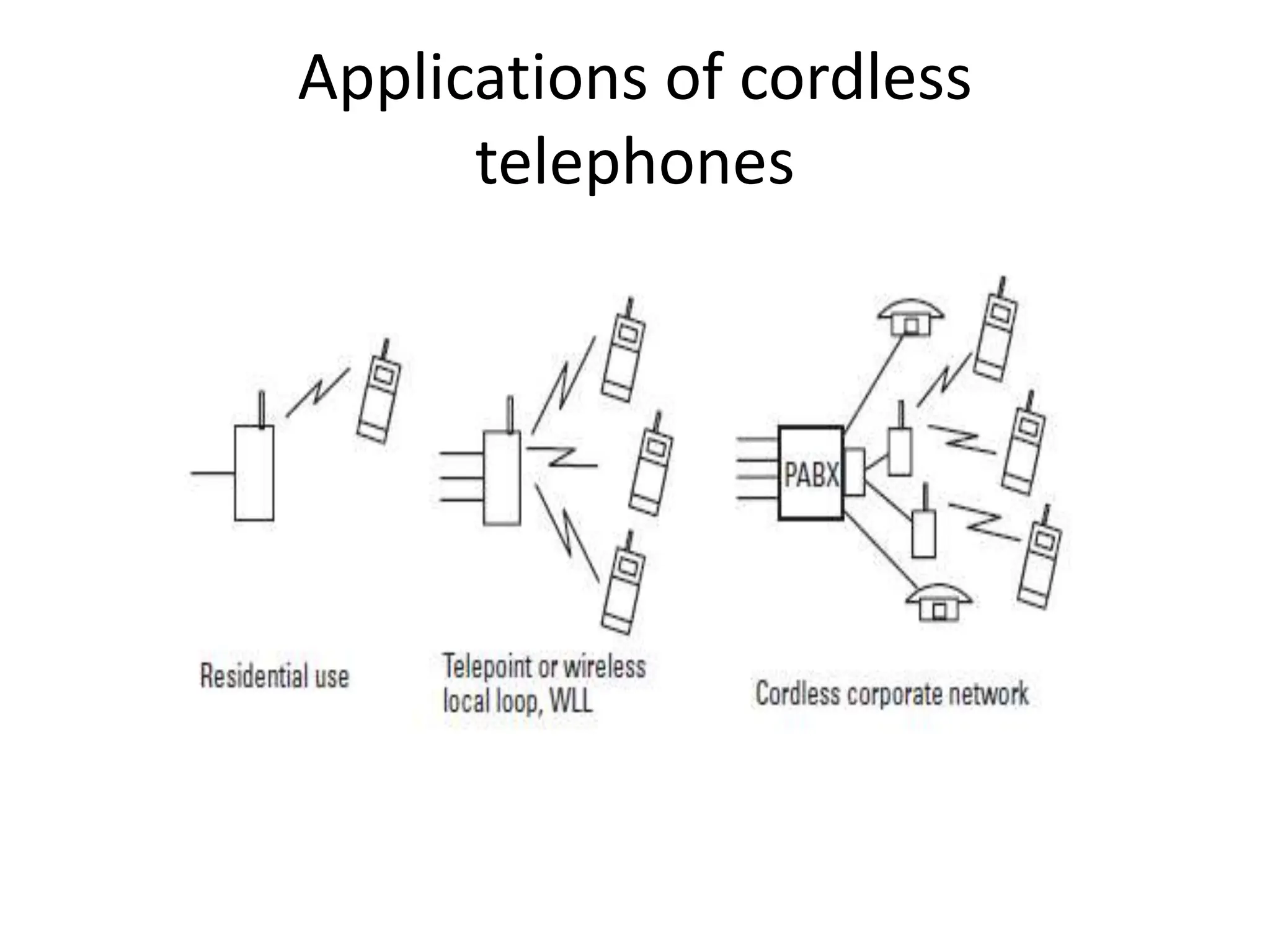
Applications of cordless
telephones
Analog Cellular Systems
• The first cellular technologies were analog and they became
available in the first half of the 1980s.
• These systems are often referred to as first generation cellular
systems
• The important analog cellular systems are:
– Advanced Mobile Phone System (AMPS) in the United States;
– Nordic Mobile Telephone (NMT) used in Nordic countries;
– Total Access Communications System (TACS) in the United Kingdom.
• They use a frequency band in the range of 800 to 900 MHz
(NMT uses 450 MHz as well)
• And they both uses FDMA
Digital Second
Generation Cellular Systems
• The important Digital Second Generation
Cellular Systems
– Global System for Mobile communications (GSM),
originally from Groupe Spécial Mobile)
– Code Division Multiple Access (CDMA)
GSM
• GSM operates at the 900-MHz frequency band
and it became the most widely used second
generation cellular technology.
• In GSM the subscription information is stored
on a smart card and a subscriber can change
his or her mobile telephone any time.
• When he or she inserts his or her card into the
new telephone, he or she has access to exactly
the same service as previously.
• The access method used in GSM is TDMA, in
which each frequency channel is divided into
time slots for multiple users.
CDMA
• CDMA was selected in the early 1990s to become the
main digital cellular standard in the United States.
• The main difference between CDMA and other
technologies discussed previously is that on the radio
path it does not use either FDMA or TDMA.
• Instead the mobiles use the wide frequency band all of
the time with the help of a unique code for each user.
• This unique code is used to spread the signal over a
wide frequency band and to detect the wanted signal
at the receiving end.
• This American system is also referred to as narrowband
CDMA (N-CDMA) or the Interim Standard-95 (IS-95)
system.
Third Generation
Cellular Systems
• The main forces behind development of the
third generation systems (3G) have been
driven by
– Low performance data services,
– Incompatible service in different parts of the
world, and
– lack of capacity of the 2G systems.
Universal Mobile
Telecommunications System (UMTS)
• UMTS is a European concept for integrated mobile
services and it is based on the GSM and GPRS.
• Its goal is to provide a wide range of mobile services
wherever the user is located.
• For UMTS cordless (TDD), cellular and satellite
interfaces are defined. It will provide multimedia
service with data rates up to 2 Mbps for steady MSs
and up to 384 Kbps for moving MSs.
• The cellular radio access method for UMTS approved
ETSI is wideband CDMA (WCDMA).
• The basic operating principle is the same as in CDMA,
which was introduced previously.
UMTS
• The new frequency band at the 2-GHz range is
allocated for UMTS. The channel bandwidth is
5 MHz, and each channel is used by all cells.
• The core network of UMTS is based on the
core network of GSM and GPRS.
• The UMTS BSs can be added to the GSM/GPRS
network to operate in parallel with GSM base
stations.
• Even handovers between UMTS and
GSM/GPRS are supported.
CDMA 2000
• The main 3G technology for the United States
is based on second generation IS-95 CDMA.
• CDMA2000 is specified to use a sophisticated
modulation scheme to increase the data rate
over an ordinary 1.25-MHz CDMA channel.
• The problem with 3G systems in the United
States is that a much smaller frequency band
is available for 3G service than in areas
following European frequency division.

Mobile Telephone system lecture 5.pptx

  • 1.
  • 2.
    Content • Cordless Telephones •Analog Cellular Systems • Digital Second Generation Cellular Systems • Third Generation Cellular Systems
  • 3.
    Cordless Telephones • Cordlessphones were originally developed for the residential market and they were designed to cover only one local area such as a house and garden. • They support only local mobility and should not be considered competitors for cellular mobile networks.
  • 4.
  • 5.
    Analog Cellular Systems •The first cellular technologies were analog and they became available in the first half of the 1980s. • These systems are often referred to as first generation cellular systems • The important analog cellular systems are: – Advanced Mobile Phone System (AMPS) in the United States; – Nordic Mobile Telephone (NMT) used in Nordic countries; – Total Access Communications System (TACS) in the United Kingdom. • They use a frequency band in the range of 800 to 900 MHz (NMT uses 450 MHz as well) • And they both uses FDMA
  • 6.
    Digital Second Generation CellularSystems • The important Digital Second Generation Cellular Systems – Global System for Mobile communications (GSM), originally from Groupe Spécial Mobile) – Code Division Multiple Access (CDMA)
  • 7.
    GSM • GSM operatesat the 900-MHz frequency band and it became the most widely used second generation cellular technology. • In GSM the subscription information is stored on a smart card and a subscriber can change his or her mobile telephone any time. • When he or she inserts his or her card into the new telephone, he or she has access to exactly the same service as previously. • The access method used in GSM is TDMA, in which each frequency channel is divided into time slots for multiple users.
  • 8.
    CDMA • CDMA wasselected in the early 1990s to become the main digital cellular standard in the United States. • The main difference between CDMA and other technologies discussed previously is that on the radio path it does not use either FDMA or TDMA. • Instead the mobiles use the wide frequency band all of the time with the help of a unique code for each user. • This unique code is used to spread the signal over a wide frequency band and to detect the wanted signal at the receiving end. • This American system is also referred to as narrowband CDMA (N-CDMA) or the Interim Standard-95 (IS-95) system.
  • 9.
    Third Generation Cellular Systems •The main forces behind development of the third generation systems (3G) have been driven by – Low performance data services, – Incompatible service in different parts of the world, and – lack of capacity of the 2G systems.
  • 10.
    Universal Mobile Telecommunications System(UMTS) • UMTS is a European concept for integrated mobile services and it is based on the GSM and GPRS. • Its goal is to provide a wide range of mobile services wherever the user is located. • For UMTS cordless (TDD), cellular and satellite interfaces are defined. It will provide multimedia service with data rates up to 2 Mbps for steady MSs and up to 384 Kbps for moving MSs. • The cellular radio access method for UMTS approved ETSI is wideband CDMA (WCDMA). • The basic operating principle is the same as in CDMA, which was introduced previously.
  • 11.
    UMTS • The newfrequency band at the 2-GHz range is allocated for UMTS. The channel bandwidth is 5 MHz, and each channel is used by all cells. • The core network of UMTS is based on the core network of GSM and GPRS. • The UMTS BSs can be added to the GSM/GPRS network to operate in parallel with GSM base stations. • Even handovers between UMTS and GSM/GPRS are supported.
  • 12.
    CDMA 2000 • Themain 3G technology for the United States is based on second generation IS-95 CDMA. • CDMA2000 is specified to use a sophisticated modulation scheme to increase the data rate over an ordinary 1.25-MHz CDMA channel. • The problem with 3G systems in the United States is that a much smaller frequency band is available for 3G service than in areas following European frequency division.