1.4 WIRELESS NETWORK GENERATIONS
The cellular systems have been classified into three distinct evolution of generations: The first-generation (1G) analog cellular
communication systems are voice-oriented analog cellular systems using frequency division multiple access technique. The first-
generation systems used large cells and omni-directional antennas in the 800-MHz band. The AMPS and ETACS systems use a
seven-cell reuse pattern with provisions for cell-sectoring and cell-splitting to increase capacity when needed. These systems
provide satisfactory voice communication on the move with limited traffic-handling capacity. 1.4.1 First-Generation Analog
Cellular Systems The first-generation cellular systems are based on analog transmission technology. The most popular first
generation cellular systems are AMPS (widely deployed in most parts of US, South America, Australia, China), and ETACS
(deployed throughout Europe). The systems transmit speech signals employing FM, and important control information is
transmitted in digital form using FSK. The entire service area is divided into logical cells, and each cell is allocated one specific
band in the frequency spectrum. To explore a frequency reuse pattern, the frequency spectrum is divided among seven cells,
improving the voice quality as each sub scriber is given a larger bandwidth. AMPS and ETACS cellular radio systems deploy cell-
sites with tall towers that support several receiving antennas and have transmitting antennas that typically radiate a few
hundred watts of effective radiated power. Each cell-site has one control channel transmitter that broadcasts on the forward
control channel, one control channel receiver that listens on the reverse control channel for any mobile phone to set-up a call,
and eight or more FM duplex voice channels.
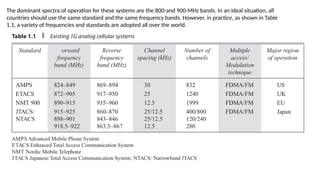
Table 1.1 shows the worldwide 1G analog cellular systems. All these systems use two
separate frequency bands for for ward (from cell-site to mobile) and reverse (from mobile
to cell-site) links. Such a system is referred to as a frequency division duplex ( DD) scheme.
The typical allocated overall band in each direction, for example, for AMPS, and NMT-900,
is 25 MHz in each direction.
The dominant spectra of operation for these systems are the 800-and 900-MHz bands. In an ideal situation, all
countries should use the same standard and the same frequency bands. However, in practice, as shown in Table
1.1, a variety of frequencies and standards are adopted all over the world.
1.4.2 Second-Generation Digital Cellular Systems
First-generation analog cellular systems were followed by second-generation digital cellular systems. The second generation
(2G) cellular systems represent the set of wireless air interface standards that rely on digital modulation and sophisticated
digital signal processing in the handset and the base station. Digital cellular technologies support a much larger number of
mobile subscribers within a given frequency allocation, thereby offering higher user capacity, providing superior security and
voice quality, and lay the foundation for value-added services (including data) that will continue to be developed and enhanced
in future. To have efficient use of the frequency spectrum, time division or code-division multiple access technique is used in 2G
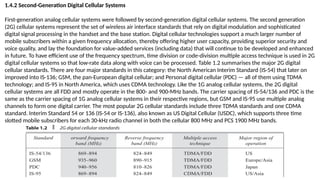
digital cellular systems so that low-rate data along with voice can be processed. Table 1.2 summarises the major 2G digital
cellular standards. There are four major standards in this category: the North American Interim Standard (IS-54) that later on
improved into IS-136; GSM, the pan-European digital cellular; and Personal digital cellular (PDC) — all of them using TDMA
technology; and IS-95 in North America, which uses CDMA technology. Like the 1G analog cellular systems, the 2G digital
cellular systems are all FDD and mostly operate in the 800- and 900-MHz bands. The carrier spacing of IS-54/136 and PDC is the
same as the carrier spacing of 1G analog cellular systems in their respective regions, but GSM and IS-95 use multiple analog
channels to form one digital carrier. The most popular 2G cellular standards include three TDMA standards and one CDMA
standard. Interim Standard 54 or 136 (IS-54 or IS-136), also known as US Digital Cellular (USDC), which supports three time
slotted mobile subscribers for each 30-kHz radio channel in both the cellular 800 MHz and PCS 1900 MHz bands.
Based on the analog AMPS cellular system, the TDMA system IS-54/136 was developed in the US that adds digital traffic
channels. IS-54/136 uses dual-mode mobile phones and incorporates associated control channels, authentication procedures
using encryption, and mobile assisted handoff. The IS-136 includes digital control channels which enable to provide several
additional services such as identification, voice mail, SMS, call waiting, group calling, etc. The USDC systems share the same
frequency spectrum, frequency reuse plan, and cell-sites as that of AMPS. Global System for Mobile (GSM), which supports eight
time slotted mobile subscribers for each 200-kHz radio channel in both the cellular and PCS bands; and Pacific Digital Cellular
(PDC), a Japanese TDMA standard that is similar to IS-136, are the other two most popular TDMA based digital cellular
standards. The popular 2G CDMA standard (IS-95), also known as cdmaOne, can support up to 64 mobile subscribers that are
orthogonally coded and simultaneously transmitted on each 1.25 MHz channel.
The speech-coding technique of all 2G systems operates at about 10 kbps. It is
assumed that large cell sizes and a large number of subscribers per cell are
available, which necessitates lower speech-coding rates. The peak transmission
power of the mobile terminals can be between several hundreds of mW up to
1W, and on the average they consume about 100 mW. All of these systems
employ centralised power control, which reduces battery power consumption
and helps in controlling the interference level. In digital communications, information is transmitted in packets or frames. The
duration of a packet/frame in the air should be short enough, so that the channel does not change significantly during the
transmission, and long enough, so that the required time interval between packets is much smaller than the length of the
packet. A frame length of around 5 to 40 ms is typically used in 2G cellular networks. GSM supports eight users in a 200-kHz
band; IS-54 and JDC support three users in 30 and 25-kHz bands, respectively. In other words, GSM uses 25 kHz for each user,
IS-54 uses 10 kHz per user, and JDC uses 8.33 kHz per user. Therefore, GSM supports 2.5 times less number of subscribers in the
given band width. The number of users for CDMA depends on the acceptable quality of service; therefore, the number of users
in the 1,250 kHz CDMA channels cannot be theoretically fixed. But this number is large enough to convince the standards
organisation to adopt CDMA technology for next-generation 3G systems.
1.4.3 Evolution from 2G to 3G Cellular Networks
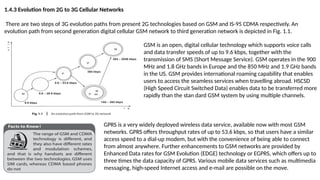
There are two steps of 3G evolution paths from present 2G technologies based on GSM and IS-95 CDMA respectively. An
evolution path from second generation digital cellular GSM network to third generation network is depicted in Fig. 1.1.
GSM is an open, digital cellular technology which supports voice calls
and data transfer speeds of up to 9.6 kbps, together with the
transmission of SMS (Short Message Service). GSM operates in the 900
MHz and 1.8 GHz bands in Europe and the 850 MHz and 1.9 GHz bands
in the US. GSM provides international roaming capability that enables
users to access the seamless services when travelling abroad. HSCSD
(High Speed Circuit Switched Data) enables data to be transferred more
rapidly than the stan dard GSM system by using multiple channels.
GPRS is a very widely deployed wireless data service, available now with most GSM
networks. GPRS offers throughput rates of up to 53.6 kbps, so that users have a similar
access speed to a dial-up modem, but with the convenience of being able to connect
from almost anywhere. Further enhancements to GSM networks are provided by
Enhanced Data rates for GSM Evolution (EDGE) technology or EGPRS, which offers up to
three times the data capacity of GPRS. Various mobile data services such as multimedia
messaging, high-speed Internet access and e-mail are possible on the move.
EDGE allows it to be overlaid directly onto an existing GSM network with simple soft ware-upgrade. WCDMA is the air interface
for third-generation mobile communications systems. It enables the continued support of voice, text and MMS services in
addition to richer mobile multimedia services. UMTS offers data speeds up to 384 kbps on the move and 2.048 Mbps stationary.
Chapters 11 and 13 gives detailed descriptions of GSM based cellular technologies. Besides GSM, CDMA is the most popular
mobile communication standard. The initial evolution of CDMA started in 1991 as IS-95A cdmaOne 2G digital cellular
technology for voice communication as well as data and multimedia services because it could allow multiple users to
communicate within the spectrum, avoid ing interference or jamming among users. Code division ensures that each user’s
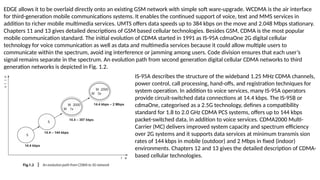
signal remains separate in the spectrum. An evolution path from second generation digital cellular CDMA networks to third
generation networks is depicted in Fig. 1.2.
IS-95A describes the structure of the wideband 1.25 MHz CDMA channels,
power control, call processing, hand-offs, and registration techniques for
system operation. In addition to voice services, many IS-95A operators
provide circuit-switched data connections at 14.4 kbps. The IS-95B or
cdmaOne, categorised as a 2.5G technology, defines a compatibility
standard for 1.8 to 2.0 GHz CDMA PCS systems, offers up to 144 kbps
packet-switched data, in addition to voice services. CDMA2000 Multi-
Carrier (MC) delivers improved system capacity and spectrum efficiency
over 2G systems and it supports data services at minimum transmis sion
rates of 144 kbps in mobile (outdoor) and 2 Mbps in fixed (indoor)
environments. Chapters 12 and 13 gives the detailed description of CDMA-
based cellular technologies.
1.4.4 Third-Generation Digital Cellular Systems
The fundamental purpose of the 3G mobile communications system is to provide a globally integrated wire less communication
system combining different incompatible network technologies already deployed across the world. All 2G and 2.5G cellular
communications systems and mobile phones will eventually evolve towards a global standard, which is referred to IMT-2000.
While no one common standard for the air interface has been approved, the number of different standard specifications includes
one FDMA standard, one TDMA standard, and one CDMA standard with three variations. The IMT-2000 system incorporates
three variations of CDMA. The modes differ in how duplexing is accomplished and how many carriers are used. All variations
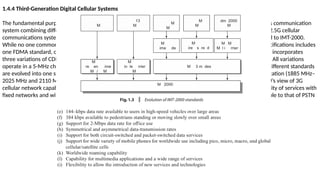
operate in a 5-MHz channel, as compared to 1.25 MHz for cdmaOne systems. Figure 1.3 illustrates how these different standards
are evolved into one standard IMT-2000. The need for a capacity increase necessitates a greater spectrum allocation (1885 MHz–
2025 MHz and 2110 MHz–2200 MHz) for 3G systems. The key features of the IMT-2000 system defining the ITU’s view of 3G
cellular network capabilities are as follows: (a) High degree of worldwide commonality of design (b) Compatibility of services with
fixed networks and within IMT-2000 (c) More efficient use of the available spectrum (d) Voice quality comparable to that of PSTN
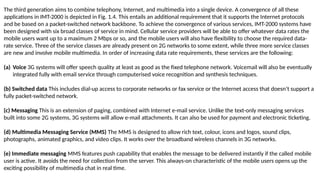
The third generation aims to combine telephony, Internet, and multimedia into a single device. A convergence of all these
applications in IMT-2000 is depicted in Fig. 1.4. This entails an additional requirement that it supports the Internet protocols
and be based on a packet-switched network backbone. To achieve the convergence of various services, IMT-2000 systems have
been designed with six broad classes of service in mind. Cellular service providers will be able to offer whatever data rates the
mobile users want up to a maximum 2 Mbps or so, and the mobile users will also have flexibility to choose the required data-
rate service. Three of the service classes are already present on 2G networks to some extent, while three more service classes
are new and involve mobile multimedia. In order of increasing data rate requirements, these services are the following:
(a) Voice 3G systems will offer speech quality at least as good as the fixed telephone network. Voicemail will also be eventually
integrated fully with email service through computerised voice recognition and synthesis techniques.
(b) Switched data This includes dial-up access to corporate networks or fax service or the Internet access that doesn’t support a
fully packet-switched network.
(c) Messaging This is an extension of paging, combined with Internet e-mail service. Unlike the text-only messaging services
built into some 2G systems, 3G systems will allow e-mail attachments. It can also be used for payment and electronic ticketing.
(d) Multimedia Messaging Service (MMS) The MMS is designed to allow rich text, colour, icons and logos, sound clips,
photographs, animated graphics, and video clips. It works over the broadband wireless channels in 3G networks.
(e) Immediate messaging MMS features push capability that enables the message to be delivered instantly if the called mobile
user is active. It avoids the need for collection from the server. This always-on characteristic of the mobile users opens up the
exciting possibility of multimedia chat in real time.
(f) Medium multimedia This is likely to be the most popular 3G service. Its downstream data rate is ideal for web surfing, games,
location-based maps, and collaborative group working.
(g) High multimedia This can be used for very high-speed Internet access, as well as for high-definition video and CD-quality
audio on demand. Another possible application is online shopping for intangible products that can be delivered over the air such
as a software program for a mobile computer.
(h) Interactive high multimedia This can be used for high-quality videophones, videoconferencing or a combination of
videoconferencing and collaborative working.
(i) Sending multimedia postcards A clip of a holiday video could be captured through the integral video cam of a user’s mobile
handset or uploaded via Bluetooth from a standard camcorder, then combined with voice or text messages and mailed instantly
to any other mobile user.
1.4.5 Wireless Networking Technologies
The use of radio signals for data transmission during World War II by the US Army inspired a group of researchers in 1971 at the
University of Hawaii to create the first packet-based radio communications network called ALOHAnet, the very first wireless
local area network (WLAN). It consisted of 7 computers that com municated in a bi-directional star topology. The first
generation of WLAN technology used an unlicensed ISM band of 902–928 MHz. To minimise the interference from small
appliances and industrial machinery, a spread spectrum was used which operated at a 500-kbps data rate. In 1990, the IEEE 802
Executive Committee established the 802.11 Working Group to create the WLAN standard. The standard specified an operating
frequency in the 2.4-GHz ISM band. In 1997, the group approved IEEE 802.11 as the world’s first WLAN standard with data rates
of 1 and 2 Mbps. Like cellphones, wireless-equipped laptops within range of a given access point have the ability to
communicate with the network. A single access point can communicate with multiple wireless equipped laptops. Many systems
allow roaming between access points. Despite their limited range (up to 100 m) and lower data rates (as compared to 1 Gbps
offered by wired Ethernets), WLANs have become the preferred Internet access method for e-mail and Web browsing
applications, in many offices, homes, campus environments, and public places.
A wireless personal area network (WPAN), such as Bluetooth IEEE 802.15.1, enables
wireless com munication between devices, ranging from computers and cell phones
to keyboards and headphones, and operates in ISM 2.4 GHz band. WiMAX (WMAN
based on the IEEE 802.16 family of standards) will soon offer wireless broadband
Internet access to residences and businesses at relatively low cost.

Wireless Network Generations (Optical and Wireless Communication)

  • 1.
    1.4 WIRELESS NETWORKGENERATIONS The cellular systems have been classified into three distinct evolution of generations: The first-generation (1G) analog cellular communication systems are voice-oriented analog cellular systems using frequency division multiple access technique. The first- generation systems used large cells and omni-directional antennas in the 800-MHz band. The AMPS and ETACS systems use a seven-cell reuse pattern with provisions for cell-sectoring and cell-splitting to increase capacity when needed. These systems provide satisfactory voice communication on the move with limited traffic-handling capacity. 1.4.1 First-Generation Analog Cellular Systems The first-generation cellular systems are based on analog transmission technology. The most popular first generation cellular systems are AMPS (widely deployed in most parts of US, South America, Australia, China), and ETACS (deployed throughout Europe). The systems transmit speech signals employing FM, and important control information is transmitted in digital form using FSK. The entire service area is divided into logical cells, and each cell is allocated one specific band in the frequency spectrum. To explore a frequency reuse pattern, the frequency spectrum is divided among seven cells, improving the voice quality as each sub scriber is given a larger bandwidth. AMPS and ETACS cellular radio systems deploy cell- sites with tall towers that support several receiving antennas and have transmitting antennas that typically radiate a few hundred watts of effective radiated power. Each cell-site has one control channel transmitter that broadcasts on the forward control channel, one control channel receiver that listens on the reverse control channel for any mobile phone to set-up a call, and eight or more FM duplex voice channels. Table 1.1 shows the worldwide 1G analog cellular systems. All these systems use two separate frequency bands for for ward (from cell-site to mobile) and reverse (from mobile to cell-site) links. Such a system is referred to as a frequency division duplex ( DD) scheme. The typical allocated overall band in each direction, for example, for AMPS, and NMT-900, is 25 MHz in each direction.
  • 2.
    The dominant spectraof operation for these systems are the 800-and 900-MHz bands. In an ideal situation, all countries should use the same standard and the same frequency bands. However, in practice, as shown in Table 1.1, a variety of frequencies and standards are adopted all over the world.
  • 3.
    1.4.2 Second-Generation DigitalCellular Systems First-generation analog cellular systems were followed by second-generation digital cellular systems. The second generation (2G) cellular systems represent the set of wireless air interface standards that rely on digital modulation and sophisticated digital signal processing in the handset and the base station. Digital cellular technologies support a much larger number of mobile subscribers within a given frequency allocation, thereby offering higher user capacity, providing superior security and voice quality, and lay the foundation for value-added services (including data) that will continue to be developed and enhanced in future. To have efficient use of the frequency spectrum, time division or code-division multiple access technique is used in 2G digital cellular systems so that low-rate data along with voice can be processed. Table 1.2 summarises the major 2G digital cellular standards. There are four major standards in this category: the North American Interim Standard (IS-54) that later on improved into IS-136; GSM, the pan-European digital cellular; and Personal digital cellular (PDC) — all of them using TDMA technology; and IS-95 in North America, which uses CDMA technology. Like the 1G analog cellular systems, the 2G digital cellular systems are all FDD and mostly operate in the 800- and 900-MHz bands. The carrier spacing of IS-54/136 and PDC is the same as the carrier spacing of 1G analog cellular systems in their respective regions, but GSM and IS-95 use multiple analog channels to form one digital carrier. The most popular 2G cellular standards include three TDMA standards and one CDMA standard. Interim Standard 54 or 136 (IS-54 or IS-136), also known as US Digital Cellular (USDC), which supports three time slotted mobile subscribers for each 30-kHz radio channel in both the cellular 800 MHz and PCS 1900 MHz bands.
  • 4.
    Based on theanalog AMPS cellular system, the TDMA system IS-54/136 was developed in the US that adds digital traffic channels. IS-54/136 uses dual-mode mobile phones and incorporates associated control channels, authentication procedures using encryption, and mobile assisted handoff. The IS-136 includes digital control channels which enable to provide several additional services such as identification, voice mail, SMS, call waiting, group calling, etc. The USDC systems share the same frequency spectrum, frequency reuse plan, and cell-sites as that of AMPS. Global System for Mobile (GSM), which supports eight time slotted mobile subscribers for each 200-kHz radio channel in both the cellular and PCS bands; and Pacific Digital Cellular (PDC), a Japanese TDMA standard that is similar to IS-136, are the other two most popular TDMA based digital cellular standards. The popular 2G CDMA standard (IS-95), also known as cdmaOne, can support up to 64 mobile subscribers that are orthogonally coded and simultaneously transmitted on each 1.25 MHz channel. The speech-coding technique of all 2G systems operates at about 10 kbps. It is assumed that large cell sizes and a large number of subscribers per cell are available, which necessitates lower speech-coding rates. The peak transmission power of the mobile terminals can be between several hundreds of mW up to 1W, and on the average they consume about 100 mW. All of these systems employ centralised power control, which reduces battery power consumption and helps in controlling the interference level. In digital communications, information is transmitted in packets or frames. The duration of a packet/frame in the air should be short enough, so that the channel does not change significantly during the transmission, and long enough, so that the required time interval between packets is much smaller than the length of the packet. A frame length of around 5 to 40 ms is typically used in 2G cellular networks. GSM supports eight users in a 200-kHz band; IS-54 and JDC support three users in 30 and 25-kHz bands, respectively. In other words, GSM uses 25 kHz for each user, IS-54 uses 10 kHz per user, and JDC uses 8.33 kHz per user. Therefore, GSM supports 2.5 times less number of subscribers in the given band width. The number of users for CDMA depends on the acceptable quality of service; therefore, the number of users in the 1,250 kHz CDMA channels cannot be theoretically fixed. But this number is large enough to convince the standards organisation to adopt CDMA technology for next-generation 3G systems.
  • 5.
    1.4.3 Evolution from2G to 3G Cellular Networks There are two steps of 3G evolution paths from present 2G technologies based on GSM and IS-95 CDMA respectively. An evolution path from second generation digital cellular GSM network to third generation network is depicted in Fig. 1.1. GSM is an open, digital cellular technology which supports voice calls and data transfer speeds of up to 9.6 kbps, together with the transmission of SMS (Short Message Service). GSM operates in the 900 MHz and 1.8 GHz bands in Europe and the 850 MHz and 1.9 GHz bands in the US. GSM provides international roaming capability that enables users to access the seamless services when travelling abroad. HSCSD (High Speed Circuit Switched Data) enables data to be transferred more rapidly than the stan dard GSM system by using multiple channels. GPRS is a very widely deployed wireless data service, available now with most GSM networks. GPRS offers throughput rates of up to 53.6 kbps, so that users have a similar access speed to a dial-up modem, but with the convenience of being able to connect from almost anywhere. Further enhancements to GSM networks are provided by Enhanced Data rates for GSM Evolution (EDGE) technology or EGPRS, which offers up to three times the data capacity of GPRS. Various mobile data services such as multimedia messaging, high-speed Internet access and e-mail are possible on the move.
  • 6.
    EDGE allows itto be overlaid directly onto an existing GSM network with simple soft ware-upgrade. WCDMA is the air interface for third-generation mobile communications systems. It enables the continued support of voice, text and MMS services in addition to richer mobile multimedia services. UMTS offers data speeds up to 384 kbps on the move and 2.048 Mbps stationary. Chapters 11 and 13 gives detailed descriptions of GSM based cellular technologies. Besides GSM, CDMA is the most popular mobile communication standard. The initial evolution of CDMA started in 1991 as IS-95A cdmaOne 2G digital cellular technology for voice communication as well as data and multimedia services because it could allow multiple users to communicate within the spectrum, avoid ing interference or jamming among users. Code division ensures that each user’s signal remains separate in the spectrum. An evolution path from second generation digital cellular CDMA networks to third generation networks is depicted in Fig. 1.2. IS-95A describes the structure of the wideband 1.25 MHz CDMA channels, power control, call processing, hand-offs, and registration techniques for system operation. In addition to voice services, many IS-95A operators provide circuit-switched data connections at 14.4 kbps. The IS-95B or cdmaOne, categorised as a 2.5G technology, defines a compatibility standard for 1.8 to 2.0 GHz CDMA PCS systems, offers up to 144 kbps packet-switched data, in addition to voice services. CDMA2000 Multi- Carrier (MC) delivers improved system capacity and spectrum efficiency over 2G systems and it supports data services at minimum transmis sion rates of 144 kbps in mobile (outdoor) and 2 Mbps in fixed (indoor) environments. Chapters 12 and 13 gives the detailed description of CDMA- based cellular technologies.
  • 7.
    1.4.4 Third-Generation DigitalCellular Systems The fundamental purpose of the 3G mobile communications system is to provide a globally integrated wire less communication system combining different incompatible network technologies already deployed across the world. All 2G and 2.5G cellular communications systems and mobile phones will eventually evolve towards a global standard, which is referred to IMT-2000. While no one common standard for the air interface has been approved, the number of different standard specifications includes one FDMA standard, one TDMA standard, and one CDMA standard with three variations. The IMT-2000 system incorporates three variations of CDMA. The modes differ in how duplexing is accomplished and how many carriers are used. All variations operate in a 5-MHz channel, as compared to 1.25 MHz for cdmaOne systems. Figure 1.3 illustrates how these different standards are evolved into one standard IMT-2000. The need for a capacity increase necessitates a greater spectrum allocation (1885 MHz– 2025 MHz and 2110 MHz–2200 MHz) for 3G systems. The key features of the IMT-2000 system defining the ITU’s view of 3G cellular network capabilities are as follows: (a) High degree of worldwide commonality of design (b) Compatibility of services with fixed networks and within IMT-2000 (c) More efficient use of the available spectrum (d) Voice quality comparable to that of PSTN
  • 8.
    The third generationaims to combine telephony, Internet, and multimedia into a single device. A convergence of all these applications in IMT-2000 is depicted in Fig. 1.4. This entails an additional requirement that it supports the Internet protocols and be based on a packet-switched network backbone. To achieve the convergence of various services, IMT-2000 systems have been designed with six broad classes of service in mind. Cellular service providers will be able to offer whatever data rates the mobile users want up to a maximum 2 Mbps or so, and the mobile users will also have flexibility to choose the required data- rate service. Three of the service classes are already present on 2G networks to some extent, while three more service classes are new and involve mobile multimedia. In order of increasing data rate requirements, these services are the following: (a) Voice 3G systems will offer speech quality at least as good as the fixed telephone network. Voicemail will also be eventually integrated fully with email service through computerised voice recognition and synthesis techniques. (b) Switched data This includes dial-up access to corporate networks or fax service or the Internet access that doesn’t support a fully packet-switched network. (c) Messaging This is an extension of paging, combined with Internet e-mail service. Unlike the text-only messaging services built into some 2G systems, 3G systems will allow e-mail attachments. It can also be used for payment and electronic ticketing. (d) Multimedia Messaging Service (MMS) The MMS is designed to allow rich text, colour, icons and logos, sound clips, photographs, animated graphics, and video clips. It works over the broadband wireless channels in 3G networks. (e) Immediate messaging MMS features push capability that enables the message to be delivered instantly if the called mobile user is active. It avoids the need for collection from the server. This always-on characteristic of the mobile users opens up the exciting possibility of multimedia chat in real time.
  • 9.
    (f) Medium multimediaThis is likely to be the most popular 3G service. Its downstream data rate is ideal for web surfing, games, location-based maps, and collaborative group working. (g) High multimedia This can be used for very high-speed Internet access, as well as for high-definition video and CD-quality audio on demand. Another possible application is online shopping for intangible products that can be delivered over the air such as a software program for a mobile computer. (h) Interactive high multimedia This can be used for high-quality videophones, videoconferencing or a combination of videoconferencing and collaborative working. (i) Sending multimedia postcards A clip of a holiday video could be captured through the integral video cam of a user’s mobile handset or uploaded via Bluetooth from a standard camcorder, then combined with voice or text messages and mailed instantly to any other mobile user.
  • 10.
    1.4.5 Wireless NetworkingTechnologies The use of radio signals for data transmission during World War II by the US Army inspired a group of researchers in 1971 at the University of Hawaii to create the first packet-based radio communications network called ALOHAnet, the very first wireless local area network (WLAN). It consisted of 7 computers that com municated in a bi-directional star topology. The first generation of WLAN technology used an unlicensed ISM band of 902–928 MHz. To minimise the interference from small appliances and industrial machinery, a spread spectrum was used which operated at a 500-kbps data rate. In 1990, the IEEE 802 Executive Committee established the 802.11 Working Group to create the WLAN standard. The standard specified an operating frequency in the 2.4-GHz ISM band. In 1997, the group approved IEEE 802.11 as the world’s first WLAN standard with data rates of 1 and 2 Mbps. Like cellphones, wireless-equipped laptops within range of a given access point have the ability to communicate with the network. A single access point can communicate with multiple wireless equipped laptops. Many systems allow roaming between access points. Despite their limited range (up to 100 m) and lower data rates (as compared to 1 Gbps offered by wired Ethernets), WLANs have become the preferred Internet access method for e-mail and Web browsing applications, in many offices, homes, campus environments, and public places. A wireless personal area network (WPAN), such as Bluetooth IEEE 802.15.1, enables wireless com munication between devices, ranging from computers and cell phones to keyboards and headphones, and operates in ISM 2.4 GHz band. WiMAX (WMAN based on the IEEE 802.16 family of standards) will soon offer wireless broadband Internet access to residences and businesses at relatively low cost.