TELEPHONE AND SWITCHING
PREPAREDBY
VICTOR BRYSON MSIGALA
NIT/BCETE/20202/9
Topic outlines
• Understand five unit code
• Explain five unit code and its application
2.
• The Baudotcode [boˈdo] is an early character encoding for telegraphy
invented by Émile Baudot in the 1870s.It was the predecessor to the
International Telegraph Alphabet No. 2 (ITA2), the most common tele printer
code in use until the advent of ASCII.
• Each character in the alphabet is represented by a series of five bits, sent over
a communication channel such as a telegraph wire or a radio signal by
asynchronous serial communication. The symbol rate measurement is known
as baud, and is derived from the same name.
3.
Baudot code (ITA1)
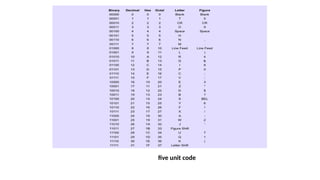
•In the below table, Columns I, II, III, IV, and V show the code; the
Let. and Fig. columns show the letters and numbers for the
Continental and UK versions; and the sort keys present the table in
the order: alphabetical, Gray and UK
• Baudot developed his first multiplexed telegraph in 1872 and
patented it in 1874.In 1876, he changed from a six-bit code to a five-
bit code, as suggested by Carl Friedrich Gauss and Wilhelm Weber in
1834,with equal on and off intervals, which allowed for transmission
of the Roman alphabet, and included punctuation and control
signals.
• The code itself was not patented (only the machine) because French
patent law does not allow concepts to be patented.
4.
• Baudot's 5-bitcode was adapted to be sent from a manual
keyboard, and no tele printer equipment was ever constructed that
used it in its original form.
• The code was entered on a keyboard which had just five piano-type
keys and was operated using two fingers of the left hand and three
fingers of the right hand.
• Once the keys had been pressed, they were locked down until
mechanical contacts in a distributor unit passed over the sector
connected to that particular keyboard, at which time the keyboard
was unlocked ready for the next character to be entered, with an
audible click (known as the "cadence signal") to warn the operator.
• Operators had to maintain a steady rhythm, and the usual speed of
operation was 30 words per minute.
5.
• The table"shows the allocation of the Baudot code which was
employed in the British Post Office for continental and inland
services.
• A number of characters in the continental code are replaced by
fractional in the inland code.
• Code elements 1, 2 and 3 are transmitted by keys 1, 2 and 3, and
these are operated by the first three fingers of the right hand. Code
elements 4 and 5 are transmitted by keys 4 and 5, and these are
operated by the first two fingers of the left hand
• Application ofFive unit code
• Communication channel such as a telegraph wire or a radio signal by
asynchronous serial communication.
• tele printer code
• Weather code in meteorologists
![• The Baudot code [boˈdo] is an early character encoding for telegraphy
invented by Émile Baudot in the 1870s.It was the predecessor to the
International Telegraph Alphabet No. 2 (ITA2), the most common tele printer
code in use until the advent of ASCII.
• Each character in the alphabet is represented by a series of five bits, sent over
a communication channel such as a telegraph wire or a radio signal by
asynchronous serial communication. The symbol rate measurement is known
as baud, and is derived from the same name.](https://image.slidesharecdn.com/fiveunitcode-250505173031-aeeec783/85/five-unit-code-in-the-communication-pptx-2-320.jpg)



![Lecture 1 Communication Systems[2886].pptx](https://cdn.slidesharecdn.com/ss_thumbnails/lecture1communicationsystems2886-250223172317-0af739f2-thumbnail.jpg?width=640&height=640&fit=bounds)


