Download to read offline
![International Journal of Computer Engineering and Technology (IJCET), ISSN 0976-6367(Print),
ISSN 0976 - 6375(Online), Volume 5, Issue 4, April (2014), pp. 73-85 © IAEME
84
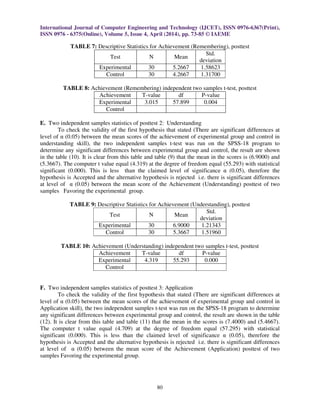
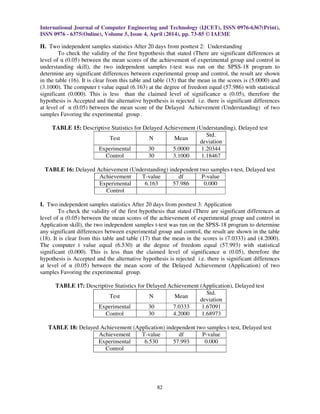
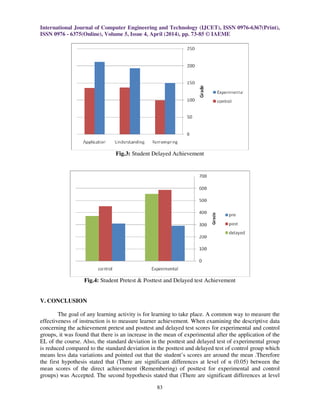
of α (0.05) between the mean scores of the direct achievement (understanding) of posttest for
experimental and control groups) was Accepted. The third hypothesis stated that (There are
significant differences at level of α (0.05) between the mean scores of the direct achievement
(Application) of posttest for experimental and control groups) was accepted. Therefore the forth
hypothesis stated that (There are significant differences at level of α (0.05) between the mean scores
of the Delayed achievement (Remembering) of delayed test for experimental and control groups)
was Accepted. The Fifth hypothesis stated that (There are significant differences at level of α (0.05)
between the mean scores of the Delayed achievement (understanding) of delayed test for
experimental and control groups) was Accepted. The sixth hypothesis stated that (There are
significant differences at level of α (0.05) between the mean scores of the Delayed achievement
(Application) of delayed for experimental and control groups) was accepted.
From this discussion, it is clear that EL approach has good efficiency in learning and
improves the students’ achievement, Delayed achievement and Interist toward this new systematic
way of learning using the new technology based on computer and multimedia tools.
VI. ACKNOWLEDGEMENTS
After the results of the research have been lighted, the researcher would like to suggest the
following points:
- Expansion in the computerization of mathematics curriculum because of its impact on student
achievement.
- Work on the provision of computers in all schools with Data show.
- The need for training and rehabilitation of mathematics teachers in the use of computer.
- The need for a teacher who specializes in computer technician in addition to the computer lab
in each school.
- Provide incentives and support for teachers who are doing the role of computers in the
educational process.
- Hold contests on the level of the Republic of programming modules in Mathematics
- The e-learning approach should be used in our Schools,
- Execute practical sessions for students of all levels concerning use of LMS.
- Encourage instructors to practice the e-learning approach and use LMS.
- Establish an authoring unit for e-learning of different courses with different experts.
acknowledgement section may be presented after the conclusion, if desired.
REFERENCES
[1] Oye, N. D., Salleh, M., & Iahad, N. A. (2010). Holistic E- learning in Nigerian Higher
Education Institutions. Journal of Computing, 2(11), 20-26.
[2] Rodgers, T. (2008). Student Engagement in the E-learning process and impact on their
Grades:. International Journal of Cyber Society and Education., 1(2), 143-156.
[3] Holley, D. (2002). "Which room is the virtual seminar in please?" Education and Training,
44(3), 112-121.
[4] Bonk C. J., & Reynolds, T. H. (1997). Learner- centered Web instruction for higher-order
thinking, teamwork, and apprenticeship. In B. H. Khan (Ed.), Web-based instruction
(pp. 167-178). Englewood Cliffs, NJ: Educational Technology Publications.
[5] Carr, Jacobson. & Brown M. (1993). Introduction to Biomedical Equipment Technology, 2nd
edition, Prentice Hall Inc. ISBN: 0-13-014333-2.](https://image.slidesharecdn.com/50120140504009-140507085237-phpapp02/85/50120140504009-12-320.jpg)
![International Journal of Computer Engineering and Technology (IJCET), ISSN 0976-6367(Print),
ISSN 0976 - 6375(Online), Volume 5, Issue 4, April (2014), pp. 73-85 © IAEME
85
[6] Clark, R. E. (2001). A summary of disagreements with the “mere vehicles” argument. In R.
E. Clark (Ed.), Learning from media: Arguments, analysis, and evidence (pp. 125- 136).
Greenwich, CT: Information Age Publishing Inc,
http://homepages.hvu.nl/ilya.zitter/References.htm.
[7] Clark, R. E. (1983). Reconsidering research on learning from media. Review of Educational
Research, 53(4), 445-459.
[8] Hall, B. (2001).e-learning: Building competitive advantage through people and technology. A
special section on e-learning by Forbes Magazine. Retrieved January 24, 2014, from
http://www.forbes.com/specialsections/elearning/.
[9] Khan, B. (1997). Web-based instruction: What is it and why is it? In B. H. Khan (Ed.), Web-
based instruction (pp. 5-18). Englewood Cliffs, NJ: Educational Technology Publications.
http://bookstoread.com.khanB1997/web-based- instruction.
[10] Kozma, R. B. (2001). Counterpoint theory of “learning with media.” In R. E. Clark (Ed.),
Learning from media: Arguments, analysis, and evidence, ISBN: 1930608772, (pp. 137-178).
Greenwich, CT: Information Age Publishing Inc.
[11] Schramm, W. (1977). Big media, little media. Beverly Hills, CA: Sage.
[12] Simmons, D. E. (2002). The forum report: E- learning adoption rates and barriers. In A.
Rossett (Ed.), The ASTD e-learning handbook (pp. 19-23). New York: McGraw-Hill.
[13] Tombkin’s W.J. (1993). Biomedical Signal Processing, by PRT Prentice-Hall. A division of
Simon & Schuster Englewood Cliffs, New Jersey 07632. ISBN: 0-13-067216-5.
[14] Webster (1995). - Medical Instrumentation Application and Design, 2nd edition, by John
Wiley& Sons, Inc. ISBN: 0471124931.
[15] Ministry of Education in yemen(2008).- Math for level 5 second semester, normal fraction,
(pp.1-45) .
[16] Abdulmalek Alhawery. (2013). E-learning in Yemen Reality and Ambition. Retrieved Feb 2,
2014, from http://www.algomhoriah.net/articles.php?id=42892.
[17] Yahya Al-Ashmoery, Rochdi Messoussi, Youness Chaabi and Raja Touahni, “Monitoring
and Visualizing Students Tracking Data Online Learning Activities (Tracking in E-Learning
Platforms) MVSA”, International Journal of Information Technology and Management
Information Systems (IJITMIS), Volume 4, Issue 3, 2013, pp. 121 - 135, ISSN Print:
0976 – 6405, ISSN Online: 0976 – 6413.
[18] Nathan D’lima, Anirudh Prabhu, Jaison Joseph and Shamsuddin S. Khan, “Novel Approach
in E-Learning to Imbibe Environmental Awareness”, International Journal of Computer
Engineering & Technology (IJCET), Volume 4, Issue 2, 2013, pp. 166 - 171, ISSN Print:
0976 – 6367, ISSN Online: 0976 – 6375.
[19] N.V.Kalyankar and S.B.Chavhan, “Canonical-Laplace Transform and its Various Testing
Function Spaces”, International Journal of Advanced Research in Engineering & Technology
(IJARET), Volume 5, Issue 1, 2014, pp. 177 - 181, ISSN Print: 0976-6480, ISSN Online:
0976-6499.](https://image.slidesharecdn.com/50120140504009-140507085237-phpapp02/85/50120140504009-13-320.jpg)

This document discusses a study that examined the effectiveness of e-learning compared to traditional learning for teaching fractions to 5th grade students in Yemeni public primary schools. An experimental group of 30 students learned fractions using an e-learning approach while a control group of 30 students learned fractions through traditional methods. Results showed that the e-learning approach led to significantly higher achievement and gains in remembering, understanding, and applying fraction concepts compared to the traditional approach. The document provides background on e-learning and reasons for its increased use, including reducing geographical and financial barriers to education.


