MOBILE COMPUTING
LECTURE NOTES
III-CSE
PRESENTED BY :
Dr R JEGADEESAN, Professor and
Head,Department of Computer Science and
Engineering
UNIT – I CONTENTS
ā–Ŗ Mobile Communication
ā–ŖMobile Computing
ā–Ŗ Novel Applications
ā–Ŗ Location dependent services
ā–Ŗ Effects of device portability
ā–Ŗ Wireless n/wā€˜s in comparison with fixed n/wā€˜s
ā–Ŗ Limitations
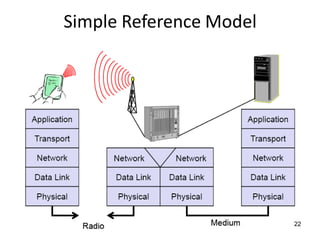
ā–Ŗ Architecture (simple reference model)
3
Goal of Mobile Computing
āž¢ People and their machines should be able to
access information and communicate with
each other easily and securely, in any medium
or combination of media
– voice, data, image, video, or multimedia any
time, anywhere, in a timely, cost-effective way.
4
Mobile Computing
• Mobile computing refers to computing in a distributed
system in which some processes or processors can
move.
– Moving processes ļƒž logical mobility, realized by agents.
– Moving processors ļƒž physical mobility, realized by moving
devices.
• Mobile computing extends a distributed computing
environment with a new dimension of mobility.
– Most existing mobile computing systems are based on client-
server computing systems.
– Recent mobile computing solutions consider general distributed
computing, namely, peer-to-peer computing environments.
• Many mobile computing techniques have their root in
distributed systems.
processors 5
Distributed system
• Definition:
– A distributed system consists of a collection of
autonomous computers, connected through a network
and distribution middleware, which enables
computers to coordinate their activities and to share
the resources of the system, so that users perceive
the system as a single, integrated computing facility.
• Multiple autonomous components
• Components are not shared by all users
• Resources may not be accessible
• Software runs in concurrent processes on different
Mobile Computing contd..,
• The process of computation on a mobile device
• In mobile computing, a set of distributed computing
systems or service provider servers participate, connect,
and synchronize through mobile communication
protocols
• Mobile computing as a generic term describing ability to
use the technology to wirelessly connect to and use
centrally located information and/or application software
through the application of small, portable, and wireless
computing and communication devices
6
Mobile Computing contd..,
• Provides decentralized (distributed) computations on
diversified devices, systems, and networks, which are
mobile, synchronized, and interconnected via mobile
communication standards and protocols.
• Mobile device does not restrict itself to just one
application, such as, voice communication
• Offers mobility with computing power
• Facilitates a large number of applications on a single
device
7
Introduction
Mobile Communication
• User Mobility:
– Refers to a user who has access to the same or similar
telecommunication services at different places.
– user mobility: users communicate (wireless) ―anytime,anywhere,
with anyone‖
• Device Portability:
– The communication device moves with or without the user
– device portability: devices can be connected anytime, anywhere
to the network
• A communication device can the exhibit one of the
following characteristics:
– Fixed and wired e.g. Typical desktops computer
– Mobile and wired e.g. some laptops
– Fixed and wireless e.g. WIRELESS LANS
– Mobile and wireless e.g. Mobile phones 8
Mobility Issues
• Bandwidth restrictions and variability
• Location-aware network operation
– User may wake up in a new environment
– Dynamic replication of data
• Querying wireless data & location-based responses
• Busty network activity during connections & handling
disconnections
• Disconnection
– OS and File System Issues - allow for disconnected operation
– Database System Issues - when disconnected, based on local
data
9
Portability Issues
• Battery power restrictions
• Risks to data
- Physical damage, loss, theft
- Unauthorized access
- encrypt data stored on mobiles
- Backup critical data to fixed (reliable) hosts
• Small user interface
- Small displays due to battery power and aspect ratio
constraints
- Cannot open too many windows
- Difficult to click on miniature icons
- Input - Graffiti, (Dictionary-based) Expectation
- Gesture or handwriting recognition with Stylus Pen Voice
matching or voice recognition
10
Evolutions of the Mobile Systems
1G Analog systems
2G systems
āž¢ voice communication
āž¢ Circuit Switched
2.5G systems
āž¢ Circuit switching for voice
āž¢ Packet switching for data
3G systems
āž¢ Packet switching for voice and data
āž¢ High speed
āž¢ Compatible with different access technologies
11
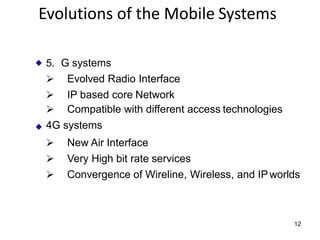
5. G systems
āž¢ Evolved Radio Interface
āž¢ IP based core Network
āž¢ Compatible with different access technologies
4G systems
āž¢ New Air Interface
āž¢ Very High bit rate services
āž¢ Convergence of Wireline, Wireless, and IPworlds
12
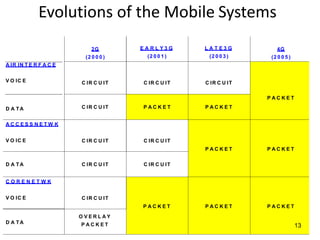
Evolutions of the Mobile Systems
A IR IN T E R F A C E
V O IC E
D A TA
2G
(2 0 0 0 )
E A R L Y 3 G
(2 0 0 1 )
L A T E 3 G
(2 0 0 3 )
4G
(2 0 0 5 )
C IR C U IT C IR C U IT C IR C U IT
C IR C U IT P A C K E T P A C K E T
P A C K E T
A C C E S S N E T W K
V O IC E C IR C U IT C IR C U IT
P A C K E T P A C K E T
D A TA C IR C U IT C IR C U IT
C O R E N E T W K
V O IC E C IR C U IT
P A C K E T P A C K E T P A C K E T
13
D A TA
O V E R L A Y
P A C K E T
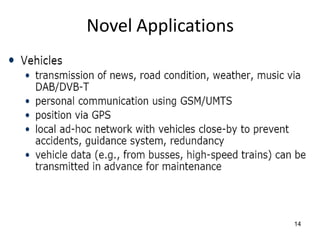
Novel Applications
14
Novel Applications [2]
15
Novel Applications [3]
16
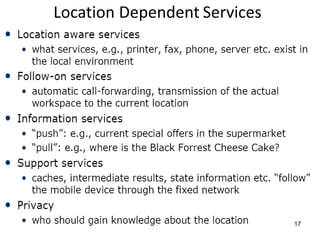
Location Dependent Services
17
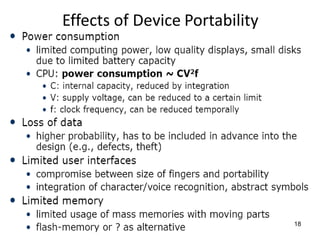
Effects of Device Portability
18
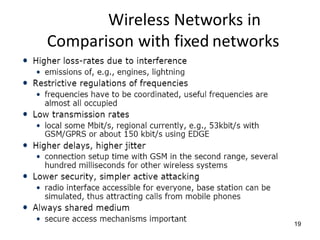
Wireless Networks in
Comparison with fixed networks
19
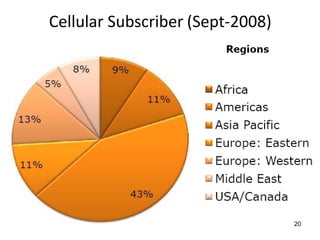
Cellular Subscriber (Sept-2008)
20
21
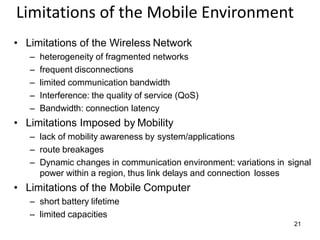
Limitations of the Mobile Environment
• Limitations of the Wireless Network
– heterogeneity of fragmented networks
– frequent disconnections
– limited communication bandwidth
– Interference: the quality of service (QoS)
– Bandwidth: connection latency
• Limitations Imposed by Mobility
– lack of mobility awareness by system/applications
– route breakages
– Dynamic changes in communication environment: variations in signal
power within a region, thus link delays and connection losses
• Limitations of the Mobile Computer
– short battery lifetime
– limited capacities
Simple Reference Model
22
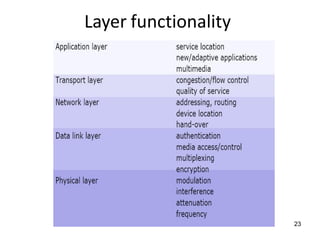
Layer functionality
23
24
PART-II
Global System for Mobile
Communication [GSM]
25
• Introduction
• Mobile Services
• GSMArchitecture
• Radio Interface
• Protocols
• Localization and Calling
• Handover
• Security
• New Data Services
CONTENTS
26
Introduction to GSM
Global System for Mobile (GSM)
is a second generation cellular
standard developed to cater voice
services and data delivery using
digital modulation
27
Introduction to GSM [2]
• Developed by Group Special Mobile (founded 1982) which was an
initiative of CEPT ( Conference of European Post and Telecom )
• Aim : to replace the incompatible analog system
• Presently the responsibility of GSM standardization resides with special
mobile group under ETSI (European telecom Standards Institute )
• GSM have 124 duplex channels, each 200Khz wide, are used for FDMA.
• GSM offer data rates of up to 9.6Kbps and up to a speed of 250Km/hr
• Under ETSI, GSM is named as ―
Global System for Mobile communication ―
• Today many providers all over the world use GSM (more than 190
countries in Asia, Africa, Europe, Australia,America)
• More than 1300 million subscribers in world & 45 million subscriber in India.
28
GSM Developments
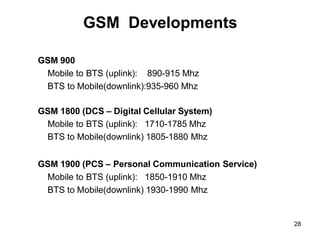
GSM 900
Mobile to BTS (uplink): 890-915 Mhz
BTS to Mobile(downlink):935-960 Mhz
GSM 1800 (DCS – Digital Cellular System)
Mobile to BTS (uplink): 1710-1785 Mhz
BTS to Mobile(downlink) 1805-1880 Mhz
GSM 1900 (PCS – Personal Communication Service)
Mobile to BTS (uplink): 1850-1910 Mhz
BTS to Mobile(downlink) 1930-1990 Mhz
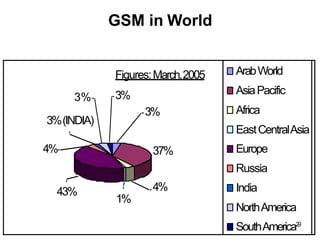
GSM in World
Figures:March,2005 ArabWorld
3%
3%(INDIA)
3%
3%
AsiaPacific
Africa
EastCentralAsia
4% 37% Europe
Russia
43% 4%
1%
India
NorthAmerica
SouthAmerica2
9
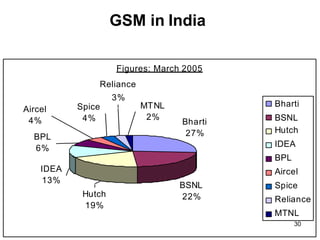
GSM in India
Bharti
27%
BSNL
22%
Spice
4%
IDEA
13%
Hutch
19%
Aircel
4%
BPL
6%
Figures: March 2005
Reliance
3%
MTNL
2%
Bharti
BSNL
Hutch
IDEA
BPL
Aircel
Spice
Reliance
MTNL
30
31
Mobile Services
• Tele-services
• Bearer or Data Services
• Supplementary services
32
Tele Services
• Telecommunication services that enable voice
communication
via mobile phones
• Offered services
- Mobile telephony
- Emergency calling
33
Bearer Services
• Include various data services for information transfer
between GSM and other networks like PSTN, ISDN etc
at rates from 300 to 9600 bps
• Short Message Service (SMS)
–up to 160 character alphanumeric data transmission
to/from the mobile terminal
• Unified Messaging Services(UMS)
• Group 3 fax
• Voice mailbox
• Electronic mail
Supplementary Services
Call related services :
• Call Waiting- Notification of an incoming call while on the
handset
• Call Hold- Put a caller on hold to take another call
• Call Barring- All calls, outgoing calls, or incoming calls
• Call Forwarding- Calls can be sent to various numbers
defined by the user
• Multi Party Call Conferencing - Link multiple calls together
• CLIP – Caller line identification presentation
• CLIR – Caller line identification restriction
• CUG – Closed user group 34
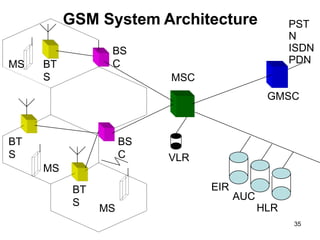
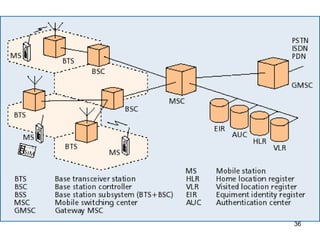
GSM System Architecture
BS
C
BS
C
MSC
MS
MS
MS BT
S
BT
S
BT
S
GMSC
PST
N
ISDN
PDN
EIR
AUC
HLR
VLR
35
36
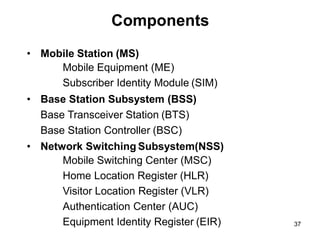
Components
• Mobile Station (MS)
Mobile Equipment (ME)
Subscriber Identity Module (SIM)
• Base Station Subsystem (BSS)
Base Transceiver Station (BTS)
Base Station Controller (BSC)
• Network Switching Subsystem(NSS)
Mobile Switching Center (MSC)
Home Location Register (HLR)
Visitor Location Register (VLR)
Authentication Center (AUC)
Equipment Identity Register (EIR) 37
38
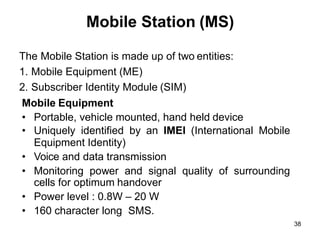
Mobile Station (MS)
The Mobile Station is made up of two entities:
1. Mobile Equipment (ME)
2. Subscriber Identity Module (SIM)
Mobile Equipment
• Portable, vehicle mounted, hand held device
• Uniquely identified by an IMEI (International Mobile
Equipment Identity)
• Voice and data transmission
• Monitoring power and signal quality of surrounding
cells for optimum handover
• Power level : 0.8W – 20 W
• 160 character long SMS.
39
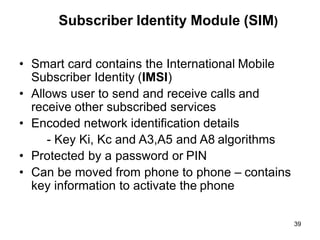
Subscriber Identity Module (SIM)
• Smart card contains the International Mobile
Subscriber Identity (IMSI)
• Allows user to send and receive calls and
receive other subscribed services
• Encoded network identification details
- Key Ki, Kc and A3,A5 and A8 algorithms
• Protected by a password or PIN
• Can be moved from phone to phone – contains
key information to activate the phone
Base Station Subsystem (BSS)
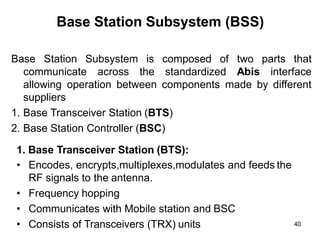
Base Station Subsystem
communicate across
is composed of
the standardized
two parts that
Abis interface
allowing operation between components made by different
suppliers
1. Base Transceiver Station (BTS)
2. Base Station Controller (BSC)
1. Base Transceiver Station (BTS):
• Encodes, encrypts,multiplexes,modulates and feeds the
RF signals to the antenna.
• Frequency hopping
• Communicates with Mobile station and BSC
• Consists of Transceivers (TRX) units 40
41
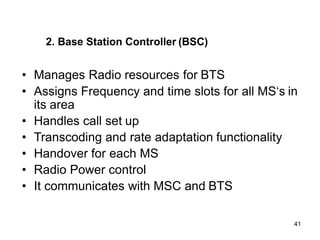
• Manages Radio resources for BTS
• Assigns Frequency and time slots for all MSā€˜s in
its area
• Handles call set up
• Transcoding and rate adaptation functionality
• Handover for each MS
• Radio Power control
• It communicates with MSC and BTS
2. Base Station Controller (BSC)
42
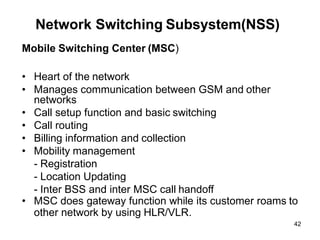
Network Switching Subsystem(NSS)
Mobile Switching Center (MSC)
• Heart of the network
• Manages communication between GSM and other
networks
• Call setup function and basic switching
• Call routing
• Billing information and collection
• Mobility management
- Registration
- Location Updating
- Inter BSS and inter MSC call handoff
• MSC does gateway function while its customer roams to
other network by using HLR/VLR.
43
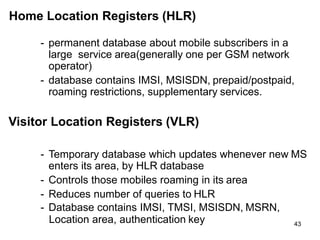
Home Location Registers (HLR)
- permanent database about mobile subscribers in a
large service area(generally one per GSM network
operator)
- database contains IMSI, MSISDN, prepaid/postpaid,
roaming restrictions, supplementary services.
Visitor Location Registers (VLR)
- Temporary database which updates whenever new MS
enters its area, by HLR database
- Controls those mobiles roaming in its area
- Reduces number of queries to HLR
- Database contains IMSI, TMSI, MSISDN, MSRN,
Location area, authentication key
44
Authentication Center (AUC)
- Protects against intruders in air interface
- Maintains authentication keys and algorithms and
provides security triplets ( RAND,SRES,Kc)
- Generally associated with HLR
Equipment Identity Register (EIR)
- Database that is used to track handsets using the
IMEI (International Mobile Equipment Identity)
- Made up of three sub-classes: The White List,The
Black List and the Gray List
- Only one EIR per PLMN
45
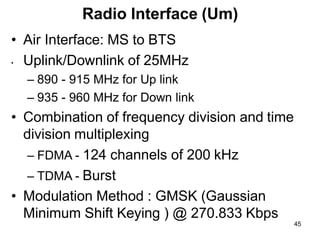
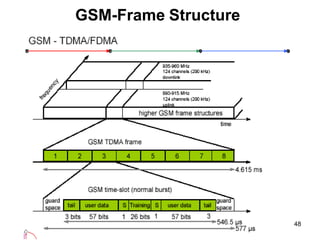
Radio Interface (Um)
• Air Interface: MS to BTS
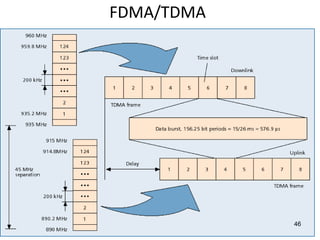
• Uplink/Downlink of 25MHz
– 890 - 915 MHz for Up link
– 935 - 960 MHz for Down link
• Combination of frequency division and time
division multiplexing
– FDMA - 124 channels of 200 kHz
– TDMA - Burst
• Modulation Method : GMSK (Gaussian
Minimum Shift Keying ) @ 270.833 Kbps
FDMA/TDMA
46
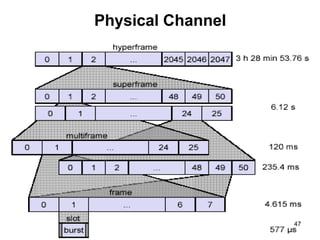
Physical Channel
47
GSM-Frame Structure
48
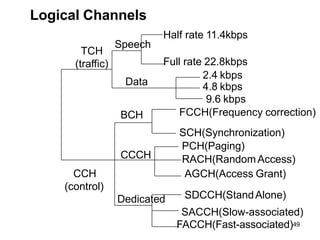
Logical Channels
TCH
(traffic)
CCH
(control)
BCH
CCCH
Dedicated
2.4 kbps
4.8 kbps
9.6 kbps
FCCH(Frequency correction)
SCH(Synchronization)
PCH(Paging)
RACH(Random Access)
AGCH(Access Grant)
SDCCH(StandAlone)
Half rate 11.4kbps
Full rate 22.8kbps
Speech
Data
SACCH(Slow-associated)
FACCH(Fast-associated)49
50
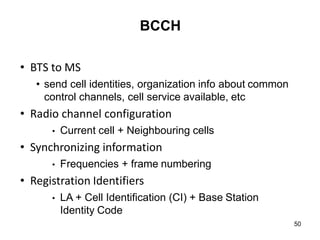
BCCH
• BTS to MS
• send cell identities, organization info about common
control channels, cell service available, etc
• Radio channel configuration
• Current cell + Neighbouring cells
• Synchronizing information
• Frequencies + frame numbering
• Registration Identifiers
• LA + Cell Identification (CI) + Base Station
Identity Code
51
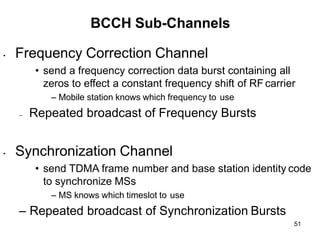
BCCH Sub-Channels
• Frequency Correction Channel
• send a frequency correction data burst containing all
zeros to effect a constant frequency shift of RF carrier
– Mobile station knows which frequency to use
– Repeated broadcast of Frequency Bursts
• Synchronization Channel
• send TDMA frame number and base station identity code
to synchronize MSs
– MS knows which timeslot to use
– Repeated broadcast of Synchronization Bursts
52
CCC
• Access Grant Channel (AGCH)
• BTS to MS
• Used to assign an SDCCH/TCH to MS
• Paging Channel (PCH)
• BTS to MS
• Page MS
• Random Access Channel (RACH)
• MS => BTS
• Slotted Aloha
• Request for dedicated SDCCH
DCCH
• bidirectional point-to-point -- main signaling
channels
• SDCCH (stand-alone dedicated control channel):
for service request, subscriber authentication,
equipment validation, assignment to a traffic
channel
• SACCH (slow associated control channel): for
out-of-band signaling associated with a traffic
channel, eg, signal strength measurements
• FACCH (fast associated control channel): for
preemptive signaling on a traffic channel, eg, for
handoff messages
• Uses timeslots which are otherwise used by the TCH53
Localization and Calling
• Localization means same phone number is valid
worldwide
• Periodic location updates
• VLR informs the HLR about MS location changes
• Changing VLRs with uninterrupted availability of all
services called Roaming
• To locate and address to the MS, GSM needs
– MSISDN, MSRN
– IMSI, TMSI
• Two ways of calling:
– Call Originating from MS (MOC)
– Call termination to MS (MTC)
54
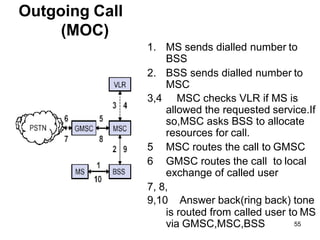
Outgoing Call
(MOC)
1. MS sends dialled number to
BSS
2. BSS sends dialled number to
MSC
3,4 MSC checks VLR if MS is
allowed the requested service.If
so,MSC asks BSS to allocate
resources for call.
5 MSC routes the call to GMSC
6 GMSC routes the call to local
exchange of called user
7, 8,
9,10 Answer back(ring back) tone
is routed from called user to MS
via GMSC,MSC,BSS 55
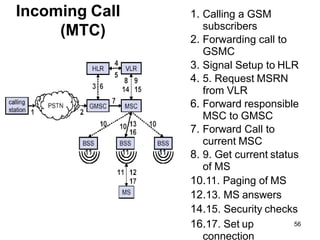
Incoming Call
(MTC)
1. Calling a GSM
subscribers
2. Forwarding call to
GSMC
3. Signal Setup to HLR
4. 5. Request MSRN
from VLR
6. Forward responsible
MSC to GMSC
7. Forward Call to
current MSC
8. 9. Get current status
of MS
10.11. Paging of MS
12.13. MS answers
14.15. Security checks
16.17. Set up
connection
56
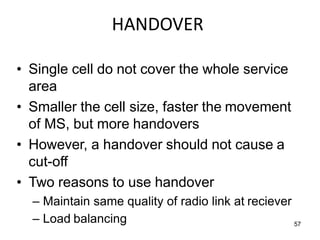
HANDOVER
• Single cell do not cover the whole service
area
• Smaller the cell size, faster the movement
of MS, but more handovers
• However, a handover should not cause a
cut-off
• Two reasons to use handover
– Maintain same quality of radio link at reciever
– Load balancing 57
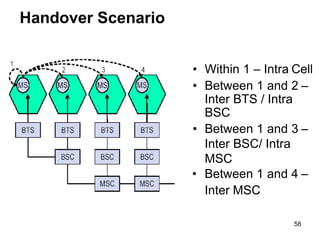
Handover Scenario
• Within 1 – Intra Cell
• Between 1 and 2 –
Inter BTS / Intra
BSC
• Between 1 and 3 –
Inter BSC/ Intra
MSC
• Between 1 and 4 –
Inter MSC
58
59
GSM networks various security
features
• A wireless radio based network system
quite sensitive to the unauthorized use of
resources
• GSM employ various security features
designed to :
→Designed to protect subscriber
privacy
→Secured network against misuse of
resources by unregistered users
60
GSM networks various security
features
• Controlled access to the network by
Mobile station
• Required to use a PIN before it can
access the network through Um interface
61
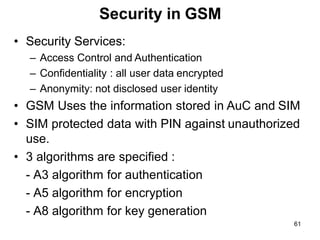
Security in GSM
• Security Services:
– Access Control and Authentication
– Confidentiality : all user data encrypted
– Anonymity: not disclosed user identity
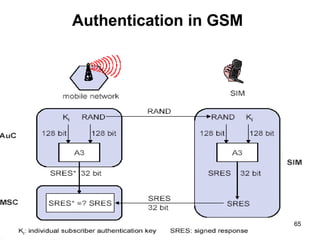
• GSM Uses the information stored in AuC and SIM
• SIM protected data with PIN against unauthorized
use.
• 3 algorithms are specified :
- A3 algorithm for authentication
- A5 algorithm for encryption
- A8 algorithm for key generation
62
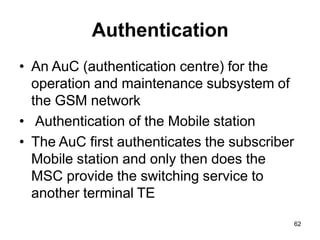
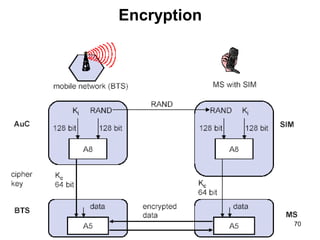
Authentication
• An AuC (authentication centre) for the
operation and maintenance subsystem of
the GSM network
• Authentication of the Mobile station
• The AuC first authenticates the subscriber
Mobile station and only then does the
MSC provide the switching service to
another terminal TE
63
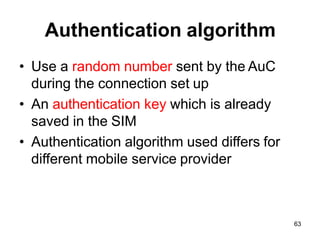
Authentication algorithm
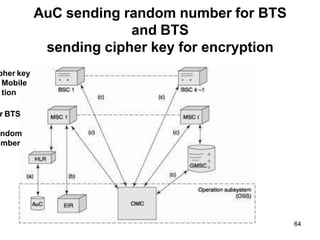
• Use a random number sent by the AuC
during the connection set up
• An authentication key which is already
saved in the SIM
• Authentication algorithm used differs for
different mobile service provider
AuC sending random number for BTS
and BTS
sending cipher key for encryption
pher key
Mobile
tion
r BTS
ndom
mber
64
Authentication in GSM
65
66
IMSI and TMSI of the Mobile
station
• Its public identity
• TMSI is the identity granted on moving to
a particular location
• When a Mobile station moves to a new
location area, the VLR (visitor location
register) assigns a TMSI which is stored in
the SIM of the Mobile station
67
TMSI
• The identification of the subscriber during
communication done not using the IMSI
but the TMSI
• The VLR assigned TMSI generates that
ID
• This protects the Mobile station against
eavesdropping from external sources
68
Encryption
• The BTS and the Mobile station perform
ciphering before call initiation or before
connecting for receiving a call
• The Mobile station uses a cipher
(encryption key) for encryption
69
The cipher
• A result of performing mathematical
operations on (a) the cipher key saved in
the SIM and (b) the cipher number
received from the BTS when the call setup
is initiated
• The BTS transmits the cipher number
before a call is set up or transmitted
Encryption
70
71
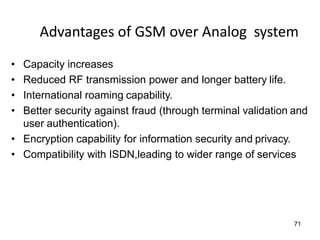
Advantages of GSM over Analog system
• Capacity increases
• Reduced RF transmission power and longer battery life.
• International roaming capability.
• Better security against fraud (through terminal validation and
user authentication).
• Encryption capability for information security and privacy.
• Compatibility with ISDN,leading to wider range of services
72
New Data Services: HSCSD
• High Speed Circuit Switched Data (HSCSD)
– Combined several GSM 9.6 Kbps channels to increase
bandwidth
– It allocates several TDMA slots within a TDMA frame
– In theory, an MS could use all 8 slots within a TDMA frame to
achieve an Air Interface User Rate (AIUR).
– Only requires software upgrades in an MS and MSC
• HSCSD exhibits some major limitations
– Still uses connection-oriented mechanism
– Not efficient for bursty and asymmetrical traffic
– Charged based on channels allocated
73
New Data Services: GPRS
• General Packet Radio Service (GPRS) features:
– It is a 2.5G system, is poised to take off this year in popularity.
– Building on the GSM network, it will provide the much needed
packet data services to most areas of the world.
– Useful for frequent small volume or infrequent small/medium
volume of data
– Time slots are not allocated in a fixed or pre-determined manner,
but on demand
– Allow broadcast, multicast and unicast service
– ―AlwaysOn‖,no connection has to be setup prior to data transfer
– Resources are reserved only when needed and charged
accordingly
74
GPRS [2]
• It offers point-to-point packet transfer in 2 versions
– PTP connection-oriented service (PTP-CONS)
– PTP connectionless service (PTP-CNLS)
• It also offers Multicasting, called Point-to-Multipoint
(PTM) service
• User specify QoS profile
– Service precedence (high, normal, low)
– Reliability class
– Delay class
– Peak throughput class for data
– Mean throughput class for data
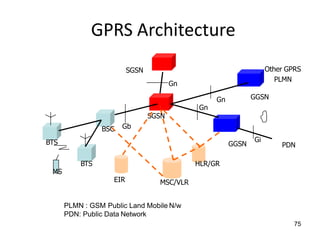
GPRS Architecture
BTS
BTS
MS
BSC Gb
MSC/VLR
HLR/GR
Gn
SGSN
GGSN
Gi
PDN
GGSN
Other GPRS
PLMN
SGSN
PLMN : GSM Public Land Mobile N/w
PDN: Public Data Network
Gn
Gn
EIR
75
76
Entities
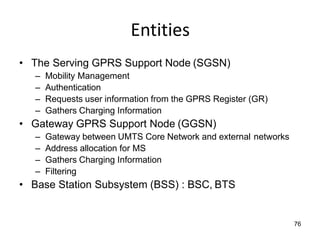
• The Serving GPRS Support Node (SGSN)
– Mobility Management
– Authentication
– Requests user information from the GPRS Register (GR)
– Gathers Charging Information
• Gateway GPRS Support Node (GGSN)
– Gateway between UMTS Core Network and external networks
– Address allocation for MS
– Gathers Charging Information
– Filtering
• Base Station Subsystem (BSS) : BSC, BTS
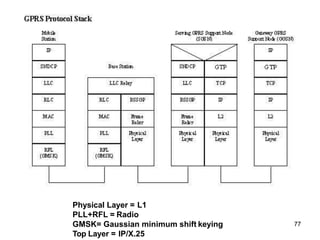
Physical Layer = L1
PLL+RFL = Radio
GMSK= Gaussian minimum shift keying
Top Layer = IP/X.25
77
Layer Functionalities
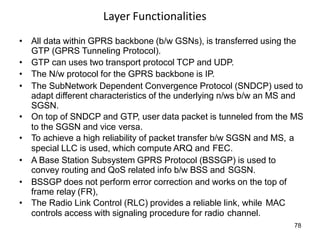
• All data within GPRS backbone (b/w GSNs), is transferred using the
GTP (GPRS Tunneling Protocol).
• GTP can uses two transport protocol TCP and UDP.
• The N/w protocol for the GPRS backbone is IP.
• The SubNetwork Dependent Convergence Protocol (SNDCP) used to
adapt different characteristics of the underlying n/ws b/w an MS and
SGSN.
• On top of SNDCP and GTP, user data packet is tunneled from the MS
to the SGSN and vice versa.
• To achieve a high reliability of packet transfer b/w SGSN and MS, a
special LLC is used, which compute ARQ and FEC.
• A Base Station Subsystem GPRS Protocol (BSSGP) is used to
convey routing and QoS related info b/w BSS and SGSN.
• BSSGP does not perform error correction and works on the top of
frame relay (FR),
• The Radio Link Control (RLC) provides a reliable link, while MAC
controls access with signaling procedure for radio channel.
78
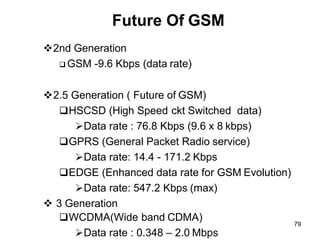
Future Of GSM
ā–2nd Generation
ā‘ GSM -9.6 Kbps (data rate)
ā–2.5 Generation ( Future of GSM)
ā‘HSCSD (High Speed ckt Switched data)
āž¢Data rate : 76.8 Kbps (9.6 x 8 kbps)
ā‘GPRS (General Packet Radio service)
āž¢Data rate: 14.4 - 171.2 Kbps
ā‘EDGE (Enhanced data rate for GSM Evolution)
āž¢Data rate: 547.2 Kbps (max)
ā– 3 Generation
ā‘WCDMA(Wide band CDMA)
āž¢Data rate : 0.348 – 2.0 Mbps
79
Thank you

Mobile computing

  • 1.
    MOBILE COMPUTING LECTURE NOTES III-CSE PRESENTEDBY : Dr R JEGADEESAN, Professor and Head,Department of Computer Science and Engineering
  • 2.
    UNIT – ICONTENTS ā–Ŗ Mobile Communication ā–ŖMobile Computing ā–Ŗ Novel Applications ā–Ŗ Location dependent services ā–Ŗ Effects of device portability ā–Ŗ Wireless n/wā€˜s in comparison with fixed n/wā€˜s ā–Ŗ Limitations ā–Ŗ Architecture (simple reference model)
  • 3.
    3 Goal of MobileComputing āž¢ People and their machines should be able to access information and communicate with each other easily and securely, in any medium or combination of media – voice, data, image, video, or multimedia any time, anywhere, in a timely, cost-effective way.
  • 4.
    4 Mobile Computing • Mobilecomputing refers to computing in a distributed system in which some processes or processors can move. – Moving processes ļƒž logical mobility, realized by agents. – Moving processors ļƒž physical mobility, realized by moving devices. • Mobile computing extends a distributed computing environment with a new dimension of mobility. – Most existing mobile computing systems are based on client- server computing systems. – Recent mobile computing solutions consider general distributed computing, namely, peer-to-peer computing environments. • Many mobile computing techniques have their root in distributed systems.
  • 5.
    processors 5 Distributed system •Definition: – A distributed system consists of a collection of autonomous computers, connected through a network and distribution middleware, which enables computers to coordinate their activities and to share the resources of the system, so that users perceive the system as a single, integrated computing facility. • Multiple autonomous components • Components are not shared by all users • Resources may not be accessible • Software runs in concurrent processes on different
  • 6.
    Mobile Computing contd.., •The process of computation on a mobile device • In mobile computing, a set of distributed computing systems or service provider servers participate, connect, and synchronize through mobile communication protocols • Mobile computing as a generic term describing ability to use the technology to wirelessly connect to and use centrally located information and/or application software through the application of small, portable, and wireless computing and communication devices 6
  • 7.
    Mobile Computing contd.., •Provides decentralized (distributed) computations on diversified devices, systems, and networks, which are mobile, synchronized, and interconnected via mobile communication standards and protocols. • Mobile device does not restrict itself to just one application, such as, voice communication • Offers mobility with computing power • Facilitates a large number of applications on a single device 7
  • 8.
    Introduction Mobile Communication • UserMobility: – Refers to a user who has access to the same or similar telecommunication services at different places. – user mobility: users communicate (wireless) ―anytime,anywhere, with anyone‖ • Device Portability: – The communication device moves with or without the user – device portability: devices can be connected anytime, anywhere to the network • A communication device can the exhibit one of the following characteristics: – Fixed and wired e.g. Typical desktops computer – Mobile and wired e.g. some laptops – Fixed and wireless e.g. WIRELESS LANS – Mobile and wireless e.g. Mobile phones 8
  • 9.
    Mobility Issues • Bandwidthrestrictions and variability • Location-aware network operation – User may wake up in a new environment – Dynamic replication of data • Querying wireless data & location-based responses • Busty network activity during connections & handling disconnections • Disconnection – OS and File System Issues - allow for disconnected operation – Database System Issues - when disconnected, based on local data 9
  • 10.
    Portability Issues • Batterypower restrictions • Risks to data - Physical damage, loss, theft - Unauthorized access - encrypt data stored on mobiles - Backup critical data to fixed (reliable) hosts • Small user interface - Small displays due to battery power and aspect ratio constraints - Cannot open too many windows - Difficult to click on miniature icons - Input - Graffiti, (Dictionary-based) Expectation - Gesture or handwriting recognition with Stylus Pen Voice matching or voice recognition 10
  • 11.
    Evolutions of theMobile Systems 1G Analog systems 2G systems āž¢ voice communication āž¢ Circuit Switched 2.5G systems āž¢ Circuit switching for voice āž¢ Packet switching for data 3G systems āž¢ Packet switching for voice and data āž¢ High speed āž¢ Compatible with different access technologies 11
  • 12.
    5. G systems āž¢Evolved Radio Interface āž¢ IP based core Network āž¢ Compatible with different access technologies 4G systems āž¢ New Air Interface āž¢ Very High bit rate services āž¢ Convergence of Wireline, Wireless, and IPworlds 12 Evolutions of the Mobile Systems
  • 13.
    Evolutions of theMobile Systems A IR IN T E R F A C E V O IC E D A TA 2G (2 0 0 0 ) E A R L Y 3 G (2 0 0 1 ) L A T E 3 G (2 0 0 3 ) 4G (2 0 0 5 ) C IR C U IT C IR C U IT C IR C U IT C IR C U IT P A C K E T P A C K E T P A C K E T A C C E S S N E T W K V O IC E C IR C U IT C IR C U IT P A C K E T P A C K E T D A TA C IR C U IT C IR C U IT C O R E N E T W K V O IC E C IR C U IT P A C K E T P A C K E T P A C K E T 13 D A TA O V E R L A Y P A C K E T
  • 14.
  • 15.
  • 16.
  • 17.
  • 18.
    Effects of DevicePortability 18
  • 19.
    Wireless Networks in Comparisonwith fixed networks 19
  • 20.
  • 21.
    21 Limitations of theMobile Environment • Limitations of the Wireless Network – heterogeneity of fragmented networks – frequent disconnections – limited communication bandwidth – Interference: the quality of service (QoS) – Bandwidth: connection latency • Limitations Imposed by Mobility – lack of mobility awareness by system/applications – route breakages – Dynamic changes in communication environment: variations in signal power within a region, thus link delays and connection losses • Limitations of the Mobile Computer – short battery lifetime – limited capacities
  • 22.
  • 23.
  • 24.
    24 PART-II Global System forMobile Communication [GSM]
  • 25.
    25 • Introduction • MobileServices • GSMArchitecture • Radio Interface • Protocols • Localization and Calling • Handover • Security • New Data Services CONTENTS
  • 26.
    26 Introduction to GSM GlobalSystem for Mobile (GSM) is a second generation cellular standard developed to cater voice services and data delivery using digital modulation
  • 27.
    27 Introduction to GSM[2] • Developed by Group Special Mobile (founded 1982) which was an initiative of CEPT ( Conference of European Post and Telecom ) • Aim : to replace the incompatible analog system • Presently the responsibility of GSM standardization resides with special mobile group under ETSI (European telecom Standards Institute ) • GSM have 124 duplex channels, each 200Khz wide, are used for FDMA. • GSM offer data rates of up to 9.6Kbps and up to a speed of 250Km/hr • Under ETSI, GSM is named as ― Global System for Mobile communication ― • Today many providers all over the world use GSM (more than 190 countries in Asia, Africa, Europe, Australia,America) • More than 1300 million subscribers in world & 45 million subscriber in India.
  • 28.
    28 GSM Developments GSM 900 Mobileto BTS (uplink): 890-915 Mhz BTS to Mobile(downlink):935-960 Mhz GSM 1800 (DCS – Digital Cellular System) Mobile to BTS (uplink): 1710-1785 Mhz BTS to Mobile(downlink) 1805-1880 Mhz GSM 1900 (PCS – Personal Communication Service) Mobile to BTS (uplink): 1850-1910 Mhz BTS to Mobile(downlink) 1930-1990 Mhz
  • 29.
    GSM in World Figures:March,2005ArabWorld 3% 3%(INDIA) 3% 3% AsiaPacific Africa EastCentralAsia 4% 37% Europe Russia 43% 4% 1% India NorthAmerica SouthAmerica2 9
  • 30.
    GSM in India Bharti 27% BSNL 22% Spice 4% IDEA 13% Hutch 19% Aircel 4% BPL 6% Figures:March 2005 Reliance 3% MTNL 2% Bharti BSNL Hutch IDEA BPL Aircel Spice Reliance MTNL 30
  • 31.
    31 Mobile Services • Tele-services •Bearer or Data Services • Supplementary services
  • 32.
    32 Tele Services • Telecommunicationservices that enable voice communication via mobile phones • Offered services - Mobile telephony - Emergency calling
  • 33.
    33 Bearer Services • Includevarious data services for information transfer between GSM and other networks like PSTN, ISDN etc at rates from 300 to 9600 bps • Short Message Service (SMS) –up to 160 character alphanumeric data transmission to/from the mobile terminal • Unified Messaging Services(UMS) • Group 3 fax • Voice mailbox • Electronic mail
  • 34.
    Supplementary Services Call relatedservices : • Call Waiting- Notification of an incoming call while on the handset • Call Hold- Put a caller on hold to take another call • Call Barring- All calls, outgoing calls, or incoming calls • Call Forwarding- Calls can be sent to various numbers defined by the user • Multi Party Call Conferencing - Link multiple calls together • CLIP – Caller line identification presentation • CLIR – Caller line identification restriction • CUG – Closed user group 34
  • 35.
    GSM System Architecture BS C BS C MSC MS MS MSBT S BT S BT S GMSC PST N ISDN PDN EIR AUC HLR VLR 35
  • 36.
  • 37.
    Components • Mobile Station(MS) Mobile Equipment (ME) Subscriber Identity Module (SIM) • Base Station Subsystem (BSS) Base Transceiver Station (BTS) Base Station Controller (BSC) • Network Switching Subsystem(NSS) Mobile Switching Center (MSC) Home Location Register (HLR) Visitor Location Register (VLR) Authentication Center (AUC) Equipment Identity Register (EIR) 37
  • 38.
    38 Mobile Station (MS) TheMobile Station is made up of two entities: 1. Mobile Equipment (ME) 2. Subscriber Identity Module (SIM) Mobile Equipment • Portable, vehicle mounted, hand held device • Uniquely identified by an IMEI (International Mobile Equipment Identity) • Voice and data transmission • Monitoring power and signal quality of surrounding cells for optimum handover • Power level : 0.8W – 20 W • 160 character long SMS.
  • 39.
    39 Subscriber Identity Module(SIM) • Smart card contains the International Mobile Subscriber Identity (IMSI) • Allows user to send and receive calls and receive other subscribed services • Encoded network identification details - Key Ki, Kc and A3,A5 and A8 algorithms • Protected by a password or PIN • Can be moved from phone to phone – contains key information to activate the phone
  • 40.
    Base Station Subsystem(BSS) Base Station Subsystem communicate across is composed of the standardized two parts that Abis interface allowing operation between components made by different suppliers 1. Base Transceiver Station (BTS) 2. Base Station Controller (BSC) 1. Base Transceiver Station (BTS): • Encodes, encrypts,multiplexes,modulates and feeds the RF signals to the antenna. • Frequency hopping • Communicates with Mobile station and BSC • Consists of Transceivers (TRX) units 40
  • 41.
    41 • Manages Radioresources for BTS • Assigns Frequency and time slots for all MSā€˜s in its area • Handles call set up • Transcoding and rate adaptation functionality • Handover for each MS • Radio Power control • It communicates with MSC and BTS 2. Base Station Controller (BSC)
  • 42.
    42 Network Switching Subsystem(NSS) MobileSwitching Center (MSC) • Heart of the network • Manages communication between GSM and other networks • Call setup function and basic switching • Call routing • Billing information and collection • Mobility management - Registration - Location Updating - Inter BSS and inter MSC call handoff • MSC does gateway function while its customer roams to other network by using HLR/VLR.
  • 43.
    43 Home Location Registers(HLR) - permanent database about mobile subscribers in a large service area(generally one per GSM network operator) - database contains IMSI, MSISDN, prepaid/postpaid, roaming restrictions, supplementary services. Visitor Location Registers (VLR) - Temporary database which updates whenever new MS enters its area, by HLR database - Controls those mobiles roaming in its area - Reduces number of queries to HLR - Database contains IMSI, TMSI, MSISDN, MSRN, Location area, authentication key
  • 44.
    44 Authentication Center (AUC) -Protects against intruders in air interface - Maintains authentication keys and algorithms and provides security triplets ( RAND,SRES,Kc) - Generally associated with HLR Equipment Identity Register (EIR) - Database that is used to track handsets using the IMEI (International Mobile Equipment Identity) - Made up of three sub-classes: The White List,The Black List and the Gray List - Only one EIR per PLMN
  • 45.
    45 Radio Interface (Um) •Air Interface: MS to BTS • Uplink/Downlink of 25MHz – 890 - 915 MHz for Up link – 935 - 960 MHz for Down link • Combination of frequency division and time division multiplexing – FDMA - 124 channels of 200 kHz – TDMA - Burst • Modulation Method : GMSK (Gaussian Minimum Shift Keying ) @ 270.833 Kbps
  • 46.
  • 47.
  • 48.
  • 49.
    Logical Channels TCH (traffic) CCH (control) BCH CCCH Dedicated 2.4 kbps 4.8kbps 9.6 kbps FCCH(Frequency correction) SCH(Synchronization) PCH(Paging) RACH(Random Access) AGCH(Access Grant) SDCCH(StandAlone) Half rate 11.4kbps Full rate 22.8kbps Speech Data SACCH(Slow-associated) FACCH(Fast-associated)49
  • 50.
    50 BCCH • BTS toMS • send cell identities, organization info about common control channels, cell service available, etc • Radio channel configuration • Current cell + Neighbouring cells • Synchronizing information • Frequencies + frame numbering • Registration Identifiers • LA + Cell Identification (CI) + Base Station Identity Code
  • 51.
    51 BCCH Sub-Channels • FrequencyCorrection Channel • send a frequency correction data burst containing all zeros to effect a constant frequency shift of RF carrier – Mobile station knows which frequency to use – Repeated broadcast of Frequency Bursts • Synchronization Channel • send TDMA frame number and base station identity code to synchronize MSs – MS knows which timeslot to use – Repeated broadcast of Synchronization Bursts
  • 52.
    52 CCC • Access GrantChannel (AGCH) • BTS to MS • Used to assign an SDCCH/TCH to MS • Paging Channel (PCH) • BTS to MS • Page MS • Random Access Channel (RACH) • MS => BTS • Slotted Aloha • Request for dedicated SDCCH
  • 53.
    DCCH • bidirectional point-to-point-- main signaling channels • SDCCH (stand-alone dedicated control channel): for service request, subscriber authentication, equipment validation, assignment to a traffic channel • SACCH (slow associated control channel): for out-of-band signaling associated with a traffic channel, eg, signal strength measurements • FACCH (fast associated control channel): for preemptive signaling on a traffic channel, eg, for handoff messages • Uses timeslots which are otherwise used by the TCH53
  • 54.
    Localization and Calling •Localization means same phone number is valid worldwide • Periodic location updates • VLR informs the HLR about MS location changes • Changing VLRs with uninterrupted availability of all services called Roaming • To locate and address to the MS, GSM needs – MSISDN, MSRN – IMSI, TMSI • Two ways of calling: – Call Originating from MS (MOC) – Call termination to MS (MTC) 54
  • 55.
    Outgoing Call (MOC) 1. MSsends dialled number to BSS 2. BSS sends dialled number to MSC 3,4 MSC checks VLR if MS is allowed the requested service.If so,MSC asks BSS to allocate resources for call. 5 MSC routes the call to GMSC 6 GMSC routes the call to local exchange of called user 7, 8, 9,10 Answer back(ring back) tone is routed from called user to MS via GMSC,MSC,BSS 55
  • 56.
    Incoming Call (MTC) 1. Callinga GSM subscribers 2. Forwarding call to GSMC 3. Signal Setup to HLR 4. 5. Request MSRN from VLR 6. Forward responsible MSC to GMSC 7. Forward Call to current MSC 8. 9. Get current status of MS 10.11. Paging of MS 12.13. MS answers 14.15. Security checks 16.17. Set up connection 56
  • 57.
    HANDOVER • Single celldo not cover the whole service area • Smaller the cell size, faster the movement of MS, but more handovers • However, a handover should not cause a cut-off • Two reasons to use handover – Maintain same quality of radio link at reciever – Load balancing 57
  • 58.
    Handover Scenario • Within1 – Intra Cell • Between 1 and 2 – Inter BTS / Intra BSC • Between 1 and 3 – Inter BSC/ Intra MSC • Between 1 and 4 – Inter MSC 58
  • 59.
    59 GSM networks varioussecurity features • A wireless radio based network system quite sensitive to the unauthorized use of resources • GSM employ various security features designed to : →Designed to protect subscriber privacy →Secured network against misuse of resources by unregistered users
  • 60.
    60 GSM networks varioussecurity features • Controlled access to the network by Mobile station • Required to use a PIN before it can access the network through Um interface
  • 61.
    61 Security in GSM •Security Services: – Access Control and Authentication – Confidentiality : all user data encrypted – Anonymity: not disclosed user identity • GSM Uses the information stored in AuC and SIM • SIM protected data with PIN against unauthorized use. • 3 algorithms are specified : - A3 algorithm for authentication - A5 algorithm for encryption - A8 algorithm for key generation
  • 62.
    62 Authentication • An AuC(authentication centre) for the operation and maintenance subsystem of the GSM network • Authentication of the Mobile station • The AuC first authenticates the subscriber Mobile station and only then does the MSC provide the switching service to another terminal TE
  • 63.
    63 Authentication algorithm • Usea random number sent by the AuC during the connection set up • An authentication key which is already saved in the SIM • Authentication algorithm used differs for different mobile service provider
  • 64.
    AuC sending randomnumber for BTS and BTS sending cipher key for encryption pher key Mobile tion r BTS ndom mber 64
  • 65.
  • 66.
    66 IMSI and TMSIof the Mobile station • Its public identity • TMSI is the identity granted on moving to a particular location • When a Mobile station moves to a new location area, the VLR (visitor location register) assigns a TMSI which is stored in the SIM of the Mobile station
  • 67.
    67 TMSI • The identificationof the subscriber during communication done not using the IMSI but the TMSI • The VLR assigned TMSI generates that ID • This protects the Mobile station against eavesdropping from external sources
  • 68.
    68 Encryption • The BTSand the Mobile station perform ciphering before call initiation or before connecting for receiving a call • The Mobile station uses a cipher (encryption key) for encryption
  • 69.
    69 The cipher • Aresult of performing mathematical operations on (a) the cipher key saved in the SIM and (b) the cipher number received from the BTS when the call setup is initiated • The BTS transmits the cipher number before a call is set up or transmitted
  • 70.
  • 71.
    71 Advantages of GSMover Analog system • Capacity increases • Reduced RF transmission power and longer battery life. • International roaming capability. • Better security against fraud (through terminal validation and user authentication). • Encryption capability for information security and privacy. • Compatibility with ISDN,leading to wider range of services
  • 72.
    72 New Data Services:HSCSD • High Speed Circuit Switched Data (HSCSD) – Combined several GSM 9.6 Kbps channels to increase bandwidth – It allocates several TDMA slots within a TDMA frame – In theory, an MS could use all 8 slots within a TDMA frame to achieve an Air Interface User Rate (AIUR). – Only requires software upgrades in an MS and MSC • HSCSD exhibits some major limitations – Still uses connection-oriented mechanism – Not efficient for bursty and asymmetrical traffic – Charged based on channels allocated
  • 73.
    73 New Data Services:GPRS • General Packet Radio Service (GPRS) features: – It is a 2.5G system, is poised to take off this year in popularity. – Building on the GSM network, it will provide the much needed packet data services to most areas of the world. – Useful for frequent small volume or infrequent small/medium volume of data – Time slots are not allocated in a fixed or pre-determined manner, but on demand – Allow broadcast, multicast and unicast service – ―AlwaysOn‖,no connection has to be setup prior to data transfer – Resources are reserved only when needed and charged accordingly
  • 74.
    74 GPRS [2] • Itoffers point-to-point packet transfer in 2 versions – PTP connection-oriented service (PTP-CONS) – PTP connectionless service (PTP-CNLS) • It also offers Multicasting, called Point-to-Multipoint (PTM) service • User specify QoS profile – Service precedence (high, normal, low) – Reliability class – Delay class – Peak throughput class for data – Mean throughput class for data
  • 75.
    GPRS Architecture BTS BTS MS BSC Gb MSC/VLR HLR/GR Gn SGSN GGSN Gi PDN GGSN OtherGPRS PLMN SGSN PLMN : GSM Public Land Mobile N/w PDN: Public Data Network Gn Gn EIR 75
  • 76.
    76 Entities • The ServingGPRS Support Node (SGSN) – Mobility Management – Authentication – Requests user information from the GPRS Register (GR) – Gathers Charging Information • Gateway GPRS Support Node (GGSN) – Gateway between UMTS Core Network and external networks – Address allocation for MS – Gathers Charging Information – Filtering • Base Station Subsystem (BSS) : BSC, BTS
  • 77.
    Physical Layer =L1 PLL+RFL = Radio GMSK= Gaussian minimum shift keying Top Layer = IP/X.25 77
  • 78.
    Layer Functionalities • Alldata within GPRS backbone (b/w GSNs), is transferred using the GTP (GPRS Tunneling Protocol). • GTP can uses two transport protocol TCP and UDP. • The N/w protocol for the GPRS backbone is IP. • The SubNetwork Dependent Convergence Protocol (SNDCP) used to adapt different characteristics of the underlying n/ws b/w an MS and SGSN. • On top of SNDCP and GTP, user data packet is tunneled from the MS to the SGSN and vice versa. • To achieve a high reliability of packet transfer b/w SGSN and MS, a special LLC is used, which compute ARQ and FEC. • A Base Station Subsystem GPRS Protocol (BSSGP) is used to convey routing and QoS related info b/w BSS and SGSN. • BSSGP does not perform error correction and works on the top of frame relay (FR), • The Radio Link Control (RLC) provides a reliable link, while MAC controls access with signaling procedure for radio channel. 78
  • 79.
    Future Of GSM ā–2ndGeneration ā‘ GSM -9.6 Kbps (data rate) ā–2.5 Generation ( Future of GSM) ā‘HSCSD (High Speed ckt Switched data) āž¢Data rate : 76.8 Kbps (9.6 x 8 kbps) ā‘GPRS (General Packet Radio service) āž¢Data rate: 14.4 - 171.2 Kbps ā‘EDGE (Enhanced data rate for GSM Evolution) āž¢Data rate: 547.2 Kbps (max) ā– 3 Generation ā‘WCDMA(Wide band CDMA) āž¢Data rate : 0.348 – 2.0 Mbps 79
  • 80.