Introduction To MobileComputing
Mobile Computing (MC):
Introduction to MC
History of wireless communication
Novel applications
Limitations of mobile computing
Mobile computing architecture
Mobile system networks
2.
What Is MobileComputing?
What is computing?
Operation of computers
What is the mobile?
That someone /something can move or be moved
easily and quickly from place to place
3.
What Is MobileComputing?
(Cont.)
Mobile Computing is a term used to describe
technologies that enable people to access network
services anyplace, anytime, and anywhere.
4.
Mobile communication
is theuse of technology that allows us to communicate with
others in different locations without the use of any physical
connection (wires or cables). Mobile communication makes
our life easier, and it saves time and effort.
A mobile phone (also called mobile cellular network,
cell phone or hand phone) is an example of mobile
communication (wireless communication)
Features of Mobile Communication:
High capacity load balancing
Network management system
Switching
Mobile device management
5.
• Mobile voicecommunication is widely established
throughout the world and has had a very rapid
increase in the number of subscribers to the
various cellular networks over the last few years.
• Mobile data communication has become a very
important and rapidly evolving technology as it
allows users to transmit data from remote
locations to other remote or fixed locations.
6.
EXISTING CELLULAR NETWORK
•Mobile telephony took off with the introduction of
cellular technology which allowed the efficient
utilization of frequencies enabling the connection of
a large number of users.
• During the 1980's analog technology was
used.
• In the 1990's the digital cellular technology was
introduced with GSM(Global System Mobile)
7.
Advances in technology
–More computing power in smaller devices
– Flat, lightweight displays with low power consumption
– New user interfaces due to small dimensions
– More bandwidth
– Multiple wireless techniques
– Device location awareness: computers adapt to their
environment
8.
There are 2aspects of mobile computing
• Two different kinds of mobility:
– User mobility
– Device portability
9.
1. User mobility:refers to a user who has access to the same
or similar telecommunication services at different places,
i.e.,the user can be mobile, and the services will follow
him or her.
2. Device portability: the communication device moves
Many mechanisms in the network and inside the device
have to make sure that communication is still possible
while the device is moving.
10.
Wireless Communication
The termwireless communication was introduced in the 19th
century and wireless communication technology has developed
over the subsequent years.
It is one of the most important mediums of
transmission of information from one device to other devices.
There are many devices used for wireless communication like
mobiles,Cordless telephones, GPS, Wi-Fi, satellite television and
wireless computer parts.
The different types of wireless communication mainly include,
IR wireless communication, satellite communication, broadcast
radio, Microwave radio, Bluetooth, Zigbee etc
11.
communication device canbe of the
following:
• Fixed and wired: The devices use fixed networks.
This configuration describes the typical desktop
computer in an office.
• Mobile and wired:Many of today’s laptops fall into
this category, users carry the laptop from one place
to the next, and reconnecting to the company’s
network via the telephone network and a modem.
12.
• Fixed wireless:
isthe operation of wireless communication
devices or systems used to connect
two fixed locations (e.g., building to building or
tower to building) with a radio or
other wireless link.
• Mobile and wireless: No cable restricts the user,
who can roam between different wireless
networks. Today’s most successful example for
this category is GSM with more than 800 million
users.
13.
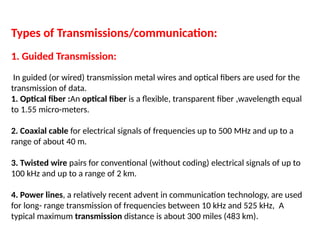
Types of Transmissions/communication:
1.Guided Transmission:
In guided (or wired) transmission metal wires and optical fibers are used for the
transmission of data.
1. Optical fiber :An optical fiber is a flexible, transparent fiber ,wavelength equal
to 1.55 micro-meters.
2. Coaxial cable for electrical signals of frequencies up to 500 MHz and up to a
range of about 40 m.
3. Twisted wire pairs for conventional (without coding) electrical signals of up to
100 kHz and up to a range of 2 km.
4. Power lines, a relatively recent advent in communication technology, are used
for long- range transmission of frequencies between 10 kHz and 525 kHz, A
typical maximum transmission distance is about 300 miles (483 km).
14.
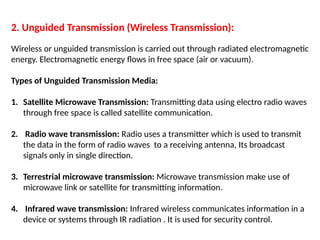
2. Unguided Transmission(Wireless Transmission):
Wireless or unguided transmission is carried out through radiated electromagnetic
energy. Electromagnetic energy flows in free space (air or vacuum).
Types of Unguided Transmission Media:
1. Satellite Microwave Transmission: Transmitting data using electro radio waves
through free space is called satellite communication.
2. Radio wave transmission: Radio uses a transmitter which is used to transmit
the data in the form of radio waves to a receiving antenna, Its broadcast
signals only in single direction.
3. Terrestrial microwave transmission: Microwave transmission make use of
microwave link or satellite for transmitting information.
4. Infrared wave transmission: Infrared wireless communicates information in a
device or systems through IR radiation . It is used for security control.
15.
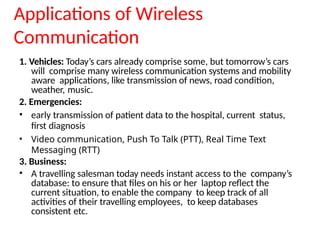
Applications of Wireless
Communication
1.Vehicles: Today’s cars already comprise some, but tomorrow’s cars
will comprise many wireless communication systems and mobility
aware applications, like transmission of news, road condition,
weather, music.
2. Emergencies:
• early transmission of patient data to the hospital, current status,
first diagnosis
• Video communication, Push To Talk (PTT), Real Time Text
Messaging (RTT)
3. Business:
• A travelling salesman today needs instant access to the company’s
database: to ensure that files on his or her laptop reflect the
current situation, to enable the company to keep track of all
activities of their travelling employees, to keep databases
consistent etc.
16.
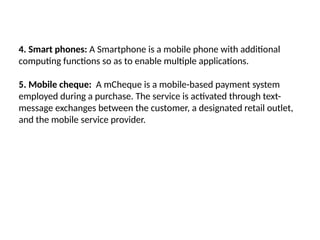
4. Smart phones:A Smartphone is a mobile phone with additional
computing functions so as to enable multiple applications.
5. Mobile cheque: A mCheque is a mobile-based payment system
employed during a purchase. The service is activated through text-
message exchanges between the customer, a designated retail outlet,
and the mobile service provider.
17.
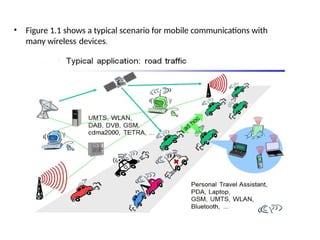
• Figure 1.1shows a typical scenario for mobile communications with
many wireless devices.
18.
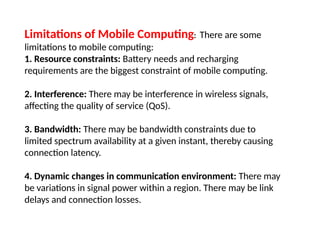
Limitations of MobileComputing: There are some
limitations to mobile computing:
1. Resource constraints: Battery needs and recharging
requirements are the biggest constraint of mobile computing.
2. Interference: There may be interference in wireless signals,
affecting the quality of service (QoS).
3. Bandwidth: There may be bandwidth constraints due to
limited spectrum availability at a given instant, thereby causing
connection latency.
4. Dynamic changes in communication environment: There may
be variations in signal power within a region. There may be link
delays and connection losses.
19.
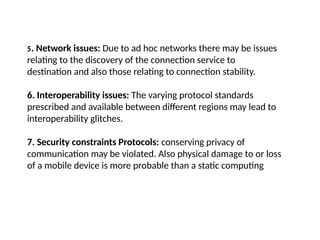
5. Network issues:Due to ad hoc networks there may be issues
relating to the discovery of the connection service to
destination and also those relating to connection stability.
6. Interoperability issues: The varying protocol standards
prescribed and available between different regions may lead to
interoperability glitches.
7. Security constraints Protocols: conserving privacy of
communication may be violated. Also physical damage to or loss
of a mobile device is more probable than a static computing
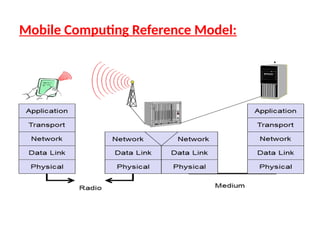
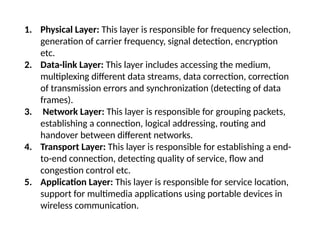
1. Physical Layer:This layer is responsible for frequency selection,
generation of carrier frequency, signal detection, encryption
etc.
2. Data-link Layer: This layer includes accessing the medium,
multiplexing different data streams, data correction, correction
of transmission errors and synchronization (detecting of data
frames).
3. Network Layer: This layer is responsible for grouping packets,
establishing a connection, logical addressing, routing and
handover between different networks.
4. Transport Layer: This layer is responsible for establishing a end-
to-end connection, detecting quality of service, flow and
congestion control etc.
5. Application Layer: This layer is responsible for service location,
support for multimedia applications using portable devices in
wireless communication.
22.
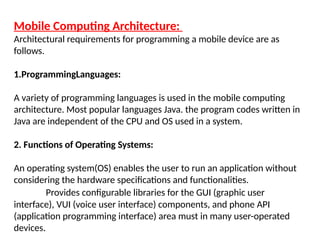
Mobile Computing Architecture:
Architecturalrequirements for programming a mobile device are as
follows.
1.ProgrammingLanguages:
A variety of programming languages is used in the mobile computing
architecture. Most popular languages Java. the program codes written in
Java are independent of the CPU and OS used in a system.
2. Functions of Operating Systems:
An operating system(OS) enables the user to run an application without
considering the hardware specifications and functionalities.
Provides configurable libraries for the GUI (graphic user
interface), VUI (voice user interface) components, and phone API
(application programming interface) area must in many user-operated
devices.
23.
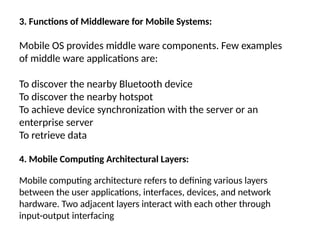
3. Functions ofMiddleware for Mobile Systems:
Mobile OS provides middle ware components. Few examples
of middle ware applications are:
To discover the nearby Bluetooth device
To discover the nearby hotspot
To achieve device synchronization with the server or an
enterprise server
To retrieve data
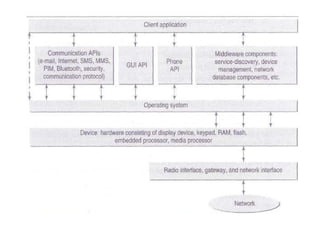
4. Mobile Computing Architectural Layers:
Mobile computing architecture refers to defining various layers
between the user applications, interfaces, devices, and network
hardware. Two adjacent layers interact with each other through
input-output interfacing
25.
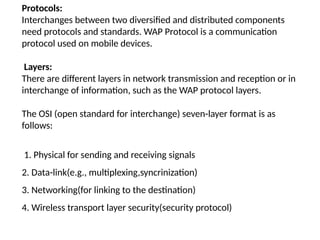
Protocols:
Interchanges between twodiversified and distributed components
need protocols and standards. WAP Protocol is a communication
protocol used on mobile devices.
Layers:
There are different layers in network transmission and reception or in
interchange of information, such as the WAP protocol layers.
The OSI (open standard for interchange) seven-layer format is as
follows:
1. Physical for sending and receiving signals
2. Data-link(e.g., multiplexing,syncrinization)
3. Networking(for linking to the destination)
4. Wireless transport layer security(security protocol)
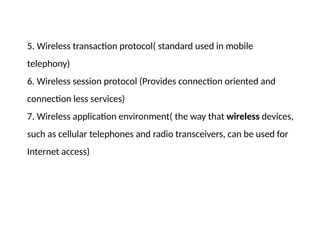
26.
5. Wireless transactionprotocol( standard used in mobile
telephony)
6. Wireless session protocol (Provides connection oriented and
connection less services)
7. Wireless application environment( the way that wireless devices,
such as cellular telephones and radio transceivers, can be used for
Internet access)
27.
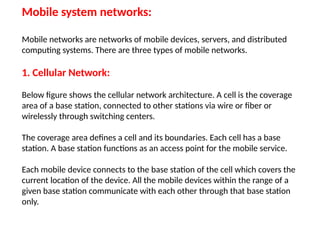
Mobile system networks:
Mobilenetworks are networks of mobile devices, servers, and distributed
computing systems. There are three types of mobile networks.
1. Cellular Network:
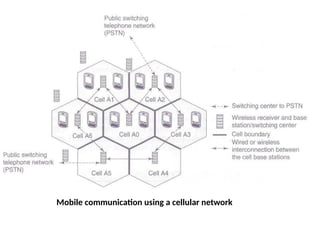
Below figure shows the cellular network architecture. A cell is the coverage
area of a base station, connected to other stations via wire or fiber or
wirelessly through switching centers.
The coverage area defines a cell and its boundaries. Each cell has a base
station. A base station functions as an access point for the mobile service.
Each mobile device connects to the base station of the cell which covers the
current location of the device. All the mobile devices within the range of a
given base station communicate with each other through that base station
only.
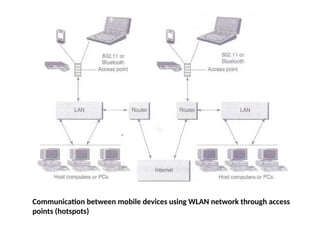
2. WLAN Networkand Mobile IP:
Below figure shows the WLAN network architecture. A mobile
device, such as a pocket computer or a laptop, connects to an
access point called a hotspot.
The access point, in turn, connects to a host LAN which links up
to the Internet through a router. Thus, connectivity is established
between the Internet, two LANs, mobile devices, and computers.
Mobile IP is an open standard. It is based on the IP (Internet
protocol)
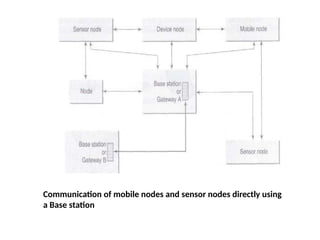
3. Ad-hoc Networks
Belowfigure shows ad hoc network architecture. Where the
nodes, mobile nodes, and sensor nodes communicate among
themselves using a base station.
The base stations function as gateways. The ad hoc networks
are deployed for routing, target detection, service discovery,
and other needs in a mobile environment. A network without
any base stations “infrastructure-less” or multi-hop. A
collection of two or more devices equipped with wireless
communications and networking Capability. Supports anytime
and anywhere computing.