
Examination of Technologies(Bluetooth, WiFi
&WiMax) related to data streaming and
applying it to perform for the same using
RPC, RMI and various Mobile Agents and
hence comparing different mobile Agent
systems
Mobility has attracted lot of attention in recent years. In this Paper we
have examined different infrastructure base and non-infrastructure
base technologies through which we can transfer Data in different
manner. We compare different technologies on the basis of their data
streaming speed, their types, and their behaviour in different
environment at time of data transfer, including Mobile Agents. Now a
days with increasing popularity for Internet and manage the
performance issues like Data transfer Rate , we are using Mobile
Agent to transfer data on fly .therefore each technology related to
Mobile Agent is Examined and compared with each other so as to
know their own Advantages and Disadvantages and hence applying
them accordingly. Herein we deployed a Mobile Agent using CORBA
and discuss importance and challenges happened during its
deployment.
Introduction
 What is Bluetooth, WiFi and WiMAX?
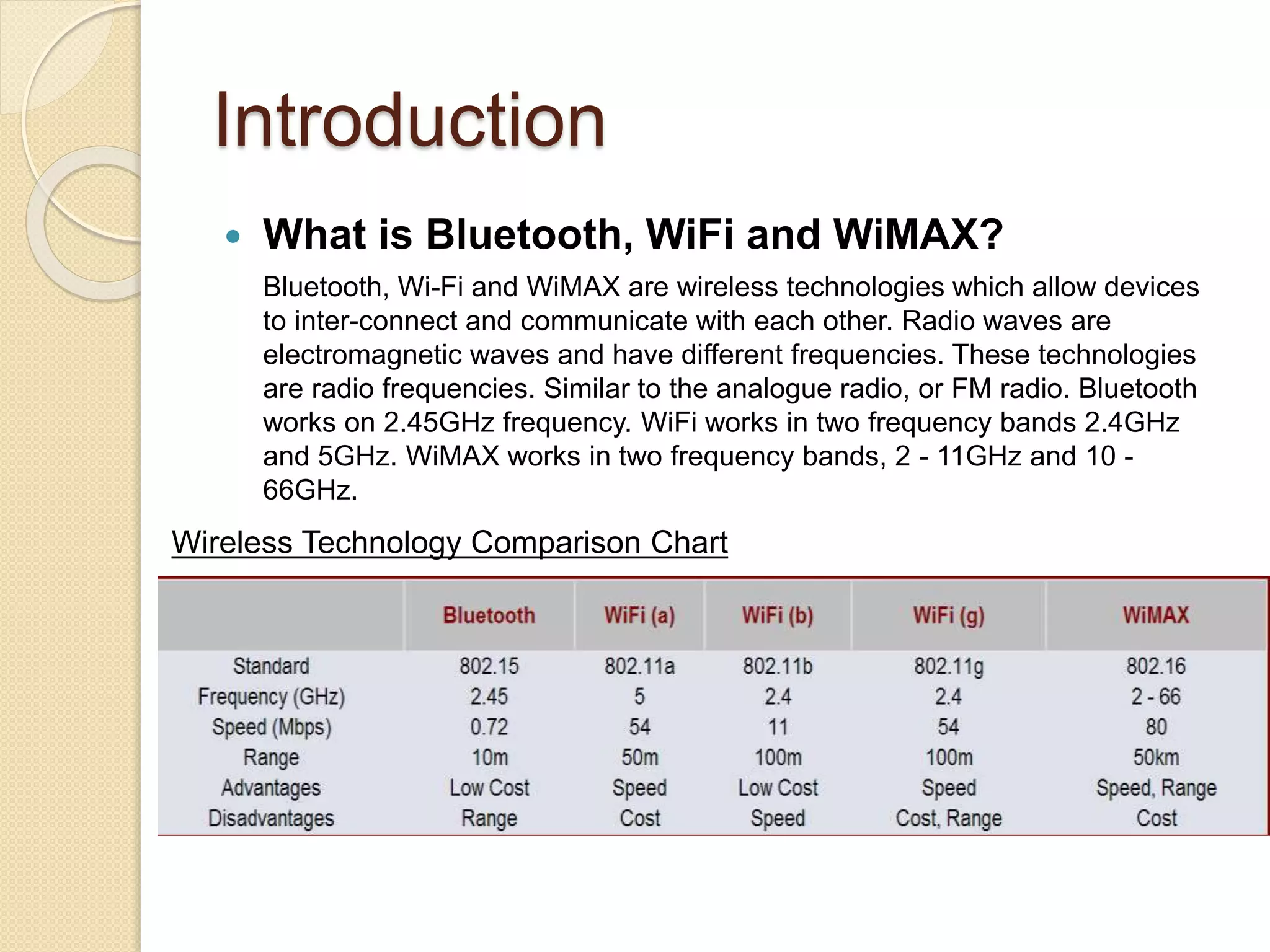
Bluetooth, Wi-Fi and WiMAX are wireless technologies which allow devices
to inter-connect and communicate with each other. Radio waves are
electromagnetic waves and have different frequencies. These technologies
are radio frequencies. Similar to the analogue radio, or FM radio. Bluetooth
works on 2.45GHz frequency. WiFi works in two frequency bands 2.4GHz
and 5GHz. WiMAX works in two frequency bands, 2 - 11GHz and 10 -
66GHz.
Wireless Technology Comparison Chart
0
1
2
3
4
5
6
Data 1 Data 2 Data 3 Data 4
WiMax
Wifi
Bluetooth
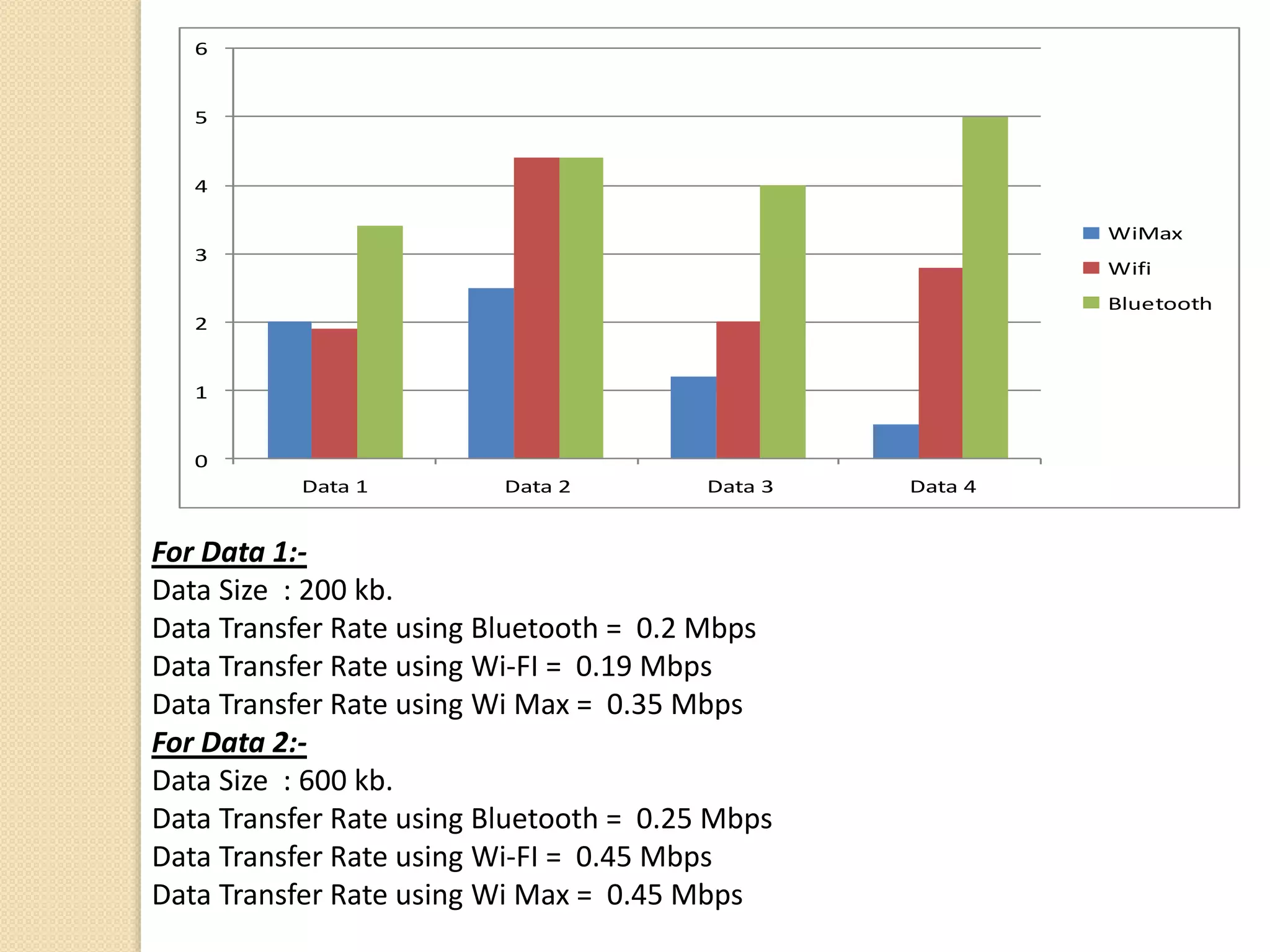
For Data 1:-
Data Size : 200 kb.
Data Transfer Rate using Bluetooth = 0.2 Mbps
Data Transfer Rate using Wi-FI = 0.19 Mbps
Data Transfer Rate using Wi Max = 0.35 Mbps
For Data 2:-
Data Size : 600 kb.
Data Transfer Rate using Bluetooth = 0.25 Mbps
Data Transfer Rate using Wi-FI = 0.45 Mbps
Data Transfer Rate using Wi Max = 0.45 Mbps
CONT……..
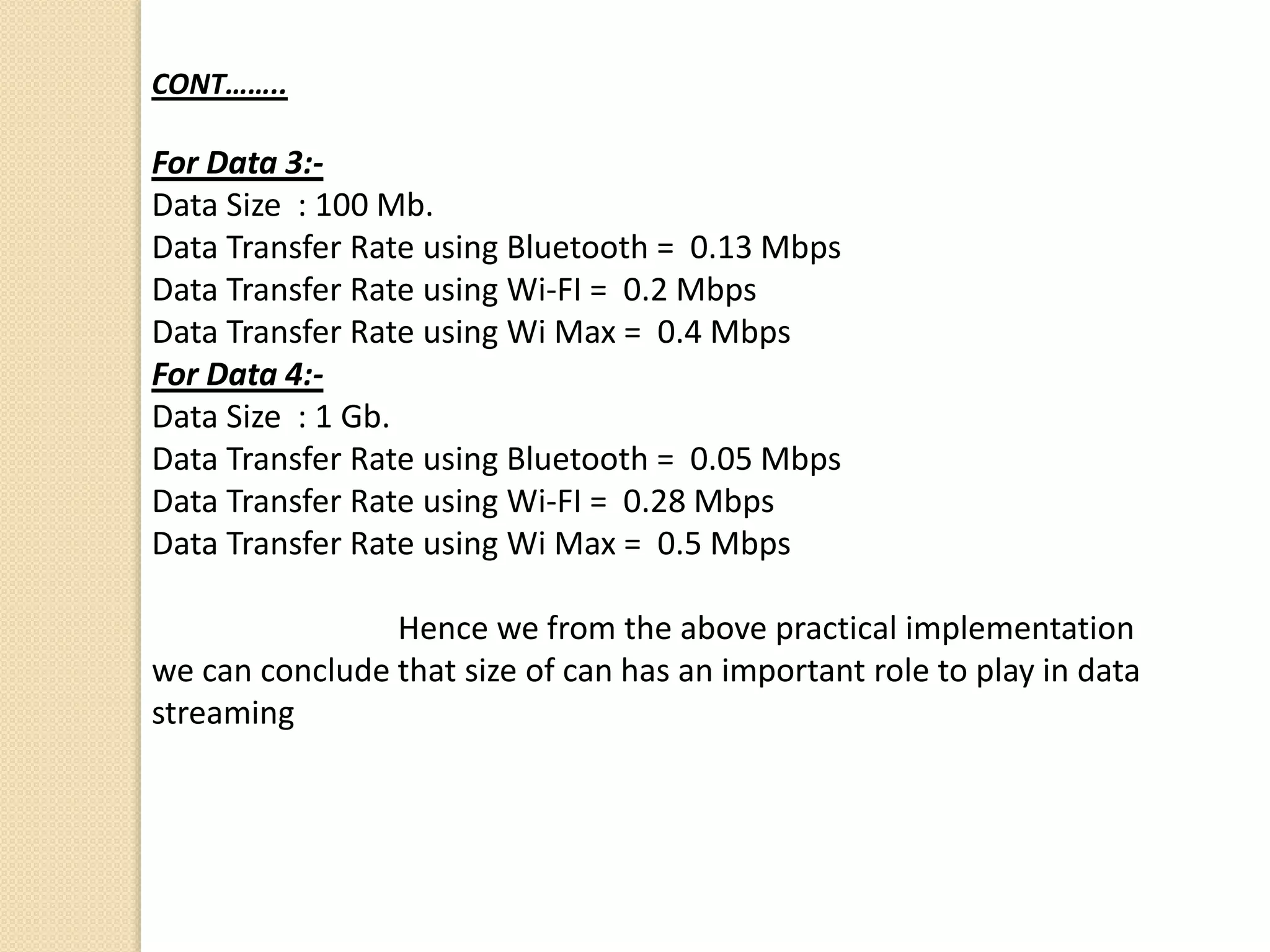
For Data 3:-
Data Size : 100 Mb.
Data Transfer Rate using Bluetooth = 0.13 Mbps
Data Transfer Rate using Wi-FI = 0.2 Mbps
Data Transfer Rate using Wi Max = 0.4 Mbps
For Data 4:-
Data Size : 1 Gb.
Data Transfer Rate using Bluetooth = 0.05 Mbps
Data Transfer Rate using Wi-FI = 0.28 Mbps
Data Transfer Rate using Wi Max = 0.5 Mbps
Hence we from the above practical implementation
we can conclude that size of can has an important role to play in data
streaming
Introdution (conti.)
 Mobile Ad Hoc :- Stands for "Mobile Ad Hoc Network." A MANET is a type of ad hoc
network that can change locations and configure itself on the fly. Because MANETS are
mobile, they use wireless connections to connect to various networks. This can be a
standard Wi-Fi connection or other media, such as a cellular or satellite transmission.
Some MANETs are restricted to a local area of wireless devices (such as a group of
laptop computers), while others may be connected to the Internet. Some MANETs are
restricted to a local area of wireless devices (such as a group of laptop computers),
while others may be connected to the Internet. For example, A VANET (Vehicular Ad
Hoc Network), is a type of MANET that allows vehicles to communicate with roadside
equipment. While the vehicles may not have a direct Internet connection, the wireless
roadside equipment may be connected to the Internet, allowing data from the vehicles to
be sent over the Internet.
 Peer-To-Peer :- Peer-to-Peer system have become a popular medium through which
to share a huge amounts of data. P2P system distributed the main cost of sharing data
space for storing files and bandwidth for storing them across the peers in the network,
thus enabling application to scale without the need for expensive and powerful server.
Their ability to build an extremely resource rich system by aggregating the resource of
large number of independent nodes enables P2P system to draft the capabilities of
many centralizes system for relatively little cost.
 Mobile Agent:- Mobile agents are autonomous, intelligent software programs which
meant that they can decide where they will go and what they will do. They can migrate
from host to host in a network, searching for and interacting with services to complete a
specific task, which means that mobile agents are also goal oriented. One of the key
Competing Technologies : Message
Passing Mobile agency faces stiff competition from other technologies that can achieve similar
outcomes, such as message passing or advanced forms of remote procedure calls.
Some of the more notable technologies that offer competition to mobile agency are
discussed.
Remote Procedure Call :
 An RPC is analogous to a function call. Like a function call, when an RPC is
made, the calling arguments are passed to the remote procedure and the
caller waits for a response to be returned from the remote procedure. Below
figure shows the flow of activity that takes place during an RPC call between
two networked systems. The client makes a procedure call that sends a
request to the server and waits. The thread is blocked from processing until
either a reply is received, or it times out. When the request arrives, the server
calls a dispatch routine that performs the requested service, and sends the
reply to the client. After the RPC call is completed, the client program
continues. RPC specifically supports network applications
Competing Technologies : Message
Passing(conti.)
 Remote Method Invocation (RMI)
Remote method invocation allows Java developers to
write distributed systems that share objects. New objects
can be transferred across the network, and RMI is
becoming a popular mechanism for agent
communication. RMI can be used to facilitate mobile
agency (acting as a transport mechanism), or as a
replacement that allows agents to invoke methods of
other agents. One of the implementations of RMI is JINI .
JINI
 Jini (pronounced DJEE-nee like the Arabic word for "magician") is a
network architecture concept that Sun Microsystems calls
"spontaneous networking." Using Jini, users will be able to plug
printers, storage devices, speakers, and any kind of device directly
into a network and every other computer, device, and user on the
network will know that the new device has been added and is
available. Each pluggable device will define itself immediately to a
network device registry. When someone wants to use or access the
resource, their computer will be able to download the necessary
programming from it to communicate with it. No longer will the
special device support software known as a device driver needs to
be present in an operating system. Jini can be viewed as the next
step after the Java programming language toward making a
network look like one large computer
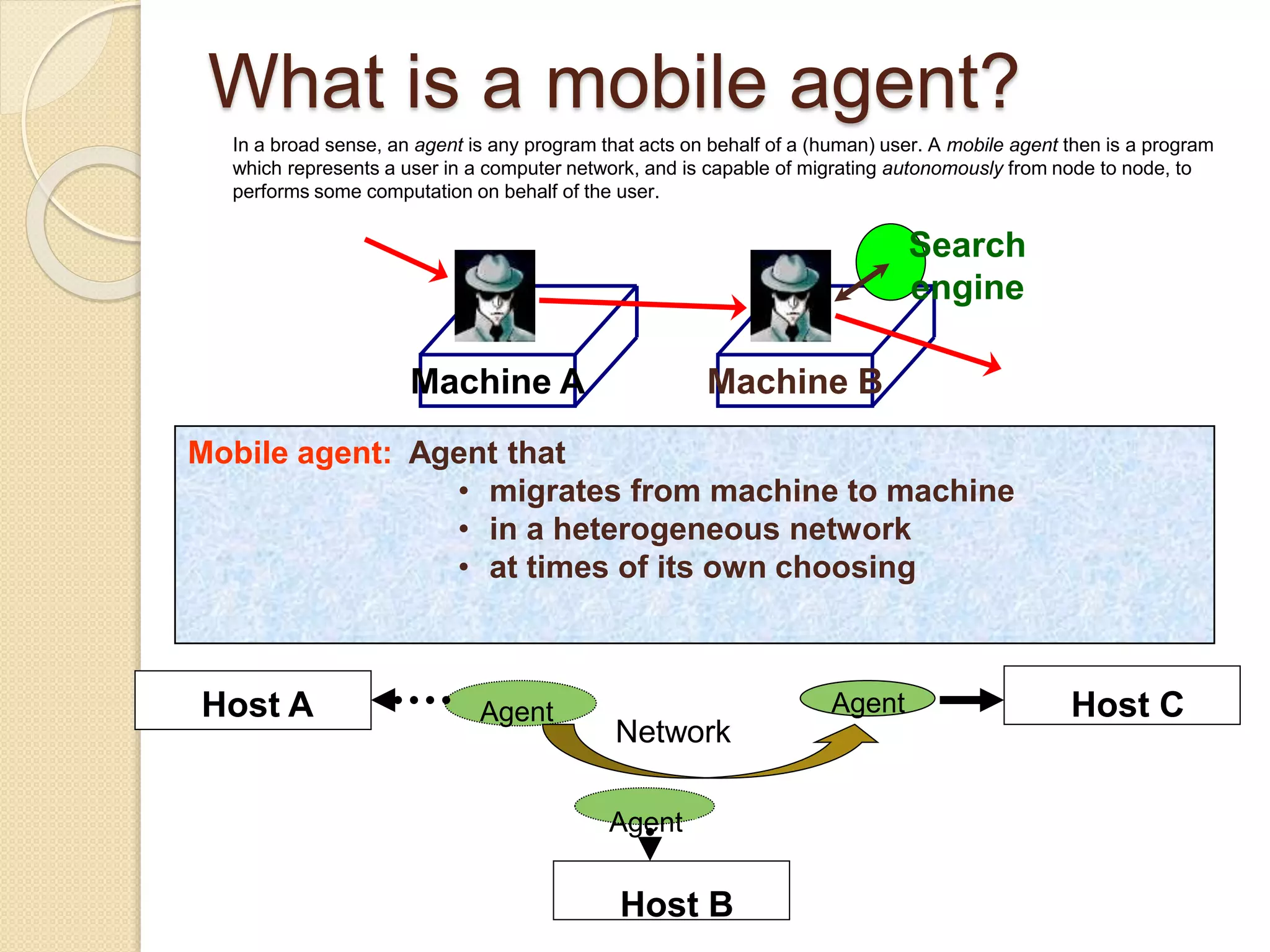
What is a mobile agent?
Machine A Machine B
Search
engine
Mobile agent: Agent that
• migrates from machine to machine
• in a heterogeneous network
• at times of its own choosing
In a broad sense, an agent is any program that acts on behalf of a (human) user. A mobile agent then is a program
which represents a user in a computer network, and is capable of migrating autonomously from node to node, to
performs some computation on behalf of the user.
AgentHost A
Host B
Host C
Agent
Agent
Network
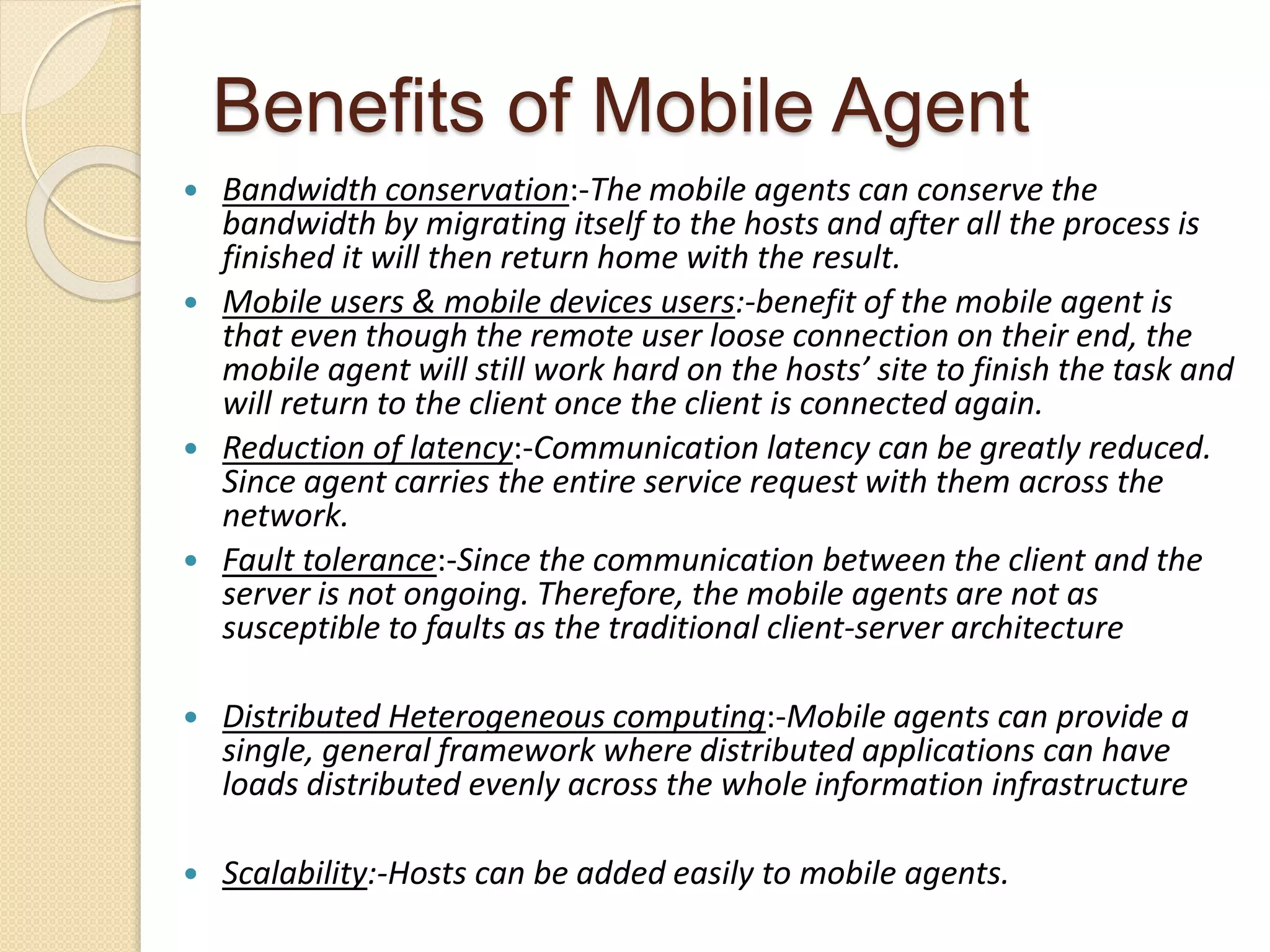
Benefits of Mobile Agent
 Bandwidth conservation:-The mobile agents can conserve the
bandwidth by migrating itself to the hosts and after all the process is
finished it will then return home with the result.
 Mobile users & mobile devices users:-benefit of the mobile agent is
that even though the remote user loose connection on their end, the
mobile agent will still work hard on the hosts’ site to finish the task and
will return to the client once the client is connected again.
 Reduction of latency:-Communication latency can be greatly reduced.
Since agent carries the entire service request with them across the
network.
 Fault tolerance:-Since the communication between the client and the
server is not ongoing. Therefore, the mobile agents are not as
susceptible to faults as the traditional client-server architecture
 Distributed Heterogeneous computing:-Mobile agents can provide a
single, general framework where distributed applications can have
loads distributed evenly across the whole information infrastructure
 Scalability:-Hosts can be added easily to mobile agents.
Different Mobile Agents Systems
 Aglet:-Aglets is a Java based mobile Agent platform and
library for building mobile agents based applications,
allowing program code to be transported along with state
information. Aglets are Java objects that can move from
one host on the Internet to another. That is, an aglet that
executes on one host can suddenly halt execution, be
dispatched to a remote host, and resume execution there.
When the aglet moves, it takes along its program code as
well as its data.
The Java Aglet API (J-AAPI) is a
proposed industry standard for Java- based mobile agents.
J-AAPI was developed by a research team at the IBM
Tokyo Research Laboratory in Japan in response to a call
for a uniform platform for mobile agents in heterogeneous
environments such as the Internet.

CORBA
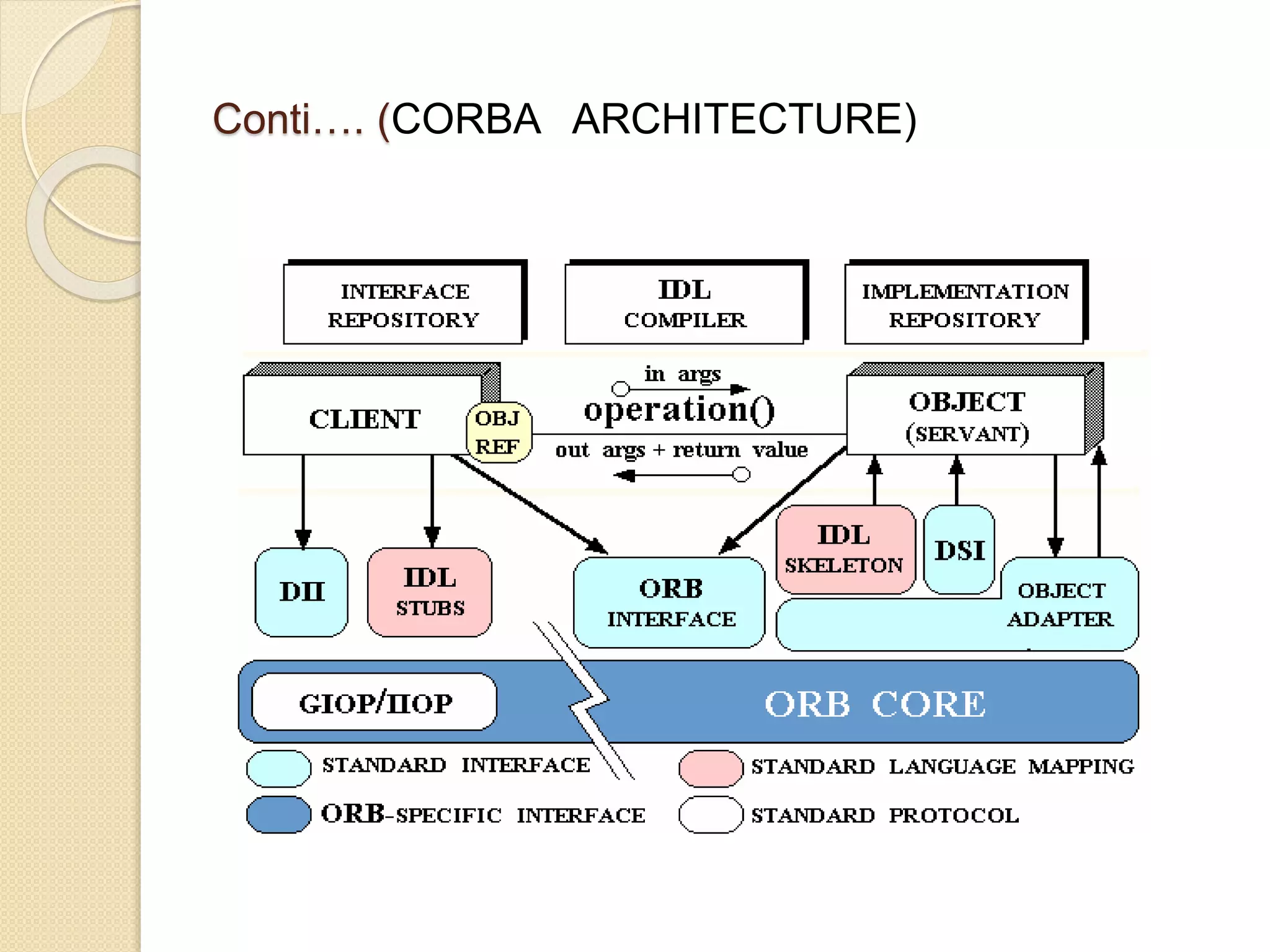
 Common Object Request Broker Architecture (CORBA)
CORBA is a platform and language independent
mechanism for invoking remote object methods. CORBA
can be used to create distributed systems that execute on
many platforms, in many languages. CORBA holds great
potential, because of its portability and flexibility. CORBA
is a direct threat to mobile agency, and would allow
developers to create agents that are capable of complex
communication without ever travelling across a network
Conti…. (CORBA ARCHITECTURE)
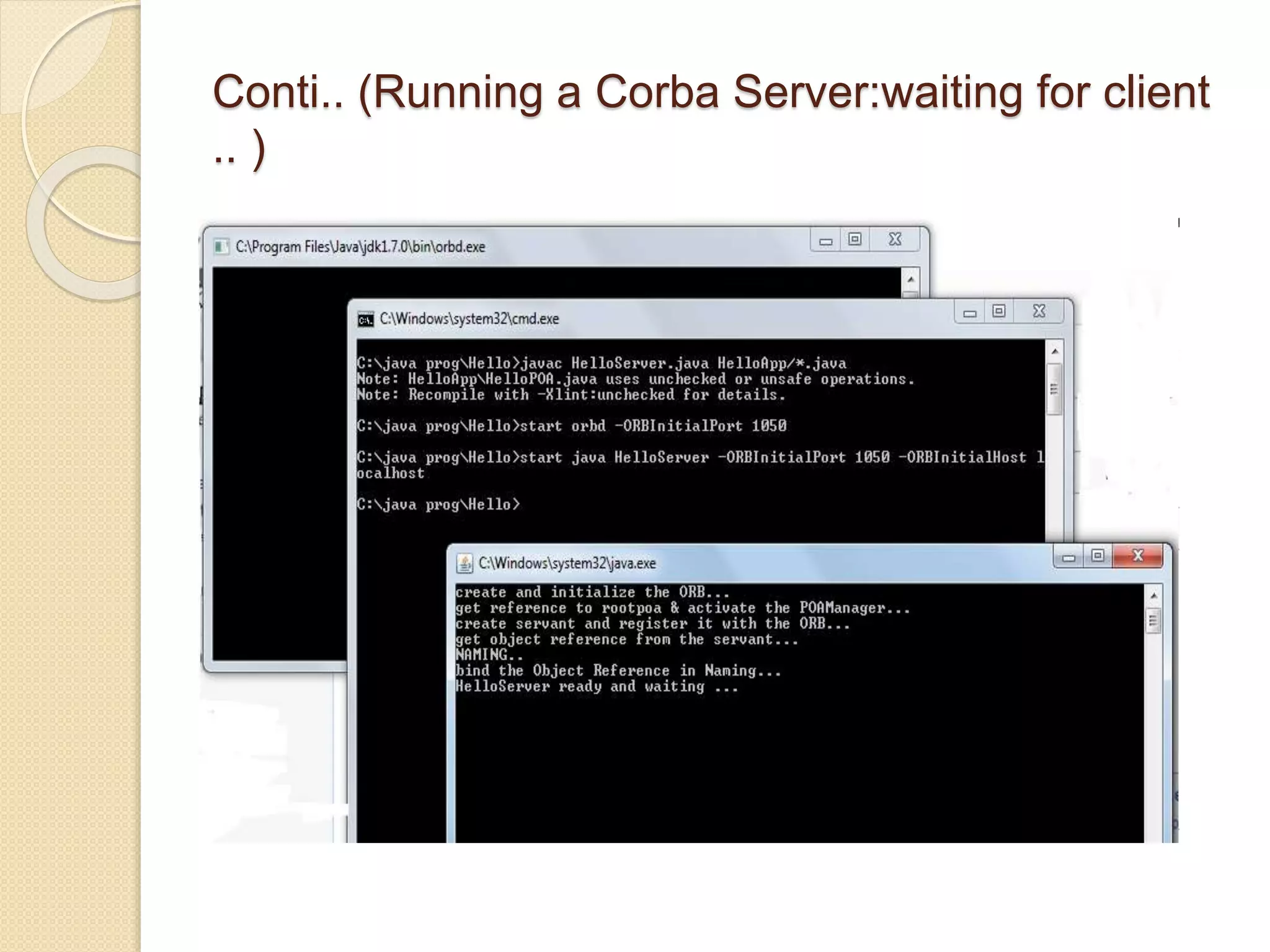
Conti.. (Running a Corba Server:waiting for client
.. )
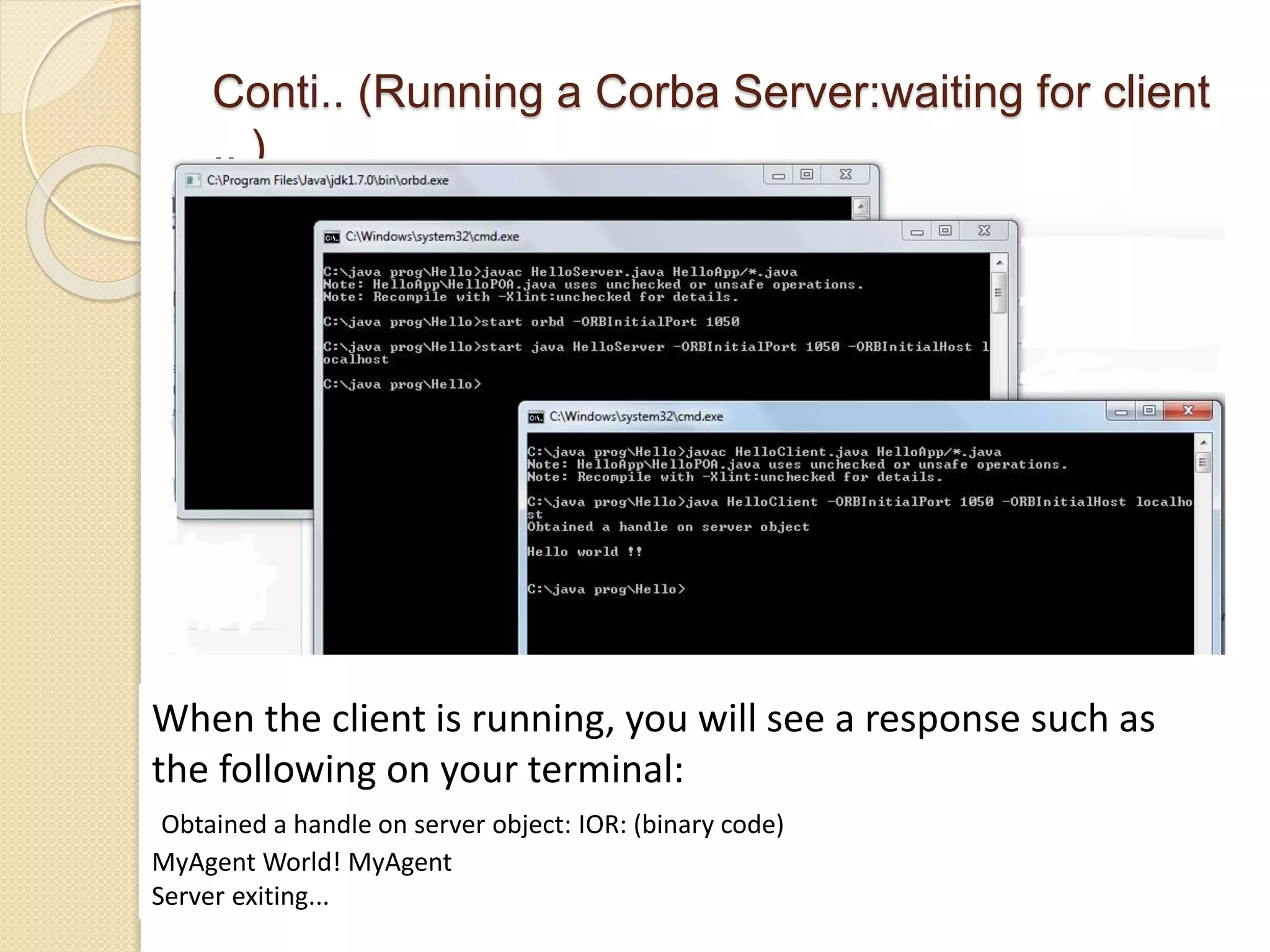
Conti.. (Running a Corba Server:waiting for client
.. )
When the client is running, you will see a response such as
the following on your terminal:
Obtained a handle on server object: IOR: (binary code)
MyAgent World! MyAgent
Server exiting...
Conclusion
 Mobile agent technology has been highlighted as a very interesting
approach to build applications for mobile environments. However, it is
hard to find practical applications with real prototypes and using the
available mobile agent platforms. One reason is probably that such
Platform has been developed with a fixed distributed environment in
mind, and not considering the features that may be of special interest
in a mobile environment. Mobile agent scales effectively as the size of
the data to be obtained increases.
• Advantages
Bandwidth & Performance
Working offline
Monitor or find information
• Disadvantages
Security concerns for both hosts & agents
Tough to Deploy
THANK YOU

Examination of Technologies(Bluetooth, WiFi &WiMax) related to data streaming and applying it to perform for the same using RPC, RMI and various Mobile Agents and hence comparing different mobile Agent systems

  • 1.
    Examination of Technologies(Bluetooth,WiFi &WiMax) related to data streaming and applying it to perform for the same using RPC, RMI and various Mobile Agents and hence comparing different mobile Agent systems Mobility has attracted lot of attention in recent years. In this Paper we have examined different infrastructure base and non-infrastructure base technologies through which we can transfer Data in different manner. We compare different technologies on the basis of their data streaming speed, their types, and their behaviour in different environment at time of data transfer, including Mobile Agents. Now a days with increasing popularity for Internet and manage the performance issues like Data transfer Rate , we are using Mobile Agent to transfer data on fly .therefore each technology related to Mobile Agent is Examined and compared with each other so as to know their own Advantages and Disadvantages and hence applying them accordingly. Herein we deployed a Mobile Agent using CORBA and discuss importance and challenges happened during its deployment.
  • 2.
    Introduction  What isBluetooth, WiFi and WiMAX? Bluetooth, Wi-Fi and WiMAX are wireless technologies which allow devices to inter-connect and communicate with each other. Radio waves are electromagnetic waves and have different frequencies. These technologies are radio frequencies. Similar to the analogue radio, or FM radio. Bluetooth works on 2.45GHz frequency. WiFi works in two frequency bands 2.4GHz and 5GHz. WiMAX works in two frequency bands, 2 - 11GHz and 10 - 66GHz. Wireless Technology Comparison Chart
  • 3.
    0 1 2 3 4 5 6 Data 1 Data2 Data 3 Data 4 WiMax Wifi Bluetooth For Data 1:- Data Size : 200 kb. Data Transfer Rate using Bluetooth = 0.2 Mbps Data Transfer Rate using Wi-FI = 0.19 Mbps Data Transfer Rate using Wi Max = 0.35 Mbps For Data 2:- Data Size : 600 kb. Data Transfer Rate using Bluetooth = 0.25 Mbps Data Transfer Rate using Wi-FI = 0.45 Mbps Data Transfer Rate using Wi Max = 0.45 Mbps
  • 4.
    CONT…….. For Data 3:- DataSize : 100 Mb. Data Transfer Rate using Bluetooth = 0.13 Mbps Data Transfer Rate using Wi-FI = 0.2 Mbps Data Transfer Rate using Wi Max = 0.4 Mbps For Data 4:- Data Size : 1 Gb. Data Transfer Rate using Bluetooth = 0.05 Mbps Data Transfer Rate using Wi-FI = 0.28 Mbps Data Transfer Rate using Wi Max = 0.5 Mbps Hence we from the above practical implementation we can conclude that size of can has an important role to play in data streaming
  • 5.
    Introdution (conti.)  MobileAd Hoc :- Stands for "Mobile Ad Hoc Network." A MANET is a type of ad hoc network that can change locations and configure itself on the fly. Because MANETS are mobile, they use wireless connections to connect to various networks. This can be a standard Wi-Fi connection or other media, such as a cellular or satellite transmission. Some MANETs are restricted to a local area of wireless devices (such as a group of laptop computers), while others may be connected to the Internet. Some MANETs are restricted to a local area of wireless devices (such as a group of laptop computers), while others may be connected to the Internet. For example, A VANET (Vehicular Ad Hoc Network), is a type of MANET that allows vehicles to communicate with roadside equipment. While the vehicles may not have a direct Internet connection, the wireless roadside equipment may be connected to the Internet, allowing data from the vehicles to be sent over the Internet.  Peer-To-Peer :- Peer-to-Peer system have become a popular medium through which to share a huge amounts of data. P2P system distributed the main cost of sharing data space for storing files and bandwidth for storing them across the peers in the network, thus enabling application to scale without the need for expensive and powerful server. Their ability to build an extremely resource rich system by aggregating the resource of large number of independent nodes enables P2P system to draft the capabilities of many centralizes system for relatively little cost.  Mobile Agent:- Mobile agents are autonomous, intelligent software programs which meant that they can decide where they will go and what they will do. They can migrate from host to host in a network, searching for and interacting with services to complete a specific task, which means that mobile agents are also goal oriented. One of the key
  • 6.
    Competing Technologies :Message Passing Mobile agency faces stiff competition from other technologies that can achieve similar outcomes, such as message passing or advanced forms of remote procedure calls. Some of the more notable technologies that offer competition to mobile agency are discussed. Remote Procedure Call :  An RPC is analogous to a function call. Like a function call, when an RPC is made, the calling arguments are passed to the remote procedure and the caller waits for a response to be returned from the remote procedure. Below figure shows the flow of activity that takes place during an RPC call between two networked systems. The client makes a procedure call that sends a request to the server and waits. The thread is blocked from processing until either a reply is received, or it times out. When the request arrives, the server calls a dispatch routine that performs the requested service, and sends the reply to the client. After the RPC call is completed, the client program continues. RPC specifically supports network applications
  • 7.
    Competing Technologies :Message Passing(conti.)  Remote Method Invocation (RMI) Remote method invocation allows Java developers to write distributed systems that share objects. New objects can be transferred across the network, and RMI is becoming a popular mechanism for agent communication. RMI can be used to facilitate mobile agency (acting as a transport mechanism), or as a replacement that allows agents to invoke methods of other agents. One of the implementations of RMI is JINI .
  • 8.
    JINI  Jini (pronouncedDJEE-nee like the Arabic word for "magician") is a network architecture concept that Sun Microsystems calls "spontaneous networking." Using Jini, users will be able to plug printers, storage devices, speakers, and any kind of device directly into a network and every other computer, device, and user on the network will know that the new device has been added and is available. Each pluggable device will define itself immediately to a network device registry. When someone wants to use or access the resource, their computer will be able to download the necessary programming from it to communicate with it. No longer will the special device support software known as a device driver needs to be present in an operating system. Jini can be viewed as the next step after the Java programming language toward making a network look like one large computer
  • 9.
    What is amobile agent? Machine A Machine B Search engine Mobile agent: Agent that • migrates from machine to machine • in a heterogeneous network • at times of its own choosing In a broad sense, an agent is any program that acts on behalf of a (human) user. A mobile agent then is a program which represents a user in a computer network, and is capable of migrating autonomously from node to node, to performs some computation on behalf of the user. AgentHost A Host B Host C Agent Agent Network
  • 10.
    Benefits of MobileAgent  Bandwidth conservation:-The mobile agents can conserve the bandwidth by migrating itself to the hosts and after all the process is finished it will then return home with the result.  Mobile users & mobile devices users:-benefit of the mobile agent is that even though the remote user loose connection on their end, the mobile agent will still work hard on the hosts’ site to finish the task and will return to the client once the client is connected again.  Reduction of latency:-Communication latency can be greatly reduced. Since agent carries the entire service request with them across the network.  Fault tolerance:-Since the communication between the client and the server is not ongoing. Therefore, the mobile agents are not as susceptible to faults as the traditional client-server architecture  Distributed Heterogeneous computing:-Mobile agents can provide a single, general framework where distributed applications can have loads distributed evenly across the whole information infrastructure  Scalability:-Hosts can be added easily to mobile agents.
  • 11.
    Different Mobile AgentsSystems  Aglet:-Aglets is a Java based mobile Agent platform and library for building mobile agents based applications, allowing program code to be transported along with state information. Aglets are Java objects that can move from one host on the Internet to another. That is, an aglet that executes on one host can suddenly halt execution, be dispatched to a remote host, and resume execution there. When the aglet moves, it takes along its program code as well as its data. The Java Aglet API (J-AAPI) is a proposed industry standard for Java- based mobile agents. J-AAPI was developed by a research team at the IBM Tokyo Research Laboratory in Japan in response to a call for a uniform platform for mobile agents in heterogeneous environments such as the Internet. 
  • 12.
    CORBA  Common ObjectRequest Broker Architecture (CORBA) CORBA is a platform and language independent mechanism for invoking remote object methods. CORBA can be used to create distributed systems that execute on many platforms, in many languages. CORBA holds great potential, because of its portability and flexibility. CORBA is a direct threat to mobile agency, and would allow developers to create agents that are capable of complex communication without ever travelling across a network
  • 13.
  • 14.
    Conti.. (Running aCorba Server:waiting for client .. )
  • 15.
    Conti.. (Running aCorba Server:waiting for client .. ) When the client is running, you will see a response such as the following on your terminal: Obtained a handle on server object: IOR: (binary code) MyAgent World! MyAgent Server exiting...
  • 16.
    Conclusion  Mobile agenttechnology has been highlighted as a very interesting approach to build applications for mobile environments. However, it is hard to find practical applications with real prototypes and using the available mobile agent platforms. One reason is probably that such Platform has been developed with a fixed distributed environment in mind, and not considering the features that may be of special interest in a mobile environment. Mobile agent scales effectively as the size of the data to be obtained increases. • Advantages Bandwidth & Performance Working offline Monitor or find information • Disadvantages Security concerns for both hosts & agents Tough to Deploy
  • 17.