Mangesh Prakash Vasu
3 Rd Year B.E
Dept. Of Computer Science And Engineering,
College Of Engineering And Tech Akola
Ad Hoc Networks:
Overview, Applications And Issues
Contents
Introduction
Definition
Ad hoc Networks – Operating Principle
Ad hoc networking issues
Applications
 Decentralized Type Of Wireless Network
 It Consists Of Mobile Node
Ex- Bluetooth Enabled Mobile Phones Such As 3G, Laptops.
 The Nodes Are Short Life Forming Temporary Network
 The Ad-hoc Network Does Not Have Any Centralized
Structure
 The Ad-hoc Network Does Not Have Any Network Infrastructure
 The Determination Of Nodes Is Made Dynamically Base On Network
Connectivity
 Ad-hoc Network Are Peer-to-peer Network
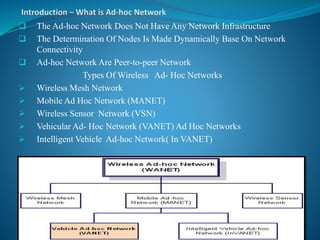
Types Of Wireless Ad- Hoc Networks
 Wireless Mesh Network
 Mobile Ad Hoc Network (MANET)
 Wireless Sensor Network (VSN)
 Vehicular Ad- Hoc Network (VANET) Ad Hoc Networks
 Intelligent Vehicle Ad-hoc Network( In VANET)
definition :-
• A decentralized type of wireless network, allowing
people and devices to seamlessly internetwork in areas with
no pre-existing communication infrastructure, It can turn the
dream of networking at any place and at time into reality. We
are almost there by the way .Ex- Bluetooth enabled mobile
phones such as 3G, laptops, handheld digital devices,
personal digital assistants, or wearable computers
Ad hoc Networks – Operating Principle
Single hop communication:-
Mobile node A communicates
directly with Mobile node B when a channel is available.
Ad hoc Networks – Operating Principle
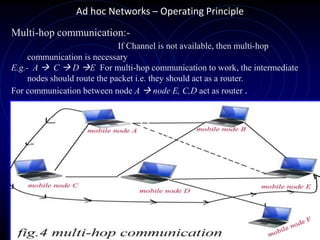
Multi-hop communication:-
If Channel is not available, then multi-hop
communication is necessary
E.g.- A  C  D E For multi-hop communication to work, the intermediate
nodes should route the packet i.e. they should act as a router.
For communication between node A  node E, C,D act as router .
Ad hoc networking issues
I. Autonomous and infrastructure-less :-
a) distributed peer-to-peer mode
b) independent router
II. Multi-hop routing : -
a) No default router available,
b) every node acts as a router
III. Dynamically changing network topologies :-
network topology can change frequently and
unpredictably
IV. Variation in link and node capabilities: -
a)Each node may be equipped with one or more radio interfaces possibly
asymmetric links.
b) different software/hardware configuration.
c) Designing network protocols can be complex.
V. Energy constrained operation: -
a) mobile node have limited power supply, processing power is limited.
b)limits services and applications.
VI. Network scalability :-
a) A system whose performance improves after adding hardware,
proportionally to the capacity added, is said to be a scalable system
b) An algorithm design, networking ,protocol, program, or other system is said
to scale if it is suitably efficient and practical when applied to large situations
(e.g. a large input data set, a large number of outputs or users, or a large
number of participating nodes in the case of a distributed system).
Ad hoc networking issues
Applications of ad hoc networks :-
Military operations
Bluetooth for personal use
Disaster recovery environments
Small wireless networks
Conclusions:-
It can be concluded that the ad-hoc networks are very
useful but the effective deployment needs effective
solutions for the issues fault detection and
management, Network scalability , pocket losses etc.
Questions ?
.
Thank you
14 march 2014 presentation at Rajarshri shahu college of
Engineering , Buldhana

ADhoc- network overview,application,issues.

  • 1.
    Mangesh Prakash Vasu 3Rd Year B.E Dept. Of Computer Science And Engineering, College Of Engineering And Tech Akola Ad Hoc Networks: Overview, Applications And Issues
  • 2.
    Contents Introduction Definition Ad hoc Networks– Operating Principle Ad hoc networking issues Applications
  • 3.
     Decentralized TypeOf Wireless Network  It Consists Of Mobile Node Ex- Bluetooth Enabled Mobile Phones Such As 3G, Laptops.  The Nodes Are Short Life Forming Temporary Network  The Ad-hoc Network Does Not Have Any Centralized Structure
  • 4.
     The Ad-hocNetwork Does Not Have Any Network Infrastructure  The Determination Of Nodes Is Made Dynamically Base On Network Connectivity  Ad-hoc Network Are Peer-to-peer Network Types Of Wireless Ad- Hoc Networks  Wireless Mesh Network  Mobile Ad Hoc Network (MANET)  Wireless Sensor Network (VSN)  Vehicular Ad- Hoc Network (VANET) Ad Hoc Networks  Intelligent Vehicle Ad-hoc Network( In VANET)
  • 5.
    definition :- • Adecentralized type of wireless network, allowing people and devices to seamlessly internetwork in areas with no pre-existing communication infrastructure, It can turn the dream of networking at any place and at time into reality. We are almost there by the way .Ex- Bluetooth enabled mobile phones such as 3G, laptops, handheld digital devices, personal digital assistants, or wearable computers
  • 6.
    Ad hoc Networks– Operating Principle Single hop communication:- Mobile node A communicates directly with Mobile node B when a channel is available.
  • 7.
    Ad hoc Networks– Operating Principle Multi-hop communication:- If Channel is not available, then multi-hop communication is necessary E.g.- A  C  D E For multi-hop communication to work, the intermediate nodes should route the packet i.e. they should act as a router. For communication between node A  node E, C,D act as router .
  • 8.
    Ad hoc networkingissues I. Autonomous and infrastructure-less :- a) distributed peer-to-peer mode b) independent router II. Multi-hop routing : - a) No default router available, b) every node acts as a router III. Dynamically changing network topologies :- network topology can change frequently and unpredictably
  • 9.
    IV. Variation inlink and node capabilities: - a)Each node may be equipped with one or more radio interfaces possibly asymmetric links. b) different software/hardware configuration. c) Designing network protocols can be complex. V. Energy constrained operation: - a) mobile node have limited power supply, processing power is limited. b)limits services and applications. VI. Network scalability :- a) A system whose performance improves after adding hardware, proportionally to the capacity added, is said to be a scalable system b) An algorithm design, networking ,protocol, program, or other system is said to scale if it is suitably efficient and practical when applied to large situations (e.g. a large input data set, a large number of outputs or users, or a large number of participating nodes in the case of a distributed system). Ad hoc networking issues
  • 10.
    Applications of adhoc networks :- Military operations Bluetooth for personal use Disaster recovery environments Small wireless networks
  • 11.
    Conclusions:- It can beconcluded that the ad-hoc networks are very useful but the effective deployment needs effective solutions for the issues fault detection and management, Network scalability , pocket losses etc.
  • 12.
  • 13.
    Thank you 14 march2014 presentation at Rajarshri shahu college of Engineering , Buldhana

Editor's Notes