Marketing Management
Global Edition
Kotler & Keller
Chapter 10
Crafting the Brand
Positioning
Copyright © 2012 Pearson Education 10-1
Chapter Questions
1. How can a firm choose and communicate an effective
positioning in the market?
2. How are brands differentiated?
3. What marketing strategies are appropriate at each stage of
the product life cycle?
4. What are the implications of market evolution for
marketing strategies?
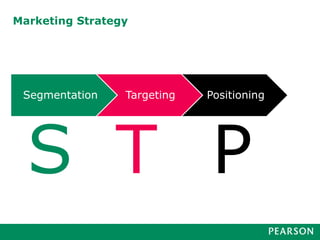
Marketing Strategy
T P
S
Segmentation Targeting Positioning
Developing and Communicating
a Positioning Strategy
Chapter Question 1:
How can a firm choose and
communicate an effective
positioning in the market?
Copyright © 2012 Pearson Education 10-3
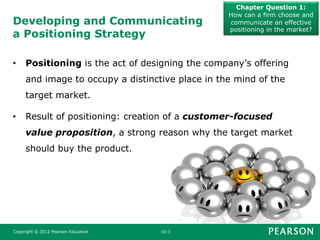
• Positioning is the act of designing the company’s offering
and image to occupy a distinctive place in the mind of the
target market.
• Result of positioning: creation of a customer-focused
value proposition, a strong reason why the target market
should buy the product.
Developing and Communicating
a Positioning Strategy
Chapter Question 1:
How can a firm choose and
communicate an effective
positioning in the market?
Copyright © 2012 Pearson Education 10-4
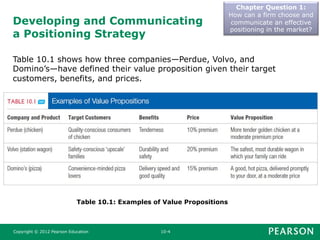
Table 10.1: Examples of Value Propositions
Table 10.1 shows how three companies—Perdue, Volvo, and
Domino’s—have defined their value proposition given their target
customers, benefits, and prices.
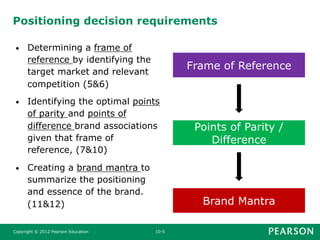
Positioning decision requirements
• Determining a frame of
reference by identifying the
target market and relevant
competition (5&6)
• Identifying the optimal points
of parity and points of
difference brand associations
given that frame of
reference, (7&10)
• Creating a brand mantra to
summarize the positioning
and essence of the brand.
(11&12)
Copyright © 2012 Pearson Education 10-5
Frame of Reference
Points of Parity /
Difference
Brand Mantra
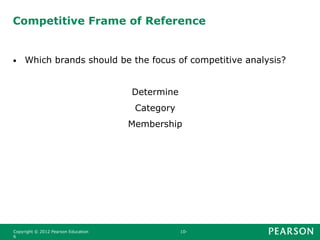
Competitive Frame of Reference
• Which brands should be the focus of competitive analysis?
Determine
Category
Membership
Copyright © 2012 Pearson Education 10-
6
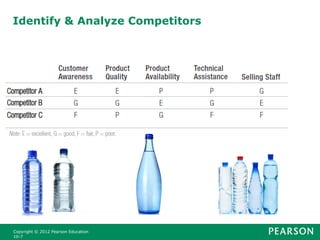
Identify & Analyze Competitors
Copyright © 2012 Pearson Education
10-7
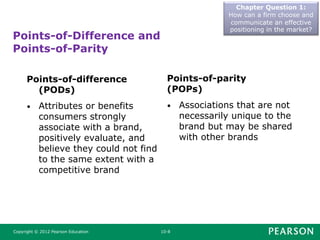
Points-of-Difference and
Points-of-Parity
Chapter Question 1:
How can a firm choose and
communicate an effective
positioning in the market?
Copyright © 2012 Pearson Education 10-8
Points-of-difference
(PODs)
• Attributes or benefits
consumers strongly
associate with a brand,
positively evaluate, and
believe they could not find
to the same extent with a
competitive brand
Points-of-parity
(POPs)
• Associations that are not
necessarily unique to the
brand but may be shared
with other brands
Identifying Optimal PODs
Points-of-difference
Attributes or benefits consumers strongly associate with a
brand, positively evaluate, and believe they could not find to
the same extent with a competitive brand
Apple (design, ease of use, irreverent attitude)
Copyright © 2012 Pearson Education 10-9
Defining Associations
Points-of-parity
Associations that are not necessarily unique to the brand but
may be shared with other brands
Copyright © 2012 Pearson Education 10-10
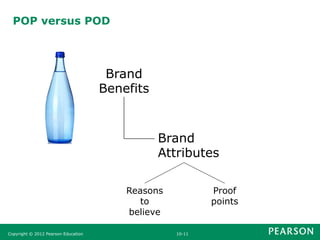
POP versus POD
Copyright © 2012 Pearson Education 10-11
Brand
Benefits
Brand
Attributes
Reasons
to
believe
Proof
points
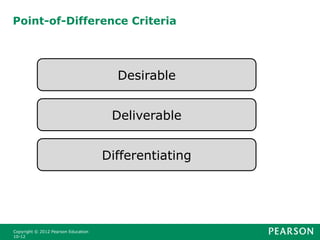
Point-of-Difference Criteria
Copyright © 2012 Pearson Education
10-12
Desirable
Deliverable
Differentiating
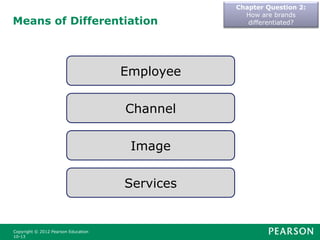
Means of Differentiation
Copyright © 2012 Pearson Education
10-13
Employee
Channel
Image
Services
Chapter Question 2:
How are brands
differentiated?
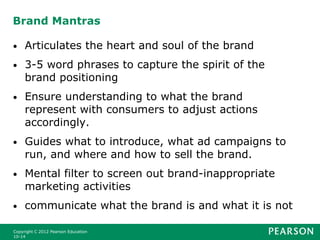
Brand Mantras
• Articulates the heart and soul of the brand
• 3-5 word phrases to capture the spirit of the
brand positioning
• Ensure understanding to what the brand
represent with consumers to adjust actions
accordingly.
• Guides what to introduce, what ad campaigns to
run, and where and how to sell the brand.
• Mental filter to screen out brand-inappropriate
marketing activities
• communicate what the brand is and what it is not
Copyright C 2012 Pearson Education
10-14
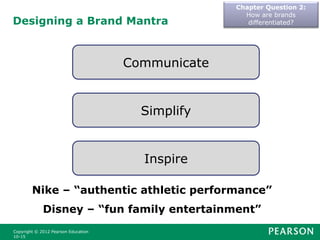
Designing a Brand Mantra
Copyright © 2012 Pearson Education
10-15
Communicate
Simplify
Inspire
Nike – “authentic athletic performance”
Disney – “fun family entertainment”
Chapter Question 2:
How are brands
differentiated?
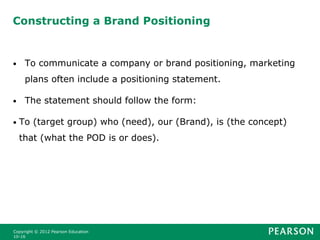
Constructing a Brand Positioning
• To communicate a company or brand positioning, marketing
plans often include a positioning statement.
• The statement should follow the form:
• To (target group) who (need), our (Brand), is (the concept)
that (what the POD is or does).
Copyright © 2012 Pearson Education
10-16
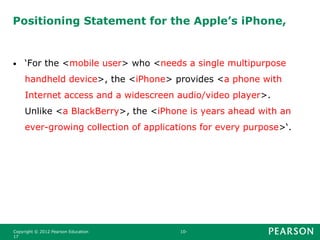
Positioning Statement for the Apple’s iPhone,
• ‘For the <mobile user> who <needs a single multipurpose
handheld device>, the <iPhone> provides <a phone with
Internet access and a widescreen audio/video player>.
Unlike <a BlackBerry>, the <iPhone is years ahead with an
ever-growing collection of applications for every purpose>‘.
Copyright © 2012 Pearson Education 10-
17
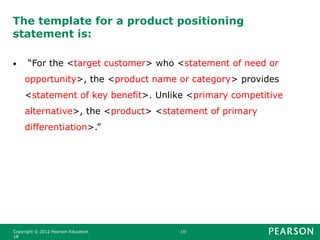
The template for a product positioning
statement is:
• “For the <target customer> who <statement of need or
opportunity>, the <product name or category> provides
<statement of key benefit>. Unlike <primary competitive
alternative>, the <product> <statement of primary
differentiation>.”
Copyright © 2012 Pearson Education 10-
18
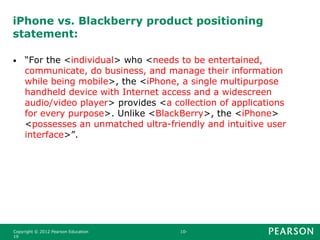
iPhone vs. Blackberry product positioning
statement:
• “For the <individual> who <needs to be entertained,
communicate, do business, and manage their information
while being mobile>, the <iPhone, a single multipurpose
handheld device with Internet access and a widescreen
audio/video player> provides <a collection of applications
for every purpose>. Unlike <BlackBerry>, the <iPhone>
<possesses an unmatched ultra-friendly and intuitive user
interface>”.
Copyright © 2012 Pearson Education 10-
19

MM Chapter 10.pdf

  • 1.
    Marketing Management Global Edition Kotler& Keller Chapter 10 Crafting the Brand Positioning
  • 2.
    Copyright © 2012Pearson Education 10-1 Chapter Questions 1. How can a firm choose and communicate an effective positioning in the market? 2. How are brands differentiated? 3. What marketing strategies are appropriate at each stage of the product life cycle? 4. What are the implications of market evolution for marketing strategies?
  • 3.
  • 4.
    Developing and Communicating aPositioning Strategy Chapter Question 1: How can a firm choose and communicate an effective positioning in the market? Copyright © 2012 Pearson Education 10-3 • Positioning is the act of designing the company’s offering and image to occupy a distinctive place in the mind of the target market. • Result of positioning: creation of a customer-focused value proposition, a strong reason why the target market should buy the product.
  • 5.
    Developing and Communicating aPositioning Strategy Chapter Question 1: How can a firm choose and communicate an effective positioning in the market? Copyright © 2012 Pearson Education 10-4 Table 10.1: Examples of Value Propositions Table 10.1 shows how three companies—Perdue, Volvo, and Domino’s—have defined their value proposition given their target customers, benefits, and prices.
  • 6.
    Positioning decision requirements •Determining a frame of reference by identifying the target market and relevant competition (5&6) • Identifying the optimal points of parity and points of difference brand associations given that frame of reference, (7&10) • Creating a brand mantra to summarize the positioning and essence of the brand. (11&12) Copyright © 2012 Pearson Education 10-5 Frame of Reference Points of Parity / Difference Brand Mantra
  • 7.
    Competitive Frame ofReference • Which brands should be the focus of competitive analysis? Determine Category Membership Copyright © 2012 Pearson Education 10- 6
  • 8.
    Identify & AnalyzeCompetitors Copyright © 2012 Pearson Education 10-7
  • 9.
    Points-of-Difference and Points-of-Parity Chapter Question1: How can a firm choose and communicate an effective positioning in the market? Copyright © 2012 Pearson Education 10-8 Points-of-difference (PODs) • Attributes or benefits consumers strongly associate with a brand, positively evaluate, and believe they could not find to the same extent with a competitive brand Points-of-parity (POPs) • Associations that are not necessarily unique to the brand but may be shared with other brands
  • 10.
    Identifying Optimal PODs Points-of-difference Attributesor benefits consumers strongly associate with a brand, positively evaluate, and believe they could not find to the same extent with a competitive brand Apple (design, ease of use, irreverent attitude) Copyright © 2012 Pearson Education 10-9
  • 11.
    Defining Associations Points-of-parity Associations thatare not necessarily unique to the brand but may be shared with other brands Copyright © 2012 Pearson Education 10-10
  • 12.
    POP versus POD Copyright© 2012 Pearson Education 10-11 Brand Benefits Brand Attributes Reasons to believe Proof points
  • 13.
    Point-of-Difference Criteria Copyright ©2012 Pearson Education 10-12 Desirable Deliverable Differentiating
  • 14.
    Means of Differentiation Copyright© 2012 Pearson Education 10-13 Employee Channel Image Services Chapter Question 2: How are brands differentiated?
  • 15.
    Brand Mantras • Articulatesthe heart and soul of the brand • 3-5 word phrases to capture the spirit of the brand positioning • Ensure understanding to what the brand represent with consumers to adjust actions accordingly. • Guides what to introduce, what ad campaigns to run, and where and how to sell the brand. • Mental filter to screen out brand-inappropriate marketing activities • communicate what the brand is and what it is not Copyright C 2012 Pearson Education 10-14
  • 16.
    Designing a BrandMantra Copyright © 2012 Pearson Education 10-15 Communicate Simplify Inspire Nike – “authentic athletic performance” Disney – “fun family entertainment” Chapter Question 2: How are brands differentiated?
  • 17.
    Constructing a BrandPositioning • To communicate a company or brand positioning, marketing plans often include a positioning statement. • The statement should follow the form: • To (target group) who (need), our (Brand), is (the concept) that (what the POD is or does). Copyright © 2012 Pearson Education 10-16
  • 18.
    Positioning Statement forthe Apple’s iPhone, • ‘For the <mobile user> who <needs a single multipurpose handheld device>, the <iPhone> provides <a phone with Internet access and a widescreen audio/video player>. Unlike <a BlackBerry>, the <iPhone is years ahead with an ever-growing collection of applications for every purpose>‘. Copyright © 2012 Pearson Education 10- 17
  • 19.
    The template fora product positioning statement is: • “For the <target customer> who <statement of need or opportunity>, the <product name or category> provides <statement of key benefit>. Unlike <primary competitive alternative>, the <product> <statement of primary differentiation>.” Copyright © 2012 Pearson Education 10- 18
  • 20.
    iPhone vs. Blackberryproduct positioning statement: • “For the <individual> who <needs to be entertained, communicate, do business, and manage their information while being mobile>, the <iPhone, a single multipurpose handheld device with Internet access and a widescreen audio/video player> provides <a collection of applications for every purpose>. Unlike <BlackBerry>, the <iPhone> <possesses an unmatched ultra-friendly and intuitive user interface>”. Copyright © 2012 Pearson Education 10- 19